
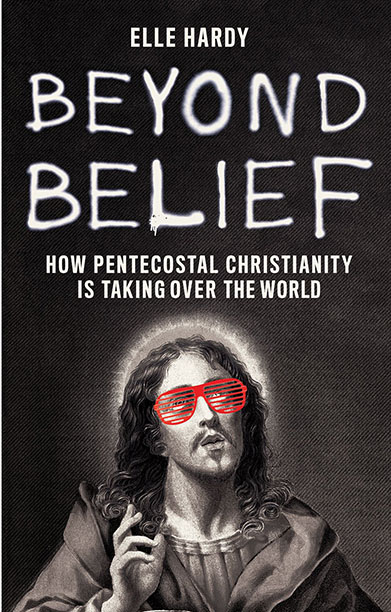
It seems rather hard to believe now, at fifty years’ remove, but as a 16 year old I was ‘born again’ and converted to evangelical Christianity. The early 1970s was a time of Jesus People, Larry Norman and Hal Lindsay’s book The Late Great Planet Earth. I’m not sure whether that would have counted as ‘Pentecostal Christianity’ as Australian journalist Elle Hardy describes it in this book because, although there was an emphasis on the Holy Spirit and although I was often in the presence of people who spoke in tongues (without ever doing so myself), it was also ‘It’s Time’ for the Labor Party after twenty-three years of conservative government in Australia. The Christianity I subscribed to had little to do with the prosperity gospel of much (not necessarily all) Pentecostal religion today – in fact, it leaned more towards anti-materialism and environmentalism- and I could see no conflict at all between progressive political ideas and Christianity, indeed I think that Christianity demanded it. I don’t think that the Pentecostal religion she describes here would have room for those views today.
Hardy’s book is divided into two parts: Part I The Good News: The Unstoppable Rise of Pentecostalism, and Part II Spiritual Warfare: The Battle to Build Heaven on Earth. She traces the modern manifestation of Pentecostalism back to 19th century America, disregarding, rather short-sightedly I believe, older British and European manifestations of Pentecostalism. Instead she identifies three founding figures: Charles Fox Parham, who preached in Kansas, Texas and Oklahoma; William J. Seymour, an African-American evangelist who was encouraged by Parham to bringing this new form of Christianity to the Black Community through the Azusa Street Revivals of 1906 to roughly 1915; and Aimee and Robert Semple whose speaking in tongues as part of their baptism in the Holy Spirit encouraged them to go to China (they believed that they were speaking Chinese) where Robert died. His widow married Harold McPherson, thus becoming Aimee Semple McPherson. All three ended up being embroiled in scandals of various types- a harbinger perhaps of the scandals that have dogged and continue to dog many Pentecostal ‘celebrities’. The Pentecostalism she describes distinguishes itself from other forms of Christianity in its heavy emphasis on the Holy Spirit, and its manifestation through speaking in tongues, miracles and healing. Rather ironically, some of the major ‘brands’ of Pentecostalism have distanced themselves somewhat from the speaking in tongues element (it is a bit unnerving).
She then embarks in Part I on a world-wide tour of Pentecostalism in its various guises across the globe, reflecting the sub-title of her book. She travels to Rock House Holiness church in Alabama, an ‘old-style religion’ type church that features snake-handling, but which also reflects the origin of much of the rock music that emerged in the 1950s where singers like Rosetta Tharp, B. B. King, Elvis Presley and the Righteous Brothers (of course!) made their start from their Pentecostal churches. The emphasis on music, most particularly through the Hillsong empire, continues today and often distinguishes Pentecostal worship, with its concerts, rock bands and lighting, from other forms of Christian worship.
Chapter 3 takes her to North Korea, where the Pyongyang Revival before the 1949 Communist Revolution saw 100,000 people converted, usually by American missionaries, to the extent that Pyongyang was dubbed ‘The Jerusalem of the East’. The North/South border between the Koreas is not just political: it is also the demarcation between Christianity and non-Christianity. Across the border, in South Korea, megachurches like the Yoido Full Gospel Church with its 200,000 regular attendees describe themselves as Presbyterian, but 85% of them are actually Pentecostal. It is quite common for defectors from the North to find themselves at these churches where, if they make their way to Seoul, they find themselves overwhelmed by the noise, competitiveness and discrimination they encounter there. They find that their conversion narrative becomes a form of ‘currency’ where churches provide scholarships, free health services and donations through their congregations, in return for these stories of redemption and conversion. A similar scenario is found in in the UK, where in Chapter 6 she finds large numbers of Travellers (gypsies) converting to Pentecostalism, where being a practising Christian makes an outsider more accepted in post-Brexit Britain. In fact, there are now 17,000 Pentecostal churches in the UK (one congregation for every 2 pubs!), with branches of international Pentecostal Churches e.g. Hillsong, the Universal Church from Brazil, and West African churches, not only ministering to their diaspora, but also engaging in a form of reverse mission, pushing back against ‘liberal’ Christianity and its acceptance in particular of gay marriage.
She visits the Universal Church in Brazil, where celebrity Pentecostalist Flordelis, politician and mother of 55 children (over 50 were adopted) , achieved media-wide coverage when she was jailed for conspiring to kill her younger husband. Indeed, Brazil is the most Pentecostal nation on earth, with the percentage of Pentecostalists rising from 3% of the population in 1980 to 30% in 2020. As she points out, the prosperity gospel preached by Pentecostalist churches is not a fallacy. Once people get their lives together through conversion, often leaving behind crime and addiction, and are encouraged to branch into small businesses which are patronized by the large number of fellow-congregationalists, people do become wealthier. Likewise in African nations. In Zimbabwe, half of the population belongs to an African Pentecostal Church, eclipsing 40% in South Africa, and one third in Kenya. African Pentecostalism often combines pre-Christianity and Pentecostal beliefs, reflecting the ability of Pentecostalism to shape-shift according to the culture. These churches often combine fasting, rituals, healing and miracles.
Part II then explores how this plays out in political trends. She starts off in Chapter 7 at Bethel Redding church in California, one of the largest and best known of the Pentecostal Churches in America. Despite being in a state dominated by liberals (in the American sense of the word), this is the heartland for the Christian Dominionist Project, better known as the Seven Mountains Mandate. This arose from about 1974 when Pentecostalists moved from the idea of The Tribulation which would presage the Second Coming, to the idea that Christians themselves would have to create the conditions of Heaven on Earth before Jesus could return by moving into the Seven spheres of education, religion, family, business, government, arts and entertainment and media. Within the U.S. the Seven Mountains Mandate has led to direct involvement in government administration, as for example in Brazos County, Texas, where the Jesus Said Love movement is contracted and paid to run ‘john’ schools as an alternative to fines or incarceration for men arrested for procuring the services of a prostitute through a ‘sting’. The related ‘Unbound’ movement, which purports to be anti-trafficking, is a way of stamping out prostitution completely (rather than legalizing it, which is another approach). It’s not surprising that this has morphed, for some people, into the QAnon child-trafficking conspiracy, and into links with the 6 January 2021 uprising.
In countries like Guatemala the rise of Pentecostalism, spurred by the arrival of US missionaries in the 1960s, has led to a rejection and even persecution of Mayan priests: a different situation from the Liberation Theology of Vatican II which encouraged a form of Mayan Catholicism. Indeed, Guatemalan Catholicism itself today can largely be described as Charismatic Revival, a reflection of Pentecostalism. Likewise in Nigeria, with its Muslim North and Christian South divide, Islamic mosques are finding themselves adopting Pentecostalist-type practices both as a way of distinguishing themselves from Islamic fundamentalism (e.g. Boko Haram) and as a way of stopping the drain of their adherents to Pentecostal Christianity. Similarly, the Jews for Jesus movement, a form of ‘Messianic Judaism”, adopts Pentecostalist- practices even though it is not recognized by the major Jewish denominations. She highlights the importance of Israel to the End Times narrative of Pentecostalism, with its ardent Zionism and support of Israel, Trump’s shift of the U.S. Embassy from Tel Aviv to Jerusalem (and Australia’s craven pretense to do the same) and the popularity of package tours to Israel amongst Pentecostalists.
I had thought at first that she had over-reached in her subtitle ‘How Pentecostal Christianity is Taking Over the World’, given the numerical growth of Islam and the increased prominence of Hinduism in India. But when she lists politicians like Duterte in the Phillipines, Orban in Hungary, and the push towards Pentecostalism in both Ukraine and Russia, and describes the adoption of Pentecostalist practices in Catholicism and some forms of Islam and Judaism that are competing in the same ‘market’, perhaps there is more truth in it. I’m not sure that she actually explained why there is this political link between Pentecostalism and populist conservatism: to me, there doesn’t seem to be anything inherent in Pentecostalism that dictates that the two be aligned.
This is a broad-ranging book, truly international in its scope, written in an engaging style with enough personal vignettes to keep the human interest in what could have otherwise been a rather turgid exploration of theology. But really, it’s not about theology at all: it’s about a phenomenon that acts as an antidote to marginalization in both First World and Global South countries, and about Pentecostalism’s link with right wing politics, power and money.
My rating: 8.5
Sourced from: Yarra Plenty Regional Library, and read after hearing the author speaking on the New Books Network podcast.
 The Resident Judge of Port Phillip
I used to think it was just some creepy stuff in the margins… now I know better.
This article explores the global rise of Pentecostalism and its various manifestations across different countries. It touches on the influence of Pentecostalism on politics and the connection between the movement and right-wing conservatism. Overall, the article provides an interesting and engaging perspective on this phenomenon. Great insights and analysis! I found this article to be informative and thought-provoking.
Pingback: ‘The Power Worshippers’ by Katherine Stewart | The Resident Judge of Port Phillip