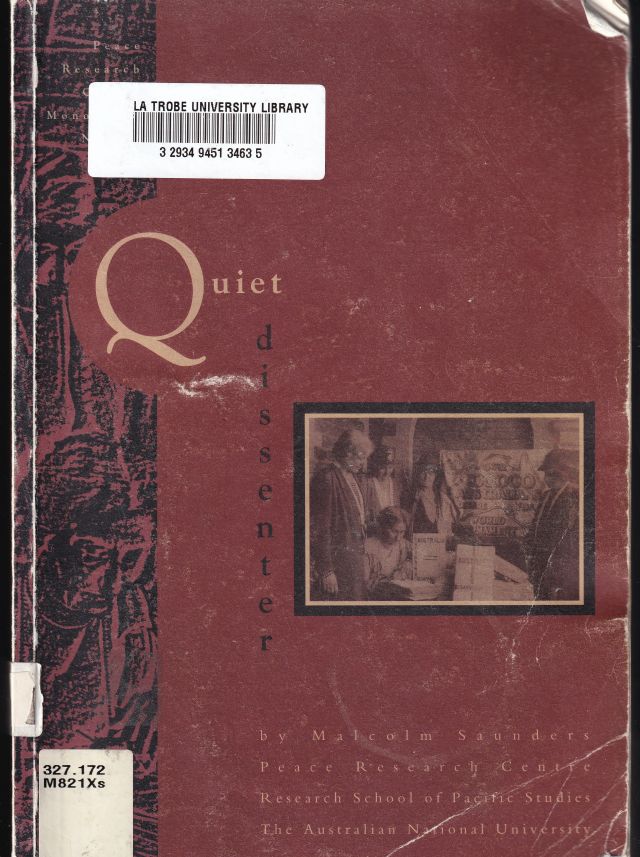
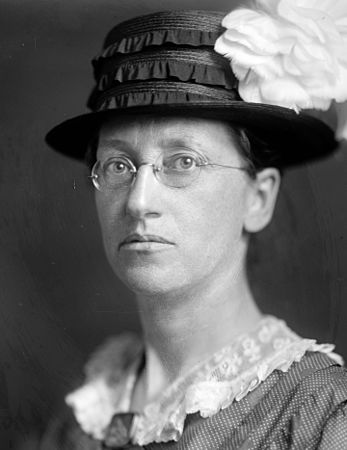
Actually, I don’t know if I would have called Eleanor May Moore a quiet dissenter. She had plenty to say over her long secretary-ship of the Victorian branch of the Women’s International League for Peace and Freedom, and she became so publicly identifiable with WILPF in Victoria that she was almost indistinguishable from it.
“So who was Eleanor May Moore?”, you may ask. Of solidly middle-class background, she was born in 1875 and educated at Presbyterian Ladies College. Rather unusually for her background, she attended Stott’s business college and trained as a stenographer. She attended Rev. Charles Strong’s Australian Church (of which, more anon) and when he suggested that the women of the church form a women-only and women-led peace group, she was there from the start. This became the Sisterhood of International Peace, which, along with Vida Goldstein’s Women’s Peace Army were represented at the international congress in Europe in 1919 which led to the formation of the Women’s International League for Peace and Freedom. Eleanor Moore had attended the congress as the Sisterhood of International Peace’s delegate, along with Vida Goldstein and Cecilia John from Women’s Peace Army. The two Australian contingents had sprung from different impetuses: the Sisterhood from a progressive Christianity, and the Women Peace Army from the suffrage movement. After the war, Vida Goldstein distanced herself from the W.P.A which soon disbanded, leaving the Sisterhood as the Victorian branch of WILPF.
It was difficult to find a shipping passage back to Australia after the war, and Eleanor stayed for some time in Geneva, where she established a friendship with WILPF international secretary Emily Greene Balch and worked with her at WILPF headquarters. This placed her in good stead to be the linchpin of the Victorian branch, and she retained this position until a few years before her death in 1949.
She was obviously a strong presence and dominated the local WILPF’s stance on a range of matters- not just peace, but also White Australia, the Pacific, economic sanctions, military service, atomic warfare and eventually, absolute pacificism. With the rise of fascism, she became particularly fixed in her views that all war was wrong – a stance that put her at odds with her old friend Rev. Strong and the European branch of WILPF. It took its toll on the local branch of WILPF too, with its numbers dropping lower and lower as women left because of this adamant stance, and through the attritions of old age.
While there is much to admire in a life-long commitment to an organization, her long career with WILPF serves as a salutary warning for all volunteer organizations, really. There is a danger in one person becoming synonymous with an organization, and that while that person remains, other people will not step forward.
In assessing her life, Saunders notes that her politics were rooted in British liberalism, and at times she sounds almost Thatcher-esque in her emphasis on the individual, rather than collective groups like ‘society’, the ‘community’ or ‘the nation’. Prior to the First World War, she had been a strong supporter of the Federal Government, which had brought about many of the progressive, independent policies that “young” Australia became famous for. But this changed with the war and the heavy-handed War Precautions Act, and by the 1930s she believed that acquiescent obedience to government was the greatest threat to Australian democracy. She had doubts about Christianity, but considered religion extremely important, hence her attraction to the Australian Church and the Society of Friends (Quakers). She supported the White Australia policy and continued to do so when many other people in the peace movement and in WILPF itself believed that it should be abandoned.
This biography was produced by the Peace Research Centre, and would probably be almost impossible to procure today. Its production values are rather rudimentary, but the research is sound and well-supported by references, and Saunders has a clear-eyed view of both Moore’s strengths but also her short-comings. He has captured well the nature of commitment to an ideal, and the narrow line between inflexibility and fidelity to a principle. The WILPF that outlived her was a dwindling, increasingly antiquated body until other, more forward-looking women stepped into her place. But for sheer persistence, intelligence and unswerving steadfastness, Eleanor May Moore was an admirable woman who should probably be better known today.
History of Rome PodcastEpisode 123 The Tetrarachy We had two emperors before (Diocletian and Maximian) and now it was about to become four with the addition of Constantius and Galerius in 293AD. Mike Duncan makes the rather large claim that the years of the Tetrarachy were amongst the most important in Rome’s history, laying down the ground rules for late antiquity. It does, however, cause a narrative problem for Duncan as a podcaster, because now there are 4 centres of power. The self-elected ’emperor’ Carausius was still sitting over in Britain, but before Diocletian and Maximian could confront him, they needed to make sure that the Germanic tribes had been pacified first. However, Maximian failed to retake Britain in 289 AD. So who were these other new emperors: Constantius and Galerius? Constantius had married Maximian’s daughter, and we really don’t know much about Galerius. However, in 293 AD they were named as part of the Tetrarachy (although they didn’t call it that then) as junior partners. Constantius was given oversight of Gaul and Britain; Maximian had Spain, Africa and Italy; Galerius had responsibility for the Danube, and Diocletian concentrated on the Far East. However, these were not demarcated political units: Diocletian always emphasized unity.
Episode 124 The Tetrarachs at War sees Constantius embarking on the job of retaking Britain. It was a hard task, because Carausius was a very able ruler, and well supported. But not supported well enough, because he was assassinated by Allectus. During Maximian’s earlier attempt to take Britain, they landed in one place but this time Constantius landed his fleets in two places. Allectus didn’t have the popular support that Carausius had enjoyed, and the people were more frightened of the Franks than the Romans, so they were willingly reabsorbed back into the empire. Meanwhile, over on the Danube, Galerius was battling with the Sassanids, who were restive again and invaded Armenia and threatened Syria. The Romans were defeated at first. Diocletian had to leave the east to go to Egypt to quash a rebellion there, and Galerius had another go at the Sassanids in Armenia, and this time he had the last word.
Diocletian wrought many changes, but always with the aim of saving the old order, not introducing a new one. Episode 125 The Best Defence is a Good Defence starts off with a summary of the changes in the Roman military over time. From the citizen army, they had gone to the Maniple structure of fighting. Professional standing armies were introduced, but they mainly ended up fighting other Romans. Augustus introduced garrisons to protected what they had captured and Hadrian and Antoninus Pius built walls. From the 3rd century AD onwards, the numerical strength of invading forces outnumbered that of the Roman legions. So Diocletian introduced 4 changes: 1. He devised a ring of small militarized provinces around the empire 2. He separated the civilian and military career paths. No longer could you have a soldier emperor. Instead, there was a general and there was a governor- two men. 3. He divided the army into legions and static frontier militia. 4. instituted webs of defence across the empire (i.e. ‘defence in depth’) which would slow an opponent’s army down, causing it to lose memomentum although this argument, exemplified by Edward Luttwak’s work, is somewhat disputed and not well supported by archaeological evidence.
Rules Based Audio. This podcast is put out from the Lowy Institute. In Ukraine and the Future of the Rules Based Order, the presenter Ben Scott discusses the war in Ukraine and international law with Professor Fleur Johns and Dr Eve Massingham. They talk about the laws of war, economic sanctions, cyber operations, neutrality, international humanitarian law, and war crimes. Certainly it’s all more complex than it might appear at first. International law is just one tool that can be deployed in this situation, and even though it may not be particularly useful at the moment, it will bring accountability once hostilities have stopped, and will (hopefully) be useful in controlling behaviour in the future (e.g. Ukraine asking for guarantees of security). Cyber war is a new complication (i.e. it is not legal to give information to direct an attack), and sanctions using electronic banking is another new horizon. It was surprising to learn what is legal under international war, and what is not.
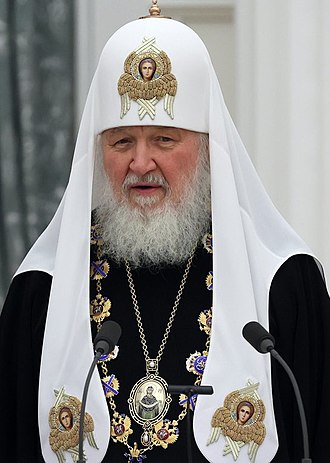
Patriarch Kirill (Wikimedia)
God Forbid (ABC) The March 20 episode Ukraine and Russia: religion and the politics of war is well worth listening to (and I did- three times, because I was listening to it in bed and I kept falling asleep!) With its own panel of speakers and drawing on interviews on other ABC radio programs, it looks at the Orthodox Church, Putin’s war against Ukraine, Patriarch Kirill of Moscow’s support of Putin and the resultant dissent amongst Orthodox clerics. Christianity came to the East in 988 and after the 2014 ‘Revolution of Dignity’ which expelled the pro-Russian president, in 2018 the Archbishop of Constantinople (the Orthodox church still calls it that), Bartholemew I, recognized a distinct, self-governing Orthodox Church in Ukraine. A study of people who identify as Orthodox in Ukraine in 2020 found that 34% identified with the Orthodox Church in Ukraine; 14% with the Moscow Patriarch and 28% as neither. Recently 300 Orthodox Clerics in Belurus, Spain and inside Russia signed a letter condemning Kirill’s tacit support for the invasion, and refusing to mention his name or commemorate the Moscow Patriarchy in their services. The speakers point out that both Russia and Ukraine are multi-cultural countries- Russia, for example has 35 official languages- with sizeable Muslim populations. Ukraine also has a large Jewish minority (and indeed Kyev and Odessa were important Jewish centres historically) and the Ukraine Greek Catholic Church is also prominent. While there are anti-Semitic groups in Ukraine, they also operate throughout Europe and perhaps to a lesser extent in Ukraine than elsewhere. Well worth listening to- even three times!
Things Fell Apart (BBC) Episode 2: Dirty Books goes back to 1974 when a church minister’s wife in West Virginia challenged the board of education when they sent textbooks to support a new curriculum to her school. She read through all the books, and was offended by many things in them and encouraged other parents to join her in refusing them. But she may well have misinterpreted some of the things that offended her so much. Fast forward thirty years, and textbooks are still being challenged- this time for Critical Race Theory (in maths books, no less).
Emperors of Rome It’s Good Friday, so I thought that I would listen to the episode on Crucifixion. Episode CLXXXI Crucifixion, as you might expect, came with a content warning. Crucifixion was a much wider term than we might imagine, because people could be nailed to a stake, tree, plank etc and the ultimate cause of death was asphyxiation when it became too difficult to heave yourself up to breathe. It was a form of death only for slaves and enemies of Rome, not Roman citizens. Owners could crucify their slaves privately, or it could be a state punishment. As well as the gospels, which give a lot of detail, there are other sources as well: Seneca, Cicero, Josephus in written form, archaelogical evidence (e.g. an ankle bone in a Judea that had a nail through it), and graffiti. Crucifixion was formally abolished in 337 CE by Constantine, who felt that no ordinary mortal should die the same way as Jesus had done (not because it was a painful, cruel and slow death).
Australia If You’re Listening (ABC). Episode 2: How we became addicted to coal. I don’t know why I have been so slow to listen to each episode of this podcasts – perhaps because I thought I already knew all about it- but it really is excellent. The historian in me really liked this episode, which focusses on Newcastle, which was Australia’s first coal region. It deals with the coming and going of ‘the’ BHP (how quaint) (1915-1997) and Newcastle’s development into a coal port, even though the local coal was eventually exhausted. The program gives a really good description of the stagnation of the Australian economy as Australia, ‘the lucky country’, drifted into a heavily protected domestic economy that was only saved by the export of raw products like coal, especially to China. Historians featured include John Maynard from the University of Newcastle, and Judith Brett, author of the Quarterly Essay The Coal Curse (which I’m sure I have unopened on my bookshelf somewhere- might be time to open it.)
Travels Through Time In this episode The Last Emperor of Mexico, historian William Shawcross discusses Maximilian I of Mexico, who was appointed as Emperor of Mexico by Napoleon III as part of a French invasion of Mexico. After the Mexican War of Independence between 1810 and 1821 and Spain’s final relinquishment in 1836, there were still a lot of royalists in Mexico. After being wupped by the United States in the Mexican-American war in 1848, these royalists approached Archduke Maximilian of Austria, a stereotypical second son to become emperor of Mexico. In 1863, he consented to do so at the request of Napoleon III. William Shawcross chooses 1867 as his year of interest, starting on 13 February 1867 as Maximilian rides out with his Mexican troops (and not his far more experienced, European troops) to confront the guerrilla fighters led by General Benito Juarez. On May 15 1867, Querétaro. Maximilian is cornered in a shell-shattered former convent, beseiged by the Mexican guerillas, getting ready to break out. By 19 June 1867, it was all over, with Maximilian under arrest in another convent in Querétaro another convent, and -spoiler alert- executed by firing squad.
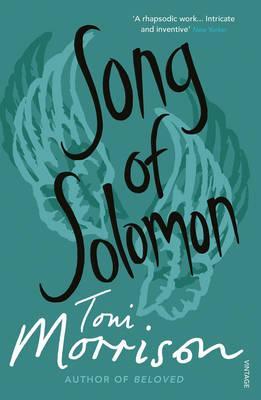
I have read this book twice and both times, to my regret, I have failed to write about it in any detail immediately after reading it. Perhaps it’s because the book itself is so complex and masterful that I have barely known where to start. I still don’t. There were more than twenty years between my two readings, so on my re-reading, it was as if I were coming to the book for the first time. I was just as impressed the second time as I had been the first. After reading some pretty mediocre writing recently, it was like handing myself over to someone who can really write. I love books that have a circular structure, where the actions in the opening pages are mirrored in the last. The book opens with Robert Smith, the insurance agent, jumping from the roof of Mercy Hospital in 1931, and it ends with Macon Dead Jr. making his own leap. In between these two flights, Morrison takes us on a Quest novel from the northern states of America to the south in Virginia – the opposite direction to the flight from slavery- and across American history from Reconstruction through to the Civil Rights movement.
The book is too complex, and too much time has elapsed for me to write about it. Suffice to say that it is a book that merits reading and re-reading and reading once again. It combines magic realism with real-life historical events; it is a meditation on naming and the loss of names; it reflects folk-knowledge and music- there is just so much here, layer upon layer. It is magnificent.
My rating: 10/10
Sourced from: Readings. My own print copy
Read because: Ivanhoe Reading Circle March 2022 book.
Axios – How it Happened More Ukraine. Putins Invasion III: How It Could End. In part three, Axios World editor Dave Lawler examines a difficult reality — that the only clear path to peace in Ukraine is a deal between Russian President Vladimir Putin and Ukrainian President Volodymyr Zelensky, but the red lines drawn by the Russian and Ukrainian leaders do not intersect. This episode features interviews with Zelensky’s chief of staff, a member of Parliament in his party, two close observers of Putin and the Kremlin, and a former U.S. ambassador to Ukraine with decades of diplomatic experience in the region. The interviewees point out that Zelensky is very ideological, a good listener, but that you can’t pressure him. They point out that legally, Ukraine’s borders can only be altered via referendum (and the Ukranian people are not likely to vote for that). Putin cannot win, but Zelensky will not accept Putin’s terms. Putin’s best hope is to exhaust Ukraine and the interest of the west. Something, they all agree, will have to change.
History of Rome PodcastEpisode 121 Phase Three Complete sees the mop-up before Diocletian comes on the scene. Mike Duncan starts off this episode, reflecting that people who were born during the Severin epoch had only know the chaos of the 3rd century when emperors came and went in regular succession. They didn’t realize that they were just about to turn the corner. We don’t really know much about Carus and his two sons Carinus and Numerian. Carus was about 60 years old, and he had been a Praetorian Prefect. Realizing that he couldn’t spread himself across the empire, he sent his son Carinus to Rome and he headed to Persia to fight the Sassanids with his other son, Numerian. It was a good time to attack Persia because the Persians had just committed most of their troops to invading Afghanistan. Carus died: struck by lightning, they said, as a punishment for straying too far outside of the empire. His son Numerian, spooked perhaps by this theory, withdrew back to the borders, even though they were beating the Persians. His sons had a brief reign until Diocles came on the scene. Apparently he was a real back-room operator. There had been a prophesy that Diocles would only become emperor when he killed a boar, and this came true when he executed the Praetorian Prefect Aper for murdering Carus’ son Numerian. ‘Aper’ means ‘wild boar’, although historians dispute this story as being ridiculous. But hey- lots of things here are ridiculous. Diocles changed his name to the more regal-sounding Diocletian and began bad-mouthing Carinus. He was about to battle Carinus, but Carinus (conveniently) died. Episode 122 Jupiter and Hercules As a back-room political operator, Diocletian had actually thought about the empire, instead of having it thrust upon him. He decided that there would be no Senatorial purges, but he also decided that he would side-line the Senate altogether. He decided that there had to be two Emperors, so he appointed Maximian to rule over the West as co-emperor with Diocletian who would rule the East. Maximian was a soldier, and so not a political threat to Diocletian. However General Carausius, who had been appointed in charge of operations against pirates on the Saxon coast, went rogue, proclaimed himself Augustus and set himself up in Britain. Diocletian came across to the West to bolster Maximian’s troops. To boost their authority, Maximian also took up the title of Augustus, and then Diocletian appealed to the heavens for legitimacy (much as Augustus had done), thus laying the foundation for Divine Right for the next 1500 years. He claimed that he had been appointed by Jupiter himself, and Diocletian assumed the title Iovius, and Maximian assumed the title Herculius.
The History Hour (BBC) usually has a couple of stories on different topics but in this episode Ukranian History Special, they concentrate on events in Ukraine’s history. It is really good. It starts with the explosion at the Chernobyl nuclear plant in April 1986 and the tardiness of the government response. It moves on to the Budapest agreement where the international community – including both Russia and the USA – offered security “assurances” to Ukraine in return for giving up its share of the Soviet nuclear arsenal. Then there is a survivor’s account of Ukraine’s great famine in the 1930s, the Holodomor, when several million people died (although she was very young- about 3. I’m not too sure about the fidelity of the memories of a three year old). It moves to the mass killing of Ukrainian Jews by Nazi Germany during World War Two- noting the irony that Putin has used ‘anti-Nazi’ as a justification for invasion. Finally, in an abrupt change of pace, the episode finishes with how Artek, on the shores of the Black Sea in Crimea, became the Soviet Union’s most popular holiday camp. Really worth listening to.
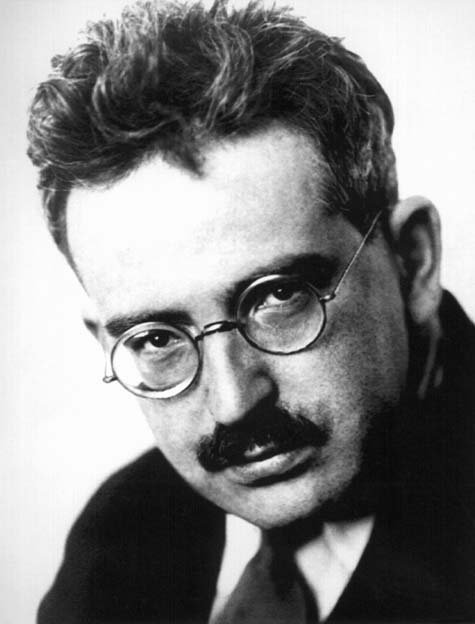
In Our Time (BBC). I thought that In Our Time must have finished, because I couldn’t find it on Stitcher but then I discovered that you can access it through BBC Sounds. Old Melvyn Bragg is sounding older and more slurred. I’ve never read any Walter Benjamin (and in fact, for half the podcast I had him mixed up with Isaiah Berlin). He was an academic, but he styled himself as a critic of what was then the modern media. Born in Germany, from the late 1920s he led a mobile life living in Russia, Italy and France. He was not interested in writing about the past as it was, but seeing it in terms of the questions of the present. Notably, in his Arcades Project, he looked into the past of Paris to understand the modern age and, in The Work of Art in the Age of Mechanical Reproduction, examined how the new media of film and photography enabled art to be politicised, and politics to become a form of art. As a German Jew, he was fearful of the rise of Hitler and was interned in Paris and although, because of his eminence he had an entry visa to America, but he could not get an exit visit. Although in very poor health, he decided to walk from France to Spain but, in very poor health and realizing he wouldn’t make it, he committed suicide on the way. Most of his work was published posthumously and taken up by the 1960s counter culture. The Work of Art in the Age of Mechanical Reproduction greatly influenced John Berger’s Ways of Seeing, and is even more apposite given the rise of digital cameras everywhere in galleries and museums and NFTs.
History of Ideas- Talking Politics. I started listening to this ages ago and just stumbled over it again on my ‘Favourites’ list. David Runciman, a professor of politics at Cambridge (and not, as I thought, the Archbishop of Canterbury) goes through the major political works starting with Hobbes. I listened to Hobbes and Wollstonecraft but then skipped a few because I was interested in Marx and Engels on Revolution. This was the best description of Marx and Engels’ ideas that I’ve heard. He points out that where Hobbes saw revolution as the problem, Marx and Engels saw it as the solution. The ideas of revolution in The Communist Manifesto were not taken up at all in 1848 (although they wrote it in a hurry because they hoped that they would be), and their ideas in their death throes during WWI when it turned out that the workers of the world did not unite but instead fought each other. However the Russian Revolution in 1917 vindicated them, and the fortunes of the book have waxed and waned ever since. They point out that the state will always be in crisis, and that in replacing the people who run the state, there will inevitably be violence. Revolution has to be international, and that has not happened (and in current events, is not likely to do so). Runciman considers that the most successful revolutions were in East Germany and Eastern Europe in 1989 and the 90s. He points out that both 1848 and the Arab Spring were short term failures, but they did have an impact on democracy later (I think that the Arab Spring has yet to show results). He questions whether class today is as important as Marx and Engels thought, suggesting that education level (albeit related to class) and age (youth) are more important on voting patterns.
Things Fell Apart (BBC) This is a terrific series about the culture wars, and things that make you scream at the television. One Thousand Dolls is about the beginning of the culture wars over abortion in America. Until the 1970s, anti-abortion was a Roman Catholic thing, but Frank Schaeffer, the son of an influential Christian art historian, talked his father into adding an anti-abortion segment into his art history films. Although poorly received, he decided to make a highly emotive Christian film against abortion, and it came to influence many anti-abortions including James Kopp, who murdered Barnett Slepian, an American physician from Amherst, New York who performed abortions. He has since distanced himself from the anti-abortion movement. Really interesting.
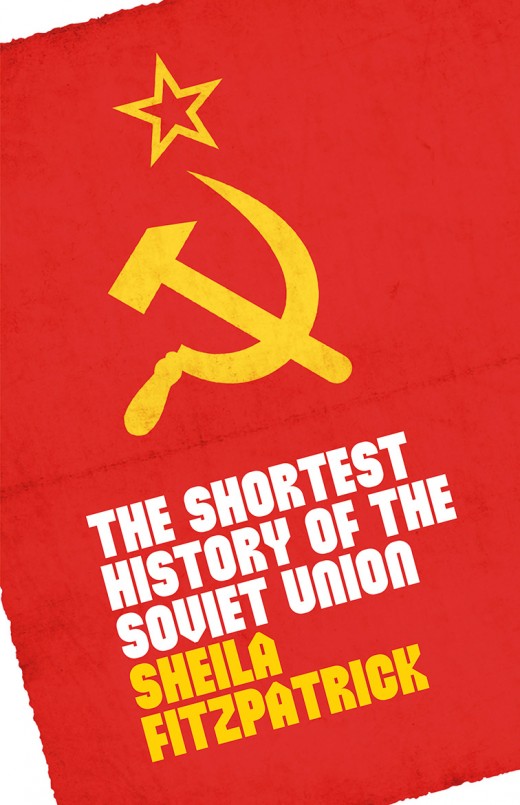
On 24 February Russia invaded Ukraine. On 1 March, Sheila Fitzpatrick’s small volume ‘The Shortest History of the Soviet Union’ was released. Although I’m sure that she takes no pleasure at all in this turn of events (indeed, you can read Fitzpatrick’s response here) – could there possibly be a better time to launch such a book? After all, we had all seen Vladimir Putin’s version of history during his speech given two days before the launch of the “special military action” where he declared Ukraine “an inalienable part of our own history, culture and spiritual space”. He blamed Lenin for the creation of modern Ukraine, with further gifts of territory by Stalin and Kruschev. Was any of this true? For those of us with sketchy knowledge of Russian and Soviet history, a small book on the Soviet Union is just what we need- and here it is.
Although the book spans the years 1922 to 1991, Fitzpatrick starts her book in 1980 in Brezhnev’s Russia, when a Conference of American Sovietologists confidently proclaimed that the Soviet Union would not become a political democracy, nor would it collapse, in the forseeable future. They were wrong. Within ten years it was gone. The abruptness of this development reflects Fitzpatrick’s stance that in history (certainly in the Soviet Union, and perhaps generally) there are few inevitabilities.
Historians’ narratives tend, by their nature, to make events seem inevitable….But this is not my intention with this Shortest History. My view is that there are as few inevitabilities in human history as there are in the individual lives that compose it. Things could always have turned out differently but for accidental encounters and global cataclysms, deaths, divorces and pandemics
p.11
Even though the Russian Revolutionaries thought that they had history taped, with everything under control and a firm view of what to expect:
The many ‘accidental’ changes of course and ‘spontaneous’ diversions along the way were simply irrelevant to this grand scheme, although they will play a large part in my Shortest History. They were not irrelevant to the life of people living in the Soviet Union, of course, and the gap between official rhetoric and lived experience was the stuff of the distinctively Soviet genre of political jokes (anekdoty) that bubbled under the surface as a constant, irreverent commentary. The contrast between ‘in principle’ (a stock Soviet phrase provoking immediate distrust, like ‘frankly’ in the West) and ‘in practice’ was one of the staples of the Soviet anekdot.
p.13
In her book, Fitzgerald illustrates this contrast between ‘in principle’ and ‘in practice’ and the place of happenstance and unexpected events throughout the history of the Soviet Union. Indeed it’s there right from the opening line of the first chapter:
The Russian Revolution was meant to spark off revolution throughout Europe. But that plan didn’t work, and what was left was a revolutionary state in Russia- the Russian Soviet Federal Socialist Republic (RSFSR) with Moscow as its capital
p.15
In principle, the Mensheviks should have taken control of the revolution: in practice the Bolsheviks did. In principle, workers of the world should have united behind the revolution: in practice, they kept fighting WWI. In principle, the proletariat should have led the uprising: in practice, the party had to do it for them. In principle, the peasants should have gladly handed over their land for collective farming: in practice, the state had to embark on dekulakization. In principle, glasnost and perestroika should have renewed and strengthened communism: in practice it shook it to the core. In principle, capitalism should have failed: in practice, it was USSR that failed.
There are seven chapters in the book, and a final conclusion. True to the name, the book deals with the Soviet Union, not Tsarist Russia which preceded it and it goes up to the fall of the Soviet Union. The conclusion deals with post-USSR events and the string of acronyms for the shifting constellation of allegiances afterwards.
Introduction
Making the Union
The Lenin Years and the Succession Struggle
Stalinism
War and Its Aftermath
From ‘Collective Leadership’ to Khrushchev
The Brezhnev Period
The Fall
Conclusion
One of the things that this book reinforced for me is that ‘Russia’ is not the same as ‘Soviet Union’, even though I have tended to use the two terms interchangeably. Putin’s claim that Ukraine was invented by Lenin is based on the fact that, yes, the Bolsheviks did encourage nationalism in Ukraine and the other regions because they realized that it was impossible to eradicate it (hence acknowledging a pre-existing Ukrainian identity) and because the Russian core of the government did not want to be seen as, or act, as another version of the Tsarist Russian empire. Despite this, the other soviet states often complained of Russian chauvinism. The ‘Russia’ we see today really is Russia, with the old imperial two-headed eagle reinstated as a state symbol, and the restoration of the Orthodox church. Related to this is Putin’s admiration for Stalin as a nation builder and the hero of WWII. I hadn’t realized how much WWII has been engraved into the present-day Russian psyche.
Because so much of this story is party-political, it tends to be a rather top-down history with an emphasis on powerful men jostling for more power. The book broadens its emphasis from the Brezhnev era on, presumably because this is within living memory and as a researcher Sheila Fitzpatrick herself had more access to social history and personal observation (see my review of her memoir A Spy in the Archives). Here we see more women, and more everyday life.
I couldn’t help but read this book with an eye on Ukraine. Some of Russia’s recent actions make more sense to me now, even though I continue to condemn them. I hadn’t realized that Crimea was such a recent addition to Ukraine, having been handed over in 1954 by Khrushchev, who was born near the present Ukraine/Russian border and had been head of the Communist Party of Ukraine. I hadn’t realized that Ukraine, Belarus and Russia formed the core of Commonwealth of Independent States after the dissolution of the USSR in 1991 – no wonder Ukraine is a hot-button country as far as Russia is concerned. Not excusable, but perhaps understandable.
Which is why, when we are increasingly sceptical of what we see and hear, a book like The Shortest History of the Soviet Union is so valuable. It is very readable, and it breathes life and colour into the greyness of the Soviet Union as it has been depicted to us. Fitzpatrick’s own sense of humour in distinguishing ‘in principle’ from ‘in practice’ is a light touch, and there is no false modesty in hiding her own contribution to Soviet history in the bibliography. And if ever there was a time to read this book, it is right now.
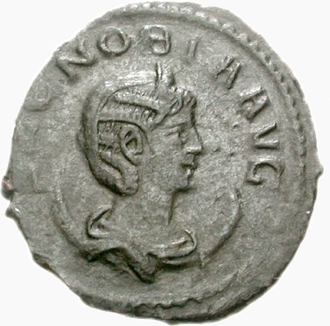
History of RomeEpisode 118 The Palmyrene Wars brings Zenobia onto centre stage. How have I gone my whole life without hearing about Zenobia?
Zenobia on a coin. Source: Wikimedia
She was the widow of Odaenathus of Palmyra and after his assassination she stepped right in. She took Egypt, Syria and part of Anatolia, each time paying lip service to the Roman emperor but really ruling in her own right. At first she minted coins with the emperor on one side and her image (the only images we have of her) on the other but she soon gave up the pretence and minted coins with herself and her son depicted. Aurelian finally decided that he needed to deal with her. Aurelian’s reputation as a hard man preceded him, and most of the Eastern cities recently annexed by Zenobia just capitulated, fearing what was to come. But to everyone’s surprise, because of a dream in which the 1st century philosopher Apollonius begged him not to shed the blood of the innocent, Aurelian did not go round sacking cities. This was a master stroke because it meant that cities did not fear surrendering to him. He regained Syria and Egypt and went on to Palmyra, where Zenobia and her son had fled, seeking assistance. Aurelian’s troops captured her there, but he wanted her for a triumph back in Rome. In Episode 119- Restitutor Orbis, Zenobia might have been captured, but the leading men of Palmyra regretted capitulating so meekly and so they fomented rebellion, forcing Aurelian to return for a second time to quash the insurgency. He was pissed off this time, and while not killing everyone (Apollonius’ advice still stood firm) he levelled the city and shifted the trade route, which is why Palmyra is in ruins today. Aurelian then turned his attention to the Gallic Empire, which he regained after some sort of arrangement with the ‘Gallic Emperor’ Tetricus. Always conscious of the need to keep the soldiers paid, Aurelian increased the number of mints issuing coins, but kept central control. Now that he had both Palmyra and the Gallic Empire under his belt, he finally had his triumph back in Rome, where he was proclaimed Restitutor Orbis (Restorer of the World). Not just the world: he restored Sol Invictus as God too (shades of Elagabalus) hoping to institute one faith across the empire. This was to make it easier when Constantine had the same strategy. Despite his triumph in bringing the empire back together again during his largely successful five-year reign, Aurelian was assassinated by his generals, who immediately regretted it. Episode 120- Interregnum sees neither the army nor the Senate wanting to nominate a successor to Aurelian. After all, emperors seemed to have a short shelf-life and there was a good chance that their sponsors would end up assassinated too. After Aurelian’s death, an old Senator named Marcus Cluadius Tacitus briefly reigned before the throne fell to Probus, who ruled from 276-282. Barbarian invasions continued but he was happy to accept the surrender of German tribes as long as they disarmed and dispersed – a policy that was followed until the Huns came on the scene. There was relative peace during his reign, but this led to unemployment among the soldiers, and so they assassinated him too. He was followed by Carus who reigned from 282 to 283, followed by his sons Carinus and Numerian. Carinus seemed to have been a lecherous tyrant, and Numerian suffered a smelly death. Finally Diocletian took over, and he was to overhaul the Empire completely.
Ben Franklin’s World I saw a reference recently to Caitlyn Fitz’s book Our Sister Republics: The United States in an Age of American Revolutions (1775-1825) which looks at the relationship between the newly-independent US and the different countries in Latin America which achieved independence from Spain and Portugal. She is interviewed in a rather muddily-recorded Episode 90 Caitlyn Fitz Age of American Revolutions : surely the sound could be better than this! She points out that Spain and Portugal arrived in Latin America a century before British Settlement in North America, and the Spanish and Portuguese empires lasted longer in a continent that was ten times larger than the Continental States that constituted the United States at that time. When Napoleon was engaged in the Peninsula War, a vacuum in power opened up amongst the Spanish colonies, and made space for revolution. After North Americans emerged after the 1820s war, they looked around and decided that they were quite supportive of the revolutions in Latin America, although this didn’t extend to financial support. Even amongst slave-owning states, there was support for gradual abolition, even though there had been horror at the Haiti revolution. When asked to speculate on what would have happened if the French Revolution hadn’t happened, Fitz suggests that the independence movements probably wouldn’t have arisen, but would have instead been channelled into constitutional reform.
History This Week I recently finished reading Anna Sebba’s book Ethel Rosenberg: A Cold War Tragedy so I was interested to listen to this episode Ethel Rosenberg’s Day in Court. If you’re not likely to read the book, then listen to this instead. It has interviews with Sebba and Ethel Rosenberg’s son Robert Meeropol, who says that despite losing his parents, he is glad that he was not his uncle David Greenglass’ son.
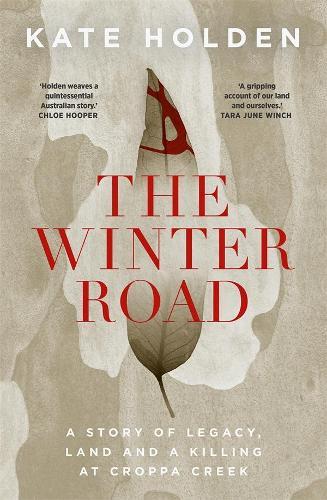
When I think of a ranger being killed, my mind skips immediately to Kenya and those brave, short, sinewy green-clad men of the Kenya Wildlife Service. The idea of a ranger being killed in Australia is so jarring that it is immediately memorable, and that’s the way it was for Kate Holden when Glen Turner was shot in Talga Lane, Croppa Creek, near Moree in 2014. His murderer, Ian Turnbull, aged 79 died in prison of heart attack, after being sentenced to 35 years imprisonment.
This book is quite a change from Kate Holden’s previous books: the first, In My Skin a wonderful memoir of heroin addiction and sex work; the second The Romantic: Italian Nights and Days a follow-up autobiography. Here she shuttles between reportage and reflection on a real-life crime which extends beyond a cold dirt road in Croppa Creek to a broader meditation on land, legacy and its meaning not just for Ian Turnbull and Glen Turner, but for both black and white Australians more generally.
We know that Glen Turner dies because she tells us, in the short prologue. The book then divides into three sections: Trespass, Murder and Inheritance. There is a chronological progress through the crime – lead-up, crime, and consequences- but the chapters themselves interweave a range of themes. Take Chapter Two, for example. It starts with a description of the Brigalow Belt that extends between Townsville and mid-NSW, the qualities of Brigalow Acacia harpohylla, the story of wheat in Australia, land-clearing legislation, clashes between Ian Turnbull and the Office of Environment and Heritage, land-clearing around Moree, and interactions between Turner and Turnbull. There is observation, reportage of conversations that Holden has held with the main protagonists, and desktop research drawing on the work of ecologists and historians. This interweaving continues throughout the book but I, as reader, I always felt that she was in control of the narrative, moving it steadily forward.
The book starts with the theme of ‘Trespass’, and there are different types of trespass at work here. Ian Turnbull’s trespass against the environmental law of the land; his accusation that Glen Turner, as a representative of government, was trespassing against his rights as a land-owner; the original trespass of white settlement onto indigenous land.
The emotional heart of the book for me comes in part 2 ‘Murder’, where she takes a slow-motion view of the murder. Here, too, there is an interweaving between the physical murder of Glen Turner, and the ecological ‘murder’ of the brigalow through the voracious demand for agricultural land. The murder itself, with Glen Turner and his old colleague Robert Strange bailed up by the gun-wielding Ian Turnbull in their departmental ute, took between twenty and thirty minutes. Twenty to thirty minutes. I think of shoot-outs or physical fights which, however long they might appear to the protagonists, are over in minutes. The thought of this deliberate, drawn out, highly personal, game of cat and mouse at sunset on a lonely dirt road is chilling.
Part 3 ‘Inheritance’ looks at the fall-out from the murder, for Ian Turnbull and his family; for Glen Turner’s family; for Robert Strange and other government employees; for the broader Croppa Creek community. It has truly been a poisoned inheritance. It seemed to me at the start of the book that she was at pains to represent all sides fairly, or at least to acknowledge the validity of their viewpoint from their perspective. But in Part 3, especially with the passing of weakened environmental laws that rendered Glen Turner’s death completely futile, it seems that Holden cannot withhold her judgment any longer. This is not a weakness: on the contrary, it would be weakness to continue to stand on the sidelines after all the exhaustive research she has undertaken.
This is non-fiction writing at its best. It is founded in research, which has been integrated with observation, conversation and reflection. It travels much further than that dirt road at sunset, interrogating Western society’s relationship with land and what it means to ‘own’ property. It is a beautiful piece of work
Emperors of Rome. At this stage, the ‘Emperors of Rome’ podcast and the ‘History of Rome’ podcast part ways. Episode CLXIX – Gallus sees Trebonianus Gallus appointed by his troops in June 251 after Decius and his son Herennius Etruscus died during a battle with the Goths. Decius’ son remaining son Hostilianus died of the Cyprian Plague, which was ravaging the Empire. (Kyle Harper has written about this plague in The Fate of Rome: Climate, Disease and the End of an Empire, which sounds quite interesting). During Gallus’ two year reign, there were uprisings East and West. Aemilian, the governor of Moesia Superior and Pannonia, defeated the Goths and was declared emperor by his troops. Somehow or other Gallus ended up dead, but Aemiliain lasted only 88 days before he was murdered by his own forces. Valerian became emperor and ruled for 15 years, ending a phase of short-lived emperors.
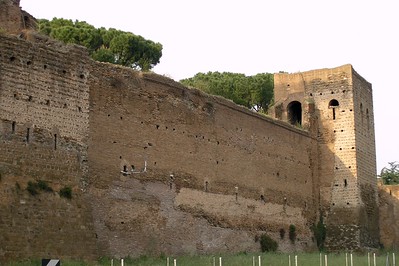
History of Rome. 116- Here Come the Illyrians sees the start of a string of Illyrian emperors. Some people mark this as the end of the ‘real’ Roman Empire, but Mike Duncan asserts that they saved the empire. Claudius Gothicus had no aristocratic links at all. He had been Gallienus’ trusted general. Maybe he wasn’t actually involved in the assassination of Gallienus, but he probably would have known about it. Nonetheless he exiled or executed the ringleaders to ‘prove’ his clean hands. He was worried about the East and the rise of Zenobia, but he had to deal with the Goths first. He oversaw a change in policy of treatment of defeated enemies, which allowed the Goths to settle on land, as long as they provided men for the army. Claudius also defeated uprisings in Germany, and then turned to the Vandals. An emperor’s work is never done. The future Emperor Aurelian was 2nd in charge when Claudius died of the plague in 270 AD. In Episode 117- Aurelian’s Walls, Mike Duncan raises the question: when you say that someone is ‘the greatest’ do you mean that they were the greatest at their peak, or do you look at their whole career? Duncan reckons that Aurelian was ‘peak emperor’ between 270 and 275, when he consolidated power in Italy, then went off to battle the Vandals. He employed the tactic of withdrawing all resources into a village, and then defending that village. When he defeated tribes, he insisted on a quota of soldiers, which eventuated in the Germanization of the Legions.
Despite his victory on the field, when he returned in triumph to Rome, he was faced with riots because people were unnerved by earlier defeats under Aurelian’s leadership; bread prices were high, and there was corruption over the mint. The old tactic of garrisoning the frontiers employed by Augustus and Hadrian no longer worked, because the invasions were bigger and it was the emperor (rather than a general) who was rushing around at the head of the army. Cities were vulnerable and needed their own walls, so Aurelian ordered a big wall around Rome (as the old 4th BCE wall was no longer sufficient. It was constructed rapidly, using existing buildings where possible, and using civilian rather than military labour. Nonetheless, the walls took 5 years to complete.
The Daily (New York Times) Ukraine Puts Putin’s Playbook to the Test (March 24, 2022) features NY Times journalist Carlotta Gall, who covered the Chechen conflict 30 years ago. She believes that there are real similarities between the two, so much so that when she hears Ukranian citizens vowing to remain, she wants to warn them just how dire it will become in the face of Russia’s ruthlessness. However, factors in Ukraine’s favour are: first, that it is much bigger than Chechnya with a population of 40 million as opposed to 1 million; second that it is already an independent country; third that it has Western recognition and finally that there is an adjoining country that fighters can withdraw to when the going gets too tough. But she reckons that if Putin follows the same strategy, it will get tough.
Australia If You’re Listening (ABC) Even though I’m a big Matt Bevan fan, I didn’t really particularly fancy this season about Australia’s politics of climate change. But when the first episode was inserted into the Coronacast podcast, I started listening (which just goes to show how hijacking an episode of a program can work). Episode 1 The legacy of our first decisions on climate change points out that warming of the environment through burning coal was first publicized in 1912. The tenor for Australia’s approach was set by none other than Labor minister Roz Kelly, who promised that Australia would not move faster than any other developed country – and we haven’t. The program looks at a big conference held in 1987 where, for the first time, scientists discussed climate change, then moves onto Kyoto and the significance of the ‘Australian clause’ over land-clearing. Interestingly, Roz Kelly defends Robert Hill, the Lib/NP Minister for the Environment who led Australia’s delegation to Kyoto- lauded by John Howard as a great result for Australia. Humpf.
The Daily (New York Times) I’m doing a fair bit of listening about Ukraine at the moment. In Four Paths Forward in Ukraine (March 17) David Sanger, White House and national security correspondent for The New York Times, explores four scenarios: 1. The diplomatic path- Ukraine agrees to Russian demands to give up any claim on Crimea; accepts independence of Donetsk and Luhansk; declarse its neutrality; and promises never to join NATO. Russia would demand that all sanctions be lifted. Scenario 2: A long war of attrition, with Russia ‘winning’ but an ongoing Ukranian insurgency (which Sanger thinks is likely). Third scenario: China helps Russia. Sanger thinks that China will just sit back and watch how things play out for now. They might assist, but from behind the scenes. Scenario 4: Putin decides to expand the conflict beyond Ukraine.
Axios – How it Happened. This series on Ukraine just has two episodes so far. Episode 1 Putin’s Invasion Part I: How We Got Here features Axios’ world editor Dave Lawler talking about how Putin came to power and how he has wielded that power. The podcast also features “our Aussie” Jonathan Swan, speaking about his exclusive Axios on HBO interview with Ukrainian President Volodymyr Zelensky. Trump, Zelensky- is there anyone he hasn’t interviewed? Episode 2 Putin’s Invasion Part II: The Consequences discusses President Biden’s decades of political experience with Russia and the sanctions the U.S. and Europe have brought against the country. It also explains why it’s so hard for the West to cut ties with Russia when it comes to energy, and why the Biden administration chose to do so even if it would send gas prices soaring.
History of Rome Podcast. Episode 113- Three Empires. Although the Roman Empire now split into three, Mike Duncan argues that all three empires remained culturally Roman, and that’s what’s important. Following the capture of Valerian in 260 AD, the western provinces broke away to form a separate Empire and the east became controlled by the city of Palmyra where Odaenathus was the last stop on the Silk Road. He defeated the Sassanids, and so he was mollycoddled a bit by the Romans who, deep down, thought he was a bit of a barbarian. Meanwhile Postumus was up on the Danube. At this time, local troops threw their support behind their own commander as Emperor, and when he had a stunning victory, Postumus was acclaimed emperor of Gaul, Germania, Britannia and Hispania in what was known as the Gallic Empire. Meanwhile Gallienus concentrated on the centre of the empire. He hit on the idea of the mobile cavalry as a way of reinforcing his authority, and it was a good psychological connection with the provinces to have the cavalry come by occasionally. In Episode 114 The Nadir of our Fortunes, Mike Duncan reminds us of the mess that the Empire was in, with the Sassanids in the East, the Goths on the Danube, the Alamanni in Italy and the Franks in the West. He then backtracks to Odaenathus over in the East, who was seen as a bit of a saviour when Macrinus and his son were killed, and he took over. Over in the west, Postumus was chosen by his own troops, and he happily embraced Aureolus, Gallienus’ top general, when he defected to Postumus. Gallienus had concentrated his efforts on Rome, but the senators hated him because he turned to military men instead of Senators- so he ended up with a bad rap from the historical sources. He founded four mints near the big military deployments so that the soldiers could be paid on time, but this just caused inflation and debasement of the currency. In the end Gallienus defeated Aureolus in battle, but then he was shot (probably assassinated). Episode 115 Phase Two Complete sees the almost simultaneous deaths of Gallienus, Odenathus and Postumus in the Late 260s. The Goths were coming south and Odenathus was assassinated by his nephew -(why? Personal reasons? or was his wife Zenobia behind it?) Zenobia stepped right in to the role of emperor of the east, assuming that she had the right as Odeanthus’ widow. The Goths sailed down and sacked Athens. When Gallienus left Rome to fight the Goths, his trusted general Aureolus mounted a revolt. Gallienus was assassinated in a conspiracy of his top officers. The troops rallied around Claudius, who demanded the head of Aureolus.
Emily Greene Balch. I prepared a presentation for my Unitarian fellowship on the Women’s International League for Peace and Freedom (WILPF), and the connection with the Australian Church’s Sisterhood of International Peace. Emily Greene Balch was raised a Unitarian in America (although she later joined the Quakers) and, along with Jane Addams, was a founding member of WILPF. This podcast, from the Internet Archive, is of Kristen E. Gwinn talking about Balch at First Church of Jamaica Plains (which Balch and her family attended). A pretty formidable woman. She was one of the pacifists who was really challenged by the rise of Fascism, and ended up siding with ‘freedom’ over ‘peace’.
Now and Then I’ve been listening to American historian Heather Cox Richardson for quite a while, and she has started a podcast with fellow historian Joanne Freeman called ‘Now and Then’. As you might expect from two American historians, it is VERY American focussed, but in the episode Avatars of Democracy, they express their admiration for Ukrainian President Volodymyr Zelensky. They then look at three other historical leaders who fought for democracy: the French-born Revolutionary War hero Lafayette, the Latin American liberator Simón Bolívar, and South African political prisoner and president Nelson Mandela.
Does having a book on reserve at the library count as having read it? Probably not. So, I must confess to not having read Our Wives Under the Sea by Julia Armfield, the starting book for April’s Six Degrees of Separation Meme. A literary association game, Kate at Books Are My Favourite and Best chooses the starting book, and participants name six books that spring to mind because of some association- no matter how obscure- with the starting book.
I could instantly think of many books about the sea, but I have chosen to stick to the idea of being underwater.
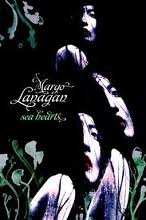
The first book that I thought of is Margo Lanagan’s Sea Hearts (2012). I have no idea what happened in Armfield’s book, but I have always been attracted to books and films about selkies (I absolutely loved the film The Secret of Roan Inish).
It’s a beautifully told story, spun out over several generations. It is set on remote Rollrock Island, with its village of fisherfolk and small cottages. The chapters are of varying lengths, told in the first person in a curious, lilting accent. Each chapter focuses on a different character and time elapses between generation to generation. One of the longest and most compelling chapters is told by Missakaella, an awkward young woman, shunned by the villagers, drawn to the sea and especially the seals in the bay. They are attracted to her, too, and her mother forces her to wear an apron with crossed strings, that somehow keeps the seals at bay. It is through Missakaella that the age-old meeting between selkie and human is reconsummated. It is a powerful and evocative piece of writing that I found oddly, and breath-holdingly erotic. That’s quite a narrative feat: to not only be lulled into suspending disbelief about the physicality between seal and woman, but to actually stir a response to it as well. But actions have consequences: obsession becomes possession; love becomes loss; something taken can take in return.
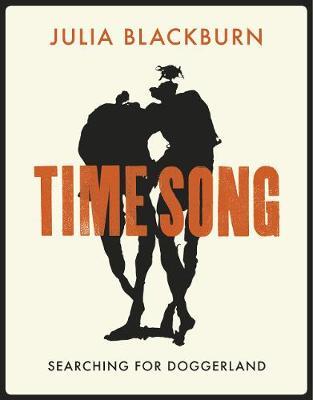
I’m fascinated by lands under the sea- in particular Doggerland, which existed in the North Sea and English Channel 18,000 years ago, making what we now know as the United Kingdom a contiguous part of Europe. It was not a land ‘bridge’, which suggests a narrow and tentative link between UK and Europe. Instead it was a fertile plain, with its own coastlines and rivers, with humans roaming across it. It was not a route from one place to another, but a territory in its own right. Julia Blackburn’s Time Song (2019) is an environmental history, but it is more:
But it’s also a very human story because of the way she tells it. Her search is narrated almost as a conversational journey, as she meets with this person and that, and as she relates her own reminiscences of places and items she has herself found. Collectors and academics share their enthusiasms with her, and indirectly with us too. There is a lot of science in this book (and her list of acknowledgments at the back of the book demonstrates her debt to academia) but it’s written very much in layman’s terms. Her response to the academic literature is expressed in 18 ‘Time Song’ poems, which intersect the text, each preceded by a black and white drawings by Enrique Brinkmann.
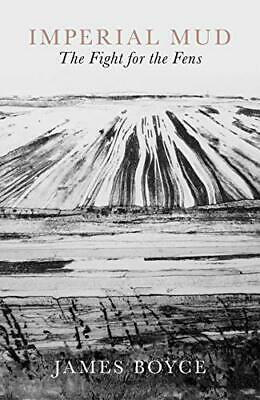
Doggerbank may be well and truly under the sea, but in James Boyce’s Imperial Mud: The Fight for the Fens (2020) we have man fighting against the encroachment of water in ‘The Fens’ in Cambridgeshire, Lincolnshire, Norfold and the Isle of Axholme in Yorkshire. The Fens, he explains, are not a precise location, given that the creeks and waterways that constitute them have always been an ever-changing phenomenon. James Boyce is an Australian historian, so this book seems a bit of a departure for him. But his focus is ‘colonization’, which can occur within a country, as well as overseas.
It is this bi-focal approach to colonization, seeing it as a process wielded in Britain and well as by Britain that is the real strength of this book, prompted by Boyce’s deep engagement with Indigenous history here in Australia. I must confess as an Australian reader, I found myself wishing that I knew more British history and geography. … Boyce is an incisive and economical writer, carefully attuned to landscape and ecology, continuity and change. His book is only small, but it makes an argument about colonization and resistance with its feet planted in two different, widely separated continents.
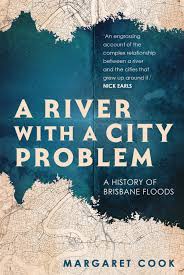
There’s plenty of water in Northern NSW and Queensland at the moment, and I’ve found myself thinking recently of Margaret Cook’s A River with a City Problem: A History of Brisbane Floods (2019).She takes as her focus the 2011 floods which devastated the homes and businesses along the Brisbane River, right into the CBC.
This book tells the story of the three major floods – 1893, 1974 and 2011 – from ecological, geographical and human perspectives. More importantly, though, it looks at the failure of policy as successive governments of both persuasions lacked the courage to say ‘enough!’ and prevent development on the floodplain. In the aftermath of a crisis, there’s a proud defiance in claiming that” we will rebuild” but often it defeats good sense.
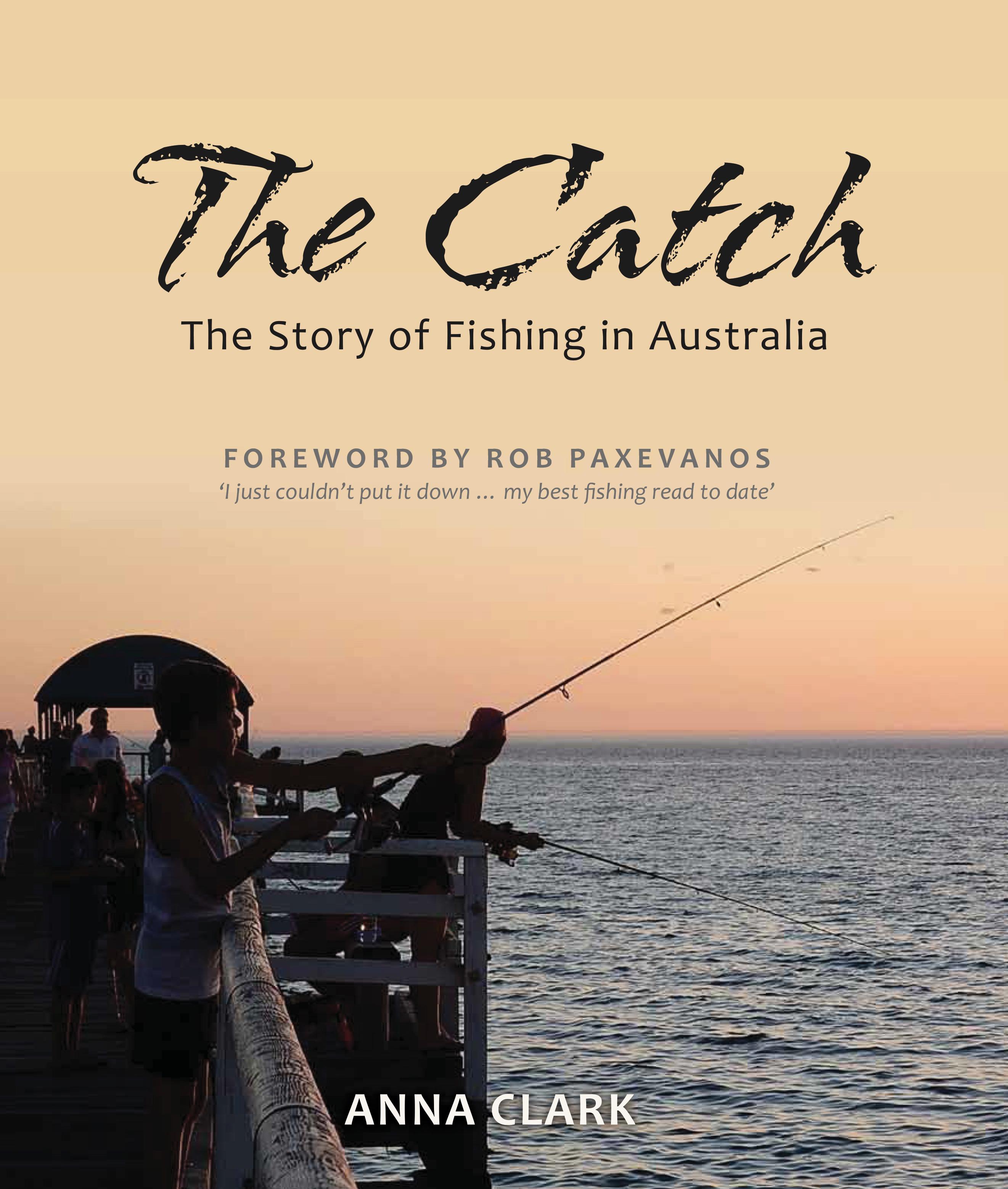
Fish live under the sea. And people bob around in boats and stand on the river banks trying to catch them. Historian Anna Clark takes a bit of a detour here from her interest in the historiography and teaching of Australian history to tell the history of fishing in Australia in The Catch: The Story of Fishing in Australia (2017). She shares her own love of fishing not just in the “we” language that Clark deploys, but also in the carefully crafted ‘fisher’s-eye’ paragraphs that commence each chapter.
Its copious and beautiful illustrations mark it out as a coffee-table book, but the text ranges beyond the ‘whoa! look at that!’ response to a photograph of a big fish. Its author, Anna Clark, is well known in academic circles for her work on public history and history teaching and she brings to the book an awareness of sources and a keen sense of finding history in the everyday. Most importantly, she brings her own love of fishing to the text, and I think that this is what fishers will respond most to in this book.
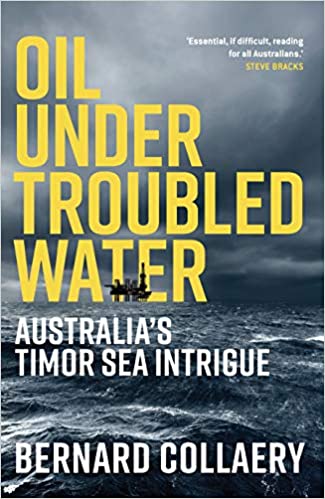
Natural resources are under the sea as well. And as Bernard Collaery has found to his chagrin in Oil Under Troubled Water: Australia’s Timor Sea Intrigue (2020), governments are fiercely protective of the negotiations that govern their use by competing nations. Bernard Collaery is a former Attorney-General of the Australian Capital Territory and worked for many years as legal counsel to the government of East Timor. In May 2018 he was charged by the Australian Commonwealth Director of Public Prosecutions with conspiracy to breach the Intelligence ServicesAct of 2001, introduced in the wake of September 11. He, and Witness K, a former senior ASIS agent, have been effectively gagged over a claim that ASIS had bugged the offices of the East Timorese team during negotiations over Timor Sea oil. Actually, even though I am very interested in the legal ramifications of Collaery’s silencing, and the sorry tale of Australia’s treatment of East Timor in these negotiations, I found the book quite difficult to read.
This, then, is a history of Australia’s dealings with East Timor and Indonesia over the oil resources- and more importantly, the helium reserves- in the Timor Sea. It moves chronologically, but it is a lawyer’s argument rather than a historian’s….I did manage to finish this book, but I found it very hard to read. Inexplicably, there is no map until page 362 and in a book that bristles with acronyms, there is no glossary. It is meticulous, with every fact noted, but it groans under the weight of so much detail. My gut feeling all those years ago was that Australia was acting like a bully, and this book only confirmed it further.

 The Resident Judge of Port Phillip