Monthly Archives: January 2009

Those party animals of 1842

Port Phillip might have been on the other side of the globe and its seasons might have been the wrong way round, but when it came to the expression of status, the ‘respectable’ citizens of Port Phillip looked, at least in this pre-Gold Rush period,  to the practices of ‘home’.
almacks

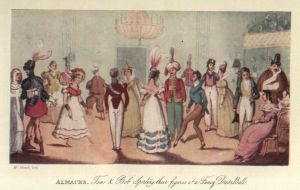
Private Quarterly Assemblies were a normal part of English social life.   Hundreds of people would flock to assembly rooms in London and the provincial cities like York and the spa town of Bath.  They were formal events where entry was by subscription, and attendees were screened to ensure the quality of those who gained admittance.  The most aristocratic was Almacks while Jane Austen’s books describe the famous Bath Assemblies and more humble affairs at provincial level.

And so to the Port Phillip Assemblies.  They were established in the midst of controversy over celebrations for the Queens Birthday ball, which culminated in two balls- a public one and a private one.  The success of the private ball prompted the establishment of a committee of twenty men to arrange Private Quarterly Assemblies.  Membership, vetted by the committee, was limited to gentleman colonists and their families.  Merchants were included, but tradesmen were not. As Edward Curr was to find out, squabbles between gentlemen settlers could bubble over into the Assembly committee.  He had argued with Lyon Campbell over the hiring of a cook, and the matter was brought before the Assembly Committee which, much to his gratification,  refused the demands to strike him from the subscriber list.

The Port Phillip Herald of 21 October 1842 has a report of the Assembly Ball held on 19th October in the long room of the new Mechanics School of Arts on Eastern Hill.  I assume that this was the original Atheneum building in Collins Street, although it was not officially opened until December.  Certainly the new building was a source of great pride, described as a building “that would do credit to a town three times as old as our metropolis” (PPH 11 Oct 1842).  Tickets for the ball had been available from the Melbourne Club.

DOMESTIC INTELLIGENCE.  ASSEMBLY BALL. (PPH 21 Oct 1842)

The second private assembly ball of the season took place at the Mechanics’  School of Arts, on the evening of Wednesday last; and, notwithstanding the wetness of the weather, the coldness of the air, and the almost impassable state of the streets prevented so numerous an attendance as was expected, at eleven o’clock eighty guests had assembled, one half being ladies.  The noble long room of the Institution was set apart for the ball, leading from which was an ante-room plentifully supplied throughout the whole evening with refreshments.  Three large chandeleers [sic] with oil burners suspended from the ceiling, and innumerable wax-candles fixed in branches fastened all round the room, threw a brilliant light upon the handsome faces and splendid dresses of the ladies, and the happy countenances of all.  A temporary orchestra was erected at the further corner of  the room, containing seven musicians, who, to do them justice, played admirably from the first quadrille to the closing country dance.  The waltz tunes were very well selected, and the time excellently marked.  At half-past one o’clock the company went below to partake of a substantial supper, provided by Mr Howe, in the two left-hand rooms, which having been done ample justice to, the ball-room was again the scene of the stirring dance till daylight, when the company separated highly gratified at the evening’s festivities, which were considerably enhanced by the excellent arrangements of the stewards.

My, these Port Phillipians knew how to party! I thought that it was only clubbers of the late twentieth century who arrived just before midnight and continued on until daybreak.  This is October, so it would have been completely dark when they arrived.  And supper at 1.30 a.m.!!

References

Paul de Serville  Port Phillip Gentlemen
‘Consolation’ by Michael Redhill

redhill

2007, 469p

So what does a new historian, weary of combing 19th century newspapers about  little colonial communities read when she heads down to the beach for a few days?  Why, a NOVEL emerging from combing 19th century newspapers about a little colonial community, of course!

I’d heard Michael Redhill talking about his book ‘Consolation’ on Radio National’s The Book Show last year.  The 1850s setting in Toronto, Canada attracted me particularly because if I am going to trace my Resident Judge John Walpole Willis to his career in Canada and British Guiana by upgrading to a PhD, then these places are going to be as familiar to me as Port Phillip is now.  But is that possible?  One of my fellow students commented that she had heard that, in the end, your thesis is always about you.  I’d resisted that thought for a while, as there seems something so self-indulgent and self-aggrandising about it, but perhaps there’s more than a little truth in it, especially in my case.  After all, my first awareness of Judge Willis came from living in Heidelberg, in what was originally the Port Phillip district.  I do not have a judicial bone in my body, but I am attracted to the idea of community cohesion, and its flipside, community rejection of someone who doesn’t fit role expectations.  I’m fascinated by the intersection of small, face-to-face relationships and politics and the Big Imperial Politics of the nineteenth century Colonial Office.

Is it possible to write about a place and a culture that you have never been to?  In the furore over Kate Grenville’s book The Secret River, particular criticism was directed at her efforts to absorb the atmosphere and emotional responses to a rough sea crossing, or the banks of the Thames by visiting them today and trying to imagine herself into the responses of people of the time.   Approaching the Heads of Port Jackson on a safe twentieth century boat with lifeboats, communications and a nearby coastguard could not possibly parallel the experience of a small boat with men alone facing huge seas, it was argued.

But, on the other hand, can a description of the courtroom atmosphere of the 1840s ignore a February heatwave?  Can the episode of two men serving papers on Judge Willis on his way to inspect the half-built courtroom make sense without an imagination of the straggly streets of early Melbourne?    How necessary is it to be aware of such things?   If I’m drawing on this almost environmental contextual awareness as the well-spring for my treatment of him in the Port Phillip community,  will I be able to do it for Upper Canada- where I have never been, and as  an even greater challenge, in British Guiana?   Port Phillip, Upper Canada, British Guiana- even their names have changed, to say nothing of the colonial nature of their societies.

And so, I thought I might turn to fiction as a taster.  Consolation is written as two interwoven stories.  The ‘modern’ story is set in a Toronto high-rise hotel, where the widow of a recently-deceased historian is looking down on an excavation where, perhaps, artefacts will be discovered to vindicate her husband’s claims over the shoreline and the likely existence of a shipwreck containing a box of photographic plates of 1850s Toronto.  The ‘past’ story concerns the photographers who created the plates and their adjustments to colonial Toronto and separation from family and ‘home’.

There’s always a peril in the ‘two interwoven stories’ structure that one will overshadow the other, and I think this happened here somewhat.  I really enjoyed the 1850s sections, and felt quite impatient when I was dragged back to the drawn out ‘suspense’ of a Time Team program written on paper.  Of course, my motivation for reading the book may differ from that of other readers, but I felt that he made the characters of the photographic partners  J. G. Hallam and Mrs Rowe come to life.  His descriptions of 1850s Toronto had the whiff of the newspaper article about them, but I enjoy that.

Apparently the book received muted praise in Toronto itself.  There is a slightly evangelical authorial tone that comes through in the ‘modern’ section about heritage and community identity, and perhaps I, too, bridled a bit against being lectured about something that, in reality, I do feel strongly about.

Putting my historian hat on, I could see parallels between the 1850s Toronto he describes, and the 1840s Port Phillip where I spend most of my mental time.  Even the concept of the photographic panorama was replicated here in Port Phillip at much the same time, for slightly different reasons.  And as a fiction reader, I was drawn to the characters he evoked and the little community in which they lived.

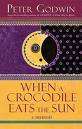
‘When a Crocodile Eats the Sun: a memoir’ by Peter Godwin

godwin

2006, 340 p.

A memoir is not the same as an autobiography.  An autobiography is driven by the ongoing elapse of time, where chronology imposes an order onto the narrative.  A memoir, on the other hand, is a construction placed over events which can be quite independent of time.  It is, in its own way, just as much an argument as a non-fiction book can be.

Godwin uses the metaphor of the solar eclipse- the crocodile eating the sun- to frame his memoir of Mugabe-era Zimbabwe.  And oh what a descent into darkness it is.  We can read in our newspapers of the inflation, the cholera etc etc and yet be none the wiser about how people continue to live in Zimbabwe (as distinct from merely surviving).  For me, it was the footage of the bashed Morgan Tsvangirai, right in the middle of an election campaign in the glare of the world’s media, that reinforced the ruthlessness, defiance and absolute power of an autocratic regime.  If this could happen to the leader of the opposition, what was happening to people without an international political profile?

But, just as much as a political commentary, this book is about being a son and identity.  Godwin’s parents are becoming increasingly frail.  Peter, the author is seeking citizenship in America where he works as a journalist, angling for African assignments that will enable him to be return to see his parents .  His sister Georgina works as an activist broadcaster and would be endangered by a return to Zimbabwe, while another sister was killed by gangs several years earlier.  At times I just wanted to shake him- why was he allowing his work to dictate when or if he would see his parents- just go there without waiting for an employer to pick up the tab.  Isn’t there some obligation on children?- I’m old enough to think that there is.  But then again, what if parents absolutely refuse to move from a situation that puts their children into danger in meeting these obligations?

The twist in this memoir is the author’s discovery that his father has hidden from his children his  Jewish identity and his lifestory as sole survivor of his family from the holocaust.  As well as shaking the author’s confidence that he ‘knows’ his father, this knowledge leads him to reconsider the role of the outsider, statelessness and exile in  twenty-first century Zimbabwe as well.

Although it would be easy to typecast the author’s family as stubborn white colonialist farmers in a changed political situation, it is not as clearcut as this.  The opposition to Mugabe’s rule seems to be class-based as much as colour-based, and many of the relationships that Godwin’s parents have with neighbours,  fellow professionals and employees cross racial boundaries.

But, as with all  people born into a post-colonial society, there is a mixture of guilt, self-interest, love of country and one’s own national identity.  Godwin’s mother, in trying to explain to her son why she cannot leave, turns to Rudyard Kipling’s poem “The Roman Centurion’s Song: Roman Occupation of Britain, A. D. 300”.  She chooses this prominent poet of the Empire, knowing that he is writing from the ‘invader’s’ perspective:

Legate, I come to you in tears- My cohort ordered home!

I’ve served in Britain forty years.  What should I do in Rome?

Here is my heart, my soul, my mind- the only life I know,

I cannot leave it all behind.  Command me not to go!”

‘When a Crocodile Eats the Sun’  is a beautifully crafted memoir.  The book starts with the cremation of his father, and closes with the same episode, in exactly the same words- evoking for me the circularity and rhythm of the eclipse metaphor he has chosen.  The author’s deliberate and self-consciousness construction of his narrative at times threatens to become a bit forced, but the raw conflict of loyalities on so many levels is the stronger quality of this book.

Things that make me laugh #1 for 2009

Surely the shiny new padlock isn’t necessary?

sillsbendjan2009

A day at Sills Bend

sillsbendjan2009-002

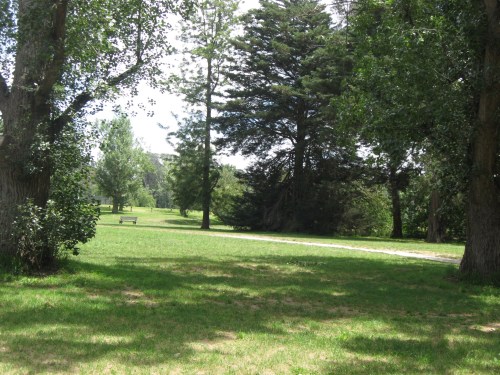
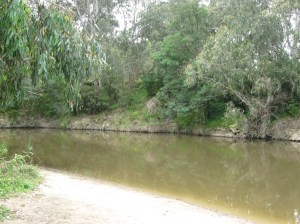
One of my favourite places to take a deck chair, picnic, glass of wine and good book on a warm afternoon is down to Sills Bend, beside the Yarra River in Heidelberg.  I’m a Heidelberg gal at heart, and down at Sills Bend I feel particularly close to the early settlers, including the Resident Judge Willis, whose rented property was on the ridge overlooking these river flats. As Alexander Sutherland was to describe it in 1888,

Heidelberg was scarcely a suburb; it was rather a favourite district for those who desire to have ample domains around their dwelling.  Until 1850 it was regarded as the distinctly aristocratic locality; the beauty of the river scenery, the quiet romantic aspect of the place, gave it an early reputation among the Melbourne men of means as the site for country residence – Alexander Sutherland Victoria and Its Metropolis 1888

The land that is now Heidelberg was offered for sale at the first land sales, conducted in Sydney. The fact that the sales were held in Sydney, meant that unless locals or their agents were prepared to travel up to Sydney, then most of the sales were to Sydney investors.  Thomas Walker, the Scottish investor, purchased several of  the available lots.  However, as is usual in land boom conditions, the estates changed hands several times in a short period of time.  And why wouldn’t they- prime land, water access through the Yarra, Darebin and Plenty rivers, and all within ten miles of the centre of Melbourne.

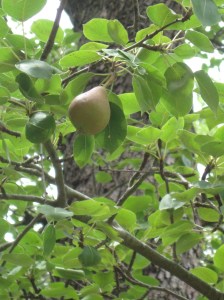
The river flats, with a good source of water were turned over to tenant farmers like Peter Fanning (1827-1905), who farmed the next bend of the river (Fanning’s Bend) , or subdivided from the larger estates and sold as small holdings to farmers like Mark Sill (1818-1885) who planted an orchard.  Several of the pear trees are still alive.

sillsbendjan2009-006sillsbendjan2009-007

The gold rush had little effect on Heidelberg beyond stimulating market gardens and agriculture to supply the increased population moving to the diggings at Queenstown (St Andrews) and Warrandyte. However, during the 1860s there was a succession of ‘droughts and flooding rains’ that made sustainable farming very difficult.  As the agent for the Banyule Estate, James Graham wrote on 12 January 1865

I am quite concerned about the low rents from Banyule area the tenants are doing no good. What with this very dry season and rust and caterpillars, the crops are very poor indeed.  Fanning is both losing money and rent altogether and he has been at me several times to let him off the lease. He had worked hard poor fellow but I see and I know that he is losing money.  His wife is in very bad health, which helps to make matters worse.

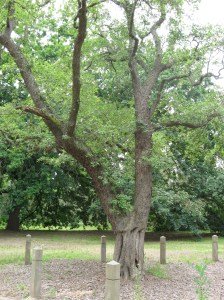
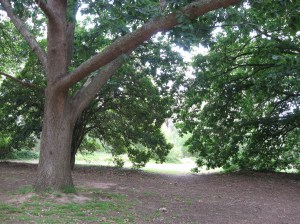
The dominance of English-style estates around the Heidelberg areas means that there are quite a few stands of oak and hawthorn trees.  The oak trees down at Sills Bend are spectacular, with branches that reach right down to the ground.  There’s a little beach (very little) down on the Yarra bank

sillsbendjan2009-008

sillsbendjan2009-013

The small size of Heidelberg militated against the provision of infrastructure like water and rail, which in turn hampered growth.  It was really only with the Depression of the 1890s that the large estates began to be broken up.  Land subdivision progressed in a piecemeal fashion right up until the 1960s.

So, Melburnians, when you read of the “missing link” between the Western Ring Road and the Eastern Freeway, look very carefully at what is proposed when they start talking about the Bulleen option.  You might want to join me on the barricades.

References:

Don Garden, Heidelberg: The Land and Its People

Plaque at Sills Bend

Good on you, Mrs Mac

From the Port Phillip Gazette 1/1/42

BIRTH EXTRAORDINAIRE! On Thursday Mrs McDonald, the wife of a respectable settler, presented her husband at Mr Mortimer’s Crown Hotel, with a Christmas box consisting of two girls and a boy, whom with the mother, are doing well. Advance Australia Felix.  The girls were christened Victoria and Adelaide, the boy Albert.

My, what regal names!  The Port Phillip Herald of 4/1/42 adds the alarming detail that Mrs John McDonald of River Plenty had presented her husband with twins about 12 months earlier!! Five under about eighteen months……

I wonder whether she came into the Crown Hotel specially for the birth or whether she just happened to be there.  Ironic, really, that maternity hospitals today shove their new mothers off into hotel suites to clear the hospital beds.

There were only occasional birth notices in the Port Phillip newspapers of the 1840s, and generally only for the wives of “highly respectable” professional men, rather than the wives of  humble “respectable settlers” like Mrs McDonald.   I noticed that the Insolvency Commissioner’s wife Mrs Verner had a baby, then about two weeks later there was an advertisement for a wet nurse with the instruction to apply at the Insolvency Court- surely not the first place one would think to make such a contract. [I feel a bad joke about milking people dry coming on…..]

Well, I wonder what happened to Mr and Mrs McDonald and their little ones?

Happy New Year!

nyeve2

Well, New Years Eve in Melbourne came and went, as it always does, last night.  Many police in the city, and just a handful of arrests apparently.

(Update: Well, more than a handful.  The Age today reports that there were 1147 arrests across the state, double that of New Years Eve 2007 when there were 511 arrests.  “The tougher stance produced ‘the quietest New Year’s Eve on record’, with no repeat of the riots that marred past New Year’s Eves at Rye and St. Kilda.”  136 people were taken off the street for offensive behaviour, indecent language and minor assaults, and 485 motorists were booked for a range of traffic offences, well up on 248 last year).

What about in Port Phillip in 1841?  Here we are, in the Port Phillip Gazette of 1/1/41 in the Police Intelligence column- where else?

POLICE INTELLIGENCE. William Porter, Charles Aldgate, David Holmes, John Walsh, John Percival, Charles Major and Richard Bennet were driven into the box like a flock of sheep, having been found suffering from the effects of the season.

Bench: Well, what have you to say?

Chorus: Christmas, Your Honor, Christmas!

Bench: Silence! We neither countenance nor approve of drunkenness, but making a little allowance for the season, we discharge you all

Chorus: Thank you, Your Honor: hurrah! a merry Christmas and a happy new year!!

The Port Phillip Patriot was a little less charitable about the lads hauled in a couple of days later:

The first day of the year 1841 must evidently have been auspicious to the publicans of Melbourne if we may judge from the number of persons, amounting to twelve who made their appearance at the bar of the Police Office on Saturday morning.  Nor was the offence confined to the male kind solely, one female being charged for the fifth time.  If we may judge from appearances, we should say that the potations of many were not pacifically concluded, the physiognomies of many bearing sanguine and sable traces of having done battle ( Patriot 4/1/41)

Given that Christmas seemed such a fizzer, I thought I’d look up to see if New Year was celebrated with any more gusto.  I checked out the chapter on Christmas in Ken Inglis’ Australian Colonists (1974) to see if my hunch about the relatively low-key, domestic nature of Christmas was sound.  He took a wider chronological sweep than I did and so includes information from later in the century (as well as the sources I found) but he  did note the prominence of New Year. He speculated whether it was the influence of the Scots and their emphasis on hogmanay but was aware of the relatively low proportion of Scots in Australia generally. However, there were proportionally more Scots in Port Phillip (40%)  than elsewhere in New South Wales (30%)  so perhaps that explains why the extended pieces I found on Christmas came from Sydney and South Australia respectively, rather than Port Phillip.

Inglis writes of Australia as a whole:

Here as at home the new year was welcomed with church bells, and people resolved to do and be better for the next twelve months.  Governors held levees, citizens played or watched games, went for picnics, listened to bands.  From the first years of the settlement it was customary for men to stay in towns, to stay out late carousing and larking, lighting bonfires and fireworks.  (p. 113)

The Port Phillip Gazette celebrated New Year by presenting its town subscribers with “an engraving by our late talented and eccentric friend John Adamson” which although falling short in conveying the size of Melbourne, “will help to convey to distant friends the position, appearance and style of the town of Melbourne.”  I think you can see the engraving here. All three papers made much of the coming of 1842,  far more than they did in 1843 when the depression was obviously biting and press columns were preoccupied with elections and politics.  All three papers in 1841/2  indulged in a bit of backward-gazing self-congratulations and worthy and jovial exhortations for the coming year, but there was none of this the following year.

So, what was there to do on New Years Eve and the following New Years Day in that party-year 1842?  On New Years Eve, you could have gone to a concert at the Pavilion

The concert held on Saturday evening last to welcome in the new year, was numerously attended and came off with considerable eclat. Although, as might have been anticipated at the season of  general jubilee, a number of rather suspicious characters were loitering about the Pavilion, many of whom endeavoured to obtain admittance, yet they were very properly excluded, and in consequence, if those favored with an entre were not all of the upper ranks of society they were respectable and conducted themselves with the greatest propriety.  The evening’s entertainment was, upon the whole, little, if any thing inferior to any similar display in the colonies and if equal attention for the future be paid to the general arrangements by the Manager, and the performers exert themselves in an equally laudable manner for the gentrification of the audience, the Pavilion will soon be a most fashionable place of resort as it is as yet the only one of rational amusement.  The “star” Miss Sinclair, fully realized the most sanguine anticipations, she has an excellent command of a good voice, and with a little more practice her success as a vocalist is certain.  Her “Kate Kearney” was sung with a spirit and national feeling which told she was at home in giving effect to an Irish air.  Miss Lucas’ “Meet me by moonlight” was good, but it was evident she labored under the effects of a bad cold; but although in consequence she had been previously recommended to resign her part, she preferred making her appearance to disappointing her previous admirers. Master Eyles’ performance was generally good, but the concluding part of the “Bay of Biscay” was excellent and promised well for future fame.  Mr Miller, as a comic singer, would not disgrace the provincial boards of the first class in Britain, and was no better received than he deserved.  In all his actions he was happy, but particularly in “Biddy the Basket Woman”.  To supply the hiatus in the performance caused by the necessary retirement of Miss Lucas, an amateur entertained the audience with a variety of dances, expert gesticulations &c. and deservedly stands a favourite.  Port Phillip Herald 4 Jan 1842

The next day, you might have attended a cricket match where “a party of civilians were duly stumped out by their opponents the government officials”. But it sounds as if THE place to be was Williams Town beach, attracting crowds from Melbourne arriving by steamer with bands playing, and spilling onto the beach to enjoy sail boat races, whale boat races, sack races, footraces,  shimmying up a greasy pole, blindfold wheelbarrow races and a greasy pig chase.

williamstown

At 1.30 a free lunch was served for 200-300 people- sheep, beef, cabbage- (mmm, mmm) accompanied by the popping of corks and music.  The crowds had all melted away by 6.00 when the town worthies had their own, more select gathering of fifteen gentlemen who sat down for a much more dignified dinner.

Of course, if you were of a more spiritual bent, you could have attended the opening of the Independent Chapel on Eastern Hill- a building that could accommodate 500-600 people, splendidly lit with chandeliers.

And so, “Thus ended the amusements of a New Years Day in Australia Felix”

References:

Ken Inglis  Australian Colonists

A. G. L. Shaw The Port Phillip District.