Monthly Archives: August 2008

David Roberts PATERNALISM IN EARLY VICTORIAN ENGLAND

1979, 278 p

One of the frustrations that I’ve faced in trying to understand Judge Willis has been to try to understand his mindset. Why did Port Phillip society of the time find him so unacceptable and demand his dismissal? Was he too radical? Was he too conservative? Was he neither of these things? This book focusses on early Victorian England which, although a hemisphere away from Port Phillip, was the milieu that informed the thinking of colonial judges and civil servants and was the lens through which their patrons and superiors back in the metropole viewed their actions.

In this book, Roberts attempts the heroic in trying to define and illustrate the workings of an unnamed-at-the-time set of varying beliefs and attitudes which he, along with other 20th historians, identifies as ‘paternalism’. He argues that, bolstered by Romanticism and literature, paternalism reached its apogee in 1844. It’s a slippery concept, though, despite his attempts to pin it down through analysis, for example, of the backgrounds of the contributors to the major ‘paternal’ journals and quarterlies of the day, or by the speeches and voting patterns of ‘paternalist’ MPs in the 1840s. He divided these parliamentarians into 6 categories: the Romantics, The Peelites, The Churchmen; the Country Squires; The Whigs and the Anglo-Irish, but even he admits that there is no consistency between their espoused position in speeches, and their actions. Paternalism, it seems, is only one of several influences. In fact, his concept is so hemmed in by qualifications and disclaimers that you start to wonder if what he is describing exists at all.

But, despite his difficulties in defining it, he posits that after 1848 ‘it’ was no longer functional: rendered less relevant by the rise of urbanisation, a self-conscious middle and working class and the mid-century intellectual developments of science, rationalism, empiricism and belief in progress.

I’m not sure that this book has taken me much further in understanding Judge Willis. It’s interesting that his major patrons are categorized as either Peelites or Whig paternalists- but I’m not really sure yet what, if anything, that means.

Possum Magic

The residence of the Resident Judge has, for some months, been under a vermin attack. Last year it was the mice, then -worse still- the rats in the ceiling.  A couple of weeks ago possums took up residence in the roof. Exterminators and removers have been called, and the place SHOULD be vermin free.

But it’s not.

A couple of weeks ago, I noticed a chewed banana on the kitchen floor.  I thought that one of our four FOX TERRIERS (supposedly renowned for their vermin-chasing propensities!) had brought it in.  A little later, I noticed that after I had used half a banana on my cereal in the morning, the other half had been eaten while still in the fruit bowl.  Alert now, AND alarmed, I started to scrutinize the fruit bowl more carefully. Yes- the tops of pears had been nibbled; whole bananas would be eaten leaving the empty skin still attached to the others in the hand; bananas would be taken out of the bowl and left on the bench.

We thought they might be getting in through the dog door (specially cleaned of doggie snot for this photo lest you think me slovenly)

Could they be getting in through the doggie door? Well, maybe…. so I’ve taken to locking it. The first night I locked it so that they could get out but not come in (lest they already be here in the house).  At 1.30 a.m. I could hear them bashing at the door.  After a brazen banana heist that night, I took to locking it completely- no ingress or egress! I’ve tested it- they can’t be getting in through here. But at 5.00 a.m. this morning they were back…

How are they doing it? The dog door is locked.  All the cupboards are shut- and I can’t believe that they’d shut the cupboard doors after them (after all, no-one else in the house does).  The airconditioning and central heating vents have not been disturbed.  The dogs are not sniffing anywhere.

My daughter’s room has a sliding door, is locked and has no visible space under it.  The bathroom and toilet don’t seem to have any visible sign of entry. There’s just one room…at the end of the passage.  My only subscriber knows what’s behind the door. COULD they be squeezing under the door and getting in from there???

So here we are: flummoxed by a possum.  I have taken to leaving some banana outside on the porch, but last night it REJECTED it!! Self-serve, it seems is the way to go.

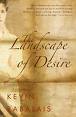
Kevin Rabalais THE LANDSCAPE OF DESIRE

2008, 280 p.

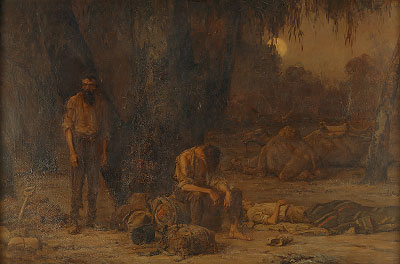
As a newcomer, you’d have to be pretty brave to write a fiction book about one of another country’s iconic stories. The author of this book is American-born and now living in Australia. Quite apart from the narrative draw of the Burke and Wills expedition in its own right, it’s obviously the sort of story that attracts writers from other countries. The English writer Sarah Murgatroyd with The Dig Tree also mined the Burke and Wills story with, I think, more success than Rabalais has had. And of course, Alan Attwood with Burke’s Soldiers and Alan Moorehead ‘s Cooper’s Creek also tell the Burke and Wills story- and they’re just the ones that I’ve read! Generations of Australian school children have heard the story; the highly glorified Burke and Wills statue has been shuffled to and fro around Melbourne streets and now overlooks the corner of Swanston and Collins Street, and the imagery is strongly reinforced by the Longstaff painting in the National Gallery of Victoria.

So how then, does a writer who has not grown up immersed and inured to all this mythologizing deal with the story? This is a fictional account, and focusses on the love interest between Robert O’Hara Burke and the actress Julia Matthews which he expands by having William Wills fall in love with her as well. I’m not aware of this twist- but hey, it’s fiction. The story is told in small snippets, disconnected in time and location and has the feeling of being at times over-written. As an Australian reader, it is familiar to me: I can’t imagine how a reader new to the story could possibly follow it.

If he is writing for an Australian audience whose knowledge of the expedition can cope with these narrative discontinuities, then he has even more responsibility to get things right. I always understood that they reached the mangroves of the Gulf of Carpentaria, observed the tidal flow, then turned back. I have never heard, as Rabalais asserts, that they stood in the foamy sea. This gives the expedition a triumph that it was denied, and there’s something very Australian in that. We are comfortable with our heroic failures- we like them that way.

There’s a sniff of the writing exercise about this book. Many sections are only 3 or 4 pages long (a good length for ‘workshopping’), and there is an appalling, anachronistic interjection of an authorial reflection about photographs which, thankfully, starts and ends abruptly never to be seen again.

The Moorehead book is the ur-text of Burke and Wills stories. Sara Murgatroyd, who died of cancer at the age of 34 just after her book’s publication, gets a good look in and has left a strong legacy. Other than that, I don’t really think the world NEEDS another Burke and Wills story.

Hey, I used to work there!!

I see from an article in the Age that the Fitzroy artist Alexander Knox has created a light installation on the old Royal Mail building, on the corner of Bourke and Swanston Street.

Wow! That looks better! By light of day it really is a rather unprepossessing modernist building. Whenever I see that AC/DC film clip of the band travelling down Swanston Street on a flatbed truck, I notice ‘my’ building and try to imagine that it was ever viewed as anything except ugly.

What was there before? Apparently, the Royal Mail Hotel, built in 1848 and named because its owner E. B. Green had the contract for carrying mail by stagecoach throughout Victoria. Its second licencee was William Johnston Sudgen, previously Melbourne’s Chief Constable – nice little career shift there.
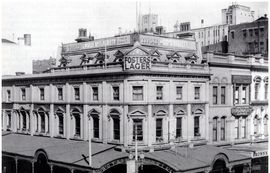
According to Robyn Annear’s A City Lost & Found, construction works to modify the building during the 1930s uncovered a wall containing bricks bearing thumbprints- generally considered to be a mark of convict manufacture. The brick-clay was examined by a visiting Tasmanian, who asserted that it was of Port Arthur origin, and the bricks were declared to be among Melbourne’s oldest.

(I am ashamed to confess that I have wasted nearly half an hour investigating when convicts were withdrawn from Port Phillip- a wild-goose chase prompted by my failure to finish reading the paragraph in Robyn Annear’s book! Stopping mid-sentence at the words “convict manufacture”, it struck me that 1848 was very late to have convicts still working in Melbourne. Half an hour later: I was right. Convict transportation from UK to New South Wales was suspended in 1840, and on 28 Oct 1843 Governor Gipps instructed LaTrobe to send the remaining convict gangs in Port Phillip up to Sydney. But they were still here 0n 13 December 1844 because Gipps again proposed withdrawing all the convicts, in exchange for the receipt of a cargo of Exiles- prisoners who had served 1-2 years in Pentonville prison before being issued with conditional pardons to take up as settlers (not prisoners) in New South Wales. A.G.L. Shaw writes that 1727 Pentonville exiles had landed in Port Phillip between 1844 and 1849 until popular protest against them culminated in the turning away of ships containing exiles and redirecting them to Sydney. So- Port Phillip convicts didn’t make the bricks in 1848. As, of course, Robyn Annear went on to say, had I read further.)

According to the excellent Walking Melbourne site, the old Royal Mail hotel was sold to the British company Hammerson Property and Investments Trust for 455,000 pounds. In October 1960 the hotel was demolished and this wonderful structure erected in its place.

I worked on both the fourth and third floors from about 2003-6. At first I was on the third floor in an office without windows located just behind the blue billboard at the bottom of the picture at the top of the page. At the time, there was a television screen mounted on the building, and I used to fantasize, in moments of extreme boredom, of sticking my head through the wall and emerging in the middle of the screen to survey the people below. I later moved onto the fourth floor to the rear of the building where my window overlooked the rooftops of the rather unsavoury cafe/restaurants fronting Swanston Street. However, it did give me a new appreciation for the copulatory habits of pigeons who inhabited the ‘pigeon brothel’ there.

On the other hand, working there did give a wonderful view of Melbourne. The Melbourne Cup march would go straight past, and political marches would stream by. Unfortunately the AFL Grand Final march turned up Collins Street instead, so I couldn’t watch that one. There’s a great little ‘structure’ of a pig with wings mounted on a pole on the corner which you can only see if you look up, but was directly in our line of sight. When the building across the road (that in my childhood had a rather evil Santa beckoning children onto the Foy’s rooftop garden each Christmas) was owned by Nike, we would watch spellbound as huge advertising posters were erected obscuring the building completely. However, the metal-man busker with his synthesizer loses his appeal after listening to him all day, and dog-lover though I am, a bait would be too good for the cattle dogs who bark twice at the end of each line of ‘How much is that doggie in the window?” sung ad nauseum for hours by the Slim-Dusty lookalike on the corner opposite.

So, good on you Alexander Knox. It looks beautiful, and I can’t wait to see it.