Tag Archives: phnom-penh

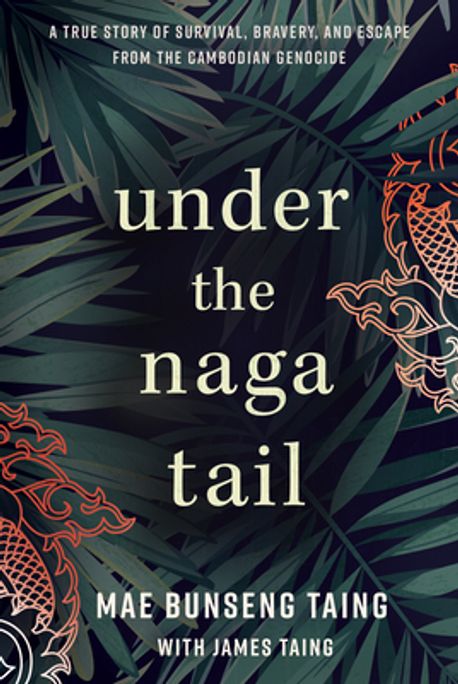
‘Under the Naga Tail’ by Mae Bunseng Taing with James Taing

2023, 352 p.

I was in Cambodia, and I wanted to read something Cambodian, but most of the fiction involved the Khmer Rouge period written by people who have escaped to Western countries. This book falls into this category too, although it is slightly different in that the narrator, Mae Bunseng Taing, is of Chinese ethnicity, living in Cambodia. I was interested to know what difference that would make. Unusually, all of Mae’s siblings survived, which is not true of many Cambodian families.

Mae was a teenager and living a fairly affluent life with his entrepreneurial family when the Khmer Rouge marched into Phnom Penh. As with other stories I have read, there was the utter bewilderment as Phnom Penh was completely emptied of people, urged (forced) to leave on the pretext that the Americans would bomb the city. He and his family were forced into the provinces to undertake agricultural work- a far cry from their trading activities in Phnom Penh previously. The family was split up as siblings were sent to different agricultural projects and communities, while his elderly and ill father was left behind in a village. They had secreted away some jewellery, so they were not completely penniless, but under the surveillance of soldiers and ‘Angkar’ operatives, they were only safe if they could merge in amongst other people. The book gives a good glimpse into the ideology that the Khmer Rouge were imposing on their countrymen, who were reduced to a form of slavery.

He finally decided to escape into the jungle, and survived several heart-stopping confrontations. With the defeat of the Khmer Rouge, he decided to cross back over into Thailand and look for his family amongst the refugee camps there. But there had been a change in Thai government policy, and now refugees were being returned to Cambodia, taken into the jungle, and left to find their own way through the explosive-laced jungles at Preah Vihear. It was an inhumane form of mine-clearing, using desperate refugees who were left screaming alone in the jungles, limbs missing, after standing on mines. Mae was, in many ways, in more danger now than he had been under the Khmer Rouge.

This, then, was a second form of Killing Fields. I found myself feeling ashamed at the kindness and the prejudice and indifference that these refugees faced, all too aware that our refugee policy some fifty years later has elements of both. The story was written down by Mae’s son James, who makes an unheralded and abrupt appearance during the narrative, and clearly Mae found his way to a Western country to start a new life.

There is a film by James Taing that you can see on You Tube here. (If you can stand the incongruent ads)

My rating: 7/10

Sourced from: purchased e-book

Read because: I was in Cambodia at the time.

I hear with my little ear: Podcasts 16-30 September 2024

In the Shadows of Utopia I was in Cambodia for most of this time, so I immersed myself in Lachlan Peters’ In the Shadows of Utopia podcasts. I didn’t really listen to much else. These episodes are LONG (over two hours) and very detailed. Episode 7 The French Protectorate ( I really wish he’d keep his naming conventions regular: it’s also called Khmer Nationalist and French Rule) deals with the years 1880 – 1938. At first, the French treated Indo-China in a fairly hands-off way but in 1885 the French Government insisted on a new treaty which abolished slavery and tried to disrupt the patronage networks that governed Khmer society. However, after rebellions, these reforms were not carried out, although French interests became uppermost. World War I had little effect in Cambodia, especially compared with Vietnam and the rural ‘old people’ lifestyle remained largely unchanged. In fact, when May Ebihara undertook her ethnographic study of a Khmer village in 1959-1960, published as Svay: A Khmer Village in Cambodia, her research was the first and only study of traditional Khmer life. The nuclear family was the basic unit, there was little mobility and a distrust of strangers. From the 1930s on, Phnom Penh began growing and we had the stirrings of an urban nationalism, spurred by the Buddhist Institute, the introduction of secondary education and the first newspapers.

Episode 8: An Introduction to Communism Part I goes right back to Marx and Engels, starting with Engels and his investigation into the condition of the working class (even though his family were capitalists). Engels and Marx saw all history and activity about the economic struggle, and capitalism would be the second last stage before the final, inevitable clash between the proletariat and the bourgeoisie. At first there was great excitement over the 1848 revolutions that gripped Europe, but they were not led by the working-class, but by liberals and nationalists. Marx blamed the petit-bourgeoisie, and he had to wait until the 1871 Paris Commune as perhaps a better, if short-lived, example of Revolution. Meanwhile, we had the rise of a united Germany as a sign of things to come, but in the end it was backward Russia where first revolution took place. If you’re a bit foggy about Marx and Engels, this is a good place to start.

Background Briefing . Kidnapping the Gods Part II. This is the second and final part of this Background Briefing episode. This episode takes us to the involvement of several ‘art collectors’ including Douglas Snelling, who became an unofficial Australian consul to Cambodia and managed to ‘collect’ many artefacts that he sold in New York. Then we have Alex Biancardi in NSW, whose Egyptian father was also a collector. The Art Gallery of NSW offered to store his huge collection at no cost (probably with the expectation that they might access some of it). He may have been in contact with the notorious ‘collector’ Douglas Latchford. The episode shows the messy links between looters, ‘collectors’ and galleries and museums.

The Rest is History Custer vs Crazy Horse: Horse-Lords of the Plain (Episode 3) The lifestyle of the Native American had changed immeasurably. In 1492, when Columbus arrived, it was thought that there were 3-4 million (and maybe as many as 8-9 million) Native Americans. By 1796 this number had halved. No tribes were on their ancestral lands: they had all been shifted around. In effect, it was a clash between emigrants. The Lakota had been shifted to the plains from their ancestral lands and were a warlike people. There are no photos of Crazy Horse (which was the name he took from his father). He was a medicine man i.e. he had a spirit animal, and had visions. He was a careful fighter- unlike Custer.

The Rest is Politics (US edition) with Katty Kay and Anthony Scaramucci is one of my regular listens, but I don’t record it because it’s usually too topical, and their commentary will be overtaken by other things. But they have recently had a four part series (only three have been released so far). on How Trump Won the White House. It starts with him winning the Republican nomination after years of bragging about (threatening) to run for President, when no-one took him seriously. The second episode (Did Obama create Trump?) looks at Obama’s ridiculing of Trump at the Press dinner, and speculate about whether this goaded him into finally running for president. The third episode (Collusion Collapse and Chaos) traces through the crazy 2016 election campaign, and the way that the momentum shifted between the Access Hollywood tapes and the accusations of Russian collusion that threatened Trump’s campaign to the ‘basket of deplorables’ and FBI Clinton emails that brought Hilary’s campaign undone. I guess I’m waiting for the last episode.

Emperors of Rome Episode CCXXVI – The Reputation of Catiline (The Catiline Conspiracy VII) At first, Catiline was seen as a by-word for ‘conspiracy’ but over time writers have softened their view of him, often reflecting the political events of the time. In Medieval times, he was re-cast as a Robin Hood type figure, and the Renaissance had a more sympathetic view of him. He was picked up in French Literature, with Voltaire and Alexandre Dumas wrote plays about him, as did Ibsen. The recent, widely panned film Megalopolis uses the names of the protagonists of the Catiline Conspiracy in a film set in an imagined modern United States. I haven’t seen it

Conversations (ABC) My brother’s death- writing the story of a family’s grief and loss. At the Ivanhoe Reading Circle, we always start our meetings with people talking about books they have read recently. A couple of people mentioned Gideon Haigh’s new book My Brother Jaz, a small volume that was written in a frenzy of writing after years of avoiding writing about the death of his brother. The book is less than one hundred pages, and the people reporting on it said that you could get as much from listening to this ‘Conversations’ interview as you would from reading the book. It was very good, although a little distant and rehearsed, which is understandable having written about it.

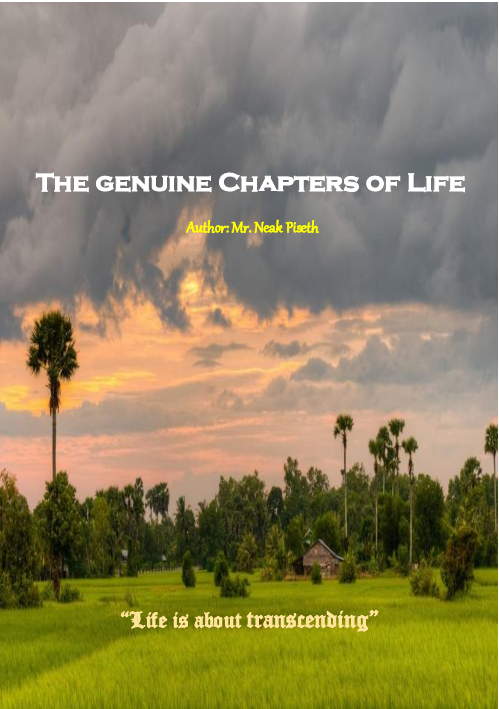
‘The Genuine Chapters of Life’ by Neak Piseth

2016, 116 p.

I’m not sure how I stumbled on this e-book which you can access through academia.edu or through issu. In fact, I’m not really quite sure what it is: on one level it is a memoir of a young man growing up in rural poverty in the 1990s to attain his dream of high education at the Royal University of Phnom Penh. But at another level, particularly near the end, it seems to become a scholarship application document where he outlines his vision for changes that he would make to his society were he successful in studying overseas. It must have worked, because he received a scholarship to pursue his master’s degree in Non-Formal Education at Chulalongkorn University in Thailand in 2019, continuing on as a PhD candidate from 2022. He has been working as an English Lecturer and as a lecturer in the Faculty of Education at the Royal University of Phnom Penh and has a number of publications under his belt.

His grandparents died under the Pol Pot regime and he was born to poor parents in 1994 with, at that stage, only one older sister. His father, an illiterate orphan, had inherited a one-hectare plantation in a village, and the family lived in a crumbling cottage while his father worked as a motor taxi driver in the city. In 1999 they received a contract to grow rubber trees on their plantation, but this necessitated moving to another dilapidated thatched, earth cottage closer to the trees. After the contract expired, they used the money they had earned to move back into the village where the author and his sister began attending school. They walked the three kilometres to school, and had to help after school looking after their three cows, while their parents worked in a small business, arriving home at midnight. In 2003 his mother had another daughter, who was often sick, and his father had to stop working to assist his mother at home. This meant that, in order to keep attending school, the author and his sister had to sell banana cakes after school to support the family. The family remained in poverty, especially after an accident on the rubber plantation resulted in his father’s blindness. Despite his father’s violence against his mother, the author deeply respects his father, and craves his approval.

He gives a fairly damning view of education in Cambodia. Teachers often took on private students as tutors in order to get additional money, which meant that they often did not teach the full curriculum at school, or charged for teaching and examination materials as a way of gaining extra students. The tutored students often received passing grades, to encourage their parents to continuing paying out for tutoring. Some students’ parents bribed the teachers, and many teachers arrived late.

Despite these difficulties, he was a very conscientious student, spending hours at night rote-memorizing his work. He really struggled to learn English- and indeed, this text is clearly written by a second-language learner- and he lacked confidence to speak in English, even when he knew the answers. By sheer hard work, and the good and well-earned fortune of a scholarship, he was able to attend Western International School in Phnom Penh. He lived in a small, dark room, continuing to rote-learn as much as he could. By the end of the book, his hard work is paying off, despite the discrimination against poor kids from the provinces.

I hadn’t expected to encounter Jane Austen and Bill Gate (i.e. Gates) in this book, but each chapter closes with an inspirational quote that he has gleaned as part of his studies. Beyond this, though, I’m really glad that I read this book while I’m here in Phnom Penh. I’ve found myself looking at the school children walking to their schools, and tuk-tuk drivers who are possibly working for their families in the provinces, with new eyes.

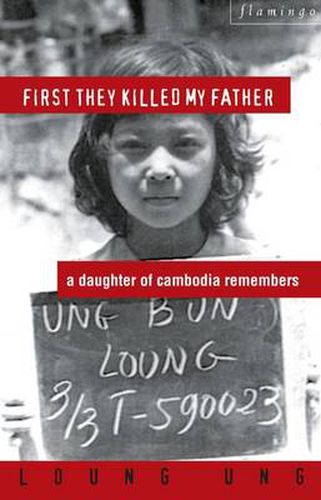
‘First they killed my father: a daughter of Cambodia remembers’ by Loung Ung

2001, 336 p.

As you might know, some months ago I travelled to Cambodia and am likely to repeat the trip a few times more over the next few years. First They Killed My Father is one of the books that tops the ‘Books You Must Read Before Travelling to Cambodia’ lists, but I felt rather reluctant to read it. In my mind Cambodia was defined by two things: Pol Pot and Angkor Wat, but I want it to be more than that. And yet, having now been there, the influence of both is inescapable. They don’t necessarily define Cambodia, but they have shaped it.

Loung Ung was five years old when the Khmer Rouge swept into Phnom Penh. They were wealthy and of Chinese descent: her mother was ‘full Chinese’ and tall, with almond shaped eyes and a straight Western nose. Her father, part Chinese, part Cambodian, she describes as having “black curly hair, a wide nose, full lips and a round face” with “eyes shaped like a full moon.” Her father originally worked for the Cambodian Royal Secret Service under Prince Sihanouk, and then as a major in the military police under Lon Nol. We don’t actually learn what he did in either of these jobs, but it did afford them an upper-middle class lifestyle in Phnom Penh. She was raised to distance herself somewhat from Cambodia: in the mornings she studied French, in the afternoons Chinese and at night Khmer, and her parents spoke about Cambodian customs as being something “other”.

Not that any of this helped when the Khmer Rouge evacuated the city completely, under the pretense that the US was about to bomb the city, and that they could return in three days. Her mother soon realizes the reality, with her offering money notes to her daughter to use as toilet paper. The family is shifted from location to location, siblings are sent to jobs in different places, and her parents are acutely aware of hiding their middle class origins and pretend that they and their children are peasants. Her parents had reason to fear. I found that one of the most chilling sights in the Tuol Sleng Prison (Security Prison 21), which I visited, was the sight of children, arrested along with their parents, who were questioned and later killed. It was fear of being arrested as a family that led her parents to send their daughters away to fend for themselves. Yet somehow, miraculously, some (but not all) members of the family find their way back to each other when the madness comes to an end. With the family in tatters, she and her brother travel to Vietnam, then use a people smuggler to go to Thailand where they end up in the Lam Sing Refugee Camp, waiting to be taken in by another country. Did her brother’s conversion to Christianity help?- possibly, and she and her brother are granted residency in Vermont.

The book is written in the present tense, and it moves chronologically in a methodical way, with each chapter headed by a date. It purports to be a child’s-eye view, but of course it is being written by an adult. The book has been criticized in Cambodia for inaccuracies, her obliviousness to her privilege, implausibilities and the racism she displays against the ‘base people’ in emphasizing her Chinese origins. You can read several critiques at Kymer Institute – in fact, it’s well worth doing so. Certainly I noticed her disdain of peasants and Cambodians generally, but as for the rest of the criticism- I don’t know enough. I read it partially as a way of trying (unsuccessfully) to understand the Khmer Rouge and how and why they took power with so little apparent resistance. Exhaustion from war and exposure to unyielding and ideologically-driven violence have much to do with it, I suspect. Reading this book while in the country, I enjoyed the descriptions of Phnom Penh (albeit at fifty years remove) and gave context to my ambivalent visit to Tuol Sleng Prison. I’m still looking for books about Cambodia that, while not blithely ignoring the Khmer Rouge years, are not defined by them.

My rating: Hard to say – 7???

Read because: I was there. E-book.