
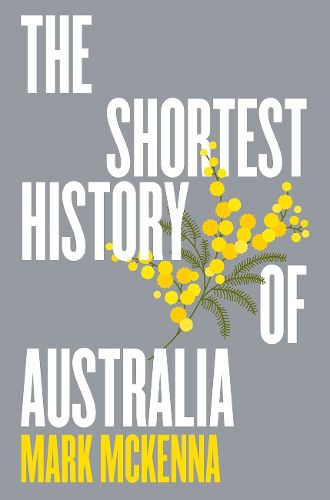
It’s appropriate that I should be writing this review on January 26, Australia Day. Here’s a recommendation: if you’re going to read a survey history of Australia, then read this one.
There’s lots of survey or short histories written by eminent historians to choose from, many of which appear in several editions as they were updated to encompass later events: Keith Hancock’s Australia first written in 1930; Gordon Greenwood’sAustralia A Social and Political History (1955) Manning Clark’s A Short History of Australia (1963) ; John Rickard’s Australia: A Cultural History (1988); Creating a Nation (1994) by Pat Grimshaw, Marilyn Lake, Ann McGrath and Marian Quartly; David Day’s Claiming a Continent (1997) and Stuart Macintyre’s A Concise History of Australia (2000). There’s even Alex McDermott’s Australian History for Dummies (2011). One could quite justifiably ask “Does the world need another short history of Australia?” And I would answer: yes, and it should be this one.
In 1968 New Zealand historian Keith Sinclair wrote an article for Historical Studies called ‘On Writing Shist’ (that second ‘s’ is very important!) He pointed out that shist (i.e. short history) is not a summary of what is known in order to be memorized, but a summary interpretation of a topic, intended to make it understandable. It should be aimed at the educated non-specialist, and the author cannot assume more than the most vague background knowledge. Facts are illustrative and form a “very thin, hard skeleton”, and the overwhelming problem is what to leave out, rather than put in. The heart of the task is to shape the overall pattern of ideas, facts and prose, interwoven into a pattern of thought and story. It is meant to be read, rather than consulted, utilizing the novelists’ tools of suspense and pace, driven by the author’s sense of commitment to his subject.
McKenna addresses the issue of the need for “new ways of thinking about the nation’s history” right in his first chapter. He writes:
Most national histories are ‘rise and rise’ narratives. They narrate the nation’s formation and walk chronologically through familiar milestones. In Australia’s case, there’s a chapter on Indigenous Australia before 1788, before moving onto the main story: penal colony to gold rushes and responsible government, then to Federation, the First World War and the Anzac legend, the Depression, the Second World War, postwar reconstruction and the Cold War; before waves of non-British migration, the new social movements of the 1960s and 1970s and the end of White Australia usher in the emergence of a more open, global economy and culturally diverse society. Or words to that effect. The history of the nation-state- from one formative event to the next. (p. 7)
So how is he proposing to avoid this straightjacket? His fundamental strategy is to see Australia as a continent rather than a nation, to turn both Edward Barton’s declaration “a nation for a continent and a continent for a nation” on its head. He foregrounds place, both the climate, ecologies and histories of different regions of Australia, and the Indigenous understanding of history which can never be divorced from place. And rather than that awkward, dangling introductory chapter of “The Aborigines”, he integrates Indigenous perspectives and actions throughout the whole book, from start to finish. Nor does he follow a well-ploughed chronological trench: indeed, Captain Cook and Botany Bay don’t appear in detail until Chapter 9, more than half-way through the book, in a chapter titled ‘Facing North’.
He starts right up front in Chapter 1 ‘The Founding Lie’, with a reflection on the Sydney Opera House, its design and construction, then considers its site – Bennelong Point. In Chapter 2 ‘From Ubirr’ he joins hundreds of visitors at Ubirr, in the Kakadu National Park looking north to the Arafura Sea at dawn- again, starting at a place- to emphasize the great migration from Asia into northern Australia, and the influence of trade with the north. Chapter 3 ‘The Island Dilemma’ looks at the sense of geography and the ‘island’ perspective that encouraged isolation as both a negative and positive force. He takes us to Christmas Island, both its now-deserted CI Club for administrators and Europeans, then its use as a detention centre for asylum seekers. Ch.4 ‘Taking the Land’ (and there, again is that ‘place’ emphasis) starts with John Howard at the Longreach Stockman’s Hall of Fame in 1997, promising that government legislation would ensure pastoralists’ rights after the Wik decision. He traverses land policy from Cook’s act of possession to the spread of ‘settlement’ and Aboriginal resistance, especially in Queensland. He notes that Australia has silenced not only the evidence of frontier warfare, but also the many efforts at reconciliation that were made between British settlers and First Nations Australians (p. 75).
Chapter 5 ‘War and Memory’ takes us to Australia’s “most storied beach”, 15,000 kms away. In a desperate craving to be connected to European history through blood sacrifice:
Over time, the birthplace of their nation was conveniently displaced 15,000 kilometres offshore to Anzac Cove. Australia thus became the only modern nation-state to create an origin myth not located on its own soil p.90
He points out that, two decades before the outbreak of the Great War, and for at least a decade after the war ended, in areas like Wave Hill and Victoria River of the Northern Territory and the Pilbara and Kimblerley regions of Western Australia, frontier violence was still occurring. War memorials to the First World War stand in villages, towns and cities throughout Australia, but the Australian War Memorial resists calls to recognize the loss of life in frontier wars.
Chapter 6 ‘Fire and Water’ takes us to Red Bluff, Kalbarri in Western Australia way back on 25 January 1697, and the desperate search for water by the men and officers from the Dutch East India Company who anchored three ships in Gantheaume Bay and rowed towards the coast. Drought, fire and flood are “a cycle as ancient as the country itself”, and while non-Indigenous Australians have long been familiar with bushfires and floods, the memory of one is swiftly erased by the arrival of the other, as if we’re fighting the same battles with the country (p. 111). Here are the plans for irrigation using the Murray-Darling, the Snowy River scheme and the fires at Mallacoota in December 2019. In Chapter 7 ‘Fault Lines’ we go to Waverley cemetery in Sydney, and the grave of Louisa and Henry Lawson, before embarking on a really good analysis of Catholic/Protestant sectarianism, touching on Ned Kelly, Billy Hughes and conscription. Chapter 8 ‘Fault Lines’ starts with Dorothy Napangardi, one of Australia’s most acclaimed artists, and the gradual recognition and appreciation of Indigenous ways of belonging to Country in the late twentieth century. For many non-Indigenous Australians, works of First Nation artists are a reminder that, as recently arrived migrants in a country, we do not have the same keys to Country. Modern Australia has always been a migrant society, and McKenna returns 19th century migration, especially from Ireland, and the Chinese migrants lured by the prospect of wealth on the goldfields. He goes through the conversion from a white, British enclave to a diverse multicultural nation, while noting that it was driven by self-interest and economic necessity. He reminds us of the memories of discrimination and prejudice through the story of William Yang, born in 1943 on a tobacco farm on the Atherton Tablelands. In Chapter 9 ‘Facing North’ (there’s that sense of place and geography again) we finally meet Captain Cook face to face. To illustrate the short-term economic mentality of resource extraction he turns not to gold, but to pearls, and the pearling industry not just for its importation of divers from Asia, but its mix of voluntary and forced Aboriginal labour (I didn’t know about this). He then moves on to New Guinea, and Australia’s WW2 in the Pacific.
I’d like to look at Chapter 10 ‘The Big Picture’ in more detail as an example of the diffuse way in which McKenna writes, his integration of stories of individual people into broader historical events, and the sweep of a theme across time. He starts with Charles Doudiet’s sketches of Eureka, which were only discovered in 1996 through a Canadian family which found them in their attic. These sketches verified for the first time the location of the Eureka Rebellion and the use of the Eureka flag, and they are the springboard for McKenna to discuss Australian democracy and its evolution from Eureka and the anti-transportation movement, through to self-government of the colonies in the mid 19th century. Then he moves to a second picture, Tom Roberts’ ‘Opening of the First Parliament of the Australian Commonwealth 9 May 1901′ and federation as a political compromise that combined elements of the US federal constitution and the Westminster system. The opening of Parliament House in Canberra in 1927 had many guests, but two uninvited guests were Jimmy Clements and John Noble, two Wiradjuri elders who walked 150 kilometres from Brungle Aboriginal station near Tumut in NSW to attend the opening. Here McKenna turns to Indigenous agitation for their rights in the 1920s and 1930s, set against Queen Elizabeth’s tour of 1954, the first reigning British monarch to set foot on Australian soil. He returns to Indigenous activism and the 1967 referendum, and the myths that surround it, before moving on to Whitlam and his deliberate cultivation of what Whitlam called “a vigorous national spirit” and ending the era of assimilation in favour of land rights and self-determination. This was encapsulated by the photograph of Whitlam pouring a handful of red earth into the hands of land rights leader Vincent Lingiari in 1975. However, the most seismic shift was the High Court Decision in the Mabo case, and he returns to Eddie Mabo’s sketch of his ancestral land on Mer which hangs not far from Tom Roberts’ ‘Big Picture’ in Parliament House. McKenna finishes the chapter with another painting of the people on Mer executed by Tom Roberts on his way to London in 1903. Twenty years after his arrival in London, Roberts presented the painting to the British Museum, and there it stayed undiscovered until found in 2009 by a curator from the National Museum of Australia.
He closes his book with an Epilogue titled ‘Modernity and Antiquity’ which starts with suburbia and the humble Sydney houses of both John Howard and Paul Keating. He notes that in the half-century since the dismissal of the Keating government, the old verities have vanished: Australia is now one of the world’s most diverse, multicultural and liberal democracies. The Indigenous cultures that White Australia tried to eradicate are now fundamental to the nation’s identity. From a protectionist economic policy, we are now an open, free-trade economy; the alliance with the US remains the linch-pin of its defence; the population has doubled since the mid 1970s and there is a distinctive rise of environmental consciousness, with the Tasmanian Greens the first Green party in the world. He notes that the closer we come to the present, the harder it is to discern which reforms will be of lasting significance. He returns to the “Big Lie” with which he started his book, and the question that continues to gnaw at Australia’s soul is how to tell the truth about the nation’s history and what Noel Pearson called “a rightful place” for First Nations Australians. Here are the apologies, the Uluru statement and the referendum campaign. He closes as he started with a place: this time Lake Mungo National Park (the most spiritual, life-changing place that I have visited in Australia) and the potential for Mungo to be “for all Australians, black and white. It can embrace us all in its spirituality, and draw us closer to the land.” (p. 266)
This is a beautifully written, really carefully crafted and highly original book. Although part of the ‘Shortest History’ series that ranges across the whole world, I feel that it is far more directed at an Australian audience than an international one, but both readers could take much from the book. Indeed, the word ‘shortest’ obscures the deep-time and Indigenous emphasis of the book. By eschewing completely the chronological approach, he prioritizes understanding of a theme illustrated through many kaleidoscopic prisms. In the author’s note at the end of the book, he says that he decided to “say more about some things rather than a little about many things”. He has certainly succeeded in this. His prose is beautiful, drawing your interest from vignettes based on people, with a pace that doesn’t get bogged down in details. It’s excellent. Read it.
My rating: 10/10
Sourced from: Review copy from Black Inc. but that hasn’t influenced my rating!
 The Resident Judge of Port Phillip