
Tag Archives: middle-east

I hear with my little ear: Podcasts 1-7 February 2026

The Rest is Classified Episode 101: Putin’s Secret Army: Wagner’s Control of Africa (Episode 4) As the French withdrew from the Central African Republic, Yevgeny Prigozhin and the infamous Wagner Group saw an opportunity to make themselves useful to the Kremlin by globalizing his model and applying it to new conflicts. After all, the East Indian Company had used this privatized company model of colonization way back in the 18th century. In the end, is there a difference between mercenaries and a government contractor? For quite some time, Prigozhin denied any involvement in Africa, adopting some fairly risible disguises when flying in for meetings. He made a deal with Sudan in exchange for gold; he took advantage of the Civil War in Libya after Gaddafi; in Mozambique different countries were pitching for deals. In exchange for his security and information warfare, he received mining concessions. Ever the publicist, he was heavily into branding, and started making his own publicity films in Africa, starring his own troops. But by January 2022 he came into conflict with the Russian Ministry of the Defence who, he felt, were locking him out.

The Rest is History Episode 637 Revolution in Iran: The Rise of the Ayatollah Part 2. The Iranian Revolution, despite being characterized in the west as ‘medieval’, is a classic 20th century revolution, with the involvement of the petite-bourgeousie, young unemployed working class men and students but also with the addition of clerics and religious students. The Shah neither repressed nor appeased the protestors, and U.S. President Jimmy Carter was completely out of his depth. He appointed the dovish Cyrus Vance as Secretary of State (of course, Tom points out the irony of having a man called Cyrus being appointed to Iranian (Persian) affairs given the historical Cyrus the Great) as well as the hawkish, anti-Russian Zbigniew Brzezinski as National Security Advisor. Needless to say, the two men did not get on. In October 1978 the Sunni, Arab, Baathist Saddam Hussein expelled Khomeini from Iraq, and he went to Paris where he made himself very available to the world press, who were happy to report his anti-colonial, anti-imperialist views. He did express to the international press his radical view that the mullahs should run the state, but he was quite open about it in his taped lectures which were sent home to Iran and circulated widely. On New Years Eve he issued a call for nine days of protests, and by 19 January 1979 the Shah had agreed to leave, wanting to go to California, which led to more conflict between Vance and Brzezinski over US’ responsibility to the Shah. On 1 February 1979 Khomeini returned after fifteen years’ exile and was greeted by crowds. Brzezinki was urging a coup, but the US Ambassador to Iran, Sullivan, rejected this plan, arguing that there were fears for US businessmen and that oil prices would skyrocket. Meanwhile, back in America, evangelical Jimmy Carter was convinced that US was gripped by a spiritual crisis, exemplified by what came to be known as his televised ‘malaise’ speech, calling for people to use less oil- not the sort of message Americans are accustomed to hearing from their President. Khomeini announced the export of Sharia Law, and the increasingly ill Shah was stuck in the Middle East.

Journey Through Time Episode 63 The Spanish Civil War: Fighting Fascism With Hemingway and Orwell (Episode 2) Despite their governments’ squeamishness about getting involved in the Spanish Civil War, combatants from more than 53 countries came to support the Republicans under Comintern. In fact, the Lincoln Battalion, a force of volunteers from the United States who served on the Republican side in the Spanish Civil War from January 1937 until November 1938, was the first racially integrated US military force. Despite the Republican fighters’ enthusiasm, they were amateurs: some came to Spain intentionally, others just happened to be in Barcelona for the 1936 Peoples Olympiad, set up in opposition to Hitler’s Olympics, which ended up being cancelled anyway because of the outbreak of the Civil War. The Republican effort was working class, but its public image has been largely shaped by the writers and photographers who attended, who had the contacts with publishers to get their work out. Women were involved too, defending the feminism in Republican Spain compared with the sexual violence amongst the Nationalists, who were not beyond using systematic rape. The Republican military training was more ideological than practical. Because of Spain’s neutrality during WWI, the Nationalist troops were not particularly experienced either, and the battle-hardened leaders from the foreign legions took control in Franco’s army. Nonetheless, the battle for Madrid was hard fought on both sides.

Late Night Live Barry Jones on a life of public service and the state of politics today Barry Jones might be 93 years old, and in frail health, but his feats of memory are amazing. Obviously interviewer David Marr was apprehensive that Jones might ramble on and kept him on a fairly tight leash, even ringing an imaginary bell when Jones went on for too long. I couldn’t believe how easily Jones could bring to mind names and acronyms in a wide-ranging conversation: none of the -oh-it’s-on-the-tip-of-my-tongue lapses of people half his age. I loved his discussion of the ‘numinous’.
I hear with my little ear: Podcasts 24-31 January 2025

The Rest is Classified Episode 100 Putin’s Secret Army: Fighting with Assad in Syria (Episode 3) Prigozhin met with Dmitry Utkin, a Nazi-leaning ex-soldier with the GRU Military Intelligence Unit. His favourite composer was Wagner, which is not unexpected amongst neo-Nazis, and this became his call sign, and later the name of the group he founded with Prigozhin. The hosts of the podcast, former CIA analyst turned spy novelist, David McCloskey, and veteran security correspondent, Gordon Corera, note that in all ages and all countries have their own mercenaries, not just Russia. There was restlessness in the Crimea and Ukraine, and with his contacts and supply lines of food to the military, Prigozhin could make himself “useful”. He arranged for 200 mercenaries (the ‘little green men’) in Crimea and Ukraine before their takeover by Russia, and it was proRussian groups who shot down Malaysian airlines MH17. Using his PR skills, Prigozhin was able to muddy the waters over the whole affair. The Wagner group fought a dirty war and by 2011 they had committed 1000 men, but the 2015 Minsk theoretically brought the fighting to a close (theoretically). By Sept 2015 the Wagner group was involved in Syria, where Russia had many interests and wanted to project its power. Russia was a big arms supply to Assad, and by 2016, 2500 mercenaries had been equipped by Russia. Soon there were very violent videos circulating on the internet showing beheadings etc. which all helped to build the mythology of the Wagner mercenaries. Prigozhin’s men were involved in fighting IS in Palmyra, and he soon started taking his cut from the infrastructure he ‘liberated’. But when the Wagner group attacked a US base, the Russians denied all knowledge of him and the attack, and suggested that he was freelancing (which he may very well have been doing). Prigozhin was furious with the Russian Ministry of Defence for not backing him up. In 2018 he was indicted by the US for interference in the 2016 election, and he shifted his attention to Africa.

The Global Story. The whole world was talking about Mark Carney’s talk at DAVOS, and I just felt relief that someone was FINALLY standing up to the Orange Bully. In Is Canada leading the global resistance against Trump? we hear a familiar voice, Lyse Doucet, the BBC’s chief international correspondent who I certainly would never have picked as Canadian.

Journey Through Time Episode 62 Spanish Civil War: A Nation in Flames (Episode 1) Ah good- I’m looking forward to this. As they start off by commenting, the Spanish Civil War is better known for its cultural effects, especially in terms of the writers and artists it attracted. But why did it matter so much to people outside? 1936 the Spanish army staged a coup, but it neither succeeded nor failed- it just stalled, and the country split with the east coast and urban areas in favour of the Republicans, and the rural areas especially in the South for the Nationalist/Falangists and as they were known even then, the Fascists. The Nationalists were supported by Germany and Italy; the Republicans by Russia . The UK and France decided to abstain, and people in other countries, feeling that their countries had dropped the ball, arrived to fight themselves. In fact, they draw parallels between Spain then and Ukraine today. When the Republic was formed in 1931 it was faced immediately with the Depression. The coup actually began overseas, and Europe was already on edge. Hitler sent the Condor legion, and made Spain the testbed for international intervention, to see what he could get away with. Hitler felt that a Nationalist Spain would threaten France, and would block access to the Suez Canal, as well as distract attention from what he was doing in Europe. Meanwhile, Baldwin was occupied with the abdication crisis, and he gave oversight to Anthony Eden, who was on Franco’s side. The non-intervention pact was signed by France, UK, Germany, Italy and the Soviet Union and the latter three promptly ignored it. The League of Nations failed to act, and the US signed the Neutrality Act, which ostensibly meant that there would be no arms sales, no loans etc. However, that didn’t stop US companies from ignoring sanctions and giving support to the Fascists. Meanwhile, Stalin gave support to the Republican goverment in exchange for gold reserves. The International Brigades were organized through Comintern and soon began attracting participants including Orwell, Hemingway, Gellhorn and Kim Philby no less.

The Rest is History Episode 636 Revolution in Iran: Fall of the Shah (Part 1) Very topical, eh. This episode starts with an absolutely dreadful impersonation of Jimmy Carter toasting the Shah, just before the Revolution began. Dom and Tom make the rather big claim that the Islamic Revolution is comparable to the French and Russian Revolutions. I need to think about that. They point out that Iran (formerly Persia, and meaning ‘Land of the Aryans’) is neither Arab nor Sunni, and their monarchy stretches back to Darius and Cyrus, before Islam. Shah Mohammad Reza Pahlavi (the father of the man who is in the US agitating to lead the current protests) was the rather timid son and heir to an overbearing bully, and he was sent to a Swiss boarding school, where he became quite the connoisseur and Francophile. His father, who was supported during WW2 to prevent the Germans from taking over, was forced by the British to abdicate after the war in favour of his son. As a result, the Shah has long been seen as a foreign puppet. In 1953 the Prime Minister of Iran Mohammad Mosaddegh threatened to nationalize BP (formerly the Anglo-Persian Oil Company) so the CIA organized a coup. The Shah did nothing. In the mid 1950s the Shah began modernizing, and began believing his own publicity that he was a celebrity. In 1967 he organized a second coronation and renamed Persia to Iran as part of the 2500 year anniversary (quite amazing really, that any nation could have a 2500 year anniversary!) Corruption was rife, with the CIA training the Savak, the Iranian secret police, and big US arms sales going to Iran, even though the other Middle East countries tried to warn America. Then along comes Jimmy Carter- Christian, Southern Democrat, inexperienced in international affairs, populist outsider and micromanager. He appointed William Sullivan as Ambassador, but the US embassy was largely oblivious to the unrest that rising under Khomeni. Khomeni himself was born in 1900 to a middle class family, he was clever, serious and revered as a Shi’ite ayotollah. It is this Iranian Shi’ite identity that distinguishes Iran from the Arab Sunnis. Local mullahs are very important, and there was always tension between the clerics and the Shah. Khomeni entered politics in 1960, drawing on anti-Zionist, anti-imperialist rhetoric. Revolution was brewing with inflation, unemployment and the bombing of the Cinema Rex, probably by Islamic militants. Strikes shut down the oil fields but the US government, under the unlikely President Jimmy Carter, was slow to realize what was happening until finally William Sullivan, the US ambassador began warning that perhaps the US should distance itself from the Shah, because change was afoot.

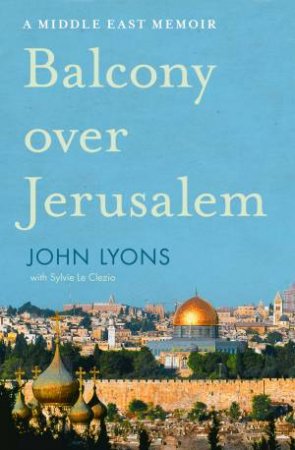
‘Balcony Over Jerusalem’ by John Lyons

2017, 376 p

This book, co-written with his wife Sylvie Le Clezio in 2017 was another amongst the selection of books handed to Australian MPs by a number of prominent local writers. It is a memoir of the six years that Lyons spent based in Jerusalem as Middle East correspondent for the Australian, not a newspaper that I read often. He has worked for most of the media groups in Australia: Murdoch with the Australian, the Sydney Morning Herald and now for the ABC as their Global Affairs Editor. I must say that I will now watch his reports from the Middle East in the wake of October 7 with added interest because, not only does this book deal with the swirling constellation of Middle East politics between 2009 and 2015, but also it highlights the heavy influence of the Israel lobby in Australia in shaping the news for an Australian and Jewish/Australian audience to reflect an even harder line here than in Israel.

The book is named for the large balcony in their apartment that overlooked a vista which encapsulated Palestinian/Israel history: Old City of Jerusalem, modern Jerusalem, the headquarters of the United Nations, and the concrete wall that separates Israel from the occupied West Bank. In front of their balcony was the ‘peace park’, where six days of the week Israelis would place their picnic baskets on the upper parts of the park, and the Palestinians would picnic on the lower parts. Except for Friday evenings, when on the sound of a siren announcing Shabbat, Israelis would leave the park and walk home for their Shabbat dinners. On cue, the Palestinians would appear carrying plates of kebabs and tabouli and move to the higher parts until, on Saturday evening, the Israelis returned, taking up their place on the top of the hill, and the Palestinians would move back down again.

In his opening chapter he declares that

As for my own perspective, I approach reporting of Israel from a ‘pro-journalist’ stance. I’m neither ‘pro-Palestinian’ nor ‘pro-Israel’. My home is in Australia, on the other side of the world. To use an old Australian saying, I don’t have a dog in this fight. (p. 12)

This is not, however, the conclusion that he comes to by the end of the book, which has documented the pervasiveness of Israel control, particularly in the West Bank, and trenchantly criticized the role of Benjamin Netanyahu in particular for making a two-state solution impossible. In spite of Israeli finessing to obscure the fact by withholding and withdrawing Palestinian residency status in the West Bank, the demographic tipping-point between Israelis and Palestinians has been reached: during Lyons’ stay the number of Palestinians in Israel, the West Bank and Gaza equalled (or, depending on your sources, passed) the number of Jews in Israel and the West Bank. As he sees it, in coming years, there will be tragic consequences of this policy.

This tragedy now seems inevitable. Almost 3 million people in the West Bank cannot be denied all civil rights for more than 50 years without dire consequences and almost two million people in Gaza cannot be locked forever in the world’s largest open-air prison. One day many of those five million people will rise up. (p. 357)

As Middle East correspondent generally, his brief extended to countries beyond Israel. He was there to witness the Arab Spring uprisings and subsequent crackdowns in various countries and the political permutations in Iran, Egypt, Libya, Lebanon and Syria. His conclusion was that the Arab Spring failed because the step between dictatorship and democracy was too large, especially without the in-between establishment of independent institutions like police forces and civil services (p.355).

However, his major emphasis is on Israel, and the politics that have shaped the United States response, which flies in the face of world opinion which is gradually hardening against Israel (and, I would suggest, has hardened even further in the last year). He writes honestly and persuasively about the power of the Israeli-lobby group, particularly the AIJAC (Australia/Israel & Jewish Affairs Council) headed by Colin Rubenstein, in pressuring the Australian media and targetting particular journalists (including him) in their reporting. He writes about its influence on politicians, especially through the generous ‘study’ tours that are provided to MPs – several of whom have attended on multiple trips hosted by Melbourne property developer Albert Dadon- which give a one-sided view of the Israeli/Palestinian situation. He particularly focuses on Labor politicians- Rudd, Carr, Gillard- because of the mismatch between party policy, the views of party members, and Government policy- and the way that Israeli policy became caught up in the leadership ructions during the first decade of the 21st century. He highlights the importance of language used in reporting- for example, whether East Jerusalem is described as ‘occupied’ or not and whether ‘occupied’ has a capital ‘O’ or lower case ‘o’; or whether SBS should use the word ‘disputed’ territories.

As might be expected, this book was criticized by politicians and commentators who take a different line to him. But, as he says

…those who’d read my reports over these six years could have been confident that they were reading facts, not propaganda….That, in the end, is what journalists should do: report what’s in front of them. Then it’s over to the politicians and the public to decide what they do with that information. But without facts, they cannot know what they are dealing with (p.356)

Having read this book, and knowing his own personal and professional opinion, casts a different light on his dispassionate, fact-based reporting for the ABC, reporting that saw him named Journalist of the Year at the 2024 Kennedy Awards. On the one hand, it fills me with admiration that he’s even able to report so calmly and authoritatively. On the other hand, though, I’m now aware of the editorial pressure and careful vetting that would have gone into his reports- and no doubt, for this book. It stands the test of eight years well, especially the last 18 months, and is a sobering analysis of not just the ‘facts’ of Israeli/Palestinian conflict day after day, but the political and public relations filter that screens and shapes what we receive as readers and viewers- and our responsibility to question it.

My rating: 8/10

Sourced from: Yarra Plenty Regional Library

Read because: it was one of the 5 books given to MPs, but I have had it on reserve at the library for months previously.