My non-trip in the days of coronavirus #17: Lake Titicaca

Puno doesn’t look the most prepossessing town in Peru.  Like all other Peruvian cities, it has a Plaza de Armas, and taken from this drone footage, it has more high-rises than I would have imagined. I wonder how they would stand up in an earthquake- do they have earthquakes there? Oh yes, they do-  they had a magnitude 7 on 1 March 2019.

But the real appeal of Puno is that it is the gateway to Lake Titicaca. You can do a tour which includes a night on Taquile island in a homestay. I must say, viewing all these videos from the comfort of my desk, that there is a much stronger emphasis on the tourist economy here than other places that I’ve been to. I know that people’s livelihoods depend on the sales they make, but it seems to have such a distorting effect on the economy.

So how would I feel about a homestay? Here’s an interesting article about the experience.  I think I’d probably do it- I don’t envisage that I’d be coming back here.  Do they speak Spanish, I wonder? Or Quechua?

My non-trip in the days of coronavirus #16: Cusco-Puno

Would I really subject a 15 month old baby to a 10 hour rail journey? Probably not. But as I’m not really doing this, let’s enjoy the train trip from Cusco to Puno

or if you want a 3 minute video instead (although it is travelling in the reverse direction)


My non-trip in the days of coronavirus #15: Machu Picchu

The reality is that if we had gone to Peru in April 2020, we would have had to miss this whole Machu Picchu leg because we were advised that we shouldn’t take 15 month-old Nina to such a high altitude area.  But given that we didn’t go…… let’s go now.

You could hike for four days…or you could catch the train. I’d catch the train. There’s a few options, but I think I’d go on the Vistadome with the windows in the roof.

Why are all these people called ‘Cody’ and ‘Rory’? Here’s Cody, rudely interrupted by advertising exploring Machu Picchu. What I liked was how he showed the train trip up, waiting for the bus, then puffing and panting to be one of the first people on the peak (my eyes are rolling). Anyway, he got some good shots.

And a slightly more formal National Geographic video. I just can’t imagine what Hiram Bingham would have thought when he saw it for the first time.

Movie: The Invisible Man

Another pre-coronavirus movie. Sigh. Why did I ever take sitting in a movie theatre for granted?

This was really scary!  A spooky story interwoven with domestic violence and surveillance.  Although I must say that I would really like to see a film where Elizabeth Moss isn’t the victim: where she’s the baddie instead.

4.5 out of 5.

My non-trip in the days of coronavirus #14: Q’enco and Maras

I’m still working up to Machu Picchu- leaving it to last.

Quite close to Cusco are the ruins at Q’enco.  It is one of the largest huacas (holy places) in the Cusco region, and like other huacas, it was built amongst naturally occurring rock structures. It is believed that sacrifices and mummification took place there.  ‘Q’enco’ or Q’inqu  is a Quechua word meaning ‘maze’, but it was the Spanish conquistadors who named it that: it is not known what the Inca actually called it. The name refers to the zigzag channels carved into rock where it is thought that the priests poured the sacred chicha, which they drank during the sacrifices.

Close to these ruins are eucalypt forests- yes, eucalypts! Apparently there are very few native trees left in Peru. Eucalypts were brought from Australia especially during the agrarian reform programs of the 1960s and 1970s. They were first promoted as a source for mine supports,  and then as a source for fuel and building materials. They have since discovered that eucalypts dry out the soil and are highly flammable (we could have told them that), and there are now reafforestation projects to replace the eucalypts with Queuña and Chachacomo trees, native to the area.

Well, this is all rather close to Cusco, so let’s venture a little further afield to the Maras Salt Mines, about 40 kms out of Cusco. There are over 5,000 salt ponds, some unused and some owned by families. There is a subterranean spring  which is directed into an intricate system of tiny channels that run down onto the ancient terraced ponds, none of which is more than 30 cm deep. As the sun evaporates the water, the salt precipitates on the walls and floor of the ponds.

The ponds are owned communally, and new families tend to get the outlying, disused ones at first. The size of the pond assigned depends on the size of the family. Last year tourists were banned from walking around the ponds because of people throwing contaminants into them, and now they are restricted to an observation deck.

My non-trip in the days of coronavirus #13: Sacred Valley

The main tourist destination from Cusco is Machu Picchu but I’m going to spend a day or so exploring the Sacred Valley instead.  I would probably go on a one day tour, I guess.

First stop, after about an hour’s travelling is the Mirador de Taray.

From there, we would go to Pisac, which is famous for its markets. For the vegetarian in the family, there is a Potato Park.  Why not? Big banana, big pineapple…although I think this is just a Potato Park. It covers 10,000 hectares, and they have 600 varieties of potatoes, many of which are endemic to the area. It’s a local conservation project, formed by Six Quechua communities joining forces. You can have lunch and guess what’s on the menu? However, I think I’d pay them to stop playing music at us. I confess to only lasting about 2 minutes through this video. It’s like listening to a Grade 3 student learning the recorder.

There are ruins above Pisac, and this young fellow is climbing up to them. He thought that he would avoid the taxi fare.  I would take the taxi, myself.

Yep, that would be me, one of the tourists hopping on and off a bus at the main site.  My, he looks quite peaky by the end.

Then on to Urubamba- and here’s our Aussie narrator again!

Had enough ruins yet?  On we go to Ollantaytambo, which is at a slightly lower altitude. During the Inca empire, it was the royal estate of Emperor Pachacuti, the 9th ruler of the Inca state, who conquered the region and built the town and ceremonial centre. He created the Inti Raymi celebration that we ‘saw’ yesterday. At the time of the Spanish conquest, Ollantaytambo served as a stronghold for the Inca resistance. In 1536 their leader Manco Inka defeated a Spanish expedition, blocking their advance from the high terraces. But knowing that his position was untenable, he withdrew .  There lots of water being piped around the city – generally a sign of wealth and display.

This one is a bit longer, and beautifully photographed.

Back home, I think, going past Chinchero where there are plans to build an international airport to attract visitors direct to Machu Picchu without having to go to Lima first. They are expecting six million people a year to use it by 2023, and there is opposition from historians, anthropologists and scientists who argue that the plateaus and valleys are lined with ritual lines, that the soil is not suitable for an airport, and that it would affect the water supply for Cusco. But contracts have been signed with South Korea, and it seems that it will proceed….well, it would have if not for coronavirus.  There’s a market here  in Chinchero, too. Given that I’m not a great souvenir shopper, I’d probably give this a miss.

Enough ruins for today?  I think so.

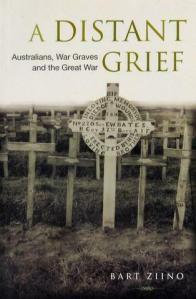
‘A Distant Grief’ by Bart Ziino

ziino_distant

2007, 191p & notes

In the time of coronavirus, we have seen funeral services stripped back to just ten people. It’s a cruel thing. Just those few people, sitting far from each other, unable to hug or comfort- those most human of responses to pain and grief.

A cruelty of a different sort was exerted on the families and loved ones of soldiers who died over in Europe during WWI (and the following war).  After some hesitation in the early months of the war, it was decided that none of the soldiers who died in British Empire troops would be repatriated to their home countries: not English, not Canadian, not South African and not Australian soldiers.  Apart from the practical difficulties of locating and shifting the remains (if any) of individual soldiers, this was seen as an expression of equality and solidarity amongst the countries of the Empire, with no soldiers seen as any more important than the others.  It was a big call. There was serious dissent against the policy in Britain by the 1920s.  I would imagine that for British families, it would have seemed to be merely bureaucratic inflexibility that prevented bodies being transported a relatively short distance. Canada was unhappy with the policy, especially when America managed to ship back 70% of their dead. (p.83)  But Australian families had few expectations that the bodies of their soldiers would be sent home. It hadn’t happened during the Boer War, and a recognition of the logistics involved meant that there was little public agitation for it to occur in WWI either.

Instead, the role of interring and marking the graves of Australian soldiers fell to the Imperial War Graves Commission. With the exception of the soldiers who fell at Gallipoli,  it was decided that each soldier should have an identical headstone marker, 81cm high, 38 cm wide and 8 cm thick. They were generally of white Portland stone and engraved with name, rank, unit, date of death and age. A religious emblem could be included if desired, and next of kin were permitted a personal inscription at their own cost. Where the identity was unknown, the headstone reads ‘A Soldier of the Great War. Known to God’. (p.3)

The Imperial War Graves Commission asked for 10 years to finalize the burial of WWI soldiers, and this book, which draws on the archives of the Commonwealth War Graves Commission, tells the story of the Commission, and the way that Australian reactions to death were defined by distance. Certainly, these deaths were of individuals – loved, mourned individuals- but without individual bodies, mourners had to take on more communal responses to their loss.

Chapter 1 ‘Imagined Graves’ examines the imaginative way that bereaved loved ones tried to understand soldiers’ deaths and make some connection between their lives on this side of the globe and the grave on the other. As Ziino writes:

Imagination, of course, could not function in a vacuum. From the first news of death, grieving Australians sought knowledge of what exactly had become of loved ones. They needed that knowledge to give substance to the mental images they were already developing. Relatives wanted to know that the last moments of life had been painless or that the dead had received the particular blessings of their faith. Ultimately, they wanted confirmation that the body had been buried and identifiably marked- an essential part of their imagining. Mourners wished that they had been there to palliate soldiers’ dying, to make the break between life and death personally- this was an important part of coming to terms with death. At home these people were removed from all but the fact of death, and detail was required to give structure to that event. (p. 15)

In the absence of a grave, ceremonies of farewell and release were carried out through the ‘In Memoriam’ columns of newspapers – sometimes for decades afterwards. Other families treasured photographs and relics of the dead that made their way home, while soldiers still serving at the front often served as a conduit between the front and the family by writing to and visiting bereaved families after the war.

Chapter 2 ‘The Sacred Obligation’  shows the way that Australian families, realizing that it was unlikely that they would visit the European cemeteries, turned to others to care for the war graves. The state stepped into this space. Public memorial services were held in Australia, while over on the front administrative responsibility was initially vested in the Directorate  of Graves Registration and Enquiries, and turned over to the Imperial War Graves Commission which came into being on 21 May 1917.

Chapter 3 looks at ‘Gallipoli and Australian Anxiety’. As the first large scale ‘Australian’ battle of WWI, there was particular concern that the bodies of fallen soldiers lay for three years in ‘alien’, non-Christian soil where there were no brother soldiers or officials to act for relatives. While the war was still underway, there were attempts by the British government to gain access to the cemeteries on the peninsula that the Turks had created. Not surprisingly, the attempt was rebuffed, but an Australian presence was quickly established at Gallipoli after the Armistice.  There was not, as they had feared, widescale desecration of the graves, although wooden crosses had been removed by Turkish soldiers for firewood. Almost immediately there were attempts to make a claim on the cemeteries, a difficult legal point of  sovereignty. It was decided that the cemeteries on Gallipoli would not have cruciform shapes visible from beyond their walls, and that the headstones would take the form of a low sloped stone, rather than upright headstones as in other Commonwealth War Cemeteries. Australians had to accept that Australian graves would rest on Turkish soil, which gives some context for the words purported to have been said by Mustafa Kamal (Ataturk) – an issue of recent controversy.

Chapter 4 ‘Agents for the Bereaved’ turns its attention to the Western Front and the way that families wanted an ‘Australian’ presence and identity on the former battlefields. The Australian Graves Service was established, with its headquarters at Australia House in London. It oversaw (rather than conducted) exhumations and concentrated on identifying Australian remains and maintaining records for the bereaved at home. They provided photographs of the grave for the families at home, and were seen as an ‘Australian’ presence even though there were serious questions asked about their behaviour. When it was disbanded in 1921, with its work subsumed into the Imperial War Graves Commission, there was dissatisfaction back in Australia not only amongst families, but also the RSSILA (forerunner to the RSL) and different public bodies.

Chapter 5 focuses on the Imperial War Graves Commission itself, and the way that its role changed over time. At first, it held itself aloof both physically and emotionally, from the bereaved of the Empire. It was essentially a political body, and as time passed the  Commonwealth War Grave cemetery, with its row upon row of identical headstones, came to have a different meaning for generations who had not known or loved the individual who was buried there.

In Chapters 6 and 7 focus returns to Australia, and the ways that Australians expressed their grief. Chapter 6 looks at the memorials erected, the photographs cherished and the nature of the 66-letter inscriptions that families were allowed to place on the gravestones. As returned soldiers began dying in Australia, the question of ‘official’ headstones in local cemeteries arose.  Lost sons began to be commemorated on their parents’ gravestones and horticulture began to be linked with commemorative spaces. The 1991 repatriation of an unknown Australian soldier in 1991 reminds us that grief carried across generations, although now it was imbued with other political and nationalistic themes.  Chapter 7 ‘Pilgrimage’ looks at the personal journeys that some families were able to make to the grave of their loved one. Most Australians at first accepted that would never make the trip to see it, and especially immediately after the war, the Government actively discouraged trips to the politically unstable Gallipoli. Those who travelled often had a keen awareness that they were doing something unavailable to most Australians, and many felt a personal obligation to share their experiences with other families through photographs and letters. A formal pilgrimage was organized in June 1929. And as we all know, a pilgrimage to ANZAC Cove has become a rite of passage for young Australian travellers- one that I find rather problematic, especially with recent Australian governments’ obsessions with creating memorials on other people’s land.

This book is an academic monograph, but a very human one.  The argument of the book is the juxtaposition between administrative efficiency and personal grief, and this is reflected in Ziino’s use of his sources. As well as the bureaucratic archives of the Commonwealth War Graves Commission and other bodies, Ziino draws on personal letters and communications in family archives, and the human stories found in newspaper articles.

As he points out in the conclusion, if physical distance marked the Australian experience of battlefield death, it is now a chronological distance that shapes our response.

Australians are no longer so distant from the graves of their dead. Modern transport has telescoped distance and made travel to the battlefields possible for thousands of Australians who now undertake such pilgrimages. Yet distance remains important to Australians’ relationships to the Great War. While it has contracted physically, distance has lengthened chronologically. Today’s generation is reconceptualising the legacy of that war…These modern pilgrims are expressing grief, but the nature and meaning of that grief is not the same as for those who endured it first hand. Time and further conflicts have intervened in their memory of war. (p. 190-1)

Source: My own copy

I hear with my little ear: Podcasts 9-16 April 2020

Heather Cox Richardson. Really people – this is must listen stuff. She does two video casts a week: on Tuesday about current affairs, and on Thursday about American history. In the episode on Tuesday 7th (I think) which is about current events,  she discusses the Wisconsin debacle and previous attempts to disfranchise (which is a word, apparently) voters then she moves on to gerrymandering… and even little ol’ Australia gets a mention. She picks up on that strange comment by Jared Kushner that the masks and PPE belonged to ‘us’ (i.e. the federal government). Who is ‘us’? Very discursive and wide-ranging, but she really brings a historian’s eye to current events. Her Thursday 9 April history podcast looks at the west coast, and the way that there was a strong push by the oligarchs of the slave states to replicate a slave-based economy in the West as well. There’s a bit of myth busting here about the Alamo (I never did get Davy Crockett and all that stuff, fodder of black-and-white afternoon movie fare).  You can access her videos through her Facebook site https://www.facebook.com/heathercoxrichardson/

The Documentary (BBC) I’m always quite interested to learn what other people think of Melbourne.  In ‘Melbourne: The Sounds of the City‘, Peter White, blind since birth, negotiates Melbourne’s tourist highlights – MCG, St Kilda etc.

The Eleventh (ABC). In Episode 5, Deadlock,  Elizabeth Reid, Whitlam’s advisor on women, tries to convey a warning from artist Clifton Pugh, that Governor General John Kerr was on the move. The Khemlani loans affair just goes on and on, and Malcolm Fraser starts playing hardball.

Revolutions Podcast  Back with Mike Duncan for the Russian Revolution up to 1905. (He’s taking a six month break, then returning in October to take the Revolution up to the early 1920s).  In Episode 10.28 The Spark  Lenin and his wife Nadia Krupskaya returned from a relatively easy exile in Siberia. Lenin moved first to Germany, then after Nadia’s release, they moved to London where they established the marxist newspaper Iskra (The Spark). In Episode 10.29 Bolsheviks and Mensheviks, the second conference of the Russian Social and Democratic Labour Party was held in 1903, also in London after being disrupted by police attention in Brussels. Duncan here argues that the famous split between Bolshevik/Menshevik was a question of whether the party was to remain a fist, or more of an open hand encouraging a wider membership. He also suggests that it was a highly personalized split. Lots of lessons for any organization, actually.

Strong Songs  Oooh! A new discovery (courtesy of Looks 10 Chats 3 which I drowsed through while enduring a migraine)!  This is a fantastic series where Kirk Hamilton takes a song and pulls it apart, showing why it works. I started from the beginning, with Episode 1 Toto’s “Africa”, created when he didn’t even know if there would be an episode 2. He obviously decided that there would be because there is an Episode 2 You Can Call Me Al, looking at the Paul Simon song from the Gracelands album. You’ll hear the song with different ears afterwards.  Really, really good.

My non-trip in the days of coronavirus #12: Cusco

Well, we did really have plans to go to Cusco and Machu Picchu but even before the coronavirus put the kybosh on the whole trip, we hit a roadblock with Cusco. At an altitude of 3399 metres (higher, in fact than Machu Picchu) we were told by The Travel Doctor that we shouldn’t take a 15 month old baby there.  (I’m sure that amongst its population of 428,450 according to Wikipedia, there must be a baby or two – but who is to argue with The Travel Doctor?)  So, in real life we would have had to rethink this part of the trip – but sitting here on my computer chair, I can do whatever I like! So…off to Cusco!

Another city, another Plaza de Armas. This plaza looks huge, but fairly low rise. It has two prominent buildings, the Cusco Cathedral and the Church La Compania de Jesus. It looks gigantic now, but it was in fact just part of the Haukaypata,  the Great Inca Square, that predated the arrival of the Spanish.

It is the site for important festivals, including Inti Rayma- the Inca Festival of the Sun, and the religious festival of Corpus Christi. The ceremony of Inti Rayma has three different scenes conducted in three different places. The first scene of the festival, is held at the Qoricancha Palace situated on Av. El Sol. (see below). It then moves to the  Plaza de Armas and finally ends up at  Sacsayhuaman 3 kms out of Cusco. It is held on June 24th, the winter solstice and the Inca New Year.

The original Inti Rayma celebration was first held in 1412. It went for 9 days, with dances, processions and animal sacrifices. The last one held in the presence of the Inca emperor took place in 1535. I’m sure that it comes as no surprise that the Spanish outlawed it and other Inca religious practices. In many places the celebration was interwoven into the Catholic festival of St John the Baptist (no doubt to appease the Spanish Catholics) which occurred at much the same time. In Cusco, the Inti Raymi was reintroduced in 1944 as a historical reconstruction, and has been conducted every year since then as a theatrical production.

Theatrical production notwithstanding- this would be amazing to see. (I guess it won’t go ahead this year, though)

Very close to the Plaza de Armas is Corichancha, variously spelt Koricancha, Qoricancha or Qorikancha. It is now the Convent of Santa Domingo,  but it was built on the base of the Inca temple which was uncovered in 1953 when an earthquake destroyed the church but left the Inca walls intact.  Corichancha was the centre of the Inca cosmos, from which 42 straight lines spread out on all directions, sometimes for hundreds of miles.  It contained several temples within the complex, with the walls covered in gold plate.  As you can imagine, the Spanish were quick to ship that gold back to Europe and, as was their wont, they quickly demolished the Inca temple and built a church on the site instead.

Now here’s a different take on Coricancha, presented by a tour group interested in megaliths, who are exploring the sonic and energy fields of the old Inca Temple. Apparently if you stick your head in the alcoves on the walls and sing ‘A’ it sets up a reverberation. Likewise, you can take your dowsing stick and detect a petal shape of energy in the centre of a courtyard. Hmmm.

My non-trip in the days of coronavirus #11: Colca Canyon

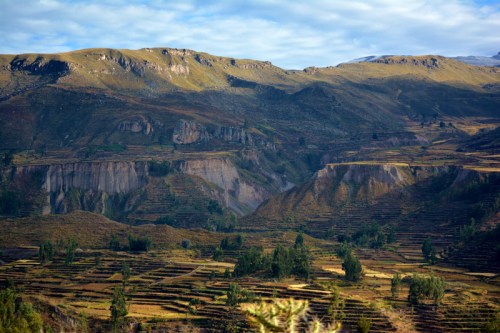
This is all just fantasy, right? Because I don’t know if I really would get up at 3.00 a.m. to sit in a minibus for many hours to visit Colca Canyon. It is located 160 kilometres out of Arequipa on very small roads, and the altitude is high (4910 m. above sea level). I suspect that both the bus ride and the altitude would see me doing this trip by myself, as it wouldn’t be suitable for a 15 month old baby.  You can do it as a two day hike, but there’s no way that I’d be climbing out of this canyon.

But the canyon itself is one of the deepest in the world at a depth of  3,270 metres (10,730 ft) and it looks spectacular.  Touristy, yes but- hey, I might see a condor! I’ll stand there with a bloody great eagle on my head!

Not too sure about that tunnel in an area full of earthquakes and volcanoes, though.

I know that many travellers suggest taking a 2-3 day hike, instead of trying to squash it all into one day. That way you walk from the bottom of the canyon to the top. But this fantasy, remember, and this fantasy doesn’t stretch that far!