Category Archives: Uncategorized

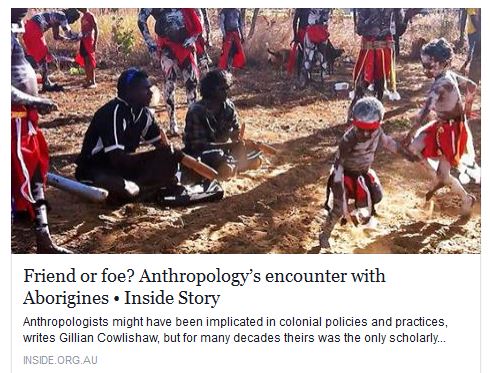
‘Friend or foe? Anthropology’s Encounter with Aborigines’ Gillian Cowlishaw

Cowlishaw

There’s a very interesting recent article on the Inside Story website.

http://insidestory.org.au/friend-or-foe-anthropologys-encounter-with-aborigines

The article reprises many of the arguments and critiques that Cowlishaw has been making for the past thirty years (as this recent article about her shows) but its publication in Inside Story makes it accessible, not just in its language, but beyond the paywall that so many academic journals erect.  In it she argues that recent, postcolonial

wholesale condemnation of the anthropological endeavour has become shallow and moralistic, and an excuse for continued misperception of that complex, contradictory and contentious phenomenon known as “traditional Aboriginal culture.” There is a postcolonial fantasy that wants to achieve redemptive virtue by condemning the past rather than understanding the complex political and social legacy that colonialism created and bestowed on us all.

While acknowledging that foundational Australian ethnographic texts used language that we now find offensive, she argues that ethnography- albeit implicated in colonial policies and practices –  employed anti-racist, anti-colonial and even anti-state frameworks at the time.   Her article is a reflection on the intersection of anthropology and politics, both black and white (she notes particularly the rise of ‘native title anthropology’) and her own development as anthropologist.

It fits in well with the recent Message from Mungo documentary that was shown on NITV this week.  [I must confess that this was the first time that I’ve watched NITV.  It’s a pity that the Recognize campaign advertisements that ran during this program aren’t shown on ABC/SBS (or at least, I haven’t seen them) and commercial stations].  It was easy to mock the accents and demeanour of English archaeologists shown, but the documentary revealed well the range and contradictions between different specialities and world views.

And  Message from Mungo was echoed by last night’s documentary on the reburial service of Richard III’s remains at Leicester Cathedral  in March 2015. The formality of the ceremony was sanctioned at the highest level of state with the Countess of Wessex in attendance and all the pomp and historical clout of the Anglican Church behind it.  It struck me, listening to the choir which included girls and singers whose  lineage was drawn from an empire undreamt of in Richard’s time, that it was a service that would have been completely foreign to Richard himself.  The desire to ‘show respect’ through ceremony sprang from the same urge voiced by those in the Mungo documentary.

‘Message from Mungo’ screening 18 August NITV

The documentary ‘Message from Mungo’ which was also shown at the Australian Historical Association conference this year, is screening on NITV on Tuesday 18th August 2015 at 8.00 p.m.  Filmed over eight years, the documentary explores the 42,000 year old remains of Lake Mungo woman, revealed by the shifting dunes around Lake Mungo in 1968.  The indigenous people of the area see the repatriation of her bones as a way of  returning to her tribal lands, while  historians and archaeologists see her as an artefact that reveals information about mankind. This Guardian article gives more information.

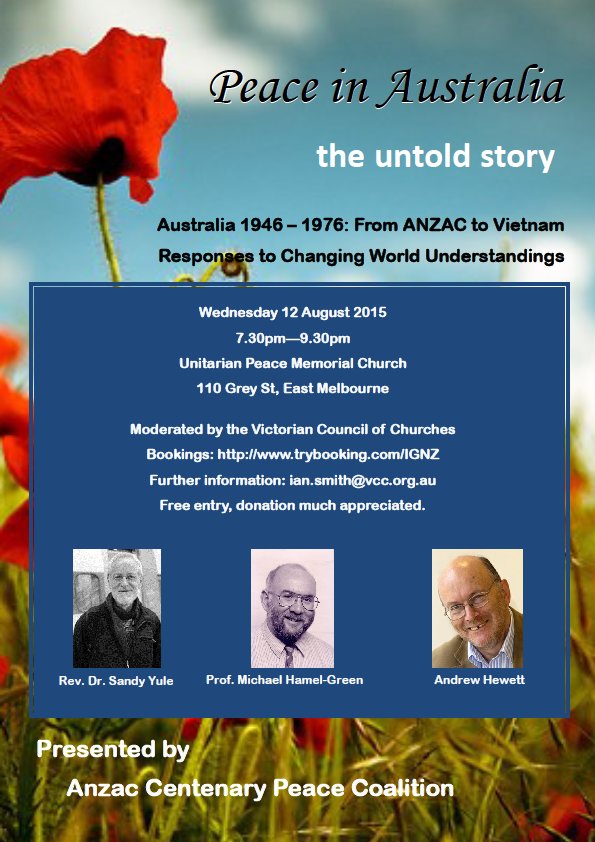
ANZAC Centenary Peace Coalition Forum #3: Australia 1946-1976 From ANZAC to Vietnam

peacecoalitionaugust

I’ll be going to this on Wednesday 12 August at the Melbourne Peace Memorial Unitarian Church.

Cooking up a storm for Cooking for Copyright

Here’s my little contribution to Cooking for Copyright Day.

borrowdalebiscuits

They’re Ruby Borrowdale’s Rolled Oat Biscuits and the recipe made mountains of the things.  As you’ll see, Ms Borrowdale has given us a very…um….stripped-back recipe consisting merely of ingredients with nairy a mention of method or cooking instructions. (was there another page I wonder?) I melted the generous quantity of butter and added it to the other ingredients and cooked at 180C for about 12 minutes.

So who was Ruby Borrowdale and why I am posting a picture of her biscuits? (not cookies, note!)  Ruby Borrowdale was Queensland’s best known cookery expert.  From 1932 she was the Chief Instructress, and later the superintendent of the test kitchen at Simpson Brothers, well-known Queensland manufacturers of flour and baking powder. Simpson Brothers published an annual cooking book featuring their baking products.  The John Oxley library have produced a video on Ruby and their collection of the Borrowdale papers.

She also wrote a weekly cooking column under the name of Patricia Dale for the Brisbane Telegraph and wrote columns for other regional  newspapers. If you do a Google search, you’ll find much reference to her book The Golden Circle Tropical Recipe Book which I can only imagine would be the source of much merriment today for its imaginative use of pineapple rings and beetroot  (as you can see in this blog here).  She also featured on the radio and was the first Queensland cook to appear on television.

But why my sudden interest in Ruby Borrowdale and Queensland cuisine? Ruby Borrowdale’s recipes are featured as part of the FAIR (Freedom of Access to Information and Resources) campaign today regarding the status of unpublished manuscripts in Australian libraries, museums and historical societies. Unlike in other countries, in Australia,  copyright on unpublished sources lasts forever.  As a point of comparison, in Canada and New Zealand it is the life of the author plus 50 years and in the EU generally it’s the life of the author plus 70 years.  In the UK, works unpublished by 1989 whose authors died before 1969 will be in copyright until 2039, and otherwise it is life plus 70 years.  In US it is also life plus 70 years, or 120 years where the author is unknown.

FAIR are campaigning for all published and unpublished works in Australia to have the same copyright term, in line with international norms.  As part of their campaign today, they have broken copyright by posting recipes on their website and ask people to bake them and photograph their efforts  — hence the rolled oat biscuits above.  Of course, ironies abound:  the YouTube video above was produced by the John Oxley library which holds the Borrowdale collection and uses images of published works but none of their manuscript collection. And, strictly speaking, given that Ruby Borrowdale died in 1997, her works would still be in copyright anyway (although she may have granted it to the library perhaps?).

Ah, but it’s all a new world, isn’t it, and this provision is ridiculous and out of line with international practice.  So, please,  have a biscuit or two for Cooking for Copyright Day.

AHA Conference 10 July

Plenary panel: Historicizing International Law

I must confess to feeling completely out of my depth in trying to write about this session.  Not only was it an intellectually complex area, but my background knowledge of the area is wafer thin.  Any observations I make will be inadequate, so if you’re interested in a fuller representation of what was said, I suggest that you look at the abstracts in the Conference Program.

If the plenary yesterday was about the relevance of history to contemporary life, then this one, at the most basic level, was about the relevance of history to international law. Ian Hunter opened the session by describing two ways of historicizing international law.  The first is the dialectical approach which draws on Kant and Hegel, and sees international law only beginning in the second half of the 19th century and passing through stages towards a telos of possible harmony amongst the international community. The second, more contextual approach (e.g. Lauren Benton, Mark Hickford) postulates that international law has emerged through treaty making, and that the 17th and 18th century writings of Puffendorf, Vattel etc which were so heavily drawn upon in debates over sovereignty and conquest, were  themselves post-facto rationalizations arising from universities attached to sovereign interests.  The two views, Hunter claims, are irreconcilable.

Anne Orford also drew on this distinction, noting that from the 1990s onwards there has been the emergence  of scholarly writing intent on disrupting the celebratory nature of international law. Third World Approaches to International Law argue that imperialism is ingrained in international law; while disciplinary histories of international law see international law as a profession and a human construct. A maximal contextual approach to international law would argue that we must not look at how the law has been modified over time, whereas international justice relies exactly on that argument: that concepts change over time.

Jessica Whyte used the recent revision of the United States Department of Defence Law Manual as an example.  In an update of the 1956 manual, the new version argues, citing in particular Augustine and Aquinas, that there is a ‘just war’ tradition that this new revision is based upon. This is a marked change from the United States’ disavowal of ‘just war’  as a medieval construct when it was during the 1970s in the context of wars of national liberation (like Vietnam).

The questions that followed ranged across a number of current events: the invocation of the Treaty of Waitangi in the context of the Trans-Pacific Partnership negotiations, and the approaches taken by Indian and Irish commissions into famine in the face of food security in a Free Trade world.

Panel: Indigenous Foundation Histories?

The final session I attended noted the publication over the last decade of two ‘foundational’ Indigenous texts: The First Australians  documentary series and book for Australian Indigenous people in 2008,  and a very handsome (and large) recent volume Tangata Whenua: An Illustrated History.

Common to these texts was a depiction of identity in historical terms, and an assumption of Indigenous agency. In this panel, indigenous authors who had been involved in writing these or other ‘foundational texts’  addressed the question of whether these books were, in fact ‘foundational’ at all, their methodology, and their intended audience.

Aroha Harris, one of the authors of Tangata Whenua noted that the book was a collective enterprise, which tried to write a ‘general’ Maori history.  This endeavour, however, is in tension with the focus on iwi (community).  The book uses many images, but there were limitations on the images that could be used e.g. images of dead people lying in state.  In making decisions about the writing and portrayal of events, she used what she anticipated the response would be from  her cousins and aunties as a form of mental guidance. She demurred at the idea that Tangata Whenua might be ‘foundational’: perhaps it is more correct to say that it is overdue.

Heidi Norman is the author of What Do We Want?  an analysis of lands right protest in NSW , a specific, fine-grained story from the 1970s onwards of the enduring but changing demands for land.

norman It was prompted by events in 2004  when Howard had dismantled ATSIC and the Sydney Morning Herald maintained a steady campaign against individuals in the state Aboriginal Land Council.  There was no response to this: what had happened, she wondered, to the protest of the 1970s?  Her book is an exploration of a new governmentality amongst a new generation of educated Aboriginal people with an ever-expanding conception of land.

Michael Stevens was a contributor of Tangata Whenua and he picked up on the idea of ‘foundational’ not so much in historical terms, but as his grandfather- a builder- would understand it: that without a strong foundation, things can fall down; that any mistake you make at the bottom will follow you up. His contribution, a section titled ‘Fat meat for the winter’ was based on his PhD thesis and drew on his own iwi and family photographs of mutton-bird harvesting and the connection between land and genealogy.

Vicky Grieves responded to these three speakers pointing out that Indigenous histories needed to change the mix, to include genealogy, languages, different ideas of time, ‘everywhen’ and the complexity of identity. Such histories would be a basis for building new histories  (often written by non-Indigenous historians) through critique by Indigenous people.

And at this point, my conference came to an end. I had a plane to catch so I wasn’t able to catch the screening of  Message from Mungo, an award-winning 2014 documentary.

It’s been a thoroughly enjoyable (if cold) four days: a beautiful setting, terrific food [always important!], well organized and stimulating.

They’ve just unpacked the entries for the Archibald Prize here at the Art Gallery of New South Wales.  To which presentations would I award my conference version of the Packers Prize?  For the keynotes, Jill Matthews reflection on the writing of Good and Mad Women on 8th July, and for the papers, I think it would have to be Nick Brodie’s presentation on the pictorial boards in Van Diemen’s Land, which I heard on 9th July.  Congratulations and thanks all round!

Yet another day in Sydney

This time, walking up to the university from my hotel.

This site housed the Sydney Benevolent Society Asylum between 1821 to 1901. From 1913 it operated as the Parcels Post Office until the mid 1960s but fell into disrepair for an extended period. It was sold for conversion to a serviced apartment complex in 1997.

This is ‘home’ for four days. The site housed the Sydney Benevolent Society Asylum between 1821 to 1901. From 1913 it operated as the Parcels Post Office until the mid 1960s but fell into disrepair for an extended period. It was sold for conversion to a serviced apartment complex in 1997.

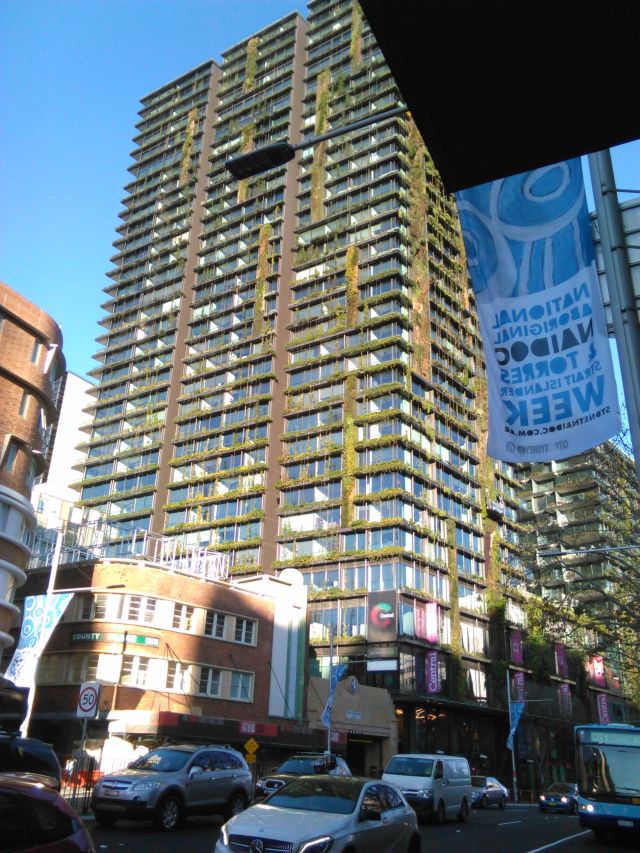
Hey- look at this building! It’s covered in greenery although by night it has a rather tacky illuminated panel suspended from the building. But if they decide that they simply have to build a high-rise on the top of Heidelberg Hill in Melbourne, perhaps they could aspire to something as striking as this.

From a distance, there is a green fuzz on the side of the building

From a distance, there is a green fuzz on the side of the building

Closer up you can see the plants growing on the walls.

Closer up you can see the plants growing on the walls.

At night there is an illuminated panel that bridges the two towers. Love the building, but not too sure about the fairy lights.

At night there is an illuminated panel that bridges the two towers. Love the building, but not too sure about the fairy lights.

It looks better from inside the building.  You can look up through a glass atrium.

I took this from inside the building, looking up through the glass atrium

I took this from inside the building, looking up through the glass atrium

I wonder what this building used to be? It looks like a power station perhaps? No- I asked a Man in a Hard Hat, who I figure would know.  He said it was a brewery. But it seems that it, too, will be turned into apartments.

IMG_20150708_083911a

The university fronts onto Victoria Park, which has an outdoor swimming pool. None of that mamby-pamby indoor pool stuff for these swimmers!

IMG_20150707_083752a

AHA Conference 9 July

Plenary Panel: Big Questions in History- History for Life

In introducing this plenary session, Penny Russell enumerated a slew of Big Questions in History, but they boiled down to “what is the relevance of history to contemporary society?” Six historians responded, ostensibly in ten minutes each, so of course they only had time to approach the question from one perspective alone.

mandlerPeter Mandler, who as an overseas visitor has limited experience with Australia, took a historical approach to history in the United Kingdom (as one might expect a historian to do!) The 18th century gentlemanly use of history and classics for diplomatic purposes gave way in the 19th century to the use of history for nation building, the invention of tradition and commemoration: functions it still fulfils today. The 20th century saw the rise of subaltern histories and an emphasis on place, family and the individual.  He noted the popularity of military history in Australia aimed at a middle-aged male market, whereas in the United Kingdom there is the enduring popularity of Tudor history and histories of everyday life in different historical eras.

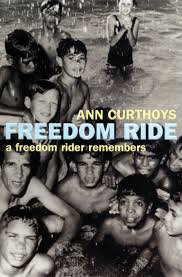
curthoysAnn Curthoys spoke on historians and public memory, using her own experience as the author of a book on the Freedom Ride of the 1960s, which she attended as a non-Indigenous participant.  After being almost forgotten in the 1980s, this event has been more recently memorialized in books, film, radio and re-enactments.  She has found her book, and even more importantly, her diary as a 19 year old student, used almost as a ‘guide book’ for Freedom Ride commemoration- becoming by default a keeper of public memory.

mckenna_clarkMark McKenna looked to Manning Clark, the subject of a biography he has written, and questioned why he was so successful in connecting with a larger audience and popularizing Australian history. Part of it, he thinks, was his way of speaking, but there was also a strong element of self-promotion, where his telling of the story of writing his six volumes of history became part of that history.  While we don’t need another Manning Clark, especially in the diverse and unpredictable media of today,  the importance of communication is paramount, as is the “disciplined imagination” of history.

freyneCatherine Freyne of the much-loved and sadly missed ‘Hindsight’ program on Radio National reflected on her experience at this AHA, the first that she has attended as a paid-up delegate. In her previous career as presenter of ‘Hindsight’, she had trawled through the AHA program,  contacting people for future program.  She posed the question: much-loved though ‘Hindsight’ was, would it meet the criteria for relevance?  Podcasts on the RN website have given programs a long shelf life and can provide the references and further reading that an audio program cannot.  Historians don’t need to rely on radio networks: they can do it themselves (although she did play a cautionary clip on the dangers of production clichés in podcasting!). She now works with the City of Sydney, which has made a strong investment in public historians, and a marketing study they had conducted had highlighted the market segmentation of history (did I detect a collective shudder?) into skimmers, delvers and divers. She particularly noted the power of alternating anecdote and analysis that historians use in storytelling (e.g. in This American Life) and referred in particular to Maria Tumarkin’s insightful essay ‘This Narrated Life’.)

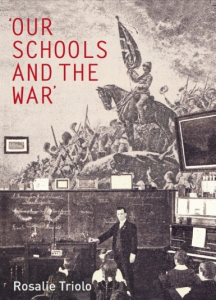
triolo-our-schools-and-warRosalie Trioli spoke from her perspective as a lecturer in history method in teacher preparation courses.  Some students come to history method as former history students themselves: others have had no experience of history in the later years of school at all.  She spoke of the importance of the teacher who sees history all around them  in conveying a love a history to their students. The reality is that few history students taught by such teachers will actually visit museums, historical societies etc, even though we might wish that they will.  But history as a subject develops transferrable vocational skills, is the basis of lifelong learning and critical literacy and can lead to informed leisure choices (e.g. not graffiti-ing the local war memorial!) Teachers need to be more pro-active in defending the place of history in curricula.

history-s-childrenAnna Clark carried on from this, based on her study of history in schools. She noted the popularity of family and personal history, rather than the periodized, political history that is deemed ‘good’.  There has been an explosion of the historical market, and yet at the same time, we bemoan ignorance.  How does nostalgia affect history?

Unfortunately there was a lot here, and too little time to unpack it!

Quakers and Missionaries

The two speakers in this session are collaborating in writing a work on the Quaker transnational settler, Thomas Mason.  It is a pity that they presented in the order that they did, because Kristyn Harman’s paper gave a fuller picture of Thomas Mason, whereas Eva Bischoff’s presentation addressed methodological questions that made more sense once you had the background information about the man. So, I’ll reverse the order in which they spoke for this summary.

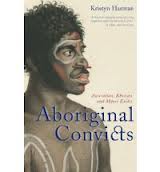
harman_aboriginalconvictsKristyn Harman came across Thomas Mason, also known as ‘Quaker’ Mason when writing her book Aboriginal Convicts, which dealt with Indigenous convicts sent from Cape Colony, New Zealand and from within the Australian colonies themselves to Van Diemen’s Land, a gazetted penal colony which could receive convicts from across the empire.  Mason had been resident in New Zealand, and when a group of Maori prisoners were transported to Van Diemen’s Land, he was called on as an ‘expert’ in dealing with them.  He himself had left New Zealand at much the same time, feeling uncomfortable about settler/Maori conflict. Ironically,  (given their own frontier history) Van Diemen’s Land settlers were outraged by this too, and the Maori prisoners were visited by a stream of curious supporters including the artist Prout who made several striking portraits of them. Mason advised that the Maori prisoners should be kept separate, be given Christian education and not restrained in any way, and kept busy.  They were sent to Maria Island Probation station (a relatively mild penal settlement). Four of the five returned (one died; his body repatriated to New Zealand in the 1990s). When the prospect of gazetting NZ as a penal settlement arose, Maori themselves objected. In 1851 Mason returned to New Zealand, bringing fruit trees and has become noted for reshaping both the physical and cultural landscape.

Eve Bischoff is also writing about Thomas Mason, but in a different way.  Marsh, as a Quaker was a literate and prolific correspondent, and she has already been working on an associated project about Quaker settler families. There are two related approaches that can inform such work: the network approach of mobile, interconnected elite families in general (Laidlaw, Lester) and the individual or family approach used by, for example, Linda Colley in Elizabeth Marsh (see my review here) or Foster’s recent Private Empire.  She notes, however, that the biographical approach rests on the European idea of the individual and identity, and that it conceptually favours coherence and continuity and thus loses non-linearities.  She then turned to the methodology of microhistory, which involves: 1. detailed analysis of actors 2. reconstruction of their social roles; 3 critical reflection of the narratives employed by actors and researcher (this is where it diverges from close reading) 4.play with scales of reference  (Levi On Microhistory 2001).  As she explained this, I wished that I had heard this paper about six months ago because they I would have had a name for what I have been doing!

And then, because the session finished early, I slipped into the next room to catch the last paper in the History on Screen session and to hear Clare Corbould speak on Roots, the book and miniseries and the correspondence it generated from readers to both Arthur Haley the author and David Wolper, the producer. Roots was published in 1976 and the miniseries was shown in 1977. It was a television phenomenon. It was screened on consecutive nights (largely from a fear that it would tank) and thereby became an intense, shared, national experience. The letters received from both white and black viewers, of varying educational levels and diverse experience in writing such letters, had been collected in David Wolper’s archive, which has since been closed.  Many letters from white Americans either emphasized the ‘understanding’ that the program had engendered amongst viewers- although for many writers this remained attitudinal rather than political. Others, however, seeing America under siege at the time (oil shock etc) pointed to the need for whites and blacks to work together and  criticized the program for raising issues that should be left untouched. Other hostile white letter writers felt that the debt had been paid because their family ancestors had fought in the Civil War. African American writers pointed out the fear of redress on the part of whites.  The program had a huge effect on interest in family history.  Armenian Americans began lobbyingd Wolper to make a similar series for their ethnic group- but he went on to make- wait for it, The Thorn Birds!

Colonial military cultures

James Dunk returned to a well-furrowed field in examining the Rum Rebellion, (now more properly called the 1808 rebellion because it involved more than just rum)  but from a very different perspective.  He did not stop at the governor under the bed, or the court martial, but instead followed the protagonists in their later life and found a prevalence of suicides, depression and anxiety. He argues that this madness (“the Botany Bay disease”)  should be seen as part of the story- and indeed, part of the strain of the colonial project itself, as well as the moment of rebellion.

Trish Downes turned to the convict soldiers and sailors who were involved in the exploratory expeditions of men like Oxley, Sturt and Mitchell.  She notes the attention to Irish and Scots convicts as a sub-group of the convict population, but even more numerous were military convicts- men who either had been, or were still, serving soldiers and sailors who had been convicted for a variety of crimes including desertion, mutiny and theft.  Although tried in military courts, transportation was not an approved sentence, so the offence needed to be reassigned so that the punishment could take place. Although transported, they brought with them their military and technical skills which were highly valued by explorers.  Some military convicts volunteered for expeditions in the hope of regaining their dignity; others became ‘career’ expeditionists, embarking on multiple expeditions often with the same leader. There was a painful  irony in choosing ex-sailors to carry a boat into the interior in the quest for the inland sea.  Despite the opportunity to do so, only one absconded.

Finally Paula Byrne (whose work I have often read) spoke of her study into the sensibilities of groups of people, rather than individuals, using letters, journals and documents to examine the language they used to describe and define themselves.  This is an aspect of her work on the family and associates of Ellis Bent.  She identified four features of this group identity amongst the military.  First, the concern for money. Soldiers enriched themselves from booty, and NSW did not offer such opportunities (although it did offer land). Officers sent to the colonies faced years without prizes.  Second, violence was an inherent part of a shared military identity. Sydney Harbour was a fortified garrison; they enjoyed hunting as a leisure activity; they used military language in describing their work.  Third, they focused on entertainments rather than ‘things’ (as settlers tended to do). Finally, they often made use of the classics in their letters, an affectation amongst military men. They were conscious of conversations (perhaps on the look-out for duelling opportunities) and their women were known for being loud.

Colonial Imaginaries

This was a rather diverse group of papers. Judith Jonker described the 1854 Sydney exhibition, one of a series of local  colonial exhibitions held in preparation for the Paris International Exhibition that was to be held in the following year.  There had been an earlier exhibition in London during 1851 but the Australian contribution had been a private venture, and the exhibition was ordered by the simplified classifications based on the old rubric of ‘animal, vegetable, mineral’ and arts and manufactures.  This Sydney exhibition used the same classifications, although the Paris International that followed adopted new, more complex classifications of exhibits.  Advertisements were placed in the Sydney newspapers, inviting collectors to make their geological collections available for display, and Jonker examined a number of these exhibitors. Rev William Branwhite Clarke was the major exhibitor, but it was also an opportunity for a small number of women exhibitors to make their collections  available as well (even though there were no female naturalists in their own right).  Many more women participated in the arts and manufactures section, which was a safe public place to display female activity. The geological displays were accompanied by a catalogue containing essays which enhanced the reputation of Australian science.

Nick Brodie gave a fascinating presentation on work he is doing in collaboration with Kristyn Harman on  Governor Davey’s Proclamation to the Aborigines- you know the one, with diagrams showing that if whites kill natives, they will be executed, and that if natives kill whites, they will suffer the same fate.  But do we know the Proclamation? He argued convincingly that we think we know more about it than we do.  There are seven ‘original’ boards, although the one that is best known was supposedly donated to the Tasmanian museum by a man working at the Supreme Court House in 1858. A copy was displayed at the Melbourne Intercolonial Exhibition of 1866, but it showed a different date and had a different reported conversation at the bottom of the poster.  An oral history at the time led to its designation as being Governor Davey’s Proclamation, but this has since been muddied by an attribution to Governor Arthur.  Then there is yet another poster that has been described but not found, depicting a far less even-handed legal approach and conveying a different message entirely.  All in all, fascinating detective work- and I’m keeping my eyes peeled for the journal article!

And the last presentation for the day was by Michael Warren. He located his question within the long-running debate over the extent to which settler colonialism constituted genocide. However, his interest is in the settlers’ fears of ‘depredation’ and how they presented themselves as victims of Indigenous violence in order to leverage official protection.   In particular he referenced an article in the Sydney Gazette that warned that there would be an attack at the next full moon, when the Jervis Bay aborigines would join forces with local groups to annihilate the white settlers. He is working within an emotional dialectic, and a ‘history of the emotions’ approach, and taking a comparative approach utilizing both New South Wales and Van Diemen’s Land.

And so, thus ends Thursday.

AHA Conference 8 July 2015

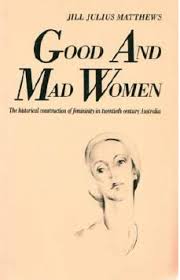
Australian Women’s History Network Keynote Address: Jill Matthews, ‘Good and Mad Women: Histories of Gender then and now’.

“Should I even be at this session?” I wondered as I filed into a steeply-raked lecture theatre to hear Jill Matthews speak on her book Good and Mad Women, written in 1984 and yet another of the books that I will read one day.  Possibly Matthews thought the same thing, as she declaimed any interest in speaking at writers’ festivals and meet-the-author functions, believing that the author’s work should speak for her.  But I’m so glad that I was there, to hear a very human and wide-ranging reflection on the political, cultural and academic influences on the writing of this very influential book thirty years ago.

Born in 1949 into the stultifying stolidity of the Menzies and Playford state governments in South Australia, she was the first in her family to attend university on a Commonwealth scholarship. As an undergraduate and then postgraduate,  she threw herself into the revolutionary activism of the late 1960s and early 1970s of Vietnam, Marxism, Women’s and Gay Liberation. Her studies co-existed with twirling the Gestetner handle to print off flyers and newsletters, conducting sit-ins, performances, reading and study groups and meetings, meetings, meetings.  Among her interests was anti-psychiatry which she drew upon when she embarked on a PhD looking into the admission records of women admitted to the Parkside Lunatic Asylum/ Glenside Mental Hospital at a time when homosexuality was viewed as a mental illness that could be ‘cured’ by lobotomy and aversion therapy.
matthews

The book Good and Mad Women emerged from her Ph D but had to be substantially changed to broaden the focus from South Australia to the eastern seaboard generally, strip out the jargon and shift the focus from “madness” to the everyday life of women.   On re-reading both the thesis and the book in preparation for this talk, Matthews found herself pleasantly impressed by  them both.  She recognized anew the patchiness of the research available at the time; noted how visible her concern with methodology was, and she recollected how miserable the research made her- not so much in terms of doing the research but the emphasis on women as victims.  Where was the fun? she asked herself.  It came as no surprise then that her later work moved to examine women’s bodily pleasure in dance halls and film, although none of her later work had the success of Good and Mad Women. This wonderful, funny, engaging presentation finished with an exhortation over the importance of hope as a way of holding our different lives together.

The Whitlam Government 1972-75: a foundational moment? Transforming Political Space: Whitlamism as Quality of Life

There is an all-day stream of the conference devoted to different aspects of Whitlamism.  I missed the first one ‘From Inspiration to implementation” but caught this second one that dealt with the human policies of the Whitlam government.

Michelle Arrow gave a presentation about the Royal Commission into Human Relationships, that was  championed by the Women’s Affairs Advisor Elizabeth Reid in the wake of the divisive debates about abortion law reform.  Chaired by Elizabeth Evatt with Rev Felix Arnott and Anne Deveson, it was one of thirteen Royal Commissions  initiated during the Whitlam years, and it spawned five volumes and 500 recommendations that extended far beyond abortion into human relationships more generally.  Derided by some at the time as “a giant talkback show”, by the time it released its interim findings during the 1977 election campaign, it was greeted with outrage and largely disowned by then-Prime Minister Malcolm Fraser, minister Bob Ellicott and also by-then Opposition Leader Whitlam, under whose auspices it had begun.  Although it was never debated in Parliament, it did guide policy in later decades, even though its calls for state intervention ran counter to Fraser’s stance on non-intervention.

The two other papers were quite complementary, both dealing with regional policy as a way of sidelining the states and improving life at the lived, community level.  Lyndon Megarrity’s paper  noted that there had been an attempt after WWII to form regional development committees but these were abandoned by 1949 by both Chifley and Menzies who had other priorities. Whitlam himself lived in the suburbs and appreciated the planned nature of Canberra , and so when developing his ideas he put federal funding of local government on the agenda.  He saw support for the local as part of the national interest, but felt that it was best addressed at a regional level through the creation of  76 regional organizations.  There was no constitutional basis for this action, and the referendum held in 1974 to allow borrowing for local government failed.  After 1975 the regional councils were dismantled, but regionalism still exists, as evidenced perhaps by Abbott’s recent proposal for development of the ‘northern region’ of Australia.

Melanie Oppenheimer’s paper examined the Australian Assistance Plan which combined the three elements of regionalism, federalism and voluntarism. It delivered social welfare reform  and community development through Regional Councils for Social Development, thus by-passing the states. Although Fraser promised in 1975 to retain the Australian Assistance Plan, it was scrapped two years later.  She is working on a project with two other historians, examining the archives of the Loddon Campaspe Regional Council, supplementing the documentary record with oral histories with former workers and participants. The Regional Council encompassed multiple municipalities and  was based in Bendigo, and the funding that flowed from the Australian Assistance Plan supported Meals on Wheels, the employment of a youth development officer and adventure playgrounds. There was an emphasis on youth, and evidence-based practice.

Love and Law in the Colonial Archive

Penny Russell started this session with a paper ‘Exposing the ‘Family Man’: Seduction and Credit in Colonial Sydney”.  The said ‘Family Man’ was John Thomas Wilson, an apparently successful iron monger, thoroughly embedded with the moral and business leaders of Sydney, despite the fact that he had taken up with an actress Marie Taylor at the Theatre Royal,  in plain sight.  In March 1836 he was exposed in print by J.D. Lang’s Colonist newspaper (in a poem possibly written by Lang himself) which made reference to Wilson’s earlier affair with a Miss Marion Cavill, a former Lang emigrant.  A horse-whipping of the editor and charge of assault ensued. Tit-for-tat court cases and assaults followed, drawing in Wilson, Lang, Miss Cavill’s brother Mr Wylie- a  “very blokey” story, as Russell points out. Although the sexual scandal seemed to stop here, it had financial implications for Wilson and by early 1837 Wilson left for England leaving huge debts behind him. News of his debts preceded him, and when he returned to Sydney in 1838, he became a successful auctioneer, only to abscond a second time with his clients’ goods leaving even more debt. At this stage, the Sydney Gazette published extensive news of Wilson’s indebtedness, imposture and immorality. A series of betrayals and suicides followed, in what is an incredible colonial story of seduction: seduction of women for their sexuality and men for their money.

Kiera Lindsey’s paper “When the Law Sleeps Justice Must Awaken: Nineteenth-century abduction cases and the colonial newspapers” prefigures her forthcoming book “Mary Ann: A Colonial Romance” which promises to be a rollicking read. Elopement and abduction cases came before colonial courts, and were commented on at length by local newspapers.  Her study of abduction cases in newspapers, starting in 1832 and finishing in 1932, uncovered 580 individual cases. Abduction law at the time took no account of the woman’s consent, but as the century wore on the newspapers became more  colourful in their reporting of such cases, and sympathy shifted from fathers to thwarted lovers, even though such cases remained illegal. Two Mary Anns in Sydney in 1848 slipped away from their parental homes; one with a young man who married her; another with a man more than 20 year older than her who abandoned her.  In the latter case, Bell’s Sporting Life became increasingly critical of the rascally behaviour of such men.  Another case in Gundagai in 1872 involved an Aboriginal tracker and a 16 year old, who ran away to marry. The racial identity of John Gallagher became the main issue of press commentary; Miss Noonan refused to condemn the prisoner. The defendant was found guilty and sentenced to 18 months hard labour. Press reports varied, some making much of the prisoner’s racial identity, others blaming Miss Noonan.  In the final case she discussed, the Syrian community in September 1892 was in uproar over an elopement which provoked press commentary condemning bride-price and oppressive parental behaviour in Syrian law.

Finally Alecia Simmons spoke on “Gay Lotharios and Unsuspecting Eves” dealing with maintenance provisions breach of promise cases between 1823 and the 1970s.  She started with the story of Esther Stewart, who was sent to the Newcastle Benevolent Asylum when she fell pregnant to John Joseph Duggan,  a man with whom she had ‘stepped out’ with for three years.  When she sued him for breach of promise, she was awarded 1000 pounds. Breach of promise files, particularly in early cases, contain love letters, tickets etc. as proof, because the parties themselves could not give evidence. Such cases often involved working class women, who needed to prove their chastity while pursuing men for money, with the law suit as a supplement to maintenance.  Breach of promise was an overwhelmingly feminized phenomenon, and women were overwhelmingly successful (76% of cases).  44% of the women had illegitimate children.  South Australia formed quite an exception because it allowed breach of promise to be heard in the local court (compared with the other states which heard such cases in the Supreme Court).  The defence for breach of promise was the bad character of the woman and the cases turned on what constituted immoral conduct. She suggests that the courts were attempting to shift financial responsibility for single mothers and their children from the community and charitable organisations, to the man. However, it was difficult to prove paternity, a maintenance order only applied in the colony in which it was issued and cases could only be brought after the birth of the child.  However, breach of promise cases were likely to be more successful and provided a lump sum rather than an ongoing payment.

The Whitlam government 1972-75: a foundational moment? Whitlam and the Australian Political Tradition.

Greg Melleuish warned against being captured by myths- in particular the way that the Whitlam government was came to seen as the party of progress, compared with the deadness of the latter Liberal Party years.  Yet the Labour party had also been derided as anti-intellectual and tainted with Tammany-Hall politics, and both parties were led by men who were born in 1914.  It was not a foregone conclusion that the newly-educated classes would jump to the left. What was contingent was the way that Whitlam emphasized the ALP as the party of ideas, attractive to the new knowledge class.  His paper drew heavily on Manning Clarke and Donald Horne, Hancock and Rand. He argues that Whitlam was attempting to modernize the ALP, a project associated with the extension of education inaugurated by Menzies.  The real opposition to Whitlam was not Menzies, but Santamaria.  The subsequent failings of the ALP were mythologized as a tragic narrative, dominating the historic record as the party of progress, rather than seeing continuities from Menzies to Holt to Whitlam and Fraser.

Stuart Macintyre sees the 1940s and 1970s as bookends of a period of wage growth, decline in inequality, increase in participation in education and improvement in health provision and cultural life.   His paper compared the Labor governments of the post-war 1940s and1970s, the needs they identified and the techniques they employed.  Whitlam often made reference in conversation to the post-war reconstruction Labor government but this was not made explicit in policy terms. The were parallels in the methods that both these Labor governments used: Chifley and Coombes  instituted commissions of enquiry as a way of laying the groundwork for change, a technique also used by Whitlam. Both proceeded by referendums.  In the 1940s the Labor Party was able to implement its changes in a lasting way, compared with the Whitlam government, which saw many of its changes wound back.

Finally, Carol Johnson spoke on ‘Gough Whitlam and the re-imagined citizen-subject of Australian social democracy’.  Whitlam saw himself as the heir of Curtin and Chifley. She argues that it is necessary to recognize Whitlam’s expansion of the view of the citizen-subject of social democracy.  Whitlam spoke of ‘positive equality’ which could be achieved by extending already-existing programs, especially in education. Whitlam began with the premise that protecting working class employment and conditions was no longer necessary: instead he saw positive equality through the combined resources of the community. Chifley saw the male wage-earner head of household as the primary citizen-subject, (although Johnson would argue that Labor was always a social-democratic party). Whitlam argued that women were re-defining and re-describing the political and he placed more emphasis on education  than his predecessors as a means of quality of life and equality of opportunity. Chifley supported the White Australia Policy: Whitlam argued for integration rather than assimilation.  With increased inflation and increasing unemployment in 1974, Whitlam urged wage restraint, but he later conceded that he was not able to bring the unions along with him. Both the right and left now point to a split in the ALP between workers and progressives, but Whitlam did not see this way.  Although when push came to shove in harder economic times, male labour was protected, we should not overlook the importance of Whitlam’s reimagining of the citizen-subject.

Keynote Address: Ann Curthoys ‘Race, Liberty, Empire: The Foundations of Australian political culture’.

This address, which was recorded by the ABC and will be heard on the Big Ideas program at a later date foreshadows the research she will be undertaking with Jessie Mitchell for a book to be called ‘Taking Liberties’. Their research will combine two separate historiographies: that of aboriginal dispossession (tragedy) and colonial political history (triumph). They will look at all the states of Australia, because the issue of self government arose for each colony at a different stage of indigenous/settler interaction. Indigenous people responded differently, depending on their experience of colonization; and the term ‘settler’ is also complex, depending on class, nationality and gender. The ‘over-determined’ moment of self-government came at the conjunction of five major developments: the failure of ‘protection’; the strengthening of racial thinking exemplified by the Great Chain of Being; the perceived inevitability of Indigenous extinction; the increasing desire for self-government and British rights, and the metropolitan turn towards self-government.

When granting self-government to New Zealand and Canada, Britain tried to retain control over Aboriginal policies, but did not even attempt when granting self-government to Australian colonies.  It became the responsibility of the separate governments of each colony to devise their own policies which led to variation between the colonies.  In Victoria and South Australia there was more evidence of humanitarianism and Protection policies, although in Victoria this gradually became a system of surveillance and control while South Australia still had a large, moving frontier. In NSW there was a strong belief in imminent  extinction, so little policy was implemented.  Queensland expanded its Native and Mounted Police.

Western Australia formed a major exception. Because of its small population, the issue of self-government did not rise until long after the other colonies.  British policy had changed by this time, after involvement in wars in Natal and New Zealand, and it was concerned  over harsh treatment in the West Australian pastoral and pearling industries. As a result, in Section 70 it maintained British control over Indigenous affairs, but it was strongly resisted by Forrest and West Australian settlers and repealed.  However, Section 70 had a long history in Aboriginal memory, right up until 2002.

So, wait for the ABC Big Ideas repeat to hear this in a much more coherent and eloquent form!

Presenters: again, if I have misrepresented your presentation or made errors, please contact me at the email address in the ‘About’ section.

Another day in Sydney

When  one of the sessions finished early yesterday morning, I popped into the Nicholson Museum in the Quadrangle of Sydney University.  Sir Charles Nicholson was the Speaker of the Legislative Council and one of the founders and early provosts of the University of Sydney. In 1856 he embarked on a three-year Grand Tour of Europe where he purchased a huge tranche of artefacts which he shipped back to the University.  He also arranged for the manufacture of the stained glass windows for the Grand Hall, which were the topic of conversation between Nicholson and Queen Victoria and Price Albert.  Prince Albert  questioned the historical authenticity of some of the windows and Queen Victoria expressed interest in seeing some images of Sydney,

The exhibition at the museum at the moment is called “50 Objects, 50 Stories” and it’s fantastic- one of the quirkiest exhibitions I’ve seen in a long time. 

When you peep into the (free) museum, you think that it’s going to be full of Greek urns and marbles. But when you look more closely it’s just as much an exploration of the concept of provenance, as of the objects themselves, all presented in a cheeky riot of type fonts and puns.

So we see some medieval lead figures that turn out to be fakes created by William Smith (Billy) and Charles Eaton (Charlie) in 1857 to sate the demand of eager dealers: a bold but not illegal entrepreneurial enterprise. There’s a terracotta figure that can be appreciated as either a big-hipped female figure or, alternatively, a phallus that was excavated at a site that yielded hundreds of the objects, yet nearby sites contained nothing similar.  Another fake perhaps? A ‘kitten’ found in Tutankhamun’s tomb that was x-rayed by University of Sydney graduate Sir Grafton Eliot Smith in his role as Professor of Anatomy at Cairo ended up being a bag of bones and not a cat at all.

There’s the unexpected artefacts: a rather mundane 19th century tableaux of English Royal Seals turned out to contain, underneath, the bones of the Duke of Burgundy (1371) that were looted during the French Revolution.   There’s tales of perilous sea journeys conveying the artefacts, where Lord Hamilton, the cuckolded husband of Emma Hamilton was delighted to find that a case of greek urns that he thought lost on the bottom of the ocean, turned out to have been sent in an earlier ship.

There’s a fragment of Homer’s Iliad, procured and donated by the 1937 Professor of Greek at Sydney University, Enoch Powell (yes, THAT Enoch Powell).

There are artefacts that have no stories at all, and the panel makes reference to the opposite situation in Edmund de Waal’s book The Hare with Amber Eyes where the artefact is lost, but the stories remain.  There are suggestions of pretty dodgy collecting practices: a Palaeolithic stone axe handle that was just handed over for the museum as part of the imperial desire to ‘spread things around’;  the example of the US Ambassador to Cyprus in 1872 who sent home 35,573 artefacts to the Metropolitan Museum of Art. Then there are the female figures that were transferred to Nicholson  out of India immediately after the Indian Independence Act.  The display notes the conflict between archaeologists, who insist on rigour and provenance, and connoisseurs who emphasize beauty and financial value.

This is a fantastic display, curated by Michael Turner, and not an electronic screen in sight!

AHA Conference 7 July 2015

Keynote Address: The ‘Crisis in the Humanities’ in Comparative Perspective- Peter Mandler

A beautiful crisp winter morning to start the conference.  The Keynote Address was given by Peter Mandler, Professor of Modern Cultural History and Bailey College Lecturer in History at Gonville and Caius College, Cambridge.  Titled ‘’The ‘Crisis in the Humanities’ in Comparative Perspective”, and replete with graphs and statistics,  it was an unusual opening address.  Confining himself to examining  recruitment to undergraduate degrees in US, UK and Australia , he argued that the “crisis in the humanities” has been a familiar trope since the 1950s, and that in fact, the sciences have fared even worse, without being characterized as being ‘in crisis’.  Instead, by broadening the definition of ‘the humanities’, the proportion of students in the humanities has remained remarkably stable despite the democratising shift to mass education and the corresponding dramatic expansion of subjects on offer.  Former polytechnics and technical colleges have been integrated into higher education, and they are not (despite their names) necessarily about technology but the humanities.  He noted that during the 1970s higher education was no longer seen as an “investment good” in terms of human capital theory, but instead as a “consumption good”: that people wanted to go to university.  This is still the case, despite lobbyists calling in the media for increased STEM uptake (science, technology, engineering, mathematics) as an economic growth measure.  The humanities are not ‘in crisis’, he argues, any more than the sciences are: the story is neither declinist nor triumphalist.

IMG_20150707_083805a

History and Fiction

The first concurrent session for the day was History and Fiction. Bronwyn Lowe discussed Enid Blyton, who was wildly successful with young readers (particularly girls) in 1940s and 1950s Australia, but also widely disparaged by teachers, librarians and some parents for her repetitive  and formulaic plots, two-dimensional characters and more recently, on class and gender lines.  The BBC banned Enid Blyton’s books  as early as the 1930s, and even though not actually banned in some Australian children’s libraries until the 1960s, they were viewed as being ‘not the right sort of book’.  Some of this concern revolved around the quantity of Blyton and that some children would read nothing else- a similar complaint perhaps to the Harry Potter phenomenon (although by now the heat has gone out of the argument as there is more relief that children are reading something in these screen-based times.) By looking at reading surveys and interviews conducted by academics over the years, children’s pages in the newspapers at the time, autobiographies and nostalgic memoirs, she noted that Blyton books often became a currency in their own right among children swapping and collecting them, and that the concerns by parents about their deleterious effects were largely misplaced.

Christopher Bond then examined Pat Barker’s Regeneration trilogy, which has been criticized by some military historians for historical inaccuracy and inauthenticity by its melding of fictional characters with the historical figures of  the poets Wilfred Owen and Sigfried Sassoon and Dr Rivers.  He referenced Hayden White, who speaks of the way that historians deploy ‘emplotment of the past’ in the writing of their histories- a phrase I hadn’t heard before, but find interesting.   Although Tolstoy also combined historical and fictional characters in War and Peace, he has not been subjected to the same criticisms as Barker has, possibly because of his iconic status and detailed descriptions of military strategy- but also, he ventured, because Barker is a woman.  He noted that Paul Fussell, the venerated military historian, excluded all war literature written by women and citizens, and yet Stephen Crane, whose Red Bad of Courage has been highly acclaimed, was never a soldier.

IMG_20150707_084020a

Colonial Elections

After lunch I attended the Colonial Elections session. Chris Holdridge examined elections in Van Diemens Land, where the anti-transportation league was trying to flood the Legislative Council with their representatives.  Elections as public performances were an expression of political will, even though the majority of men were not enfranchised to vote.  He examined poems, posters and squibs in the 1851 and 1856 elections where the question of ‘character’ and convictism were deployed against emancipists. In particular, he spoke of the 1856 mayoral election and showed a hand-drawn election pamphlet which attacked mayoral candidate ex-convict William Thompson for his former ‘career’ as a flogger of his fellow convicts. Somehow this pamphlet nestled amongst the ephemera at the Mitchell Library- the stuff of historian goosebumps!

Naomi Parkinson compared the siting of  Jamaican and New South Wales colonial elections. In Jamaica, elections were held in the policeable space of the courthouse, with non-voters excluded, whereas  New South Wales held strongly to the English practice of out-door hustings where anyone could attend and question the nominees. Although women could not vote in either colony, electoral proceedings conducted outside made it possible for them to be spectators from windows or carriages.

Finally, Howard Le Couteur  used newspaper sources to explore the case of the Chinese candidate James Chiam who contested and won, in a landslide, a by-election for the Maryborough Municipal Council in 1861.  In his election speech (delivered in Chinese and translated for listeners)  Chiam identified himself as a naturalized settler who spent his money here (as distinct from remitting it to China) and identified with the working men of Maryborough, who were wary of Chiam’s business-men opponents.  Although Chiam only acted as alderman for a few months (possibly because he recognized the limitations of his poor English), his election demonstrates an overlooked example of  Chinese agency in local politics.

Foundational Religious Histories: Local and Global, Past and Present

The final concurrent session of the day was part of the Religious History Association strand and I found it quite different to the other sessions. Mark Jennings spoke on Pentecostal Charismatic Christianity (PCC) as a manifestation and possible influence on late modernity. PCC is an ecstatic religion which sees the act speaking in tongues as proof of God. It makes up 23% of the population of the United States and is the fastest growing religion in France, with Hillsong and similar manifestations in Australia. I was surprised that the movement dates its origin only back to the turn of the twentieth century, with the American narrative placing its origins in 1901 in Kansas and 1906 in the Apostolic Faith Church in Los Angeles.  However, he argues that it can be seen as a broad set of movements, emerging in other places in the world at much the same time e.g. the Welsh revival of 1904, India.  He suggests that PCC and late modernity exist in symbiosis with each other, particularly through the influence of rock-and-roll.

The second speaker was Bernard Doherty who spoke on ‘Spooks and Scientologists: Secrecy, Surveillance and Subversion in Cold War Australia 1954-1983’ which traversed almost fifty years of interaction between Scientology and ASIO.  Since 2000 the National Archives of Australia have been releasing the ASIO files relating to Scientology going back to the mid-1950s.  It was a broad-ranging paper, encompassing Whitlam, Lionel Murphy, and the Ananda Marga and the Hilton bombing.  He suggested that ASIO gave low priority to Scientology (and likewise to its critics, most particularly ALP publicity officer Phillip Bennett Wearne) but Scientology’s belief that it was under surveillance became a self-fulfilling prophesy. It has, however, kept the question of ‘who watches the watchers?’ alive ( an even more salient question today given recent events).

Keynote Address:  In the Beginning: The Origins and Impact of the Alliance between Church and State in the Delivery of Welfare Services in Australia

This rather unusual and confronting session was followed by the Keynote Address for the Religious History Association given by Shurlee Swain. This was far more familiar territory for me, as she traced the nature of church/state relations in the delivery of welfare services.  Right from the start, Australia eschewed the Poor Law approach of England: either people had suffered under it themselves as bounty immigrants shovelled out of England, or because they did not want to pay taxes.  Hence Australia opted from the start for a subscriber charity model which was ostensibly non-sectarian but was, in reality, implicitly Protestant. During the second half of the 19th century there was increased Catholic provision and the proliferation of mission-based evangelical services.  By the 1960s the church/state partnership was beginning to fracture with declining church attendance and the increasing diversity of voices that had the ear of government.  However, in the 21st century, as the post-welfare state wound back government action, competitive tendering changed the relationship between church and state again into one of mutual dependence.  She then moved on to the current child-abuse commissions, noting that in the UK (think Jimmy Saville, politicians etc)  there is not the same narrow focus on the churches that we have in Australia. However, she suggests, there is an undercurrent that is beginning to question the charitable tax treatment of church organizations, while faith-based organizations are finding themselves providing a mission to their own professional staff. Strange times indeed, explored well in a terrific presentation.

Note to presenters: These are my impressions, gleaned from my rather inadequate notes at the end of a long day. If I have misrepresented what you said or included inaccuracies, please contact me at the email address in the ‘About’ section.