Category Archives: This Week in Port Phillip District 1841

This Week in Port Phillip 1841: 8-15 March 1841

A DANGEROUS PLACE

It is often amusing to Australians just how scared the rest of the world seems to be of the dangers of the antipodes. Snakes, spiders- even drop bears! But the depiction of Port Phillip as a Place of Peril seems to have started early.

There were industrial accidents:

A few days ago a poor man named Johnson in the employ of Messrs Alison and Knight, incautiously placed his hand on a piece of timber which the steam saw was then cutting up, and before he was aware of his danger his hand was caught by the machine and dreadfully lacerated. Doctor McCrae was immediately applied to, who found himself under the necessity of amputating one of the fingers, we are happy to add that the sufferer is now fast recovering. (PPH 9/3/41)

Then there were stingrays (if only you had taken heed Steve Irwin!)

EXTRAORDINARY CIRCUMSTANCE “We regret that one of the officers of the Majestic now lies seriously indisposed from the effect of a severe wound which he received whilst that vessel lay at Geelong. It appears that he was standing in the water near Point Henry, when a large string-ray drove its sting into his thigh and dragged him some distance before assistance could be afforded. He was taken on shore and put under the care of Dr Clarke, the assistant colonial surgeon, who with much difficulty succeeded in extracting the sting which measures eight inches in length and nearly one [inch] breadth. (PPH 9/3/41)

Even walking down Elizabeth Street (above the ‘River Williams’ which ran under it) you put your life in peril:

This beautiful and picturesque piece of water was on yesterday near being the scene of the loss of human life. A man in a state of inebriety rashly attempted to cross it, near Collin’s –street, instead of going over at the only fordable place, near Messrs. Lovell and Co, the consequence was almost fatal, he fell into one of the many holes with which the river abounds, and had it not been for the humane exertions of a person who stood on the banks, who on seeing his perilous situation instantly jumped off and ultimately rescued him, he must have been drowned. (PPH 9/3/41)

HOSPITAL

It was just as well, then, that the good people of Melbourne turned their attention to the lack of hospital facilities in the town. It is a good example of the way that public institutions were formed from scratch in a new community. On 5 March a meeting was held at the Police Court, with Superintendent Charles La Trobe in the chair, conferring respectability and authority on the proceedings. Justice of the Peace Thomas Wills moved, seconded by the Anglican minister Rev. A. C. Thomson, that

It appears to this meeting that the rapid Increase in population in Melbourne and the surrounding country, naturally involving a proportionate increase of cases of sickness, accidents and distress, renders necessary the immediate establishment of a Public Hospital, for the purpose of affording to patients clean and comfortable accommodations, regular medical attendance and the means of attention to diet and regimen.

It was decided that subscriptions would be opened immediately and once contributions reached £800, an application would be made to the government for a site and financial assistance in erecting a building for what would be known as “The Melbourne Hospital”. A provisional committee of nineteen men was established and a quick glance at their names reveals a microcosm of respectable networks within Port Phillip Society, many of whom I’ve mentioned before in this blog. There were seven J. P.s : Brewster, Lyon Campbell, Kemmis, Lonsdale [who acted at various times as both Police Magistrate and Sub-Treasurer], Simpson [also a Police Magistrate for a time], J. B. Were and Thomas Wills. The clergy of the dominant congregations were prominent: Rev. Geoghegan for the Catholics, Rev Orton [Methodist], Rev Waterfield [Congregational] and the two secretaries of the committee were Rev A. C. Thomson from the Anglican Church and Rev James Forbes of Scots Presbyterian. Dr Patrick M. D. was on the committee, as were a slew of other Esquires: Robert Deane; J. W. Howey; F. Manton; A.M. McCrae; A. McKillop; D. C. McArthur (manager of the Melbourne branch of the Bank of Australasia), and J. H. Patterson. Once the board had been appointed, La Trobe vacated the chair to the Rev. A. C. Thomson who took over the meeting which then adopted 17 regulations for the role of directors and subscribers which had clearly been formulated beforehand. (PPH 9 March 1841)

ARRIVAL OF THE JUDGE

Finally, and most importantly for this blog, Justice John Walpole Willis and his wife arrived on the evening of Tuesday 9th March by steamer from the Australian Packet which was moored out in the bay. The Port Phillip Herald welcomed him with some reservations

We hail the arrival of the first Judge with no small degree of pleasure, as the introducer of a new era into the monetary affairs of our province, and should he be the means of effecting as much good as is anticipated, his appointment will indeed be a blessing to our country of no small magnitude. He is generally understood to be an eccentric, learned and impartial Judge; and these three characteristics when united do not make up a bad mean. Every person has some peculiarity or deficiency of character, and those which would pass unobserved in a private individual appears of the first magnitude, when possessed and displayed by a Judge from his, in every sense of the term, elevated seat on the Bench. Hence it is, that Judge Willis’ eccentricities may not be greater or more numerous than those of many other men. In a Judge, ability and impartiality make up for many deficiencies, and, therefore, upon the whole, we have every reason to congratulate ourselves upon his appointment amongst us. (PPH 12 March 1841)

AND THE WEATHER

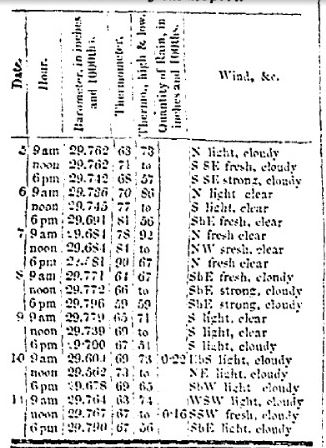
So what weather greeted our new judge? Pretty mild really, at about 65-mid 70s daytime temperatures (18-24 Celsius) . The warmest day was 15th March, with a morning temperature of 81 (27C)
This Week in Port Phillip 1841: 1-7 March 1841

This first week of March 1841 was marked by comings and goings.

COMINGS

The arrival of the 700 ton barque Argyle from London via Plymouth after a journey of 120 days was big news. In reality, the ship had a rather inglorious entrance, limping into Hobsons Bay after becoming stranded near Swan Island near Queenscliff.  I’m perhaps particularly attuned to the experience of emigration after reading Roslyn Russell’s book High Seas and High Teas but this particular journey has been well-described, largely because of the presence of a number of notable female first-class passengers whose writings and work have added substantially to our knowledge of early Port Phillip society. Foremost amongst these was Georgiana McCrae and her four children. Brenda Niall has given an evocative account of the journey in her excellent biography Georgiana, drawing on Georgiana’s journal of the voyage. Also present on the journey was Susanna (Sarah) Bunbury, accompanying her husband Capt Bunbury with her two year old son, and she also conveys a lively picture of Port Phillip through her correspondence. (There’s a fantastic article by Trudie Fraser on the Bunburys and their time in Fitzroy ‘The Bunbury Letters from New Town’ available online through the Fitzroy Historical Society’s webpage at http://www.fitzroyhistorysociety.org.au/publications.php.)

As well as’ Captain Bunbury, Lady and Child’ and ‘Mrs McCrae and Four Children’, there were eight ‘intermediate’ passengers and 228 bounty emigrants (PPH 2/3/41). For a full list of the passengers, see http://www.oocities.org/vic1840/41/am41.html The bounty emigrants, selected and accompanied by Mr John Marshall, were particularly welcome.   Anne Drysdale’s journal in Bev Roberts’ book Miss D and Miss N refers often to the difficulties in obtaining labour during these early years of the 1840s. A list published in the Port Phillip Herald on 5 March listed the skills of the labour available, inviting parties desirous of engaging their services to apply to the Surgeon:

MARRIED Labourers 23; Carpenters 83; Brickmaker 1; Shepherd 2; Painter, Gardener, Butler, Stonemason, Stockman, Sawyer, Groom 1 each

SINGLE MEN Labourers 36, Shepherds, 10, Carpenters, Ploughmen and Gardeners 2 each.

SINGLE WOMEN Housemaids 23; cooks 2; farm servants 19; dressmakers 2, laundresses 2 and ladies’ maids 3.

GOINGS

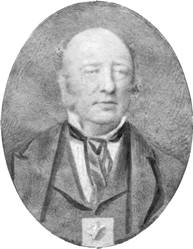
Although most emphasis is placed on the people who are arriving in Port Phillip, there was a steady trickle of people leaving Port Phillip as well. Some went back to England permanently, others shuttled between ‘home’ and the colonies depending on family circumstances, while others moved to other colonies and settlements within Australia. Willian Henry Yaldwyn was one of the latter. He differed from many of the other settlers at Port Phillip in that he was an English landowner in his own right who emigrated to the colonies with his family. He was a leading member of Port Phillip Society in its earliest years and prominent as a magistrate, member of the Melbourne Club, committee man for the Melbourne Fire and Marine Insurance , the Proprietary College and the Melbourne and Port Phillip Bank. He was on the organizing committee for regattas and the Committee to Welcome Lady Franklin in 1839- a journey described by Penny Russell in This Errant Lady (which I reviewed here)

William_Henry_Yaldwyn_-_Queensland_Politician

https://en.wikipedia.org/wiki/William_Henry_Yaldwyn

In March 1841 he left for NSW and Queensland, where he ended up a member of the Queensland Legislative Council. The people of Port Phillip gave him a good send-off from Melbourne:

DINNER TO MR YALDWYN. “On Friday evening the farewell dinner to Mr Yaldwyn came off with great éclat at the Adephi Hotel. The public room was laid out tastefully and redounded much to the honor of ‘mine host’. About a quarter to eight o’clock dinner was announced and fifty-three sat down to a sumptuous feast, consisting of all the delicacies the season could afford. After the cloth was removed Mr Powlett was called to the chair, when, after the health of the Queen the Royal Family &c had been drunk, and responded to with the innate loyalty of Britons, the chairman rose and proposed the health of their respected guest Mr Yaldwyn, which was drunk with the customary honours, and one cheer more. Mr Yaldwyn returned thanks in a suitable speech in which he expressed deep regret at his departure from among them. After several minor toasts had been drunk, the party broke up about two o’clock when every one present seemed pleased with their evening’s entertainment.” (PPH 2 March 1841 p. 2)

SCHOOL DAYS

Education at this stage was not controlled by government regulation and was delivered through sectarian schools and private enterprise. There were frequent advertisements in the papers for schools, many of which opened and closed almost without trace. Mr James Smith advertised that term would begin on 8th March at his school which would be conducted in connection with the Independent or Congregational denomination of Christians in Melbourne. The curriculum would consist of English, Reading, Spellng, Writing, mental and slate Arithmetic, English Grammar, History, Georgraphy, Elements of Geometry &c.

The pupils will be instructed as far as practicable according to the system of the British and Foreign School Society, Mr S. being thoroughly acquainted with that system, having been regularly trained at the Normal Institution, Borough Road, London. Hours of teaching from 9 till 12, and from 2 till 4.30 p.m (PPH 5/3/41)

Meanwhile, Mrs Williams and Miss Casey advertised their establishment for the young ladies of Melbourne:

Mrs Williams and Miss Casey beg to announce to the inhabitants of Melbourne that they intend opening a Seminary for the instruction of young Ladies. The course of Education will comprehend French and English in all its branches, including Writing and Arithmetic. Mrs W. And Miss C in soliciting the patronage of the public, rest their claim for support on their determination to pay the most unremitting attention to the religious and moral instruction of those pupils who may be entrusted to their care, as well as on the experience they have already acquired, while engaged in many respectable Schools and Families in the south of Ireland, where they have had opportunities of studying and adopting the several improvements in the modern system of education. (PPH 5 March)

FIRE AND FIREWOOD

In the early years of Port Phillip, much of the area surrounding Melbourne was quickly combed by timber-gatherers. By 1841 they were having to range further afield:

FIREWOOD. In consequence of the extension of the town and the great increase of inhabitants, this necessary article has lately become very scarce and the price has risen in proportion. The persons who procure a livelihood by supplying the town with fuel have now to go out some distance into the bush before they can get wood of a proper description for burning- the clearances in the immediate vicinity of the town are in many places converted into pleasure gardens which though devoid of the sublimity attendant upon the “mighty monarchs of the forest” yet carrying a feeling more homely, remind us of the chastened features of our native land. (PPH 2 March p. 3)

But where there’s firewood, there’s fire:

FIRE “We have often observed with alarm the idiocy of some persons in lighting large fires in close proximity to their habitations and this too, regardless of the weather and the calamitous consequences that may ensure, and we have perused with astonishment the annals of Melbourne without finding, as the negligence of the inhabitants would lead us to expect, more than one conflagration since the foundation. On Saturday evening a fire broke out in the chimney of a house situation in the rear of Mr Rushton, Little Collins-Street. The strong wind at the time accelerated the power of the flames which rose to an alarming height; fortunately the rain during the day had left an abundance of water on the [stove? stone?] which some men present assisted to draw, and the fire was soon got under. It appeared it owed its origin to the usual carelessness, a large fire had been piled on the hearth, which coming in contact with the charred timber in the chimney soon ignited, and spread through the entire: had not assistance been at hand and the flames permitted to increase, the consequences might have been serious, as the house is situated amidst a cluster of others built in the same frail manner and situated immediately behind the principal thoroughfare of the town, Collins Street. (PPH 2 March p. 3)

WATER

Meanwhile, there were increasing complaints about the quality of the drinking water that was being drawn from the Yarra. A small natural waterfall at about the site of the present Queens St Bridge separated the fresh water of the Yarra from the salt water coming up from the bay. Water carters drew from the Yarra and delivered it to householders at a cost of 6 or 7 shillings per load. On 2 March, the Port Phillip Herald published a letter written Dr Clutterbuck to Superintendent La Trobe, complaining about the brackish state of the water. La Trobe responded:

I beg leave to assure you and the gentlemen who have added their signatures, that having been subjected during the whole summer to the same inconvenience as my neighbours, and believing, moreover, that the brackish water is one cause (though not the only one) of the sickness which has prevailed of late, especially among new comers, I could neither be indifferent as an individual or as a public officer.” (PPH 2/3/41 p.3)

It was popularly believed that the poor water and drains had contributed to the illnesses suffered by many of the recent immigrants who had arrived on board the Argyle. The Port Phillip Herald pointed out that it was the duty of government to apportion some of the general revenue

to the formation of sewers with drains through the marsh into the Yarra, below the fall, to carry off the filth and excretions, which are daily collecting in the lower parts of the town, putrefying and exhaling pestiferous miasmata in a climate where it is actually requisite to fight against nature to render it unwholesome…[Recently arrived immigrants] instead of recovering from any lurking symptoms of disease they might have contracted on board ship, immediately on landing and exchanging the pure breeze of the ocean for the stagnant currents of the back slums of Flinders-lane, were attacked with what has been emphatically termed the “Yarra fever”, for the results of which we refer to the destitute widows and orphans, whose husbands’ and fathers’ remains lay mouldering in our churchyard. (PPH 5/3/41)

AND THE WEATHER?

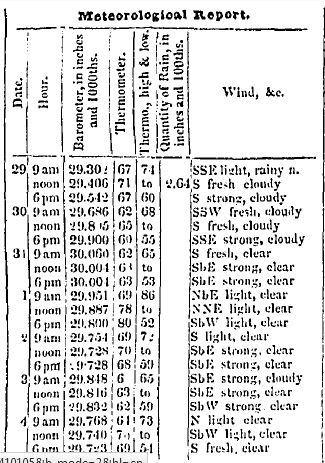
The weather for the week was generally fine, with light winds freshening occasionally. The highest temperature for the week was 86 degrees (30C) on 5 March, with a little rain the following day.


This Week in Port Phillip 1841: February 1-7, 1841

THEY’RE OFF TO GIPPSLAND

You’ll remember that while he was collecting the survivors from the wreck of the Clonmel the observant Captain Lewis noticed navigable access to what he hoped would be an inland sea. [link] This ongoing fantasy- the inland sea- reminds us that although there were established routes etched onto the Port Phillip District, there were still vast expanses ‘unexplored’- at least by white settlers.  They weren’t wasting any time: by the 3rd February the barque Singapore was heading back to investigate further, bearingDr Steward, Messrs Kinghorne, Orr, Rankin, Brodribb, McLeod, Kirsopp and McFarlane

A number of enterprising colonists are about to proceed by the barque Singapore ,to country discovered by Count Streslecki on his land route from Sydney and designated by him Gippsland. Captain Lewis has discovered an excellent approach by sea, and the Singapore will proceed to either this entrance or Corner Inlet.

Port Phillip Herald, 5 February 1841.

AN AMATEUR CONCERT

Meanwhile, those left at home could amuse themselves at the Caledonian Hotel, as part of the audience for the Amateur Concert. The Caledonian Hotel was located on the southwest corner of Swanston and Lonsdale Streets. Originally built by Rev. Clow it was quite large with 13 rooms, dormer windows, French doors, outhouses. The licence holder was Mr Robert Omond. See http://www.bayanne.info/Shetland/getperson.php?personID=I137530&tree=ID1   It was later a Temperance Hotel owned by the improbably named Mr Tankard in 1845.

But on 3rd February, the place was rocking:

On Wednesday evening the Amateur Concert came off at the Caledonian Hotel with great éclat. There were above 150 ladies and gentlemen present, composed of the wealth and fashion of Melbourne and its vicinity, amongst whom we noticed His Honor and lady, whose entrance was greeted by the orchestra striking up the national anthem. The room was well lighted, and the platform so elevated as to afford the audience, even at the furthest extremity, a full view of the performers. Madame and Monsieur Guatrot lent the aid of their brilliant talents to add additional effect to the pleasures excited by the Amateur band. The ladies and gentlemen were in ‘full dress’ and the tout ensemble presented an animated scene both “rich and rare”…although the performance was rather protracted, every soul seemed to enjoy the whole to the last with those enlivening and hallowed emotions which it is the special province of music to inspire… At eleven o clock the party rose simultaneously with buoyant and loyal hearts to respect by the echo of their feelings to Britain’s national air “God save the Queen!” This of course closed the evening’s enjoyments and the gay assemblage dispersed with reluctant hearts, but with fond hopes that the generous and gallant band of Amateurs would soon again repeat the attractions which had drawn them together, and which had so charmed their souls and so effectually secured their gratitude.

Port Phillip Herald 5 February 1841.

You’ll note the presence here of Superintendent La Trobe and Mrs La Trobe, ensuring that the concert was a respectable one.  The practice to sing the national anthem at the end of the performance might seem strange to those of us who can remember standing up for the national anthem at the cinema before the pictures started. However, this practice started in Drury Lane in 1745.The anthem was also played when royalty entered the theatre, but I don’t think that the designation ‘royalty’ quite stretched to Superintendent La Trobe at this stage.

WANTED- A PRINTER

When a low-level government position needed filling, it was not uncommon for the governor to look to the convict population. Although the ability to dispense patronage in the form of a job was an important aspect of power, it saved money if a convict could be found who had the skills, especially in the trades. And so:

Assignees of convicts in this District are required to furnish me with as little delay as possible the Names of any Men in their employ, who are either Compositors, Printers, Pressmen or Bookbinders, the Government requiring their services. Men will be assigned in lieu of those returned to the Government. James Simpson Police Magistrate 4th Feb.

Port Phillip Herald 5 February 1841

The substitution of one convict for another reminds us that even though Port Phillip was not, ostensibly, a penal colony, the assignment of ‘servants’ was still a bureaucratized system.

THE STREETS

The boggy state of Elizabeth Street was often remarked upon by the newspapers.  As I’ve written about before, Williams Creek runs under Elizabeth Street, and in times of downpour it became very muddy. But the Port Phillip Herald was pleased to see that a gang (most probably of convict workers) were on the job:

We were glad to perceive on Wednesday that the Police Magistrate had placed a gang of twelve men to convert Williams River into a street to be called Elizabeth-street.

Port Phillip Herald 5 February 1841

The good people of Melbourne needed to be chided to keep their dogs – and other animals- off the streets:

Caution to Owners of Dogs &c. The Magistrates have given instructions to the Police to destroy all dogs found about the town without collars. This is as it should be, and if a similar order was extended towards unclaimed pigs it would be of infinite service to the public as the devastation committed by the animals is great, and the soon their destructive pursuits are got rid of the better

Port Phillip Herald 2 February 1841

HOW’S THE WEATHER?

According to the Government Gazette, it was “fine open weather, with fresh and strong winds, frequently clouded by Cumuli”. The maximum temperature for the period was 92 degrees (33 celsius) and the lowest minimum was 56 degrees (13).  There was no rain.


This Week in Port Phillip 1841: January 24-31

ANNIVERSARY DAY

Of course, to us today this week is dominated by Australia Day on January 26th.  As I’ve written about before, Australia Day as a national day is of relatively recent origin (1946, and on the day itself 1994) and until then was known as Anniversary Day. In Port Phillip in January 1841, where the Separation Movement was stirring and beginning to agitate for Port Phillip as a separate colony from New South Wales,there was some resentment at celebrating “their” Anniversary:

We have received too much injustice already from head quarters to make it at all palpable to the Port Phillipians to celebrate the foundation of their colony, with which we want nothing to do.

The Port Phillip Gazette and Port Phillip Herald offered two other dates for celebration that would be more acceptable for the colonists of Port Phillip:

We would, however, suggest that instead of taking the foundation of Port Phillip from the 29th August 1835 as the Patriot recommends, that we should say the 1st June 1836, the day on which the first sale of Port Phillip lands were held, and which gave the Port Phillipians the first legal title to property in our fine country.

Interestingly, the good burghers of our present-day Melbourne have lighted on 30 August as ‘Melbourne Day’, commemorating the day that those on board the Enterprize disembarked onto land.

Whichever way you look at it, it’s dispossession.

WAGES

During late 1840 and early 1841 landowners were pressuring the government to increase its intake of emigrants as a way of alleviating the shortage of farm and domestic labourers, thereby reducing what appeared to employers to be exorbitant wages.   A bounty scheme was established whereby the NSW government would pay for the emigrants’ passage, either through a government scheme, or by a privatized scheme. Under the private scheme, agents in Britain would select eligible applicants and provide their passage and on their arrival, the £19 fare would be refunded by the government.  The bounty scheme was being funded largely through the sale of land in the Port Phillip District.

The table below was drawn up by the Port Phillip Herald on 8th January to support the argument that bounty migrants (i.e. those that the NSW government paid to come here) should be directed to Port Phillip, rather than sent up to Sydney.  Wages were higher in Melbourne, they argued, because of the labour shortage.

As the Herald itself admits, the methodology is questionable: the Sydney wage rates were affirmed on oath before Magistrates, Commissioners of Requests, Chairmen of Quarter Sessions and Judges or from the lips of workmen. In Melbourne, the rates were not attested on oath but had been “obtained from some of the most respectable masters in Port Phillip” and may have even understated the wages given.  (‘per diem= per day’, There were 12 pence [d] to the shilling; and twenty shillings to the pound)

OCCUPATION SYDNEY MELBOURNE
Brickmakers 10/- to 15/- per diem. Piecework 10/- to 16/- per diem None employed by the day. Piecework 20/- to 25/- per diem
Bricklayers 8/- to 10/- per diem 13/ 6 ½ per diem
Blacksmiths 35/- to £3 per week £3/12s to £4/4s per week
Compositors 8/- per diem 12/- per diem
Cabinet makers and upholsterers 6/- to 8/- per diem 14/- per diem
Farriers 30/- to 50/- per week £3/12 to £4/4 per week
Fencers 3d to 4d per rod 4/6d per rod
Field Labourers 2/9d to 5/- per diem independent of lodgings, vegetables, firing water etc. 7/- per diem without board
Glaziers 8/- to 9/- per diem 10/- per diem
Harness makers 5/6d to 6/- per diem 8/- to [?] per diem
Joiners 8/- to 10/- per diem 12/- to 14/- per diem
Plasterers 7/- to 9/- per diem 12/- per diem
Ploughmen £30 to £40 per year with rations and lodging £52- £60 per year with boarding and lodging
Quarrymen 6/- to 8/- per diem 10/- per diem
Sawyers 8/4d. to 11/- per 100 feet 17/- to 21/- per 100 feet
Shoemakers Shoes 5/6d Boots 15/- Shoes 7/6, Boots 21/-
Shepherds £20 to £35 per year with rations £40 to £50 per year with rations
Wheelwrights £25 to £50 per year with rations £3/15s to £5 per week without rations.

PRICES

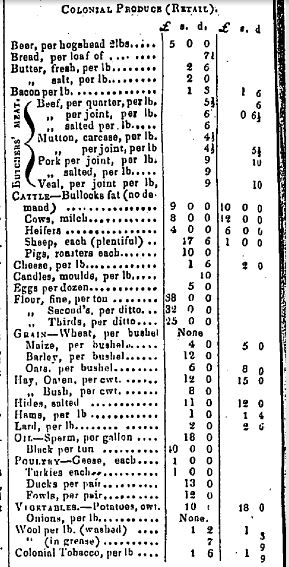
So, if this is what people earned, then what did things cost?  The Port Phillip Herald of 29 January 1841 listed the following prices for local goods:

priceslocal

Imported goods (as you might expect) were more expensive again

TO MARKET, TO MARKET

Speaking of buying and selling, there was a meeting at the Police Court on Friday 29 January 1841 to discuss a new location for the market. There had been a site set aside for a market in- you guessed it- Market Street, but the market wasn’t yet formally established at this time, and people weren’t happy with the proposed location. They didn’t actually get round to deciding where the market should be at this meeting, just that another spot other than the present market reserve should be found.

HOW’S THE WEATHER?

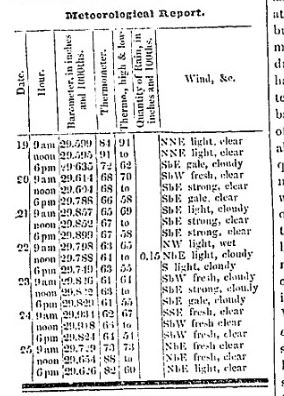
The 19th January was the hottest day, with a maximum of 91 degrees (33 celsuis) but the rest of the week was pretty mild.

weather29_1_41

The Government Gazette reports that the week had “dry weather, generally clear of clouds, but very hazy; strong winds from the south continuing.”


This Week in Port Phillip 1841: January 16-23 1841

RETURN OF THE CLONMEL SURVIVORS

On the 15th and 16th January, the two ships sent to rescue the Clonmel survivors arrived back in Port Phillip, after the wreck of the Clonmel a fortnight earlier.

MELBOURNE   THE CLONMEL. The Sisters, from the Clonmel, arrived on Friday, and the Will Watch on Saturday, bringing up the crew and passengers of that ill fated vessel. From what we can learn, it seems that the steamer having gone ashore during a spring tide, is now embedded in the sand at some considerable distance from the outer edge of the sand spit at low water mark; she is consequently comparatively safe from the waves. Her hull is sunk in the sand so that there is ten feet water in the hold, the cargo, it least so much of it as would damage from salt water, is consequently destroyed. As she swings at high water, and had not when the vessel left sustained any very material injury, sanguine hopes are entertained that she will ultimately be got off. We confess however, that there is but a remote possibility that a consummation so devoutly to be wished will ever be effected. The engines at all events are safe, and it may be that when the cargo is removed, the Clonmel will float again ; this. however, is rather to be hoped than expected. The rumours regarding the misconduct of the crew which have been afloat since the intelligence of her loss arrived have, we are glad to say, proved to be groundless. Some trifling peculations were committed, and one individual is in custody, charged with the commission of a petty theft but no robberies of such magnitude as were stated ever occurred. The natives made their appearance only once to the shipwrecked mariners, just before the Sisters and Will Watch sailed, but they offered no molestation of any description. What brought the steamer into such a predicament remains still unexplained. It is obvious even to persons unacquainted with nautical matters, that provided the vessel had been steered her course, she never could have been carried so far out of the way by the force of the current. We refrained from observations of this nature when Captain Tollervey and his officers were not present to answer for themselves, but we are conscious we are only giving utterance to the general feeling, when we say, that if as much attention had been paid to the navigation of the vessel as to the the comforts of the saloon, a catastrophe so very injurious to the interests of this community could not have occurred. The goods on board were chiefly the property of Messrs. J. M. Chisholm & Co., Mr. Cashmore & Co., Hamilton & Goodwin, Turnbull Orr & Co., and Capt. Cain. A small portion only, we fear, was insured

Geelong Advertiser 23 January 1841

THE CLONMEL– WINNERS!

But the wreck of the Clonmel wasn’t bad for everyone. Captain Lewis, who captained one of the ships that picked up the survivors, entered Corner Inlet and noticed a huge expanse of water.  In a reminder to us of how new the white settlement of Port Phillip was, hopes of the mythical inland sea were kindled:
Captain Lewis is all but certain that this Inlet communicates with a large inland sea, which he discovered and entered from shallow inlet, where the Clonmel at present lies. Time did not permit to examine the communication between corner inlet and the inland sea, but from his observations from the mast head, he is of opinion it is about a mile wide without a bar…. Thus, then, there is every probability of a most valuable tract of country being made available for colonial enterprise, should the Government order the necessary surveys.
Port Phillip Herald 19 January 1841
THE CLONMEL– LOSERS!
The wreck of the Clonmel wasn’t good for Mrs Beard though, who had previously worked as Superintendent on the vessel. She now had to find a new position.
Mrs Beard, lately Stewardess of the Steamer Clonmel begs to inform the respectable portion of Melbourne, that having, in consequent of the wreck of that vessel, lost all she possessed, and being a Widow without incumbrance, she will be most willing to engage herself as either a Lady’s Maid, Housekeeper, or Forewoman in a shop. The most respectable references can be given
Port Phillip Herald 19 January 1841

THE TRADESMEN’S BALL  After so much excitement in the last week (the regatta, the races, the cricket, the ball) , on Wednesday 18th January the inaugural Tradesmen’s Annual Ball was held at the Caledonian Hotel. This hotel, which was located somewhat out of town on the south-west corner of  Swanston and Lonsdale Streets, had originally been the large residence of the Rev.Clow and comprised 13 rooms as well as outhouses.  It was a commonly-used venue for large entertainments.  As might be deduced from the name of the ball, it was not a vice-regal occasion, and did not attract the clientele of ‘good’ Port Phillip Society. Nonetheless, a good time seems to have been had by all:

There were upwards of 80 couples present, dancing commenced at 9 o’clock, and after enjoying the pleasures of the ballroom until 12, the whole party partook of a rich banquet served up in that sumptuous and tasteful style for which my host of the Caledonians is so justly celebrated. Dancing, in all its varieties, was renewed and kept up with, if possible increased animation, until the golden tints which streaked the instant horizon proclaimed that the night was spent… Throughout the entire evening not the least commotion or unpleasant consequences took place.

Port Phillip Herald 19 January 1841

DEATH ON HOLIDAYS

But it was a very bad start of the year for Mr William Ker Senr. and his family when their New Year’s vacation was cut short by an untimely death on Saturday 16th January

SUDDEN DEATH.  On Saturday last, Mr Ker proceeded to the beach with his family intending to erect a tent for their temporary residence during the summer. He left his family at the Marine Hotel and went for the purpose of erecting the tent. Being absent for some time, Mrs Ker walked in the direction he went and not far from the Marine Hotel she discovered the body of her husband in the water, rolling about in the surf.”

Port Phillip Herald 19 January 1841

The Marine Hotel at this time was in Sandridge (Port Melbourne), and I’m rather amused by the description of the water there as ‘surf’.  A post-mortem was carried out by Dr Cussen, the colonial surgeon, who found “very extensive tubercular disease of the brain, accompanied by a serious effusion.”

At first I wondered whether this was a holiday-trip-gone-wrong, with Mr Ker the fore-runner of those Mornington Peninsula campers in their tents and caravans on the foreshore today? Or were Mr Ker and his family homeless and taking advantage of the balmy summer weather to live by the sea instead of in the township?  After all, as Bill Garner reminds us in his book Born in a Tent, living under canvas remained an important form of housing in Australia for much longer than we realize.  On reflection, I think the former. Some days later a well-attended funeral service was held for Mr Ker in the newly opened Independent Chapel, so it would seem that the family was well-established in Port Phillip and that it was likely to have been a beach-side holiday.

SCOTS PRESBYTERIAN CHURCH

On 22 January the foundation stone was laid for the Scottish Presbyterian Church on the corner of Collins and Russell Street, the site of the present Scots Church (constructed between 1871-1874 to replace this 1841 building). Although they had been in Port Phillip right from the start, the Presbyterians were the last to establish a permanent church, after holding services in several other locations (including this one) up until this time. See an image of the original church here and the plans and ground elevation here.

The Port Phillip Herald of 26th of January reported that it was a rainy day but that a “goodly concourse of the Presbyterian population and friends of the cause” attended, including several ladies who had come a considerable distance to be present. During the ceremony a bottle was deposited below the foundation stone with a copy of Mr Kerr’s Almanac for 1841, copies of the daily newspapers and a certificate.

HOW’S THE WEATHER?

No daily weather report this time, but the Meteorological Journal reprinted in the Government Gazette shows that the highest temperature for the week was 94 degrees (34.4 celsius) on the 19th January with the lowest recorded 55 (12.8 degrees). The week was described as “dry clear weather, but horizon seldom free from clouds; strong winds and squalls from South still frequent”.

This Week in Port Phillip 1841: January 8-15 1841

The habit of kicking back over January was established by 1841, and it was all happening this week! On Tuesday 12 January there was the Regatta on the bay.

High indeed were the expectations of our fellow colonists of every rank and age and bustling the scene of general preparation to celebrate the first Regatta, but the pleasure of the reality and the fond reflection upon its varied and enchanting amusements have eclipsed the brightest anticipations of its most sanguine admirers and rich and abundant is the fund which Memory has [?] stored up for future enjoyment (Port Phillip Herald 15 January 1841]

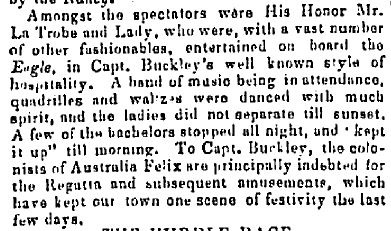
There were four races in all for different crafts:four-oared gigs; first class boats and five-oared whale boats.  As is the case today, there was just as much interest in watching the spectators as watching the spectacle:

regatta

(Port Phillip Herald 15 January 1841)

Then on Wednesday 13th it was the Hurdle Race at 1.00 p.m. “The course marked out is selected on the other side of the river Yarra Yarra, near the beach, and about half a mile to the left of Mr Liardet’s hotel“. (PPH 12 January 1841) Mr Liardet’s hotel was at Port Melbourne.

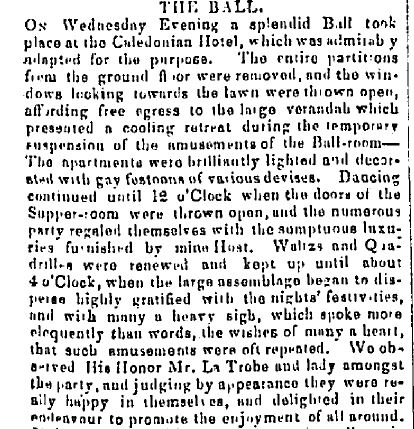
A “ vast assemblage had collected to witness the sports” at the beach where a limited number of horses competed against each other in three heats.  The writer for the Port Phillip Herald became very excited about the whole thing but it really doesn’t bear repeating 175 years later.  More interesting was the ball that was held that evening:

ball

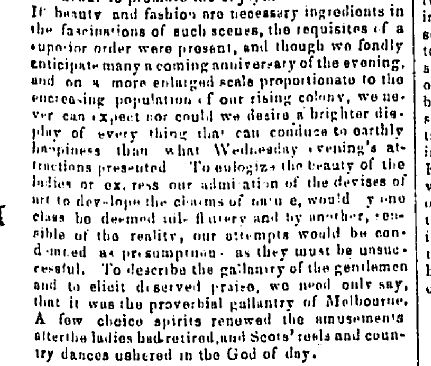
The presence of Superintendent La Trobe and Mrs La Trobe is important because they conferred an aura of respectability to the proceedings. If they were there, then all the Port Phillip worthies would have wanted to be there too.  Just like our clubs today, these balls went until late at night (or rather, early the next morning), with this one breaking up at about 4.00 a.m.

ball2

The cricket match was held on Thursday 14th January, “on the usual ground” .This was, at this stage, at the foot of Batman’s Hill, near the site of the present day Southern Cross station.  However, the match was abandoned “owing to the boisterous state of the weather“, to be continued on the following Saturday.

WEATHER REPORT

So how was the weather?  How frustrating- it doesn’t go up to 14th January!

PPH15Jan1841

Port Phillip Herald 15 January 1841.

It was 92 degrees (33 celsius) on 7th January, followed by a 67 degree (19 celsius) on the 8th.  How Melbourne!

And according the report of the week from the Meteorological Journal for Port Phillip, published some two months later (19 March 1841)  in the Government Gazette,

Weather generally dull and cloudy; rain in small quantities 9th, 10th and 14th; strong winds and squalls from S continuing frequent; N. W. gale 14th.

The highest temperature for the period 8th-14th January was 89 degrees (31.7 celsius) on 7th January, and the lowest was 51 degrees (10.6 celsius).

This Week in the Port Phillip District 1841: January 1-8 1841

COMING SOON….A RESIDENT JUDGE

Even though Superintendent La Trobe and the people of Port Phillip didn’t realize it, on 1 January 1841 Governor Gipps took up his pen to formally notify the Secretary of State at the Colonial Office in London that Justice John Walpole Willis had been appointed to Port Phillip as the first Resident Judge of the Supreme Court of NSW for the district. Gipps’ letter to La Trobe informing him of the appointment was actually written on 29th December, but it hadn’t arrived in Melbourne yet.  So, let the period of the Resident Judges begin!

THE WRECK OF THE CLONMEL.

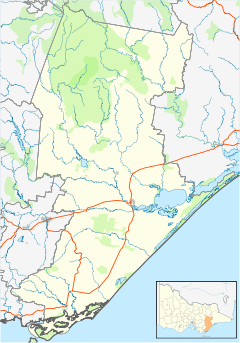
The year started with a bang, literally, for the steam-ship Clonmel which ran aground on a sand spit at the entrance to Corner Inlet  200km south-east of Melbourne, at 5.00 a.m. on the misty morning of 2 January 1841.

clonmelmap

See also: http://mapcarta.com/16688280

The five-year old Clonmel was a new addition to the shipping route   between Launceston, Port Phillip and Sydney, having only arrived in Sydney in October 1840. This importance of this intra-town communication through shipping at this time cannot be overstated.   A wooden-hulled, masted paddle steamer, it carried 75 passengers and crew, and this was only its second*  voyage on its circuit between the three ports.  Daybreak revealed that the beach was about half a mile away, and that a heavy surf was running. Several trips by whale boat initially, and then with the assistance of quarter boats, deposited every soul in safety on the beach by 2.00 p.m. that afternoon. Sail awnings were brought on shore and a camp of tents was established for the ladies.  Provisions sufficient for ten days were also brought from the boat, including livestock, hams, bread, flour, biscuit, rice, tea, sugar and wine.  A sketch by Robert Russell showing the huts of the Clomnel survivors can be seen here.  [Accession number: MS 9555]

Water was located, but found to be brackish.  Safely onshore, the Captain harangued the passengers about the need for discipline and the punctual obedience of orders. Two-hourly watches were posted and the provisions were securely stowed under a boat turned upside down to guard against petty depredations and the effect of the weather.

The next day,  two passengers Mr D.C. Simson and Mr Edwards and five unnamed seamen headed off to get help. First they inspected the wreck of the ship as they passed, and then headed towards Sealers Cove where they rested overnight. At 3.00 a.m. on 4th January, they awoke early to fill buckets with water to continue their journey when they observed “the natives coming down upon us.” They hurried on board and headed for Wilsons Promontory, which they sighted at about 10.00 a.m.  They arrived in a small bay at Westernport at 8.00 p.m. that night.  The following day they reached Port Phillip Heads by 2.00 p.m. but because there was a strong ebb tide, they needed to wait for a flood tide.  They were approached by a cutter The Sisters which towed them into Williamstown at 11.00 p.m. making a total of 65 hours since their departure from Corner Inlet.

All passengers were safe, although Mr Robinson lost the £3000 of Union Bank notes he had in his custody.  The newly-wed Mr and Mrs Cashmore lost a large quantity of goods that they were bringing for their new establishment to be opened on the corner of Collins and Elizabeth Street.  (Source: Port Phillip Herald 8 January 1841;  http://perdurabo10.tripod.com/ships/id296.html )

See the Victorian Heritage Database entry for the wreck of the Clonmel (which still lies on the ocean floor) here.

TICKETS OF LEAVE

Even though the people of Port Phillip prided themselves that they were not a ‘convict’ colony like Van Diemens Land or Sydney, there were convict gangs, ‘assigned servants’ and ticket-of-leave prisoners in Melbourne.

On New Years Day a general muster of the ticket of leave men of the district took place at the Police office. They presented the appearance of a clean and orderly set of men, and were each passed in review before the police magistrate; such of them as resided in the town were sworn in special constables, a very excellent and salutary arrangement (Port Phillip Herald 5 January 1841)

It’s hard to know what to make of the final sentence- sarcasm, most likely. Nonetheless, many of the early police in Melbourne were of convict background and many were quickly dismissed for drunkenness. Edmund Finn, writing as ‘Garryowen’ in his Chronicles of Early Melbourne describes the ordinary policemen of the first few years as “mostly convicts freed by servitude, with now and then a ticket-of-leave holder.” (p. 52)

A NEW CHURCH

On 1 January the new Independent Chapel was formally opened for Divine Worship. “The design of the Chapel is both neat and tasteful, and its internal fittings up render it extremely commodious.” Three sermons were preached on that day by Reverends Waterfield, Forbes and Orton.

A booklet called The Collins Street Independent Church (available here) shows a small brick church building 20 X 30 ft in size, erected at a cost of £231. It was later extended, but pulled down in 1866 to construct the current-day St Michael’s on the corner of Russell and Collins Streets.

HOW’S THE WEATHER?

According to the Port Phillip Herald, in the days between 29 December- 4th January, there was a fairly mild start to the year, with the first of January the warmest day with a top temperature of 86 degrees F (30 degrees C)

PPH5Jan41

The Abstract of the Meteorological Journal kept at Melbourne, Port Phillip was reprinted in the Government Gazette at roughly monthly intervals. The January report is in Gazette 22, Friday March 19 1841.  It reports that in the week 1st-7th January, there was “dry weather, frequently cloudy” with “strong southerly winds”. The highest temperature recorded on this week was 92 degrees on the 7th.

Notes:

*The Victorian Heritage Database and other sources say that it was its third journey. I can only find two.  The plan was for the Clonmel to run a circuit between Sydney, Melbourne, Launceston then return.  The first journey from Sydney was planned to terminate at Melbourne, but was extended to Launceston after all (which might be where the confusion lies between two and three journeys). The wreck occurred on the second journey from Sydney.

References:

Port Phillip Herald 1, 5 and 8 January 1841