Category Archives: This Week in Port Phillip District 1841

This Week in Port Phillip 1841: 1-7 October 1841

‘Scrutator’ fall-out

One of the problems of writing a libelous letter against the only Judge in town is that, when you’re hauled over the coals for it, it will be before that very same Judge. So 21-year-old George Arden was to learn, after publishing the Scrutator letter in the Port Phillip Gazette. At the next sitting of the court, the Crown Prosecutor made an application grounded on an affidavit made out by the Acting Crown Solicitor against George Arden for “false, scandalous and malicious libel, reflecting on the administration of justice and upon His Honor [Judge Willis] personally”.  Willis made a long speech in his own defence, then, after quite properly declaring his unwillingness to act as a judge on his own case, turned proceedings over to the Police Magistrate Major St John and three other magistrates on the bench: Powlett, Verner and Lyon Campbell.  The personalities of these magistrates is important:  William Verner and James Lyon Campbell were strong supporters of Willis and his neighbours in Heidelberg. They announced that Arden should be bound over with recognizances of 400 pounds and two sureties of 200 pounds each (in effect, a form of good-behaviour bond) and attend the Police Court the next day.

Arden fronted up as required at the Police Court on Saturday morning, where Major St John was joined by a different group of magistrates: McCrae and Were.  Now these magistrates were no friends of Willis’, each coming into conflict with him in their own right.  In Willis’ absence, they decided that it was not necessary to enforce the order (a rather ‘brave’ decision, one would think, given Willis’ combativeness).  On hearing of this decision, Willis immediately launched an appeal which was heard in Quarter Sessions on the following Monday before the same magistrates as on Saturday, but this time they were joined by six other magistrates of the district, including Powlett, Verner, Lyon Campbell.  After much discussion, they re-affirmed the order about recognizances.

The three newspapers devoted columns and columns to these events, framing it as a liberty of the press issue which, indeed it was.  All three were scathing of Willis’ actions, with even the pro-Willis Port Phillip Patriot under the proprietorship of John Fawkner declaring that Willis should “resign the office of Resident Judge into the hands of one or other of his brethren on the bench” (PPP 7/10/41).

As it turned out, Arden was released from his recognizances a month later amongst all the bonhomie surrounding the visit of Governor Gipps- but, oops!- that hasn’t happened yet. But rest assured, this matter isn’t going to go away, and we’ll revisit it in February next year.

St Francis’ Catholic Church

On 4th October 1841 Fr. Geoghegan laid the foundation stone for St Francis’ Church which still stands on the corner of Lonsdale and Elizabeth Street, looking much as it did in the 1840s.
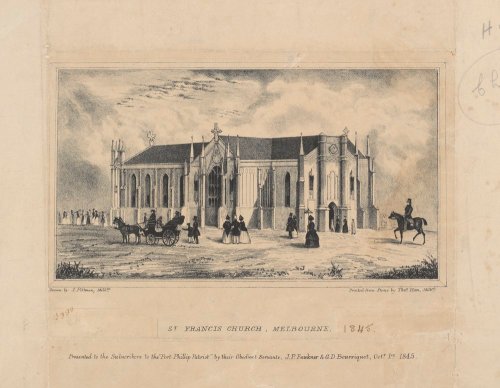
 

st-francis-church-melbourne

St Francis Church 1845 from stone by Thomas Ham. Source: State Library of Victoria

The major denominations were hard at work in these early years of the 1840s building their first permanent churches to replace the rather makeshift structures had had been quickly erected as the population of Melbourne began to boom.  There was nothing that Melburnians liked so much as a good ceremony (in fact, that’s still true) and the Masons were usually on hand to make an occasion of it.  But not so when it was a Catholic chapel, notwithstanding the general co-operation between the denominations at this stage.

On Monday last the foundation stone of the new Catholic Church was laid by the Rev. Mr Geoghegan on the ground set apart for that purpose in Lonsdale-street, and upon a portion of which the temporary edifice at present stands.  In consequence of the reverend gentleman being a member of the order of St Francis, the church was dedicated to that saint.  It was contemplated that the Masonic body should have proceeded in due form, and assisted in the ceremony; but the opinions of others being at variance with this suggestion, it was dropped to prevent a schism. About £200 was collected on the ground.  The following inscriptions upon parchment were deposited, along with some coins, in the foundation stone:
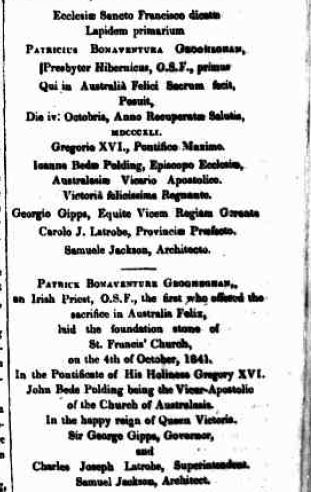
stf.JPG

PPG 6 October 1841

The Port Phillip Herald, which gave more attention to news of the Catholic church than the other two papers, carried a full report of the ceremony and the addresses given in its 12 October issue.  The crowd, it seems, was smaller than might have been hoped:

The day was unfavourable, being tempestuous and showery, besides many of the congregation and persons of other religious persuasion were prevented attending by reason of occupation at either of the two Courts which were then adjudicating [on the Arden case above!] nevertheless a considerable assemblage was present at the sacred ceremony.[ PPH 12/10/41]

Fr. Geoghegan finished his oration praising the ecumenical spirit that generally existed in these early Melbourne years (the absence of the Masons notwithstanding). I’ve often wondered if it was the arrival of the bishops that hardened the sectarian lines in Port Phillip society, or did it just reflect the increasing size and complexity of a town outgrowing its frontier status?

Thanks to God we live in a country of liberty where it is the recognized right of everyone to worship God according to his conscience: Australia Felix! a country happy and true to its name, where we can appeal even to our Dissenting brethren to defend us from an encroachment on our religious freedom as if it were their own [PPH 12/10/41]

Unfortunately it seems that the coins did not stay for long in the foundation stone. On the 7th October the Port Phillip Patriot carried this report:

SACRILEGE. On Monday night last some paltry ruffians removed the foundation stone of the new Roman Catholic Chapel, which had been laid during the day, and carried away the bottle containing the inscription and the different specimens of the coins of the realm, which were deposited in the stone.  The whole value of the property stolen is not more than thirty shillings and to accomplish this notable feat there must have been at least six thieves employed, the dimensions of the stone being such as to preclude the likelihood of a smaller number being able to accomplish the theft without the aid of machinery.

How’s the weather?

Light winds 1st and 2nd, gale on 3rd, afterwards fresh and strong winds; weather damp and cloudy until 4th, afterwards bright and clear.  Top temperature 74 (23.3C), lowest 41 (5.0C) and the coldest day of the month was on 5th October.
 

This Week in Port Phillip 1841: 26-30 September

Census results

Given that in September 2016 we’ve had the census uppermost in our thoughts, you might be interested in the results of the 1841 census. Mind you, the Port Phillip Gazette scoffed at the figures recorded for Melbourne, boldly declaring that:

If [the figures] are all as incorrect as Melbourne, this document is sheer humbug [PPG 29/9/41 p.3]

LOCATION MALE INHABITANTS FEMALE INHABITANTS GENERAL TOTALS NUMBER OF HOUSES
Melbourne 2676 1803  4479 769
Geelong  304  150   454  70
Total Melb & Geelong  4933 839
Rest of NSW 48,584 4052

What would they say on ‘Gruen’?

‘Gruen’ is a weekly ABC program that dissects advertising and marketing, and the angles and techniques used to persuade consumers.  I wonder what they’d think of these advertisements?

The first, for the grocery store Albion House, places itself as on the side of the embattled settler while at the same time trying to entice him into buying:

ALBION HOUSE. AN ESSENTIAL PUBLIC GOOD. The depressed state of the times, the stagnant state of commerce, the scarcity of cash, the great reduction in wages, the number of persons thrown upon our shores sixteen thousand miles from their friends and native homes, having no employment and but little cash in their possession, have long cried aloud for a reduction in the high prices of the necessaries of life; indeed it is whispered in the cottage, it is muttered in the cheerless unfurnished cot, “Give us cheaper food; let us have a reduction in the prices of the measures of life, or we starve!” Their demands are satisfied, their cries are heard, and they have now an opportunity of procuring not only the necessaries of life, but also many little comforts that have existed only in desire without the means of procuring them, because of the highness of prices.  C. S. BARRETT & CO having recently taken those extensive premises lately occupied by Mr Empson, draper, Collins-street, which they have opened with a very large stock of grocery, tea and provisions of every description, direct from England; and, that the public may not be deceived, they have named in The Albion House, where the above named articles may be purchased at prices astonishingly below anything as yet submitted to the inhabitants of Melbourne. [PP Gazette 29/9/16 p.1]

Or how about this advertisement for a laundry service? Mangling…a ‘beautiful science’ no less!

IMPORTANT TO FAMILIES. W. Herbert begs to acquaint the inhabitants of Melbourne and the surrounding district that he has opened those premises lately occupied by Mr Melbourne, Hairdresser, Little Flinders-street and invites the attention of the public to the circumstance that he, with Mrs H and female servants, intend Washing, Mangling &c for those families who will honour him with their patronage; and having brought a Patent Mangle with him, will be able to accomplish this beautiful science in first-rate style.  W. H. is aware of the scarcity of money, and therefore will work for the lowest figure; but he must have cash, as nothing else will keep the Mangle going: a man has been engaged for the express purpose of keeping it in constant motion; and as steady women are engaged for the washing department, W. H trusts he will have a share of patronage for so novel a business or profession.  The prices will be as follows:

Washing and Ironing per doz….4/6

Mangling per ditto…………….0/6

Mrs Herbert has female servants that may be hired by the hour or day to wash and clean as charwomen.  [PPG 29/9/16 p.2]

A new variation on the ‘dogs-as-nuisance’ theme

dogs

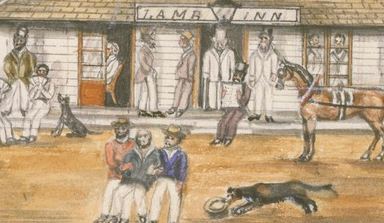
Detail from Liardet’s picture of the Lamb Inn, Collin’s street. Note the dogs.  Source: SLV

The Port Phillip newspapers have had plenty to say in their columns about the nuisance posed to the inhabitants of Melbourne by stray dogs. But even the attempts to curb the numbers of dogs by offering a bounty seems to have backfired:

PUBLIC NUISANCE.  We have to call the attention of [Police Magistrate] Major St John to the disgraceful conduct of the constables in leaving the carcasses of the dogs they have killed for the sake of their tails, putrefying on the sides of the street.  We would suggest that in order to abate the evil, the reward given for the tails of unregistered dogs shall not be issued in any case, unless the claimant can show that the carcasses of the animals have been disposed of in such a manner as to prevent the possibility of their becoming a public nuisance. [Port Phillip Patriot 30/9/41 p.2]

Family Jars

The Police Intelligence columns are the gift that keeps on giving. Obviously the whole family, including the women, got into this one:

FAMILY JARS. Peter Connell was charged with cracking the head of Stephen Moore with a ginger beer bottle. From what could be gathered from the statement of Connoll, whose head was bound in a Turkey red handkerchief, it appeared that on Saturday, about half-past one o’clock, he was requested by Moore, who is a neighbour, to remove a water cask then reclining against a fence near his door.This being complied with, Connell’s servant pulled down some of the fencing, and made a thoroughfare through the premises; to this he objected whereupon Mrs C. came out and emphatically laid down the law on the case; this was rebutted by Mrs M., who declared that a free passage and female rights were her motto, and on that she would stand. Connell and Moore then came upon the ground, and issue was quickly joined, and scuffling, thrashing and the cracking with the ginger beer bottle followed.[(PP Gazette 29/9/41 p3]

 The ‘Scrutator’ letter

On 29 September George Arden, the young editor of the Port Phillip Gazette published a letter which criticized Judge Willis , supposedly penned by ‘Scrutator’.  After starting with a complaint about Judge Willis’s ban on raffles, the letter moved onto a wide-ranging attack on Willis’ fitness as a judge. The authorship of the letter was never questioned but Arden’s role as editor in publishing it certainly was, suggesting that Arden himself probably wrote the letter (as did most of the other editors when wanting to stir the pot a bit). In fact, as we’ll see as time goes on, Willis’ heavy-handed response to press criticism was to be one of the loudest complaints against him, both by Melbourne inhabitants and eventually, by the government as well.  So, because this letter was so important for Judge Willis’ career and for the public debate for the next six months or so, I’ll transcribe it in full (but I give you permission to skip reading it and just jump down to my comments below!):

TO THE EDITOR OF THE GAZETTE: SIR- In consequence of some sensible remarks which appeared in your last paper, as to the impropriety of Judge Willis directing the Crown Prosecutor to take steps to prevent raffles, I beg to direct your attention to a habit of His Honor’s which is not only unbecoming in a Judge, but which has done much injury, and the baneful consequences of which will extend more widely over the colony, unless at once stopped by the interposition of an independent press: I allude to His Honor’s practice of giving his opinion and directing the proceedings, not only in matters collateral, but even in those totally unconnected, with the question he is called upon to decide.  To one who has attended the English courts of justice, and observed the scrupulous caution with which the judges therein refrain from allusions to all portions of a case except that immediately at issue, and even then declining to make any remarks upon- not to say decide- any point to which their attention has not been directed by full an deliberate discussion, Judge Willis’s conduct is in most startling contrast.  No opportunity escapes him for scattering his dicts, for stating what he conceives to be the law and merits of every subject, no matter how extraneous to that under consideration, if it happens to strike his fertile fancy.  Who has not censured the un-called for stigmas he carelessly heaps on the conduct and character of Magistrates, Barristers, Attorneys, Witnesses, Suitors, or any one whose name may have been unfortunately mentioned in his court? the praise he never awards, except to those who flatter and cringe to him, is nearly as disgusting as the unmeasured censure he so copiously visits on the other wretched individuals who are dragged beneath the outpourings of his bilious temperament; and should he ever find a dearth of legitimate victims, Simpsons, Carringtons, Editors &c with what a master hand, supported by what ancient authorities, will he summon from the peaceful repose of a newspaper advertisement a Cunningham or a McNall, …entire horses, donkeys, raffles, and gambling. But, Sir, what is equally to be lamented, though not so generally known, is his practice of advising upon titles to land, the validity of grants from the crown- stating that deeds are inoperative, conditions not being complied with- that the land fund having been applied to immigration, and not to the consolidated fund, all the Governor’s conveyances are illegal, and even if they were not, lands sold before the Governor has dated his grant can never pass the property to the purchased; in fact, whether in or out of court, the sole result of his unfortunate temper and his distorted judgment is raising disputes and fomenting instead of suppressing litigation. Is this a fit or proper person to fill the highest judicial chair in the province? Judge he is not, nor ever will be, being in every case so much a creature of deluding impulse.  To those who are so connected with him as to be obliged to bear the burthen of his acquaintance, the endless disparaging terms in which he speaks of his late brother Judges, the gentlemen of the bar, and all with whom he came in contact in Sydney; the egotism and vanity which actuate his very look and expression, have demonstrated that the fountain of his acts is drawn not from the pure sources of liberal learning and enlightened knowledge, but the sterile rock of ignorance and self conceit; coupling these with his penurious miserly habits (for never was he, whom from his position and salary should be an example of liberality, known to see a friend within his poverty-stricken doors) is he, I would ask a proper person to have been sent to a young colony as its Judge? Yet, Sir, Some hope remains that this paralyzing member of an otherwise healthy community may ere long be removed, under the [indistinct] fearless catchcry of an independent press. I have the honour to be Sir &c &c &c. SCRUTATOR. [PPG 29/9/41 P.3

In transcribing this letter,I’m struck anew by how barbed it is, even for the time. Even though the three Port Phillip newspapers were published legitimately and regularly, they were a mixture between, using the example of 20th century Melbourne, the Herald Sun and Truth magazine, or to bring us into the 21st century, very similar to the internet’s mixture of hard news and utter scurrility.  Judges were criticized in the press (it seems to me, more than today but I’m not sure) but then, as now, it would have been a dangerous undertaking, particularly in a district that had only one judge.

Looking at the letter, ‘Scrutator’ starts off by criticizing Willis for making extraneous commentary from the bench, asserting that the judges in England did not do so.  That’s not true: the judge’s speech at the opening of term was a time-honoured occasion for moral commentary, usually about the evils of alcohol and godlessness (but gambling could conceivably fit under such a tirade). That said, Willis used the opportunity to make such commentary excessively. ‘Scrutator’ then makes criticisms that were to be echoed two years later when the whole Willis thing blew up. Willis’ attacks on magistrates, barristers and individuals like Simpson and Carrington were all listed as reasons for his dismissal and ended up being aired in the Judicial Committee of the Privy Council in Whitehall.  Even Houndsfoot the stallion and Montezuma the donkey get a look in!

More pointed, though, is ‘Scrutator’s’ report of Willis’ private conversation, and here we get into murky territory.  Arden was most certainly not part of Willis’ social or conversational circle- so who was telling him all this?  And the content of this reported conversation at a time when the property bubble was just about to pop was incendiary, then as a final kick to the shins was a dig about Willis’ dearth of friends and lack of gentlemanly sociability.

How’s the weather?

This week the weather was more settled, with light winds generally and bright and clear after 24th September.  The 28th and 29th were the warmest days of the month, with a top temperature for September of 76F (24.4 C) and a low for the week of 45 (7.2C)


This Week in Port Phillip 1841: 1-8 September 1841

HOUNDS FOOT! HA, HA, HA!

The newspapers in Port Phillip often reported on Judge Willis’ performance on the Supreme Court bench, largely because there was little other ‘hard’ news to fill the columns with. Nonetheless, he did give them plenty to write about, especially when getting stuck into the barristers and attorneys who appeared before him. He took his responsibility for keeping the bar in line very seriously – and indeed, that was part of his judicial duty- but often made theatrical threats and gestures that make it easy to see him as a figure of fun.  His attacks on the court personnel make good newspaper copy, but it is telling that many of the people who were the recipients of his tongue-lashings signed petitions against him once there were moves to remove him.

One of Willis’ more theatrical outbursts was against Archibald Cuninghame – also spelled Cunninghame and Cunningham.  He had practiced at the Scottish bar for seven years when he emigrated to Sydney with his brother and two sisters in 1839, an example of the sibling migration patterns that I have spoken about earlier. While he did not necessarily see New South Wales as his permanent home, he did see the financial opportunities it offered, writing to his mother “I see a prospect not of making, a rapid fortune, but yet, of very good returns for my Capital”.  After overlanding down from Sydney, he quickly took out a licence to depasture stock and bought up 139 acres around Northcote (in Melbourne) at the 1840 government land auctions.  His two sisters travelled down to Melbourne in the Bright Planet (the ship that Peter Mews used as the springboard for his excellent book of the same name), while his brother took up the management of the station Wanregarwan, up on the Goulburn River. Archibald joined Redmond Barry, Edward Brewster, James Croke and Robert Pohlman as the first barristers admitted to the Port Phillip bar in April 1841.

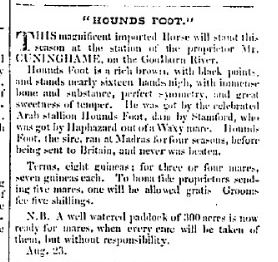
At the end of August 1841, an advertisement appeared in several editions of the Port Phillip newspapers.

houndsfoot

Contact with horses was part of the gentlemanly image – and indeed, Judge Willis himself was an enthusiastic horse-rider while in British Guiana and certainly had his own horses in New South Wales.  However, that was riding them, not hawking them for stud services, and Willis took exception to the difference.

THE LAW AND THE ASS- On Friday last, previous to the commencement of the trials at the Supreme Court, his Honor, Judge Willis, produced a copy of the Herald Newspaper in which appeared an advertisement of an entire house, Hound’s Foot “to stand this season,” signed by Mr Cuninghame. His Honor expressed a hope (to the Crown Prosecutor) that this horse was not the property of Mr Cuninghame, the Barrister, who was an Officer of the Court. Mr Croke being unable to satisfy the interrogatory, his Honor proceeded to say that, if such was the case, it was exceedingly derogatory to the respectability of the bar, that it would look rather curious to see written upon the door of the “Horse and Jockey” “Law business transacted here”, and that he considered one as bad as the other.  Judge Willis proceeded to make some further remarks on the subject, but before concluding, requested to know from the gentlemen of the bar, how it would look to see an advertisement in the public papers headed “Montezuma, this splendid ass, will stand for the season at the stables of His Honor, Judge Willis, Heidelberg” would this add dignity to the bench. (PPH 31 August 1841)

Judge Willis certainly did live at Heidelberg, but I’m not aware whether he had an ass called Montezuma. But nor did Archibald Cuninghame have a stallion called Hounds Foot- it was his brother John up on the Goulburn.

THE JUDGE AND MR CUNINGHAME – As reported in our last number, his Honor Judge Willis remarked to Mr Croke that he hoped the celebrated imported horse “Hounds Foot” had not been advertised “for the season” by Mr Cuninghame the barrister, as such a circumstance would not add respectability to the bar.  The impression produced by His Honor’s remarks was that Mr Cunninghame the barrister had so advertised “Hounds Foot”. To shew that even Judges may err in their opinion of matters of this kind as well as in others, we may state that Mr Cuninghame has a brother residing on the Goulburn river; and as the advertisement, which attracted his Honor’s attention particularly states that the horse “will stand this season at the station of the proprietor, Mr Cuninghame, on the Goulburn river” (where Mr Cuninghame’s brother actually resides), we infer that the barrister of that name, who resides in town and follows his profession, is not the Mr Cuninghame “of the Goulburn river.” But Editors, like Judges, may err- who is wrong? (PPH 3 Sept 1841)

Humour by a powerful person is a dangerous thing.  Sometimes when I look at some of Willis’ more outrageous antics from the bench, I wonder if he was performing for the audience, in the same way that our politicians do before the despatch box.

Certainly Willis was very strict about any involvement in ‘trade’ amongst those solicitors and barristers who came before him seeking admittance to the court.  Probably the major fact that led to Willis’ dismissal was the campaign he waged against public officers and members being involved in land speculation and bill-trading. Neither of these activities were illegal, and in a new frontier colony, most people with capital deployed it in either land or financing in this way. Willis’ criticisms of high-ranking people in Melbourne for their involvement in such activities was, I believe, a direct cause for his dismissal.

But Willis’ riff on the Ass Montezuma suggests that he’s enjoying himself here at Cuninghame’s expense. I think of footage of powerful people making a joke, and the forced laughter of their minions around them. Historian Greg Dening wrote about William Bligh’s “bad language” in that people didn’t know how to take it. I would argue that Willis had “bad language” too, and the Hounds Foot incident, while farcical, highlights the difficulty of humour from the bench.

Certainly, the Port Phillip Gazette in its editorial columns, was becoming increasingly critical of Willis.  Its editor, the young George Arden, was clashing with Willis and within weeks publish a letter signed ‘Scrutator’ which would lead to an open conflict with the Judge.  But here’s the Gazette editorial on 4 September:

Mr Justice Willis has certainly the merit of being singular, if not sensible, in his opinions on matters connected with his own department, and he occasionally expresses his conceits in a manner and language that is equally awful to the officers of the Court and amusing to the public…If, however, it will serve the purpose of Mr Willis equally well, and he will condescend to permit us, with all just and proper humility, to tender our opinion on the subject, we will observe that it would be no matter of surprise to the public to hear that there was an ASS connected with the Bench, or that the amiable quadruped resided at Heidelberg, but the attempt of Mr Willis, trivial and vexatious as it was, considering the scanty foundations he had for his extraordinary comments, is viewed on every side with marked and universal disapprobation. (PPG 4 September 1841)

Mr Cuninghame recovered from his unmerited dressing-down and continued to serve in Willis’ court. As an equity lawyer (like Judge Willis himself), he was involved in discussions about the introduction of usury laws, and he was involved in many of the philanthropic and civic organisations of Melbourne.  He went to London in 1846 to represent the Port Phillip colonists in their campaign for Separation, and died there unmarried in 1856.

In fact, the whole little contretemps probably more harm to Willis’ reputation than it did to Cuninghame.

More information on Archibald Cuninghame: Marion Amies and Martin Sullivan ‘Manuscript: 3 Letters from Christian Cuninghame to Agnes Cochrane-Patrick Describing Life in the Port Phillip District’ LaTrobe Journal No. 30, December 1982 http://www3.slv.vic.gov.au/latrobejournal/issue/latrobe-30/t1-g-t4.html

AND THE WEATHER?

“Strong winds on the 3rd 4th and 5th; weather cloudy and uncertain; rain several days but inconsiderable in quantity.” Highest temperature 66F (18.8); lowest 38 (3.3)


This Week in Port Phillip 1841: 25-31 August 1841

THE SAD TALE OF OF VEZELLA RAINBOW

It was not particularly common for the Port Phillip Herald to comment on the parlous circumstances facing impoverished individuals, but during much of June 1841 it conducted an appeal in its columns for donations to the widow of Trooper Rainbow, of the Mounted Police, who drowned when crossing the Goulburn River on 26 April 1841.  As the Sydney Herald reported, Trooper Rainbow had been with the Mounted Police for seven years, and was regarded as an active, steady man.

REAL DISTRESS. We beg to draw the attention of our humane readers to the case of the widow of Trooper Rainbow of the Mounted Police, who was lately unfotunately drowned when crossing the River Goulburn on duty. What makes this case one of peculiar sympathy is that while the bereaved woman has no claim whatever on the service, she has a babe in arms and expects shortly to again become a mother! Need we say more to call upon the liberality of the public to step forward at once to her relief? Subscriptions will be thankfully received at the Herald office.  (PPH 25/5/41 p. 2]

And so they were. For a month an article appeared in the Port Phillip Herald, listing the names of people who had donated to the appeal and the amount that they had donated.  I really can’t emphasize the rarity of a public subscription for a woman being reported like this.   Subscription lists for church buildings,  letters of support for Port Phillip personalities who were being attacked by Judge Willis, or benefits for clapped-out theatre performers- yes; but not a woman.

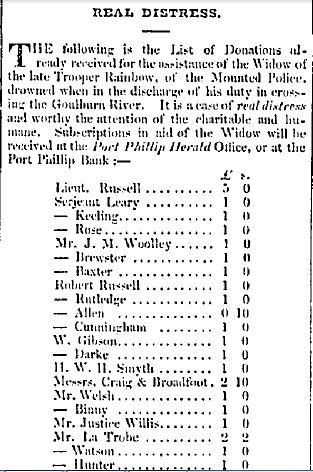
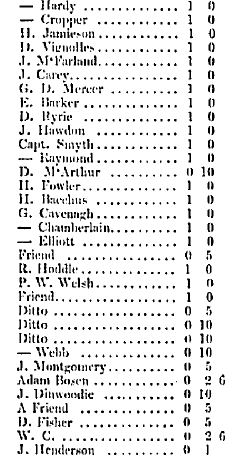
By 2nd July, the last advertisement appeared. It read

Rainbow1

Rainbow2

It’s a highly respectable donation list that raised £51. [A (male) overseer at that time might earn £100 per annum; single female servants were having to accept about £25 p.a. with board.]  Lieutenant Russell, was the most generous, with a donation of five pounds. It is likely that this Lieutenant Russell was the Lieutenant Russell who was commander of the Mounted Police, and other donations were given Trooper Rainbow’s fellow soldiers. Superintendent La Trobe was the next most generous with a donation of two guineas  (2 pounds and 2 shillings), and it is surprising to see Judge Willis’ donation of one pound because he rarely made public donations like this to individuals.

His donation is even more incongruous, because on 27th August, the Port Phillip Herald reported that Vezella Rainbow had been arrested for shoplifting.

The trial before Judge Willis was reported in the next edition (31 August). It was a jury trial, conducted on Friday August 26 before twelve good men of the town (women did not serve on juries). Trials moved pretty swiftly back then, and it was common to have three or four hearings within the one day. Juries made up their minds very quickly, often not even leaving the courtroom at all.   The prisoner was not called to the witness box and did not give evidence on their own behalf. Instead, it was up to the crown to prove the case through witnesses, and the question of ‘character’ often entered into consideration. In this case, the prosecution called three witnesses: Mr Codd the shop assistant, Mr Whitehead the shop-owner, and Constable Stapleton, who arrested her.

Vezella Rainbow, widow of the late Corporal Rainbow, was placed at the bar, charged with stealing a shawl, value two pounds, and five yards of Saxony cloth, value 18s.

Clement Codd, being sworn, deposed- I am shopman to Mr Robert Whitehead, Elizabeth-street; I saw the prisoner in his shop on Monday last; she purchased to ribband [sic] waistbands and paid for them four shillings, giving two half-crowns and being returned one shilling; did not ask to see any other goods; I was serving other customers at the time shewing them some shawls and Saxony dresses; the dress and shawl produced I identify to be the property of Mr Whitehead (here the witness received a caution from His Honor as to how he would swear to the identity of articles), I know them by private marks; I took them from the prisoner at the bar; she had them concealed under her shawl; they had been lying on the counter. I do not think Mrs Rainbow could have only taken them up to look at, without intending to take them away; they were concealed in such a way that when I took the dress from prisoner she denied having anything else in her possession; I had given her the change, she was putting it in a handkerchief and was about to leave the shop, when I perceived the articles with her.  After taking the things from her, I left them on the counter and went for a constable; I left Mr Whitehead in the shop; I marked the things and gave them to the constable who took the woman away; there are other Saxony dresses in the shop but none of the same description.

Cross examined by Mr Barry; there was another woman in the shop when the prisoner entered; subsequently a man came in; the woman who came in looked at some saxony dresses and then came out; brought back the man with her to buy her one, which he did.  The prisoner had a bundle under her arm; can’t say what it was; thinks it was a bundle rolled up in a yellow handkerchief: I marked the things after bringing back the constable; the prisoner was in conversation with the other persons in the shop: can’t say what they said: it was about articles of dress.  I particularly observed when the prisoner came into the shop that she had something under her arm; before I took the articles in question from Mrs Rainbow, she had not attempted to leave the shop: the articles she purchased still remained on the counter, when I perceived the dress with her: when I took the things she did not say any thing, but when going to the watchhouse, said the other woman had given them to her.

Robert Whitehead, being sworn, deposed, I keep a shop in Elizabeth-street; I know the prisoner at the bar; saw her in my shop on Monday evening last; I identify this shawl as being my property by the shop mark on it; I positively swear to the shawl.  I do not know any other shop that makes use of the same marks as I do; I saw Codd take the things from under prisoner’s shawl; just as a came into the shop; there was a man and a woman in the shop at the time the prisoner and another woman was conversing together; there was a man between them: I desired Codd to go for a constable, he brought one back with him. (The Judge here addressed the witness, stating, that although he did not mean or wish to impune his evidence, still there were many things he had stated required explanation.  His Honor compared different portions of the evidence and pointed out various discrepancies) another shopman was present, part of the time.

The witness was here cross examined by Mr Barry, but nothing particular was elicited.

Constable Stapleton, deposed to the facts of having taken the prisoner in charge, she being delivered up to him by Mr Whitehead, he also stated that the prisoner on being conveyed to the watchhouse said, that it was owing to bad company she got into the scrape.

Redmond Barry (yes, that same duelling Redmond Barry) acted as her defence counsel.

For the defence, Mr Barry addressed the jury as follows: I have no doubt Gentlemen, that after the evidence you have heard, you will proceed to discharge the defendant, for in my humble opinion there is no evidence to prove that the prisoner at the bar feloniously took the articles with intent to carry them away, which the law requires to constitute the crime, with which she is charged.  My client stands in a situation of peculiar delicacy; it is most distressing to witness it; and bear in mind gentlemen, the great disgrace she has already undergone by being arraigned at a bar of justice, on a charge of such a description.  Discrepancies of the most serious nature occur in the evidence to which I must request your particular attention, as they occur in the testimony of all the witnesses.  Gentlemen, the prisoner at the bar is the widow of the late corporal Rainbow, who was drowned in the Broken River, in the discharge of his public duty.  I can call innumerable witnesses as to the very good character of the unfortunate defendant, and you may well remember the great commiseration that was exhibited by the public towards Mrs Rainbow, on the death of her husband.  Indeed, gentlemen, I feel deeply affected by being obliged to come before you to plead in such a case as this; for the miserable prisoner at the bar is in such a state that she must soon give birth to an infant, who if you find the prisoner guilty, must first receive the pure air of heaven, the gift of the Almighty, in the murky dungeons of a loathsome prison, redolent of vice, obscenity and filth. I hope therefore you will immediately proceed to acquit my client, as I am sure you are already persuaded of the innocence of the prisoner, and as the entire of the evidence is so contradictory and unsatisfactory.  I shall leave the case in your hands, satisfied that it will meet with that consideration it so imperatively calls for.

It’s interesting to watch Judge Willis in action here.  He was very active during the case itself, pointing out the discrepancies in Mr Whitehead’s testimony and, according to a separate article in the same issue of the  Port Phillip Herald (31 August) Willis called up Codd immediately after the case and “proceeded to reprimand him in the strongest terms for gross prevarication in his testimony”. Willis read Codd’s  testimony at the Police Office and the Court back to him, pointing out the inconsistencies, and warned Codd that “he might be thankful for the clemency shewn him in not being committed to gaol for his gross prevarication”.   Notwithstanding these inconsistencies, and the  pound that Willis himself had donated for the unfortunate Mrs Rainbow a few weeks earlier, he then summed up very strongly against the prisoner:

The Judge summed up the case in an able manner, concluding by desiring the jury to divest their minds of any influence that the affecting address of Mr Barry might have on them, for notwithstanding the distressing circumstances of the case, as good and honest subjects they were bound to give their verdict, and assist as far as it lay in their power to have the law  carried into effect, justly and uprightly.  The jury after a few moments consideration found the prisoner guilty with a strong recommendation to “mercy”.

His Honor, in an affecting manner passed sentence on the prisoner, sentencing her to “six months imprisonment in her Majesty’s gaol of Melbourne”.  [PPH 31/8/41]

In his book Crime in the Port Phillip District (p. 198), Paul Mullaly reports that Vezella Rainbow (the spelling of her first name varies) was Freed by Servitude (i.e. an ex-convict) which may account for his hardline approach.  It was reported that “other Police had to take care of her children”.  On 15 April 1842, the Colonial Secretary wrote to La Trobe approving remission of sentences of 16 listed individuals including Vizle Rainbowe [sic] (VPRS Series 19 Unit29), so it does not appear that her sentence was reduced much, if at all.

HOW’S THE WEATHER?

Just as we’re experiencing here in 2016, the spring weather wass changeable. The warmest day for the month was 27th (69 degrees or 20.5C), followed by a strong gale the very next day.  The coolest temperature was 37F or 2.7C.

This Week in Port Phillip 1841: 17-24 August 1841

THE WATER CARTERS

At this stage, Melbourne was reliant on water carters for its water supply. Having recently spent some time in Nairobi where our house was reliant on tanked water for its domestic supply, I have a new appreciation for the angst caused by the non-appearance of the water delivery tank.

THE WATER CARTERS: Of late, several impositions have been attempted, and threats made by the carters who are in the habit of supplying the inhabitants of Melbourne with water. On Tuesday last one of these worthies was requested to bring a load to a resident in Bourke-street, which he willingly promised he would, and proceeded, as he said, direct to the pumps for the purpose. Hours, however, passed over, and no water cart made its appearance.  After waiting for so long a time, absolutely in the greatest want of the water, there was no other alternative left than to send through the streets and purchase a cask from another man. When a considerable period had elapsed after the so-much-required supply had been procured, the first carter arrived with his load, but as he had so disgracefully broken his agreement, and besides, as the water was not only then not required, but as there was no vessel for its reception, it was refused, and no payment of course would be made. Upon this announcement, the villain burst out into a violent storm of passion, discharged the water upon the path near the door, and threatened he would instantly have the person who had given him such offence summoned to the court.  Certainly there must, in a civilized colony, be some law wherewith to punish such vagabonds. It would be well for a case to be tried to solve the question. [PPH 17/8/41]

AN AFFAIR OF HONOUR

On 20th August the Port Phillip Herald reported a “hostile meeting” between “Mr B___ a gentleman of the bar” and Mr S_____.  These thinly disguised names would have been readily known to Port Phillip inhabitants: Redmond Barry (then aged 28) and Peter Snodgrass (aged 24).  As Edmund Finn, writing as ‘Garryowen’ described in his inimitable way:

In August 1841 occurred a hostile meeting, remarkable in consequence of the position attained in after time by the principals. Mr Peter Snodgrass was by no means the least pugnacious individual of an extinct generation, and it did not take much to get up a casus belli with him. Mr Redmond Barry was a gay and promising young Barrister, and the two were prominent members of the Melbourne Club. Barry had written a letter to a friend, who injudiciously showed it to Snodgrass, about whom it contained some reference, which was deemed to be personally offensive, and a challenge was the consequence.  The gage of battle was taken up, the preliminaries were quickly arranged, and in the rawness of a winter’s morning the meeting came off by the side of the “sad sea waves,” between Sandridge and the present Albert Park Railway Station.  Though the weather was the reverse of promising, Barry made his appearance on the ground done up with as much precision as if attending a Vice-regal levee.  Even then he wore the peculiarly fabricated bell-topper, which a future Melbourne Punch was destined to present to the public in illustrated variety; he was strap trousered, swallow-tail coated, white-vested, gloved and cravated to a nicety.  He even carried his Sir Charles Grandison deportment with him to the pistol’s mouth, and never in years after appeared to such grandiose advantage as on this occasion.  When they sighted each other at the recognized measurement, before Barry took the firing-iron from his supporter, he placed his hat with much polite tenderness on the green sward near him, ungloved, drew down his spotless wristbands, and saluted his wicked-looking antagonist with a profound obeisance that would do credit to any mandarin that ever learn salaaming in the Celestial Empire.  They taking his pistol and elevating himself into a majestic pose, he calmly awaited the word of command.  Snodgrass fussed and fidgetted a good deal- not from the nervousness of fear, for he was as brave as an English bull-dog, but rather from a desire to have the thing over with as little ceremonial nonsense as possible, for he was Barry’s antithesis as a student of the proprieties.  It was his over-eagerness on such occasions that caused his duelling to eventuate more than once in a fiasco, and unfitted him for the tender handling of hair-trigger pistols. By a laughable coincidence, the present “engagement” was terminated in a manner precisely similar to what happened at the duel of the year before, when a hair-trigger prematurely went off.  The same fire-arm was now in use, and just as the shooting-signal was about to go forth, the pistol held by Snodgrass, getting the start, was by some inadvertence discharged too soon, whereat Barry at once magnanimously fired into the air. Little could either of the duellers foresee what futurity had in store for both.  The one grew into the esteemed and popular forensic Advocate, and on to the eminent and universally-valued Judge; whilst the other, in the following year, was a gallant capturer of bushrangers, and ended his career as an active Member of Parliament, and a voluble if not eloquent Chairman of Committees in the Legislative Assembly.

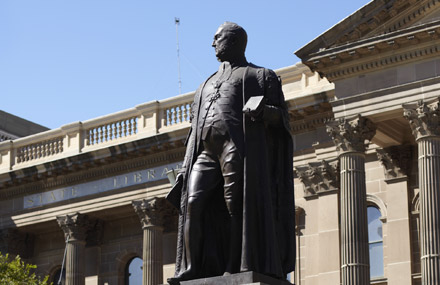
redmond_barry_statue

Redmond Barry in his later, more sober years.

A NEW POST OFFICE

The new post office had opened on the corner of Bourke and Elizabeth Streets week earlier, having vacated its former premises in Little Collins Street.

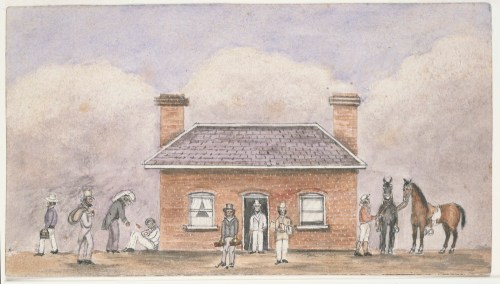
Secondpostoffice

The Second Post Office by William Liardet. This post office in Little Collins Street was superseded by the ‘new’ post office on the corner of Bourke and Elizabeth Streets, which opened in August 1841.  State Library of Victoria

http://handle.slv.vic.gov.au/10381/151517

[Actually, looking at this picture- is that a beggar sitting against the wall, receiving alms from a lawyer??]

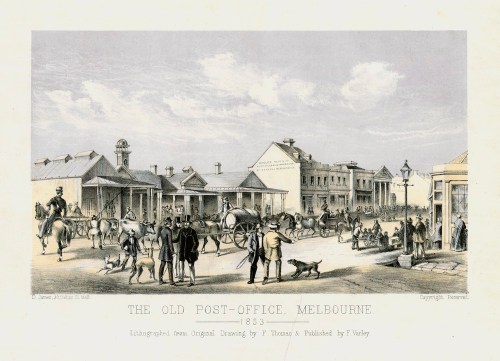
3rdpostoffice

The third post office, which opened in August 1841, is shown here in 1853, only six years before it was demolished for the first GPO which was built on the site. Note the deep gutter to the right of the image, built to try to control the unruly waters of Elizabeth Street. Original drawing by F. Thomas. State Library of Victoria

http://handle.slv.vic.gov.au/10381/261742

On August 17 the Port Phillip Herald praised the appearance of the letter-carrier, who seems to have cut quite a dash:

The scarlet coat, gold band on the hat, and leather case under the arm of the letter carrier, give a very gay appearance to the town of Melbourne, and to the gay lothario who sports them [PPH 17/8/41]

SOME BITS AND BOBS

An arrival in port

There was a 62 ton schooner called Truganini that arrived from Hobart. Interesting that the the woman we know as Truganini (Trugernanner) was at this stage in Melbourne, having come across with the Aboriginal Protector George Augustus Robinson.  I wonder how and why the boat was named Truganini?

A caution

An interesting advertisement:

CAUTION.  The public are hereby Cautioned against giving credit or harbouring my wife, Agnes Brown, she having decamped from her home, taking with her a watch, tea caddy, box and bed quilt on Thursday last.  Any person found harbouring her, will be dealt with according to law; and persons giving me such information as will lead to conviction, shall receive Five Pounds Reward.  James Brown. X his mark.

Until the passing of the English Divorce Act in 1857, divorces could only be granted by an Act of the British Parliament: an avenue restricted to very wealthy people. Only one petition for divorce was ever made in New South Wales (and that, interestingly enough, was on the part of the wife). Although legislation to protect Deserted Wives and Children was introduced in NSW in 1840, the emphasis was on men deserting their wives rather than the other way around.  However, as the advertisement above makes clear, women did not have property rights to any family goods, when they left a marriage, an illegal act in itself. A watch, a tea caddy, a box and a quilt: possibly  the watch and the contents of the tea caddy were all the portable property the couple held, while the quilt seems a particularly female object to take. [Memo to self: must go see the Quilt Exhibition at NGV Australia before it finishes in November].

And another interesting advertisement:

STRAYED about a fortnight ago- a boy about nine years old, had on light trowsers, blue cloth jacket, rather large pair of old worn out boots, dark hair, freckled features, round plump face; a small dog following blind of one eye.  The boy has strayed in a similar manner before and went in a fictitious name. He is supposed to be in the vicinity of Melbourne. Whoever will give information where he may be found to Mr Henny, Irish Harp, will be thankfully received. [PPH 17/8/41]

AND THE WEATHER?

Strong winds prevailing, weather cloudy or rainy.


This Week in Port Phillip 1841: 9-16 August

There’s been a little story bubbling along in the papers over the last week or so about a “cowardly assault” on the Rev. A. C. Thomson, the Anglican minister of St James Anglican Church.  St James was the only Anglican church in Melbourne at this stage, and it was located at that time near the corner of Collins and Williams streets. It was then a small weatherboard building, with a school building attached.

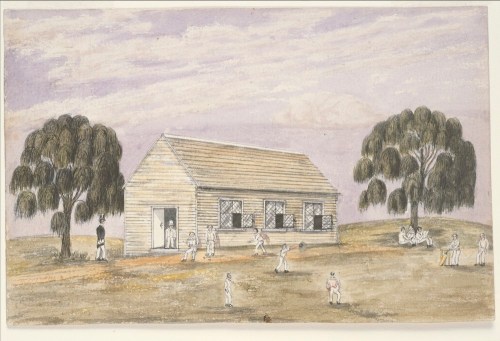
St. James Church and School

St James Church and School by William Liardet (painted 1875), State Library of Victoria, http://www.slv.vic.gov.au

http://handle.slv.vic.gov.au/10381/151499

The original weatherboard building was replaced by a brick building which opened in 1842 but was not completed until 1847. This second brick building was relocated to its present site in 1914 where it is now known as St James Old Cathedral.

On 3rd August, the Port Phillip Herald reported that the Rev and his friend Mr Patterson had been the victims on an assault. [Apologies for the queries- it’s difficult to read]

COWARDLY ASSAULT. Yesterday evening as the Rev Mr Thomson and Mr Patterson, son of Dr Patterson, were proceeding along the newly erected fence [?outside?] Rev Thomson’s residence, the crash [of a ?] was heard at some distance, when the gentlemen immediately hastened [?] but the depredators fled hotly pursued.  Mr Patterson first came up with the [?] a struggle ensured which continued as Mr Thomson came to his assistance.  They eventually succeeded in taking whole, three in number, prisoners and [?] them in the watchhouse. [?] Rev Thomson and Mr Patterson were [?] by the ruffians with palings, but although hurt, we are glad to say, not seriously. We shall give the full particulars in our next [PPH 3/8/41]

And so, as promised, the next issue reported that the case was brought up in the Police Court on Tuesday, the lawyer Mr Carrington was acting for the prosecution.

Mr Carrington begged of their worships to postpone a case in which he was engaged for the prosecution. It was a case of assault on the Rev Mr Thompson [sic] committed by John Hunter, Campbell Hunter and Alexander Hunter on the night of Monday last, one of the party being unwell and unable to attend. Mr Meek and Mr Gourley consenting to go security for the appearance of the parties on Friday next (this day). The application was granted. [PPH 6/8/41]

So, who were these Hunter boys?  The Australian Dictionary of Biography lists John and Alexander under the omnibus title of the ‘Hunter Brothers’ (John, Alexander, James, Andrew and William) five of the six sons of Alexander Hunter of Edinburgh.  Paul de Serville in his book Port Phillip Gentlemen has John and Alexander as brothers, with Campbell listed as their cousin, who also rather confusingly had a brother John Hunter as well (this other John Hunter was part of the firm Watson & Hunter). From the shipping lists, Elizabeth Janson has the two brothers John and Alexander arriving in Port Phillip on 13 August 1840 on the Culdee.  They were all young: in 1841 Campbell was the eldest at 22, John was 21 and Alexander was 20. Campbell was to die only five years later, but John and Alexander’s lives demonstrated the mobility of Scots settlers throughout the empire, with John dying in Buenos Aires in 1868 and Alexander settling in South Africa, returning to Port Phillip then dying at sea in 1892 on his way back from Scotland.  In Port Phillip, they were part of the influx of Scots settlers, but there was little love lost between them and the Scots leaders of Melbourne society including Lyon Campbell and Farquahar McCrae.  Paul de Serville describes them as “high-spirited”, adding in parentheses that  “(the unkind might call some of them gentlemen larrikins)” (de Serville, p. 64)

Despite their high spirits (which may or may not have been bolstered by spirits of another kind), the Hunter boys would not particularly have appreciated being hauled before the Police Court along with all the other petty thieves and drunkards.  It’s no surprise, then, that things were smoothed over:

THE ASSAULT CASE. The three Messrs Hunter, who had been summonsed to appear at the Police Office on Friday, charged with an aggravated assault upon the Rev. Mr Thomson, on the night of Monday last, have settled the matter out of Court, by making a written apology to that gentleman, and an acknowledgement of their error through the local press.  We are glad that the matter has been thus settled without being brought before a Court of Justice; for although we are firmly convinced that nothing could have been pleaded as an excuse for so wanton an outrage on public decency, it would not have added much to the respectability of our province to have matters of this kind, where the parties implicated move in the most respectable sphere, brought before the Police Office. Mr Thomson has shown himself to be a Christian in every point of view, in waiving the prosecution, and we do sincerely trust that Tom and Jerry larks, as they are fashionably termed, of this description may never again disgrace the province of Australia Felix.  What fun there can possibly be in breaking into a Clergyman’s premises, and then knocking him down, and shamefully ill-using him, we confess ourselves entirely at a loss to discover; in our humble opinion, it is the ne plus ultra  of genuine blackguardism, and as such should meet with the most severe reprehension of every honest man; for ourselves we most candidly state that a repetition of such disgraceful conduct shall meet with the strongest condemnation and most public exposure, through the columns of this journal, no matter what the rank of the parties implicated may be; we have had by far too much of these pranks already.[PPH 10/8/41]

In his book Port Phillip Gentlemen, Paul de Serville notes that the Melbourne Club, “the most important social institution in Port Phillip” (p. 63) was made up of two groups.  The senior group in age and position were the inner circle of ‘good’ society, while the other group was younger and wilder, “the gentlemen rowdies of the Waterford school” (p. 66), a reference to the Marquess of Waterford, Henry Beresford, who was said to have ‘painted the town red’.

They were mainly squatters with some town allies: Peter Snodgrass, Gilbert Kennedy, Henry Fowler, Alexander Hunter, his brothers and cousins.  After long drinking parties, they fought duels, assaulted the constables, broke windows, removed signs and sawed down verandah posts. (de Serville, p. 66)

Poor old Rev Thomson was one of their victims, but it is interesting to note the ‘tut-tut but boys will be boys’ attitude of the Port Phillip Herald.  It’s a far cry from the moral panic provoked by petty crimes committed by former convicts or recent immigrant labourers. The concern seems to be mainly with the challenge to the respectability of Port Phillip if  “parties who move in the respectable sphere” were forced to face the indignity of the Police Court.  I find myself reminded of similar gentry larrikinism in Upper Canada, where the young scions of MPs and the ‘best’ families rampaged through the offices of William Lyon Mackenzie’s newspaper, throwing his type and printing press into the lake in the Types Riot. In both cases, these young men could avail themselves of means to escape the full wrath of the law that were unavailable to less well-resourced lads.

EMIGRANTS

Even though Melbourne was groaning at the seams with the sudden influx of a number of immigrant ships, I was interested by an advertisement in the Port Phillip Herald on 10 August by an Irish emigration agent, advertising his services in bringing immigrants out to Australia.  The advertisement was clearly aimed at settlers who had already made the trip themselves, and who might be contemplating encouraging other family members to join them here in Port Phillip.

FREE EMIGRATION

REGULAR PACKETS FOR AUSTRALIA. Under the management of Messrs Carter and Bonds in conjunction with Messrs John Gore and Co, Mr Robert Brooks and other merchants of London, interested in the colony.

JOHN BESNARD, Junr. CORK. SOLE AGENT FOR IRELAND.

These Packet ships are all first class, of large tonnage, have poops and first rate accommodations for Cabin, Intermediate and Steerage Passengers.  The Captains and Officers are carefully selected for character and experience, and a skilful Surgeon is appointed to each ship.  They will sail in the following order, and never deviate (wind and weather permitting) from the fixed day of sailing, viz:

For PORT PHILLIP FROM LONDON

March 1

May 1

July 1

September 1

November 1

FROM CORK

March 12

May 12

July 12

September 12

November 12

For SYDNEY April 1

June 1

August 1

October 1

December 1

April 12

June 12

August 12

October 12

December 12

Passengers from the East Coast of England and Scotland, reach London by Steam at a small expense. Cork has been selected as the final place of departure, on account of the superior advantages of its Harbour, and from its offering great convenience to Passengers than any Port in the British Channel; Passengers from the West of England and West Coast of Scotland, can join at Cork by the numerous Steamers which give cheap and rapid conveyance direct to that Port from Plymouth, Edmouth, Bristol, Liverpool, Glasgow etc.

Free passage, with Victualling and Bedding, will be granted by these Ships to a limited number of Emigrants of the following classes: viz- Agricultural Labourers, Shepherds, Carpenters, Smiths, Wheelwrights, Bricklayers, Masons and Female Domestic and Farm Servants, who are all much wanted in the colony, and will obtain high wages there.

A House has been fitted up for the reception of Bounty Emigrants, where they will be received on their arrival at Cork, and lodged free of cost; and should the Ship be prevented from sailing on the day named, by contrary winds or any other cause, they will be supported, as well as lodged.

A Matron has been appointed to attend to the comfort of the single females. The whole establishment will be under the superintendence of a respectable married couple.

Every person who may go out under the Colonial Government Bounty will be allowed (in case of need) to remain on board the Ship and be victualled for ten days after arrival in the Colony, in order to afford time for his or her engagement in service.  The undersigned has two Brothers residing in New South Wales, with whom he is in constant correspondence; he also receives the Sydney and Port Phillip papers regularly, and has made arrangement with two of the first Mercantile Houses at Sydney and Port Phillip to supply him with every information calculated to be of use to the Emigrant.

As these ships are to be dispatched under the superintendence of Mr Besnard, he pledges himself that nothing shall be left undone to secure the comforts of all parties proceeding by them, whether as Cabin, Intermediate or Steerage Passengers.

A Cow is carried in each Ship, especially for the benefit of Infants and Young Children

All particulars respecting the above ships, and the Australian Colonies, may be known on application to JOHN BESNARD, JUN. Australian Emigration Agent, Cork/.

Quite apart from the momentous nature of leaving to settle on literally the other side of the globe, this advertisement picked up on many of the anxieties attached to the prospect of the journey itself.  The Captain and staff were to be carefully selected, and although the presence of a surgeon was mandatory, their surgeon was to be ‘skillful’. Although the ship departed from Cork, Ireland  it was clearly intended to carry English and Scots, but not Irish passengers.  Bounty emigrants of limited means, selected for skills that had (until recently) been in demand in Port Phillip, did not have to fear being thrown on their own resources should the ship be delayed, and they would receive ten days’ shelter and food on board the ship on arrival after which, I assume, they had to make their own arrangements. Single women would be overseen by both a matron and a married couple, and young children had access to fresh cow’s milk!  Now that the readers of the Port Phillip Herald had arrived safely, surely it would be safe to encourage brothers and sisters, cousins, even elderly parents to come over as well!

HOW’S THE WEATHER?

The weather for the week was generally fine and clear, with slight rain on 14th August.  The top temperature for the week was 60F (15.5C) and the lowest temperature was 32 (0). The coldest day of the month was on the 9th.

However, the heavy rain of the previous week had led to flooding in many areas.  Even Judge Willis, a real stickler for punctuality, was delayed on his journey from Heidelberg by the impassable roads. And news from out Gisborne way indicated that it was flooded out there too.

 A settler who arrived on Sunday last from the Mount Macedon district, left his station on the Tuesday previous, and from the flooded state of the roads and creeks he had to cross, was detained three days on the journey; and then he had to swim two Creeks (Jackson’s and the Deep Creek) before he could reach Melbourne; our informant states that a considerable quantity of snow had lately fallen in that district (PPH 13/8/41)


This Week in Port Phillip in 1841: 1- 8 August 1841

Melbourne was bravely proclaiming that perhaps things weren’t too bad economically here (even if Sydney, South Australia and Tasmania were in trouble)… but then the ships came in.  Seven in all – five of them big ships- disgorged 1356 bounty emigrants in July and in this first week of August, the enormity of the influx became apparent.  The Royal Saxon had arrived on July 17 with 246 bounty migrants from Cork, predominantly Roman Catholic, under the aegis of J. B. Were.  The same day the England arrived from Liverpool, straight into quarantine, with 367 bounty emigrants, after losing sixteen children on the voyage through whooping cough. The George Fyfe arrived on the 23 July with 214 bounty migrants from Plymouth, organized through the agent John Marshall, and another of his consignments of 246 British migrants arrived on July 30th on the Westminster.  The William Abrams, which arrived on July 26, had 171 bounty migrants, mainly for pastoralists Watson and Hunter.

Initially, inbound migrants were housed and fed in tents for a two-week period only on the south side of the Yarra, with the intent of moving them quickly into paid employment. This canvas town, which included people no longer eligible for government aid, swelled to two thousand at its peak.  Eventually the assisted immigrant camp was shifted to the Government block bounded by Collins, Market and William Street and hospital facilities were established in what had been John Batman’s house near what is now Southern Cross. At this stage, everything was makeshift, and the Port Phillip Herald began calling for dedicated immigrant barracks and a month’s rations, as provided in Sydney:

A similar place of refuge here, under a similar arrangement, would be found beneficial, the stream of emigration having set in strong towards Australia Felix, of course decreasing the prospect of immediate employment, and thereby rendering it imperative that the same protection should be extended here to the unprovided for (PPH 27/7/41)

The Herald’s wells of sympathy did not run deep, however, with complaints about unrealistic expectations on behalf of the immigrants:

 A day or two since a respectable master builder went on board the emigrant ship England, for the purpose of engaging a few carpenters and joiners.  The fellows refused to take his offer because he would not give more than twelve shillings a day . These worthies deserve to starve, as it is very evident they do not feel disposed to work.  The agent for the ship, it is hoped, ordered them on shore forthwith, instead of allowing them to luxuriate in idleness on board the vessel, making demands exorbitant in their nature in the highest degree, and much more than they will be able to get at present in town.(PPH 30/7/41)

On 3 August, the newspaper reported that the emigrants camped in the tents had received some spiritual sustenance at least:

THE CAMP. On Sunday a Presbyterian Clergyman, went to the place where the emigrants by the Royal Saxon and England are encamped, and delivered a lecture much to the comfort of those present; he was heartily joined in the psalmody by many of the emigrants. He appeared to sympathise with the poor creatures, particularly with those having large families of seven or eight children, of which there are too many. It is hoped a few days more will free them from their sufferings. (PPH 3/8/41)

It reported that there were a number encamped ‘at the Supreme Court’, which I assume refers to the government block. I’m not aware that there were any formal arrangements for them at the court.

THE EMIGRANTS.  There are now only twenty males and nine females disengaged amongst the emigrants encamped at the Supreme Court. This does not include the children of whom unfortunately there are too many. They are hiring with masters for any thing they can get, they are principally country employers who are taking them away.  It is a loss to the people, but an advantage to the settler.

A few days later, the Herald reported:

THE CAMP There are now only very few left in the camp.  By degrees the settlers up the country are hiring them, but at a very low remuneration.  There is one family at present in a most deplorable state.  The mother and infant have never left their bed since being brought there, and are supported solely by the neighbouring inhabitants.  It is a case well deserving  the attention of the kind hearted.  The heavy rain on Wednesday and today penetrated through the tent, and the poor creature was lying all the time under a wet blanket.  Could not some more suitable habitation be found in Melbourne for such an object of compassion as this?

There were calls for the migrants to be put to work on the roads or set to repairing the wharf, but this would not occur for some time yet.  There was disquiet about the quality of some of the migrants, particularly those from Ireland, and the pro-private-enterprise Port Phillip Herald championed the private bounty agent scheme, such as that conducted by Mr John Marshall who arranged the George Fyfe and Westminster consignments, over that of the government schemes:

There can be no doubt that either system could be made to work if the necessary trouble were taken by the respective agents; and it therefore only remains to determine under which it is probable these agents will be more honest in the discharge of their duties; and on this point we have very little hesitation in according our opinion, that it is more reasonable to infer that those agents will be more attentive whose character and interests are at stake, than those who receive a definite salary, and who have no ulterior advantage resulting from the character or proper treatment of the persons sent out. By the bounty system, the colonists are enabled to write to their agents at home, or to select some gentleman of colonial experience from amongst themselves to procure the most suitable description of emigrants: and these agents being accurately informed of every particular; and, as upon their fidelity will depend their future employment, they, it is only reasonable to infer, will use every effort to comply in every respect with the wishes of their employers.  The government agents may be men of ability and honor, but as they cannot be aware but by general report of the particular description of emigrants most urgently required; and as they may never have been in any of the colonies, they will of course be entirely ignorant of the natural circumstances of the country, and therefore, even if they were as wise as Solon, and their honesty, like Cato’s wife “above suspicion”, it is contrary to every established maxim of doctrine and principle to suppose for an instant that they either could or would be so efficient as the bounty agents…(PPH 6/8/41)

Occasionally you get a glimpse of an individual amongst all these people streaming into Port Phillip, although it’s generally tragedy or notoriety that brings them to our attention. Such is the case of Sarah Russell, who was said to have arrived on the William Abrams:

SUPPOSED SUICIDE. On Sunday morning at an early hour, a female residing in Roach’s Terrace, left her lodging and went in the direction of the Yarra, near to the place where the steamer lies.  The other parties in the house were surprised at her leaving so early, and were of opinion she was not right in her mind. During the morning some of the parties were walking by the river, and saw her sitting under a tree close by the bank.  In the evening a little girl called at the house for her, but she had not returned; search was made, but no trace of her could be obtained; it is supposed she has thrown herself into the Yarra, and the cause is reported to be disappointment in love  (PPH 3/8/41)

A couple of days later, she was found:

ATTEMPT TO COMMIT SUICIDE. The female who it was supposed had thrown herself into the Yarra on Sunday last, was brought before the Magistrate on Tuesday morning.  It appears she did throw herself in , but afterwards by some means or other was relieved from a watery grave.  She came to the house of a man named Lake, in Little Flinders-street (he, who formerly kept the Ship Inn) with her clothes dripping wet, and being provided with dry clothes went out gain in the direction of the river; she was followed, and from her actions when near the water it was plainly seen she intended to throw herself in again; she was, however, secured, and placed in the watchhouse. Her name is Sarah Russell, an immigrant by the William Abrams; the Bench ordered her to be taken to Doctor Cussen’s to get his opinion as to her sanity. She appeared very much excited. (PPH 6/8/41)

I wonder what happened to her?  A study of the arrivals pre-1847 lists two young Sarah Russells arriving in July 1841, both by different ships and neither by the William Abram. I’m going to hope that she’s the Sarah Russell who married James Dobson in 1845.

The weather?

As might be expected in winter, the weather was ‘cloudy and rainy’ with strong winds on the 5th, 6th and 7th August. The highest temperature for the week was 58 (14.4 C) and the lowest 38 (3.3 C)


This Month in Port Phillip: July 1841

Oh dear, all my good intentions of writing a weekly report have all turned to dust! I think I’ll just do a quick skate through July 1841 and then take up again in August 1841.

So what did happen in July 1841?

THE APHRASIA ARRIVES

With our own emphasis on roads and across-land transport, we tend to overlook the steamers that plied their way across Port Phillip and Westernport Bays. In July 1841 the coal steamer Aphrasia joined three other regular steamers based in Port Phillip.

There’s a picture of the Aphrasia here.

The Aphrasia plied between Melbourne and Geelong, a 45 mile journey that took about five hours. When the service started in July 1841, it was planned to run twice a week to Geelong on Monday and Thursday mornings and return the following evening.  It was hoped that an extra service could be introduced shortly.  The Aphrasia was captained by Capt. Henry Lawler, and is commemorated in Geelong in Aphrasia Street.

Interestingly, in the last year or so, two new ferry services have commenced in Melbourne. One runs from Werribee South to Docklands, and the other which commenced last week goes from Portarlington to Docklands.

THERE WAS A DUEL

DUEL EXTRAORDINARY.  On Saturday night last, a hostile meeting took place between Mr S___ and Mr D’M_____ near the Flagstaff.  The quarrel originated after dinner, in consequence of a tumbler of whisky toddy having been thrown in the face of the latter gentleman, which not being taken in the Pickwickian scene as intended, a challenge was the immediate consequence.  Mr S. was attended by Mr B., and Mr D’M by Mr R. when by the full ‘light of the moon’ two shots each were exchanged, but happily without effect.  The parties then returned to the house where the quarrel took place, and spent the evening with much conviviality as if nothing had occurred. – It is only necessary to add, that the seconds, unknown to the principals, had adopted the necessary precuation of loading the pistols with powder only! (PPH 6 July 1841)

I assume that Mr S____ was Peter Snodgrass, who was rather fond of the odd duel here and there. Paul de Serville has D’M written as D.Mc____.

THE GLOSS FADED ON JUSTICE JOHN WALPOLE WILLIS

Judge Willis had only been in Melbourne since April, but already by July people were starting to grumble about him.  The barrister Edward Brewster and the Police Magistrate James Simpson both fell under his animadversion (what a splendid word!) and public opinion was very much on Simpsons’ side.  When Willis first arrived in Melbourne, there had been gossip about his ‘lack of dignity’ and ‘injudicious temper’ on the bench, but it was largely overlooked in the excitement of opening a Supreme Court in the district. But now, Willis’s “lamentable deficiency of that uniform temperament so desirable in all, but so absolutely important, and in fact indispensable in a Judge upon the Bench” came more clearly into view. (PPH 23/7/41)  The Port Phillip Herald wrote:

A very short period of the continuance of His Honor’s course will be sufficient to render it imperative upon our fellow-colonists, out of justice to themselves, to address His Excellency the Governor upon the subject, and although such petition may not have the direct effect of obtaining the removal of the judge, still the result will be indirectly the same, for it is not probable His Honor could feel comfortable in presiding in the court of a province after the public expression of the colonists’ dissatisfaction with his manner, and under these circumstances we may reasonably infer, that an immediate and voluntary resignation of his seat will be the necessary consequence. ( PPH 27/7/41)

As the good people of Melbourne were to discover, it wasn’t quite that simple….

STILL, THERE’S ALWAYS LAND ISN’T THERE?

Land was advertised on the corner of Lonsdale and King Streets. I hadn’t noticed advertisements for this part of town before.

Here’s a Google map street view of it today.

The situation of this valuable property is almost unequalled- being in the most beautiful, healthy and respectable part of the town, and within 150 yards of the telegraph, which is becoming a most FASHIONABLE PROMENADE. This part of Melbourne promises to become in a few years the most eligible part of the town, from the considerable reserves devoted to public buildings, the church, market and others; and this neighborhood has escaped being filled with a dense population, living in skillions, and congregated into rookeries, to the great detriment of public health. Gentlemen desirous of a site for a house in a respectable, quiet, airy and healthy situation are requested to attend this sale.  (PPH 6/7/41)

I don’t think that this was ever the most eligible part of town! However, I noted that ‘Anonymous’ in Graeme Davison’s article thought that the Flagstaff area should become a city square.  I’m interested that so early in Melbourne’s history – after only six years-  there is already being promulgated an almost Dickensian view of Melbourne as a crowded, unhealthy urban space.

AND THEN….

It’s just as well that someone was still boosting the economy because prices are falling, land auctions are faltering and wages are being reduced.  And then two more ships arrived…

This Week in Port Phillip 1841: 24 June-30 June 1841

MR DIGHT’S FLOUR MILL

You might remember that on May 1-7 the Port PHillip Herald announced that construction was to begin on a water-driven mill at what we now know as Dight’s Falls. Work had continued apace:

NEW FLOUR MILLS. Mr Dight, a gentleman lately arrived in our province from Sydney, has commenced operations for the erection of a flour mill, at the junction of the Merri Creek and Yarra Yarra.  This will be an inducement for the settlers in the neighbourhood to cultivate more extensively than hitherto, as they will now be enabled to have their wheat ground without the necessity of exporting it to V. Diemen’s Land, or any other of the neighbouring colonies, and being at the additional expense of importing flour in return.  The back or “tail” race has already been cut, and the building itself will be commenced in about six weeks; and as almost all the fittings up, and other requisites are already provided, we may expect that the mill will be in full operation before many months. The situation has been well selected, and the government have promised every encouragement which such undertaking so richly merits.  We heartily wish the spirited proprietor, who is a native of the colony, every success; and we embrace the opportunity of congratulating our fellow-colonists upon the prospect of being enabled to produce facts in refutation of the jealous misrepresentations of such productions as Murray’s Review, in which the province is said to be entirely “unfitted for agriculture”.(PPH 25/6/41)

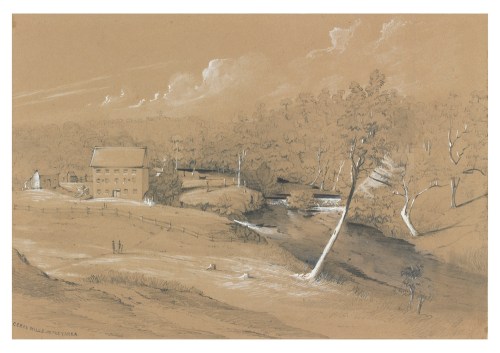
Ceres Mills on the Yarra

Ceres Mill on the Yarra by George Alexander Gilbert, 1846-7 SLV (or possibly by one of his pupils)

http://handle.slv.vic.gov.au/10381/298652

THINGS LOOKING WORSE

The same inactivity which existed in our markets last week has still continued and no expectation of a rise can be entertained when a comparison is made between the present stock of all articles of general consumption and what it was at this present period in 1840 (PPH 25/6/41)

Wages for recently arrived emigrants were falling. Several recently arrived emigrants engaged at £25 per anuum for single farming men; their wages used to be from £35-40. However, at this stage it was perceived that

This is to be attributed solely to the pressure of the times, and not to the labour market being over stocked. (PPH 25/6/41)

Not only were wages falling, but prices were falling as well. A  4lb loaf of bread fell from 1s.6d to 1. 3d, and meat could now be purchased at 4d. a lb instead of the 5d and 6d a pound that was the going price in May. (PPH 29/6/41)

BUT YOU CAN’T GO WRONG WITH LAND, CAN YOU?

IMPORTANT LAND SALE. On Friday morning last, it was generally known in Melbourne, that Sir George Gipps had given notice of his intention to throw open for selection, on the uniform-price system of 1 pound per acres, a very large quantity of Port Phillip land.  The consequence was, that during the whole of that and subsequent day the Survey Office was thronged by parties desirous of obtaining information on the subject. We are indebted to Mr Hoddle for the following particulars, and are requested by that gentleman to state, he will feel obliged if parties will not call at the Survey Office to make enquiries relative to the sale until after tomorrow, as the clerks are all busily engaged in making out the descriptions which are very lengthy. The land will be advertised in the usual way, either at the end of this or the beginning of next week. It may be as well to remind our readers that the following are the conditions under which the land will be disposed of. Immediately after it has been advertised, parties who pay in their money first will be entitled to first choice, that is if they are in attendance at the time appointed by the Government for the selection to be made; provided always that no land order from England of previous date be presented at the same time.  The allotments vary in size from 35 to 800 acres, but the majority of them are about 150 acres each.  The sale will not take place before three months from the date of it being first advertised; at the expiration of which period there will doubtless be a considerable rush on the opening of the door of the Treasury.

Land was offered on the Werribee River, Geelong, Lake Colac and at Doutagalla parish “between the Salt Creek and the Moonee Moonie chain of ponds”. In the parish of Bulleen, 7635 acres was put up for sale:

The land in the Parish of Bulleen is for the most part thickly timbered with stringy bark, and is also very hilly. There are however several extensive patches of “good grassy hills” (as laid down in the chart at the survey office). The land for sale is immediately adjoining Mr Unwin’s special survey, near Dr McDermard’s cattle station and about seven miles distant from Melbourne, on the South bank of the Yarra.” (29/6/41)

AND THE WEATHER?

Well, it’s winter. A maximum for the week of 60 (15.5C) and a minimum of 42 (5.5C). The weather continued variable, with a gale on 26th.


This Week in Port Phillip 1841: 16-23 June 1841

BAD TIMES A’COMING

On the 18th June the Port Phillip Herald carried a verbatim report of Governor Gipps’ address at the opening of the Legislative Council session in Sydney on 8th June. Among other things, he talked about the opening up of Port Phillip and its contribution to the economic life of the colony.  It was the only bright spot in what was looking to be an increasingly gloomy economic report. We know, as they didn’t at the time, that this was just the start of the 1840s Depression, which was to shake out the speculators from the Port Phillip financial scene.  He noted that the revenue of Port Phillip had more than doubled on that of the preceding year  (from £14608 in 1839 to £29799 in 1840), and the District had contributed a  large amount to the general Land Fund (£217,127):

thus affording to the older parts of the colony, the means of replacing the labour and capital, which the opening of Port Phillip had drained from them. Aided by the resources of the Older Settlement but unassisted with borrowed money; the district of Port Phillip has risen rapidly to a state of wealth and importance which cannot but be highly gratifying to the entire colony.

This was to be an ongoing source of tension between Port Phillip and the old colonies. The residents of Port Phillip felt that they were the ones drawing in all of the money, and that therefore they should be entitled to a greater share of it, especially as it was a new district with large infrastructure needs.

Gipps went on:

The pecuniary difficulties under which many interests in the colony are still suffering must naturally be expected to affect the revenue of the present year, and of probably the next succeeding one; the falling off however is as yet only sensibly felt in the branch of it which is derived from the sale of land, and in this even the deficiency may in part be ascribed to other causes.

These pecuniary difficulties may safely, I believe, be said to have arisen from excessive speculation and an undue extension of credit; they seem to be of the nature of  those which frequently, and almost periodically occur, in all places  where commercial adventure is eager, and the remedy is, I think, to be looked for in the natural course of events, rather than to be sought in any Legislative enactments.

A few of the circumstances which have contributed to bring about these embarrassments in our commercial relations, may perhaps, without much risk of error, be pointed out, though it is very necessary to bear in mind, that in seeking to discover such agencies, we are very likely to mistake effects for causes.

The scarcity of 1838 and 1839 caused a great drain from the colony for the first necessary of life and produced excessive fluctuations in the price of every description of grain.  The decline in price of our chief staple commodity, wool, lessened the value of our exports in the home market.

The excessive consignment of goods to the colony, mostly on speculation by mercantile houses in England produced a  depreciation in value of nearly every species of merchandise, circulated to affect more or less the transactions of the whole commercial body.

The  necessity of disposing of these goods contributed to the undue extension of credit;  whilst the  rapid influx of capital into the colony may have had a tendency to  encourage hazardous speculations and the employment of money in investments, not yielding any immediate return.

A more abundant supply of labour is undoubtedly the one great thing wanted in the colony, for without labour no wealth can be produced, no capital can be profitably employed.(PPH 18/6/41)

If only he knew:  there were boatloads of bounty migrants on the way, many of whom would be unemployed when they arrived at a colony by then in recession.

The following week, the Port Phillip Herald had its own commentary on financial conditions in the District.  At this stage, there was confidence that Port Phillip could ride out the financial storm, even if the other colonies could not:

“THE SISTER COLONIES AND THE PANIC. When we attentively consider the state of the surrounding Colonies, as ascertained both by public statements and private communications, we have indeed much reason to rejoice in our own condition.  It is true that we are not altogether free from the evils which press so heavily upon of neighbours, but whilst our monetary affairs are not in the most healthy state, and our mercantile transactions occasionally dull, they bear no comparison whatever with the alarming state of others.  The depressed, if not altogether ruined condition of South Australia has long been know; in Sydney we are informed, and are convinced by experience, “all things are going on as badly as may be, short of bankruptcy”; whilst in Van Diemen’s Land, the general insolvency expected in other places has for some time actually commenced.  The papers we have received by the last arrivals are absolutely filled with notices to creditors; by private communications we learn that insolvencies are the general subjects of discussion, and everyone is so suspicious of his neighbor, that nothing but absolute necessity compels him to dispose of his goods, trusting to the possibility  of payment to meet his own engagements. (PPH 22/6/41)

Ah. If they only knew what was to come.

THE TROUBLE WITH YOUNG ELIZA

One of the court cases that came before Judge Willis during this criminal sessions was that of young Eliza Jennings, sixteen years old, who had been charged with stealing from her employer, Rev. Joseph Orton.  Joseph Orton was a Wesleyan Methodist missionary, who had earlier fallen foul of the Jamaican magistracy through his strong advocacy for the slaves.  He had arrived in the Australian colonies in 1831, where he travelled between Parramatta, Sydney, Hobart, New Zealand and then Port Phillip. He was the first clergyman to preach in Port Phillip, and he was a driving force in the establishment of the Buntingdale Mission near Geelong.  Known amongst Methodists as “The John Wesley of Australia”, perhaps it was his desire to rescue lost souls that led him to employ Eliza Jennings, who was known to be “light-fingered”.

Eliza Jennings, aged 16, was indicted for stealing three sovereigns, ten half sovereigns, one  pocket-book and a child’s nightcap, the property of Rev Joseph Orton, at Melbourne, on the 11th June.

Prisoner, who came to the colony in the [?] ship Theresa about ten months since, was employed as a general servant in the family of the Rev. Joseph Orton, in whose house she had resided [?] or ten days.  At the time of entering upon this service she was known by her mistress to be light-fingered, and consequently not permitted to enter her bed-room in which Mr Orton kept a cash-box; from this box were missed, on the [?] laid in the information, three sovereigns and ten half sovereigns; the key had been left in the cash box; suspicion alighted on the prisoner and [?] her room was searched, and a pocket-book and a few articles of children’s under-clothing were found.  Upon a second search taking place, a small work box belonging to prisoner was closely  searched […] in a pin-cushion artfully concealed so as to defy detection, were found three sovereigns and ten half-sovereigns. The money had been evidently put inside the pin-cushion by one of the sides, which were of wood, being forced out, and then glued together again, so that the top, which was a piece of silk, was not disturbed.  The girl had been asking for some glue to mend her pin-cushion.

The only way in which prisoner endeavoured to account for the possession of the gold was, that it had been given to her by her father.

His Honor in summing up remarked, that in this case, there was more than mere presumption. He thought the presumption of law that the prisoner had come honestly by the sovereigns was against her, other stolen property having been found in her box for which she could not account. It had been said that the sovereigns were given to her by her father previously to leaving home. It was probable a child like her, leaving home for a distant country, that her friends might scrape together a small sum of money, and that most likely would be in gold.  It was a matter of notoriety that emigrants coming to the colony were in the habit of concealing money about their persons, and in boxes &c.; a work-box was therefore not an improbable place in which a child like her should conceal her money if she had any. The presumption of law was, however, against her in consequence of the other property being found. From the evidence of Mrs Orton, it was clear that in law she was doli capar , or capable of committing the offence, as she was known to be light-fingered before she entered her service.  They would give the case their most careful consideration, and if they could find anything in her favour, arising in the case as in the ordinary course of life, they would give her the benefit.

The Jury, after the absence of a few minutes, found the prisoner guilty, but recommended her to mercy on account of her youth, and the incautious manner in which the money had been taken care of.

Eliza had arrived on the migrant ship Theresa that landed in Port Phillip in July 1840.  As Judge Willis noted, she came out by herself and her religion was registered as Roman Catholic.  It was quite common for juries to reach their verdict within minutes: in fact, they sometimes did not even leave the courtroom.

It was up to Judge Willis to pronounce the sentence. I really don’t know quite how to read the next part.  I’m hoping that his comment that “he had found a place in which she would not be enabled to indulge her vicious propensities” was not a grim joke, but I’m not sure.

Having been called up for judgment, his Honor remarked, that the Jury had returned a very proper verdict, they could not have arrived at any other conclusion. He felt great pain that a girl of her age should be placed as she was; she was, however, old enough to know better.  The Jury had mercifully taken into consideration her age and the improvident manner in which the property was secured. He, Judge Willis, had been making inquiries, and had found a place in which she would not be enabled to indulge her vicious propensities.  A clergyman of her persuasion would visit her, by whose instruction he hoped she would benefit so as, in after life, to become a useful member of society.  The sentence of the Court was, that she be imprisoned in Her Majesty’s gaol, Melbourne, for 12 calendar months, and be kept to hard labour.  He mentioned hard labour, that she might be kept employed during her imprisonment. (18/6/41)

I’m relieved to find that, according to family historians, she might have travelled to the goldfields and ended up on Kangaroo Island by 1847, married, had several children and lived until 1880.

WESLEYAN METHODIST CHAPEL

Actually, it was a busy time for Rev. Orton.  On 24 June the new Wesleyan Methodist Chapel opened on the corner of Collins and Queen Streets.  It was 47 ft x 57 ft, and its organ, installed in 1842, is apparently still in the present Wesley Church in Lonsdale Street. You can see a picture of the Collins/Queen Street church here.  The church was opened on a Thursday (which seems an unusual choice of day to me) with Rev William Waterfield presiding over the 11.00 a.m. service, and Joseph Orton preaching at the 6.30 service. On the following Sunday 27th Rev Tuckfield preached in the morning; Rev James Forbes in the evening.  This is all rather ecumenical: Rev Waterfield was a Congregationalist;  Rev James Forbes was Presbyterian and  Orton and  Tuckfield were both Wesleyan Methodists.

Actually, in these early days at Port Phillip there was much more cooperation between the denominations than was apparent some five years later (with the exception, perhaps of the Roman Catholics). At this stage, the Protestant ministers contributed to each other’s building funds; marched together in public occasions and, as we see here, gave sermons at each other’s churches.

AN ADVERTISEMENT

You might remember Mr Liardet, who drew the pictures at the top of this blog.  We also encountered him in April, when his daughter was the victim of a sexual abuse crime.  He had the Pier Hotel in Sandridge (later Port Melbourne) (image here) which he rather confusingly called Brighton on the Beach. From the hotel he ran a carriage service into Melbourne.

Pier Hotel, Brighton on the Beach and ferry House. BY W.F. EVELYN LIARDET. Superior accommodation for families and gentlemen Carriage conveyance to and from Melbourne; carts and drays; conveyance for luggage. Saddle horses and good stabling. Boats to be had at all hours, on application at the bar; fishing parties attended with lines and nets. An ordinary on Sundays at half-past two o’clock. N.B. The Pier Hotel is the right hand house on approaching the shore from the shipping. A stockyard for cattle and every requisite accommodation.

AND THE WEATHER….

Top temperature for the week 60F (15.5) and a low of 38F (3.3). Wind generally fresh and strong. Rain on 17th, 18th and 20th and fresh breezes on 22nd and 23rd.