Category Archives: Things I’ve seen recently

Movie: Mr Holmes

I’ve been taking advantage of the cheap day to go to the movies but  I didn’t pay any price at all for this movie because I received two free tickets as a prize in a Council of Adult Education competition.

It’s good. It’s worth going to see for Ian McKellan alone, who is just brilliant with that wrinkled, earnest face registering a flood of emotions at times, and taking on the blankness of old age at other times.  The young boy, Milo Parker, is excellent as well and looks the quintessential Edwardian schoolboy. It’s beautifully filmed, with evocative music.

Shall I channel Margaret Pomerantz? 4.5 stars for mine.

Movie: Far from the Madding Crowd

I hadn’t seen the 1960s version of Far from the Madding Crowd, nor have I read the book.  I really had no idea what it was about, although I assumed (correctly as it turned out) that it would be yet another of Thomas Hardy’s Wessex tales. I’d enjoyed Tess of the D’Urbervilles as a first-year university student in the 1970s; came out thoroughly depressed from the movie Jude based on Jude the Obscure and I’ve never read The Mayor of Casterbridge.

Carey Mulligan is luminous, as she always is.

My rating: 4 out of 5.

Movie: Love and Mercy

At choir the other night, our choirmaster distributed ‘God Only Knows’, the Beach Boys song.  I’ve always loved this song and its complexity is writ large in the myriad guitar chord changes shown on the sheet music.  As often happens with songs we sing at choir, it’s been stuck in my head ever since, and was even more firmly cemented there after seeing the biopic of Brian Wilson in ‘Love and Mercy’. It’s still on at Cinema Nova (‘Last Days!) but probably won’t be for much longer.

Brian Wilson’s story is told in two intercut storylines, one from 1966 during the taping of Pet Sounds, and the other from the 1980s when Wilson is a heavily medicated shell of a man.  The 1960s thread is shot in Super 16 film and has that saccharine look of American beach movies, while the 1980s vision is sharper and cleaner.  Two different actors play Brian Wilson.  Paul Dano, who plays the young Brian looks quite similar to the real man, but John Cusack playing 1980s Brian looks nothing like him. I must confess that I found it hard to suspend my awareness of the pasty, empty Brian Wilson that we see today when faced with an actor who looked almost Dustin Hoffman-esque.  An excellent story  though, that has you despising the bad buys (and realizing the dangers of power of legal and medical attorney) and cheering for the good guys who in this case are good women.

And just to keep ‘God Only Knows’ in YOUR head too, here’s the film clip.  Having seen the movie, I’m more aware of the studio-engineered complexity of the orchestration which references the contribution of the backing session players, themselves featuring in the coming documentary The Wrecking Crew. I’m also more alert to the redundancy of the other Beach Boys in this film clip and particularly the resentful irrelevance of Mike Love in the right hand corner.

https://youtu.be/AOMyS78o5YI

Movie: Freedom Stories

Freedom Stories won’t be on for much longer and its season has already been extended at Cinema Nova.  It’s a documentary that follows a number of Australians who arrived during 2001 as asylum-seekers and, under the policies in force at the time, spent time in detention centres before being released under Temporary Protection Visas.

It was strange to see suburban settings juxtaposed against the images that the government didn’t want us to see of Baxter and Curtin detention centres.  It gives these people back their names, instead of the numbers they were dehumanized by.   The film-maker’s (Steve Thomas) presence is quite obvious, with each separate story starting with a computer screen-shot and a running sheet.

The documentary starts with a customer collecting his car from the mechanic after having it serviced.  “What do you know about Mustafa?” asks the film-maker.  “Oh, he comes from- was it Afghanistan, Mustafa? That’s about it really…”

I found myself looking a little more closely at the people on the footpath as I walked back from Parkville to the city.  They were from so many countries and cultures: each of them with a story.  The participants in this documentary are good new citizens, working hard, optimistic. What on earth are we doing  to people with our  refugee policies?

Movie: Madame Bovary

I don’t really think of myself as a retired person, but I suppose that I am. And what does a retired person do but go to the movies during the week, taking advantage of Miserly Monday or Tight-Ass Tuesday to avoid paying full price to watch a movie?

I’d wanted to see this for some time, and it’s now listed as ‘final days’ at Cinema Nova (my cinema of choice). I read the book at uni some 35 years ago but I don’t remember seeing any other movie adaptation of Madame Bovary.  I remembered the plot, theme and the characterization (especially of Emma) but was not particularly aware of the setting, beyond the boredom it induced in her.

Film captures setting beautifully and this is certainly the case in this book.  Village life  was muddy and it was a much smaller village than I remembered: just a single street in effect.  The houses were dimly lit at night, and rather grubby.  Emma was fetchingly decked out in orange in many scenes and, set against the forested setting, the framing of many shots reminded me of a pre-Raphaelite painting.

It was a very quiet movie and rather emotionally dead.  I expected to shed a tear (I am an emotional old thing, after all), but I felt oddly detached from her fate.

My rating:  3 out of 5.

Medieval Moderns

MEDIEVAL MODERNS: THE PRE-RAPHAELITE BROTHERHOOD

National Gallery of Victoria (International), Until 12 July 2015

There’s a lovely small, free exhibition of pre-Raphaelite paintings on show at the National Gallery International until  12 July.  The exhibition exemplifies the fallacy in trying to carve off ‘Australian’ from ‘International’ art because it includes artists like Edward La Trobe Bateman (in Australia between 1852-69) and Thomas Woolner who worked in Australia in 1852-4 after arriving for the gold rush.  He, like Bateman, associated with the Howitt family who were the centre of cultural Port Phillip in a reminder to us of the transnational nature of artistic and cultural interests.  Many of these works- particularly those of William Holman Hunt, Dante Gabriel Rossetti, Ford Madox Brown and Edward Burne-Jones- were purchased as part of the Felton Bequest.

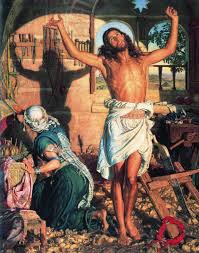
The Pre-Raphaelite Brotherhood was a group of artists in the mid -19th century who eschewed the current trends in art and the increasing industrialization of production, and consciously turned to older styles of painting and imagery – hence dubbing themselves ‘pre’ the painter Raphael (1483-1520). Many of their works, created in the last half of the 19th century harked back to a quieter medieval milieu and a mythical forested, European setting. They marked their paintings with a small PRB logo in the corner. They came to the attention of the wider public through their illustrations of Tennyson’s poetry which was itself steeped in the mythological realm. Reproductions of their works were circulated throughout the Empire, with the Maitland Mercury noting on 26 September 1885 that a reproduction of Holman Hunt’s “The Shadow of Death” on show in a shop window had formed the basis of the local vicar’s “very eloquent” sermon.

An unusual window display for Maitland - Holman Hunt's 'The Shadow of Death'. I wonder what they were advertising?

An unusual window display for Maitland – Holman Hunt’s ‘The Shadow of Death’. I wonder what they were advertising?

When we were in Birmingham we heard a lecture about Lizzie Siddal, whose long red hair and pale, thin features adorn many of these paintings, and she (and others visually similar to her) can be found in several of these paintings. As well as paintings and sketches for paintings, there are woodcuts, furniture, photographs, book bindings and wallpaper produced by the PRB, marking the extension from painting into the decorative arts and production methods, especially through William Morris’ influence with his company, Morris & Co.  Men predominate, of course, but there are photographs by Julia Margaret Cameron

We downloaded a PDF of the wall-panel labels used in the display before visiting, which I thought would be a good way of avoiding having to cluster up close to the painting, squinting at writing in the dark before moving back to view the picture. Unfortunately there seems to be no order at all to the PDF- or at least, I couldn’t detect it, and it seemed to be completely unrelated to the layout of the exhibition. A good idea poorly executed.

All-in-all, it’s a lovely little exhibition that reminds us of the riches that the Felton Bequest has brought to Victoria.

‘A Camera on Gallipoli & Recollections’ Hatch Gallery until 30 May 2015

Hatch Gallery, 14 Ivanhoe Pde Ivanhoe Tues-Sat 10.00 a.m -5.00 p.m, until 30 May 2015. Free entry

An inordinate number of your taxpayer dollars have been directed towards the commemoration of Gallipoli and there have been many enticements to community groups to participate at a local level in the centenary. Banyule City Council put up its hand and its display will be open until 30 May- so only a couple more weeks to view it.

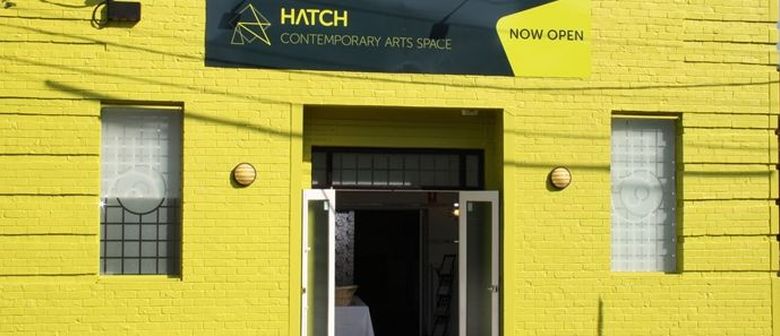
hatch

The HATCH Gallery is a fairly new venture located in a small hall behind the iconic Heidelberg Town Hall in (perversely) Ivanhoe. It is on two levels, as is this exhibition. The ground floor features a travelling exhibition mounted through the Australian War Memorial of the photographs of Sir Charles Ryan, while upstairs is a more localized display of artefacts and stories of local men who enlisted.

Sir Charles Snodgrass Ryan (1853-1926) was a scion of many early Port Phillip pioneers.  His father was Charles Ryan, who along with Peter Snodgrass were part of the ‘Gallant Five’ who helped  capture the Plenty Valley Bushrangers. His maternal grandfather was Joseph Cotton; his uncle, Albert Le Soeuf was the pioneer director of Melbourne Zoo and his sister was the artist Mrs Ellis Rowan.  After starting medicine at the University of Melbourne, he finally qualified through the University of Edinburgh.  While touring Europe and undertaking postgraduate qualifications, he saw an advertisement for medical officers to work for the Turkish government. He  worked in a medical capacity with the Turkish armies in the Turko-Serbian war of 1876 and the Russo-Turkish campaign of 1877-78. He would have only been quite young, and this serves as a reminder to us that the Balkans and Ottoman regions were heavily contested long before World War I.  On return to Australia he was appointed an honorary surgeon at the Royal Melbourne Hospital where, among other patients, he had the care of Ned Kelly to ensure that he faced trial after the Glenrowan siege.  When WWI broke out, he volunteered for the position of Assistant Director of the AIF Medical Service, aged sixty. He took with him his camera and the black and white images in this display are the result.

Perhaps because of his administrative and hence logistic role, many of these photographs show the supplies stacked along the small beach at Anzac Cove. It hadn’t particularly occurred to me that the task of supplying the troops continued during the months that the troops were there. He took photographs of the men in the trenches and swimming at Anzac Cove- it was certainly no Bondi Beach. In many of the photographs, men were sleeping in the trenches in broad daylight. This reminded me of the comment that Peter Cundall made at the ANZAC Eve commemoration I attended that soldiers often slept because of both physical and emotional exhaustion. One of the photographs depicts Lt Col Robert ‘Dad’ Owen, who had fought in the Sudan in 1885 with the NSW contingent and now led the 3rd Battalion at Gallipoli. His son fought in the same battalion and died in Belgium in 1917.

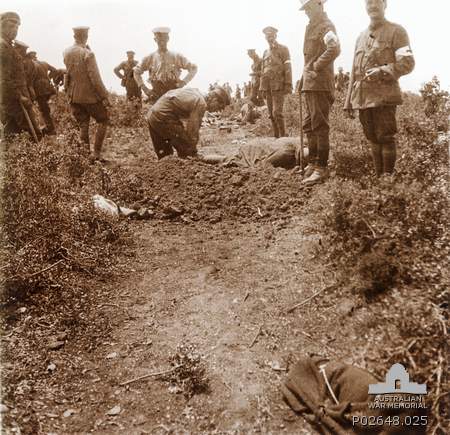
On 24 May 1915 after particularly heavy fighting, the corpses were piling up, rapidly putrifying in the sun. A truce was called and, against orders, Ryan took him camera with him to photograph the bodies. There is a story that he was challenged by Turkish officers who saw his Turkish medals from his youth, but they were mollified and then intrigued when Ryan conversed with them in Turkish (I assume), regaling them with stories of the war that their fathers and grandfathers had fought.

Burials

Source: Australian War Memorial site

These truce photographs are disturbing a hundred years later, and would have been even more so at the time, had they become public. In fact, I don’t think that I’ve often seen so many photographs of dead bodies and there is certainly none of the nationalistic ra-ra that makes me uncomfortable about much Anzac commemoration.  You can read historian Frank Bongiorno’s speech in opening this travelling exhibition in Canberra in 2014 here.

Upstairs there is a small theaterette that has a rolling, silent loop of photographic images of the war (although I must confess to feeling somewhat sated by the display downstairs). Another room contains artefacts donated by local families whose grandfathers and great-grandfathers fought during the war with biographical panels alongside.

This is a well-laid out exhibition that combines the national with the very local. It hasn’t really received a great deal of publicity, and given that it closes soon, you’ll need to visit soon to catch it.

‘The Trouble With Harry’ Northcote Town Hall

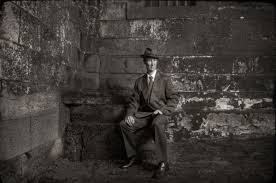
troublewithharry

Allow me to rave.  No- before I do, if it’s before November 9 when you’re reading this,  open a new tab and find tickets and buy them. Right now.  If it’s after November 9, then you’ve missed a wonderful show.  Remember the name and look out for it.

I’ve been fascinated with Eugenia Falleni’s story for some time and have reviewed Mark Tedeschi’s book Eugenia here  and Suzanne Falconer’s book Eugenia: A Man here.  If you’re not familiar with Eugenia’s story, you can see her ADB entry here.  Eugenia Falleni lived most of her life as Harry Crawford in post- WWI Sydney where he worked as a ‘useful’ at various factories. He was convicted and found guilty of the murder of his wife, Annie. This play adopts a different slant to the two books that I have read by placing a queer interpretation onto the relationship between Harry and his wife.  The dramatist, Lachlan Philpott does not give definitive answers: instead he opens up possibilities.

Apart from my fascination with the subject, I was drawn to see this because it stars Maude Davey (who played the minister in the excellent movie My Year Without Sex– one of my favourites) and Caroline Lee.  But, by the end of the show, I really couldn’t have identified any one actor out of the six in the cast as ‘the star’ because they were all excellent. Excellent.

It is staged at Northcote Town Hall which is just like any other 1900-ish town hall- stage at the front, large hall behind.  They do not use the platform at all, but instead utilize about 2/3 of the space at the front of the hall as stage, with temporary raked seating placed in the rear 1/3 of the hall.  The set is minimal: a large wooden box, a wall of panelling which looks at first as if it is part of the fabric of the Town Hall itself, and several steel structures, not unlike the legs of a table with the table top removed.  The actors themselves shift these around the performance space, turning them one way to be a pub bar, another way to represent a front porch; another way to represent a window. The set is fluid and changing continuously throughout the play

You are handed a set of headphones as you enter the hall.  Not only does this give scope for the use of a soundscape to supplement the admittedly sparse set – bird calls, fairground, night sounds- but it also acts to unsettle you as listener when you hear whispered asides that would otherwise have been lost in a more conventional sound production.  The script itself comprises mainly short sentences, often uttered over the top of each other.  There is a ‘chorus’ of a man and woman who comment on proceedings  in short stanzas, like a poem. The headphones help, I think, in keeping the different voices distinct.  It is a strange, disconnected experience, though.  You feel very much as if you’re watching it alone, completely immersed, and it’s not possible to nudge the person next to you and comment on what you’re seeing.  At one stage, people laughed and I’m still not sure if it was the audience around me, or whether it came through the headphones.

This is a fantastic production- one of the best plays I’ve seen in a long time.  It is lyrical and it has emotional depth.  It’s clever.  See it if you can.

‘Coming Home’ Exhibition Bundoora Homestead

There’s a fantastic exhibition on display at Bundoora Homestead called “Coming Home” that commemorates the use of the homestead as a convalescent farm and repatriation mental hospital between 1920 and 1993.  Even though it’s ostensibly an exhibition about the use of a house,  it’s a sad and very human exhibition. There are none of the brass bands and official ceremonies that we saw last week at Albany , but this exhibition is an act of commemoration nonetheless.

As I’ve written about previously, (here and here) Bundoora Homestead was built in 1899 by the Smith racing family as their residence and stud farm. In 1920, immediately in the wake of WWI the Commonwealth government negotiated the purchase of Bundoora Park estate as a convalescent farm for returned soldiers from the WWI front.  As Marina Larsson wrote in her book, Shattered Anzacs (review), the families of returned servicemen with mental illness were keen that their loved ones not been seen as ordinary ‘lunatics’, but housed and treated in repatriation facilities in recognition of their war service. Bundoora Repatriation Mental Hospital was sited across the road from Mont Park as a separate, soldiers-only hospital that could draw on the facilities of the civilian asylum nearby.

The exhibition focuses on individual men, most particularly Wilfred Collinson and Harry ‘Lofty’ Cannon,  who spent decades of their lives at Bundoora.

Wilfred Collinson was a British migrant, who arrived in Australian in 1914. He hadn’t been here long, working as a farm labourer with a friend that he’d met on the ship over, before the two lads volunteered and were returned to Europe to fight in WWI.  He had a long war, and was gassed four times.  On his return to Australia he and his friend, Eric Brymer, boarded in South Melbourne, and Wilfred soon married the girl next door and embarked on a family life.  His children grew up with a father affected by “nerves” who became increasingly delusional, and eventually he was committed to Bundoora in the 1930s.  As Larsson points out, families often had to battle the government for pensions and recognition that illnesses and injuries were war-based, and Wilfred Collinson’s wife is a case in point. His friend Eric Brymer, who was the only person who could testify to what Wilfred had been like before the war, wrote a letter in support of his wife’s application on her husband’s behalf.  Then followed another thirty-five years, and two generations, as his wife and daughter, then daughter and his granddaughter, went out to visit ‘Dad’ at Bundoora.  He died there in 1972. His war, in effect, was never over.  (You can see the video of his daughter and granddaughter on the exhibition site here.  The video is also running at the exhibition).

Harry ‘Lofty’ Cannon was a medical orderly with the 2/9 Field Ambulance and Changi POW.  We’ve all heard about Weary Dunlop, but I’d not heard of Lofty Cannon. He was a tall man- 6 foot six- but it was a shrunken life that he returned to after WWII. He’d married just six days before leaving for the front, he fought in the Malay campaign and was captured as a prisoner of war in 1942. While he was at Changi he met Ronald Searle, an English prisoner-of-war, who later credited Lofty with saving his life, nursing him through beri-beri and malaria. Lofty wasn’t in much better shape, with ulcers, malaria and dysentery and the after-effects of beatings from the Japanese guards. He was hospitalized at the Repat. in Heidelberg in 1946 on his return to Australia, where he received ECT and insulin coma therapy.  By 1947 he and his wife were living on a soldier-settlement farm near Swan Hill but by 1960 his wife and adopted son returned to Melbourne and Lofty went to Bundoora.  From Bundoora he wrote letters to his wartime friend, Ronald Searle in England, by now a noted artist and illustrator, probably best known for his  St Trinian’s illustrations.  Much of the display shows Searle’s sketches that he made of Changi, several featuring Lofty.  These are in the possession of the State Library of Victoria, and you can see them online if you search slv.vic.gov.au for “Cannon, Harry (Lofty)”. He died in 1980 at Bundoora.  Rachael Buchanan wrote a terrific essay about him in Griffith Review 2007 freely available here.

Bundoora Homestead is beautifully restored and such a peaceful place today that it’s hard to believe that so much sadness seeped through its walls and the  now-demolished wards that once surrounded it.

The exhibition runs until 7 December at Bundoora Homestead Art Centre, 7-27 Snake Gully Drive Bundoora, Wed-Friday 11.00-4.00 p.m and Sat and Sun 12.00-5 p.m.

Website: http://www.bundoorahomestead.com/

Facing up to it

My heart has been gladdened by the words of two honest, wise women this week.

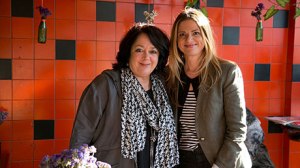
The first is Wendy Harmer, comedian and journalist who was featured this week on Julia Zemiro’s ‘Home Delivery’.  It’s available on iview until 24th December 2014.  In ‘Home Delivery’, comedian Julia Zemiro drives around with fellow comedians and media personalities, revisiting childhood places and reminiscing and reflecting on what has made them the person they are. Wendy Harmer, like me, is a ‘woman of a certain age’ and, like me,  has a cleft lip and palate.  She has appeared on Australian Story in the past, talking about the experience of growing up with a cleft and her career as a stand-up comedian- surely one of the most naked,  ‘look at me’ and razor-edge occupations there could be.  In this episode, there she is, being driven to the Last Laugh theatre in Collingwood where she made her stand-up comedy debut and Selby and Upwey in the Dandenongs, where she spent some of her childhood.
harmer_zemiro

The second is the writer Paddy O’Reilly’s  whose article  What it feels like to always be stared at by strangers appeared last week. Paddy O’Reilly who has gathered acclaim over recent years for her books The Colour of Rust and The Wonders, suffers from Graves Disease, and before she had surgery on her eyes, it made her look as if she was staring at people, who often stared at her.   “Yep, female Marty Feldman” she would joke pre-emptively, using humour, as she says “as the refuge of humiliation as well as of adversity”.

There is a particular pain that comes with looking and sounding different.  It’s completely intractable, no matter how many people assure you that they didn’t even notice.  In the very core of you, you don’t believe them.  It’s right there, as a little jab that can dart out to prick you with each new person you meet. Sometimes.  You think that you have it under control but it bursts out when there’s the look that lingers just a second too long , or the hot burning stare that you’re aware of, off to your side or behind you that, perversely, makes you feel shame.  It’s worse as a child because children don’t filter it, but it’s still there even in middle age.  It’s there when you hear yourself on tape, or as I’ve experienced just recently, in podcasts talking about a topic I know well, with work I’m proud of.  It gives extra power to that little gremlin of self-doubt that I know everyone carries around.  For us, no matter how good we might feel in that new outfit, or with that good haircut or how happy we might feel in our expertise and knowledge, that too-long look somehow makes it all fall away.  Not always, but sometimes.

And so, I knew the layers of pain that would have built up when Wendy Harmer spoke about shifting from school to school because her father was a school teacher.  A new start each time, but yes, a new scab to be picked off as well. And I know what her memory of pashing with boys up on the railway bridge would have meant.  And what her father meant when he praised her diction after her first television performance. I know her feeling of gratitude for husband and children, and the silent rage inside that dammit, I shouldn’t have to feel grateful.

In her article, Paddy O’Reilly quotes an American comedian, David Roche, who has a severe facial disfigurement from a facial tumour.  Everyone stares, she says:

… that accidental, snagged way we do when we see something different. It’s hard-wired into us to stare at novelty. Novelty stimulates the brain and the dopamine rushes in, causing pleasure. Yet we’ve been told since we were children that it is wrong to stare, so as adults we pull our gaze away, feigning nonchalance or indifference.

This initial stare is beyond our control. David Roche, an American comedian with a severe facial disfigurement, says that the first stare is not the time of hatred or prejudice or judgment. It’s about getting used to difference. The second look is what counts – what we choose to do once our initial curiosity has been satisfied.

That second look- what a powerful idea, and one that had never occurred to me before.  I wish I could go back and tell seven-year old me about it.

Thank you, my courageous, honest ladies.  I’ve hesitated about posting this –why???– but you’ve been brave, and I want to be too.