Category Archives: The ladies who say ooooh

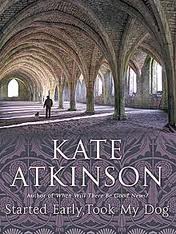
‘Started Early, Took My Dog’ by Kate Atkinson

Image

2010, 350p.

Kate Atkinson is a favourite author of The Ladies in my bookgroup.  We’ve read several of her Jackson Brodie books, and Behind the Scenes at the Museum is one of my all-time favourite books.  But I must admit that I think I’m just starting to tire a little of the Jackson Brodie series.

I looked back at the reviews I’d written of her books on this blog- One Good Turn  and When Will There Be Good News (and I’d read Case Histories and Behind the Scenes before I’d started blogging here) and I think that I could make exactly the same observations about this book as I did with her earlier ones:  that you need to suppress your fear of being unable to keep up with such a huge array of characters because it all comes clear at the end; that red herrings and coincidences abound;  that she is really having fun with the genre etc. etc.

Atkinson does reference events that occurred in her other books, but not so much that you’d feel excluded if this was the first Jackson Brodie you’d read.  It’s like a little wink to the initiated, but unfortunately The Ladies and I found ourselves racking our brains to remember the specifics of the earlier books. I noticed in my other reviews that I didn’t say much about plot- no doubt from a fear of giving things away in a plot-driven book- but I found that my reviews were of absolutely no use in triggering memories of the book I’d read.

So, in anticipating that a) Kate Atkinson will probably write another Jackson Brodie after all even though she said she mightn’t  and that b) I’ll probably read it—- here’s a plot and character summary for future reference.

  • Jackson Brodie- our main character from the series; ex-cop turned private investigator; still smarting from being ripped off by his second wife Tessa; coming to terms with the idea that he has fathered young Nathan with Julia the actress
  • Tracy Waterhouse- in her fifties; a large woman; recently retired from the police force
  • Tilly – an aging soap-opera actress, frightened by her rapidly-gathering dementia which is opening up regrets from her past
  • Kelly Cross- a prostitute who sells her daughter Courtney to Tracy
  • Courtney- four years old, says little but gives the thumbs-up to life

In this book, as in Atkinson’s others, there are doubles, parallels and counterpoints.  Tracy witnesses the abusive treatment of a child in a shopping centre and somehow ends up with the child Courtney: Jackson witnesses a dog being mistreated and somehow ends up with the dog. There are two murdered prostitutes; two private investigators; two children looking for their roots; lost memories and lost children, and the hunters become the hunted. There are two narratives here- one is a flashback to 1975 policing which evokes the television series Life on Mars beautifully, while the other is set six months ago.  The flashback narrative is intentionally confusing but it gradually settles into something more definite, while the current day plotline becomes far more tentative and unresolved.

The missing child is a theme in Atkinson’s writing that goes right back to Behind the Scenes and there is certainly an elegiac,yearning quality that seeps through the otherwise conventional (if subverted) crime fiction elements of the story.

But I must confess to feeling that I’d read the book before and had almost been taken back to where I started with her first book Behind the Scenes at the Museum.  I think that perhaps she should give Jackson a bit of a breather.  Although having said that, I must confess being tempted just a little by her new book.  I must just wait a while, though.

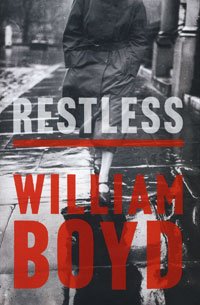
‘Restless’ by William Boyd

RestlessNovel

2007, 336 p.

Last month I was rather embarrassed that the bookgroup ladies disliked my book group choice, Brooklyn, so vehemently. So it was with relief that I was able to march in this month, book under my arm, and proudly announce that “I chose this book!”

I must admit, though,  that when I read the blurb on the back I wondered if I really had chosen this book.  I’m not really into spy novels at all- so why had I nominated this one?  I could only think that I was aware of his book Any Human Heart and must have been swayed by the comments about the book in the catalogue (which does beg the question ‘why didn’t I go for Any Human Heart then?)  Oh well- no matter.  This is a very good book for readers who don’t like spy novels.

There are two alternating narratives.  The first, told in the first person, is that of Ruth in the 1970s whose mother Sally begins acting very strangely.  Her mother hands over to her, chapter-by-chapter, her autobiography that reveals that her mother is not, as Ruth believes, an English-bred housewife and mother but instead, a spy for the British recruited during WWII.  The second narrative is the third-person autobiography itself, which tells of Eva (Ruth’s mother) and her recruitment and life as as a British agent, working to influence America to join the war effort during WWII.  This part of the book is quite factual, based on British Security Coordination, an espionage unit based in the Rockefeller Centre.

The descriptions in the book are very carefully written, with the eye of one trained to notice small details, as Eva was. Increasingly her daughter Ruth, and eventually you, too, as reader begin to scan the settings he describes with a  heightened awareness as well.  He brings the two narratives together carefully, leaving you quite unsettled about the ending.  Normally I don’t particularly like alternating narratives because I come to favour one over the other and resent being tossed between them, but I didn’t feel that way with this book: I enjoyed each narrative equally.

There’s not a lot of violence in this book (some, but not excessively) and it has much to do with identity, manipulation and distrust- all very human emotions  at the intersection of relationships and this other, weirder world of espionage.

I enjoyed it. There’s a 2 part BBC series that aired in England in December 2012. (Fantastic cast- Charlotte Rampling, Rufus Sewell, Michael Gambon…..)

My rating: 8.5/10

Sourced from: CAE book groups

Read because: Book group selection

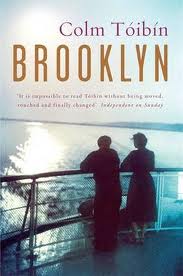
‘Brooklyn’ by Colm Toibin

brooklyn

2010, 320 p.

There are spoilers in this review

There used to be an online bookgroup called “Who chose THIS book?”, the wail set up after a bookgroup has read a book that members didn’t like much.  When I met Kay from my bookgroup in the supermarket, she didn’t have to ask the question because everyone knew that, yes, I had chosen this book.  And no, they didn’t think much of it.

I had heard good reviews of it and had read Toibin’s “The Master” about Henry James.  I must confess to getting mixed up between Colm Toibin and Colum McCann (whose book This Side of Brightness I absolutely loved) so, yes, perhaps I was confused when I selected this book.

Personally, I didn’t think that it was too bad.  It is set in the  dank, depressed 1950s in Dublin when young Eilis is encouraged by her older sister Rose to emigrate to Brooklyn where there are more employment opportunities.  She goes and lives in a boarding house in Brooklyn, finds a job in a department store and gradually overcomes the homesickness that, even though she doesn’t recognize it for what it is, hollows her out.  She meets Tony, an Italian plumber and becomes swept up into his large, impoverished and noisy family.  When she receives sad news from home, she marries Tony before returning.  He fears that she will not return, and so they marry as a guarantee that she will come back.

Tony was right to fear.  Once she returns to Ireland, it is as if she has never left.  Even though she has been changed by the vitality and relative prosperity of America, bit by bit it all drops away from her as she slots back into the social life of the village.  Employment seems to find her this time (with the help, perhaps, of her mother who wants her to stay), and she starts going out with Jim Farrell.  No one knows that she is already married to Tony, back in Brooklyn.

The book is told in a very Henry Jamesian fashion.  There is no back story; small events are told simply and in detail; every little act is described by a narrator who seems to be hovering up in the corner of the room, watching everything.  There is no interiority, only action, and they are the domestic, quotidian small actions of ordinary life.  In spite of this- even perhaps because of this?- I found myself swayed, just as Eilis was, by the slow unfolding of a good-enough life.  At first I was angry at her family and friends at home for wanting her to stay in Ireland: by the end of the book, I didn’t know whether she should leave or not.  I felt sad no matter which way she moved.

So, even though I enjoyed the book and was moved by it, certainly the rest of my bookgroup didn’t feel the same way.  It was too long, they said; nothing happened, they said- and both these things are true.  But “who chose THIS book?” Well, I did.  Given another chance, I might not have chosen it for a bookgroup, but I’m glad that I read it for me.

My rating: 7.5/10

Sourced from : Council of Adult Education book groups

Read because: I had read good reviews (and I got a bit confused….)

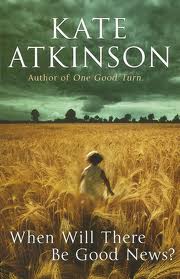
‘When Will There Be Good News?” by Kate Atkinson


2008, 348 p.

“A coincidence is nothing but an explanation waiting to happen” is the modus operandi of Jackson Brodie, ex-policeman and now private investigator, who is the main character in Kate Atkinson’s crime series, of which this book forms the third offering.  Well that’s good, say I, because it doesn’t do to take all the coincidences woven into crime fiction too seriously.  I love the subversiveness of Kate Atkinson’s writing.  She has detectives who really don’t want to investigate crimes; she has little interest in the perpetrators of crimes but instead focusses on the victims and by-standers, and things happen just “because”.  There’s no need to lie in bed afterwards asking “But why….?” or “Just hold on a minute….” about the plot.  It just is.

Her books generally start with a bang, and this one is no exception.  A horrific crime occurs within the opening pages, then the book leapfrogs some 25 years.  Victims have grown up, and perpetrators are about to be released from jail.  Detective Chief Inspector Louise Monroe, whose unresolved love-interest with Jackson Brodie has extended over the series, is obsessed with a recent appalling domestic violence crime, and somehow all these crimes are brought together through a series of coincidences, missteps and what-ifs.

This is the third book in the series ( I reviewed an earlier book ‘One Good Turn’ here) , but it is not necessary to have read the earlier books.  If you have, then you get the warm inner glow of recognizing carry-overs between the stories, but they would pass a new reader by.

As with her other books, there is a huge  almost-Dickensian cast of characters.  The allusion to Dickens is quite deliberate, as she interweaves literary references throughout the book, both  in her chapter headings (e.g. ‘Satis House’ or ‘She would get the flowers herself’) or throughout the text.  Sometimes the punnery is groan-inducing, but it adds to the flippancy of her approach.  There are so many characters and red-herring plot lines that it can be quite anxiety-producing (have we met this character before? how am I going to remember all these characters?)

There’s a humanity about her writing though, that challenges the sometimes clinical omnipotence of the crime writer.  She is messing with the pomposity of the genre and once you lie back and let it all wash over you, it’s a fun ride.

My rating: 9/10

Sourced from: CAE bookgroups

Read because: it was the July book for my face-to-face bookgroup.

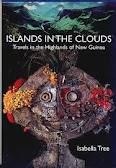
‘Islands in the Clouds: Travels in the Highlands of New Guinea’ by Isabella Tree

1996, 256 p.

I must admit that I’ve never really understood the appeal of the travel-book genre but this was the selection for my face-to-face bookgroup this month. Just as I would entreat my children “Just a little taste…”, so too I had to be nudged into reading this book, but just like broccoli, it wasn’t too bad after all- in fact I quite enjoyed it.

The book itself is a compilation of three different journeys to New Guinea: the first in 1986, the second in 1991 and the epilogue in 1993. The author tries as much as possible to erase herself from the narrative.  We do not know why she is there, what her expectations are, and what other experiences she brings to her observations.  The fact that she is a young woman traveling alone into remote and partially traditional tribal homelands is largely left unremarked, and the trips she describes are not lengthy at all- each one lasting barely a week.

Her travel companion for much of her journey was Akunia, an Eastern Highlander man, who had had a Western education, courtesy of various aid and diplomatic  schemes. Over the years he had been involved in both local politics and development projects, and he provided another lens through which to view the places and events they encountered.  However, the author soon realized that Akunia’s expertise was largely limited to his own local region: once they moved the Western highlands, and even further into Irian Jaya, he was almost as much of a stranger as she was.  Perhaps even more so, because he knew enough to be apprehensive, and was at various times frightened, racist and dismissive.

In crossing into Irian Jaya (West Papua), they were indeed entering another country, and were not allowed to forget it.  All entry was by air only and under heavy border scrutiny.  However, once they moved away from the Indonesian-dominated coastal area into the highlands of West Papua, the tribal people were both amazed and delighted to find commonalities in customs and appearance between themselves and Akunai, a rare venturer from the other side of the border.  She makes no secret of her uneasiness over the Indonesia domination- and I believe that there is much to be uneasy about.

Her criticisms of the rapaciousness of the mining companies rang even more true for me having witnessed the ruthlessness of the mining lobby here in Australia against a democratically- elected, first-world government. A young democracy, wobbly on its feet, wouldn’t stand a chance.  Akunai and the author both share an ambivalence over the inevitability of consumerism and ‘progress’ at all levels: cultural, spiritual, environmental.  The violence, it seems, abated under the influence of missionaries, but there too is another conundrum.  I found myself reading the newspaper reports about the commencement of their election process this week with more interest than I would have previously.

The book is well-written and very easy to read.  It had a good useful map at the start, which would have been even more useful had her journey been marked on it. She integrated pidgin into her chapter headings and within the dialogue of the book, and although she provided a glossary, I found myself able to work it out for myself if I spoke it out loud.

So- this book, published under the  the Lonely Planet imprint, was a pleasant surprise really. Not enough, however, to tempt me northwards…

My rating:  7/10

Sourced from: CAE

Read because: it was the June selection for my face-to-face bookgroup

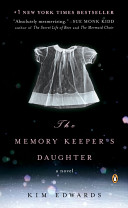
‘The Memory Keeper’s Daughter’ by Kim Edwards

2006, 414 p.

I’ve seen this book in bookshops for several years now, but I must admit that I wasn’t particularly tempted to read it.  Perhaps it was the pink back cover, the book-group questions at the back, or perhaps it was the shelf-company it kept… oh, alright, call me a literary snob.  I do read and like Anne Tyler and Sue Miller who write American family-based fiction similar to this one, but you’re probably better off classing this with Jodi Picoult.  It was selected for my face-to-face bookgroup (so its marketing strategy of the bookgroup questions at the back was probably spot-on), and I probably wouldn’t have read it left to my own devices, but I have to admit to being thoroughly drawn in right from the opening pages.

It probably speaks volumes about the plot-driven nature of this book to say that it’s impossible to review it without spoilers.  So I won’t, other than to say that structurally, it makes decade-wide leaps as it traces through a decision made in the in 1960s as it unravels through the lives of two different families.  It is a fairly long book at over 400 pages, and particularly near the end I felt it dragged a bit with just a few too many plot-lines introduced and a heavy reliance on reminiscence to develop her characters.  I realized in reading this book how rarely I read a book that relies so heavily on plot (I’m not, for example, much into crime books or murder-mysteries) and I found myself raising questions like “But what about…?” and “I don’t believe that….”

Still, I must admit rather grudgingly that it generated a good book-group discussion (as no doubt it was intended to), and whatever frustrations I may have felt about length or plausibility did not stop me from reading it to the very end.  But I still kept wondering, rather guiltily, (and as I often had cause to say to my children when I perceived that they were wasting their time) “Is this the best use of my time?”  Probably not, but I enjoyed it anyway.

‘Cold Comfort Farm’ by Stella Gibbons

1932, 307 p.

This was the April selection for my face-to-face bookgroup, and for me it was a re-read, but ah! who can begrudge reading such a little gem of a book?!!  It’s laugh-out-loud funny (or at least, I found it so) and if you haven’t read it- DO!

The book is set, as the small note on an opening page says, in the ‘near future’.  As twenty-first century readers, this is immediately unsettling because a book written in 1932, as this one was, is very much set in the past for us.  Some of her predictions, like air-taxis for short-distance travel, the Anglo-Nicaraguan War of ’46  or video-phones jar you into thinking “hold on, when was this set?”  In many ways it feels like a novel set in the 19th century both in its setting and characterization with the ramshackle manor house and loping rural farmworkers, but it was set in the future at the time it was written.

It was intended, apparently, to be a satire on the rural-gothic novels of the Mary Webb and Thomas Hardy ilk, which are hardly bestseller material these days. Satire, unfortunately, generally requires at least a nodding acquaintance with the subject or genre being satirized.  So here we have the odd situation where we are reading a satire that feels oddly familiar, as if we have met all these characters before-   the mad great-aunt in the attic, the simple farmhands, the young girl unaware of her beauty- and yet it seems that they have seeped into our consciousness without  being able to identify where they have come from.

The orphaned young Flora Poste decides that instead of getting a job, she will sponge on her relatives for her upkeep.  When an answer to her request for board comes back on a grimy piece of paper, followed by a warning to stay away, she decides that of the lukewarm responses she has received from her surviving relatives, it is this one from Cold Comfort Farm that attracts her the most. So off she bustles to Cold Comfort, bringing her modern girl sensibilities and common sense to an aging, rambling manor house where all the closely-intertwined Starkadder family are in thrall to the matriarch of the family, Great-Aunt Ada Doom.  Great Aunt Ada, who has sequestered herself in the attic after seeing “something nasty in the woodshed”, has ensnared the extended family around her, afraid to leave the farm to pursue their own destinies, declaring that “there’s always been Starkadders at Cold Comfort”.  Into this comes young Flora who, with her aid of her trusty handbook “The Higher Common Sense,” schemes and plans to set up some with marriages and to nudge others into following their vocations.  It’s all thoroughly good fun.

As I reached the end of the book, I was struck by how completely and deftly within just over 300 pages the author has sketched out such memorable minor characters.  In a closing scene, she lists the guests at a Starkadder wedding, and as she numbered them off, one by one, I felt a little jolt of recognition and affection, as if I was attending a family wedding myself, where the guests were all known to me.  And as for “something nasty in the woodshed”…..well, you’ll have to read it for yourself.

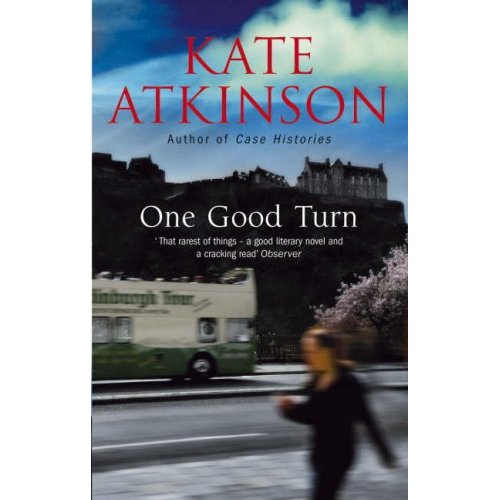
‘One Good Turn’ by Kate Atkinson

2006, 527 p

I don’t even LIKE crime novels as a rule, but I’ll make an exception for those written by Kate Atkinson.  This book follows on from her earlier novel, Case Histories by bringing to us again  detective Jackson Brodie, but it’s not at all necessary to have read the first book.  In the earlier book, there are three crimes that seem unrelated but become increasingly interwoven. This book is similar to its predecessor in that Jackson is searching desperately for “a tangible connection, not just a coincidence”, but it is more straightforward in that there is just the one crime initially that involves, in different ways, the many characters.

The book is set during the Edinburgh Festival, and the author turns a wry eye on the literary events and art-house performances that are part and parcel of such productions.  The crime occurs in the opening pages- always a good start, and in Rashamon-fashion the book moves from character to character in the lead up and fall0ut from the crime.  Her characters are full-bodied, and there’s enough romance to pep things up (and enough to induce deep groans in Mr R.Judge, should he ever read it, because he doesn’t like all that “love-stuff” mixed in with his crime stories).  Atkinson doesn’t take any of this too seriously, and there’s a cheeky humour that runs through the book.

The plot itself, while convoluted as crime novels tend to be, is easy enough to discern in retrospect, which is just the way I like it. Many’s the time that I’ve watched the credits roll on yet another ABC Friday night crime show, and I’ve twisted myself up on the couch and said “But I don’t get it…who?  why?…” and I can barely piece the plot together coherently enough to even formulate a question.

But this is a thouroughly satisfying crime novel, with a laugh or two along the way, several twists in the plot, and I can even tell you what happened!

My rating: 9/10 (I seem to be particularly generous at the moment. Perhaps I need to read a dud or two to get myself back into balance)

Sourced from: The Council of Adult Education

Read because: It is our March book in my face-to-face bookgroup

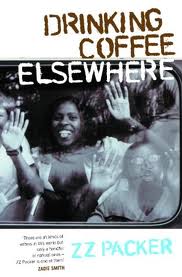
‘Drinking Coffee Elsewhere’ by ZZ Packer

224 p, 2004.

I was aware of ZZ  Packer, and the acclaim that she has garnered, even before I opened this book.  I was still reading Aphrodite’s Hat, and enjoying its understated, mature stillness, and from the little that I knew of Packer, I didn’t want her youth and exuberance intruding onto my reading.  I’m glad that I waited because keeping the two books separate enhanced them both, I think.

Z Z Packer was born in Chicago in 1973, attended Yale University and the Writers Workshop at John Hopkins University, and has been the recipient of several writing fellowships.  The short stories in this collection have appeared in various journals, and this volume received glowing praise.  She sure can write.

The stories are about 30 odd pages in length- just right, as far as I am concerned- short enough to be read at one sitting and long enough to develop character and a span of time. They are taut, confident, and she really doesn’t put a foot wrong.  Many of the characters are African-American (as is Packer herself), mainly they are women, and several of the stories are set in, or refer to Baltimore.  The Pentecostal Church is a potent and often ambivalent influence in her characters’ lives, and her characters are just clinging to the margins- sometimes physically, sometimes socially.

There is real complexity in this book.  There is no clear delineation between goodies and baddies, and life is uncomfortable and painful on the edges. The stories took me to a place and an existence that is completely foreign to me as a white Australian, older woman and she depicted it sharply enough that I ached, fretted and cared about characters encountered in thirty short pages.  Her endings were ambiguous but not unsatisfying.

You can read the short story ‘Drinking Coffee Elsewhere’ that gives its name to this collection in the New Yorker, where it was originally published here.

My rating: 9/10

Sourced from: CAE bookgroups

Read because: It was the February book for the Ladies Who Say Oooh (i.e. bookgroup)

‘Aphrodite’s Hat’ by Salley Vickers

2010, 262 p.

My face-to-face bookgroup has a bit of a Christmas tradition, whereby each of us lends a copy of a book that we have enjoyed from our own bookshelves to another bookgroup member.   It’s a Kris Kringle-y sort of arrangement because you don’t know who donated the book you receive, and you can’t tell where your book is going to end up.  At our February meeting, the first for the year, we talk about the book and try to guess who chose it for us.  It is a bit of a hit-and-miss affair: sometimes you receive a book you’ve already read; sometimes you loathe the book you’ve received and wonder how you’ve managed to sit all year talking about books with the woman who chose it; other times you give a much-loved book (as I did with Kristin Lavrensdatter), only to have it trashed!

February is coming on quickly, so I thought that I’d better get stuck into my ‘present’.  Aphrodite’s Hat,  I see, by Salley Vickers.  I’ve read two of her books, with wildly different responses.  First I read Miss Garnet’s Angel with an online bookgroup and just loved it.  My response to  it was complicated by one of the bookgroup members arguing strongly and fairly (but not completely convincingly) that there was a whole other reading of the book possible that turned the plot on its head.  To this day, I’m still not sure.  When Instances of the Number Three came out, I snapped it up but this time felt that it was twee, repetitive and just plain silly.

But ten years have gone by, and I’m now well and truly of the middle-aged demographic that she writes about.  And, despite my frequent declarations that I don’t like short stories, I was quite happy to see that the book was in fact a collection of her short fiction. I’m finding myself happy to read something light and put-downable just before I go to sleep.

The longest story in this collection is ‘The Buried Life’,  after the Matthew Arnold poem of the same name, which she very helpfully gives at the end of the story (just as the cover of the book helpfully shows ‘Aphrodite’s Hat’ which is the title and theme of another of the stories in this collection). It’s a beautiful poem: this is one part:

But often, in the world’s most crowded streets,

But often, in the din of strife,

There rises an unspeakable desire

After the knowledge of our buried life;

A thirst to spend our fire and restless force

In tracking out our true, original course;

A longing to enquire

Into the mystery of this heart which beats

So wild, so deep in us- to know

Whence our lives come and where they go.

This captures the themes of many of these stories: middle aged people -generally women- often in their second marriages, who are disappointed that this second chance at love has not worked either; unhappy people teetering on the edge of infidelity;  loss of a child through death or intransigence.  They are very still stories that seem calm on the surface but cover a deep well of sadness.  As with Miss Garnet’s Angel,  there is a hint of the supernatural but it is so closely interwoven with love and longing that it pushed my derision to the side.  Many of the stories are set in England, with visits over to Rome or Venice for honeymoons and naughty weekends away, in the twentieth century tawdry version of the Grand Tour- again, shades of Miss Garnet’s Angel.  Most of the stories are very short, with a similar narrative voice, and often even start the same way with a voiced comment in a conversation.  They are very similar to each other, but I enjoyed each one so much that I found myself wanting more and happily turned to the next.

As I said, February approaches, and not only do we talk about our Christmas gift book at our meeting, but we also have our February selection- in this case, a collection of – you guessed it- short stories by Z. Z. Packer.  Somehow, I couldn’t bear to mix up my reading of these two very different authors.  I wanted to let the quiet, middle-aged, introspectivity of Vickers’ stories  have their own space, without being swamped by a younger, more rambunctious writer.

It doesn’t surprise me that, according to Wikipedia,  Salley Vickers is a 64 year old woman, or that she is a psychotherapist, and that she has had two marriages, both finished.  I suspect that there is an autobiographical bent to these stories, and perhaps my criticisms of Instances of the Number Three  could well apply to these stories as well.  Except that I am older, except that there is a clarity about human nature, except that I was utterly charmed by them.

My rating: 8.5/10

Sourced from: Who knows??

Read because: it was a reading gift over Christmas from my bookgroup.