Category Archives: The ladies who say ooooh

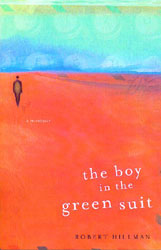
‘The Boy in the Green Suit’ by Robert Hillman

2003, 232 p.

My bookgroup ladies (aka “the ladies who say oooh”) were not unanimous in their opinions of this book.  I liked it though.

For me, a memoir is not the same as an autobiography.  There is not the same imperative to cover all the major bases; it does not have to start at the beginning and end at the end.  A memoir, for me, is more a construction, given its own shape by the author, and truth or completeness are not the major criteria by which it is to be judged.

This memoir was not complete, and some of the bookgroup ladies felt that it was not true either.  It focussed on one year in the author’s life when as a naive and rather pathetic sixteen-year old he left behind his apprenticeship in the butcher’s shop in Eildon and job in the shoe department of Myer Melbourne to embark a Greek ship for Ceylon.  He wore a green suit already too short in the leg that made him look, by his own admission, like a grasshopper, and he carried a suitcase of books and his typewriter.  With no money and no passport, he travelled through Athens, Istanbul, Tehran and Kuwait, ending up in a Pakistani jail.

There are aspects that stretch credulity.  His misadventures are told at a distance, complete with reported conversations which, of course, must be a construction after the event.  The CAE booknotes we used when discussing it quoted Hillman insisting that he remembered conversations word-for-word.  The ladies-who-say-ooh lifted a sceptical eyebrow. This didn’t particularly trouble me.   I found myself more stunned by the naivete  and youth of the lad, and that he survived relatively unscathed. For me, the charmed status he enjoyed in the jail compared with his fellow-prisoners added to the credibility of the book- if the author was inclined to exaggerate or embroider, this Bangkok-Hilton scenario was the place to do it.  But he didn’t.

His narrative is interspersed with events from his emotional life that both explain, and follow through on his travel experience.  His mother walked out on the family when he was very young;  he was uncomfortable with his step-mother and she with him; his father contemplated having his adopted out until dissuaded by Hillman’s older sister; his mother reappeared in his life; he himself had a succession of failed relationships.  These snippets are short, barely two pages and marked with a different font. They raise more questions than they answer.  His relationship with his father is wistful and inadequate, and he seems set to repeat the same pattern.

I thought that this memoir was beautifully constructed, with self-deprecating humour and an ongoing flinch of pain.  It won the National Biography Award in 2005, and I think it was well-deserved.

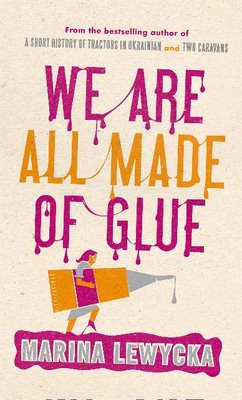
‘We are all made of glue’ by Marina Lewycka

2009, over 400 pages but large print.

As I may have mentioned, like nearly every 50 plus, middle class suburban woman, I belong to a book club.  I’m very fond of my Ladies Who Say Ooooh.  That’s my daughter’s name for  the group after listening to us chortling and “oooohing” when the meeting was held at my place once.  We have good discussions.  Although we might go off-topic occasionally, we always answer the questions in the booklet that comes with the book , which yields us a satisfying conversation of  well over an hour.   I always read the book, or re-read it if I’ve read it before and I’ve never once abandoned a book club book. But with this book, I was sure tempted.

We had read A Short History of Tractors in Ukranian previously, and enjoyed it well enough, so I was happy to read this one too.   I couldn’t tell at first if it was a parody of bad writing- it was, after all supposed to be a comedy- but unfortunately, I don’t think that was the case.

I’m not even going to try to describe the plot.  Just a few words, then.   Marriage breakup; sonky teenaged son; batty old lady; the Holocaust; a mystery;  tangled identities; Israel; nefarious real estate agents; old people’s homes; Palestine; apocalypses; cat poo.  Holding all this together is the metaphor of glue, and if you don’t get the metaphor, I’ll tell it to you again because Lewycka sure did.  Glue.

There are just too many threads in this story and the book cries out for a good edit.  It’s touted as “black humour”- are you supposed to laugh at black humour?  Or is it slapstick?- certainly not a genre I’m fond of.  I kept reading, expecting that at some stage it might all come together and that I’d be overwhelmed by how cleverly the author had disguised her intentions behind this implausible, overburdened storyline.  By page 350 I had resigned myself to the likelihood that it just wasn’t going to happen.

When, at the end of the discussion we awarded our notional stars out of five, I gloomily intoned “ONE”.  The others, to be fair, stretched to three, and one Lady even gave it four.  “You don’t HAVE to finish it, you know, Janine” they said.  Ah, but I do!  It’s a book club book!

‘Balzac and the Little Chinese Seamstress’ by Dai Sijie

No, I’m not the last person in the world to read this book.  I read it for a second time, for my Council of Adult Education bookgroup a.k.a “the ladies who say ooooh”, so named by my daughter for our loud ejaculations and bursts of laughter.

So I already knew that it was the story of two young men, the sons of  so-called ‘intellectuals” who were sent to a remote and primitive Chinese village as part of the process of re-education following the Cultural Revolution. After deviously coming into possession of a suitcase of translations of largely 19th century French novels, they decide to share them with the tailor’s daughter, the Little Seamstress, with whom both boys are in love, as their own form of ‘re-education’.

I’m always a little wary of books written by expatriates: not dismissive by any means, but aware that the act of leaving springs from disillusionment and opportunity, and that the narrative may not be untouched by the need to justify the departure.  But this book, although probably somewhat autobiographical given the history of the author, does not dwell on the hardships of their exile.  The poverty and the grinding labour they are put to is not where their real life is.  Instead it is in their resistance and subversion of the situation in which they are placed.

On re-reading it, I appreciated it anew as a bitter-sweet coming-of-age novel, as all good coming-of-age novels are, and as a variation on the Pygmalion story which, like the the original, does not end as the ‘re-educator’ intends it to end.

I haven’t seen the film, but “the ladies” assure me that it is beautifully done.

‘Falling Leaves’ by Adeline Yen Mah

fallingleaves

When this was distributed as the next month’s read for my CAE bookgroup (a.k.a. “The Ladies Who Say Oooooh”) my heart sank.  “I’ve read this”, I thought.  But as I read further into it, I realised that it was not a clone of  Amy Tan 3-female-generation saga, as I expected it to be.  I had not, in fact, read it and now that I’ve finished I wish I hadn’t anyway.

This is a grubby, self-serving, vindictive book.  The author has left her (now deceased) parents’ names unaltered, along with that of her husband.  She did, however, change the names of her siblings.  I think that the issue of changing or not changing names in an autobiography really highlights the sore spots and anxieties in an author’s telling of their story.

The book is one long howl of wounded dignity and pain.  The author’s mother died after giving birth to her, and her father remarried a young, beautiful French-Chinese woman that the family called ‘Niang’, an alternative form of “mother”. The besotted father is putty in her hands, and betrays his allegiances to the children of his first wife- although admittedly, the relationship between a widowed father and the child whose birth precipitated the mother’s death must always be a fraught one.

This is a toxic family.  Niang certainly does appear a cold, manipulating, scheming woman who sows jealousy and dissesion amongst her children and their half-siblings.  They are all- parents and children- dominated by the love of money, ruthless in their determination to get ahead; remorseless in their own quest for parental approval.  The author, as narrator, portrays herself always as the innocent victim of others’ perfidy- a rather self-serving and perhaps not always accurate assessment.  There is no loyalty to family, and certainly no loyalty to country among the immediate family- they collect and discard nationalities at will in their thrust to get ahead.

Why did she write this book?  One can only think that it is her revenge, served cold and in print.  And wait- there’s more!  Not only did she write this book, but she rehashed her revenge  in her second book Chinese Cinderella which from its description, sounds like the same book fictionalized.

I feel complicit in her vindictiveness by even having read this book.

‘Modern Interiors’ by Andrea Goldsmith

goldsmith

1991, 242p.

This is Andrea Goldsmith‘s second book, and one that I hadn’t heard of before.  I read it for my C.A.E. bookgroup – a night of wine, laughter, affection amongst the women my daughter has dubbed “The Ladies Who Say Oooooh” (because apparently we work ourselves up into a chorus of  ‘oooooh’ at some stage during the night. I’m not sure if this is a compliment or not).

The book’s main character, Phillipa Finemore, is a wealthy widow whose adult children expect her to share the family money with them and subside into a well-heeled widow’s existence as their mother and grandmother.  Instead she sells the big family home, shifts into a terrace house in Carlton, starts a charitable foundation, travels with her deceased husband’s lover and secretary, and befriends a Jewish bookstore owner and then a 25 year old university student.

The goodies and baddies are stereotyped and one-dimensional.  There’s the grasping daughter and embezzling son-in-law; the insipid and incompetent son, and the good gay son who gets on well with his mother.  There are overdrawn parodies of the self-aggrandizing business school and a grasping evangelical preacher and his young wholesome wife.  The slabs of Goldsmith’s own opinions about the perils of family and the commodification of university education, voiced through the characters, became laboured too.

In spite of all this, though, I enjoyed reading the book.  It was almost Anne Tyler-ish in places, and although very wordy, captured emotions and descriptions well.  I felt glee at the come-uppance of such unpleasant people, so I must have been engaged with this book in spite of myself.