Category Archives: The ladies who say ooooh

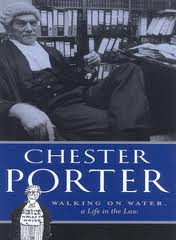
‘Walking on Water: A Life in the Law’ by Chester Porter

2003, 309 p.

One of the high points of my CAE bookgroup meetings (a.k.a. The Ladies Who Say Ooooh)  is when the book for the upcoming month is fished up out of the plastic box and brandished with a flourish. I’ve found recently that one advantage of actually doing some work on my thesis is that I am no longer likely to look at the next month’s offering and think “Damn, I’ve already read it!”. When our book for our final meeting was revealed last month, I found myself thinking “Good grief, who on earth chose this?” because it was Chester Porter’s memoir Walking on Water: A Life in the Law.

At first I thought that I’d never heard of the man, but I soon realized that I had without realizing it.  Most famously, he worked as Counsel assisting the Royal Commission into the convictions of  Lindy and Michael Chamberlain case, and he successfully defended Det. Sergeant Roger Rogerson on a bribery charge. He was known as “the smiling funnel web” and the title of the book comes from a quip directed towards him that “Chester Porter Walks on Water”.

Even though I encountered this book as part of my “off-duty” reading, I was very happy to read it in relation to Judge Willis.  The little gremlin of self-doubt that lives in my head regularly derides my ability to write about a man of the law (albeit a 19th century colonial man of the law) when I have no experience of that milieu at all.  The 19th century judicial culture is something that I am deducing for myself, largely from negative evidence of Willis’ breaches of judicial etiquette, rather than from any deliberate exposition of it by an insider.   So what did this book, written by a late twentieth century Australian barrister show me?

First, that even though a man might be a highly educated, brilliant barrister, he is not necessarily a successful memoirist.  Although Porter clearly expresses a number of opinions about the law, they are hedged with qualifications and nimble logical footwork. The book reads like a series of mini-essays which, from a reader’s perspective, made it easy to abandon a chapter or two if one’s attention was wandering.  There was no discernible overarching structure or motif to tie the book together.  In several places it was quite repetitious and the prose was doggedly careful. His daughter is the late poet Dorothy Porter, but whatever else she gained from her father- and I am sure that there is much- there is little poetry here.

Second, the book shares with military memoirs that felt need on the writer’s part to doff one’s hat (wig?) to learned colleagues, by praising them, rather formulaically, in passing.  Hence, many of his associates are named with the bracketed annotation (now SC; now QC, now Supreme Court Judge).  Given this emphasis on naming his colleagues, it seemed strange that there was no index.

I found myself wondering about the audience for the book. The frequent greetings-in-print that he gives to his colleagues suggests that he sees them as one readership, but the careful explanations and observations about the law are aimed at a more general lay readership.  The author comes over as a somewhat stilted, and rather old-fashionably decent man, able to look back at his life and acknowledge mistakes, and reticent about his family and private life.

Nonetheless, a book can work on one level while being perhaps less successful on another.  Despite my qualms about the structuring and language of the book, I found myself listening carefully to the radio report of evidence given recently by Ian Macdonald  at the recent Independent Commission Against Corruption hearing. It was another cross-examiner at work because Chester Porter retired eleven years ago, but as I listened I found myself thinking about the construction of a chain of questions and responses as an intellectual and rhetorical exercise. And as I read about the successful appeal of Jeffrey Gilham a few days ago, Porter’s warnings about expert testimony, the demeanor of witnesses and the shortcomings of police evidence loomed large in my mind.

My rating: 6/10

Read because: it was a face-to-face bookgroup choice

Copy sourced from: Council of Adult Education Book Groups

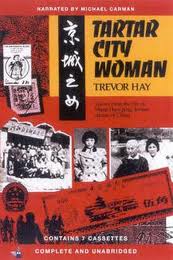
‘Tartar City Woman’ by Trevor Hay

1990, 178 p

I must admit that my heart sank a little when we received our November book for The-Ladies-Who-Say-Oooh bookgroup this month. Yet another book about a Chinese woman growing up in Communist China, I thought.  I’m over all these three-part family saga with grandmother, mother and daughter full of co-mingled admiration and resentment, alternately solved and exacerbated by the magical escape to the Wonderful West.  Well, there were elements of this here, but because this is a memoir of a woman, related by a man (rather than an autobiography), it thankfully lacked some of the emotional tantrum of such books.

Wang Hsin-Ping  grew up among the old gentry class in pre-Communist Peking.  Her father had emigrated to Australia and rather unaccountably disappears from the story completely, and after her mother died, she was brought up by her grandmother.  Members of the family seemed to be able to leave for the West fairly easily, and it was these family connections overseas that compromised her reputation during the various twistings and turnings of  Communist Party ideology as she grew up.  She was a forthright, intelligent young woman, thwarted in her career aspirations by her ambivalent attitude and suspect family allegiances.  Although she lived in a community of suspicion and fear- and I am not under-estimating the effect of this- she was not denounced; not sent out into the country; not beaten or starved or any of the litany of outrages that we often read of in totalitarian societies.  In fact, she testifies to a low-key subversion of authority, albeit over minor details. The peasant village sent her exiled 70 year old grandmother  back to the city because she was useless with her bound feet, and students sent to work in villages simply  returned to the city, in spite of the fact that without their ration books they would be dependent on others for food.

The book opens Trevor Hay’s own reflections on his attitude to China, particularly in the 1970s as he travelled there with an enthusiastic wide-eyed, left-leaning tour group, completely oblivious to Hsin-Ping’s journey in the other direction as she emigrates, seemingly easily, to Australia.  He meets Hsin Ping working in a Melbourne restaurant, and I can only assume that the book is the product of her reminscences and their conversations.  It is not co-written as such, at least in the authorship.

Yet there is a real distance between the teller and the recorder of the narrative. It is a rather cold, bloodless tale, with emotional relationships dispensed with in mere sentences.  Perhaps this is Hsin-Ping’s choice, but Hay does not problematize this in any way.  There is much detail about pedagogy and curriculum, and this ‘teacher’s eye’ view of the world perhaps mirrors the shared professional bond between Hsin-Ping  as an erstwhile classroom teacher and Hay’s own profession as academic in the education faculty at the University of Melbourne.  The book was useful in explaining the U-turns and contradictions in Chinese government policy.

Overall, I found this rather disappointing. It was not the family saga I expected, and for that I suppose I should be grateful, but it felt a rather stilted and incomplete picture of growing up in Communist China.

My rating: 6/10

Read because: it was the November for my face-to-face bookgroup AKA ‘The Ladies who say Oooohh’

Sourced from: CAE bookgroups.

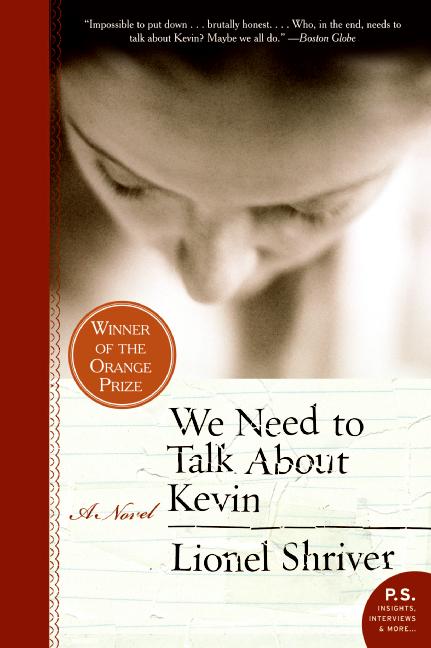
‘We Need to Talk about Kevin’ by Lionel Shriver

2003, 400 p.

I was surprised to note that this book was written in 2003. I felt that it was much more recent than that, and I see that it is about to be released as a movie later this year.  It was my selection for my face-to-face bookgroup, and I was rather dismayed that we did it while I was overseas, thus missing our meeting.  It was the first book that I have purchased for my e-reader, as distinct from the freebies that either came with the reader or that I have downloaded from Internet Archive.  It was rather distressing then, to find that it disappeared from my reader when I had to recharge its batteries through the computer.  I’m not really sure how to get it back: I had downloaded the original on my computer at home, and there was a message about not being able to download it in Canada- obviously ‘they’ had detected that I was in Canada now.  Most curious.  I was about 300 pages, and really wanted to finish it, so I ended up buying a hard copy as well.  So I guess that you could say that this first foray into purchasing an e-book was not an unqualified success.

The fact that I wanted so much to finish it says much about the book.  For about the first 100 pages I was really annoyed by the volubility of this narrator- did she have to go on and on about everything?  Surely Franklin, her estranged husband, would never read these lengthy, detailed letters!

The letters are arranged chronologically, and speak to Franklin as “you”.  They are a form of confession and catharsis as she re-lives her relationship with her son Kevin.  From the outset, she was ambivalent about Kevin: she was undecided about a pregnancy because of her success with her travel-guide company ‘On a Wing and a Prayer’, and she resented her husband Franklin’s overwheleming solicitude for the baby.  Both these tendencies intensified as Kevin grew from baby, to boy, to adolescent: Franklin could see only good in his son, Eva could see only manipulation and malevolence.

I’m not sure at what point my frustration at Eva the narrator dissipated.  It was probably as Kevin became more and more chillingly evil. The small details of his malevolence  were, in many ways, the most disturbing.  We are told in the first pages that Kevin will end up perpetrating an atrocity at his school, and the book slowly, but inexorably, moves towards that point.

I’m sure that the ladies-who-say-ooh in my bookgroup would have discussed motherhood and our ambivalences about our children, and the contribution (if any) of the family’s dynamics to Kevin’s personality.  I’m sure they would have discussed the nature of evil, and whether it is ever inherent, and how the trajectory of Kevin’s crime unfolded.  I wish I’d been there for the discussion.

My rating: 9/10

Reason read: My face to face bookgroup.

‘Other people’s words’ by Hilary McPhee

2001, 312 p.

Most people writing an autobiography (or even more risibly, having it ghost-written) announce that it is ‘in their own words’.  The title of this book is a little disingenuous.  The book certainly is in the words of the author, Hilary McPhee, but it is the story of her time dealing with other people’s writing as editor and proprietor of McPhee/Gribble books- a small, relatively short-lived, but influential publishing house in Australia.

As you might expect from someone immersed in other people’s words, the book is very well written.  It is divided into two parts.  Part I is largely biographical, pulling on a few family history strings, and contextualizing McPhee’s life as an Australian, swept up in the political and social changes of the Whitlam era and afterwards.  It establishes her as an intelligent, middle-class, educated young woman who seemed to fall into the publishing industry almost inadvertently, although her love for reading was a constant throughout her life.

Part II commences many years later as she settles down in the Melbourne University archives, reopening the files of the defunct McPhee/Gribble company which had been donated to the university.  As she does so, the emotions evoked by memories sweep over her- elation, bitterness, cold disappointment.  The company was started by two Australian women, in a male-dominated industry still hidebound by the copyright and marketing constraints of the colonial publishing market.  And for a golden moment, it worked. They were young, they had children, it was exciting and new and different.  Somehow, in a less performance-driven time, they managed to combine what sounds like a creche with the sensitivities of working with authorly egos and wading into an international industry where Australia was only a minor player.  It ended in tears, of course and quite literally, as most people reading this book would probably know.

In this regard, I find myself wondering whether the first part of the book was even necessary.  Apparently McPhee herself found the arc and voice for Part I only after writing Part II, and while it helped to contextualize the story of the company and its main actors, I would have been quite happy just to have had Part II.

This is a real reader’s book.  McPhee/Gribble developed an enviable list of writers- Helen Garner, Tim Winton, Murray Bail spring immediately to mind- but there are other writers here too that, after reading this book several years ago, I rushed out to read (e.g. Glen Tomasetti’s Thoroughly Decent People). Or at least, I bought their books to add to the to-be-read pile (e.g. Rod Jones’ Julia Paradise, and Gerald Murnane).  She occasionally gives the opening paragraphs of the most famous of the books they published and the words hit you with a rush of familiarity and affection, as if they are old friends from way back that you  weren’t expecting to see.  I haven’t read all the books she mentioned by a long shot, but I’d heard of most of them, and while the book could descend into name-dropping in less skilled hands, I certainly didn’t feel that way.  I found myself scouring my bookshelf, and pouncing on the McPhee/Gribbles I found there – “aha! there’s one”- and perusing the little logos on the spine in a way that I hadn’t before.

The book ends wistfully and rather pessimistically as the book industry becomes more depersonalized and more market-driven. I hadn’t realized the consequences of industry policies before globalisation- I was aware of the difficulties of Australian authors getting published, but less aware that the British dominance of our industry meant that American titles were rarely released here.  And since globalisation, she describes a scenario (that one suspects in drawn from real life, unfortunately) of a young writer’s first book being rushed through into a marketing schedule before it was ready and sinking silently as the next product was pushed through.  I suspect that things have not improved, ten years later.

Look- she has a blog where you can read a chapter of the book, a transcript of a 2006 interview and there’s a 2010 interview on Radio National’s bookshow.

My rating: 8.5/10

Reason read: Face-to-face bookgroup (the ladies who say oooh, except that they don’t anymore.)

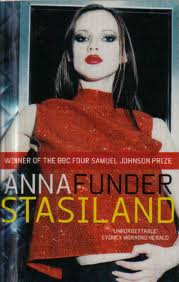
‘Stasiland’ by Anna Funder

2002, 288 p.

(4/5)

Every year for the last five or so years I have put Stasiland onto my list of selections for my face-to-face bookgroup (AKA ‘The Ladies who say Ooooh’). Every year for the past five years, the year elapsed and Stasiland wasn’t chosen.  Ah! But this year IT WAS!!!

I was a little tentative about subjecting The Ladies to yet another of my gloomy selections after subjecting them to The Land of Green Plums about Ceausescu’s Romania last year- what would they think of the Stasi in East Germany this year?  I need not have feared: the narrative was more straight-forward here, and having a young Australian journalist as the first person narrator introduced a familiar voice and viewpoint onto something that, fortunately, is not within the experience of most of us.

Funder, working as a journalist in Europe after reunification, was first attracted to investigating East Germany when a request for a program on the “puzzle women” was brushed aside by the television producers she worked with. There was, it seemed, an embarrassment about the East Germans, as if it would all just disappear if no-one spoke about it.  These “puzzle women”, she later discovered, were employed to reassemble the papers shredded by the Stasi as the wall was falling, a task that would take over 300 years at the current speed.  Methodical to the end, the papers had been shredded in order and shoved into a bag together, and so it was possible to piece them together and reveal the banality and the all-pervasive intrusion of the Stasi into the lives of East Germans.

In East Germany, it has been estimated, there was one informer for every six people.  Some of the surveillance was the stuff of farce, like the  ‘smell samples’ that purported to capture every individual’s smell for later reference.  Other surveillance was more insidious: the reports that were given to potential employers who later changed their mind about the offer of a job; the insistence that there was no unemployment when, as a result of such reports,  one could not get a job; the  warning that a rock group singing subversive lyrics would no longer exist, only to disappear completely from all public view and hearing.  Escapes that were thwarted, imprisonment, blackmail, and the withholding of contact for years with a sick baby on the other side of the wall- by such means the Stasi dabbled in one’s very soul.   There was physical torture as well, but she broaches this only at the very end of the book.  By this time the claustrophobia, vindictiveness and degradation of such minute surveillance seemed on a par with physical torture.

But of course, such intrusion and cruelty leaves no physical trace.  She comments on the memorialization- or more correctly, the distortion of memory regarding East Germany.  She notes the way that East Germans distanced themselves from the Nazis immediately after the war, as if Nazi ideology had flowed from the West and engulfed them, then withdrawn completely afterwards, leaving them innocent of it completely.  She comments on tourist industry that has arisen around the physical fact of the wall- the remnant sections, the tours- that co-exists with a nostalgia amongst some East Germans for the simplicity and security of a life without the bombardment of consumer ‘choice’ and capitalist pressure.  When she places an advertisement seeking ex-Stasi operatives for interview, she encounters men  holding onto the shreds of a Communist dream,  in denial of reunification, and hopeful of the re-emergence of the Stasi.  She finds men who have mounted their own museums to East German life; she speaks to others who have their own justifications for their actions which ring hollow and rather pathetic in a changed world.

The stories of the Stasi operatives and their victims are important, because the Stasi’s reach was not so much in physical things but in the more intangible  sense of safety, identity and autonomy.  There is no museum to hold such things.

I was particularly interested in this book because of the role of the narrator in it.  It is not an academic book as such, and I was surprised to find notes related to specific pages at the end as there had been no footnotes to alert me to their existence.   The narrator is front and centre in this book: we see through her eyes and filter through her consciousness.  At times you need to read against her prejudices- for example, with one man who, as perfect East German man, was moulded this way through his own father’s well-founded fears and insecurities as a dissident, and was to a large extent, a victim as well as perpetrator.  I’m aware of a trend in academic history,  to make oneself part of the story as well, and to use one’s own doubts, questions, misconceptions and false trails as part of the intellectual journey.  I can see its allure as narrative device, but I’m wary.

Funder is not, though, offering this as academic history.  She is upfront about her outsider status, and she documents rather than explains.  It is powerful, chilling reading nonetheless.  Timely, too, as we hear of the Egyptians gaining access this week to their files, many of which had been hastily shredded.  Just as the East Germans before them, they are becoming aware of the size and pervasiveness of the secret police and the complicity of family and neighbours in their midst.

Laugh?

At our bookgroup (i.e. the Ladies Who Say Oooh)  last month we were talking about comedy in books.  The book we were reading, “Two Caravans”,  was billed as humourous, but I really didn’t find it very funny at all.  I commented that there are very few books that I have actually laughed out loud at.  Two that do come to mind are Clive James’ “Unreliable Memoirs” and Denise Scott’s “All that Happened at Number 26“- both of which had me laughing out loud, almost to the point of tears. We dourly vowed that we’d monitor our laughing at books for the rest of the year- a resolution that’s almost certain to deaden any mirth at all for the remainder of 2011!

I don’t think of myself as a humourless person, but I just don’t seem to do it very often when I’m reading.  Perhaps I do- it will be interesting to see.  I laugh at television and in movies, although come to think of it,  I rarely choose to go to a ‘funny movie’.  I think that I often laugh during conversations, and I quite enjoy listening to radio comedy.  I’m really looking forward to seeing Tim Minchin in a fortnight or so, but I think he’s one of the few comedians that I’ve actually seen live.  Of course, there’s laughing and laughing- can I categorize it?  Surely this is a truly kill-joy endeavour…

1.The little sub-vocalized ‘hmmph’ with a raising of the shoulders

2. Breaking into a smile with a little chuckle

3. Laughing out loud- head thrown back, shoulders shaking

4. Extended laughing out loud, perhaps with tears! or perish the thought- a little snort!- subsiding into chuckles then bursting out again.

And I often laugh at watching other people laugh.


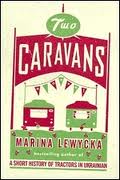
‘Two Caravans’ by Marina Lewycka

309 p. 2007 p.

(2.5/5)

That’s it.  I’m over Marina Lewycka.  I really enjoyed A Short History of Tractors in Ukranian but I loathed We Are All Made of GlueTwo Caravans, which is her second book, comes in between, so perhaps my esteem for her declines with each publication.  I do not intend reading any more of her work: I wouldn’t have read this one, except that it was a selection by The Ladies Who Say Oooh (aka bookgroup).

The title refers to the two caravans that house a motley group of itinerant workers drawn from various countries: Irina and Andriy are both Ukrainian but from very different political and cultural backgrounds; Tomasc,  Vitaly, the middle-aged Yola and her daughter Marta are Polish; there are two Chinese girls, Emanuel from Africa, then the dog.  The dog was probably the last straw for me.  They are swimming in the slimy waters of the pits of the British economy working as fruit pickers on strawberry farms, processors on a chicken-farm assembly line, kitchen hands and waitresses.  Some of the others disappear as sex workers, or reappear as spivs.

They fit every stereotype and I felt uncomfortable reading it and somehow colluding in it. Yes, I know that Lewycka herself is Ukrainian, and that there is a whole vein of humour that can be generated and voiced within a minority group that could not and should not be voice elsewhere-  I’m thinking the string of “Wog” comedies created by Nick Giannopoulous and suchlike.  But it’s a sharp and dangerous humour that feeds on stereotypes, and while some might be challenged by it, others draw a perverse pleasure from having all their prejudices confirmed.

It is touted as a comedy, but I found little to laugh about. I suppose that the book worked in that the amorphous umbrella term “immigrant worker” was broken down into individual people from a range of backgrounds, and it was not an ‘us versus them’ scenario as there were shysters, grubbers and exploiters among the English and the immigrants alike.

Obviously some reviewers liked it- The Sunday Times, The Telegraph and The Guardian.  Reviews from Australia are rather less glowing- The Australian was equivocal and The Age rather dismissive.  I’m wondering if it’s a cultural thing perhaps?  As we well know, there’s a strong streak of prejudice and intolerance that runs through Australia, and probably every other country as well, but what struck me in England in particular was the assumption, from people you’d just met, that you would unquestionably share their barely-disguised contempt for people from the eastern EU countries.  I didn’t want to buy into it then, and I don’t now- even if it does come from ‘inside’.

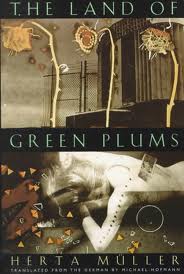
‘The Land of Green Plums’ by Herta Muller

242 p. 1998

This was my selection for CAE bookgroup (aka “The Ladies Who Say Ooooh”) and within about three pages of opening it, I thought to myself: oh dear, The Ladies are not going to enjoy this book.  It is a book of unrelieved bleakness.

The unnamed narrator is one of a small group of student dissidents in Ceausescu’s Romania.  There is a nightmare-like dissonance and bestiality about this semi-autobiographical telling of their lives: people barter sex for offal; abattoir workers jostle to drink the animals’ blood; factory workers labour making tin cows.  The title of the book alludes to the childhood warning  given to the narrator that eating green plums would kill you, and yet the swaggering soldiers of Ceausescu’s regime stuff their pockets and saunter around with bulging cheeks full of green plums with impunity.

The friends write to each other in coded letters where certain phrases convey whether they are being interrogated or watched and each letter is sealed with a hair to alert that the letter may have been tampered with.  As a reader, I found myself hyper-alert to these words- so much so that much later in the book when one of the code  words was uttered just in passing, that I turned quite cold.  Running through the book is the narrator’s constant surveillance and inquisition by the chilling Captain Pjele of the Securitate.  Even when three of the four friends escape to Germany, they are aware of the tentacles of the Securitate and the impossibility of freedom.

The book won the International  IMPAC Dublin Literary Award in 1996 and the author was awarded the Nobel Prize for Literature in 2009.  The language of the book is dense and throbbing, and reads more as poetry than plot.  In fact, the book itself is quite hard to follow during the act of reading, although you discern the plot almost without realizing it.  As a book in translation, the deeply political act of writing a book about Romania in German escapes us, as do the nuances of being part of a German-speaking minority in Romania in post-war Europe.

I can’t say that I enjoyed reading this book.  I found it oppressive and disturbing and rather unfortunately- very memorable.

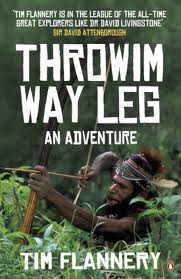
‘Throwim Way Leg’ by Tim Flannery

1998, 326 p.

I’m not sure about Tim Flannery’s writing, or Tim Flannery himself for that matter.   I was astounded when he was proclaimed Australian of the Year under the Howard government.  Although I don’t know how much influence a government has over the Australian Day board, it seemed to me during the Howard years that the government’s conservative influence was pervasive across all institutions. Tim Flannery with his 2006  book The Weather Makers certainly seemed at odds with the Howard government stance on climate change at the time .  But there seem to be many contradictions – or more charitably, nuances- in Flannery’s views on a whole range of topics: whaling, nuclear energy,  restoration of ecosystems.  Is he a brilliant, wide-ranging thinker?  Or does he not think widely and carefully enough?

It’s hard to classify Throwim Way Leg.  It’s organized geographically around different locations in New Guinea and Irian Jaya where Flannery had worked over an extended period of time, going back to the 1980s.   At times it reads like an extended set of case notes, at other times it is more autobiographical and even political in places.

There is a rather juvenile and somewhat disconcerting fascination with penises-  although the sight of the penis gourd does tend to attract one’s attention somewhat.  There is a whiff of self-absorption in his cataloguing of his illnesses and discomforts, and I don’t know whether I’d find him a particularly amiable travelling companion.  In fact, he comes over rather as he does in “Two Men in a Tinnie” with John Doyle- full of information and lessons to be conveyed, but a bit wooden.

His work is steeped in blood.  He no sooner arrived in a location than he had dispatched his hunters off into the jungle to bring back bodies for him which he skinned, boiled down for their bones, and bundled up to send to an Australian museum back home.  I felt uncomfortable at the undercurrent of colonialist appropriation- all in the name of science, of course- and the sheer profligacy of killing even rare animals for specimens.  It did not seem too far removed from the Hunters and Collectors of the nineteenth century so well captured in Tom Griffiths’ book.

At the same time, there is a naiveté about his work as well.  He admits, to his credit, the assistance he received from the Ok Tedi mine but one wonders whether the company has bought his silence about their environmental and commercial practices.  Not so for the Freeport mine, however, which he speaks out strongly against.  In this regard, I can forgive him many of his other shortcomings.  I look at a map of West Papua (he calls it Irian Jaya) and I shake my head at how Indonesia could make any claim to it on either geographic   or ethnic grounds, and even the historical argument based on earlier Dutch colonialism seems rather dubious to me.  I think that Australia, along with the Western world generally , is spineless in its acquiescence  to strident Indonesian rhetoric over their claims to West Papua.  At least Flannery calls it as he sees it.

I read this book with the Ladies Who Say Oooh, several of whom really enjoyed it for its depiction of adventure and discovery occurring within the last thirty years in a world that we think of as fully mapped and known.  I, on the other hand, was frustrated by the plodding prose and the “well done those men”- type of masculine back-slapping often found in military histories.  I note that Flannery’s first degree was in English literature before embarking on a more science-based academic journey.  There’s not much of the poet here.

‘The Rugmaker of Mazar-e-Sharif’ by Najaf Mazari and Robert Hillman

2008,  262p

Right wing commentators have been insidiously successful in characterizing refugees as “illegals”- a term that is both inaccurate and dehumanizing.  The few images we see from detention centres reinforce the characterization of angry, defiant and confronting young men and their ‘demands’ often evoke a bristle of resentment.   It has struck me that the people I know who are most strident in their denunciation of refugees are often those people who would bribe and bully their way to the top of any putative ‘queue’ if their own families were under threat.

This is the first book that I have read about an Australian Afghan refugee, although I suspect that others will follow, just as the life-stories of Vietnamese boat people and Jewish refugees have before them.  The book is written in conjunction with Robert Hillman, whose book,  The Boy in the Green Suit I read recently with my bookgroup ladies- indeed this too, was a bookgroup choice. It was a happy coincidence: having read the two books in close succession I can see why Robert Hillman would have been attracted to his story, but also it reinforced for me that it is indeed Najaf’s voice that we are hearing here.

I suspect (on the basis of no evidence whatsoever!) that Hillman’s contribution came in the structuring of the book, rather than in the words or sentiments uttered.  The language itself is simple, and occasionally captures that shard-like truth that comes because the writer is not a native-speaker: “I did not know that I could feel this much sorrow without a body to bury”.  The book is not a straight chronological narrative- and here, perhaps Hillman’s familiarity with an Australian audience and the Australian publishing market comes into play- because it starts with Woomera which is well known, albeit somewhat uneasily among Australian readers, before returning to Afghanistan and the beginning of his journey.  A rather incongruous outburst of foreshadowing near the start of the book reassures us that there will be a wife and daughter in suburban Melbourne one day in the future, and the draw of the book is to find out how he gets to that happy situation.  His journey through Indonesia and onto the boat does not emerge until close to the end of the book by which time you are won over by his goodness and humanity.   The logistics of the financial transaction with the people smugglers is somewhat glossed over, but the journey on the small, overloaded boat is well described.  Perhaps, too, this is a statement that even though the means by which refugees arrive is a red-hot issue for Australians, it is only a small part of the overall story and by no means its defining feature.

As a reader, I was aware throughout that Mazari was not of my own culture.  His belief of God’s will, his acceptance of mystical explanations and the tenor of  his family and marriage relationships made this plain.  On the other hand, though, people obviously warmed to him as a person and there were small acts of kindness that changed the trajectory of his life.  There were petty cruelties too. I am appalled by the vision of women floating in those perversely ethereal blue burkas, but had not particularly considered the plight of young boys growing into adolescence who would be hoovered up into the politics of warfare.  No-one could be unaware of the civilian deaths, but seeing them played out within one family, over an extended period of time, brought home the drawn-out nature of this ongoing conflict.

You can read more about Najaf Mazari here and it makes me smile to see him there in his rug shop- I feel as if I know him.  I find myself reading about Afghanistan again with more interest and it has put the human back into these reports for me.  Quite an achievement.