Category Archives: Port Phillip history

No Good Damper

While reading through the newspapers of 1840s Port Phillip, my attention has been arrested several times by the location called  “No-Good-Damper”.  The location seemed to attract malfeasants and scoundrels of all types: people were often being held up and robbed on the road, and the Plenty Valley bushrangers were sighted there.  So where is No-Good-Damper?  Why was it called that?

The No-Good-Damper hotel was located, apparently, near the present Springvale six-way junction where Dandenong and Centre roads converge.  For those who are topographically inclined, the longitude is approximately 145.16 and latitude 37.95.

The present-day Vale Hotel claims it as its forerunner.  The original licence for the No Good Damper hotel was granted to Christian Ludolph Johannes De Villiers on April 20 1841, and it seems to have changed hands several times- to William Scott who also had the licence for the Squatters Rest in April 1842 (they may have been the same hotel), and then to a Robert McGhee in May 1844 who may or may not have been the same person as Robert McKee who held the licence in April 1845.

It was a rather dangerous place to hang around.  The Port Phillip Herald of April 4, 1843  reports that Mr Bond of No-Good-Damper was the victim of an attempted robbery:

On Monday night week as Mr Bond of No-Good-Damper was returning home from Melbourne, and only a short distance from his house, he was suddenly commanded “to stand” by an armed man, who after demanding his money, and not waiting to see if the same would be delivered to him, struck Mr Bond a violent blow with a bludgeon, which, however, did not bring him to the ground, but being armed with a leaded riding whip, he quickly knocked down the ruffian, and before he could dismount a pistol was fired at him, the ball carrying away the brim of his hat, and shaving off a portion of the hair of his head.  Mr Bond made up to him with the intention of closing with him, but the villain took to his heels, and notwithstanding that he was pursued for a short distance he succeeded in getting clear off.

A year earlier, in April 1842, there had been another more daring raid by the Plenty Valley bushrangers, who were to later be sentenced to death by hanging by Judge Willis. On April 29th 1842 the Port Phillip Herald reported

In our last we reported some daring attacks, which have been recently made upon the stations of a number of settlers in the vicinity of Melbourne, since which we have learned the particulars of another outrage committed, it is presumed by the same banditti, upon Captain Gwatkin of the ‘Scout’ at present in our harbour, and Mr F. Pittman.  On Wednesday evening as these gentlemen were proceeding in a gig to the station of the Messrs. Langhorne at Dandenong, they were stopped at about seven o’clock, a mile and a half on this side No Good Damper, or about twelve miles from Melbourne, by four men heavily armed both with guns and pistols, three of the gang being well mounted and the other on foot.  They immediately ordered Messrs. Gwatkin and Pittman to get out of the gig and strip off their clothes, which of course they were compelled to do, as during the time the guns were held cocked at their heads, and threats of instant death pronounced should they disobey orders.  The clothes were minutely rifled, and from those of Captain Gwatkin were taken 21 pounds in Launceston notes, of which 3 were fives and the remainder ones, 33 pounds of the Melbourne Banks, of which five were fives, also four sovereigns and a half, a quantity of silver, and a few coppers, amounting in all to 63 pound 1s. 8d.  They returned 5s to Mr Pittman “to pay for his bed at No Good Damper”, but upon being remonstrated with by Captain Gwatkin, who said that having got such a handsome booty they might have the generosity to return a sovereign to pay his expenses until his return to town, they very cooly informed him that he could go to sea and make more, and to think himself safe they did not blow his brains out; they had at first demanded and learned his name.  The horse was next taken out of the gig; the harness, with the exception of the bridle was taken off; and Mr Pittman ordered to assist the ruffian on foot to mount thereon, when the whole party rode off at a brisk pace. Messrs. Gwatkin and Pittman proceeded on to No Good Damper, from which they immediately despatched a messenger to town with the intelligence; and on coming into town yesterday morning they called at Mr Le Mann’s near the place where they were robbed, and were informed that about 8 o’clock the previous evening, four men paid him a visit, “bailed up” two men who were in his hut, forced a woman to make them some tea, helped themselves to two saddles, one for the horse they had taken out of the gig, and the other for one of the horses on which they had previously only a saddle cloth, gave a boy 1s. 7d. for holding their horses, and decamped.

How  did this salubrious location get the name No-Good-Damper?  Let’s be charitable and go with the explanation given to the editor of the Argus on 9 September 1924:

Sir: In the interesting article “The Gippsland Mystery” on Saturday by Ernest McCaughan it is stated that a party of five whites and ten blacks were sent out under the leadership of De Villiers, an ex police officer who kept the extraordinary named No Good Damper Inn.  Apropos of this, a story was related to me by the late Robert Rowley, then of Rye (a very old colonist who had known Buckley, the wild white man). The story, which may be of interest, is that about the year 1840 lime was being burnt about Sorrento and Rye.  A layer of sheoak logs was laid on the ground, then a layer of limestone.  Another layer of logs, then again stone, and so on, until there was a considerable stack.  Fire was next applied.  By this rough and ready, though wasteful system, lime used in the building of early Melbourne was then burned.  The lime was then “slacked”, afterwards sieved through a fine sieve, and forwarded to Melbourne by ketch.  One of these old windjammers had the misfortune to go aground near the site of Frankston.  The lime was taken off  undamaged, stacked, and carefully covered a little way from the shore. A number of blacks were in the vicinity.

They had some little experience of the white fellow’s flour.  When they found the lime, sieved and done up in small bags under a tarpaulin, they were sure they had got the genuine article in plenty.  So they mustered in force, took away all they possibly could and fearing pursuit did not stop running until they put about 12 miles between them and the stack of lime.  The blacks then mixed their flour with water upon their ‘possum rugs and put the dough in the ashes to bake, the result being spoiled rugs and bad damper.  In the words of Mr Rowley, “they called that place Dandenong” which means “no good damper”.

Yours &c J. L. Brown, Sandringham Sept 8.

And now for the slightly less cheery version, courtesy of Edmund Finn (Garryowen) p. 963.

There is a place near Dandenong called “No good Damper”, and the origin of this name is very laughable.  The proprietor of a small store there had occasion to be sometimes away from home, and the Aborigines, who had a great weakness for flour and mutton, stole a quantity of some flour, but the storekeeper said he would be even with the blacks.  So he got a couple of bags of lime from Melbourne, and made them do duty for the flour at his next absence. “Blacky” called again, but instead of flour purloined a bag of lime, and left in great glee. On arriving at their quambying ground they commenced baking operations, when on mixing water with the supposed flour, they were horrified to find it fizz, and fancing the white man’s “debble debble” was about to bewitch them, they ran away yelling “No good damper, no good damper.”  So thus the phrase took, and so the storeman’s place is named to this day.  The flour was never troubled after.  Arsenic, is said to have been often mixed with flour for the special use of the blacks at more than one of the stations in the then wild interior.

Ah, yes, a laughable little story indeed.

And George Dunnerdale, who wrote ‘The Book of the Bush’ in  1893  wrote:

It was near Caulfield on the Melbourne side of  “No Good Damper swamp”.  Some blackfellows had been poisoned there by a settler who wanted to get rid of them.  He gave them damper with arsenic in it, and when dying they said “No good damper”.  (p. 276)

Would it have been possible at the time to pass off a deliberate poisoning as a “laughable” little anecdote, or even then would it have to have been disguised in some way?  Certainly, several of the settlers who came before Judge Willis made no secret that they had shot aborigines who had “trespassed” on their land, or in retribution for stock deaths. And even now, you could be sitting in the comfort of your twentieth-century car passing “Murdering Gully” near Camperdown or   Massacre Hill near Port Campbell.

For what-ever reason, though, “No Good Damper” seems to have slipped away as a place-name, even though it was used quite freely in the early 1840s.  I wonder what would be the response if we tried to revive it?

In the news 14 April 1843

The Port Phillip Herald of 14th April 166 years ago has its usual lengthy report of the Town Council proceedings of that week.   The newly-minted Council must have been a god-send to newspapers looking for material to fill their columns.  In tedious detail are written the motions put forward, the speeches given while presenting and seconding the motions, speeches against, objections etc. etc.  Not that there was much action from the council, though.  Judge Willis had protested against the legality of its incorporation, rendering it unable to collect rates and hence hobbled in actually doing much.

As part of their ineffectual bluster, on 14th April 1843 Councillor Stephen (long time opponent of Judge Willis) rose to put forward a motion.  The Council, he said, acted something like a Grand Jury (something that Judge Willis might not have agreed with), and it was within its rights to offer  suggestions to the Government.  In this spirit, he noted that Judge Willis had often commented on the dearth of spiritual education in the gaols.  There were 840 prisoners per annum incarcerated in the gaol,  but only 213 visits by the clergy.  He gave a breakdown of these visits by denomination:  77 visits by the Roman Catholic clergy; 65 by the Episcopalians;  48 by the Presbyterians and 25 visits by the Wesleyans.   He proposed that a sum be put aside for chaplains’ visits, which should be divided amongst the clergy according to the frequency of their visits.

His fellow councillors did not agree.  Cr. Smith (who was himself an Episcopalian) argued that one chaplain should be appointed by the government to the position.  Cr. Fawkner (Congregationalist) was appalled at the idea that an Episcopalian chaplain might minister to a Presbyterian or a Catholic, and bridled at the idea of a government church.  Cr Kerr said that in Sydney,  Gov Bourke’s Church Act notwithstanding,  Episcopalian chaplains only were appointed to preach to convicts and those on the chain gangs.  However, he thought it was none of the Council’s business.   And in the end, the motion was put but defeated.

Let’s unpack this a bit.  Cr Stephen was right in saying that Judge Willis had been agitating for better religious education in the jails for some time.  The Port Phillip Herald of 29 November 1842 reports Willis stating from the bench that he did not know how, in his conscience, he was justified in sending a prisoner to a place beyond the reach of all religious instruction, and bemoaning  that despite his utmost exertions to get the services of a chaplain at the gaol in Melbourne, he had not been successful.  Certainly he had been lobbying privately to Governor Gipps, although his requests at first had been for a paid position for Rev Thom(p)son, his own Episcopal minister (and incidentally, a steadfast supporter of the Judge) who had been providing these services previously without charge.   He changed tack some six months later, decrying the neglect of religious education in jail and noting that under English law, prisoners were entitled to the benefit of a resident chaplain.  He pointed out that the Sydney gaol had recently  allocated funding of 30 pounds per annum for one chaplain, with two additional chaplains receiving 25 pounds.

The issue of whether there was to be an ‘established’ Church in Australia was a fraught one.  As Michael Roe argues in The Quest for Authority in  Eastern Australia 1835-51, the Church of England was one of the bastions of  conservatism in early New South Wales.   Governor Bourke’s Church Act gave subsidies to the main religious denominations, thus granting legal equality between the churches.  Nonetheless, the battle over Anglican establishment continued, albeit in smaller arenas- like prison chaplains. Judge Willis, who was not backward in his vehement criticism of the Roman Catholic church,  seemed to be lending his support- at least at first.

The prominence of the chaplains in execution rituals is striking, but not unexpected.  After all, the law drew its legitimacy for capital punishment not only from the State, but also from religious justifications involving eyes and teeth.  The first executions in Port Phillip, of the aborigines Bob and Jack, were conducted with the oversight of Rev Thompson, while the bushranger executions later in 1842 involved all three chaplains:  the Episcopalian Rev Thompson; the Presbyterian Rev Forbes and the Roman Catholic Fr. Fogarty.  The chaplains visited the condemned men, prayed with them, accompanied the coffins and accused men in the parade to the execution spot;  even physically escorted them and helped them up to the scaffolds.  Their reports of their charges’ penitence and contrition fed into the script of the ritual, published in minute detail for the newspaper public.

So, if Judge Willis was unsuccessful in lobbying for paid chaplains, and if the Council motion lapsed, what happened next?  Garryowen tells us that on 1 January 1847, funding was finally allocated for paid chaplain positions.  Rev. A. C. Thom(p)son and the Roman Catholic priest Rev. J. J. Therry both shared 25 pounds per annum for chaplaincy services to the gaol.

References

Michael Roe The Quest for Authority in Eastern Australia 1835-1851

Garryowen

The Elizabeth Street Creek

Melbourne has experienced two earthquakes in recent weeks.  They tell us that it’s due to geological activity around Korumburra, but don’t believe a word of it.  It’s not an earthquake: instead, it’s the sound of the Port Phillip fathers turning in their graves as they hear of a proposal to return Elizabeth Street in Melbourne to a creek bed.

The Age on Saturday invited a number of Melbourne worthies to respond to the question “What would you do for this city if you could?” releasing them from those pesky considerations of economic and political constraints.  Gilbert Rochecouste, described as a “planning mastermind” (who has escaped my radar completely, but apparently he’s the man who led the rejuvenation of Melbourne’s laneways), suggested opening up the concrete on Elizabeth Street and letting Williams Creek underneath flow free.

Actually, I hadn’t heard it referred to as “Williams Creek” before, but William Westgarth’s recollections confirm that it was previously known by this name.  The people of early Melbourne had other names for it too- “a jungly chasm” is particularly evocative.   The corner of Collins and Elizabeth Street seems to have been particularly treacherous.  Thomas Strode the newspaperman recalled in 1868

At almost every hour of the day may be viewed the interesting spectacle of drays being bogged in the muddy depths of Collins-street…We remember on [one] occasion a dray of bullocks were so hopelessly imbedded in a hole in Elizabeth-street, that the animals were allowed to stifle in the mud, and its being nobody’s duty to remove the nuisance, their remains with that of the dray, lie buried in that extemporary graveyard to the present day.  (cited in Annear p. 41)

Perhaps the reclamation of “Williams Creek” may uncover them!  It was obviously a pretty boggy area. Apart from Williams Creek, two other tributaries  ran  into Yarra.  “River Townend” which ran from the corner of Collins and Elizabeth Streets  was named after Michael Townend, the ‘fat, comfortable-looking grocer’ on the south-west corner. “River Enscoe” ran from the north-west corner of William and Flinders street, and was named for the merchant John Enscoe who very nearly drowned in it.

Each winter “Lake Cashmore” would form on the doorstep of Michael Cashmore the draper who owned the shop on the northeast “Block” corner of Collins and Elizabeth Streets, described by Garryowen as “a large pool of stagnant water, not sufficiently deep to drown a man, but quite sufficient to half do it. ” (Garryowen p. 457)

During downpours of rain,  litter from the surrounding streets would pour into Elizabeth Street gully:

Pieces of timber, wisps of straw, waste paper, and corks, as they are borne past and beyond carpenter’s shops, stable yards, printing offices, or hotels, sufficiently indicate the character of the neighbourhoods from which they have been carried; corks come down into the main stream from every side.  From all the ‘rights-of-way’ they pour in crowds.  They rush out of the lower slums of Little Bourke Street, and from both ends of every street in the town, until they collect in a dense mass in the wide space between Collins Street and Flinders Lane, where they form a closely-packed army of bobbing bedouins… (cited Brown-May, p. 75)

Somehow the ‘bobbing bedouins’  of wine and champagne corks is a quainter image than a congealed mass of Big Mac wrappers.  Melburnians of a certain age will remember when Elizabeth Street flooded in 1972:  looking back, it seems remarkable that no-one drowned given the number of basement shops and subways there.

elizabethflood

When the ravine was in full flood during the early years, the only safe place to cross it was at Lonsdale Street.  In 1880s Elizabeth Street became one of the first stormwater drains, carrying water from Carlton down to the river.   In the Stork Hotel at the top of Elizabeth Street (much loved for the late Dennis Prior’s dramatizations of the Greek myths), there used to be a series of photographs on the wall showing the raising of Elizabeth Street so that what had previously been the street-level bar became the basement.

All that engineering; all that technology!  What would the city fathers say?

Well, actually, one of them thought of it first. William Westgarth in his Personal Recollections of Early Melbourne wrote in 1888:

Melbourne missed a great chance in filling up with a street this troublesome, and as a street, unhealthy hollow… A reservation of the natural grass and gum-trees between Queen and Swanston street would have redeemed Melbourne up to the first rank of urban scenic effect and the riotous Williams might, with entire usefulness, have subsided into a succession of ornamental lakes and fish ponds.

Maybe all this earthquake activity is not the city fathers turning in their graves; perhaps it’s old Willie Westgarth slapping his knees and roaring with laughter that it has taken us 121 years to embrace his vision.

References:

Robyn Annear, Bearbrass: Imagining Early Melbourne, 1995

Andew Brown-May Melbourne Street Life 1998

Garryowen Chronicles of Early Melbourne

Kirsten Otto Yarra: A Diverting History of Melbourne’s Murky River,  2005

William Westgarth Personal Recollections of Early Melbourne (e-text)

‘Crime in the Port Phillip District 1835-51’ by Paul R Mullaly

You can get all excited about the latest, contentious, revisionist contribution to those ‘big’ historical questions (those questions that somehow fail to capture the public interest!).  My wordy, I know I do!  But there’s something quite humbling about the labour-of-love, extended type of research that provides the building block foundations for this other more controversial, more debated but somehow more ephemeral work.  I’m thinking about the edited series of documents, the painstaking deciphering of a diaries, the compilation of administrivia into a logical process after it has been distributed across multiple bureaucracies.  There’s a danger, of course, that it can descend into mere list-making, and the hunt become more seductive than the actual capture.  But thank you to those historians who share the nuts and bolts of their research with others.

In relation to my own research, I’m thinking of A.G.L. Shaw’s Gipps-La Trobe Correspondence with its wide-ranging footnotes that make me realize I’m following a well-trodden path.  I’m thinking of Ian D Clark’s persistence in deciphering George Augustus Robinson’s diaries- ye gods: that handwriting! I’m thinking of Paul de Serville’s typography of Port Phillip ‘gentlemen’ before and after the gold rushes. And now, too, I’m thinking of Judge Paul R Mullaly’s book Crime in the Port Phillip District 1835-51.

This is a big book- 763 pages- so big in fact that the subject and names index has to be downloaded from the publisher’s website separately-  a costly compromise when dealing with such an exhaustive work.  The author, a judge and Q. C. with a long history of involvement in the Supreme Court of Victoria, undertook this huge endeavour in his retirement, drawing on material at the Public Records Office of Victoria, newspapers, and both Redmond Barry’s and Judge Willis’ own case books.  Here is where his experience comes into its own.  For the non-lawyer, many of these documents are fragmentary and utilitarian, and all too often opaque.  But  Mullaly can cast his legal eye over them, piece them together into a narrative and contextualize them into a standardized legal process.

The book is divided into three themes, although the table of contents doesn’t reflect this.  He starts with a snapshot of Port Phillip itself and its legal system, with an emphasis particularly on the status of Aborigines under colonial law.  He then moves to a step-by-step description of the legal process, from arrest through to sentence, highlighting along the way where practices differ from those today. Finally- and this is the largest section of the book- he analyses different types of offences e.g. those against the person, against property, against justice, miscellaneous and sectarian offences,  with a selection of chronologically-presented vignettes of particular cases.  The regularity of his structure was helpful.  I was concentrating on judgments between 1841-3, and the chronological presentation made it easy to locate the material I wanted.

There is not an argument as such in this book,  beyond his long-held belief expressed in his introduction that “the elite in society tended to be far too ignorant of the realities of much criminal activity and were much too judgmental in attributing a high degree of moral culpability to many offenders” (p. vii).  This is, instead,  a descriptive work, focussing on the administration of the criminal law, which he hoped would “help the present community understand many aspects of our present culture and give many citizens an insight into the community in which their ancestors lived.” (p.viii).  Perhaps because of its descriptive intent, the ending of the book felt a little abrupt.  I found myself wishing that he’d made an overall assessment of crime at that particular time- was it any more or less violent then? did the nature of crime change? was society well served by its criminal justice system?  I really enjoyed the parts where he tried to explain some anomaly that he had detected, or fill in the gaps that had been left in the documentary record.

There’s just so much that can be done with the material he has assembled here.  I’ve been frustrated by the elusiveness of women in my study of Port Phillip but here they are- not just as victims but also as witnesses, neighbours, people just going about their lives.  There’s a fascinating study of childhood glimpsed in these cases; there’s a geography of the streets and pasttimes.   There’s another economy here- not that of the Blue Books or Select Committees into Monetary Confusion, but the economy of buying and selling and just getting by.

This book provides well-dug, solid foundations. Thank you.


‘Lawless Harvests’ by Alex Castles

hobart-jail

2003, 209 p.

As a primary school child in the 1960s, there were certain stationery items that your parents had to buy for you each year.  They always had to buy two HB pencils and a red-lead pencil that would kill you if you sucked the end of it (surely not?).  There was the 12-pack of Cumberland pencils that always looked insipid and cheap against the 24-pack Derwent pencils that the luckier kids had, with that brilliant aqua and lush bright green that even now gives me pleasure.   There was the pack of Greyhound Dry Pastels that went unopened all year until they crumbled to dust in your desk.  And then there was the plastic stencil map of Australia, with the states marked out with a thin line except for Victoria, where the boundary with NSW seemed to inexplicably dribble out into a series of dots on the right hand side.

It must have been a source of much chagrin for school children on the Apple Isle (Tasmania) to realize that their own state was left off the map.  No doubt having the little island dangling below Victoria added a level of complexity and expense to the manufacturing task that was not worth the effort.  And so, if you remembered Tasmania at all, you had to hand-draw it, down below Victoria somewhere.

Yet when looking at Port Phillip in the 1840s, one is struck by the dominance of Van Diemens Land on the new settlement.  George Town at the mouth of the Tamar River was much closer to Port Phillip than Sydney, 600 miles away.  Trade was frequent between Hobart, George Town and Port Phillip, and it was largely the scarcity of  available land after a heavy bout of land-grant activity in the late 1820s/early 1830s that drew men’s eyes northwards across Bass Strait.  Just as men and stock meandered down from the settled districts of New South Wales, so too did ship after ship from Van Diemens Land disgorge sheep that moved into farms throughout the Port Phillip district.

New South Wales dominates our awareness of early colonial Australia, but Van Diemens Land runs alongside it as a parallel but separate colonial entity.  Although the NSW Governor was officially Governor-in-Chief,  from 1825 onwards he played no active role in the administration of Van Diemens Land. The Van Diemens Land Lieutenant-Governor styled himself “His Excellency” (suggesting that there was no immediate superior) rather than the “His Honor” title that he had used up until this date, and the Tasmanian Supreme Court, officially proclaimed on 31 March 1824 was a separate entity in its own right rather than an arm of the Supreme Court of New South Wales as Judge Willis’ Port Phillip court was.

Alex Castle’s book, published posthumously in 2003 tells the story of the Van Diemens Land legal system.   The book had its genesis in a plan by the Law Society of Tasmania in 1985 to commission a history of the legal profession in Tasmania.  Professor Alex Castles from Adelaide University offered to write it, with a view to publication during the Law Society’s centenary year in 1988.  But only 3 chapters were written at that stage, and focus shifted to the 28th Australian Legal Convention to be held in September 1993.  By May of that year, twelve chapters had been completed and the final chapter was in draft form.  However it was never editted sufficiently for publication and the manuscript remained unpublished in a filing cabinet.  In 2003, after the death of Professor Alex Castles, the Law Society remembered the part-completed manuscript, and engaged its librarian to retrieve the text, and Dr Stefan Petrow to edit it, write an introduction and epilogue and compile a bibliography, as the text itself does not have footnotes.

In his introduction, Stefan Petrow discusses this book in relation to Castles’ other work, particularly his pioneering textbook 1971  ‘Introduction to Legal History’.  In this textbook, Castles concentrated on the English influences on the Australian legal System but Petrow detects  a movement in Castles’ work in later years that acknowledged local variation, particularly in frontier legal environments.  I wonder if Castles had written the introduction himself,  how he would have addressed himself to this question.

This book traces through the earliest legal steps in Van Diemens Land, which are hard to recover because the papers were burnt on the evening of  Lieutenant Governor Collins’ death- possibly to obscure legal decisions made during his time of office.   Collins’ successor Davey was completely out of his depth, and it was William Sorell, the next Lieutenant- Governor who reordered local affairs.  But the main focus of the book is on Lieutenant George Arthur and his devolution of power to himself, with the acquiescence of his fellow-Tory Supreme Court judge Pedder.   Castles credits Sir John Franklin (yes,  the villain of Richard Flanagan’s Wanting) with introducing the legal changes resisted for so many years by Arthur.  He traces through the amoval of the puisne judge Algernon Montagu and the attempted amoval of Pedder by Franklin’s successor Denison over the taxation-like nature of the Dog Act-  the same process of amoval (but for different reasons) which finished off Judge Willis’ career.

One thing that I very much appreciated in this book was the way that each chapter started anew with a little vignette or anecdote that piqued the reader’s interest anew.  He finished each chapter a similar way too, often returning to the episode with which he opened the chapter.  In between things got a little turgid, with a very ‘top-down’ perspective running throughout, but the openings and closings of each chapter remedied this.  I’m not sure that Castles himself would have finished the book with the what-happened-next epilogue that Petrow wrote-  the book suffers from the lack of a strong, argumentative final chapter.  However, it would have been beyond the ethical and editorial demands on Petrow to have written anything beyond what he has done.

Some figures

The other day I was reading through the Votes and Proceedings of the Legislative Council for the 1840s (as one does) , and looking at the Statistical Returns for 1834-43, which were printed in June 1844.

There I found a table of the official figures of whites killed by Aborigines, and conversely, Aborigines killed by whites for the district of Port Phillip.  These are, of course, the ridgy-didge “official” figures- the sort that Keith Windschuttle in his Fabrication of Aboriginal History upheld-  with all that entails.

WHITES KILLED BY ABORIGINES PORT PHILLIP.

1836 2
1838 12 10 + 1 +1
1839 3
1840 11
1841 6 + 2 The two were murdered by the Van Diemen’s Land blacks
1842 4
1843 1
1844 1

Total: 40

NATIVES KILLED BY WHITES.

1836 1
1838 16
1839 8
1840 67 30 by the Whyte Brothers- rests on Aboriginal evidence. 10 in Grampians by Messrs Wedge, depends partly on Aboriginal evidence
1841 10 Based on statements by Aborigines
1842 6 4 at Smith and Osbrey’s station – great investigation and 3 persons tried and acquitted
1843 3 In one event at Mr Rickett’s
1844 2

TOTAL 113

I’m surprised that the figures are so low on the white side.  Given the heightened anxiety and dread expressed by settlers on the frontier, I’m surprised that there are not more white deaths.  However, many attacks involved property loss- particularly the hacking and killing of sheep- and given that stock (rather than the ownership of land) formed the basis of wealth in this pastoral squatting society, these attacks were property crimes that struck at the heart of the settlers’ financial viability.   The low figures on the aboriginal side are more to be expected. The figures for black deaths had to be corroborated by white evidence.  There was little to be gained in reporting an aboriginal death.  If  an aboriginal was  “said to be” killed, on aboriginal evidence only, then it was not counted.  You’ll note the qualification of  “based on statements by Aborigines” in the third column.

The statistics for whites killed show that overwhelmingly these deaths occured among hutkeepers, shepherds and servants.  These men were isolated, often far from the homestead (such as it was),  far from surveillance and likewise far from assistance.  They were also often assigned servants or ex-convicts.  Only four of the 40 were designated as “Mr —“, and only one was categorized as a settler.

The large spike in both white and native deaths in 1838 was because of the six-hour pitched battle that took place on Faithful’s station near Benalla, in retaliation for the massacre of 10-14 of Faithful’s workers (the official figure shows 10; Faithful claims 14).  I quoted Faithful’s description of the retaliatory battle  in my post on Letters from Victorian Pioneers.

I find it interesting that the Whyte brothers are named so openly here, and in the Letters from Victorian Pioneers.    The aboriginal deaths in 1840 around Whyte’s station in Coleraine came to be known as the Fighting Hills Massacre.  The Whyte brothers reported the attack themselves.  No charges were ever laid.

The trial of the men charged with the aboriginal deaths at Smith and Osbrey’s station occurred right at the point when Judge Willis was dismissed as Resident Judge.  The murders had occurred in February 1842 and a 50 pound reward was offered, later increased to 100 pounds with a free pardon and a free passage to England if the informant was a transported convict.  Nothing was heard, until a transported ‘bush carpenter’ employed at the station reported a number of men for the murder in May 1843.  Three men- Hill, Beswicke and Betts were committed to trial and it was, in fact, this case that Judge Willis was hearing when the court was interrupted by the serving of the Executive Order for Willis’ amoval.  Justice Jeffcott, who was Judge Willis’ replacement, took over the trial and the men were acquitted.  Gipps privately wrote to La Trobe that if he had been on the jury, he would have committed at least two of the three men, but Jeffcott was “not dissatisfied with the verdict”.

References:

Richard Broome Aboriginal Australians pp.40-48

A. G. L. Shaw The History of the Port Phillip District p.  114,130,138

Paul R Mullaly Crime in the Port Phillip District p.290-297

Museum Victoria: Encounters  http://museumvictoria.com.au/encounters/journeys/Robinson/Fighting_Hills.htm

Bride Letters from Victorian Pioneers

Votes and Proceedings of the NSW Legislative Council

Letters from Victorian Pioneers (or “It wasn’t me Guv’nor, it was him”)

victorian_pioneers

When Lieutenant-Governor La Trobe sailed home  for England on 6 May 1854, he carried with him a series of letters which he hoped to use when writing a history of the Port Phillip district in his retirement.  He had officially approached a number of the early pastoral pioneers and asked them a number of questions, and as you might expect, they answered his survey letter fairly promptly.  I’m not sure what the official letter said-  one of his respondents referred to a section that asked  “If preceded, accompanied or immediately followed, by whom and when, and the general state of the district around and in advance of me at that period.”  He obviously also specifically asked about encounters they had had with aborigines in their area, and their opinion of the future facing the aboriginal tribes.

He had big plans for these letters.  He intended his book to start with Captain Cook’s discovery of the Gippsland coast, then move to the early futile attempts at settlement.  It would then go on to record the effective colonization of the region by pastoralists, ending with the discovery of gold in 1851.  Part II would deal with the geology, botanty and zoology of the land; the aborigines and the human aspects of the spread of settlement.  He would then pass on to separation and the consequences of gold discovery, where he would rebut the criticisms that had been levelled against him for his administration of the gold fields.  He would then finish with ‘My Australian Home, a walk around my garden’.  (Gross, p. 131)

It was not to be.  He was increasingly afflicted with blindness, and realizing that he would never write this book, he returned the letters to Victoria in 1872 , where they were preserved in the public library.  Times had moved on: people were ‘moving forward’ then too, and not all that interested in the preceding generation. It was not until 1898 that the 58  letters were published by the Trustees of the Library under the name ‘Letters from Victorian Pioneers’.

Because they were responding to an official request with guiding questions, there is a sameness about the responses of his correspondents.  But there’s also quite a bit of similarity in their experiences as well, which is what I expected.  In fact, my impetus for reading this book was the suggestion in Robert Redfield’s book that people living in a small community often held a common biography.  Even though Redfield specifically states that his approach does not hold for frontier communities (which of course Port Phillip was), I was interested to see if the early pastoral settlers of Port Phillip could be said to have a common life story.

And yes, they could.  All his respondents were male, and many of them were young when they settled in Port Phillip- usually in their early to mid 20s.  Many of them came over from Van Diemens Land  from where they had initially emigrated (none admits to convict origins).  Many of them had brothers with them.  And they held in common sheep and cattle– hundreds and hundreds of them, trotting along, being slaughtered by marauding natives (and  what a dispiriting and expensive loss of life that must have been), moving from run to run.  Some time ago I read Roger McDonald’s book  The Ballad of Desmond Kale, and was frustrated by the sheep-sheep-sheep  emphasis of it, but sheep-fever is amply demonstrated here too.  It’s not as exotic and alluring as gold, but the sheep-rush  obviously drove the early settlers of Port Phillip.

They all mention the 1840s depression- although one canny Scotsman seems to have escaped it because he had savings still in Van Diemens Land.  There are names of landholders that spring up again and again- obviously big stockholders held land in several districts.  Many of them moved from station to station.

Some of them were quite observant about the changes wrought on the land after settlement.  Several mentioned that it was very dry when the area was first opened up, and that the rainfall had  improved in the last few years of the 1840s, drawing later settlers to land that had seemed uninviting when the first settlers passed it initially.  One or two mentioned changes in the grasslands, and some were quite nostalgic for the beauty of the unsettled areas.

Most fascinating of all was the range of responses to the question about aborigines.   Most of them knew of “other people” who had gone on shooting reprisals- as perhaps might be expected when the Lieutenant-Governor asked you such a question.  Several of them mentioned the Whyte brothers by name as being particularly responsible for aboriginal deaths, one respondent attributing 51 deaths to them compared with the official count of 30 aboriginal deaths.  A couple of respondents mentioned that they had shot aborigines in reprisal-  just one or two, mind you, and always because the aborigines started it first.   Another settler was named as responsible for several deaths, but he protested (too much?) his innocence. George Faithful of Wangaratta, however, reported quite openly his actions after suffering several attacks from surrounding natives:

At last, it so happened that I was the means of putting an end to this warfare.  Riding with two of my stockmen one day quietly along the banks of the river, we passed between the anabranch of the river itself by a narrow neck of land, and, after proceeding half a mile, we were all at once met by some hundreds of painted warriors with the most dreadful yells I had ever heard.  Had they sprung from the regions below we could have hardly been more taken by surprise.  Our horses bounded and neighed with fear- old brutes, which in other respects required an immense deal of persuasion in the way of spurs to make them go along.  Our first impulse was to retreat, but we found the narrow way blocked up by natives two and three deep, and we were at once saluted with a shower of spears.  My horse bounded and fell into an immense hole.  A spear just then passed over the pummel of my saddle.  This was the signal for a general onset.  The natives rushed on us like furies, with shouts and savage yells; it was no time for delay.  I ordered my men to take deliberate aim, and to fire only with certainty of destruction to the individual aimed at.  Unfortunately, the first shot from one of my men’s carbines did not take effect; in a moment we were surrounded on all sides by the savages boldly coming up to us.  It was my time now to endeavour to repel them.  I fired my double-barrel right and left, and two of the most forward fell; this stopped the impetuosity of their career.  I had time to reload, and the war thus continued from about ten o’clock in the morning until four in the afternoon.  We were slow to fire, and I trust and believe that many of the bravest of the savage warriors bit the dust.  (p. 220)

Several of the respondents noted that they had taken young aboriginal girls and boys to live with them, but that once they reached adulthood, their tribes came and took them away.   One settler commented that  he gave a baby back to its mother after he had taken it because the servant wasn’t prepared to look after it, and  seemed rather put out that she refused to give it to him a second time.  Several reported infanticide, especially where there was a white father and a black mother.  There were several allegations of cannibalism, although interestingly one settler reported that the aborigines thought that the whites were cannibals!

Where aboriginal deaths had occured, several claimed, it was because the blacks had become over-familiar.   White men didn’t take lubras, they claimed- the black men offered their wives to them freely.

Even amongst those who were most positive about the aborigines working for them on their stations, or their quickness and willingness to forgive, there was overall a deep sense that influenza, smallpox, VD or alcohol would decimate their numbers.  They all reported that there weren’t as many aborigines on their stations as there had been years earlier- strange that.

References

‘Letters from Victorian Pioneers: being a series of papers on the early occupation of the colony, the aborigines etc addressed by Victorian pioneers to His Excellency Charles Joseph La Trobe Esq. Lieutenant-Governor of the Colony of Victoria’. Edited with an introduction and notes by C. E. Sayers from the original edition edited for the Trustees of the Public Library by Thomas Francis Bride L.L.D during his period of office as Librarian of the Public Library of Victoria. (Phew!), 1969.

Alan Gross ‘Charles Joseph La Trobe, Superintendent of the Port Phillip District 1839-1851 Lieutenant-Governor of Victoria 1851-1854’. Melbourne, Melbourne University Press, 1956.

1851 Black Thursday

The Royal Historical Society of Victoria is having its centenary this year.  One of the aims of the founders of the society was to capture the stories of the early colonists of Port Phillip before they died.  I was flipping through some of the earliest volumes of its journal, and it is impressive to see papers given by people at their meetings who had been here (albeit as children) right from the start of Victoria’s settlement- just think of it: they would have seen and met these people of Port Phillip that I’ve read so much about.

At the 25th June and 3rd September meetings of the society in 1923,  a paper was read called “Reminiscences from 1841 of William Kyle- a pioneer. Communicated to and transcribed by Chas Daley”.    I hadn’t heard of William Kyle and I know nothing more about the paper than just this.  William Kyle was born in Greenock, Scotland in 1832 and came out to Port Phillip as a child with his father.  The paper extended over two editions of the Victorian Historical Magazine and traced through his arrival, life in the country and in Melbourne pre-gold rush with some fascinating descriptions of Aboriginal life on the edges of what are now the inner-city suburbs of Melbourne, then right through to the latter years of the century (I’ll admit that I didn’t read the whole thing).

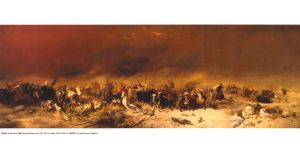
I was drawn to this description of Black Thursday of 1851, and perhaps to get yourself in the mood you should visit the State Library of Victoria page and have a good look at William Strutt’s painting.

And here’s how William Kyle remembered Black Thursday of 1851:

The floods of 1849, which were the result of a general rainfall throughout the colony, caused an excessively dense growth of vegetation, and much grass.  Little clearing had been done in the forests, and ring-barking trees was not yet in vogue, so that, after a very hot summer, the outbreaks of fire which swept throughout the land under the stimulus of a fierce hot wind caused the conflagration known as Black Thursday.  The fire spread with amazing rapidity.  Three-quarters of the colony was in a blaze.  The flames were so intense that trees two or three hundred yards away from the advancing wall of flame were shrivelled before the flames reached them.  In the unsettled districts there was little loss, but thousands of sheep and cattle succumbed.  The native game was almost annihilated.  The fire was so near Melbourne that the sky seemed to be a mass of floating fragments of bark and leaves ablaze with the intense heat.  Many people thought the Day of Judgment had surely come.  We could hardly breathe the stifling air.  The floating embers even set on fire some of the ships in the bay.

After the conflagration had exhausted itself the scene was one of intense desolation.  Nothing was visible but charred stumps and blackened smoking trees, bereft of all foliage.  No sound of bird, insect or animal was to be heard.  It was years before game was plentiful, and it was never so again near the settled districts after Black Thursday.  Fortunately, although there were the most wonderful escapes from death, there were not many human lives lost, owing to the sparseness of the population.

Sounds very, very familiar.

Reference:

Reminiscences from 1841 of William Kyle, a pioneer’ Victorian Historical Magazine, Vol X, Dec 1925 No 4.

Bushfires

Australia Felix, as Victoria used to be designated, is in shock and disbelief at the loss of life and property in the bushfires over the weekend- 103 lives lost and still counting.  Shock at the sheer numbers;  and disbelief, at least sitting here in the north-east suburbs of Melbourne that all this destruction was occuring in areas that we might drive through on a leisurely Sunday afternoon drive less than fifty kilometres away.  It’s a cool morning: there’s not even a whiff of smoke on the air; the sky is clear; the sun has none of that sullen reddened glow that indicates that there’s fire somewhere.

The people of Port Phillip in the 1840s would have been aware of fires, but not fires of the magnitude we’ve seen this past weekend.   Most reports of fire  in the Melbourne newspapers of the early 1840s  related to house and shop fires fires within the town boundaries. For settlers further out, fires started through lightning or were lit by the aborigines either as an act of depredation against a particular settler, or as part of  land and food management.  Looking through my summaries of two years of the Port Phillip Herald, I can find only two mentions of bush-fires – both in January 1842- and interestingly both involve the natives.   The first report was of a fire at Port Lincoln in South Australia, which was caused when the Resident Magistrate there asked the natives into town at the full of the moon to receive rations of flour; some arrived with fire-sticks and a fire was started, although it was not clear whether the fire was accidental or not.  The second report, also in January 1842, made a correction to earlier reports that the blacks at Mr Bathes’ property in Westernport had fired four acres of barley and fencing.  In fact, instead of causing the fire, they had tried to extinguish it, and chief Gellibrand in particular was singled out for conducting himself in the most praiseworthy manner.

Bushfire seasons come and go- I can, for instance, remember driving with my mother up to Warrandyte in 1962 to collect my father who had been working on fire-breaks with his earthmoving machinery in the fires there.   Every time I drive past Lara on the way to Geelong, I remember the people who died in their cars on the Princes Freeway in 1969. But every few decades in Victoria, there are huge, state-wide conflagrations of a completely different magnitude.  This weekend was such a conflagration.

When reading through the newspapers of 1840s Port Phillip, it is instructive to remember that  for white settlers, this was a new colony, and the vagaries of temperature, rain, snow, bushfire were still largely unknown.  Black Thursday on 6 February 1851 was the first recorded widespread blaze,  covering a quarter of what is now known as Victoria including Portland, the Plenty Ranges, Westernport, the Wimmera and Dandenong districts.  Twelve lives are recorded lost, along with over a million sheep.

struttblackthursday1

People of my parent’s generation still speak of  “Black Friday” of 13 January 1939, the day that until last Saturday held the record for the highest recorded temperature.  My father recalls seeing the ranges surrounding Healesville silhouetted with fire; just last week I was speaking to someone who  mentioned that her mother, having just given birth, was wheeled out onto the balcony of the city hospital, from where she could see the Dandenongs alight.  Seventy-one people died in the fires which devastated Noojee, Woods Point, Omeo, Warrandyte and Yarra Glen.

300px-ashwednesday1

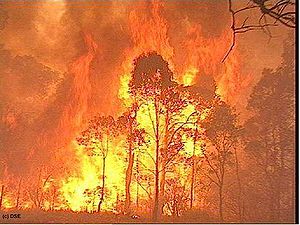
And then Ash Wednesday, 16th February 1983- well within my memory.  A few days earlier there had been a huge dust-storm that rolled across Melbourne, then Ash Wednesday itself.  I recall watching, transfixed, the unfolding disaster on television, hour after hour, then walking out into the front garden in the dark with the sky glowing, ashes falling, and wondering if the whole world was going to combust.

And so, onto this last weekend.  On the Friday night, after a day of about 30 degrees, we watched the news where authorities were warning of extreme heat and fire danger on Saturday and worst bushfire conditions in Australia’s history.  It was difficult to believe- it was still with no breeze at all, and not unduly hot.  But, oh, things are so dry: Melbourne has been in drought for many years and has had the second-driest January rainfall figures on record- just one millimetre of rain compared to a January average of  48 mm.   The Saturday itself was oppressively hot, reaching the highest ever recorded  temperature of  46.4 degrees.  When you opened the door, it was like opening a fan-forced oven with the rush of dry heat and wind.  The wind got stronger and stronger with trees bending, dust whipping, but there was still no sign or smell of fire.  We did notice a large, towering white cumulus cloud to the north, but by then it had clouded over, and we thought that it must have been a storm cloud. Then, at about six o’clock, the cool change came through- even a few spatterings of rain.  We went to bed aware that there were still fires, that there were fears that what had been the fingers of the blaze would become the palm of the blaze on a much wider front once the wind swung around, but that perhaps it hadn’t been quite as bad as they predicted.

By the next morning, things had changed completely.  Fires that we hadn’t even been aware of, at Kinglake, at Marysville had wiped out the towns; 27 dead, maybe 40, then 65, then 93 and now over 100.   These are much-loved places.  Kinglake, some 20 kms away was where we had a camp every year in my long-ago born-again Christian days; I fell off a motor-bike there and still have the scar on my ankle; I drove there at about 50 kms a hour in my old Morris Major with a couple of girlfriends as my first foray as a new driver on country roads.

Marysville, home of all the Mary-guesthouses (Marylands, Mary-Lyn etc) built in the 1920s in mock-tudor style and the prettiest little main street with huge deciduous trees, with a crystalline creek  fringed with tree-ferns running through it.  We went there for September holidays at Marylands when I was a child in the 1960s;  I’ve camped beside the Steavenson River;  walked through the bush bird-watching,  my husband and I went there about five years ago, stayed at a guest-house,  ate at the pub, visited their historical society.

marysville

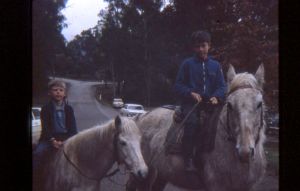
My brothers horse-riding at Marysville, 1960s

And St Andrews- famed for its weekend market; Sunday lunch at the pub.    Chum Creek near Healesville- my father spent a couple of years up there in the 1930s/40s with his grandparents, attended the primary school,  lived through bushfires there, battled the blackberries and bracken there.  I wonder if his house is still standing?

There’s grief, disbelief, and a degree of helplessness about it all.  In recent years there’s been a change of attitude about staying to defend your house- they no longer force people to evacuate, but encourage householders to develop a fire-plan of clearing around their houses, dealing with ember attacks, wetting down the house etc.  The common wisdom is to evacuate early if you’re going to leave, or else stay and defend a well-prepared house from fire after the main front has gone through.  People know all this;  the whole state was in a heightened sense of readiness, fire-plans were made, people were ready to stay and defend and yet, in the middle of the noise, smoke, heat obviously the fear is just too much to bear and people flee.  There’s much more sadness to come.

‘Redmond Barry: An Anglo-Irish Australian’ by Ann Galbally

barry3

1995, 228 p.

As a Melburnian, it’s difficult to get past the image of Redmond Barry as a strong, imperious philanthropist.  He is still very much a visible presence:  a large statue of him rears up in front of the State Library (one of his projects); his name adorns prominent buildings at the University of Melbourne (another of his projects), and of course his reputation has been forever intertwined with that of Ned Kelly, whom he sentenced to death.  This is the stuff of myth-making: the pompous Supreme Court judge cursed by the fearless bushranger “I will see you there when I go” (or words to that effect), only to die 12 days later of “congestion of the lungs and a carbuncle in the neck”.  [ Can you die of carbuncle? Dear Lord, if I should die, please let it NOT be of a carbuncle!]

Ann Galbally’s biography covers, of course, his whole life but my interest is mainly on his early years in Port Phillip and his relationship with Judge Willis.  Barry was born into the Anglo-Irish ascendancy.  The peace that followed the Napoleonic Wars cruelled his chances for a military career, so he entered the law instead only to find the Bar crowded with other young men who had made the same vocational choice.   When his father died in 1838, he emigrated to Sydney where there was less competition.

barry4

On the journey out, he embarked on a relationship with a Mrs Scott- and worse still, continued it when he reached Sydney.  News of the affair reached the ears of Governor Gipps, and he was awarded few government briefs as a result.  He continued to suffer from disapprobation even after leaving Sydney for the small town of Melbourne because, although he socialized and got on well with Superintendent La Trobe, the more prominent legal positions were in the gift of Gipps rather than La Trobe.   His unorthodox relationships with married women seem to be an ongoing theme: in 1846 he took up with a Mrs Louisa Barrow, with whom he had four children, in a  public, lifelong relationship that was never regularized by marriage.

Barry was only 26 when he arrived in Melbourne, and Galbally paints an engaging picture of Barry socializing with the other predominantly-Irish members of the Bar:  his good friends Sewell, Foster and Stawell and fellow Trinity-college and King’s Inn  graduates Brewster and Croke.  Although a member of the Melbourne Club and welcomed to all the vice-regal social occasions, he had little capital behind him and thus was not caught up in the land speculation of the early 1840s and  “perhaps for this reason his managed to maintain civilized relations with Willis for longer than most of the legal fraternity” (Galbally p. 49).

Not that Barry found Willis easy.  His diary records a succession of entries where he “argued with Willis“, “fought with Willis” or had a “blow-up with Willis who threatened to suspend me“.  He greeted the news of Willis’ suspension with relief  “Supreme Court Willis suspended + removed, Te Deum Laudamus” (24 June 1843).

In spite of this, Barry did not seem to have been exposed to the same personal insults or attacks that other barristers and officers of the court suffered.  Willis seemed to greet his appointment as the Commissioner for the Court of Requests in January 1843 with genuine approval, and at times their sparring in court (complete with historical allusions and Latin jests)  seemed to be equally relished by them both.   Although Barry had a reputation as a bit of a dandy who wore an old-fashioned Beau Brummel style suit, obviously Judge Willis did not take exception to this as much as he did the trimmed moustaches of Edward Sewell, Barry’s friend and erstwhile housemate.

barry1

Unlike Judge Willis, Barry was noted for his “dignified deportment and invincible politeness” (Garryowen p. 867). Galbally captures this quality well.   Against such a man, Willis’ own failings of temper and demeanour would have been even more marked.

References

Ann Galbally  Redmond Barry: An Anglo-Irish Australian

Barry, Sir Redmond, Australian Dictionary of Biography (online)