Category Archives: Port Phillip history

Magistrates in Port Phillip

When Governor Gipps was running through the long list of people who had complained about Judge Willis, he mentioned that eighteen magistrates had come forward with complaints about Willis’ behaviour.   How did people get to be magistrates in Port Phillip in the early 1840s?

A bit of back-tracking first.  The role of ‘magistrate’ has a long history. In England they have been a feature, in one guise or another, of the justice system for the past six centuries.  Traditionally the gentry families of the countryside, almost as a matter of course,  appropriated the role as their right within the village system of deference and moral responsibility that underpinned English rural life.  The magistrate, who usually held unreported hearings in his own house, had wide latitude over many areas of life; magistrates knew the villagers  (their families, their entitlements and their histories)  and were known themselves (their families, their entitlements and their histories)  by the village inhabitants.

In the early years of penal settlement in New South Wales and Van Diemens Land, there were very few free settlers and at first nearly all magistrates held other positions.  As more free settlers arrived and took up large land grants, they were called upon to police the work and leisure of the convicts who worked on their properties.  Have no illusions about this: the colony depended on the forced labour of convicts, and the efficiency of this dispersed, in effect privatized, system depended on the surveillance, assiduousness and authority of the magistrates.

The Colonial Office back in London appointed the main office-bearers for Colonial positions,  shifting, juggling and negotiating individual careers as part of a huge chess-game, with influential spectators on the side making their ‘suggestions’, pulling their strings and calling on and bestowing favours in the swirl of patronage and reciprocity.   The appointment of magistrates was, however, one of the positions in the gift of the local Governor in the colony- and he used it.  And eager aspirants knew that and approached him too, with their letters of introduction and recommendation from patrons both at home and those who had preceded them to the colony.

The early magistrates in Port Phillip were appointed from Sydney, both paid and unpaid.  There was a sniffiness about paid (or stipendiary) magistrates, and certainly the London-based Colonial Office preferred honorary magistrates who did not need to be paid.  But from about 1822-42 the courts had increasing oversight over magistrates’ activities and the issue of conflict-of-interest became more pressing.  Unlike in England, the landed proprietors of New South Wales were not a leisured class: they were entrepreneurial men on the make themselves, who were anxious for quick returns on their capital, which in turn depended on convict productivity.   The rapid extension of settlement necessitated the appointment of paid magistrates in charge of an organized, generally ex-convict, police force.   On the anxious fringe of frontier settlement, there was increasing demand for police magistrates which was on  one level resisted by the local government on grounds of cost, but acceded to as a ‘temporary’ measure because it meant that personnel could be shifted to meet population movements and changing needs, unlike honorary magistrates who were appointed because they were already established in a particular locality.

Patronage power tended to be diluted the further one travelled from the metropole.  The Colonial Office could, and did, ask that particular men be appointed magistrates-  F. B. St John, the Police Magistrate in Port Phillip was one such Colonial Office request.  But generally, the magistracy was one area of patronage, interwoven as it was with local status and visibility, that the Colonial Office was prepared to devolve to the Governors.  Once La Trobe arrived in Port Phillip, Gipps shared aspects of this patronage with La Trobe.  He always consulted La Trobe before ratifying appointments and he entertained suggestions from La Trobe’s end.  But the actual gift of  the magistracy rested with him.

Gipps’ practice was to avoid making magistrates from among practising doctors and from the clergy (unlike earlier times- the Rev Samuel Marsden was commonly known as a whipping parson). He insisted that magistrates must have been in the colony for one year, and must be at least 24 years of age.  Gipps relied on La Trobe’s opinion and asked him to vet the appointments amongst others in the locality- for instance, before appointing Stephen and Edward Henty to the position of magistrate in Portland, La Trobe consciously sought out people who thought they should not be appointed- to no avail.  Gipps advised La Trobe to broach the topic with nominees beforehand: “I hope you always obtain a man’s consent to act before you recommend him as it is very necessary to do so.”  Gipps suggested that La Trobe make the recommendation directly to him (Gipps) or to his Private Secretary as “a man might not want his qualifications for the Magistracy discussed in public office” (Gipps to La Trobe 1 March 1840, Shaw Gipps-La Trobe Correspondence p.17)

By the early 1840s the magistracy was no longer seen primarily as a penal surveillance mechanism, but had been overlaid with other municipal, moral, licensing and public order issues.  The honorary and police magistrates were responsible for the “regulation and control of a community” including the administration of regulations over buildings, fire prevention, roads, cleanliness etc.   as well as petty crime and public safety.  When the Melbourne Town Corporation was created in 1842, a separate division of magistrates was created from among the town councillors.

One thing that you did not need was legal training.  In the 1830’s Plunkett published his book which came to be known as “Plunkett’s Australian Magistrate” and the mainstay of legal advice for magistrates and the first Australian practice book of its kind.  As the 1840s went on, there were increased bureaucratic demands made of magistrates in terms of documentation and official oversight.

Paul de Serville  in Port Phillip Gentlemen lists the magistrates appointed in 1841.  Several held other government positions e.g. Edwards,, Le Souef, Parker, Robinson  and Sievwright were all magistrates by virtue of their positions as Aboriginal Protectors;  Airey, Fyans and Powlett were also Commissioners of Crown Lands.  Lieutenant Russell as Commander of the Mounted Police was a magistrate; as was  James Simpson as Police Magistrate until replaced by the Colonial Office’s suggestion of F. B. St John.  Alongside these were the honorary magistrates recognized for their importance in the community.  As part of the gentlemanly identity that they all projected and drew upon, all magistrates were involved in myriad civic and business activities.

As might be expected given Willis’ temperament, he clashed with several of the magistrates under his purview.  He strongly embraced the educational aspects of his role as Supreme Court judge, insisting that the magistrates attend court to familiarize themselves more fully with the law.  He was critical of magistrates who were involved in speculation – or at least, those who got caught out in the financial distress of the early ‘4os, and clashed with Simpson, Farquhar Mc Crae, Lonsdale and Brewster.  He was often critical of the Aboriginal Protectors, especially Sievwright who was by this time under a cloud over other improprieties as well.  In one of the frequently-retold vignettes from Judge Willis’ courtroom, he clashed on several occasions with J. B. Were, most famously when he without warning ordered Were, attending court as a magistrate,  to take the witness stand to testify.  When Were protested that he could not remember certain details, Willis awarded him one-two-three-six months in jail for contempt of court.  Needless to say, J. B. Were was one of the 18 who protested Willis’ behaviour.  But not all magistrates opposed him.  Willis looked favourably on Robert Martin, William Verner and J. D. Lyon Campbell- all of whom happened to live nearby to Willis in Heidelberg- and they gave him their unstinting support.   The split in support or opposition to the Judge amongst the magistrates mirrored the division in public opinion more generally.

Bushrangers!

One of the most high-profile criminal cases of 1842 was that of the Plenty Valley bushrangers who were hanged on Judge Willis’ instructions in 1842.

The four Plenty Valley bushrangers embarked on a five-day spree on 26th April 1842 that entailed eighteen robberies and eventuated in a shootout where one of bushrangers was killed and the leader of the captors, Henry Fowler, was injured through a gunshot wound.[1] After robberies on 26th-28th April around the Oakleigh/Mulgrave area, they turned northwards towards the Plenty Valley.

Click here to see a map of their exploits in the Plenty Valley

In her study of convict bushrangers, Jennifer McKinnon draws a distinction between “footpads” the often- unarmed bandits in small groups staying close to the main centres of population, and “banditti” in large armed and mounted gangs who operated in the interior.[2] She cautions, however, that the distinction between “footpads” and “banditti” is not a hard and fast one. Certainly the Plenty Valley bushrangers combine elements of both: they ranged around familiar, relatively settled territory in what are now fringe suburbs within riding distance of central Melbourne, where they had been employed previously. But they operated on horseback, at first in pairs, but later in a larger group of four, and possibly five, armed men.

To a certain extent they fit the archetype of social bandits and draw on a time-worn trope of

…the bold Robin Hood of their morning songs, and … the unfortunate victim of legal oppression, the captured of the chase….His reckless daring would be the noblest chivalry; and the jovial freedom of his manners, the frankest generosity.  His immoral jests would be treasured for posterity, and the éclat of his life and death would stimulate the worthy ambition of sympathizing souls.[3]

Graham Seal, likewise, identifies Robin Hood as the beginning of a coherent and continuous tradition of British outlaw heroes portrayed as

“friends of the poor, usually driven to outlawry by some injustice.  They are however, brave, courteous to women, and use violence only when it is unavoidable or in justified revenge.  Generally, they die bravely and usually through treachery.”[4]

Thus, we see the Plenty Valley bushrangers avidly pocketing the £63 they stole from Capt Gwatkin from the trading vessel Scout in a hold-up on the road to Dandenong, while giving 5 shillings of the Captain’s money to fellow-victim Frederick Pitman so that he can pay for his bed at the Travellers Rest Inn at nearby No-Good-Damper.[5] Paula Byrne’s study notes the extravagant dress often adopted by bushrangers, and here we see one of the Plenty Valley bushrangers resplendent in the scarlet-lined Austrian Hussars costume stolen from an earlier victim, complete with dangling sword, in a subversive and swaggering challenge to uniformed authority.[6] Food, too, was important: Byrne comments that settlers often recalled the exact food taken or consumed by bushrangers.[7] Hence we have the goose killed and thrown to Capt. Harrison’s cook with instructions to have it ready for their dinner the next day, and the roast ducks and herrings appropriated for their own breakfast when the bushrangers burst in on five men at Campbell Hunter’s station, the site of the final shoot-out.  We have the bravado of bushranger Jepps, nonchalantly standing outside the door of the hut, lighting his pipe with bank notes and, as Constable Vinge recalled later, challenging his captors:

After considering for a time he opened his arms and walked towards us, and then stood still for a while and said, ‘Gentlemen, I have robbed most of you that I see, but I want to get away!’  I answered ‘No; you will not get away’.  He then said ‘Gentlemen, rather than be taken to Melbourne and made a public show of on the gallows, shoot me’. I walked up and handcuffed him.[8]

Although there may not have been outright support from settler sympathizers, there does seem to be a degree of ambivalence amongst some of their victims.  An early victim, James Bruce Donaldson, may have been robbed by them one or two days previously, but did not report the crime.[9] The bushrangers took another settler, George Rider, hostage and ordered him to guide them to the next victim’s house where he interceded with the two women present, shared a champagne with the bushrangers, and was released with his watch.  Rider returned home with no attempt to alert the authorities, and returned the next day to act as intermediary between the besieged bushrangers and their captors.[10] He later handed in a sum of money for the prisoners’ defence, but Willis disallowed the use of the proceeds of crime for this purpose.[11]

However, the Plenty Valley bushrangers differ from the convict bushrangers in several important ways. Chronologically they fell between the convict bolter period of the 1820s and 1830s and the “golden age” of bushrangers in the 1860s.  During this hiatus, there was a marked decline in social prestige for bushrangers. With the abolition of assignment in the early 1840s, they lost their raison d’etre as social bandits, and they had not yet taken on the mantle of exemplars of the social struggle over land of the 1860s.[12]

Moreover, and importantly, the Plenty Valley bushrangers were not perceived to be convict bushrangers at the time. Their leader, 27-year old John Williams was a Catholic bounty migrant, thought to be Irish but actually born in England.  Martin Fogarty was also described as an Irish bounty migrant.  Charles Ellis, aged 18 was English and appeared to have arrived as a free immigrant, and Daniel Jepps was a 27 year old American whaler, said to have “had the air of having once moved in a different sphere”.[13] Although Ellis was later described as “an old lag from Van Diemen’s Land” and Fogarty was said to have been forced to leave Ireland after turning Queens Evidence in a number of murder cases, the public perception, at least prior to the trial, was that they were not ex-convicts.[14] Hence Willis’ address to the jury focused on the need for attention to be paid during the selection process to the character of incoming immigrants- a variation on his more common warnings about the degradation of society occasioned by convict gangs employed on public works and expirees from Van Diemens Land.[15] In the mirror that Willis held up to the community in his courtroom addresses, Port Phillip was not a penal colony.  Indeed Willis prefaced his Latin-laden address to the jury hearing the Plenty Valley bushrangers’ trial by noting that it seems

“as if the contamina [sic] of similar enormities in the penal colonies had extended its baneful pestilence to this district- a district colonized by free emigrants, not peopled by convicts, and therefore reasonably expected to be the less polluted.”[16]

In a settlement that distinguished itself from the older penal colonies, this first incidence of bushranger activity elicited a strong public response.  No fewer than three police groups, headed by ex-Chief Constable ‘Tulip’ Wright; Crown Land Commissioner Powlett and Constable Vinge, and two groups of civilians converged on Lowland Flats for the final confrontation.  One of these volunteer groups was a contingent of five men from the Melbourne Club who were feted as “the gay and gallant ‘Five’, the heroes of the time, whose bravery was theme on every tongue” [17] Their earlier indiscretions of dueling, insolvency and altercations at the horse races were forgiven as the gentlemen of Melbourne drank their health at a public dinner and the Masonic Lodges awarded three of them with gold medallions.  The formation of a Yeomanry Corps amongst the “gentleman residents” of the District for the protection of the community was proposed by Police Magistrate F. B. St John, and the Plenty Valley settlers offered to form a volunteer corps among themselves- an offer endorsed by the “resident ladies” of Plenty Valley in a rare petition with only female signatures.[18] In the immediate aftermath of the capture, rumours circulated that other fugitives from the Goulburn River had conspired to meet with the Plenty Valley bushrangers on the Maribyrnong River where they would wait in hiding until an opportunity arose to steal a vessel to make their escape.[19] There was heightened agitation for surveillance of the sawyers and timber cutters along the rivers as anxiety rose about the need for social control of “skulkers of various descriptions” and expired convicts from the penal colonies, especially Van Diemens Land, flooding into the Port Phillip district.[20]

So, what happened when the captured bushrangers encountered Judge Willis in the courtroom?? Ah- for that you’ll have to wait for the completed thesis (from which this was cut- as if you can’t tell!) and the supporting documentary and soap opera.  Suffice to say, the three surviving bushrangers were hanged on 28th June 1842- three of the six executions carried out during 1842 under Willis’ sentencing.


[1] Mann, The Plenty Bushrangers of 1842: the first Europeans hanged in Victoria, pp. 1-33.;Finn, The chronicles of early Melbourne, 1835 to 1852 : historical, anecdotal and personal / by “Garryowen”, pp. 352-356.


[2] Jennifer A McKinnon, Convict Bushrangers in NSW 1824-1834, La Trobe University, 1979,  61-62.

[3] James Bonwick, The Bushrangers: illustrating the early days of Van Diemen’s Land (1856), Hobart, Fullers Bookshop, 1967, p. 89.

[4] Graham Seal, Ned Kelly in Popular Tradition, Melbourne, Hyland House, 1980, p. 31.

[5] Mann, The Plenty Bushrangers of 1842: the first Europeans hanged in Victoria, p. 5.

[6] Paula J Byrne, Criminal Law and Colonial Subject: New South Wales 1810-1830, Cambridge (Eng), Melbourne, Cambridge University Press, 1993, p. 134.; Mann, The Plenty Bushrangers of 1842: the first Europeans hanged in Victoria, p. 15.

[7] Byrne, Criminal Law and Colonial Subject: New South Wales 1810-1830, p. 135.

[8] Constable George Vinge ‘Bushrangers in the Olden Times’ The Argus, Friday 6th August 1880.

[9] Mann, The Plenty Bushrangers of 1842: the first Europeans hanged in Victoria, p. 12.

[10] Ibid., p. 25.

[11] Port Phillip Patriot 12 May 1842.

[12] Michael Sturma, Vice in a Vicious Society: Crime and Convicts St Lucia Qld, University of Queensland Press, 1983, p. 101.

[13] Mann, The Plenty Bushrangers of 1842: the first Europeans hanged in Victoria, pp. 2-3.; Port Phillip Herald 20 May 1842.

[14] On Ellis as expired convict see Macfarlane, 1842 The Public Executions at Melbourne, p. 28. and Fogarty as exile Port Phillip Herald 20 May 1842.

[15] Port Phillip Herald 13 May 1842.  For his more-frequent commentary on the dangers of convicts and ex-convicts see Port Phillip Herald 28 May 1841; 17 August 1841; 14 January 1842.

[16] Port Phillip Herald 13 May 1842

[17] Finn, The chronicles of early Melbourne, 1835 to 1852 : historical, anecdotal and personal / by “Garryowen”, p. 408.

[18] St.John to La Trobe 30 April 1842, PROV 19, Unit 33, 42/1366; Campbell Hunter and men of the Plenty to La Trobe, 5 May 1842 PROV 16 Unit 3 42/592;  Ann Bear and ladies of the Plenty to La Trobe 5 May 1842 PROV 16 Unit 3 42/593.

[19] Mann, The Plenty Bushrangers of 1842: the first Europeans hanged in Victoria, pp. 29-30.

[20] La Trobe to E. D. Thomson 4 May 1842 PROV 16 Unit 12 42/571   This was not an unjustified fear.  Sturma notes that of 5000 convicts freed by servitude or holding conditional pardons recorded leaving Van Diemens Land between 1847 and 1849, over 3,800 departed for Port Phillip compared with less than 250 for Sydney.  Cited in Sturma, Vice in a Vicious Society: Crime and Convicts p. 54.

Mr Robinson reports

I’ve been reading the Port Phillip journals of George Augustus Robinson.  Note that these are the Port Phillip ones, not those that he wrote in Van Diemen’s Land which were edited by N.J.B.  Plomley.  Actually,  Plomley’s work has had a bit of renaissance lately, with the republishing of his Friendly Mission and the release of Reading Robinson,  a set of essays by various authors which extends Robinson’s work into a broader imperial context.   I have this book of essays on hold, and shall report anon.

Robinson himself seems to be undergoing a reconsideration.  Until recently, his main biography has been Black Robinson by Vivienne Rae-Ellis, a vehement portrayal that depicts him as an incompetent and dishonourable liar and cheat.   Rae-Ellis’ book had a troubled publication history and  received much critical comment on its publication (Pybus, 2003).   Keith Windschuttle in his Fabrication of Aboriginal History interprets this as an attack on Rae-Ellis for her negative depiction of Robinson, who has been treated more benignly by Henry Reynolds, Lyndall Ryan and other historians that he himself attacked for their depiction of Aboriginal history.  Perhaps it’s a matter of “the enemy of my enemy is my friend” because Windschuttle certainly did not extend the same level of scrutiny to Rae-Ellis as he did to Reynolds and Ryan.

Robinson’s Tasmanian journals have received most of the attention, but the ones I’ve been reading are his Port Phillip journals, written after he had spent several years on the blighted Flinders Island with his dwindling band of natives.   He took with him to Port Phillip  several Aborigines from Flinders Island, including Truganini and Wooredy.   He arrived in Melbourne in February 1839, prior to La Trobe.  His instructions were vague.  Glenelg at the Colonial Office in London sent a copy of the report of the 1837  parliamentary  Select Committee  to Gipps, with recommendations to protect, educate, provide religious education for and ‘civilize’ the aborigines.   Glenelg told Gipps to fill in the details, but Gipps was loathe to do so.  He argued that Robinson had been appointed Chief Protector on the strength of his “acquired experience superior to that which is possessed by any other individual in the Colony”, and he was left largely to define the role himself.  It seems that La Trobe was keen for Robinson to move around the District: he sent him on his trips to the Western District and was reluctant to appoint Robinson as a town magistrate lest it “seem to form the idea that his Duties lie in Melbourne instead of in the Bush” (Gipps to La Trobe 11 Feb 1843).  But his role did, indeed, involve both administration in Melbourne- in fact, he was appointed an office in Willis’  “old” Supreme Court building once the “new” courthouse was opened- and field work both supervising the Assistant Protectors and recording the language, names and habits of Aborigines throughout the District both as a form of ethnographic study and census.

This dual focus of  acting both as administrator and protector is reflected in his journals.  Inga Clendinnen tells us in her memoir Tiger’s Eye that she  drew on Robinson’s diary of his Western District  journey between 20 March and 15 August 1841 as her first step back into the academic waters after a long period of illness.  Her essay ‘Reading Mr Robinson’ focusses on Robinson’s  journey, but the George Augustus Robinson we see in the saddle, riding from tribe to tribe and outstation to outstation is not the same fussy, petty man that we see around the streets of Melbourne.  His role was not just to observe and count: he was also a minor bureaucrat puffed up with self-importance but ultimately impotent and compromised when the pointy end of the law intersected with the humanitarian aspects of his task.

Clendinnen admits “I have become very fond of Mr Robinson”.  I’m not quite as fulsome.  The ‘town’ Mr Robinson is rather wearing; in management-speak he is unable  ‘upwardly manage’ his relationship with his superiors (if indeed, he even perceives them as such), and he undermines and backstabs the assistant protectors under his supervision- although admittedly some of them were a rum lot too.  His attitude towards the Aborigines he brought over with him from Flinders Island is puzzling: he distances himself emotionally from the execution of  “Bob” and “Jack” for murder in January 1842, fulminating about process but oblivious to the tragedy; he goes into organiser-mode for the return of the women to Flinders Island without expressing any regret. The death of Peter Brune, who did not return to Flinders Island but remained with him as his native right-hand man, is brusque and matter-of-fact.

He doesn’t really seem to “get” Aboriginal communication, despite his compiling of long lists of words.  The whole idea of bringing the Van Diemen’s land natives over to smooth his path with the mainlain Aborigines highlights his lack of awareness of the distinctiveness of the Tasmanian tribes.   His interaction is often completely utilitarian on his own terms: he is dismissive of the context of communication wanting only the content:

When the natives appear I brake through all Aboriginal ceremony [sic] (which to observe would be a waste of time) and go forth and meet them  (10 May 1841)

There are several occasions of riding into a location incognito, and pumping people for information about “Robinson”- a curious way of gaining feedback, if that’s what he was doing.

Although, having said all this, there are times when the humanitarian breaks through, and I think that this side of him is what Clendinnen is responding to.  He is genuinely filled with admiration when he sees the construction of eel-traps, and acknowledges the ingenuity, strength and dedication of the men who created them, quite irrespective of race.  He is sceptical of the numbers of deaths reported by the settlers; he decries the preference for emancipated convicts as workers who, unlike new emigrants were not frightened of the natives.  He hears, and understands, the aboriginal claims on the land:

I should remark that, when Tung.bor.roong spoke of Borembeep and other localities of his own nativity he always added ‘that’s my country belonging to me!! That’s my country belonging to me!!” This language language is [plain] but not the less forcible on that account.  Some people have observed, in reference to the natives occupying their country, what could they do with it?  The answer is plain- they could live upon it and enjoy the pleasures of the chase as do the rich of our own nation (17 July 1841)

He is dismissive of the stories of cannibalism relayed to him by the settlers- “Fudge!”. And when he comes across a settler who freely admits murdering five natives,  he is chilled and repulsed by the man.  He is determined not to partake of the lonely man’s desperate hospitality:

Francis pressed me to sleep in his hut and it was evident the bed had been prepared, clean sheets and pillow case.  He entreated and said he would play me a tune on the fiddle and I was to make myself at home, &c.  I however had made up my mind to sleep in the van and got away.  I could not sleep in the place; I was disgusted and my heart sickened when I thought of the awful sacrifice of life done by this individual.  He acknowledged to five, the natives say seven.  (30 July 1841)

On leaving the man as quickly as he can, he passes a skull planted nearby- shades of Kurtz.  Robinson knows the message it is sending- and no doubt the local tribes do too

I cannot conceive why this skull was permitted to remain exposed in such a situation; it is doubtless best known to Francis. (30 July 1841)

With my almost endless ability to be diverted from actually writing my thesis (as distinct from wool-gathering about it), I’m looking forward to reading the new Robinson essays.  I’ve also borrowed a book of Sievwright, the assistant protector who was the cause of much scandal and criticism from all sides.  More on him anon too.

References:

Ian D. Clark  The Journals of George Augustus Robinson, Chief Protector, Port Phillip Aboriginal Protectorate, Volume Two: 1 October 1840-31 August 1841 Melbourne, Heritage Matters, 1998.

Ian D. Clark (Ed) The Journals of George Augustus Robinson, Chief Protector, Port Phillip Aboriginal Protectorate, Volume Three: 1 September 1841- 31 December 1843Melbourne, Heritage Matters, 1998

Inga Clendinnen Tigers Eye 2001 (includes the essay ‘Reading Mr Robinson’)

Anna Johnston and Mitchell Rolls (eds). Reading Robinson 2008

N.J.B. Plomley Friendly Mission 1966

Cassandra Pybus ‘Robinson and Robertson’   in R. Manne (ed) Whitewash: On Keith Windschuttle’s Fabrication of Aboriginal History, Black Inc, 2203

Vivienne Rae-Ellis Black Robinson: Protector of Aborigines 1988

A.G. L. Shaw  A History of the Port Phillip District: Victoria before Separation 1996

A.G.L. Shaw Gipps-La Trobe Correspondence

Keith Windshuttle  The Fabrication of Aboriginal History, 2002


The naming of names

If you watch almost any documentary on Aboriginal Australia, it is usually prefaced by a warning that the program will depict the names and images of people who have passed away.  The sensitivity about naming people who have died was also highlighted in Chloe Hooper’s book The Tall Man, which traces the events that followed the death of Cameron Doomadgee on Palm Island.  His name is no longer used in media and court reports: instead he is now referred to as Mulrunji, at his family’s request. This sensitivity is completely at odds with a Western view, where we yearn to have our name live on, even though we may have died.

I’ve been particularly aware of the naming of people while reading George Augustus Robinson‘s Journal as he travelled around the Western District of Victoria in the early 1840s.  The volume I am reading is part of a series edited by Ian D. Clark,  a true labour of love when you consider Robinson’s handwriting seen here.   I have commenced at Volume 2, as this covers the time that Judge Willis was in Victoria and so I have missed the specific details of  Robinson’s commission in the Port Phillip District but he, at least, interpreted it as among other things, a linguistic and ethnographic investigative task.  As he wrote on 10 May 1841:

My Aboriginal attendants, assured of my anxiety for information respecting themselves and the names of localities and animals, vegetables, insects, were at times extremely annoying in making this communication.

But he not only collects names of localities and animals, but also investigates and confers names on the natives he encounters as well.

robinson

It’s interesting to look at the names that he records.  On 11 October 1840 he records the original and conferred names of the Goulburn blacks under arrest at the time.

  1. Yar.mer.der.rook  – Long Bill
  2. You.ur.but.kalk, otherwise Pon.der.min – Lankey
  3. Yabbe – Billy Hamilton
  4. Kor.ram.mer.bil – Fuckumall
  5. Kan.nin.il.lum – the same appellation
  6. Pin.gin.quor, otherwise My. tit – the same
  7. Log.er.ma.koom  Jackey Jackey
  8. Nan. der.mil – John
  9. Kor.me.wor.rer.min -Charley
  10. Wor.gon.mil, otherwise Gine Gine – Mr Clarke
  11. Cow.in.gow.lit, otherwise Un.mo.war.in – William (I’ll skip a few here)
  12. Pee.beep – Mr Maclane
  13. Tare.rin.galk – Mr Langhorne
  14. Moor.in.bal –  Tom
  15. Tarm.bid.er.me  – Billy
  16. Won.gon.bul – Mr Clarke
  17. Cor.muth.er.gi – Mr White
  18. Bor.in.al.lok- No name conferred by settlers
  19. Mare.mil – Fuckemall
  20. Nili.gurn –  Mr. Murray

These were the names conferred by other settlers, prior to Robinson’s contact with the natives.  In April 1841 Robinson travelled down to Port Fairy where he came across

the wildest natives I have seen, that is, as their entire absence of all and everything connected with white people: they had not a word of English nor any of the manners or customs or the usual salutation of shaking hands.  …they had not any names from the English; all were pure, original  (28 April 1841)

He describes the process by which he gave them names:

I then took down their names &c. …I had some difficulty in inventing names for them.  They were not satisfied unless they had one; they wanted to be served all alike. (26 April 1841)

He then lists some of the names he bestowed:

  1. Tal.line.malk,    Mr Robinson
  2. Tin.gin.ne.arm.yo,  Bonenepart
  3. Tarn.be.cum.mer.rong,  Mungo Park
  4. Til.gid.de.an.u,  Franklin
  5. Un.gone.ne.ner,  Truggernonner
  6. Cor.rer.pe.wil.lap,  Jupiter
  7. Murm.rum.gid.de.yoor.nung,  Neptune
  8. Mee.pal,  Woorradedy  (28 April 1841)

In his book Aboriginal Victorians, Richard Broome discusses the significance of the name-giving ceremony.   Citing Jan Penney, he notes that “names possessed power and indicated relationships, which in turn carried obligatory rights and duties”.  He notes:

Before long new names were bestowed on the Aborigines.  This pleased Europeans, who were unable to master Aboriginal names and their tricky pronunciations, with soft ‘ng’ sounds and all syllables emphasized.  The bestowal of names also suited Aboriginal people for it established an attachment and avoided the use of traditional names that were hedged with protocols and strictures. (Broome, Aboriginal Victorians p. 57)

It’s interesting to note the names that were conferred by white settlers.  One of the most striking, and disturbing things about the list of names bestowed on the Goulburn River Blacks- widely feared for their ferocity- was the prevalence of the name “Fuckemall”.  Robinson decried it:

The names given to the natives by the stockeeepers [sic] and others is a proof of the depraved state of the community of those parts.  This boy mentioned a woman named ‘cunt’ and ‘arsehole”, and another ‘white cunt’.  Faithful [a settler]  said Mr Docker asked a black woman her name before him and she replied ‘white cunt’. I asked same woman and she gave me same answer. Her husband told me the same.  I gave her a fresh name.  (15 Feb 1841)

The names that Robinson himself conferred are interesting.  Perhaps as a response to young, well formed men, he seems to have often named a young man “Mr Robinson”, and on several occasions he named ‘Mungo Park‘ (the explorer of the African continent) and Napoleon.  Here we have Franklin (Benjamin? Sir John?), Jupiter and Neptune.  He also confers aboriginal names himself, even though they already have aboriginal names.  The aboriginal names are those of Van Diemens Land aborigines he knew- or is he just lacking imagination?-  Wooreddy (as in the fascinating fictional account of early VDL clashes Doctor Wooreddy’s Prescription for Enduring the Ending of the World) and Truggernonner, (Truganini) considered to be the last Aboriginal “full-blood” and who was brought over by Robinson himself from Flinders Island.

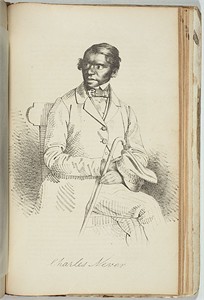
It’s interesting to note that several are given the names of white settlers, but in Robinson’s notation are given the designation “Mr”.  This does not always seem to be the case.  Broome tells the story of Charley, the aboriginal boy who wanted to become a gentleman, and managed to equip himself with all the accessories, including top hat and cane :

Charley realized that Europeans had two names and that gentlemen had formal ones, so he renamed himself Charles Never. (The other youths wanted two names as well, and with the help of the Edgars, became James White, Jacky Warren, Thomas Gurrenbook, and Kitty, Harry and Tommy Bungaleenee.) (Broome, p. 51)

charlesnever

As Broome points out, the conferring of a name did not necessarily have to denote ownership, but could be an act of affiliation that worked to Aboriginal advantage as well, either by a claim on the settler or as a way of deflecting white intrusion into private beliefs. It’s striking that prominent people in the Koorie community today often share surnames with 1840s settlers as well-  there are several prominent Koorie ‘Firebrace’ s for example,  probably named by Major William Firebrace, a prominent Port Phillip personality.  Likewise Pettits and Atkinsons – common Koorie surnames.  I had always assumed that this suggested that white men had consorted with Aboriginal women: it had not occurred to me that perhaps there was Aboriginal agency in adopting these names.

The naming went both ways.  Aboriginal people also named white people- for example, Robinson rather proudly announces that:

They conferred on me a new name namely Ar.rum.ar.rum.nare.nit, which in their language is great or big chief  (12 August 1841)

Robinson also reports on Glendinnon, a white man much respected by the natives he deals with.   Robinson arrived at Mt Emu

where the far famed among the Aborigines, Jaggy Jaggy, resides.  He is a white man and a lowland Scotchman named Glendinnon and whom the Aborigines have designated as Jaggy jaggy min min. (5 August 1841)

After Robinson’s description of many callous, brutal white settlers, Glendinnon stands out for his calm demeanour and humanity.  I don’t know what Jaggy jaggy min min meant, but I’m sure that it denoted more dignity, for both the namer and the named,  than ‘Fuckemall’.

References:

Richard Broome Aboriginal Victorians, 2005

Ian D. Clark The Journals of George Augustus Robinson, Chief Protector, Port Phillip Aboriginal Protectorate, Volume Two: 1 October 1840-31 August 1841.


Port Phillip Newspapers

This morning’s Age newspaper brought with it a supplement sponsored by Melbourne University called “Voice”.  I’m usually rather sniffy about this supplement, which feels like a long advertisement for the Melbourne Model, but I must admit that I do take a peek at it nonetheless. Interestingly enough, pages 3, 5 and 7 identify the supplement as an ‘Advertising Feature’, but this is not apparent on the first page.   This particular edition is all rather reflexive: a supplement of the newspaper devoted in this edition to predictions about the death of the newspaper;  a supplement called “Voice” that is print-based; mirrors upon mirrors upon mirrors.

I was interested by an article ‘NEWspaper Business Model’ by Joshua Gans , Professor of Management (Information Economics) at Melbourne Business School.  In an article reflecting on the business imperatives that militate against the ‘old’ newspaper business model, he notes  the inflexibility of publishing deadlines for the conventional newspaper, and the effect of loss of timeliness in an immediate, socially-connected online environment.  He makes the comment:

The conventional view about the news is that it is ‘information’ or ‘content’.  People value knowing what is going on.  But this fails to recognise that as content, the news is fairly inconsequential…Put simply, for the vast majority of news, the value comes from being able to talk about and share it (“did you hear about?”) rather than add to your pool of knowledge per se.  And this is precisely why the loss of timeliness is so critical.

Thinking about the Port Phillip newspapers, I think that this has always been the case.  Melbourne’s first newspaper, John Fawkner’s  Melbourne Advertiser was hand-written and largely filled with shipping news, cut-and-paste from Sydney papers and advertising for local businesses – especially Fawkner’s own!  (click here for images and transcripts of the first editions).  However, much as Gans suggests here, the importance of the paper lay not in the content, but the fact that people talked about it, and Fawkner initially planned to give the paper away for free. But never one to let a business opportunity pass him by, he began including the paper in the cost of a counter meal at his pub.

By the time that Judge Willis arrived in Port Phillip, there were three regular newspapers, each published twice a week: the Port Phillip Gazette, edited by the very young George Arden (in fact, it never fails to strike me how much Port Phillip was a young-man’s sort of place); the Port Phillip Herald, edited by George Cavenagh; and the later incarnation of the Melbourne Advertiser, John Fawkner’s Port Phillip Patriot.  Newspaper editors were prominent in civic affairs and they had a vested business interest in stimulating passions over local politics and events.   Their newspapers reflected the political stance and interests of their editors, and in Judge Willis’ case, the editors and their relationship with the Judge often was the news.   Each newspaper appeared on a different day, giving six-day-a-week coverage, but without directly competing with each other by appearing simultaneously.  On momentous occasions- for example, Governor Gipps’ visit, the newspapers co-operated to publish a common supplement.  Not that all was sweetness and light by any means: many column inches were devoted to slanging off at each other’s accuracy, print quality and personal qualities of their respective editors.  Underneath all this largely confected piss-and-vinegar was a fundamental political split between Arden and Cavenagh on the one hand, and Fawkner on the other.  The controversy over Judge Willis fed directly into and reflected this political factional split.

The nature of timeliness- as commented on in the Gans article-  is instructive here.  The newspapers themselves seem to have a very limited time-scape at the local level, possibly because there was a three day gap between editions of any one paper.  Events were generally advertised only about a week in advance, and reports of events after the fact tended to only look back a couple of days.   For example, meetings were advertised that would occur that day, or in the next couple of days; and court reports might extend backwards perhaps four or five days but not much further than that.

Juxtaposed against the limited time-frame of local events is the long gaps between intelligence received from other colonies and especially from overseas.  The newspapers often listed the dates of the most recent newspapers received as ships docked, and all three newspapers would comb through for news articles that would then be presented as if they had just occurred, although of course, they were some four or five months outdated.  But for the people of Port Phillip, they were literally ‘news’ as no-one else had any more recent intelligence, and very much the stuff of “Did you hear about?” conversations.

The National Library of Australia has a fantastic site for colonial newspapers, although the early newspapers of Port Phillip do not yet appear (nor do there seem to be any plans for them to do so in the next 3 years) , with only the Argus from 1846 represented- too late for Judge Willis.  However, just as the Port Phillip papers cut and pasted extracts from the newspapers of other colonies,  the action was reciprocated and extracts from the Port Phillip Gazette, Herald and Patriot often appear in other newspapers, albeit some weeks after the original publication.

If you look at other newspapers published at the time (e.g. Hobart’s Courier, Town Gazette; the Maitland Mercury; the Perth Gazette and the Sydney Gazette), you’ll notice a similarity between them in layout and structure.  For the Port Phillip Herald which, until recently was available at Paper of Record but has since been swallowed up without trace by the Google juggernaut,  it might be interesting to do a content analysis on a few 1840s editions.

Tuesday 13 July 1841 (168 years ago today)

Page 1

Page 1 consists entirely of advertisements.  The only illustration is a picture of a ship which occurs against a number of the shipping advertisements- a stock icon that is identical in each case.  There are eight advertisements for ships soon to depart (1 for London; 2 for Hobart, 1 for Port Albert (Gippsland) and Launceston; 1 for Launceston direct; 1 for Adelaide, 1 for Port Nicholson New Zealand, and one to ship goods up from Hobsons Bay).  Six advertisements refer to goods recently landed and 1 refers to a tobacco shipment.   There are 9 real estate advertisements, 1 for a demountable house and 2 for tents.   There are 13 advertisements for stock (cattle, sheep and pigs); 3 for seed crops; and 2 for horse sales.  There is an advertisement for the sale of  a carriage ; a printing press (the Herald’s very own!), surgical instruments, a piano and a billiard table.   There are retail advertisements for 2 butchers, 1 chemist, 3 grocery warehouses, 1 coachbuilder, 1 hairdresser, 2 cloth warehouses, and 1 saddler.  Four hotels advertise their services; there are 2 advertisements for accountant/attorneys and 1 for an agent.  Two banks and one insurance agency advertise; and there are three advertisements for ladies’ seminaries (but not boys’ schools). There is one advertisement for the upcoming races, and one for a subscription concert, complete with a list of the men who have already purchased their tickets.

Page 2

Page 2 and 3 generally constitute the local news- the “Did you hear about?” component of the paper.  The top of the first column is always dedicated to Shipping Intelligence, with a list of the ships due to arrive and depart.  This is followed by Commercial Intelligence, which brings market news from Hobart, the Cape of Good Hope (extracted from the South African Advertiser of May 5), and Melbourne auction sales of merchandise, property sales and sheep prices.  Then appears a Calendar, showing the moon’s age, sunrise and sunset and tide times for high water in Hobson’s Bay- reminding us of the importance of night in a colony with only very rudimentary street lighting outside public house and otherwise reliant on moonlight.  Further on this page there is a call for lamps to be hung near the ditches that run beside the main intersections.

The dates of the most recent newspapers received are then listed, and this emphasizes the variation of currency of overseas intelligence:  England 10 March; China 23 March; America 17 February; Sydney 26 June; Van Diemen’s Land 1st July; South Australia 9 June.

Then follows a bit of inter-newspaper squabbling over circulation figures- a newspaper habit that seems to persist until today with the Age and Herald Sun always BOTH managing to draw comfort from recent circulation figures in 2009.  There is another dig at the Patriot’s inaccuracy further in on this page, in relation to the War with China.

The Editorial for this issue has two topics: first, a call for Gipps to consider the figures in the Abstract of Colonial Revenue which demonstrate the wealth being siphoned off  from Port Phillip, without any reciprocal expenditure; and the need to fix the prices charged by Carters.

The Domestic Intelligence section lists the auctions scheduled for today, tomorrow and Thursday.  There is a long report of the Coal Company meeting with the resolutions listed.  There is a call for more punts,  government-funded hospital conveyance, and a complaint about rubbish and effluvia in the streets, and the failure of the church doors to properly close out the sound of the street outside.  Mr Gautrot’s benefit concert (advertised on p. 1) is publicized, and there is a cautionary tale about the drunkenness of an old army pensioner who ended up falling into the Salt Water Creek.   There is a humourous and  evocative word-picture of a steamer departing from Queen’s Wharf, and a commentary on under-age children giving the oath in the courts.   The Commissioner of Crown Lands now has a drop-box for documents,  and St John is mentioned as a candidate for the Police Magistrate position.  There is also a vacancy for Chief Constable, as well as a criticism of the behaviour of other police constables. A bag of ginger that must have dropped from a dray now rests at the police office.  The pastoral and farming nature of the colony is emphasized by an article encouraging people to feed maize to their horses, the danger of infected scabby sheep, and the habit of hiding stolen cattle in the bush then claiming the reward for their return.  There are street dangers from runaway horses, four cases of burglary, a murder on the Sydney Road, a drowning on the Goulburn River, and the death by burning of a man so intoxicated that he fell into the fire.  The construction of the new jail is progressing well; a Sabbath Observance petition is in circulation; there is talk of the purchase of a second steamer for Hobson’s Bay; there is a creditors meeting for Langhorne Brothers and fall-out from the windup of the Pastoral Society.  The military escort accompanying La Trobe and Lonsdale back from church is berated for smoking cigars in public.

Page 3

The court and police reports are often found on p.2 or 3.  This issue has notice of the upcoming criminal hearings on 15th, two reports of the coroner’s inquests (both deaths caused by excessive drinking), and a daily report of Police Intelligence.  The Police Intelligence column, which often culminates in a hearing before the magistrates or with the perpetrators cooling their heels in the lockup is written in a jovial, Pickwick Papers-esque style.  The Original Correspondence consists of two letters to the editors: one from “A Settler on the Plenty” complaining about the erection of fences across what had until recently been public thoroughfares, and a letter from “Justicia” arguing that there are no avenues for appeal against the findings of the Court of Quarter Sessions.  There is one personal classified, advising of a marriage.  The paid advertisements then continue from Page 1, with 2 shipping advertisements, five positions vacant and six positions wanted advertisement, 10 real estate to let advertisement, 3 lists of stock available in trading houses, 13 auction notices for property, stock and china sales.   The Sabbath Day Observance petition is printed, along with arrangements for signing it, and there are other small notices e.g. tenders to build the Roman Catholic Church, stolen horses; notices from the Navigation Company and the Port Phillip Bank etc.

Page 4

The top left hand column of the Port Phillip Herald is usually reserved for poetry- in this case “Oh! I remember well”- author unknown.  Then follows extracts from other newspapers: in this case, from Van Diemens Land (which includes some news from Madras); Sydney extracts, and about 3 columns of English Extracts.   For the predominantly British settlers in Port Phillip, no doubt the English Extracts held strong “Did you hear that..?” appeal.   So what sort of information was extracted?  There’s a long report of the English and Turks fighting the Bedouins in Gaza; information about settling the Danish claims; fires in Bermondsey, a robbery in Liverpool, a duel in Regents Park, the defalcation of one of the Dublin Board of Aldermen, a horse accident involving the Hon. Mr Dundas the M.P. for York, George Stephenson the engineer’s purchase of coal mines and the presentation of plate to Rev T. Dale, late Professor of English Literature and Modern History at Kings College London.

A half-column of Miscellaneous Extracts includes a piece from the United Service Gazette about Commodore Napier;  and a list of moral virtues drawn up by Dr Franklin for the regulation of his life- temperance, silence, order, resolution, frugality, industry, sincerity, justice, moderation, cleanliness, tranquility and humility.

Then follows more paid advertising- 13 ‘to let’ advertisements, two board and lodging advertisements, a string of lost, found or strayed advertisements for stock (offering up to 20 pounds reward for a bullock) with one advertisement for the return of George Williams who had engaged as a servant but absconded (offering only 2 pounds reward).   Four creditors meetings; one legal notice, two change of trading address, 1 dissolution of partnership.  The final column is always devoted to Wholesale Prices Current for imported and local produce, then subscriber and advertiser information and the name of the editor and printer.

So two years later, did the papers look the same?  By this time, Port Phillip had been gripped by economic crises, and the Legislative Council elections and Town Council elections had been held.  Judge Willis had just returned to England, so that particular controversy should be in abeyance.  I actually started looking at March 1843 to avoid these events, but found myself wondering if seasonal events were influencing the content so have settled for a similar date, two years on.

Friday 14th July 1843

p. 1

Only one ship, bound for Sydney.  A large advertisement for the Australian Colonial and General Life Assurance Company, and small advertisements for a butcher, umbrella seller, wine and spirits.  The silk dyer and scourer has reduced his prices because of the depression; a registry office for servants has opened, and there is one position wanted advertisement.  Two houses to let, one house for sale, one farm.  One ladies seminary.  There’s quite a bit of official Government advertising- a long column authorized by Gipps proclaiming the boundaries of the Port Phillip district, deeds of (land?) grants arranged alphabetically, depasturing licences.  There’s a list of eight men who had absconded from the government stockade, along with descriptions (Thomas Taylor, age 30; native place Liverpool;  trade or calling, sailor;  when tried April 1836; sentence, life; ship, John;  year of arrival 1837;  height 5 feet 6 inches; complexion, ruddy; hair, brown; eyes, grey.  Marks, woman and flag anchor,  F. O. seven stars on right arm, and weeping willow on left arm).  Actually- they’re all quite short- the tallest is five feet 10 inches; the shortest 5 ft 3.  There’s official notification of the opening of the post office at Port Fairy.  There’s a column of stock impounded at the South Yarra Pound.  The Wholesale Price Current list has moved onto the front page in this issue.

p. 2

The shipping news remains at the top left column of Page 2.    There is an advertisement for a special opening of the theatre for a performance of ‘Frederick the Great’ , followed by singing and dancing, and the favourite melodrama ‘The Bandit Merchant or the Dumb Girl of Genoa’.

The editorial greets the arrival of Judge Willis’ replacement Justice Jeffcott.  From Sydney comes the results of the Legislative Council elections.  Four and a half columns follow with details of the Town Council proceedings from Tuesday.

The Domestic Intelligence column includes information about the anti-Willis petition (which the Herald championed); the thwarted escape of two convicts en route to Sydney; notice of scabby sheep; criticism of the Town Clerk for accompanying Judge Willis to the boat for his return home; a sentence of flogging for theft.

p. 3

As with the 1841 paper, the third page maintained its focus on court and police matters.  Of course,  the Supreme Court was in abeyance because of Judge Willis’ amoval, and half of the first column reports on the address to Judge Willis by some of his supporters.   There is then a long report about a summons issued at the Police Office over Capt S. J. Browne (the father of the writer Rolf Boldrewood) and his attempt to take property back to England on the same ship that Judge Willis was to sail on.  There is a short report on the Court of Petty Sessions,  and notice of the next sitting of the Court of Requests.  Police reports include arrests for prostitution, insolence and neglect of duty by the assistant executioner at the jail, and forgery.  A Fred Ebsworth of Pitt Street  writes to the editor in the Original Correspondence column regarding the boiling down of sheep (a process that stopped the free-fall in sheep prices in the province).   A Government proclamation issued under the auspices of Governor Gipps  marks the August meeting of the Legislative Council in Sydney.

Paid advertising follows- 2 ‘to let’ advertisements, one farming allotment sale, an offer of indenture of two respectable young men as druggists.  There are auction sales for building materials, carpet, clothing, tea, ironmongery, coffee and clothes, and four stock sales.  There is a long list of the library books being auctioned by a gentleman about to leave the province- on the Glenbervie with Judge Willis perhaps?  Willis himself- although there’s a large number of theological works in the collection.  Current events include meetings of the Port Phillip Bank and shareholders meeting for the Port Phillip Steam Navigation Company, notification of the cancellation of a lecture at the Mechanics Institute and the second anniversary of the opening of the Wesleyan Chapel.  It is striking and telling that there are four insolvents’ sales- something not seen as prominently in 1841.

p. 4

Two rather paradoxical themes take up the final page of the paper.  One is the aerial ship, and a long extract from the Sydney Morning Herald of June 28th praises the technological change experienced so far- railways, gas lighting- and heralds developments in aerial navigation, with an aerial carriage raised and driven by a 14 horsepower steam engine.  Other extracts from the Sydney Morning Herald include a list of new insolvents, and a report of the 28th Regiment in India.

The aerial ship is taken up in the English Extracts.  The carriage is to be constructed of thin copper sheaths, with a boiler and two high pressure engines, and wings.  A similar report is taken from the Calcutta Englishman.

Rather more prosaically, there is a continuation from Chambers Information for the People No 79 titled ‘Sheep: Choice of Breeds’ that takes up nearly three columns and is to be continued.  The identifying information at the bottom of the paper lists the printer and publisher of the Port Phillip Herald as Charles Fyshe.

So, where am I going with this? I don’t know!  The local papers provide probably a higher proportion of international news than our newspapers today would, and much of this content is conversation-provoking gossip from home, or technology-based ‘next new thing’ ideas.  There’s not a large ‘What’s On’ emphasis, especially in 1843.  By 1843 there is much more emphasis on formal political structures like the Town Council and Legislative Council in Sydney.  The small business ethos of traders and entrepreneurs seems to have dropped away by 1843, and the shadow of insolvency falls over the paper.

But in terms of “Did you hear about…?” the Port Phillip papers operate just as well as papers today do.  A winning formula, you might say.

More on the Burchett boys

I recently wrote about the three Burchett brothers who arrived in Port Phillip in the late 1830s/early 40s- Charles Gowland Burchett (1817-1856), Henry Burchett (1820-1872), Frederick Burchett (1824-1861) and Alfred Burchett (1831-1888).

I came across a reference to the Burchetts in William Westgarth’s  Personal Recollections of Early Melbourne and Victoria in his chapter on Early Western Victoria:

Thence I reached “Burchetts’ of the Emus” less finished, indeed, but hardly less attractive. They were business clients of my pleasant old friend Charles Barnes, whose name I gave as my pass, with, however, but little need in those open-door days.  This was a sheep station, as it was a drier locality, the other stations having been more suited for cattle.  We sat joyously chatting in the bright midwinter sunshine.  The air was redolent of humour, for which the Burchetts had a name.  One of them was rather deaf– indeed very deaf, but when he did pick up the current subject, he seldom failed to contribute good sauce.  With regret I remounted next morning, for with business finished in this direction, I was resolved to push on to the Glenelg, as I wished to see through Victoria westwards while I had the opportunity.  So I turned my steed north for the Wannon.

The reference to ‘The Emus’  and the deafness of one of the brothers confused me, and I assumed that they might be different Burchetts. But I’ve also been reading George Augustus Robinson’s journals, and found that on his Western Victoria travels, he also came across some Burchetts.   The editor, Ian Clark, identified them as “my” Burchetts.

A few miles from Gray’s came to another branch creek of the Hopkins on which was a sheep station of Burchett’s.  From this station proceeded to Burchett’s head station.  There are three brothers of the Burchetts’ they are from Kentish Town, London and the eldest is well informed.  They had on a curious costume: common floss jackets much too large for their little persons.  Two of the brothers are deaf.  There is also a Mr Bayley, an elderly person in partnership with them.  They have cattle and sheep.  It was raining when we arrived.  A youth, the youngest of all the Burchetts came out of the hut.  We asked the time; he said half past four by the appearance of the sun.  We judged it later and asked him how he knew.  He said, by the cattle coming home; they were to come home at four and they had just arrived. I asked a woman at one other hut and she said between five and six; she was correct.  The elder brother gave us directions to Muston’s to which station we were anxious to get this evening. He said if we kept the bank of the creek we were upon it would bring us to Muston’s.  I asked Burchett if he had been troubled by the blacks.  Said no, but he had heard that the natives had been at Kemp’s.  (The Journal of George Augustus Robinson, Volume Two: 1 October 1840-31 August 1841, p. 125, 3 April 1841).

There’s the same reference to deafness- although Robinson says that two of the brothers are deaf.  Well,  according to Google Maps, Penhurst and Mt Rouse (where I know that the Burchetts settled) are  about 50ks from the Hopkins River, so I assume that it’s the same group.   They sound a hospitable bunch.

The boys go to Port Phillip

As part of examining Judge Willis’ interaction with Port Phillip society, I’ve read folder after folder of official correspondence, column after column of newspapers, memoirs  and several diaries.  But one thing that I have barely dipped into is personal correspondence.  So it was armed with a few names that I headed into the State Library yesterday- off to read the correspondence of the Burchett brothers who arrived from 1839 onwards to their family ‘back home’, and a thesis based on the correspondence of  Alexander F. Mollison who visited Melbourne in its earliest days, then settled in the Port Phillip district from about 1837.

The survival of any cache of correspondence is  a mixture of luck, diligence, intent and circumstance.  There are those rare individuals who keep copies of all correspondence both sent and received, but it’s more likely that an archive of correspondence is likely to be largely one-sided, usually consisting of  letters received, with the letters sent reflected only obliquely.  The preservation of letters within a family depends largely on the importance placed on them by the recipient, and the custodians to whom they pass when the recipient dies.  Then there is another  step between private ownership and their availability to a wider public through a museum (where they can linger undiscovered and uncatalogued for years) or publication.

Moreover, the practice of mail correspondence between New South Wales and the metropole,  particularly during the 1840s, reflected the realities of a 4-6 month time lag with a swag of letters arriving in one dispatch, or likewise, no mail appearing at all.  No doubt the receipt of letters would trigger off a frenzy of response, with the minutae of day-to-day life telescoped into a potted narrative that would reassure loved ones who were totally unfamiliar with the sights, smells and local personalities on the other side of the world.  On both sides, the pictured recipients would be kept in a mental time-warp that kept them as they were when last seen, with shared acquaintances and memories given more prominence than perhaps they merited. I tend to think of this correspondence as similar to the word-processed  Christmas updates we all started to include in our Christmas cards a few years ago,  up until they fell out of favour for being homogenized, impersonalized and too cheery and cheesy.  (Mind you, I enjoy receiving them and still do send them- cheesy and impersonalized though they may be).

So, with these constraints in mind, how likely is it that any of this correspondence would mention Judge Willis?  I guess that it depends on how personally involved the writer was with the agitation to either remove or support him, which in turn might reflect the political engagement and interests of the intended recipient of the letter.  How much of any politics would filter through, say, into the Christmas Update we might send today?  I suspect that 2001 Christmas Updates reflected the shock of September 11;  we may have written to overseas correspondents about a change in government.  But, unless personally involved, it’s not likely that day-to-day politics is likely to find its way into correspondence intended for an overseas readership, even in our connected, globalized world, and probably even less so from 1843 New South Wales.

The Burchett Brothers

And so to the Burchett letters.  The copy of the letters I saw had been typewritten and photographed.  Now, there’s nothing quite like the pleasure of the looped, cursive script, the browning ink and the texture of the paper of the original.  But I’ve been there, and done that, and there’s also nothing quite like the regularity and ease of a typewritten transcript!!  They were catalogued under “Burchett family”, and the collection includes letters written by Charles Gowland Burchett (1817-1856), Henry Burchett (1820-1872), Frederick Burchett (1824-1861) and Alfred Burchett (1831-1888).   The boys arrived out here over a period of time, with the 22 year old Charles and 19 year old Henry arriving first in 1839, followed by their younger brother Frederick, aged 16, the following year.   I’m not sure when Alfred arrived.   There were obviously other children still left at home- Henry’s letters in particular are full of high-spirited and affection  in-jokes with his younger siblings.   All the same, it must have been hard to have your three eldest boys heading off across the globe at such young ages.

Charles, in particular, seems to have been of a slightly more political bent than his brothers.  In his letter to his father on 12 June 1841 he writes about a meeting to petition the Home Government for separation from New SouthWales, and mentions the Resident Judge obliquely in reference to Sydney’s neglect of Port Phillip- a comment by then obsolete given that Judge Willis had by that time arrived in Melbourne.

Even in Sydney they know little of us.  Fancy the wilful blindness of a tardy determination to allow us the services of a Supreme Judge three times in two years.

This was to be his only mention of Judge Willis.  He goes on:

The principal evidence of the moral advance of this place may be enumerated as follows- a Society lately formed on the plan of the “Highland Agricultural Society” for the promotion of Agriculture, Horticulture and Breeding, William Mackenzie Esq, the son of a Scottish Baronet is the Chairman.  Two or three hundred chapels; the church, however, on account of its ambitious pretensions, is at a standstill for want of funds, a considerable part of the edifice completed evidently exhibits the intention of the Trustees to make it a handsome structure- it is of stone.  And last, but not least, the Mechanics Institution.  Among the lectures at this last has been one “On the Influence of the Press in disseminating knowledge” by George Arden, the Editor of the Port Phillip Gazette.  This said G. A. (the Boy Editor, as he is called) I have known since my arrival here; he gave a splendid speech at the meeting.

The boys established a run called ‘The Gums’  near Mt Rouse in the Western District.  In a letter dated 1 Oct  1841,  Frederick was not pleased by the news that Charles Sievewright was to establish the Western District  Aboriginal Protectorate nearby:

There is a rumour that a Black protector is coming to take up his station at Mt Rouse, with his tail of 4 or 500 blacks, if he does we shall have to keep a sharp lookout, as the gentleman of his suits have been playing up a hurricane (colonial phrase) down below, and they are not very remarkable for their honesty

Five days later his brother Henry added:

How little do the good people at home, who are instigators of benevolent systems of civilization understand the character of these barbarous cannibals.

The financial depression of the early 1840s hit the Burchett boys badly, and Frederick returned home, followed by Charles who arrived back in England  on the Glenbervie on November 24 1843.  They obviously did not stay: Frederick returned to Van Diemens Land in March 1844 and the others must have returned at some stage too.  Charles died in 1856 at their property St Germain’s (near Echuca); Henry died in 1872 at “Albert Road, Regent Park” (not sure where); Frederick died in 1861 in Melbourne, and Alfred in 1888 at St Kilda.

Alexander Mollison

And so on to the second batch of letters from Alexander Mollison, this time as part of a thesis written by Marie Hyde who transcribed and annotated the letters as part of a Bachelor of Letters degree in 1988.  Alexander Fullerton Mollison (1805-55) has a higher profile that the Burchett brothers with a shared entry in the Australian Dictionary of Biography with his brother William Thomas.

Alexander arrived in Sydney in 1834 at the older age of 29, and did not ever marry.  After an exploratory trip to Port Phillip in 1836, he overlanded down from his property at Uriani (near present day Canberra) with his flock of 5000 sheep, 634 cattle, 28 bullocks and 22 horses, to establish Colliban Station, near Malmsbury.  He was joined by his brothers Patrick, who was based in Sydney, another brother Crawford, and William aged 22, who arrived in 1838 who joined Alexander at Colliban.   A fifth brother, James, aspired to be an artist and several of Alexander’s letters warn him specifically not to come to the colonies, as there were few prospects for artists here.   Two sisters were left at home: Jane, to whom many of the letters are addressed and for whom Alexander obviously had a great affection, and Elizabeth.  Again, I find myself thinking about the parents left back in England with their daughters, with the ‘boys’ of the family so far away.

The early letters reflect Alexander’s interest in the  zoological and botanical sciences- and I assume that sister Jane shared this interest too.  Although he didn’t send her actual specimens- as Judge Willis was wont to do with patrons he wanted particularly to impress- he did write long descriptions of rainbows he noticed at sea and his first sighting of a platypus.  Zoe Laidlaw, in her book Colonial Connections 1815-45:  Patronage, the Information Revolution and Colonial Government, highlights the importance of scientific networks, and the overlap between amateur colonial naturalists and visiting scientific professionals.  It also evokes for me the burgeoning interest in science more generally reflected in another book I’m reading at the moment- Richard Holmes’ The Age of Wonder: How the Romantic Generation Discovered the Beauty and Terror of Science.  It seems that Alexander was very much a man of his times.

As Hyde points out, the shipboard voyage

had positive benefits as an interlude between the old world and the new in helping to establish that network of connections with the well off and influential that would serve him well in years to come.(p. 5)

He travelled with the Rusden family, little realizing that the 12 year old son George would later become Clerk of the Executive Council and a member of the National Board of Education.   He became friends with Charles Nicholson, who was later become Sir Charles Nicholson,  statesman, landowner and businessman.

In an odd conjunction, he wrote to his father that Henry Burchett (of the letters above) had arrived at the station to learn sheep farming before striking out on his own.  The Burchett letters also resonate when the Aboriginal Protector Parker took up land on the Loddon to establish a Protectorate.  Unlike the Burchetts, Mollison willingly gave up land for the Aboriginal station, and assisted Parker in running it.

Alexander obviously spent some time in Melbourne where he mixed with the other ‘respectable’ pastoralists.  On 26 December 1839, he wrote to his sister Jane about the Melbourne Club:

I do not remember having told you about the Club House in Melbourne. The Inns were found to be so dirty and disordered that several respectable settlers and townsmen formed a club about 18 months ago.  William and I are members.  There are now eighty permanent members.  The house affords twelve bedrooms, a dining room, drawing room, library and smoking room or [?].  The bedrooms are rather small but exceedingly comfortable and well-kept.  Each member is allowed to occupy a bedroom one week and then must make way for another if required…The yearly subscription is five pounds and the charges are the same as at the inns.

His respectability gave him access to the political sphere.  Soon after La Trobe’s arrival in Melbourne,  Alexander and his brother Crawford called on him.  To his father, Alexander wrote:

Mr La Trobe arrived at Melbourne some weeks ago.  He told me that he had been introduced to you.  I called once at his offices with Crawford but came away as soon as our business was finished, as Mr La Trobe seemed to be very much occupied.  He is so far in public favor here and seems to be candid, sincere and unostentatious.

He also met with Governor Gipps when he visited Melbourne, and was one of the five men deputized to make a welcoming address to him.  In October 1841 Alexander wrote to his father:

We have had great doings this past week in honour of Governor Sir George Gipps’ first visit to this district, but I have not time to relate them.  I may however say that I was one of a deputation to draw up and present an address and also the president of a public dinner of one hundred and fifty people.  Sir George is frank, clever, and a ready and pleasing speaker.  I was introduced to him during my late short visit to Sydney.

When his friend Charles Nicholson put himself up for election as the Port Phillip member for the first District Council, Mollison seconded his nomination.   Nicholson was elected the representative for Port Phillip on the part-elected Legislative Council in 1843, served as Speaker in 1846 and twice more before the granting of responsible government.  Mollison was one of the inaugural members of the Melbourne branch of the Australian Immigration Society in 1840 (Garryowen p. 492); he addressed a meeting against the resumption of transportation (Garryowen p. 524); he presided over a Squatters Meeting in June 1844 and a committee member of the Separation Association (Garryowen p 907).  He was made a Justice of the Peace.

It’s not surprising, then, that Mollison does mention Judge Willis’ suspension, albeit briefly, with the terse comment that “he certainly deserved it”.  Mollison does not seem to have been particularly heavily involved in the movement against him, however, declining to sign the anti-Willis petitions.  Both Alexander and his brother William did , however, sign a letter in support of Lonsdale who was under attack by Judge Willis, and another letter on 14th June 1843 directly before Judge Willis’ amoval complaining about aspersions raised in the court in relation to the magistracy generally.

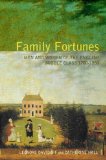
The sheer distance between the colonies and the family at home was reinforced for me by the report of Patrick’s illness in Sydney.  Charles Nicholson notified Alexander that Patrick was gravely ill, and within days Alexander was writing a second letter to say that he had died.  In his will, Patrick left his colonial assets to his sister Jane and Alexander, although they did not cover his debts.  Jane had obviously advanced money to Patrick, and Alexander later made an investment of Jane’s money in land on the portion bounded by Highett, Lennox and Erin Streets, Richmond.   Davidoff and Hall’s book Family Fortunes notes that the daughters of a family often made their inheritance available to their brothers for investment, in return for a roof over their head and keep.

Although he suffered financially during the Depression, he did not go under, which is a testimony to his good management and frugality.  By 1845 he was writing “I now begin to feel that my home is here.”  He did return to London in 1850, where he stayed for 8 1/2 years.  A photograph held by the State Library of Victoria taken in London during this time, describes him as

Seated, wearing three-piece suit with fringed black and white paisley patterned tie (probably a scarf). He has a full brown and gingerish beard speckled with grey, and wears a light coloured top hat with a very high crown.

He returned briefly to Victoria, then went again to England where he lived for another 13 years.  After the death of his beloved sister Jane, he and his remaining sister Elizabeth returned to Victoria in 1873.  They settled together, unmarried brother and sister, until he died after years of ill-health in 1885.

References:

Leonore Davidoff and Catherine Hall Family Fortunes: Men and Women of the English Middle Class 1780-1850

Edmund Finn (Garryowen) The Chronicles of Early Melbourne

Richard Holmes The Age of Wonder: How the Romantic Generation Discovered the Beauty and Terror of Science

Marie Hyde Letters from Port Phillip:  the letters of Alexander Mollison 1833-1859 (thesis)

Zoe Laidlaw Colonial Connections 1815-1845: Patronage, the Information Revolution and Colonial Government

A. G. L. Shaw A History of the Port Phillip District

‘Family Fortunes’ by Leonore Davidoff and Catherine Hall

davidoff

Some time ago, I read Michael Roe’s ‘Quest for Authority in Eastern Australia’.  Roe argued that the tenor of Australian society appeared to be set on a paternalistic, conservative path dominated by a landed elite who had been dealt with generously in the carve up of land and authority in the former  penal colony.  By the 1820s, however, a diversion from this path occurred with the influx of mainly British settlers who were shaped by what Roe called  ‘moral enlightenment’,  a philosophy drawing on 18th century thought, combining Romantic, utilitarian, Protestant and liberal values.  He did not claim that this was an intrinsically Australian characteristic- instead it was a ‘transplanted species’, drawn from similar currents in Britain at the time.

As I wrote in my post on Roe’s book, I was nudged into reading it by a friend’s dissatisfaction with the sterility and abstraction of his argument, which was largely a roll-call of local colonial male-dominated politics, with no ‘real’ people.  This didn’t trouble me so much, but I found myself wanting to dig back even further into the mental baggage of new settlers- where did this ‘moral enlightenment’ come from?  This led to me onto reading Davidoff and Hall’s ‘Family Fortunes’- a book that seems to have been cited everywhere!- a sure sign of the ‘landmark’ and ‘seminal’ text!

The full title of the book is ‘Family Fortunes: Men and Women of the English Middle Class 1780-1850’.  Its time-frame is important for considering early Australian society because it encapsulates the settler phase of Australia so closely, and even though this book is set entirely in Britain, I found resonances in Australian history as well.  Every white settler carried with them the sensibilities of their home society, not necessarily replicated in the new society, but present nonetheless.    The authors argue that the middle class mentality of the early 19th century (later overwhelmed by the dominance of later Victorian bombast) was centred in the religious revivals of the late 18th century, manifested through the non-conformist and  evangelical Anglican middle class families that prospered in the early years of the Industrial Revolution.  They based their argument on the study of four locations: Birmingham and its satellite suburb Edgbaston; the market town of Colchester, and the villages of Witham in Essex, and Suffolk.  Their book is studded with people, met again and again, who exemplify the embeddedness of religion in family, business and public life: here are the fleshed-out personalities so absent in Roe’s book.

They draw an interesting distinction between adult converts in the religious evangelical fervour of the 1780s and 90s, and their own children, born as natives into evangelical Christian families.  Many of my Port Phillip pioneers are here among this group: particularly those public men who expressed their respectability and masculinity through the Debating Society, the balls, the subscriptions and churches in the new town of Melbourne.

The full title of the book emphasizes family and the role of both men and women in the economic milieu of middle-class English society.  They argue that during the first half of the 19th century, middle-class women were removed from the ‘establishment’ that supported the family- in terms of both role and location.  They moved to less visible, ‘back of house’ roles within the family business and the enterprise itself became town-based, while the family shifted to outlying satellite housing suburbs.  Male and female roles became increasingly separated into public and private spheres, that varied during the life cycle, with women’s contribution to the family capital and success increasingly sidelined.

I find myself thinking of Port Phillip’s development, starting with a blank slate as it were.  In the earliest days, housing and enterprises were intermingled- Georgiana McCrae and her family started off in Argyle Cottage in Little Lonsdale Street West, and many public men lived ‘in town’ as well as having other properties further out.  As part of the 1840s land boom, suburbs like East Melbourne, Fitzroy and Brighton were being subdivided and sold as residential property. Yet among the ‘public’ families, however, in a social and economic sense the  separate spheres seems to have been established almost from the start- although this would no doubt be less true amongst smaller trading and shop-keeping enterprises.  I’m also very much aware of the phenomenon of brothers emigrating together and business partners becoming -in laws: that web of family connections that was elastic enough to stretch across the globe, and yet was still stitched closely together where it caught at the extremities.

‘Family Fortunes’ is exhaustive (and exhausting!) in the sheer weight of evidence drawn from a variety of sources including diaries, letters, hymns, memoirs, family and local histories, minutes, business documents, wills and tracts- this is a BIG, important history drawn from small, domestic, often ephemeral, lived-in documentation.

Happy (un)Birthday, Your Maj

queen

Yes, Ma’am, another un-birthday- although given that your birthday is celebrated on multiple days in multiple countries, and you have your ‘real’ birthday and your ‘official’ birthday, you must be about 428 years old by now.  We’re celebrating it today in Australia- although not all of Australia mind you- Western Australia celebrates it on the last Monday of September or the first Monday of October. This is because Western Australia celebrates its Foundation Day on the first Monday in June, and we can’t use up all our Public Holidays at once, can we ma’am?

Her Maj’s birthday is actually on 21 April, but after George V died they decided to keep the ‘official’ birthday on or around 3rd June, which was his birthday.  England celebrates the Trooping of the Colours on the 1st, 2nd or 3rd Saturday in June, but this actually commemorates the anniversary of Elizabeth’s coronation on 2 June 1952.  And it doesn’t really count because it’s a Saturday.  Anything worth celebrating is worth a day off, I reckon.

Up until 1936 the Monarch’s  birthday was celebrated on the actual day.  So up until 1820 that would have been 4 June for George III; between 1820-1830 it was 12 August for George IV; between 1830-1837 King William IV’s birthday was celebrated on 21 August, then 24th May for Victoria’s birthday between 1837-1901.  You’ll note that these are all in summerish months in England.  Edward VII’s birthday on 9 November was celebrated between 1901-10 and both he and his people came to appreciate the idea of birthday celebrations in summer rather than winter.  George V’s birthday was honoured on 3 June between 1910-1936- a more favourable date for Northern Hemisphere climes than November.  It’s been 3rd of June or thereabouts ever since.

New South Wales celebrated King’s Birthday right from the start.  David Collins described the first celebration of King’s Birthday in 1788

His Majesty’s birthday was kept with every attention that it was possible to distinguish it by in this country; the morning was ushered in by the discharge of twenty-one guns from the Sirius and Supply; on shore the colours were hoisted at the flag-staff, and at noon the detachment of marines fired three volleys; after which the officers of the civil and military establishment waited upon the governor, and paid their respects to his excellency in honor of the day. At one o’clock the ships of war again fired twenty-one guns each; and the transports in the cove made up the same number between them, according to their irregular method on those occasions. The officers of the navy and settlement were entertained by the governor at dinner, and, among other toasts, named and fixed the boundaries of the first county in his Majesty’s territory of New South Wales. This was called Cumberland County, in honor of his Majesty’s second brother; and the limits of it to the northward were fixed by the northernmost point of Broken Bay, to the southward by the southernmost point of Broken [sic] Bay, and to the westward by Lansdown and Carmarthen Hills (the name given to the range of mountains seen by the governor in an excursion to the northward). At sunset the ships of war paid their last compliment to his Majesty by a third time firing twenty-one guns each. At night several bonfires were lighted; and, by an allowance of spirits given on this particular occasion, every person in the colony was enabled to drink his Majesty’s health.

Some of the worst among the convicts availed themselves of the opportunity that was given them in the evening, by the absence of several of the officers and people from their tents and huts, to commit depredations. One officer on going to his tent found a man in it, whom with some difficulty he secured, after wounding him with his sword. The tent of another was broken into, and several articles of wearing apparel stolen out of it; and many smaller thefts of provisions and clothing were committed among the convicts. Several people were taken into custody, and two were afterwards tried and executed.

The following year was slightly more decorous:

The anniversary of his Majesty’s birthday, the second time of commemorating it in this country, was observed with every distinction in our power; for the first time, the ordnance belonging to the colony were discharged; the detachment of marines fired three volleys, which were followed by twenty-one guns from each of the ships of war in the cove; the governor received the compliments due to the day in his new house, of which he had lately taken possession as the government-house of the colony, where his excellency afterwards entertained the officers at dinner, and in the evening some of the convicts were permitted to perform Farquhar’s comedy of the Recruiting Officer, in a hut fitted up for the occasion. They professed no higher aim than ‘humbly to excite a smile,’ and their efforts to please were not unattended with applause.

Thomas Keneally drew on this for his novel The PlaymakerWatkin Tench has a description of it too:

The anniversary of his majesty’s birth-day was celebrated, as heretofore, at the government-house, with loyal festivity. In the evening, the play of ‘The Recruiting Officer’ was performed by a party of convicts, and honoured by the presence of his excellency, and the officers of the garrison. That every opportunity of escape from the dreariness and dejection of our situation should be eagerly embraced, will not be wondered at. The exhilarating effect of a splendid theatre is well known: and I am not ashamed to confess, that the proper distribution of three or four yards of stained paper, and a dozen farthing candles stuck around the mud walls of a convict-hut, failed not to diffuse general complacency on the countenances of sixty persons, of various descriptions, who were assembled to applaud the representation. Some of the actors acquitted themselves with great spirit, and received the praises of the audience: a prologue and an epilogue, written by one of the performers, were also spoken on the occasion; which, although not worth inserting here, contained some tolerable allusions to the situation of the parties, and the novelty of a stage-representation in New South Wales.

By the time our Judge Willis arrived in Port Phillip, it was Queen Victoria’s birthday that was being celebrated on 24th May, as it was to be for sixty-five years.  From the 1820s onwards, Sydney society had celebrated the Birth Day of the monarch with  a levee and ball at Government House, and by 1841 a similar practice was proposed for Melbourne.  However arrangements broke down in acrimony in 1841 over whether the ball should be a public or a private event.

The private ball (sneering described as the ‘Dignity Ball’ by its critics) was defended by the Port Phillip Herald as a private occasion that had been postponed from the race-week earlier in the year, and that it just happened to occur on the Birth Day.  The Herald argued

When the Government give a ball, which is generally on the birth day of the sovereign, cards of invitation are issued to the public and to different classes of society and this is as it should be for a simple and substantial reason- the expenses are defrayed out of the public purse. (PPH 7 May 1841)

However, this was a private occasion, overseen by stewards prominent in Port Phillip Society at the time: Simpson, Powlett, Meek, James McArthur, J. Lyon Campbell, Verner and Major St John.

The Port Phillip Gazette and Port Phillip Patriot, affronted at these “upstart exclusives” and “ill-bred puppies” proposed a truly public ball to be held at Yarra Yarra House in Flinders Street on 24th May, with admission tickets for a gentleman and a lady priced at 2 guineas.  Messrs Abrahams, Langhorne, Kerr and Sullivan were stewards, with Connolly and Urquhart’s disputed involvement.

So who won the Battle of the Balls? The private ball was postponed until 4 June, then later until 8th June to accommodate Presbyterian families who would not have been able to attend on the 4th because that week had been set aside for religious observances.  The Public Ball went ahead on 24th as planned, but it rained.  The Private Ball took place on 8th June, attended by 44 ladies and 67 gentlemen; the stewards provided a most magnificent supper, which was done ample justice, and festivities continued until 5.00 a.m.  In a coup for the  more exclusive Private Ball,  Superintendent La Trobe and his wife attended: they had not attended the Public Ball.

The next year only one private ball was held.  I find myself wondering why the fuss of the preceding year was not repeated: perhaps it had been just newspaper hot-air. The Port Phillip Herald of 27th May devotes half a column to it:

THE BALL. The most splendid entertainment that has ever yet taken place in the province was held in the long room of the Royal Exchange on Wednesday evening, in honor of the Queen’s birth-day.  The ball, although got up by private subscription, and as one of the regular “private assemblies”, was attended by nearly all the rank and fashion of our rising town.  Notwithstanding the very unfavourable  state of the weather, and the almost impassable state of the roads, the ball room was crowded at an early hour.  Several of the gentlemen appeared in rich fancy disguise, and some of the dresses were very much and deservedly admired.  The gentleman who appeared as an Italian Brigand was perhaps the most successful in attracting the fair notice of the visitors, although there were other parties very elegantly attired.  The enlivening colour of the different fancy dresses added much to the brilliancy of the entertainment, which was considerably increased by the fascinating beauty of several of the ladies, who, believing that “beauty unadorned is adorned the most,” trusted to their usual tastes in not appearing in fancy costume.  His Honor Mr La Trobe and Lady honoured the Ball with their presence, and dancing was kept up with the greatest spirit throughout the whole evening; the arrangements altogether were excellent.  The music gave evident satisfaction, and was only eclipsed by the management of the supper, which met with deserved encouragement, and reflected great credit upon the caterers of this very necessary appendage to a dance.  Nearly three hundred persons, it is calculated, graced the scene, and all departed to their homes highly delignted with the evening’s amusement.

Georgiana McCrae attended the 1843 Queens Birthday Ball and describes it as follows:

Dr Thomas drove out in his gig and took me to town.  At 10 p.m. we went en masse to the Mechanic’s Institute.  All the elite of the colony assembled, and in full swing, including Mr and Mrs La Trobe; the Mayor, Mr Condell and his niece, dressed in Mantis green, not unlike the insect itself in the waltz attitude. Mr C. H. Ebden’s movements somewhat eccentric, now and then cannoning among his neighbours…Dancing was kept up briskly till after 1.a.m.

Well, ma’am no dancing any more.  In fact, it’s a dead loss as a celebration of anything except perhaps the opening of the ski season and a few football matches.  And a very merry un-birthday to you ma’am.

References:

Paul de Serville Port Phillip Gentlemen

Hugh McCrae (ed) Georgiana’s Journal

Ken Inglis Australian Colonists Ch.4


Where’s that wrecking ball?

n_williamstown-420x0

I see that the good people of Williamstown are concerned about the possible demolition of what they suspect might be Melbourne’s oldest house.  Judging by the McMansions in the background, it no doubt occupies valuable space.   The evidence for the 1842 date seems to be rather sketchy though- land could change hands several times in the efferversence of the early 1840s without an actual dwelling being built.  A search on the Heritage Victoria database records that Pope, who purchased it from James Cain in 1842, was a property-owner and eligible to vote in 1843.  However, many men had several parcels of property, and he could have qualified otherwise through other holdings.  The database gives an approximate date of 1855, presumably because the type of construction was common around 1850.  The 1856 rate book records it as a four room timber building.

Attached though I am to old things, I don’t know if I’d die in the ditch for it.  It needs so much work as to constitute an absolute re-build.   Its value as a curiosity, or as a reminder of times past could just as easily be achieved by shifting it to a park somewhere.

One building that I would have stormed the barricades for, though, was Redmond Barry’s house at 494 Bourke Street that was demolished in 1924.  (It must be a sign of age that I think of it as “only in 1924″ when it’s actually ninety years ago).   It was situated between Queen and Elizabeth Streets, on the north side of Bourke Street- then numbered as  97 Bourke Street West.  The five roomed, low-slung brick cottage with an old mulberry tree in the remnant of a garden would have stood as a reminder that there were people living in that section of  Bourke Street, at that time close to the hub of town,  as distinct from shopping or working in it.  There’s so much else in Melbourne that commemorates him as literally larger-than-life, and this brings the man back to a human scale.

You can see a painting of the house made in 1915, and a photograph of the house just prior to demolition.

But this building is long gone of course, so perhaps I should gird my loins to defend the Northcote Bowl.  Ugly, yes.  At one time ubiquitous, yes.  And, while not the first or only, it’s one of the last left standing in suburban Melbourne, yes.  There’s a sentimental glow about something from a hundred years ago, but it’s just as important- and more difficult- to fight for something forty years old that now violates every concept of good taste without yet attaining the gravitas of being ‘historical’.

northcotebowl21

References:

Robyn Annear  A City Lost & Found: Whelan the Wrecker’s Melbourne

Update to the Williamstown house:

The Sunday Age of 30 August 2009 reported that the land will be auctioned on Sept 19 2009 and it is expected to bring about $1 million dollars and be developed as a townhouse project.  Heritage Victoria recently authorized the dismantling of the house.

“The dismantling will be recorded and it will form part of an archival record which will be lodged with the State Library, the National Trust and the Williamstown Historical Society” Heritage Victoria acting executive director Jim Gard’ner said.

williamstownmap

The permit be directed that the parts of the house be “stored” at the owner’s discretion.   Apparently all fabric and any significant archaelogical items are to be removed and catalogued.

I think they could do better than this.  Somehow the documentation of the dismantling seems a rather inadequate response, and “at the owner’s discretion” is so wide that you could drive a truck through it.