Category Archives: Port Phillip history

Election Day

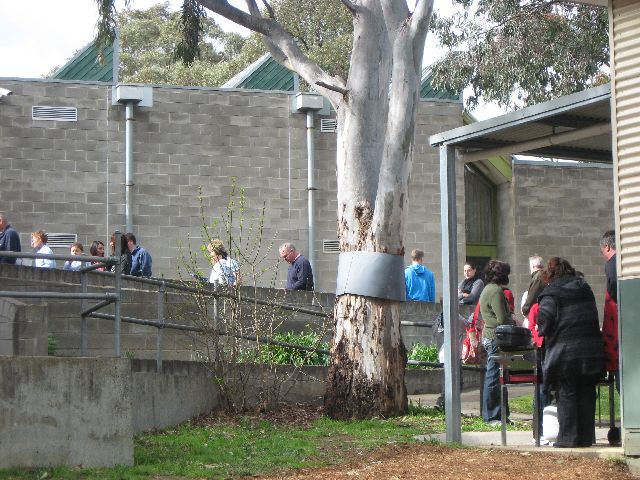
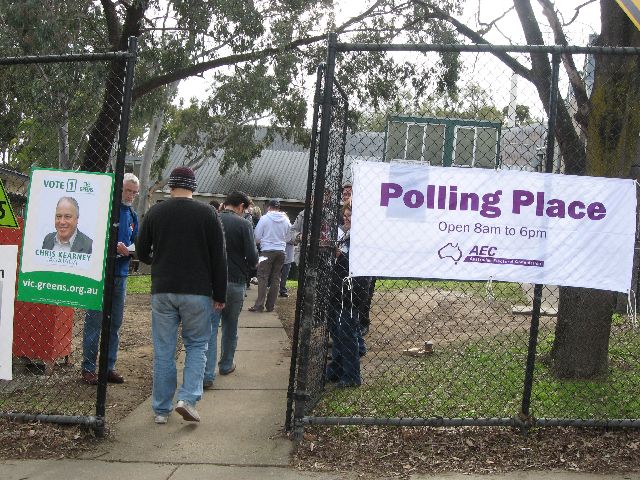
I’ve just returned from doing my democratic duty up at the local school.  It’s election day here in Australia, and one that I feel rather pessimistic about.  Elections are always held on a Saturday and voting is compulsory- something that I have absolutely no problem with.  I think of the bravery of people in other parts of the world who carry around their ink-dipped fingers (how dangerous could that be in some situations!) and I am grateful that I can vote in a country that expects and requires me to do so as a citizen in a well-organized and fully-financed electoral system.   My gratitude and trust in the system stands, no matter what the outcome tonight, tomorrow or maybe weeks down the track.

Yes, the sausages are sizzling as the good people of Macleod line up to vote

So what about elections in Judge Willis’ time? Of course, the whole concept of a Federal Election in Melbourne had to wait until 30 March 1901 but the first colony-wide election for NSW was held in 1843.  Until the passing of the 1842 New South Wales Act, the Legislative Council had been nominated by the governor, but the 1842 Act allowed for 36 members, twelve appointed and the rest elected.  The relative lateness of elected representation reflects the penal origins of the colony: Upper Canada had been awarded representative government nearly fifty years early with the Constitutional Act of 1791.

Port Phillip was still part of New South Wales at this stage.  Six members in total would be elected from the Port Phillip district, five from the district as a whole, with one from Melbourne.  There was not exactly a rush: the Council sat in Sydney, six hundred miles away, and few Port Phillip citizens were prepared to travel and stay in Sydney for council sessions.  As a result, of the five district members who were elected, only two – Charles Ebden and Dr Thomson from Geelong- were from Port Phillip.  The rest were Sydney-siders: Dr Charles Nicholson; the merchant Thomas Walker (who did have extensive holdings in Port Phillip and particularly in Heidelberg but was based in Sydney); and Rev John Dunmore Lang.  Two other Sydney residents- Thomas Mitchell, the Surveyor General, and James Macarthur Jnr, the son of Hannibal Macarthur also stood, but Mitchell was not successful and Macarthur withdrew his nomination before election day.  There had been talk earlier that Joseph Hawdon, the wealthy cattler overseer and  builder of Banyule homestead in Heidelberg, would stand but this did not eventuate and he, too, was  Sydney-based.

Certainly the election did not have the immediacy of the Town Council elections which had been conducted some six months earlier. Edward Curr, who had previously been a member of the Van Diemens Land Legislative Council, accepted candidacy for the Melbourne seat.  He was a prickly, forthright character who clashed strongly with Willis, along with many others in Port Phillip, it must be said.  It was his strong Catholicism that prompted the equally prickly and forthright Presbyterian candidate Rev J.D. Lang to cast about for a contending candidate for the Melbourne seat, lest Curr the Catholic be elected unopposed.  Lang and Kerr, the editor of Fawkner’s Port Phillip Patriot (with whom Lang was staying while campaigning in Port Phillip) decided to approach Henry Condell, the Mayor, asking him to stand.  They promised to organize a petition of 200 Melbourne electors by 4.00 pm the next day and Lang offered to write all of Condell’s speeches for him.

Once Condell had been persuaded to stand,  an element of sectarianism was introduced  into the campaign in a town which had, until that point, seen the denominations generally co-operating with each other, although this was being affected also by the changing demographic makeup of immigrants into the colony.  Curr and his letter-writing supporter Alexander McKillop certainly saw the contest in these terms, as did Lang himself. And it is into this contest between Condell and Curr that we see Willis intervening in a way that even today raises eyebrows, just as it did at the time:

Alston's corner, cnr. Elizabeth St and Collins St today, the site of Willis' shop-bench encounter over the Curr/Condell contest

As a climax to these indecencies, the Resident Judge (Willis) dishonoured the ermine of his high office by requesting the retailers, with whom he did business, to vote for Condell; and one day, whilst on a vote-touting expedition Willis and Curr met face to face in the shop of Mr Charles Williamson, a Collins Street draper (lately Alston and Brown’s) where the Judge waxed so personally offensive that Curr’s forbearance only prevented the public scandal of a pugilistic encounter between the judicial canvasser and the candidate.” p. 333

The election was conducted in four locations. Voting for the district seats took place in Portland, Geelong and Melbourne, while the voting for the Melbourne seat took place in the Gipps ward of Melbourne.  In many regards they were typical English-style elections:  the votes themselves were announced (no secret voting here!), there were placards and ribbons, and the alcohol flowed freely.

The voting went off well enough until the polls closed at about 4.00 pm.  Once it was clear that Curr had been defeated, his Irish Catholic supporters moved to the Golden Fleece Hotel where they hoped to find Condell, then to the main polling site at the Mechanics Institute in Collins Street where the results were to be announced.  The Chief Magistrate Major St John and Dana, Chief of the Native Police arrived on horseback , and in the midst of brawling, the Riot Act was read.  Forming groups of 50-100, the crowds broke up and raged through Little Collins, Collins and Elizabeth Streets with stones and brickbats.  The military arrived, charged the mob with bayonets; hotels were closed and the mounted police patrolled the town.   However, unlike Sydney where similar riots occurred resulting in the death of one man, there was no loss of life. A couple of days later, once the results had been collected from Portland and Geelong, the successful candidates were announced. The Port Phillip Herald 27/06/43 reported:

At the close of the ceremony, Mr Ebden’s horses were taken from his carriage, which containing Mr Ebden, his brother Mr Alfred Ebden, Mr Curr and Mr Foster, was dragged through the town.  The town band paraded the streets from an early hour in the morning til late in the afternoon, but little interest was manifested in the proceedings, the dismissal of the judge having evidently taken possession of the public mind.

And here two of the anxieties that La Trobe dreaded coincided: the unruliness of the election, and the excitement over Willis’ dismissal.  But that’s a post for another day (maybe).

It’s hard to tell how many people were eligible to vote.  The franchise was for males over 21 who owned freehold property worth 200 pound or rented a property worth 20 pounds per annum,  a natural born (British) subject or naturalized.  Those who had committed “treason, felony or infamous offence” could not vote unless they had been pardoned or undergone their sentence- an issue of controversy in regard to the applicability of English law in a former penal colony.  As far as the ‘district’ elections were concerned, the Port Phillip Herald a few days later published full details of the results. The names of the voters were given, the booth they voted at, the time that they attended, and the candidates to whom they gave their votes – no privacy here! The final results were: Ebden 228, Walker 217, Nicholson 205, Thomson 1843, Lang 165 and Mitchell 157 .  In Melbourne, Condell received 205 votes to Curr’s 174 but the names of the voters were not given.  I’m not sure how many votes people had, given that many men owned multiple properties,  and how the practice of ‘plumping’ (i.e. giving all your votes to one candidate)  applied here.  Either way- we’re not looking at a huge electorate.

For myself, I would gladly drag a carriage with my first female prime minister through the town with the town band playing but I don’t know if that’s going to happen…

References:

M. M. H. Thompson The Seeds of Democracy, NSW, The Federation Press, 2006

A. G. L. Shaw  A History of the Port Phillip District: Victoria before Separation Carlton Vic., Melbourne University Press, 2003

Jennifer Gerrand  ‘The Multicultural Values of the Melbourne 1843 Rioting Irish Catholic AustraliansJournal of Historical and European Studies, Vol 1 Dec 2007

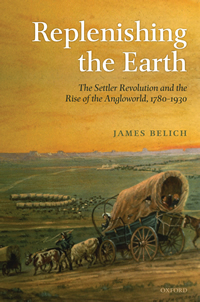
‘Replenishing the Earth’ by James Belich

Replenishing the Earth: The Settler Revolution and the Rise of the Anglo-World 1783-1939, Oxford University Press.

2009, 579 p.

Melbourne, formerly Port Phillip, is mentioned right from the opening words of this book.

Let us begin with two problems in urban history, exemplified by two pairs of cities:  Chicago and Melbourne and London and New York. (p.1)

Why did Chicago and Melbourne undergo such explosive growth, and why in 1890 were London and New York the only two mega-cities in the world?  And why are these four cities English-speaking? Given that there were other empires and cultures- the Portuguese, French, Dutch, Chinese, Russian- that could have rivalled or even exceeded the British empire, why didn’t they?

Replenishing the Earth is a big book that asks big questions and gives big answers.  Big ideas demand mental dexterity of readers, and Belich asks us to do some geographical somersaults as well.  He speaks not of  the “British Empire” as such, but of the Anglo-world, composed of two parallel, twinned structures (I wish I could show you the diagram- see Note 1 below)

To visualize this two-pair Anglo-world, imagine a malleable map like those used to illustrate pre-historical continental drift.  Place your thumbs above Florida, and your forefingers firmly in the Great Lakes.  Prise the United States apart along the line of the Appalachians, splitting it into Atlantic East, roughly the original thirteen colonies, and the vast American West.  The East, in our period, was an emigrant society as well as an immigrant society.  It was one of the world’s greatest sources of long-range migration and investment.  It was the American ‘old-land’, a metropolis equivalent to Britain.  Now gather up Australia, New Zealand, and with some hesitation, South Africa and place them in the Central Atlantic.  With Canada, the Dominions make up a water-linked ‘British West’. This West and old Britain combined to comprise ‘Greater Britain’, the white, un-coerced part of the British Empire, the British flank of the Anglo-world.  Here we have two metropolises or ‘oldlands’, the British Isles and the US East, and two Wests or constellations of ‘newlands’, land-joined in the American case and sea-joined in the British. p. 70

These two parallel ‘oldlands’  (i.e. Britain and Eastern America)  spawned what he calls a ‘settler revolution’ as people, technology and communications flooded into the ‘newlands’ (i.e what became the Dominions and Western America).  This might be thought of simply as good old-fashioned colonization but he separates out four phases that have their own rhythm:

  1. incremental colonization- the slow development of small settlements along trade routes and waterways, looking seaward with their interiors viewed as wild back-country
  2. explosive colonization.  This occurred from 1815 onwards with the mass transfer of technology, money, information, skills and people.  The settlers demanded oldland support, often on their own terms, and the whole scenario usually ended with a bang
  3. re-colonization.  Once things went pear-shaped, settlers cast about for an export that fed into oldland demand that would rescue their local economy- sheep, tallow, timber etc.  In this regard, “[t]he Anglo-world was built like a coral reef on layer after layer of fiscal corpses” (p. 206)  But this was not necessarily exploitative, but a matter of mutual dependency. By integrating themselves into the oldland economy, they saw themselves as part of ‘Greater Britain’ or ‘Greater America’, and “virtually metropolitan co-owners rather than subjects…” p. 180
  4. decolonization. This works only for the British scenario, but it marked the emergence of real as distinct from nominal Dominion independence.

His book focusses mainly on explosive colonization and re-colonization and he argues that the boom-bust waves run as an undercurrent through the histories of the newlands and their relationship with the oldlands.   He suggests that being aware of these rhythms is akin to being attuned to the seasons when describing agriculture- something that I had sensed myself in my own work with Judge Willis in Port Phillip during a time of financial bust, reflected in my several postings on this blog on the Twelve Apostles.

This book invites those who study settler pasts to add another colour to their palette. A booming settler society was very different from the same society in busts, or under re-colonization.  The mood was different, the atmosphere was different, the popular culture was different.  Social structure, crime levels, labour relationships, and gender relations in an explosive colonial society all differ significantly from those in a re-colonial one. (p. 548)

This book draws heavily on economic history: you only have to look at the secondary sources he has used to see that.   This is not the type of history with which I am particularly comfortable, but he adds to the ‘rational choice’ explanation of human economic activity another less measurable influence.   Immigrants, or their immediate forebears, had often shifted internally within Europe in preceding decades, and they were not moving as strangers into another people’s society, but were instead part of the cloning process whereby Anglophone language, institutions, credit and finance systems, plays, books, newspapers, fashions were transplanted into newland territories.  There were always the ‘boosters’ in these newland communities who spruiked the climate, the riches for the taking and the opportunities for settlers- and even the terminology that came to be used for the newcomers is important here-  but the mass transfer of people happened because of what happened in people’s heads when they weighed the possibilities of migration.  This, too, is an approach to history that I feel comfortable with.

His book focusses on the Anglo-phone world, but he makes -rather unclearly-  a distinction between Anglo-phone and Anglo-prone.  Quite apart from the linguistic punnery here, he is at pains to point out that many of the features he identifies are not exclusive to English-speaking peoples, but that they were more likely to display them than, say, French or Spanish societies. His book also encompasses Brazil, Argentina, Siberia, Algeria and Manchuria as alternative scenarios.

There are big ideas in this book, and I can’t do justice to them.  In fact, in a blogpost of this length I can’t even give Belich’s answer  to the questions he posed in his opening sentence above.  I am in awe of the breadth of reading that the author has undertaken and the sheer size of the explanation he offers.  I could not write this sort of history- I admire those who can- but I don’t know if I would necessarily want to, even if I could.  I found myself sitting up a little straighter once people and voices were brought into the spotlight, and I think that reflects my own historical leanings.

Note

You can see the map if you go to the Googlebooks page and search for “The Two-Pair ‘Anglo-World'”. This will take you to Page 70, from which you can go back one page to p.69 where the map is shown.

Other reviews of this book:

The Independent 3 July 2009

The Times Higher Education 27 August 2009

Andrew Smith’s blog (which is where I read of the book, then made the connection with the Keynote speaker at the recent AHA conference- that’s Australian Historical Association, by the way)

‘Memoirs recorded at Geelong by Foster Fyans’ ed. Phillip L Brown

“What is the use of a book, ” thought Alice “without pictures and conversations?”  I’m with you, Alice.  I  certainly wasn’t expecting conversations in Foster Fyan’s memoirs, and I very much appreciated the maps and illustrations.

Foster Fyans is well known in Geelong as the first police magistrate there (1837-40), then he became Crown Land Commissioner in the district.  The area just out of Geelong known as Fyansford is named after him, and there’s a Fyans Street in Geelong itself.  After visiting Geelong a fortnight ago for the Robert Dowling exhibition I seem to be rather Geelong-conscious at the moment, and I’ve been reading Fyans’ memoirs for a paper that I’ll be giving much later in the year.

As his entry in the Australian Dictionary of Biography suggests, there is not much known about his early life beyond that he was Irish and brought up by an uncle.  In these memoirs he springs from the page as a fully-formed army man, in charge of taking bringing a band of recruits to Portsmouth.  From the start he portrays army life full of masculine humour, eating and drinking, marching and high-jinks- almost a dead ringer for Lydia Bennett’s Mr Wickham and his mates.   His description of the Peninsular War likewise emphasizes life amongst his fellow soldiers, with more distress ascribed to the illness that swept through the camps rather than actual combat.  Then off to India for several years where again, life revolved around hunting and carousing and little mention of actual soldiering.  After a short time in Cape Colony (more parties and shooting), he arrived in Sydney where he spent a short, restless, lonely time before reporting to his regiment and joining his fellow soldiers at Parramatta.  Although he attended Government House, the jocular hail-fellow tone falters here, as the realities of convict settlement and official responsibilities become more apparent to him.  He is sent to the high-security  Norfolk Island where he eventually becomes Acting Commandant, and from there as commandant to Moreton Bay (now Brisbane) which was also a penal settlement at the time.  While  in Moreton Bay he oversaw the rescue of  Eliza Fraser.   His response to the convicts probably reflects the contradictions thrown up by the system- an uneasy wariness of violence that runs just below the surface co-existing with close day-to-day proximity with men not so different from oneself.

From there he was sent as Police Magistrate to Geelong, which is about fifty miles from Melbourne and rich pastoral land.  His memoirs become even quieter at this stage.  He spends quite a bit of time describing an expedition to the port settlement of  Portland, the first recognized land journey between the two settlements.  With only two mounted police and the surveyor Mr Smythe and no maps, they set off in what seemed to be atrocious weather, greeted each morning by the “flying jackass” (kookaburra), the “chanticleer of Australia”.   By 1840 he had been appointed Commissioner of Crown Lands, responsible for maintaining order among the squatters and investigating clashes between the settlers and the displaced aboriginal groups.  Here is a sad litany of violence,  where he mainly sides with the settlers in sympathy for what they perceive as needless stock loss. Like the settlers he is critical of the Aboriginal Protectors and the nearby mission station that he feels only attracts more aborigines to the area and imbues them with a misplaced sense of inviolability.

What started out as a military romp has become a nomadic police-like existence, accompanied mainly by his aboriginal “boy” Bon Jon (the purpose for my reading these memoirs).  It has become much quieter and more isolated.  Perhaps it’s the memoirist running out of puff too, because the memoirs stop abruptly in the bush in 1842.

The editor has written an introduction, where he describes the provenance of the manuscript and the various branches of the Fyans family tree, then gives a brief summary of the content of the memoirs.  I always enjoy hearing about how a manuscript comes to be published. The original, scrawled across five hundred foolscap pages had been typed up by Fyans’ great grand-son and it was donated by his descendants to the State Library of Victoria in 1962.   Although Fyans himself did not divide it into chapters, he did create sections by inserting a page with rough headings for the pages that follow. The  editor has created chapter headings and provided notes  at the end of each chapter.  These rather dour and punctilious annotations to the entries, which are painstaking in their detail, remind the reader of the fallibilities of memory and chronology, and the infelicities that arise when a raconteur is  telling a good story.

I think that it’s almost certain that anyone working exhaustively on an archive of memoirs, diaries or letters comes to build some sort of a relationship (albeit completely one-sided) with the author.  The editor, P. L. Brown (who also wrote the ADB entry) seems rather disenchanted by the many inconsistencies and errors he found

Fyan’s reminiscences had to be checked in order to assess their worth as historical material. This checking disclosed considerable and frequent divergence between actual and remembered events, and made it clear that the text, unless fully annotated, must be more entertaining than instructive. Hence the presentation of archives, both British and Australian, from the latter of which Fyans emerges as an energetic, conscientious public servant, rather let down by his rambling old self, who nevertheless conveys the authentic atmosphere of his historical period, and told few stories which lacked a germ of truth (p. xv)

The memoirs themselves ended abruptly, and the notes themselves end with the transcription of assorted letters and returns, and further details about wills and inheritances.  I found myself wishing that P.L. Brown had returned at this point to round out the picture somewhat and to help me, as reader, to bid farewell to Fyans.  After all, he’d been a rollicking companion for the first 100 pages or so, and despite infelicities and distortions in his retelling, he sure had a story to tell- Spain, India, Cape Colony and Australia- as did many of those peripatetic colonial civil servants.

Weston Bate at the RHSV

Weston Bate gave a presentation at the Royal Historical Society of Victoria a couple of weeks back.  It was called “How I Became a Local Historian” and you can listen to it here.

He studied history at Melbourne University during Max Crawford’s time, and although he had done well in essays, did not perform as well in his honours exam as he had hoped.  He jumped at the chance of writing a history of Brighton, commissioned by the Brighton mayor, largely because of the sense of place that he himself had developed growing up in suburban Melbourne.

He started off with the rate books, utilizing the “birds eye” view of the RAAF pilot he had been during WWII, mapping out the streets, the type of building constructed and the people who lived there.  He tramped the streets of Brighton too, getting a feel for the place.  He took a slice approach with the newspapers, reading at ten year intervals (and ruing, with hindsight, that he didn’t align his reading with the censuses).  Brighton as a suburb was a rich field-  it threw up Dendy’s special survey and the involvement of J. B. Were; the development of the resort town; market gardening; the influence of Tommy Bent; the nature and contribution of the ‘middle suburb’.  It was a local history, but it illustrated big themes.

He speaks of the academy’s condescension towards local history, and the sidelining of the Royal Historical Society of Victoria by the University of Melbourne for some time, reciprocated by the local historians’ disdain of “academic” historians for their lack of interest in primary sources.

A good, well-constructed talk- and I do love being able to catch up on things I have missed through podcasts!

A memorial for a memorial?

You might have seen on the back page of  today’s Age  a little article about the re-enactment of a photograph.  You can see the article here (scroll down about half way).  Apparently 50 years ago, as part of the 125th anniversary of Batman’s proclamation,  Robert Waddell stood with his mother Beryl at the corner of Flinders and Willliams Streets to have their photograph taken beside the Batman memorial plaque that was embedded in the footpath, outside what is now the Immigration Museum.  And here they are, fifty years later, standing on the same spot beside a piece of empty footpath.

As Bain Attwood tells us in his book Possession, this memorial has had a contested history right from the start.  In 1923, after the Old Melbourne Cemetery had been removed from what is now a Victoria Market carpark, it was felt by some city worthies that Batman deserved a new memorial close to where he was said to have disembarked and declared “This will be the place for a village”.  As a result R. A. Crouch proposed that a memorial be erected on the corner of Williams and Flinders Streets that read

This is the place for a village- John Batman 1835.

However, the Secretary of the Historical Society of Victoria, A. W. Grieg was wary of the wording because his own research had questioned whether Batman himself had visited Melbourne on this occasion.   A compromise, from which Grieg later distanced himself, was reached, and the amended wording read

John Batman landed near this spot June 1835. “This will be the place for a village”.

You can see a photograph of the artisans working on the plaque here and a report and photograph of the hatted gentlemen watching the slab being placed in the footpath at the official ceremony in March 1925  here and here.

The plaque became a popular rallying spot, not only for commemorations of Batman’s putative landing (the last of which probably occured in 1973) , but also for Aboriginal protest.  The Aborigines Advancement League began its protest rally against the loss of Lake Tyers from the memorial in 1963, and in 1970 The Day of the Mourning also commenced its march from the same spot.

Right from the start there had been disquiet about the accuracy of the claims on the plaque: whether Batman had even been there at that time;  whether the portentous words were ever uttered; whether “this” was the spot even under consideration.  Along with a heightened discomfort about the treaty and Aboriginal possession, there was the increased prominence given to John Fawkner as the alternative “founder of Melbourne”.  In 1995 a corrective marker was placed beside the plaque that read:

There is some doubt as to whether Batman was actually with the party that rowed up the Yarra in June 1835 or that they landed near this site.  The map that was drawn up by surveyor John Hedger Wedge on Batman’s return to Launceston indicates the land south of the Yarra River and down to its mouth as being reserved for a “Township and Other Public Purpose”.

This rather wordy correction was stolen in 1998 and not replaced.  But by 1998 the memorial stone itself went as well, gazumped somewhat by Enterprize Park directly opposite.  Ah well, we can always remember the memorial.  Perhaps a plaque for a plaque?

References:

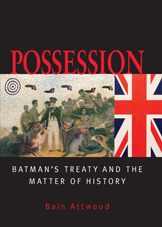
Bain Attwood Possession: Batman’s Treaty and the Matter of History , Melbourne, Miegunyah Press, 2009.

Shane Carmody ‘John Batman’s Place in the VillageLa Trobe Journal No 80, Spring 2007

‘Convicts of the Port Phillip District’ by Keith M Clarke

One of Port Phillip’s claims was that, unlike Van Diemen’s Land and New South Wales,  it was not a penal colony.  It was opened up during the 1830s when emigration schemes were hitting their strides and there was much to be gained by distancing Port Phillip  from the degradation and corruption that was perceived to flow from contact with convicts.

But it was not as clear cut as this.  Right from the start, there were convicts in Port Phillip.  The earlier abandoned attempts at settlement at Sorrento and Western Port involved convicts, and had they been more successful, there would have been a permanent convict presence in the area.  As it turned out, Melbourne was established by, or at the behest of,  private pastoral and agricultural interests.  When these pastoralists, their sons and their agents moved in, especially from the Middle District around Sydney, they were able to bring their assigned servants with them.  John Hirst, in his book Convict Society and its Enemies notes the slippage in terminology that avoided the use of the term “convict” and instead used “assigned servant”.  He suggests that all sides were comfortable with this linguistic subterfuge:  emancipists and expirees were keen to expunge the moral connotations of ‘convict’, and for those who availed themselves of labour from the assignment system, the use of the term “servant” framed the contract as the more acceptable master-and-servant relationship that underpinned all labour exchange at the time.

Once they were here as assigned servants, there was no formal supervision at the local level.  In theory, assigned servants could only be transferred between owners with the permission of Governor Gipps, but this does not seem to have been strictly enforced. An advertisement for land of the Plenty River in May 1841 included “five government men” in the purchase, and according to Judge Willis,  at the height of the economic depression in 1842 there were two hundred assigned servants wandering at large because their masters could no longer afford to keep them.

Then there were convicts sent down from Sydney.  Some of these were highly qualified “specials”, who were sent to fulfill particular roles.  For example Phillip Harvey, who had been transported after pleading guilty to a charge of forging and altering two Bills of Exchange, was sent down from Sydney after being instructed by Mr Dunlop the Astronomer on the keeping of meteorological journals.  Another convict worked as a writing clerk at the Police Office and Judge Willis strenuously protested him being left in charge of prisoners on remand because he was  “not fit to have charge of free persons, who coming out to this colony were entitled to all the privileges of British subjects.”   The distinction between government and domestic employment was not clearcut: a letter to the Port Phillip Herald complained that Dr Shaw of Geelong had been using men assigned to the customs service to fetch wood and move furniture.

Then there were the public works gangs sent down to work on roads and other constructions.  They were a highly visible presence, although they do not seem to have worked in irons.  Just as one could imagine today, the “shockjocks” of the press at the time became highly exercised at the sight of convict gangs fiddling around on their spades in fine weather, and when unemployment rose in 1842, it was felt that government work should be provided to emigrants rather than convict work-gangs.

Added to this were convicts who had gained tickets-of-leave (for example, the Port Phillip Herald of 12 April 1842 has an advertisement of a ticket-of-leave belonging to Martin Brennan that had been found), and those whose sentences had expired.  A large number of people coming across from Van Diemens Land fell into this category.

So, we should perhaps raise a sceptical eyebrow at all the “free” rhetoric coming from the Port Phillip boosters.

A book that deals with the convict presence in Port Phillip in more detail is Keith M Clarke’s Convicts of the Port Phillip District.  Self-published in 1999, it is a large, illustrated paperback book of 370 pages, much of which is made up of appendices giving names, shipping details, and sentencing data and comments for the different waves of convict settlement (Sorrento, Western Port, Port Phillip and later the exiles sent between 1844-1849).

It is from this book (p.100)  that we learn that, of the population of 12, 994 in Port Phillip during the 1841 Census, there were 2,762 who had been transported to the colonies- i.e. 21% of the Port Phillip population at the time.   Although the numbers are rubbery, there were 338 holding tickets-of-leave, 185 on Government Service, 637 on private assignment and 1455 “other free” men and 147 “other free” women.  “Other free” was a catch-all category that included emancipists, those free by servitude, and those holding conditional pardons.

We can also see from his compilation of Supreme Court data that many of these assigned servants were under the control of prominent Port Phillip personalities that we have met before: William Verner (Judge Willis’ good friend), Porter, Carrington, Thomas Wills, Dr Thomson, Ebden, Lonsdale,  Peter Snodgrass.  It is significant that Judge Willis himself did not have assigned servants, and in this he was true to his word in 1839:

For my own part, I have ever  considered the provisions of His Majesty’s order in Council, in 1831, for reconstructing the Supreme Courts of Judicature in certain crown colonies, when negro slavery unhappily existed, to be most wise in prohibiting the Judges from being owners of, or in any wise interested in slaves, or their labour. Believing the same principle to be as applicable to the bondsmen of Australia, as to the negroes of Guiana, Trinidad, and St Lucia, I have abstained, and ever will abstain, so long as I remain on this bench, from being the assignee of convict service. I will never permit the possibility of insinuation that my private interest can in anywise interfere with the honest discharge of my judicial duties.  I will always endeavour to keep myself beyond all reach of vulgar suspicion.

A large part of this book involves a retelling of the different settlements in Port Phillip, albeit with particular attention to convicts.  It is a largely narrative approach, and while the bibliography cites the body of academic work on this era, it does not engage with the literature in an academic sense.   It starts with a description of the parish system in England and the changes to Poor Law legislation during the Industrial Revolution.  The second chapter describes changes to the penal code in England during these years and the global nature of transportation to penal settlements worldwide.  The third chapter involves the establishment of the Botany Bay scheme and explorations of the Port Phillip Area.  Chapter 4 involves Sorrento (Sullivans Bay); Chapter 5 Westernport, and in Chapter 6 the coming of sealers, the Hentys, Batman and Fawkner.  Chapter 7 describes the appointment of William Lonsdale and the convict workforce under his supervision.  Chapter 8 covers the La Trobe years, including the pressure to accept exiles under the revamped transportation-that-dare-not-speak-its-name system.

The heart of the book is the 200 pages of appendices with names and details.  These are set out in spreadsheet format and give you the little jolt of recognition that these are real individuals, who each have their own life story.  In this regard, the book would be a useful addition to a family history resource centre, where family historians would no doubt fill in the gaps between the statistics.

References

Keith M Clarke Convicts of the Port Phillip District, Waramanga, KM & G Clarke, 1999.

J. B. Hirst Convict Society and its enemies


Masters and servants: a Labour Day reflection

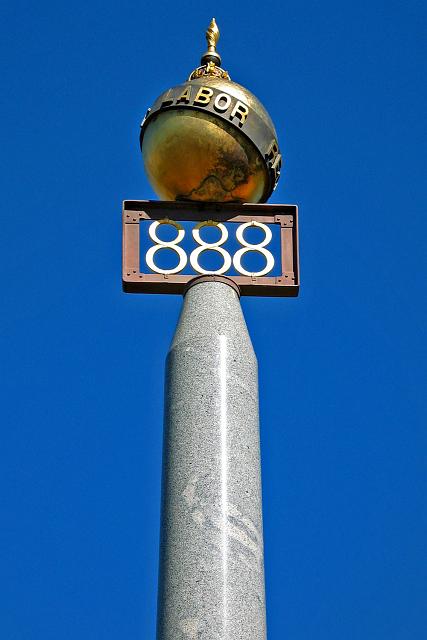
It’s Labour Day here in Victoria, celebrating the awarding of the eight hour day to the stonemasons employed at Melbourne University in 1856.  The idea of eight hours work, eight hours recreation and eight hours rest seems rather quaint in our deregulated, open-all-hours economy.

During Judge Willis’ time in Melbourne, labour relations (a terminology not even dreamed of at the time) were governed by Master and Servant legislation.  Such legislation was an empire-wide concept whereby relationships between employers and employees were governed by contracts that were enforceable by magistrates and where breaches by employees were punished.  The New South Wales legislation promulgated in 1828  was even harsher than the corresponding English statute because it provided up to six months imprisonment for absenteeism and desertion, double the penalty in the English legislation.  Labour shortages were an ongoing problem in the colonies, although during the 1840s depression workers were exhorted not to keep insisting on their wages because it would only push their employers into insolvency (huh- I’ve heard THAT before!).  The legislation applied to the overwhelming majority of workers including, at first, independent contractors as well as hired servants and apprentices.  Domestic servants, and especially female domestic servants were expressly included because of perceptions of scarcity and troublesome character, and to prevent them absconding.  The Act was modified in 1840 but still remained heavily weighted towards the employer, although cases for non-payment of wages were reported in the newspapers as well.  This legislation was generally heard by the Police Magistrate in the Police Court.

So, in the Port Phillip Herald on the 24th January 1843 we have an item headed “Female Impudence”

At the police office, on Thursday, Jane Kelly preferred a charge against Mr J. Cade of the River Plenty, under the Masters’ and Servants’ Act, inasmuch as she had been in the service of the said Mr John Cade as a maid of all work, he refused to pay the balance of wages due to her, 24s.  The defendant on being asked by the Police Magistrate if he denied “the soft impeachment” ungallantly said, the fair Jane had got drunk last Sunday evening, disturbed the whole family with her vagaries, while in that unenviable state of oblivion and would not go to her own bed, but wanted to come to his, and to effect her purpose broke open the window of his bed-room. Here an angry discussion ensued between the parties as to who had the best right to the bed in question, the complainant contending the bed was hers, and the defendant with equal pertinacity urging his claims to it.  The bench consisting of the police magistrate, Mr Airey, and Capt. Smith endeavoured to solve the point by ascertaining its position in the house, but nothing definite from the conflicting statement of the parties could be arrived at. The complainant at last said the least the defendent said on that subject the better as he had bit her finger and endeavoured to take liberties with her, which charge was indignantly denied by the defendant, who expressed his honest indignation at her impudence in endeavouring to force an entrance into his bed-room. The court and bench were frequently convulsed with laughter at their mutual recriminations, and the police magistrate suddenly discovered her as an old acquaintance who had formerly endeavoured to force an entrance into the bed-room of Mr Boyd, who was so alarmed on the occasion as be compelled to have recourse to the protection of the police: she had since been in gaol several times for misconduct, and under all the circumstances the bench dismissed the case, to the no small mortification of Miss Jane, whose countenance, which had been before sprightly and gay, now assumed a dark and down-cast hue.

Or, another report in the Port Phillip Herald of 28th June 1842 where  a servant girl took her employer to the Police Court for non-payment of wages.

On Saturday, at the Police Office, in a case for the recovery of wages, by a servant girl from her master, Mr Murray a late arrival, the defendant stated in his defence that in the place where he came from, in Scotland, three pounds per annum was the rate of wages which he was willing to allow her, but as she had made an application for the return of a certificate she had received from her clergyman, and which he held, he refused to give it up, he having himself paid 2s 6d for it before leaving home.  Major St John [the police magistrate] after having patiently heard both sides of the case, immediately directed the payment of the wages due, and that the certificate of character should immediately be given up, and that he would himself pay the half-crown, which he presented to Mr Murray.  The latter, however, said he could not give it up as he had it not, whereupon the Major ordered him to sit down and write her out a receipt for the document, which Mr Murray did without specifying whether it stated that her character was good, but was forthwith directed to add the fact to the receipt, as the poor girl, like many others, had nothing but her character on which to depend.

It wasn’t just women who fronted the courts.  An item headed “Cakes” of 4th January 1842:

A person whose name like his trade was A. Baker, summoned his master on Saturday last to the Police Office for wages due: the latter in his defence stated that the man engaged with him as journeyman Baker, but proved a traitor to his name and profession, being neither baker nor tradesman, having lately spoiled a family Christmas cake, by flattening the nose of the white sugared Queen seated thereupon. On being reproved therefore he offered to perform the like service for his master “if he was game” for which the latter stopped payment until advised to stump up by the Bench.

It seemed fitting to spend Labour Day at the movies seeing George Clooney in “Up in the Air”

I assume that the last segment of talking heads was just to reassure us, in case we didn’t already know, that life is really about family and loved ones in your backpack.  And I just shake my head in amazement that somehow Americans assure themselves that they can stand on their own two feet and don’t need “big government” and that having a health insurance system tied so closely to employment status is a good idea. Sheesh.

References:

Michael Quinlan ‘Australia 1788-1902: A Workingman’s Paradise?’ in Douglas Hay and Peter Craven Masters, Servants and Magistrates in Britain and the Empire, University of North Carolina Press, 2004

Review of ‘Masters, Servants and Magistrates in Smith Book Review

‘Possession: Batman’s Treaty and the Matter of History’ by Bain Attwood

2009, 323 p & notes

We will never really know how much of the [Port Phillip] Association’s narrative was true because of the paucity of contemporary sources.  Indeed, all we have are the few accounts created by these colonisers.  In respect of the famous treaty-making, we cannot even be sure it took place.  Arguably, it might simply be an imaginary event that never happened.  In the end, it probably doesn’t matter very much whether it occurred or not. (I assume that some parts of the treaty-making did take place.) What is more important historically are the stories that have been told about it. (p. 47)

As you might gather from this quote, this book is not just about Batman’s treaty.  In fact, looking at the book lying on my desk here with  “Possession” in large silver letters on the spine, I’m not really sure that the book is about possession at all.  The treaty itself could be a construction, and whatever ‘truth’ there is about it has been overlaid by boosterism, intentional forgetting and spin.

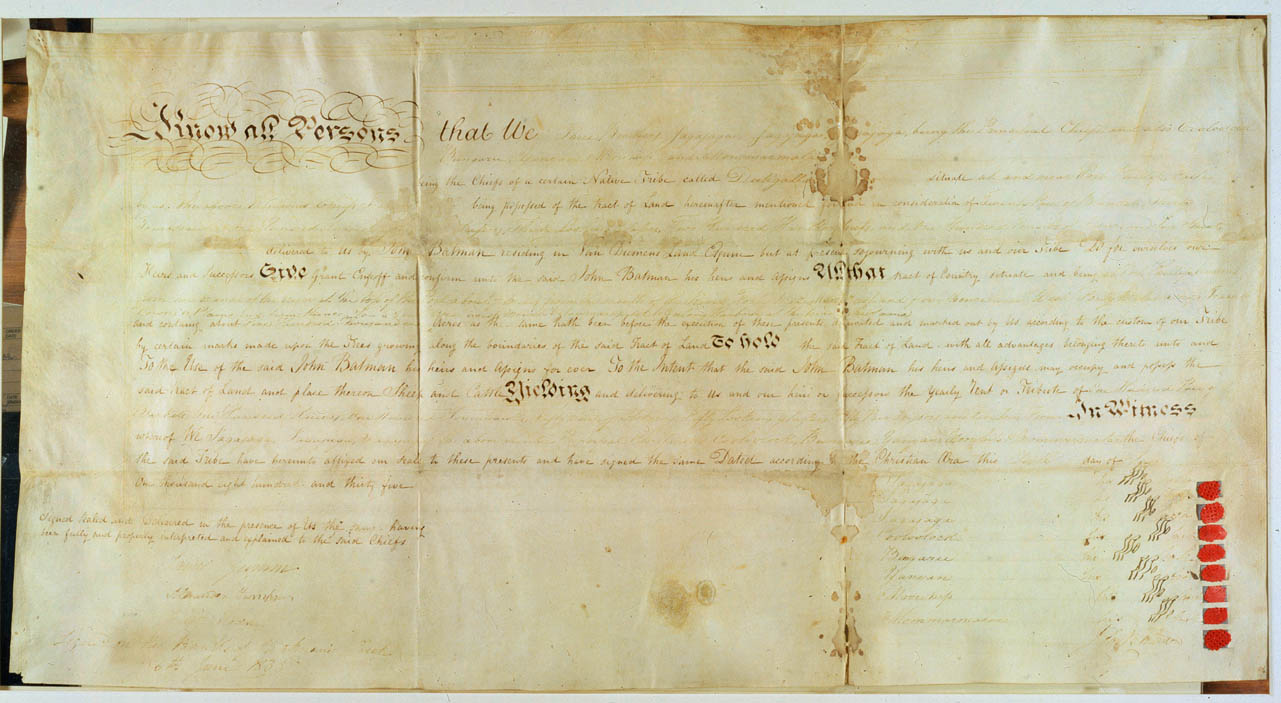
The treaty document itself was drawn up in Van Diemen’s Land before Batman arrived in Port Phillip; the ‘signatures’ have a suspicious similarity, and Batman did not, as he claimed, walk the boundaries of the land ‘traded’.  The motivations for the treaty and its subsequent quashing by the NSW goverment,  as Attwood explores, are best explained in terms of the time in which it was put forward – 1835- in the wake of the Black Wars in Tasmania, under the influence of the humanitarian lobbyists in London, and in light of the invention through the NSW courts during the 1830s and 1840s of a spurious ‘authorized’ history of British sovereignty in New South Wales, some 50 years after the event.

The creation and rejection of the treaty takes up only the first 100 pages of the book.  It then meanders into an exploration of the artistic depiction of the treaty over time and the change in emphasis on Batman’s treaty to Batman’s purported (and spurious) sailing up the river and declaration “This will be the place for a village!”.  I found the artwork fascinating.  Some time ago I had pooh-poohed the grand, commemorative American artwork tradition but here it is, alive and well in Melbourne- see here – it’s just not displayed in our art galleries any more.

The book moves into a discussion of history-writing in Victoria, with a string of antiquarian historians burnishing the Batman legend and feeding the Victorian (in both senses of the word) obsession with memorials and commemorations.  There was the Batman memorial over his putative grave; a memorial stone embedded in the footpath, Batman Park, Batman Avenue.  Then gradually the cracks in the image started appearing with questions over Batman’s parentage and sobriety and the championing of Fawkner’s settler history as an alternative story, pushed along by the tourism industry and latter-day Melbourne boosters and P.R. agents.  Gradually the memorials were shifted to quieter, less prominent locations, parks were renamed, and explanatory plaques were attached to statues qualifying some of the more gushing tributes to Batman and his activities. Just to add another layer to this already contorted history, it was Aboriginal people in Victoria who maintained the memory of Batman as the white man who dealt fairly with them, at a time when white history had consigned his treaty to the status of a curiosity.  The turn to politics becomes more weighty when Attwood takes on Henry Reynolds’ book The Law of the Land , which Attwood argues was a juridical history, intended to present sovereignty as a legal problem for 20th century political  purposes and one that, oddly, disregarded the Batman treaty entirely in the original edition of Reynolds’ book.

This is a richly illustrated book with coloured reproductions of the grand celebratory paintings, photographs of top-hatted men at yet another Batman memorial unveiling, reproductions of the string of illustrated histories that were published over the years and recent colour photographs of the now-discredited old memorials  and their newly-minted replacements.  It’s a book that takes us far beyond the treaty.

Miss D’s big New Year Celebrations

You might remember that I’ve snaffled myself a copy of Miss D and Miss N, edited by Bev Roberts.- and yes, you’re still waiting for a blogpost that reviews it.  So, how did Anne Drysdale see in the New Year?  Well, definitely her New Year celebrations on the ship out were the feistiest she wrote about!

January 3rd 1840- New Year celebrations

I feel very thankful that all the rejoicing days are over.  Monday the 30th December was the 6th anniversary of Mr and Mrs Gibson’s marriage.  On that account the Capt ordered a better dinner than usual & the gentlemen had an extra quantity of wine & grog.  The consequence was they all got tipsy.  Mr Baird very drunk.  There was a great deal of fighting.  Mr Clark &  the Dr. revived the subject of their duel, which they still intend shall take place when they get on shore.  The drinking this day was a beginning of what was so soon to follow on New Year’s morning, & such a scene that was!! The ship was running right before the wind at 7 1/2 knots.  Whenever 8 bells rung, intermediate & steerage passengers rushed into the cabin with bottles of spirits & all who were in their beds were roused out, then such a noise & drinking went on.  Passengers of all ranks & sailors fighting & flying about. It was fearful.

The 2nd mate was I believe the only sober man on board, mercifully the wind was aft & [the ship] drove before the wind as there was none to manage it. While it was yet dark one of the steerage passengers discovered a ship close to us.  The 2nd mate got a light put up & we escaped & have great reason to be thankful that all passed over without any serious accident.  Nearly all are cut and bruised more or less & their cloathes in tatters, but it might have been worse.  (p. 50)

Her partying days over,  and it’s God, church and work from here on:

1843 [January] Monday 2nd- strong resolutions

Yesterday wind variable, thunder & a little rain.  All went to church except myself. Made strong resolutions, with the grace of God, of amendment for the future.  This day fine, wind S. Men finished reaping wheat & oats.  Armstrong worked with pegs for hurdles & lounged Betty. Dr & Mrs Thomson & Jane came to dinner.  Capt. P… (p. 154)

Made strong resolutions, eh? Hah! don’t we all?

1844- Monday January 1st

Yesterday all went to the chapel, Mr Smith preached.  In the evening, Dr B gave us a beautiful & most impressive address on the necessity of being regenerated.  All the men & the shearers attended.  This day fine. Shearing lambs began. Robert gone to look for horses…  (p. 179)

1846 January 1st Thursday- An unfortunate day

Storm of thunder & lightning all day with heavy rain.  Ned kept holy day but rode to Corio to know if Mr Cunningham’s cattle had come.  Mr Sproat came to dinner.  Robert came up from the marsh & announced that Di was killed by the lightning.  Colin also died & 18 young turkeys & chickens were drowned in the pen. An unfortunate day… (p207)

No, I don’t know who Di and Colin are either.

1846 Thursday 31st [December]- All things richly to enjoy

Gloomy, hot & a little rain. Again we have come to the close of another year & by the blessing of God, are still surrounded with comforts & have all things richly to enjoy.  We have indeed much cause for gratitude.  May we continue to grow in grace & in love to God & our neighbours.  Ned & Robert jobbed, Moylan went. Henry remains. (p. 215)

And so say all of us.

Anne Drysdale’s Christmas 1841

There shall be more about Anne Drysdale anon, as I have bought Bev Robert’s recent book Miss D & Miss N: an extraordinary partnership.  Enough for now to say that, emigrating at 47 from Scotland and taking up land near Geelong in partnership with another woman (Caroline Newcomb) ,  Anne Drysdale is an inspiration to  ladies of a certain age like myself.

So, picking up on my timeworn (well, last year’s) theme of Christmas in Port Phillip, how did Anne Drysdale spend her Christmas in 1841?

On Friday last Dr & Mrs Thomson came down to tea & insisted on our going with them as the next day was Christmas, so we drove up with them, had roast goose & plumb pudding. Mr Tuckfield and Capt Pollock dined, the latter was with us on Thursday night.  As the next day was Sunday we remained & went to church.  On Monday morning Caroline rode down early.  Jane & I walked down after breakfast.  Dr & Mrs Thomson have given Caroline as a Xmas box the present of a mare called Fanny which she had been riding for some time.  It had a filly foal some days since.  She is to return the foal when it is weaned.  Fanny is a handsome black mare, a very pleasant ladies horse to ride & has been tried in harness & is perfectly quiet, so if we ever get a pony chair she will do nicely.  On Monday we expected Mr & Mrs Fisher to dinner to bring down Charlotte.  After dinner Mr F &  she arrived on horseback.  They had all got into a gig with in the intention of coming to dinner but the horse wouldnot go.  Mr F remained to tea & left Charlotte.

… Mr & Mrs Love & 2 children came to tea.  Capt Pollock was here Monday night. This morning before breakfast a party from Corio arrived on their way to the lakes for a pic nic. The 2nd carriage or cart had not come up, so the contents of the 1st 8 in number, breakfasted with us.  They have had a very hot day for their pic nic.

So-  a traditional hot Christmas dinner on a hot Australian day and people popping in on the way to a pic nic.  Sounds familiar really.  But this is the only Christmas day described in any detail in the diary, which becomes more business-like each year with sheep, sheep, sheep.

No sheep for me- Happy Christmas everyone

And I’ve now read Bev Roberts’ book Miss D & Miss N and you can read my review here.