Category Archives: Port Phillip history

A day at the races 1840

Cross posted from my other blog BanyuleHomestead.   Years ago when this blog was young, I also wrote about early Melbourne racing here.

Well, it’s Cup Day today and there is, perhaps, a tangential connection between Banyule Homestead (which is in Heidelberg after all) and the Sport of Kings.

The first races in Melbourne were held on the grassy flat at the base of Batman’s Hill, now the site of Docklands, I suppose, in March 1838 in a three day carnival.  The course was marked out with stakes and saplings, commencing at what is now North Melbourne station, sweeping down through West Melbourne and finishing at what is now Southern Cross station.  Two bullock drays were lashed together to make a grandstand.

Two years later the venue switched to Flemington. The grandstand was a rough scaffolding near the river side, close to the winning post.  The run home was staked and roped.  Between the stand and the river were the “refreshment” tents.  The Grand Stand Refreshment Mart was described by Garryowen as

a sort of bower of Bacchus, fabricated out of ti-tree with the foliage left on

There were two other smaller tents, but the grandest of them all was Thomas Halfpenny’s establishment

a substantial, commodious, weatherboard three-roomed structure, partitioned with Chinese curtains.

It was obviously lucrative for its publican, taking 80 pounds on the first day of the races. There was a large attendance from Melbourne, although patrons grumbled at the change of venue.  Numbers rowed from town, while others arrived on dog-carts and bullock drays.

Again, it was a three-day carnival and the first at which the riders wore colours. The Heidelberg Cup was held on the third day with the purse of fifty guineas raised by private subscription.

Because I don’t even start to know how to describe a race, I’ll let Garryowen do it for me:

THE HEIDELBERG CUP, 3 miles, gentlemen riders, 50 sovs., and 5 guineas entrance. Town Plate Weights.

Mr Wood’s br g. Will-If-I-Can, aged -, red and black, 1.

Mr Highett’s b m Music, 6 yrs- crimson and black cap. 2.

Mr Powlett’s br h Sir Charles, 5 yrs- green and blue 3.

Mr Baillie’s br h Duke of Argyle, 6 yrs

Mr Yaldwyn’s b h Blacklegs, 4 yrs- black, pink and white; withdrawn

Mr Russell’s b g Freedom, 6 yrs- green and gold, black cap; withdrawn.

The four that came to the post made a capital start, and kept well together until half round the course, when Blacklegs bolted, and so lost all chance of the race.  Coming to the distance, Will-if-I-Can shot ahead, and won by several lengths, Music and Sir Charles working hard for second place.  The winner’s condition rendered it an easy victory.

The first Flemington racing carnival was, according to the Sydney Gazette of 26 March 1840

…very numerously attended, all the elite of the settlement were there; the weather, the animation, and the hilarity were alike delightful, and in unison with the excellence of the running.

Sources:

Robyn Annear, Bearbrass

Edmund Finn (Garryowen) The Chronicles of Early Melbourne p. 719

Trove.

A pleasant Sunday drive to….The Portable Iron Houses

Do people do Sunday drives anymore? We did- across the Yarra and down to South Melbourne to look at the Portable Iron Houses in Coventry Street South Melbourne.

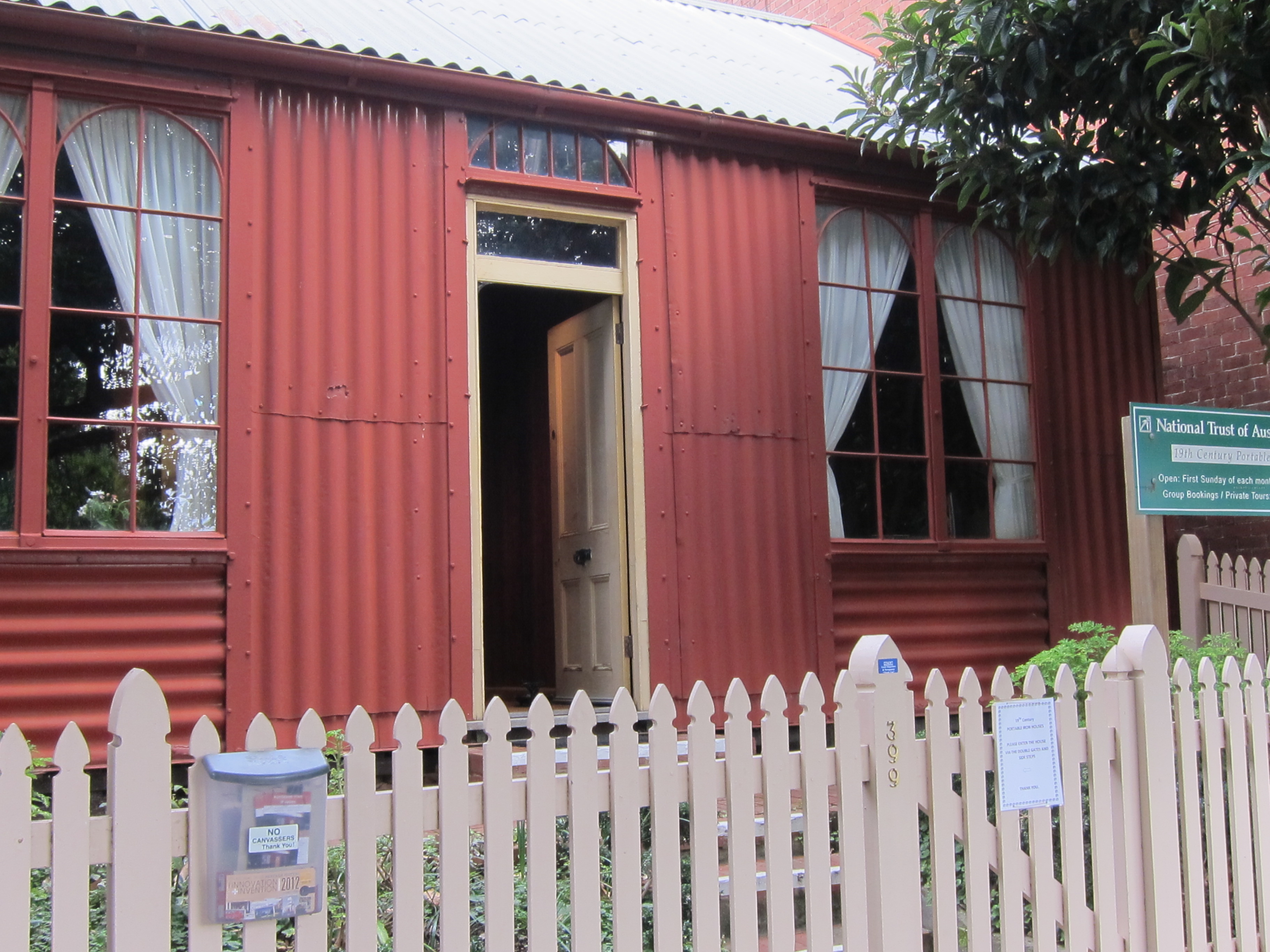
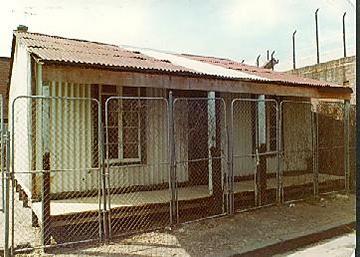
Patterson House, Coventry St South Melbourne

There are three galvanized iron houses on the South Melbourne site.  The one facing Coventry Street, shown above, is still in its original position where, in 1855 it was one of nearly one hundred portable buildings in the vicinity that included cottages, two-storey houses, shops, stores and a coach house.  It was valued at 60 pounds when it was erected in 1853/4.   Portable iron houses were packed in wooden cases (which could be used to line the internal walls) and easily transported by ship or cart.  They were quickly erected and could be unbolted and dismantled to be taken elsewhere for re-erection as a practical and enterprising solution to the dire housing shortage in gold-rush Melbourne.  The house above contained four rooms on the ground floor, with two attic bedrooms that are reached by a precipitous stairway.  I found it hard to envisage negotiating these stairs- barely more than a ladder really- with a babe in arms.  The temperature of the attic rooms in summer must have been fearsome too.

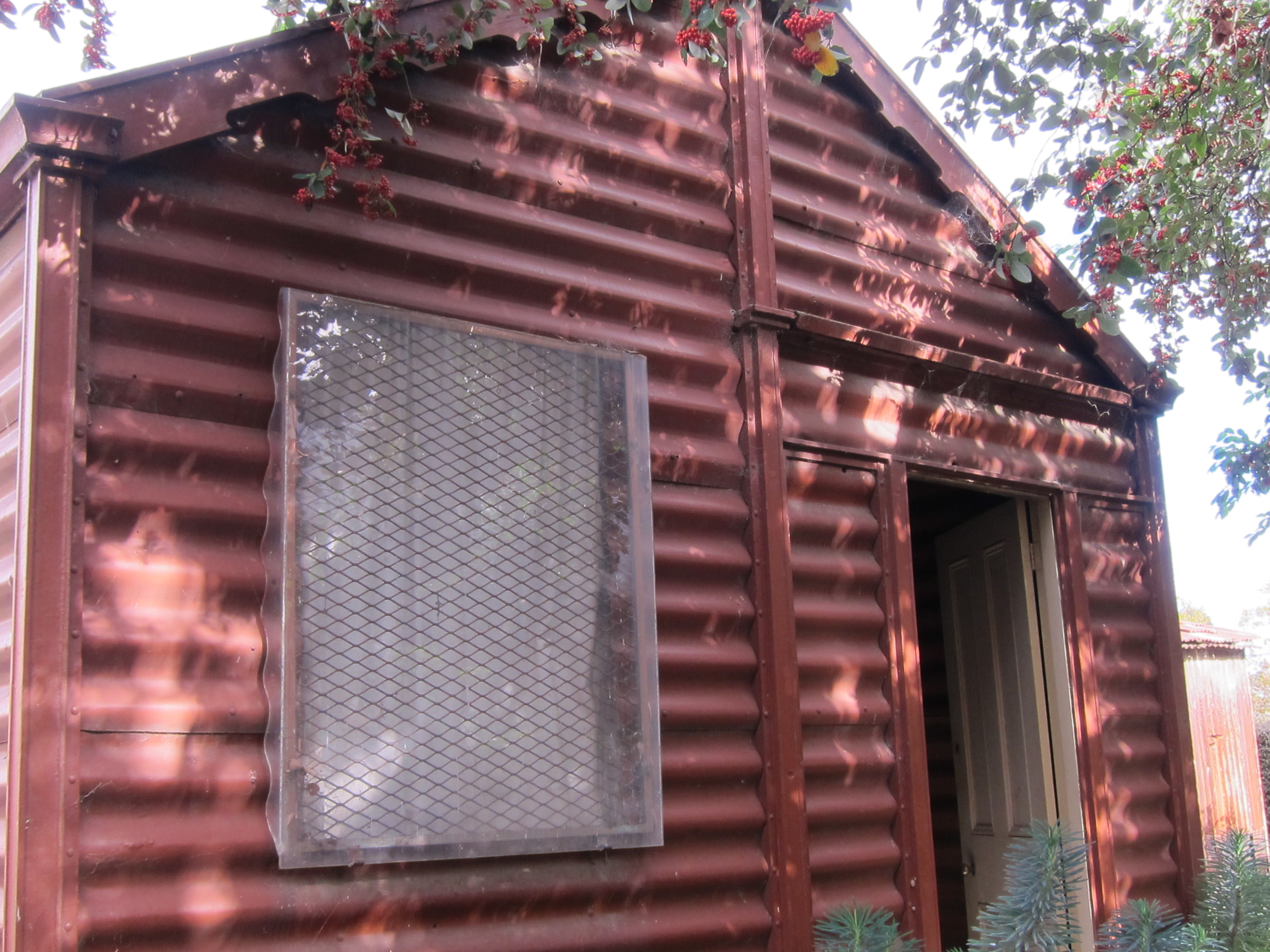
The second house on the side, Bellhouse House, was originally built at 42 Moor Street Fitzroy.

Bellhouse House, South Melbourne

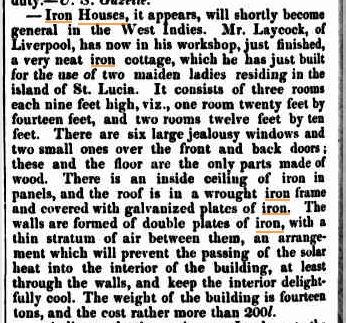
It is believed to be the only remaining example of the work of Edward T Bellhouse of Manchester England.  In 1851 he displayed his portable houses at the Great Exhibition, where they exemplified the practical use of new technology, especially for an imperial context.  There had been iron houses available previously- say for example, this house designed for St Lucia in the West Indies, but the cost and the weight were prohibitive

The Courier (Tasmania) May 8, 1845

(by the way, it should be ‘jalousie’ window, which apparently is just a louvre window).

There had been timber pre-fabricated houses as well (La Trobe’s cottage is a good example) but with these iron houses we are talking mass-produced, cheap, urban housing that could be manufactured in Britain and shipped to colonies throughout the world.  The iron on the Bellhouse House runs horizontally, and it would have originally contained three rooms.  I must admit that I found it rather charmless.

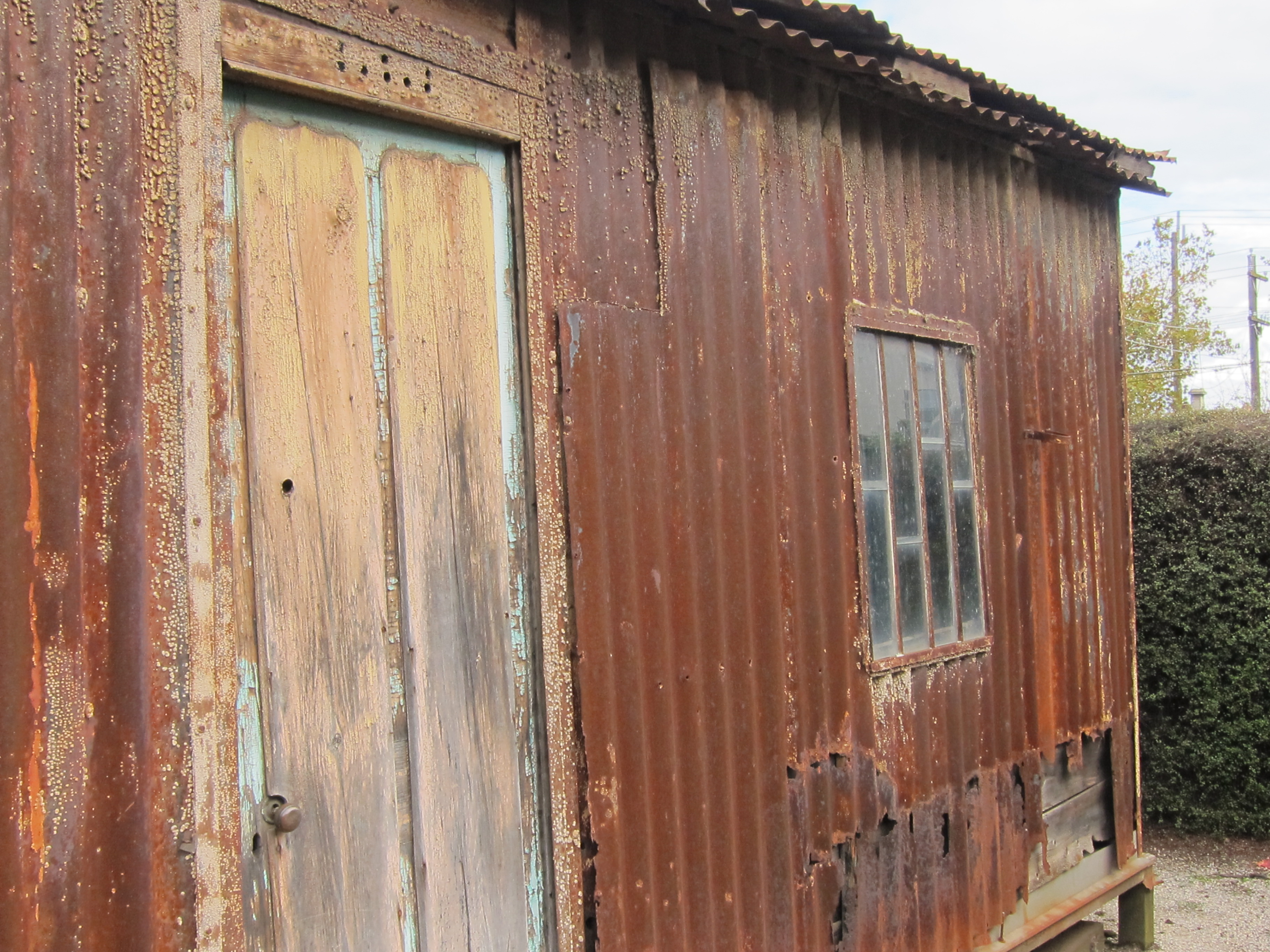
The house that I was most intrigued by was Abercrombie House, which faces Patterson Place at the back, where there were originally fourteen houses of a smaller size erected by the entrepreneur who erected the Coventry Street House.

Abercrombie House, Patterson Place South Melbourne

This particular house was moved from its original location at 59 Arden Street, North Melboune in about 1980.  You can see a picture of the house still in North Melbourne here  and it being shifted by semi-trailer after being cut in half here. They must have had their hearts in their mouths while they were moving it, because it is certainly in a very precarious condition.  It was last occupied in 1976, and standing there looking at the single light bulging hessian-covered ceiling and the layers of wall paper, it’s hard to credit that such primitive living conditions still existed in the middle of Melbourne forty-odd years ago.  But conversely, on a wet and cold winter’s day, it’s also important to recognize what a vast improvement this house would have been on the canvas tents that were the alternative.

Abercrombie House from Patterson Place

The Portable Iron Houses are presented by the National Trust, and they are open on the first Sunday of the month 1-4 p.m.

Vote 1 Joseph Hawdon!

As you may recall, I am interested in the history of Banyule Homestead, one of the few pre-gold rush mansions still standing in Melbourne.  My sister blog, BanyuleHomestead is exploring different aspects of Banyule Homestead’s history.  Joseph Hawdon, who built the homestead in the 1840s, was one of the candidates for the first election to the Legislative Council of New South Wales.  You can read about his election tilt here.

Duelling lads

The district of Port Phillip seems an overwhelmingly Victorian city. [There’s a little pun there, for those of you not familiar with Melbourne, because the Port Phillip District later came to be known as ‘Victoria’.]  Queen Victoria ascended to the throne in 1837, when Port Phillip was in its infancy, and the influx of immigrants which became a tsunami in the 1850s gold-rush, embedded the ideas and mindset of Victorian Britain along with the foundation-stones of many Gold Rush era buildings.  But there is one manifestation of an older, Georgian-era mindset in Port Phillip during the late 30s/early 1840s – duelling.

There had been a late 18th century revival in duelling in Britain, especially amongst army officers.  In 1777 at the Clonmel Assizes a group of Anglo-Irish gentlemen drew up the ‘Clonmel Code’ which comprised 26 rules for duelling. Although it was becoming less popular in Britain in the early decades of the 19th century, it continued in the colonies for longer, especially in Upper Canada, Sydney and Hobart which could perhaps be explained by the heavy presence of army officers in those locations.

It existed alongside, and was often inter-twined with the legal system.  Indeed, lawyers were frequent participants.  It was both a supplement to the legal system, and was supplemented by it, with disputes involving duelling often being played out through placards, newspaper letters and court cases as well.  Hence, while he was serving in Upper Canada in 1828 Judge Willis heard a court case that emerged from a duel that had occurred more than ten years previously, that had been reignited by a letter published in the newspaper.

There were several duels in Melbourne.  One famous one involved Peter Snodgrass (good name, eh?) and Redmond Barry who was later to become Chief Justice, and famously acted as the judge in the Ned Kelly trial.  Peter Snodgrass had been involved in an earlier duel as well.

As Edmund Finn tells it in The Chronicles of Early Melbourne (p. 776)

On the evening of the 1st January 1840, a select dinner-party assembled in one of the club-rooms to bid hearty welcome to the newly-arrived year, and here gathered as choice a dozen of exuberant spirits as could well be found from that day to this. They sat round a table of “full and plenty” where no stint was imposed upon the animal enjoyment of eating and drinking; and after dinner there was no disposition to bring the convivialism to anything like a premature termination, so there they stayed without giving a thought to an early breakup….When the wine, or rather the brandy, was in the wit flew out.  “A cup difference” arose between Mr Peter Snodgrass and Mr. William Ryrie, and heated words and offensive insinuations followed.  Snodgrass was the son of a Lieutenant-Colonel of distinction, and may be supposed to have inherited a martial ardour, which , which he was never reluctant to suppress when any occasion arose to excite it, and accordingly, a circumstance not surprising to those who knew his temperament, he forthwith challenged  Ryrie to mortal combat.  The verbal cartel was accepted as willingly as it was offered…

The shooting match was fixed for daybreak the following morning, on the western slope of Batman’s Hill, now the site of the Spencer Street [Southern Cross] Railway Station, and there was not much time for effecting the preliminary arrangements.

But an unexpected and formidable difficulty interposed…Strange and unaccountable omission! The Club was not provided with such gentlemanly indispensables as duelling pistols; and worse too, it was impossible to procure any in town without exciting a curiosity which might spread the matter abroad, and conduce to its interruption by police or other interference.

What to do?  Then someone remembered-

Mr Joseph Hawdon, of Heidelberg, was the possessor of a splendid case of hair-triggers, which could be got, if only their owner could be got at; but he was enjoying the pleasures of his peaceful home, and that was eight miles in the country.  This was a gloomy and disheartening look-out…Fortunately, there was present a man worthy of, and equal to the occasion.  H-lt-n, Ryrie’s second, had a good horse in the Club stable, and fresh from the “land of green heath and shaggy wood” was an expert plucky rider, as firm in the pigskin as on the solid ground, and jumping up, proclaimed his readiness to ride… to Heidelberg, storm the Hawdon domicile, and either return with the pistols, or never show his honest face amongst them.  The offer was rapturously applauded…

And so off he rode-

Arriving at his destination, the dreaming Hawdon was broken in upon, the pistols obtained, and the eight miles back were thundered over again in a double-quick time never out-paced since.  It was about 1 o’clock when the courier galloped up Collins Street, flourishing a pistol in each hand…

Lack of ammunition was the next problem, again solved by the enterprising second Mr H-lt-n, who sweet-talked the Military Commandant into handing over the needful.  On the way back to the club, he called in on Mr D. J. Thomas the surgeon, who agreed to accompany them.

Every obstruction now removed, the party moved off to the convincing ground, a grassy common on the verge of the swamp northwardly adjoining Batman Hill.  By this time it was clear daylight, as fine and fresh a summer morning as could be decided.  The distance was measured, the pistols primed, and the men placed; but just as the fatal signal was about to be given, Snodgrass, who was always a victim to over-impatience, or ultra excitement on such occasions, so mismanaged his hair-trigger that it went off too soon; so, instead of slaying his antogonist, he wounded himself in the toe, and came to grief.  Ryrie, as a matter of course, could not think of behaving so unhandsomely as to shoot a man down, and forthwith flared up in the air.  Thomas was immediately at work with the wounded patient, who, though literally prostrated, was found to have sustained no serious injury…

And what became of the Hawdon Duelling Pistols? As Garryowen tell us, Hawdon had a contract with the New South Wales government to convey the mail overland to and from Yass.  The pistols were placed in the hands of the first mailman, John Bourke, one of Hawdon’s employees, to be used as a means of defence against “possible bushrangers and probable Aboriginal assailants”.  Garryowen did not know if the pistols were ever deployed, but as Bourke was a good marksman, he was sure that he wouldn’t ‘toe’ himself as the first duellist did.

Sources:

Edmund Finn (Garryowen) The Chronicles of Early Melbourne

Penny Russell Savage or Civilized? Manners in Colonial Australia

Cecilia Morgan ‘In Search of the Phanton Misnamed Honour’: Duelling in Upper Canada Canadian Historical Review , Vol 76, No. 4 Dec 1995 pp 529-562

Crossposted (partially) at BanyuleHomestead because the aforesaid Joseph Hawdon later lived at Banyule Homestead in Heidelberg

‘I Succeeded Once: The Aboriginal Protectorate on the Mornington Peninsula 1839-40’ by Marie Hansen Fels

There is a somewhat elegaic, wistful tone to this book, hinted at by its title. It is a quote from the journal of Assistant Protector William Thomas as he was about to re-locate his Protectorate for the second time in three years under official instructions.  He had been forced to shift from the Mornington Peninsula in 1840 to Nerre Nerre Warren, then forced again to shift to Merri Creek in 1843.  There were many reasons that he had failed, he said, but there was one time when he could have been said to have succeeded- and that was at Arthurs Seat between 1839 and 1840.

In the Afterword to the book, the author admits that there is “no conclusion, no grand summing-up” in her work.  She evokes the late Greg Dening, who taught that “the historical effort was to understand and to explain: not to judge, not to label, not to take sides.” (p. 397).  In many ways, it would have been helpful to have her afterword as a preface, because I found myself somewhat puzzled about what this book actually is. It is part of ANU’s Aboriginal History Monograph series, which presents “studies on particular themes or regions, or a series of articles on single subjects of contemporary interest.”  In this case, it focuses minutely on a relatively small area of land, over mainly a one-year period, although it does spill out of this chronological limit at times.

The book won the ‘Best Community Research, Register, Records’ category of the Victorian Community History Awards in 2011. The typographic layout of the book is more suited to a records-based document than a narrative history: it has the appearance of a work-book or training manual, and the headings and boxed biographies of individual aboriginal people feel as if they are the product of a word-processor rather than a commercial print layout.   It is thoroughly commendable that the book is available free as a download through ANU e-press here.  I suspect that I might have felt short-changed had I paid $29.95 for a print-on-demand copy (although, admittedly that is not a high price).   The rather thin covers of my book are already curling.

But the value of this book lies in its contents, not the layout.   As a Melburnian, and one who holidays on the Mornington peninsula side of the bay (rather than the “other”, western side), it was as if my January canvas of caravans and holiday houses had been stripped back to another, earlier frontier time.  Names were familiar, but distorted (like Moody Yallock for what I assume is now Mordialloc, and Kullurk for Coolart).  Although I was of course aware of McCrae Homestead, it had never occurred to me that there were other pastoralists down on the peninsula as well. I hadn’t thought of my caravan site down at Capel Sound as part of a squatter’s run, but I think that I sensed, just a little, an older history of the peninsula when I was down at Balcombe Creek a month or two back.
Her book is, as she admits, a contrarian view to the prevailing orthodoxies of confrontation, massacres and victimhood.  Instead, hers is a story of an “amiable, intimate, non-violent coexistence”, but this is not explained by the facile “our lot were a peaceful lot” with “mild and inoffensive” men. Instead, she argues:

That there was no conflict at all on the Mornington Peninsula is to be explained in the same terms as conflict is explained in other regions of Victoria, that is, in terms of individual leaders, of social and political agendas of groups, of the tone of relationships between both Indigenous and European. (p.177)

And this is what her book is- an exploration of the tone of relationships between Assistant Protector William Thomas and the squatter farmers of the Mornington Peninsula, and the men and women of the Bunurong people who ranged over it as their traditional lands.  Just as she did in her earlier book Good Men and True: The Aboriginal Police of the Port Phillip District, Fels delineates, names and gives a life trajectory and agency to aboriginal people who otherwise remain as the shadowy ‘other’. In text boxes headed with the variations of their names- both aboriginal and conferred-  (e.g. Nunupton/Nunuptune/Nalnuptune/Naluptune/Nunnapaton/Nunupthen/Namapton/Billy Langhorne/Mr Langhorne p. 266), you sense the white informants grappling with unfamiliar sounds, trying to render them into writing and to somehow capture individuals within a bureaucratic report and a census system.  She traces the appearance of individuals at different locations throughout the district as recorded in musters, reports and official letters, their family connections, and their all-too-often premature deaths.

She brings Assistant Protector William Thomas to life for us as well.  The Protectorate scheme was devised in Britain in response to humanitarian concern over the decimation (a term that under-estimates) of indigenous people across the empire.  The Protectors were greeted by many settlers with disdain and derision, and by humanitarians with frustration and annoyance at their various shortcomings.  Rather than being mobile, single men able to follow tribes ranging across country, they were family men operating on a model of establishing a mission in a central location.  I’ve mentioned Robinson before here and here, and Sievewright here.   Assistant Protect William Thomas was a family man as well, and shared with his fellow protectors the curse of execrable handwriting, although the depth and range of his private and public writings has been invaluable for historians (especially now that someone else has grappled with the handwriting!)

And so we see Thomas trying (not always successfully) to enforce Sunday observance; we see his powerlessness to stop a raiding party; the pettiness of Protector Robinson and the futility of railing against bureaucracy, and his sense of bewilderment and sinking disappointment as he returns to the Peninsula after the enforced and much-resented shift to Narre Narre Warren, only to find the peninsula deserted.

Although the focus of the book is on 1839-40, this one year did not happen in isolation.  Actions which took place in this focal year had antecedents, and when the Bunurong men took off on a raiding party towards Gippsland, it was yet another episode in a long-running distrust between the two nations that long predated white settlement.  She works hard to uncover the context and rationale for this feud, exploring a number of hypotheses that take her beyond tribal and cultural factors into a consideration of geological and archaeological evidence of sedimentation, inundation and earthquakes in millenia past.

Moreover, there had been contact between the Bunurong people and white sealers and timber gatherers along the coast and the Bass Strait islands in the decades before Fawkner/Batman claimed possession of the district.  Fels devotes a considerable amount of time tracing the kidnapping of particular individuals, both men and women, who ended up in the Bass Strait Islands, South Australia and even Western Australia,  far from Bunurong country.  This is important: as we speak, there are competing custodial claims from the Boonwurrung Foundation and the Bunurong Land Council based on the status and identity of Louisa Briggs, one of several women abducted.  The contentiousness of such issues is highlighted by the heavily censored and blacked-out reports generated by archaeologists and ethnographers as part of this twenty-first century dispute.

There is a sense, too, of the clock ticking over several of the sites that she describes here.   A footnote questions the expertise of the author of the archaeological report for the Martha Cove development, and a planning permit has been granted on a mission site, extended to 2013, for a Holiday Resort incorporating a winery, function centre, restaurant, hotel, camping park and golf driving range. Another mission site has been identified on private property, but she does not disclose the location.

This is not a ‘straight’ narrative history.  She rebuts a number of local history myths, and she challenges other written histories, for example Bruce Pascoe’s The Convincing Ground.   There is not a smooth narrative flow and it is certainly no coffee table book (and I’m sure was never intended to be).  It is history with its sleeves rolled up.

Position, position, position

[You may be aware that I am very concerned about issues involving Banyule Homestead in Heidelberg.  I have started another blog dealing with Banyule Homestead and Heidelberg more generally, and please visit it!  You can find it at http://banyulehomestead.wordpress.com  I have cross-posted this entry]

The area of land between the Yarra River and the Darebin Creek was prime agricultural and grazing land, and the Government knew it.  It was parcelled up for sale at the first Government Land auction that was held in Sydney in 1838.  The fact that the sale was held in Sydney is significant: it meant that you needed to be in Sydney to purchase.  As a result, the land was purchased largely by Sydney-based speculators, especially Thomas Walker, who remained in Sydney.  The 920 acre Portion 6 that Banyule Homestead was later to be built on was purchased by Richard Henry Browne for 1334 pounds.

However, Portion 5, to the west of the Banyule Estate (the Brown St. hill and up to Upper Heidelberg Rd for 21st century locals!) did not sell, and was offered up for sale, in Melbourne this time, on 26th February 1840.

And just to show that position, position, position was important then too- here’s the advertisement from the Port Phillip Herald 21 February 1840.  You’ll see that Banyule (spelled ‘Banyuille’) is mentioned, and that Joseph Hawdon (who had not yet built Banyule Homestead) is listed among “the most respectable gentry” who lived in the area. And for those of you stuck in traffic along Rosanna Road, remember that you are travelling on a “romantic and beauteous road”.

Vale A.G.L. Shaw

I see in today’s newspaper that A.G.L. Shaw has died, aged 96.  His full name was Alan George Lewers Shaw, but I only ever heard him referred to as ‘Agl’ (pronounced ‘aggle’).  He was Professor of History at Monash University between 1964 and 1981, and took a leadership role in the Friends of the La Trobe Library, the Royal Historical Society and the C.J. L Trobe Society.

I first encountered him as the author of one of the textbooks we used in HSC Australian History in 1972- I can’t remember if it was The Story of Australia or The Economic Development of Australia– and with the callowness of youth, I always assumed that anyone who was old enough to write a textbook would surely be dead and buried by then.

However, I encountered him again once I commenced my work on Judge Willis some 27 years later only to find that he was not only not dead and buried, but still working hard.  I often find myself reaching for Shaw’s A History of the Port Phillip District: Victoria Before Separation, a book published in 1996 and remarkably, the first general history of the Port Phillip District written since Henry Giles Turner’s History of the Colony of Victoria in 1904.  Although there were books on particular subjects, and although such books usually had an introductory chapter on the period before 1851, he could find no general survey history.  So he decided to write one.  His introduction gives a hint of the flavour of the history that was to follow:

It is old-fashioned narrative history, and though I fully realise its statements can not be proved philosophically ‘true’ and that my judgements are my own, and therefore influenced by subjective bias and prejudice, in writing it I have been searching for the truth and trying to produce a narrative of unique events.  These are clearly not subject to general laws, which is not to say they are ‘uncaused’, but rather that they are the result of human agency, largely dependent on human motivation.

In one sense this seems a success story and therefore can be denigrated as ‘Whig’ history, but this depends on the meaning ascribed to success.  Everyone achieves something, whether it be good or bad, great or small, and I have tried to write about the bad as well as the good.  Such a mixture is, to my mind, inevitable given the mixture of qualities belonging to the members of any community- weak and strong, heroes and villains, intelligent and stupid, far-seeing and short-sighted, strong-minded and weak-willed, pushing and subservient, arrogant and humble.  From the interplay of these comes the community development, beneficial or harmful, and it is the story of that development in the Port Phillip District before the discovery of gold that I have tried to tell- though my prejudices will inevitably have influenced my telling of it.  (p. xv)

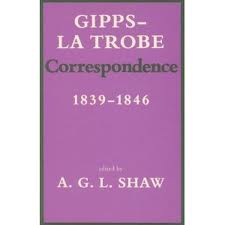
It is the interplay of personalities that is most clearly on show in my favourite of his works, and one that migrates frequently between my bookshelf and my desk: the Gipps-LaTrobe Correspondence,  written in 1989.

This is an edited collection of the ‘back-channel’ personal correspondence between Governor Gipps in Sydney, and Charles La Trobe, the first superintendent appointed to the nascent settlement of Port Phillip.  La Trobe was, perhaps, an unusual candidate for appointment.  Unlike many of the colonial appointees, he did not have a military or judicial background- indeed, he had spent quite a bit of time ‘rambling’ in Switzerland, then camping with Washington Irving in North America.  He had, however, worked on three reports on the emancipation of West Indian slaves in the mid-late 1830s, and it was this work that brought him to the attention of the evangelically-inclined Secretary of State, Lord Glenelg at a time when the Colonial Office was particularly attuned to the recommendations of the Select Committee on Aborigines (British Settlements). La Trobe brought with him his Moravian background, but he had had no experience at all in administration, and he was appointed as subordinate to Governor Gipps, an older and much more experienced officer of military background in Sydney.  La Trobe stayed briefly with Gipps en route to Melbourne, and the warmth of the relationship they established there is reflected in these personal letters.  It is a largely one-sided collection of correspondence, with relatively few letters remaining from La Trobe to Gipps, but as with such archives, it is possible to detect the tenor of the missing correspondence.  A.G.L. Shaw’s contribution to this collection is his extensive and minutely-detailed footnotes to the letters, providing not only context, but also small details of who, where, when. He is so sensitive to the reader’s needs that almost as soon as the question about something you have read forms in your mind,  the footnote number pops up to show you that Agl has thought about it before you.  And so, from a rather over-awed distance, thank you Agl Shaw.

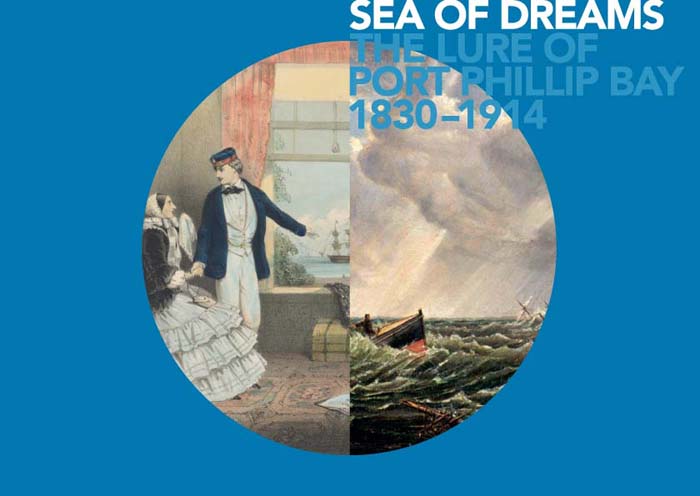
‘Sea of Dreams: The Lure of Port Phillip Bay 1830-1914’ at Mornington Peninsula Regional Gallery

Update 2013

I see that the Mornington Peninsular Gallery will be hosting a follow-up exhibition ‘Sea of Dreams: Port Phillip Bay 1915-2013’.  It will be on between 14 December and 2nd March 2014.  I must try very hard to attend before the closing week this time!

Review of 2012 exhibition

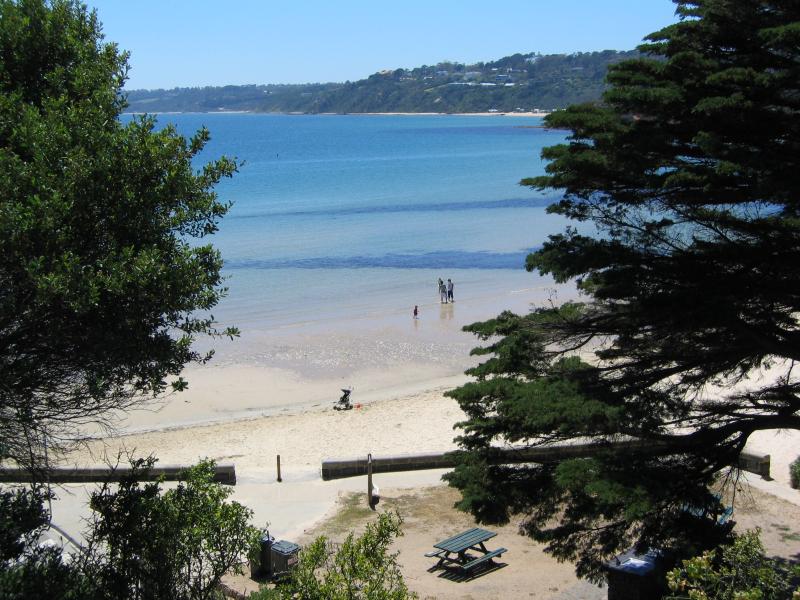
If, like my husband, your appreciation of the beach is best bolstered by being in an air-conditioned building, far from the sand and the water, then you too might like this exhibition at the Mornington Peninsula Regional Gallery.  It’s on until 19 February 2012 so you still have time to get there (just!), have lunch at Mornington, and if you feel so inspired, even walk down to Mother’s Beach, as we did on a beautiful warm summer afternoon.

Source: http://www.travelvictoria.com.au/mornington/photos/

The exhibition has been divided into five themes which highlight different aspects of Port Phillip Bay.  I can hear my uncle Peter reproving me for the tautology, but Melburnians generally call it Port Phillip Bay and I’m not absolutely convinced that a port and a bay are the same thing. (Did you know that it was originally named Port King (after King George)  by Lieutenant Grant? It was renamed Port Phillip by Governor Phillip Gidley King to commemorate NSW’s first Governor, Arthur Phillip “my worthy and dear friend, the Admiral, who, until now has not had his name bestowed on either stick or stone in the colony” [King to Murray, 31 Oct. 1801 HRNSW, iv, p. 602]  Although I wonder if King was being a bit bashful, thinking that people would think it was named after him?).

I digress.  The exhibition is divided up into five themes, which are arranged in different sections of the gallery.  The gallery, which is not large, has a long ribbon of the names of different spots along bay displayed just about the skirting board, spooling  from room to room.  I think that Melbourne people tend to be rather parochial over ‘their’ beach, identifying more with the Mornington Peninsula side or (for me) the other side over at Queenscliff. Seeing the scroll of names brought home to me just how many there are.

The first theme, “Land of Promise” examines emigration- both the experience for the emigrants themselves and for the families they left behind.  As well as emigration literature painting for a British market, it had paintings of the landing at Queenscliff, and a painting that one would hope the “home” audience didn’t see: the wreck of the ‘Asa Packer’ c. 1861 at Point Nepean as it was passing through the heads.  Although not directly related to Port Phillip, there was also a depiction of the wreck of the Loch Ard– after all, who can resist that story?- although I think that it undermined the focus of the exhibition somewhat to include it.

The second theme “Unsettling the Land” examined early depictions of the Port Phillip settlement.  A printed notice on one of the pillars was the Gallery’s response to criticisms that there was no Aboriginal representation of what we know as Port Phillip.  It explained that approaches had been made to the local Aboriginal community to become involved with the exhibition, but no response was received.  It reveals an interesting twist on the politics of depiction of indigenous presence, and the expectation that it will be represented- and what is to be done if the local community chooses not to become involved.   It pointed to the Tommy McRae painting of a corroboree (1890) included in the exhibition, but admits that otherwise the depictions of Aboriginal people in the paintings were executed by white painters.  I found it interesting that George Gordon McCrae, the son of Scottish painter Georgiana McCrae, painted a corroboree at Arthur’s Seat on the Mornington Peninsula in 1844-9 that looked very similar to the indigenous Tommy McRae painting (no relation or contact, despite the similarity of their names).  I had seen quite a few of the early Port Phillip paintings in this section of the exhibition before, but there was one Robert Russell sketch in particular that reinforced how scrappy and primitive that first white settlement on the Yarra was.

“Defending our Shores”, the third theme, highlighted the strategic importance of the Heads and their fortification, but also the ceremonial aspects of military and government display with visiting royalty, and navy and military manoeuvres intended to reinforce sovereignty.

The fourth theme picked up on trade and commerce, especially in the wake of the gold rush.  “Riding the wave” depicts the presence of American ships after the repeal of the Navigation Acts from the mid 1850s, and highlights the activity and wealth generated  around the bay.  Several of these paintings were themselves commissioned as a way of advertising the prosperity of ship-owners and entrepreneurs.

The final theme, “Whiff of the Briny” was perhaps my favourite, with paintings that showed the pursuit of leisure around the bay.  Artwork from different eras is placed side by side, so that you can move from a very detailed, almost draftsmanlike rendering of clothes and ships from the mid 19th century to the adjacent painting that might be a bolder, brighter and more impressionistic piece by one of  the Australian Impressionists. Conder, in particular, painted several works down at Mentone and Rickett’s Point, but other Australian Impressionists are represented too.

So, as is often the case, here I am telling you about an exhibition that is in its closing stages- so if you want to catch it, you’d better go soon!


Frocking up for the theatre

For a little treat the other night (well…a rather expensive treat actually) it was off to see the MTC production of The Importance of Being Earnest.  To get ourselves in the mood we watched Wilde starring Stephen Fry the night before, and sitting in the Sumner Theatre on Tuesday night, I was very much aware that we were laughing away at the same lines, probably delivered in much the same way to the audience at its opening night on St Valentine’s Day 1895.  It was a very traditional performance- no postmodern trickery or contemporary insertions here- and I felt rather overawed to be three rows away from one of the world’s greatest actors, Geoffrey Rush, right here in our shared home town.

What a striking, imperious and handsome Lady Bracknell he makes! (even though I don’t particularly think of Geoffrey Rush as handsome.)  He clearly relished rolling around in  the language, and being so close, we could see every raised eyebrow and every moue.  The rest of the cast was very good too, although if I had to name any criticism it would be at the slightly over-rehearsed delivery of Algernon’s lines. I recall Fry’s character in Wilde issuing the injunction that the lines should be delivered as sparkling, off-the-cuff repartee, rather than something that had been memorized and enunciated, and I think that the same observation could be made here too.

Two odd things about our night at the theatre though.  One was the sight of a very pushy woman, approaching everybody in the front row, asking them if instead of enduring their front row seat, they would be willing to swap with her seat at the back (“See, where the man is waving?”). When someone asked her if there was a particular reason, she said that she liked to be able to see their faces close up- well, don’t we all?  What amazed me was that someone actually did swap with her.

The second odd thing was an email we received a couple of days prior to the performance.  We have just endured a couple of hot days, and the email cautioned that the stage was heavily airconditioned for the comfort of the actors on stage in heavy costumes, and that as we were sitting in the front rows, we might want to bring a jacket or shawl.  It was good advice- it did get chilly after a while.

Patrons might have appreciated advice about their big night out at at Melbourne’s first theatre during the 1840s too.  The Pavilion, later renamed the Theatre Royal, was located on the east side of Bourke Street, between Elizabeth and Collins Street.  Garryowen describes it as:

one of the queerest fabrics imaginable.  Whenever the wind was high it would rock like an old collier at sea, and it was difficult  to account for it not heeling over in a gale.  The public entrance from Bourke Street was up half-a-dozen creaking steps; and the further ascent to the “dress circle” and a circular row of small pens known as upper boxes or gallery, was by a ladder-like staircase of a very unstable description. Internally it was lighted by tin sconces, nailed at intervals to the boarding filled with guttering candles, flickering with a dim and sickly glare. A swing lamp and wax tapers were afterwards substituted, and the immunity of the place from fire is a marvel.  It was never thoroughly water-proof, and, after it was opened for public purposes, in wet weather the audience would be treated to a shower bath. Umbrellas were not then the common personal accompaniment they are now in Melbourne, but such playgoers as could sport a convenience of the kind took it to the theatre, where it was often found to be as necessary within as without. The expanded gingham would of course, very seriously incommode the comfort and view of the adjacent sittings, but that was a consideration so trifling as to be scarcely thought about.  (Garryowen ‘Chronicles of Early Melbourne’ p. 452)

I know that we often complain about people with their mobile phones in the theatre, but there are worse things:

… the Pavilion would at times be turned into a smoking saloon, and even when some of the more mannerly persons in the pit would take off their hats and place them on the floor, the bell-topper, cabbage-tree, or pull-over, whichever it was, would be utilized as a spittoon for shots expectorated with sure aim from the dress circle.  If any of the unhatted individuals happened to present a bald pate, the spot was regarded as a justifiable target for hitting at short range, and terrible would be the indignation with which an unoffending spectator, somewhat sparse in hair, would find himself patted on the bald crown-piece with something analogous to a molluscous substance “shelled” at him from one of the side boxes.  In hot weather or cold the moist application was an unpleasant sensation, and naturally resented. The person so “potted” would pull out his handkerchief, wipe his head, jump up, and “rush the batter” whence he would be probably repelled with a black eye or enlarged nose. (Garryowen, p. 456)

So, are we ready and all frocked up for our night at the theatre? Let’s see …  umbrella, hat, handkerchief….I’ll settle for the shawl or jacket thank you.

‘The River’ at Bundoora Homestead

A wet, humid day and nothing to do on a Saturday afternoon so up we went to Bundoora Homestead to see their current exhibition ‘The River’. I’ve written about Bundoora Homestead previously.  It’s a beautiful Federation-era house, well worth seeing in its own right.

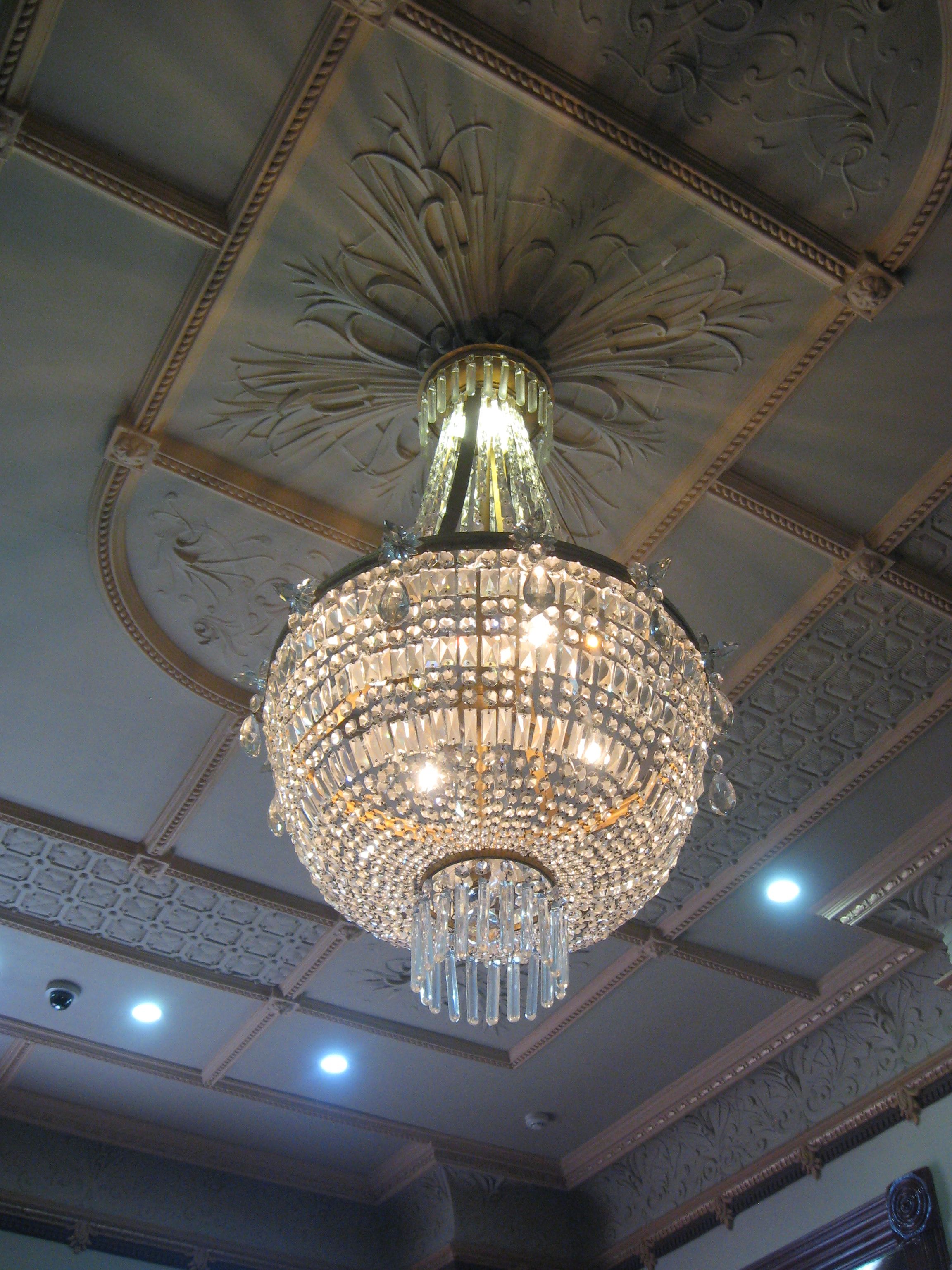
Chandelier in dining room, Bundoora Homestead

Another homestead that was once a gallery, Banyule Homestead, is very much in my thoughts at the moment.  More than ever I realize that if you value a gallery or a library or a museum,  then you need to visit it- you need to walk right through that door and go in.  In the case of Bundoora Homestead, it’s free and it literally costs you nothing: the gain is all yours.

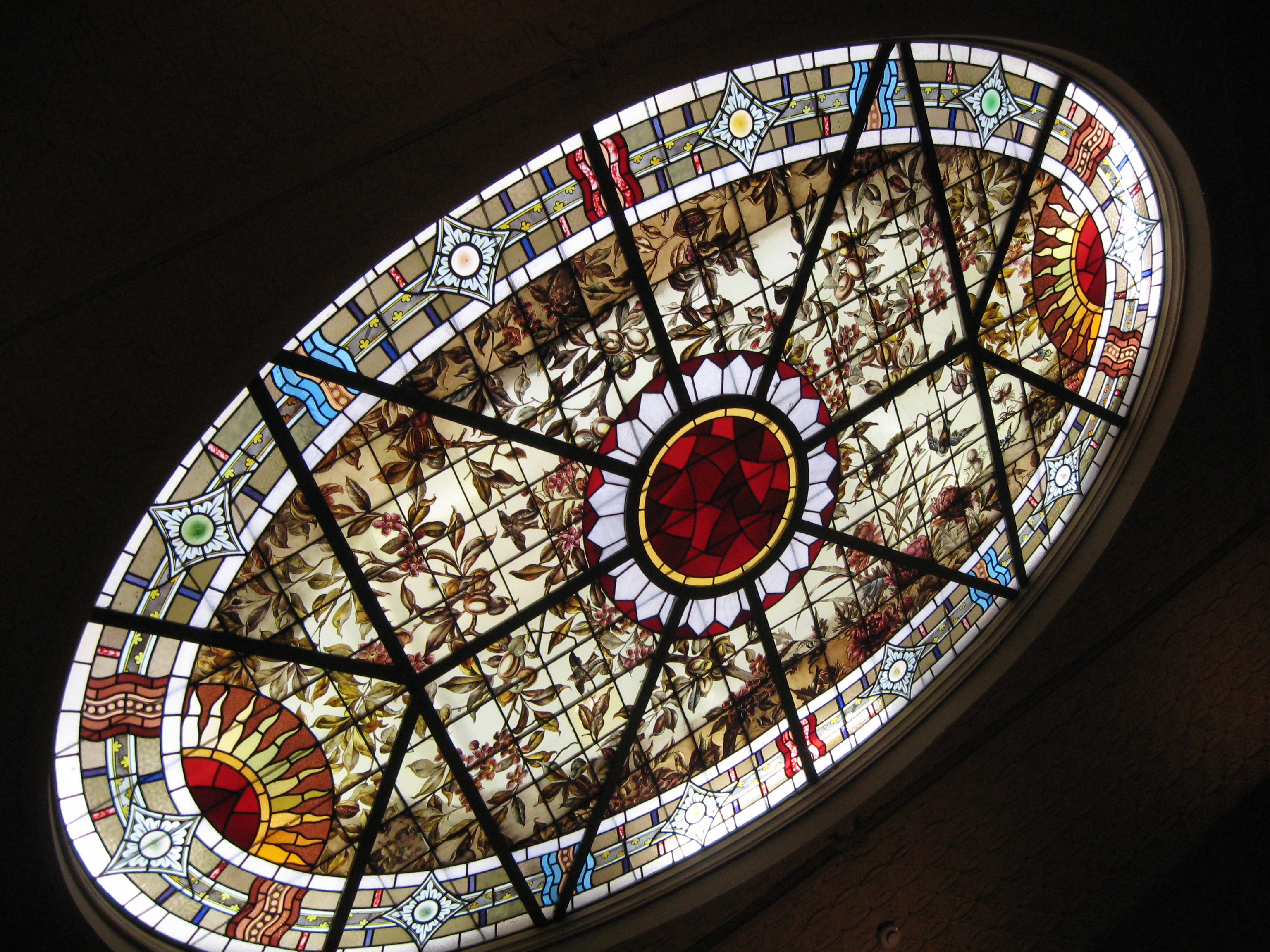
Stained glass skylight, Bundoora Homestead

The current exhibition is called ‘The River’ and it centres on Melbourne rivers (well, creeks) the Merri  and the Darebin Creeks. In recent years of drought these creeks have dwindled to small puddles connected by a fitful ribbon of water.   One of the joys of the recent rains this year has been to look down from a train into the city, as you cross over the creek, and to see the water gushing and tumbling along waterways that had seemed so dismal just a few years ago.

The exhibition contains well-known works, most particularly Burtt’s depiction of the purported signing of the Batman treaty and several Heidelberg school paintings of river scenes around Melbourne, as well as 19th century photographs and engravings.  These are juxtaposed against more recent works on the Merri and Darebin Creeks, including reflections on the ‘treaty’ painting and more surreal and threatening depictions of these urban places.  There will be a lecture panel this coming Thursday 24th November at 2.00 discussing Burtt’s painting.

This is a terrific exhibition. I’ve seen reproductions of the Batman painting before, but not the original, and I was delighted to see Sarah Susannah Bunbury’s painting of her house on the Darebin Creek in 1841.  I liked the sense of fun in many of the modern depictions, and it was lovely to see it in a beautiful suburban gallery, close by to the two rivers featured in the exhibition itself.