Category Archives: Port Phillip history

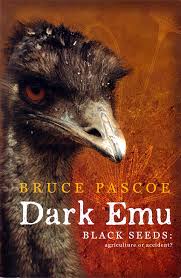
‘Dark Emu’ at Eltham Bookshop

Will I? Won’t I?  I’d better make up my mind- it’s on Monday 4th August.

https://www.facebook.com/events/558465517604082/?ref=22

darkemu“Time To Look Again”
ELTHAMbookshop, Nillumbik Reconciliation Group and Magabala Books invite you warmly to celebrate Bruce Pascoe’s new book Dark Emu

The latest foray into Australian Indigenous history by national award-winning Aboriginal writer Bruce Pascoe is set to re-ignite the long running debate about the true nature of Aboriginal civilisation at the time of European colonisation. Dark Emu – Black Seeds: agriculture or accident? is a significant new contribution to the academic and social discourse about the true history of pre-European Australia and its Indigenous inhabitants.

Bruce is an acclaimed writer, having won the Prime Ministers Literary Award for YA Fiction, 2013, for Fox a Dox.is a Bunurong man. He is a member of the Wathaurong Aboriginal Co-operative of southern Victoria and has been the director of the Australian Studies Project for the Commonwealth Schools Commission. Bruce has had a varied career as a teacher, farmer, fisherman, barman, fencing contractor, lecturer, Aboriginal language researcher, archaeological site worker and editor.His books include the short story collections Night Animals (1986) and Nightjar (2000); the novels Fox (1988), Ruby Eyed Coucal (1996), Ribcage (1999), Shark (1999), Earth (2001), and Ocean (2002); historical works Cape Otway: Coast of secrets (1997) and Convincing Ground (2007); children’s book Foxies in a Firehouse (2006); and the young adult fiction Fox a Dox (2012).

Local historian Mick Woiwod, author of engaging, very well researched books including Last Cry, The Christmas Hills Story, Diary of Andrew Ross and Once Around the Sugarloaf will introduce the evening.

Date: August 4th

Time: 6.30pm until 8.00pm

Venue: ELTHAMbookshop, 970 Main Road, Eltham

Cost: $40.00 includes a signed copy of the book or a $35.00 gift voucher and bush food flavoured refreshments

Prepaid bookings are essential:9439 8700

elthambookshop@bigpond.com

Happy 178th birthday Melbourne!

30th August is Melbourne Day- a little celebration that sputters along despite the huffing and puffing of our redoubtable Lord Mayor trying to breathe some life into what seems destined to be a rather low-key ceremonial occasion.  In a way, it’s nice that it hasn’t been commercialized and corporatized.  I’ve written about it previously  here .

Port Phillip aficionado as I am, I’m duty bound to celebrate the day, and so there I was, off to the Royal Historical society to hear Robyn Annear speaking about the writing of her much-loved book Bearbrass, which was first published in 1995 and reprinted in 2005.  It is still in print and sells consistently, not only to Melbournites, but also to others interstate and overseas.

Bearbrass is  a light, happy book divided into thematic chapters that start with a map of the city grid with the locations that are discussed in the chapter marked out onto it.  It’s full of anecdotes and curiosities, with nary a footnote in sight.

Robyn Annear describes herself as a non-academic historian, and she says that at the time of writing the book she was unaware of the scholarly conventions that she had leapfrogged over in writing her funny, affectionate book.   Quite frankly,  she was oblivious to any disapproval that she might have received from academe, because it was not her world.

She was strongly influenced by the humour in Garryowen’s writing and was swept up in the naughtiness and sheer youth and exuberance of the young population in Port Phillip at the time.  Probably her favourite episodes involved the adventures of the members of the Melbourne Club, especially in view of the utter respectability and conservatism of its members today.

She spoke about the availability of Trove and the way that it would make the writing of Bearbrass a daunting prospect today.  It would be harder to draw boundaries around it, she said and perhaps there is such a thing as too much information.  Is there still room for wondering if information is so readily at hand?

It was a lovely, engaging talk – much like the book itself.  A podcast of the talk is available here  (along with other interesting podcasts from RHSV)

Happy birthday Melbourne!

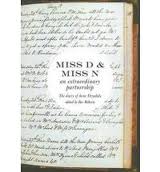
‘Miss D and Miss N’ by Bev Roberts

If I were a well-travelled person, at this point I would wave airily and announce that I always try to read a book set in a place that I am visiting.  Alas, I am not;  I can claim that I read Henry James’ The Bostonians while in Boston, and Dickens while in London…but that’s about it, I’m afraid.

So, a couple of weeks ago when we went down to Geelong (a whole 100 kms away!), I decided that of course I must read a Geelong book!!  But where to find a Geelong book? you ask.  The answer is: Miss D. and Miss N.  In fact, there’s a chance that if you’re on the Bellarine Peninsula that you’ll drive right through the areas named for them: Drysdale and Newcomb.

missdmissn

2009, 326 p.

The two women share an entry in the Australian Dictionary of Biography.   Drysdale was twenty years older than her friend Caroline Newcomb.  Anne arrived in Port Phillip in 1840, aged forty-seven, with the experience of farming in Scotland under her belt, capital at hand, and determined to take up sheep farming in the booming pastoral industry of early Port Phillip.    Caroline Newcomb had arrived in Hobart in August 1833 and found a position as a governess with the family of John Batman, one of the members of the Van Diemen’s Land- based  Port Phillip Association that looked across Bass Strait to establish pastoral runs in what they perceived (incorrectly) as land for the taking.   When she arrived in Port Phillip on April 19 1836, she was one of only thirty-five women in the settlement, out of a white population of 177.  In March 1837 she shifted to Geelong, presumably as governess to  Dr. Alexander Thomson.  The two women met at Dr Thomson’s house where they formed a strong friendship, despite the twenty year age difference between them.   This friendship became a partnership that lasted twelve years when Anne asked Caroline to join her as a pastoralist on Boronggoop, a squatting run on the Barwon River at Geelong.  In August 1849 they achieved their wish “to have a piece of land &c a stone cottage” when they moved to Coriyule, a beautiful stone house that they had built (and which, it seems, still exists).

This, then,  is Anne’s diary, commenced from on board ship in Scotland in September  1839 going through to 1852 and 1853 when she fell ill and the writing of the diary was taken over by Caroline. Continue reading

Ballarat Bound #2: The Museum of Democracy at Eureka

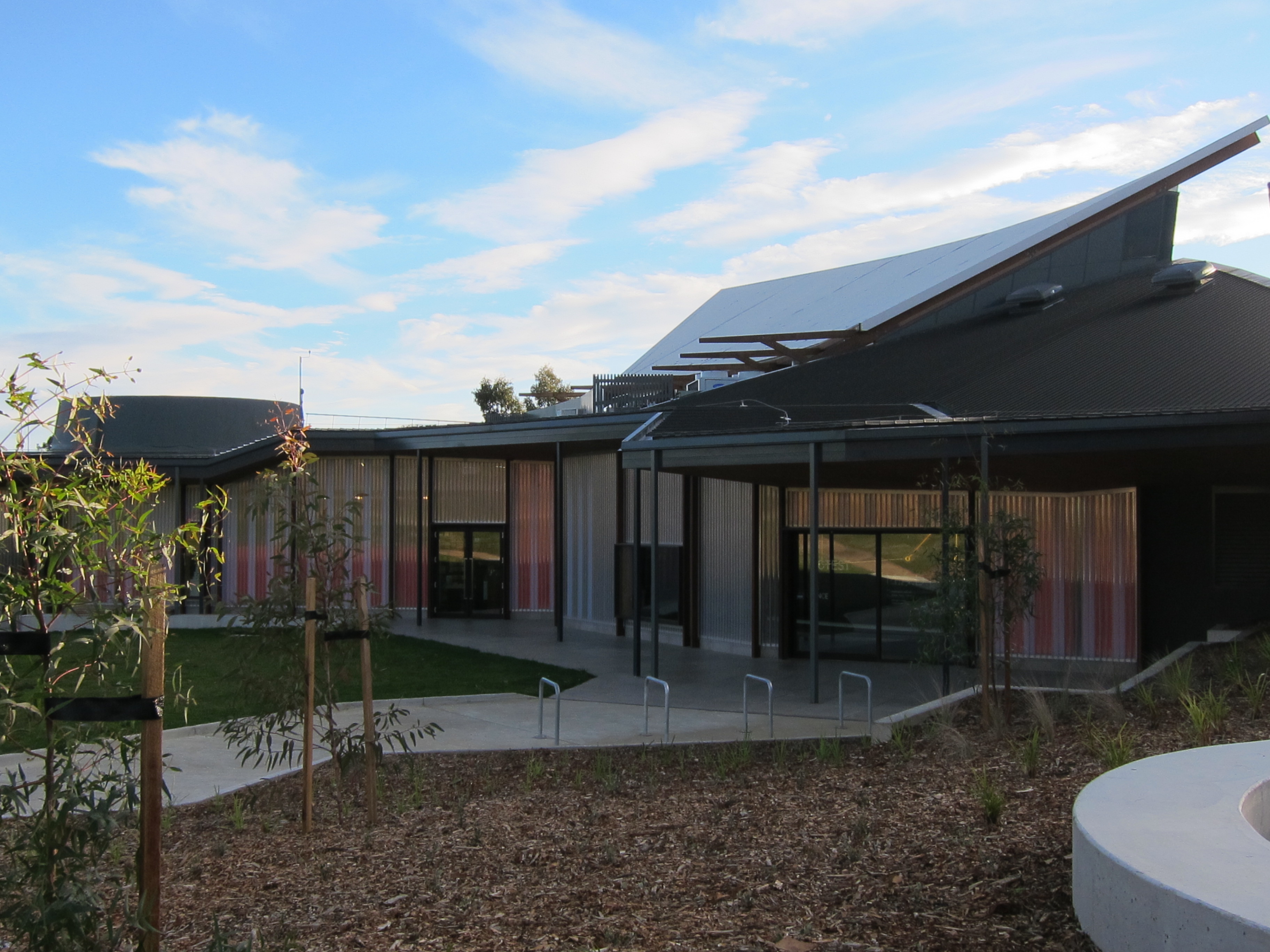
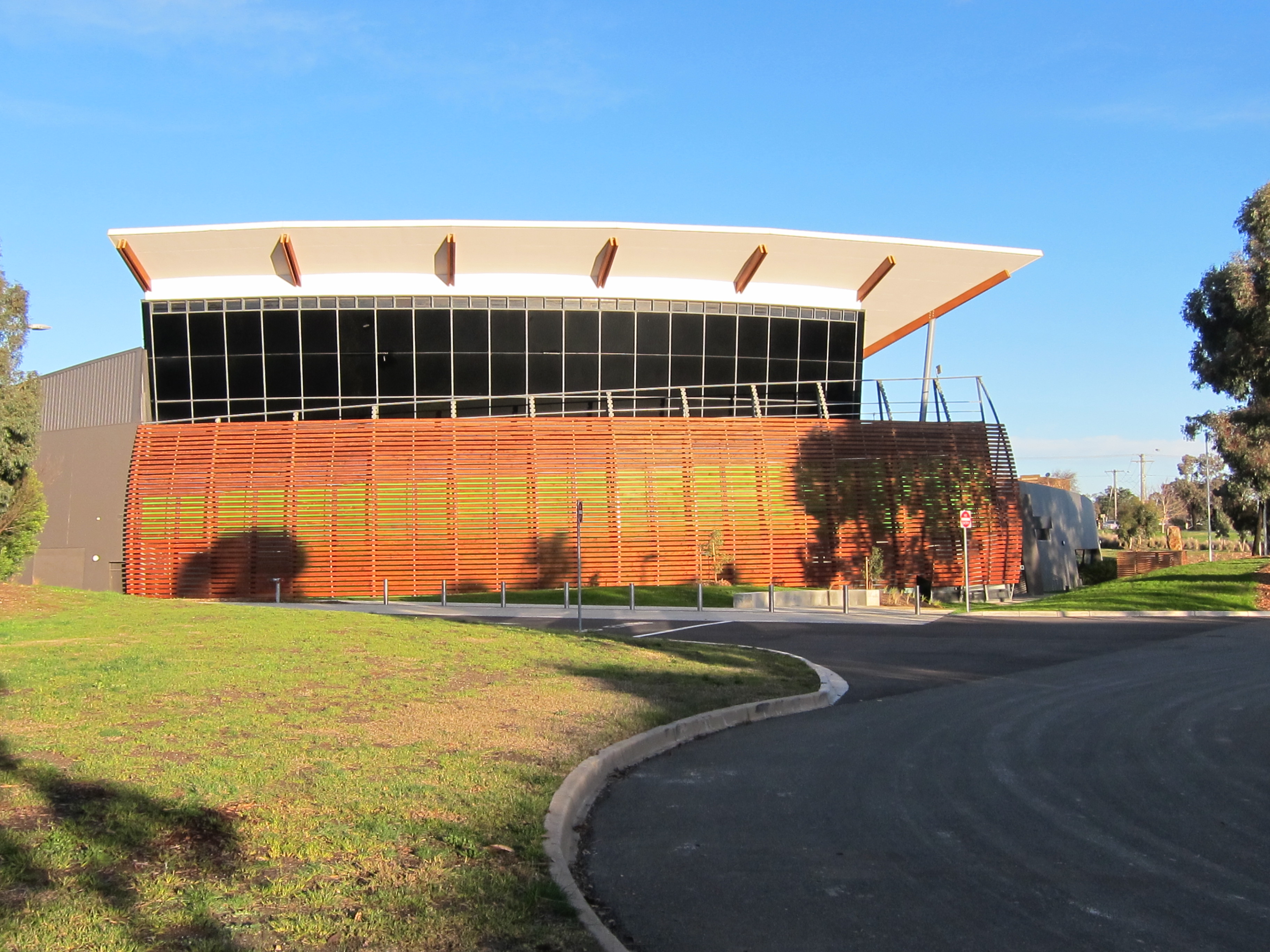
Victoria’s newest museum, M.A.D.E , The Museum of Democracy at Eureka opened in May this year.  The building looks a bit like a grown-up version of Julia’s schoolrooms throughout the country, with the timbering on the back expanse referencing the stockade that was erected roughly on the site in 1854.

IMG_0246

IMG_0247

As all of the kerfuffle over the National Museum in Canberra during the Howard years demonstrated, museums are rarely neutral institutions and this is particularly true of this museum.  You can see a number of worthy priorities at stake here: a desire to ‘teach the young ones their civics’; a desire to take advantage of one of the colourful episodes in Victorian history as something that kids might get excited about; a bit of local pride and tourism opportunities for Ballarat as a region.

The Eureka Rebellion of 1854 was a revolt of gold-miners against the expense of the mining licence they were required to hold in order to pan for gold and its administration by the Gold Commissioner and his troopers.  Civil disobedience had been rumbling along for a while, and culminated in the creation of the Ballarat Reform League and a shoot-out at a hastily erected ‘stockade’ (probably a generous term) on 3rd December 1854.

One of the claims for the Eureka Rebellion- and one that is pursued through the displays in this museum- is that the Eureka Rebellion marked the birth of Australian democracy.  This is a rather tenuous and parochial claim, and one that you’d rarely find enunciated in other museums celebrating democracy in other states.  It’s a view that largely overlooks the contribution of Chartism in UK and other international political undercurrents,  and struggles to explain why South Australia had manhood suffrage before Victoria did.  Direct links between the Eureka rebels and the Federal Parliament and its policies some 50 years later are also fairly slight.  However, not to put too much weight on this particular thrust of the display, the museum does also explore the concepts of democracy, power and participation more widely.

The exhibition space is laid out with the Eureka Story in the centre, with alcoves around the room other sections discussing differing aspects of power through words, influence, numbers and symbols.  The Eureka Story display had a good chronological narrative and was, rather surprisingly, very heavily primary document-based.  The displays were operated using all the display syntax of the i-phone: swiping, pinching to reduce and magnify etc- something that people would not have known how to do three years ago (and possibly will be surpassed in future years).  That said, it’s not a particularly option-laden display: your choice involves choosing which particular topic to explore on a given screen and then just clicking ‘next’ on the transcription of the primary document attached to it.  It was frustrating and troubling that already, after less than a month, some of the touch displays required several pressings.    Only two or three people can gather around each display tablet at a time, and only one person can ‘drive’ it. I don’t know if I would have felt comfortable poring over the primary documents in the way I did, had there been a queue of people behind me.  There’s always the tendency to keep pressing buttons (or in this case, icons) quickly just as a way of seeing what comes next, and I think that under the pressure of crowds waiting for you to move on and let them control it instead of you, you’d feel a strong pressure not to linger.

The displays on the outer walls were rather less touch-screen based.  There was an interesting video with a woman talking about feeling powerless in a Muslim country, followed by a video of a refugee;  there was an  activity where your face was scanned for digital recognition and you were either granted or denied the right to vote based on age or gender (not colour, interestingly enough given the salience of colour as a criterion for the right to vote, historically).  It was rather funny: I was trying to look as happy and beautiful as possible (!) and was assessed as a 45-55 year old MAN in a ‘neutral’ mood.  There was a display about songs, which had a rather primitive stop/start mechanism based on standing on footsteps on the floor.  The one song was played,  no matter which set of footsteps you stood on- perhaps there would have been too many competing sounds in a small area otherwise.  I don’t think that it was well enough explained why those songs, in particular, were chosen.  There was a good video-based display about the power of persuasion, with an interactive quiz at the end, and an excellent auditory presentation of famous political speeches highlighting the rhetorical devices used by the speaker.

Then, of course, there’s the Eureka Flag itself, on permanent loan from the Art Gallery of Ballarat, where it has been on display for a number of years.  It’s in a darkened room behind glass, and it’s quite a reverential experience.  A video outside the display explains the conservation techniques that have been used on the flag, and the complexity of its shift from the gallery to this new museum.

Like all  new public buildings of its ilk constructed today, the gift shop, cafe and auditorium dominate most of the usable space.

All in all, it’s a very multi-media laden display and I wasn’t at all surprised to see that the director of the museum is a digital-content expert rather than a historian.  In fact, any mention of curators or historical consultants seems to be missing entirely. Perhaps that’s why, too, the transcriber of a particular government document seemed to be completely unaware of the bureaucratic convention of writing the gist of the government reply on a diagonal angle across the back of a document.  This led to a rather garbled and nonsensical transcription, and one that should not have appeared in a display of the quality and expense of this museum.  Still, given the huge conceptual difficulties of displaying and even enthusing visitors (and especially young people) about democracy,  this museum is a very twenty-first century approach.

I’ll be interested to see how this museum fares under a conservative government, if that’s what we’re heading for.  I’d be willing to bet that Christopher Pyne, who has already reprised the cry against ‘black arm band history’ will be hightailing it to Ballarat very quickly, calling for an enquiry into this exhibition that celebrates protest so overtly.  It’s definitely worth a visit.

Happy 200th birthday Redmond Barry!

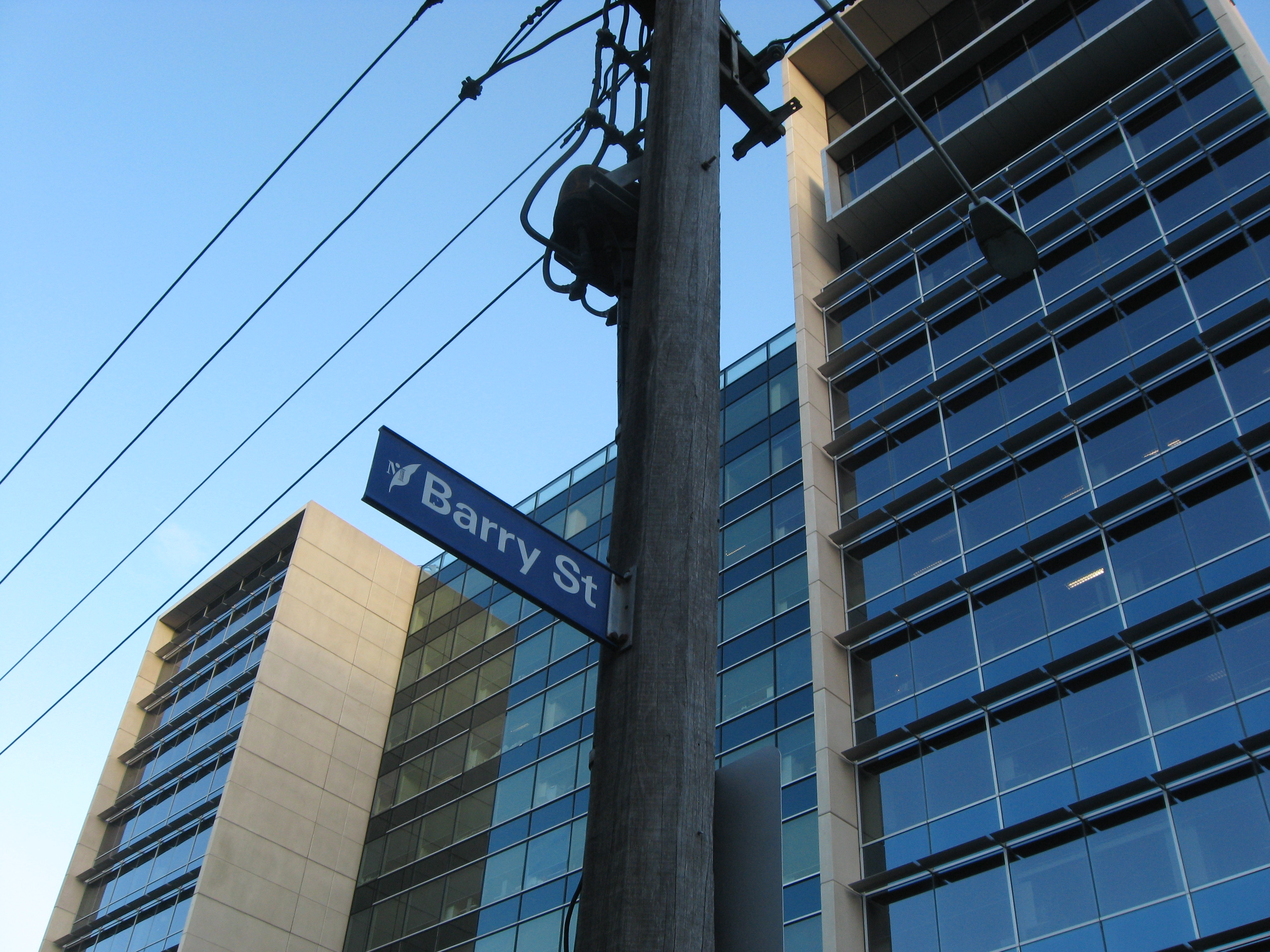
Oooffggh! I’m all “Barry”-ed out after celebrating Redmond Barry’s birthday on Friday 7th June (well, 200 years on) by visiting the exhibitions and attending a symposium to celebrate one of Melbourne’s worthies.
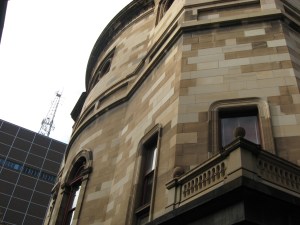
IMG_4847

First stop, the exhibition at the Supreme Court.  This display is a chronological account of Barry’s life and is mounted along the length of a long corridor in the Supreme Court building, with further historical artefacts along adjoining corridors.  I entered from William Street, where you need to go through airport style security, but once in you can wander around the corridors quite freely. The display is clear, well-laid out, and probably gave the best overview of his life of the exhibitions I saw.

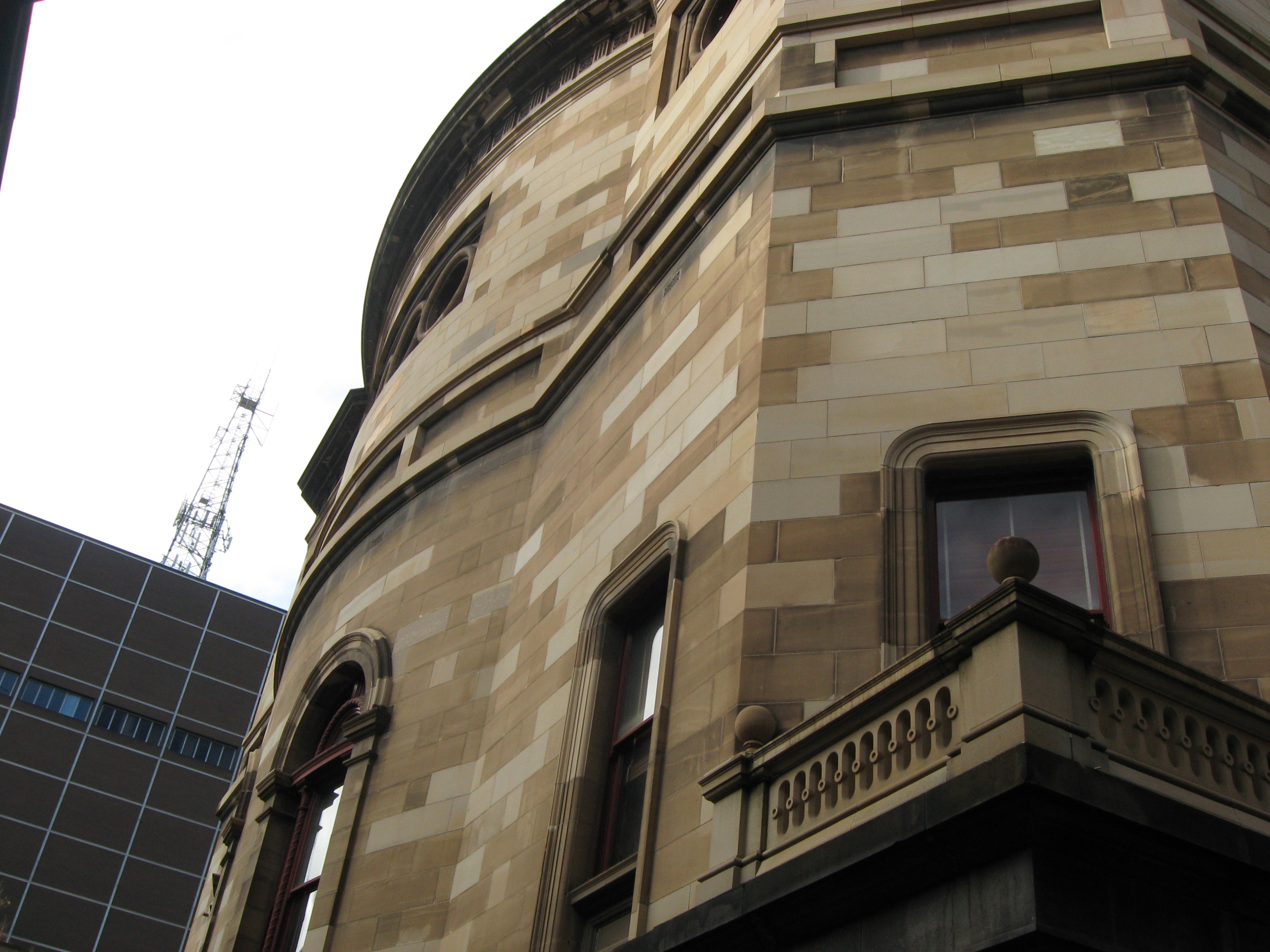
I’d never been inside the Supreme Court building and I’d always assumed that the dome visible from the street covered the courtrooms inside.  I was wrong: the domed building is actually the Supreme Court library and what a beautiful building it is.  You can go in (despite the gold lettered sign on the door that says that you can’t) and it’s spectacular.  Their website has information and a brief history of the library.

Redmond Barry was instrumental in establishing the library which was, and still is, funded by the fees that lawyers pay to be admitted to practice in the Supreme Court.  The library he established was situated in the old, since-demolished Supreme Court building on the present site of the old City Court (now owned by RMIT)- (the court that Judge Willis was so proud of but never sat in because it opened just after he left the colony).  So, too, although Redmond Barry was deeply involved in the design of this library, he didn’t get to see it, because he died before it opened.

Next stop the State Library to see their ‘Free, Secular and Democratic’ exhibition, which is on display until 2 February 2014.  The library was initially established as the Melbourne Public Library, and unlike many other libraries of the time, there was no vetting process and “every person of respectable appearance is admitted, even though he be coatless…if only his hands are clean”.  Redmond Barry was the driving force in establishing this library too, which at the time consisted of the Queen’s Reading Room at the Swanston Street frontage, designed in the style of the libraries that Redmond Barry had frequented in Ireland and England before coming to Australia.  The display has a heavy emphasis on the architecture of the “The Institution” which eventually came to include the library, the museum, the National Gallery of Victoria. The exhibition explores the idea of ‘display’ more broadly, with a section on Exhibitions as well- a real cultural phenomena of industrialised nations, empire, patriotism and competition.  There’s a good slideshow on the SLV site.

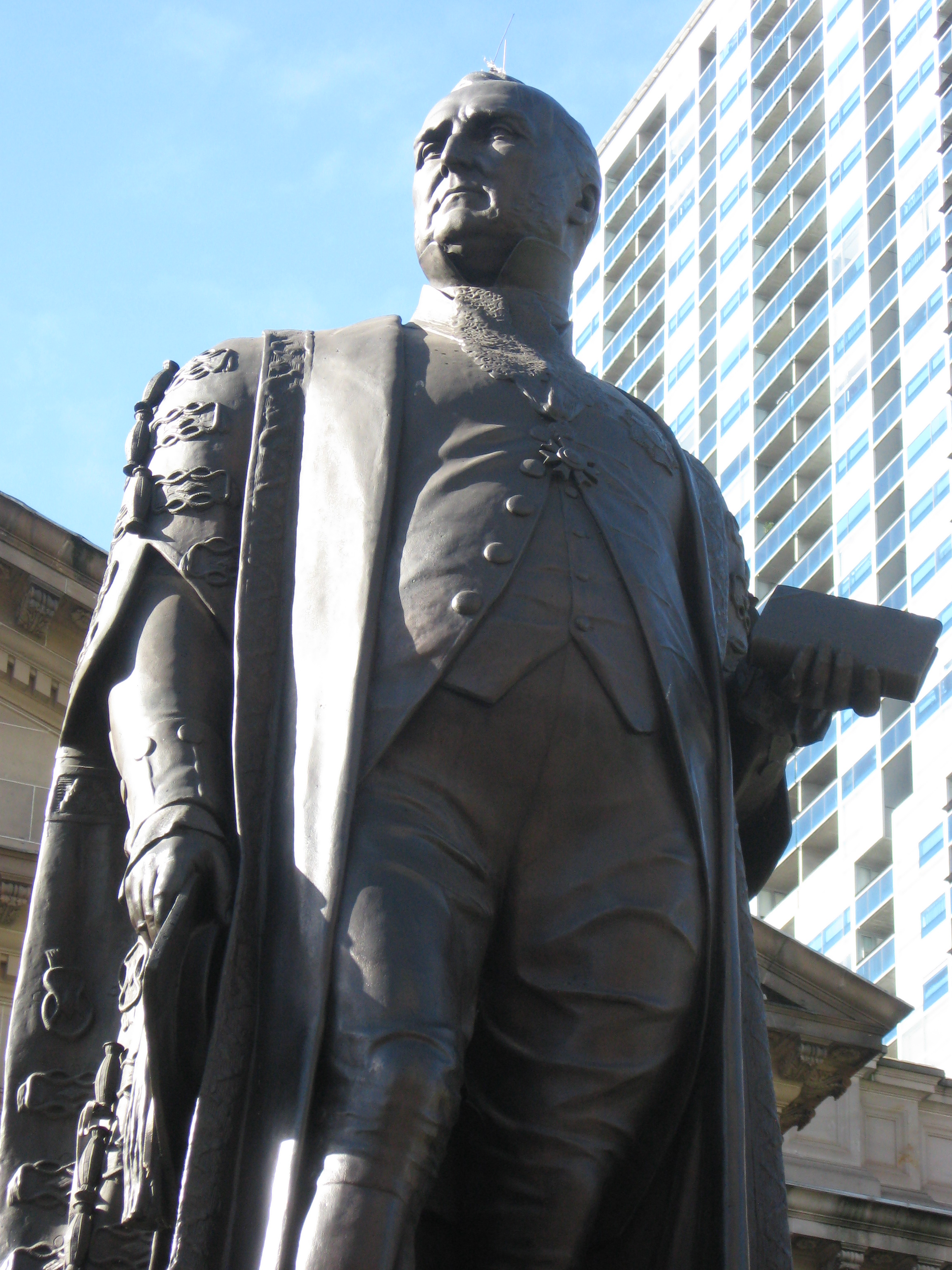
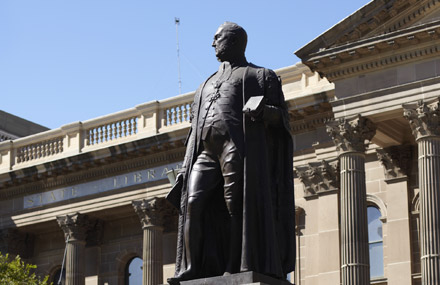
I bid farewell and ‘Happy Birthday’ to the man himself out in forecourt and caught a tram up Swanston St to Melbourne University for the symposium in the Baillieu libarary
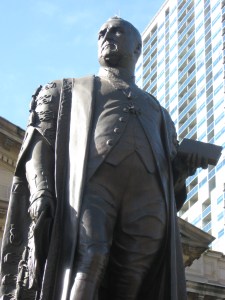
IMG_4850

There were four speakers at the symposium, each exploring a different facet of Redmond Barry.  Stuart McIntyre,  Ernest Scott Professor of History, University of Melbourne started with an exploration of Redmond Barry as the inaugural university chancellor.  He portrayed him as a hands-on administrator, with a strong ceremonial presence.  He made the study of the classics compulsory for all student, which was rather old-fashioned at the time, but as the basis of a broader curriculum in the professions like law and medicine.  He battled with the professors and with the university senate, and insisted  that the professors not comment on religion, and later politics, for fear of sectarianism.

John Waugh Honorary Senior Fellow, Melbourne Law School spoke of Redmond Barry’s contribution to legal education. In England  (and in many other places throughout the empire)  at the time, a  legal education was part of being a gentleman, but it was not professional training as we know it.  Lawyers would undertake an apprenticeship with other lawyers and undertake self study. Barry derided the practical, technical nature of this system, although he was later to exhort law students to simplicity and logic in their arguments- something rather at odds with his own love of rhetoric.  In 1857, in his dual role as chancellor and sitting first puisne judge, he ensured that law students from the University of Melbourne were exempt from sitting the examinations of the Board of Examiners. In 1872 university education was made compulsory for barristers, thus in effect delegating entry to the profession to the universities: a very unusual practice that was found only in South Australia.

The Chief Justice, Marilyn Warren spoke about Barry as a Judge.  She noted that Barry’s reputation as a harsh, conservative judge is dominated by the Ned Kelly trial.  She described him as a detached, black letter lawyer, who was a judge of his times.  She suggested that in the Ned Kelly trial, he saw Kelly as symptomatic of an ignorant, ungovernable youth culture that needed to be stamped out.  In other cases, e.g. the Eureka case, he was more liberal. She noted that contrary to popular belief, he was only ever first puisne judge and never Chief Justice. He had good reason to believe that he would be appointed to replace William a’Beckett when he retired, but he was overlooked.  She suggested that this was because he aggravated people; the government could not be quite sure of how he would act in the position, and because his long-term liaison with Mrs Barrow was a matter of scandal.

Finally, Sue Reynolds, Senior Lecturer in IT and Logistics at RMIT spoke of Redmond Barry’s contribution to the four main libraries that he has been associated with: the Supreme Court library, what is now the State Library of Victoria, the Parliamentary Library, and the library at the University of Melbourne.  She has written a book about the early years of the Supreme Court  library called  Books for the Profession.  Barry was a prominent member of the board for each of these four libraries, and very much involved in the sourcing and  purchasing of books and production of catalogues. Being so involved in each of them, he was able to guide the development of their collections to reflect the unique purpose of each one and its relationship with the others.

And so, talks presented and cakes eaten, it was time to head home. On the way out of the Baillieu library, I stopped to look at their display which was drawn from their own archives and which reflected Barry’s wide range of interests.

Time for one more- the small display in the Law School library situated- how appropriately, on the corners of Barry and Pelham Streets in Carlton.
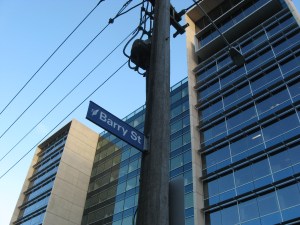
IMG_4863

Ye Gods! What is this excessively palatial university building???  (Not from the outside- go inside to the foyer.) I’d seen the beautiful Supreme Court library that day, and I’ve been into Queen’s  Hall at SLV and they too are lavish buildings in their pompous, 19th century way, but this one just seemed too slick, too “look at us-we’re world class”, too corporate- especially compared with the often overcrowded and primitive accommodation given to other faculties.  Needless to say, when I arrived home and saw the three ‘begging’ letters from the University of Melbourne addressed to the three Melbourne Uni alumni who reside at this house, they went straight into the bin.

I wonder what Redmond Barry would make of the building?  I really don’t know. Anyway, happy birthday Sir Redmond.

Redmond Barry Bicentennial coming up

BarryHeader

Big celebrations over the next few weeks to commemorate the birth of Sir Redmond Barry (1813-1880).  It looks as if 6th and 7th of June are the big days and I’m thinking I might go along for some of it at least.

The official site is here.

EXHIBITIONS:

Redmond Barry Bicentennial Exhibition – Supreme Court Library

210 William St Melbourne 17 May -11 June 2013. Free admission  Mon-Friday 8.30 -6.00  (5.00pm. on Friday)  Inquiries 96039197

You can read about Redmond Barry’s role in the establishment of the Law Library here.

Redmond Barry and the Melbourne Law School Exhibition

Melbourne Law School Library, Level 3, 185 Pelham St Carlton South

18 May- 22 June 2013  Free admission  Inquiries 8344 6177

You can read more about the teaching of law in Melbourne at the Melbourne Law School’s site here.

Evidence of a fruitful life: Redmond Barry and the University of Melbourne exhibition

Ground floor, Baillieu Library, University of Melbourne

4-10th June 2013 Free admission

Sir Redmond Barry was founding father and first chancellor of the University of Melbourne.  There’s a rather clever interactive timeline of the history of the university here.

Free, secular and democratic: building the Public Library 1853-1913

Keith Murdoch Gallery, State Library of Victoria

30 May 2013- 2 February 2014  (so no hurry for this one….) Free admission.

There’s several guided tours during June listed here.

A BICENTENNIAL WALKING TOUR

Friday 7th June 9.30-12.30 starting at the Supreme Court and finishing at Melbourne General Cemetery.  Conducted by Isobel Simpson. $25.00  Inquiries 8344 2016

EVENTS

Redmond Barry: visionary or scoundrel?

Chaired by Damien Carrick from Radio National, the panel includes Justice John Smallwood, historian Robyn Annear and barrister Ken Oldis.

Thursday 6th June 6.00- 7.15 followed by drinks and canapes until 8.30 p.m. Book by Monday 3 June $35 full/ $30 concession/$25 SLV member. 9884 7099.

Redmond Barry symposium

Baillieu Libary University of Melbourne, Friday 7 June 1.30-4.30 p.m. Free admission but RSVP essential – http://go.unimelb.edu.au/6d6n

So much Barry!!! Let’s see- I could do a couple of the exhibitions on Thursday afternoon, then go to the Panel Discussion at the library that night and eat canapes; get up bright and early on Friday morning for a walk around Melbourne to walk off the canapes; then go to the symposium that afternoon.

redmond_barry_statue

An interesting little slideshow Port Phillip early days

I found this slideshow of images of Port Phillip and its early settlers.  It seems that it was prepared by members of the Port Phillip Pioneers group for their annual Pioneers Church Service held at St James Old Cathedral in Melbourne a few years back.

There’s some here that I haven’t seen before.

http://www.slideshare.net/PortPhillipPioneersGroup/glimpses-of-the-past-presentation

Thomas Wills at Heidelberg Historical Society

For those of us interested in early Port Phillip society, there will be a presentation at Heidelberg Historical Society tomorrow night (Tuesday 9 April 2013) on one of the early settlers of the Port Phillip District.  Thomas Wills (1800-1872) is associated with the Heidelberg district through his purchase of 176 acres in 1840 to the west of Darebin Creek, in what is now Alphington, for 3784 pounds.  There he established Lucerne Farm, a double storey, stuccoed house built of locally hand-made bricks and bluestone.  Richard Howitt, a neighbour described the house as:

delightfully situated on pleasant knolls and slopes.  Seen from the south of the Yarra, with the garden like an English one, the widening Yarra at a distance from it and the gleam of the natural pond near it, partly hidden by trees, the landscape is very picturesque.  Walking in the garden, you see natural birds which have become almost tame, so well are they protected by the owner.  (Cited in Heidelberg Since 1836 p. 20)

Governor La Trobe is said to have been a frequent visitor, and the house was well known as one of the social centres of the district.  Unfortunately, despite its ‘A’ classification, the house was demolished in 1960 as a car park for the La Trobe Golf Club.

Thomas Wills was a J.P. and a founding member of the Melbourne Mechanics Institute in 1839.  He was no fan of the judge’s despite the ‘neighbourly’ connection and he signed a petition against Willis.

On Tuesday 9th April, Anne Marsden will speak to the Heidelberg Historical Society about Thomas Wills.  She was awarded a 2013 Honorary Creative Fellowship at the State Library of Victoria to research the founding committee of the Mechanics’ Institution, which included many of the most prominent Port Phillip men of the time.

The meeting commences at 8.00 pm, Tuesday 9th April 2013 at the Ivanhoe Uniting Church Community Centre, Seddon Street Ivanhoe. Visitors are more than welcome.

Update: I’ve just found five  photos of Lucerne, taken in the 1950s, when it was in very poor condition.  You can see them at:

http://trove.nla.gov.au/version/182142672

There’s other photos of Lucerne surrounded by floodwaters from the 1930s too

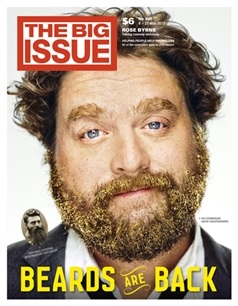
Beards are back?

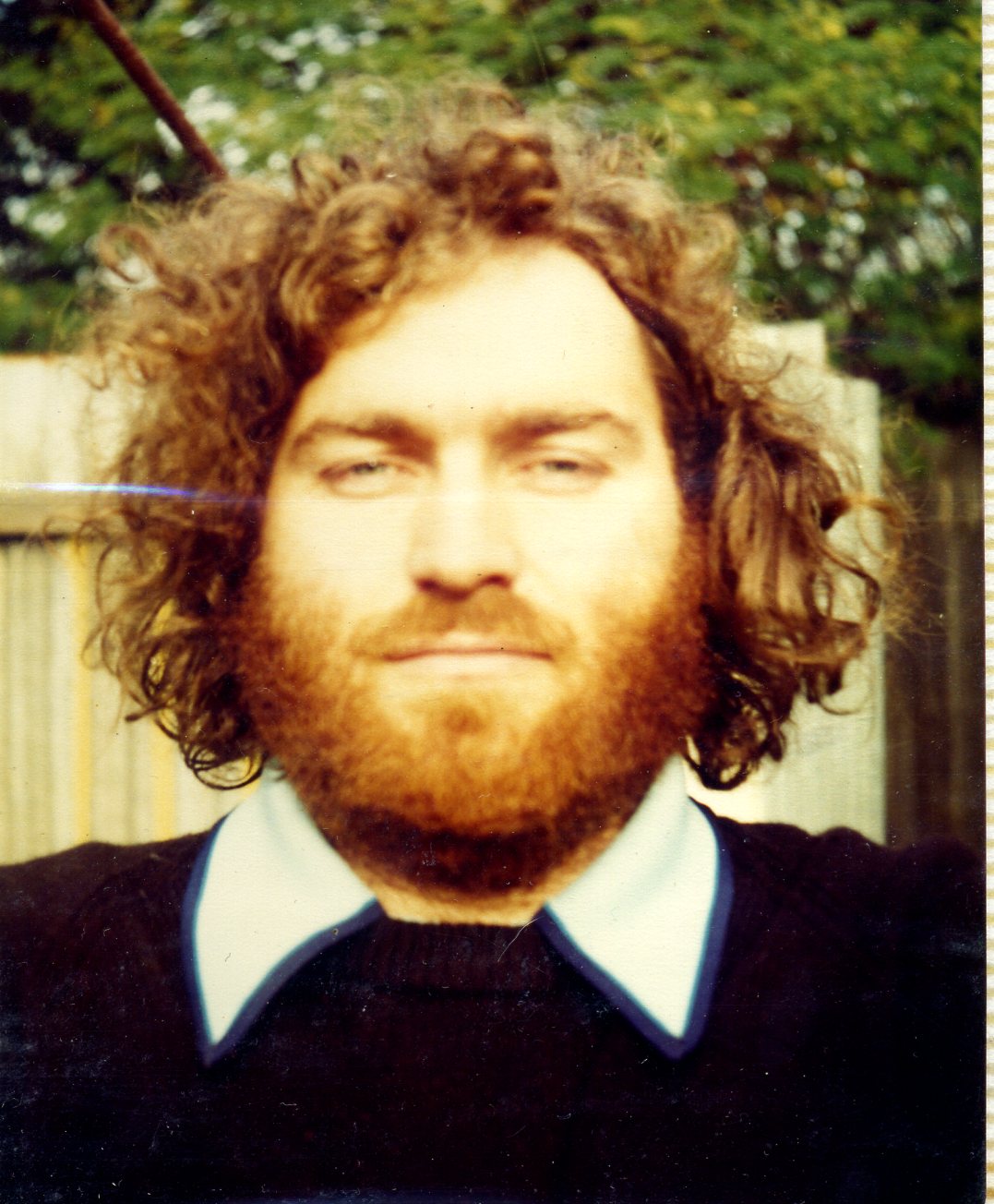
I did a double-take when I passed a Big Issue seller in the city a few weeks back.  Why does the big issue have an update of a 30 year old photograph of my husband on the front cover?

427-Beards-lowres__feature

img065

Oh no! I can feel a Six Degrees of Separation between Judge Willis coming on…..

SIX DEGREES OF SEPARATION BETWEEN JUDGE WILLIS AND FACIAL HAIR.

I’ll let Edmund Finn (better known as ‘Garryowen’) tell the story:

Up to 1851 whiskers were not articles of common wear in Melbourne, and moustachios and beards were unknown, unless with passing visitors from the bush, who periodically burst into town for a spell, and as suddenly burst out again when their cheques were liquified.  The early town colonists were well content with the barefacedness which prevailed in England since the time of William III and were loth to encumber the human face divine with hirsute protuberances.  [Mr Edward Sewell, a dandified solicitor] sometimes affected the exceptional, and, at the risk of being out of the fashion, aimed occasionally to be out of the common, and took it into his head to create a slight sensation.  Accordingly, going into retreat for some time, he emerged unexpectedly from his seclusion, with fiercely luxuriant moustache, which, if it did not increase admiration of him, certainly rendered him pro tem the “observed of all observers”.

Making for the Supreme Court, he stalked in with the swagger of a half-daft peacock, and gazed with solemn superciliousness around him.  The Judge was startled and stared with much wonderment.  He wriggled in his seat, and with much difficulty restrained himself until the business in hand was disposed of, and then Sewell, advancing towards the Bench, asked permission to appear for a client in an Equity suit, as all the limited Bar had been retained by the other side.  The Judge regarded him with astonishment, as if unable or unwilling to recognize him in his disguise.  At length he roared out that his Court was not a place for “A whiskered pandour or a fierce hussar!” If the person who had spoken was desirous to appear as counsel, he ought to have assumed the semblance of one.  As it was, his physiognomical get-up was enough to frighten a man out of his wits! He had better clear out, or he would not be long an officer of that honourable Court.  The astounded Sewell, scared by such an unexpected reception, hastily retreated from the precincts of the highly irritated dignitary, and, fearful of being struck off the rolls if he put in a second hairy appearance, dashed away for the nearest barber’s shop, submitted to a thorough tonsorial operation, and returned with a face and a conscience equally clear to the presence of the offended impersonation of Justice, where he was received as a repentant sinner, obtained solution, and was taken (metaphorically) to the Judicial arms.

I’d always wondered about Willis’ term “whiskered pandour or fierce hussar”.  I’ve since found that he’s quoting from a poem ‘The Battle of Maciejowice’ by Thomas Campbell, which mourns the Russian defeat of the Poles in October 1794.

Oh sacred Truth!

Oh sacred Truth! thy triumph ceased awhile,

And Hope, thy sister, ceased with thee to smile,

When leagued Oppression poured to Northern wars

Her whiskered pandours and her fierce hussars Waved her dread standard to the breeze of morn,

Pealed her loud drum, and twanged her trumpet horn:

Tumultous horror brooded o’er her van

Presaging wrath to Poland and to Man!

Anyway, Mr Sewell would be gratified, I’m sure, to know that beards are back, and that he could venture into court again today with his fiercely luxuriant mustachios and be embraced as being at the height of fashion.

Putting history in its place

puttinghistoryinitsplace

Well, well, well- I’m on ITunes U! (and so are some of my fellow LaTrobe-ites who read this blog!) There’s some interesting papers there, and a video of Henry Reynolds on the History of Tasmania.

The full title of my paper is “Global Positioning Systems: Circuits of Empire Large and Small”.  It was delivered at Putting History in Its Place, a conference held at La Trobe University in September 2012.

It’s labelled as “Movement around the Imperial Network” on I-Tunes.  When I played it through I-tunes it seemed to be brutally truncated at the end, but my downloaded version ran through to the end.

https://itunes.apple.com/itunes-u/putting-history-in-its-place/id571785142