Category Archives: Port Phillip history

This Week in Port Phillip 1841: May 24-31

“Melbourne” the Port Phillip Gazette announced grandly at one stage “boils over like a bush cauldron with the scum of fierce disputes.”  Of course, the Port Phillip Herald was often completely complicit in adding to the fire of disputes, but during this week in May, and the following weeks in June, we see the small colonial outpost of Port Phillip at full boil.

As I described in an earlier post, the King’s or Queen’s Birth-Day was (and still is) celebrated across the empire on different days at different times. In 1841 Victoria was on the throne, and her birthday was 24 May. The length of her reign really embedded that date on the colonial calendar.

According to the Port Phillip Gazette (PPG 8/5/41 p.3) the idea of holding a Birth-Day ball for the first time in Melbourne was mooted at the Caledonian Hotel, where a number of squatters decided that there should be a Race Ball to close the race carnival.  The stewards, however, decided that it should be held on the Queen’s Birth-Day instead, and that it should be a Private Ball rather than a Public Ball. Expenditure of 500 pounds was approved and 180 tickets put aside.

However, as the Port Phillip Patriot reported, when Mr G. G. Sullivan R. N. approached Redmond Barry and asked to be put onto the list of subscribers, he was referred to one of the stewards, William Meek.  Meek, who did not want such people to lower the tone of the gathering,  told him that the list was already full, which Sullivan disputed as he named several people who were going whose names were not yet on the list. Meek agreed to put Mr Sullivan’s complaint before the Stewards, who noted his letter but said that there was no need to comment further on it.

In the resulting furore it was decided that ball planned for the 24th May at Yarra Yarra House  would be opened up to a more ‘general’ admission with new Stewards appointed (Messrs Abrahams, Langhorne, Kerr, Connolly, Sullivan and Urquhart). The original Stewards ( Messrs Simpson, Powlett, Meek, James McArthur, Lyon Campbell, Verner, Major St John) would conduct a Private Ball instead (sneeringly characterized by the Port Phillip Patriot as the ‘Dignity’ Ball) at Mr Davis’ Exchange Rooms at a later date.

Underpinning the clash of these two Balls lay the question of colonial respectability.  Quaint as it might seem to us today, it was a question of fundamental importance to a large social stratum within Port Phillip Society, as historians Kirsten McKenzie and Penny Russell have so clearly shown. As ‘Perpateicus’ wrote to the Port Phillip Patriot on May 17

It is impossible, indeed, that society should long exist without distinctions; a line must be drawn somewhere; where choice is afforded, men will be guided by some rule in their selection.  In the colonies more especially, circumspection is needful, from the obscurity which surrounds private individuals, not to mention that many came abroad expressly for the purpose of taking up new characters, alien alike to their birth and their former habits.  In this point of view, colonial life is a grand masquerade, in which some assume stations to which they have no pretensions, while others sink those to which they justly entitled.  In such a medley, who is to judge? The members of the Club very naturally conclude that all beyond their pale are unworthy of regard.  The country settler repudiates the friendship of the Melbourne merchant. The nouveau riche derides the pretensions of his less fortunate neighbour. Latterly we have seen even the Bench itself reviving obsolete statutes for the purpose of distinctions which might better have been left to the judgment of society….[For]any man to submit his pretensions to a clique of individual who, besides being self-constituted and blessed by Club notions, have committed themselves to the egregious sentiment that gold is the correlative of gentility, would be an act of sheer folly, and a downright dereliction of self-respect. Though favourable to the distinction of society, it is important that such distinctions should be founded on some merit real or presumable. (PPP 17/5/41)

Others, like George Arden in the Port Phillip Gazette (who was highly critical of the ‘Dignity’ Ball) embraced the opportunities to do things differently in a new land:

In a new world as we may term Australia, one of the first and most important steps to greatness, is to shake off the prejudices that have so long fettered society in the father land, and in assigning any member his relative position with the mass, to be guided by character, either past or present. Birth and rank if inherited are enhanced by merit, without it these possessions are desecrated.( PPG 8/5/41)

Of course, a ball was a good opportunity to frock up with new clothes and Michael Cashmore the grocer was quick to capitalize on it as this advertisement from the Port Phillip Herald of 14 May shows:
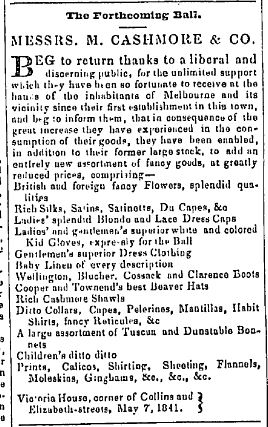
Cashmore

And so how did it go? According to the Port Phillip Gazette

Her Majesty’s Birth Day was celebrated on Monday by a Public Ball held at Yarra House, which had been given up to the Stewards by the proprietor for the occasion.  The rooms, which are admirably adapted for a large party of this description, were arranged with every consideration to the comforts and convenience of the assembly.  The two drawing rooms were set apart for dancing, and the band being placed in the hall, enabled the votaries of Terpsichore to form separate sets in each room, whilst the suite of apartments in the left wing of the building was retained for cards.  The large room in the rear was appropriated to refreshments, which were supplied in the profusion throughout the whole evening. The unfavourable state of the weather precluded a great number from attending, especially those in the country; a dark night and the almost impassable state of the roads and streets, being sufficient to deter any but the most loyal from making the sacrifice necessary to evidence those feelings of respect to Her Majesty. Those, however, who set those considerations at nought, seemed to meet a recompense in the general hilarity of the assembly nor suffered their spirits to droop until the approach of morning warned them of the period for departure. (PPG 26/5/41)

The pastoralist-oriented  Port Phillip Herald, which was derisive of the spurious and jumped-up ‘respectability’ of the Stewards of the Public Ball, did not describe the Ball in its columns (probably because they didn’t attend). Instead, it reported on the appearance of some worse-for-wear attendees in the Police Court.  The writing style with short phrases joined together with a dash was often used by all three papers in writing comedy. Unfortunately, it’s one of those narrative styles that doesn’t travel across time well: perhaps you just had to be there.

POLICE  INTELLIGENCE John Berry, a confoundedly rakish-looking youth, whiskers awry; hair matted with damp and brickdust; neckerchief disorganized and out of set; waistcoat denuded of primitive virginity and spotted with negus; Newmarket green coat, rent to the collar; pantaloons, “a world too wide for his shrunk shanks”; speckled socks cased in patent leather; an astounding display of Mosaic jewellery; and a crushed hat and opera cane, was ushered to the bar, charged with retiring to rest that morning in one of the lakes opposite Yarra House.

Bench- Were you drunk?

Berry- To be sure I was; but permit me to elucidate. But first let me invoke (here he turned up his eyes to the ceiling and ejaculated in a falsetto voice) “Muse of the many twinkling fee Terpsichore”. Now for the elucidation. Last evening, in honor of Victoria I did forty-two shillings’ worth of Yarra House, and found it a bad bargain.  Remarkably grand display- lights glittered- eyes flashed- [?] twinkled- soft music- strong negus- foolish- stewards- Health to the Queen- three cheers- one for piccaninny-Caterer “John” slaughtered ham and beef – no poultry- plenty cigars- plenty “FANCY FAIR”- Mohawks from bush – hobnailed boots – [?infutine?] elegance- young elephant – Tartan – highly approved – blacklegs chucked – dice rattled – cards shuffled – Goat in boots – talked Bob Short – devil of uproar – lady insulted – insulter floored- black eyes- bloody noses – tumble down stairs – evaporated – talk of duel – no apology – all smoke – negus operating – dancing unsteady – dozens in corners – napping – kissing &c – all up – room, lights, fiddlers, twist round – bid adieu- there I am – damn that Charley, too bed – score worse – tipped Traps, did it snug- “that’s ALL”.

Having finished his harangue, he was ordered to pay 5s. which having complied with, this sample of the Birthday Ball mob flourished his cane and departed, vowing it to be the dearest two guineas’ worth he had ever purchased.

AND THE WEATHER?

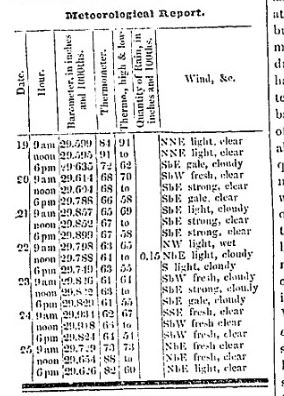
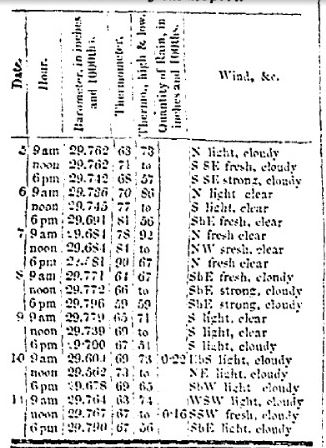
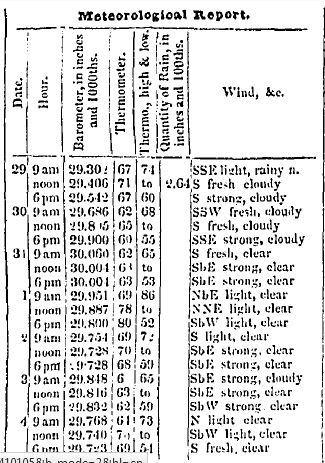
Winter had really set in with gales and strong winds on 28th, 29th and 30th.  It rained on the 23rd (hence the wet roads on the night of the ball) and there were dense fogs on 24th, 25th and 26th.  The highest temperature for the period 22nd-31 May was 64 degrees (17C) and the lowest was 37 (2.7)


John Walpole Willis’ exciting week ahead

Justice John Walpole Willis and his biographer-of-sorts (i.e. me!) are about to have an exciting few days.  Tonight (Friday 8th April) is the opening of the new exhibition at the Royal Historical Society of Victoria 175 Years of Judging for the People, which is on show between 11 April and 7 June 2016 (details here) .

Then tomorrow, Saturday 9th April is the RHSV Conference marking the publication of a new book Judging for the People: A Social History of the Supreme Court in Victoria 1841- 2016 at Victoria University in the city.  I’m giving a short paper on the Bonjon case and its relationship to the Mabo judgment 151 years later.

Finally, on Tuesday 12th April, the book Judging for the People is being officially launched by the Chief Justice of Victoria on the very day of 175 Anniversary of the opening of the Supreme Court of New South Wales in the district of Port Phillip.  I wrote the first chapter of the book which starts off with the Resident Judges, who were the forerunners of the Supreme Court here in Victoria.

So, JWW and I had better both frock up for a few days of commemorative excitement!

This Week in Port Phillip 1841: February 1-7, 1841

THEY’RE OFF TO GIPPSLAND

You’ll remember that while he was collecting the survivors from the wreck of the Clonmel the observant Captain Lewis noticed navigable access to what he hoped would be an inland sea. [link] This ongoing fantasy- the inland sea- reminds us that although there were established routes etched onto the Port Phillip District, there were still vast expanses ‘unexplored’- at least by white settlers.  They weren’t wasting any time: by the 3rd February the barque Singapore was heading back to investigate further, bearingDr Steward, Messrs Kinghorne, Orr, Rankin, Brodribb, McLeod, Kirsopp and McFarlane

A number of enterprising colonists are about to proceed by the barque Singapore ,to country discovered by Count Streslecki on his land route from Sydney and designated by him Gippsland. Captain Lewis has discovered an excellent approach by sea, and the Singapore will proceed to either this entrance or Corner Inlet.

Port Phillip Herald, 5 February 1841.

AN AMATEUR CONCERT

Meanwhile, those left at home could amuse themselves at the Caledonian Hotel, as part of the audience for the Amateur Concert. The Caledonian Hotel was located on the southwest corner of Swanston and Lonsdale Streets. Originally built by Rev. Clow it was quite large with 13 rooms, dormer windows, French doors, outhouses. The licence holder was Mr Robert Omond. See http://www.bayanne.info/Shetland/getperson.php?personID=I137530&tree=ID1   It was later a Temperance Hotel owned by the improbably named Mr Tankard in 1845.

But on 3rd February, the place was rocking:

On Wednesday evening the Amateur Concert came off at the Caledonian Hotel with great éclat. There were above 150 ladies and gentlemen present, composed of the wealth and fashion of Melbourne and its vicinity, amongst whom we noticed His Honor and lady, whose entrance was greeted by the orchestra striking up the national anthem. The room was well lighted, and the platform so elevated as to afford the audience, even at the furthest extremity, a full view of the performers. Madame and Monsieur Guatrot lent the aid of their brilliant talents to add additional effect to the pleasures excited by the Amateur band. The ladies and gentlemen were in ‘full dress’ and the tout ensemble presented an animated scene both “rich and rare”…although the performance was rather protracted, every soul seemed to enjoy the whole to the last with those enlivening and hallowed emotions which it is the special province of music to inspire… At eleven o clock the party rose simultaneously with buoyant and loyal hearts to respect by the echo of their feelings to Britain’s national air “God save the Queen!” This of course closed the evening’s enjoyments and the gay assemblage dispersed with reluctant hearts, but with fond hopes that the generous and gallant band of Amateurs would soon again repeat the attractions which had drawn them together, and which had so charmed their souls and so effectually secured their gratitude.

Port Phillip Herald 5 February 1841.

You’ll note the presence here of Superintendent La Trobe and Mrs La Trobe, ensuring that the concert was a respectable one.  The practice to sing the national anthem at the end of the performance might seem strange to those of us who can remember standing up for the national anthem at the cinema before the pictures started. However, this practice started in Drury Lane in 1745.The anthem was also played when royalty entered the theatre, but I don’t think that the designation ‘royalty’ quite stretched to Superintendent La Trobe at this stage.

WANTED- A PRINTER

When a low-level government position needed filling, it was not uncommon for the governor to look to the convict population. Although the ability to dispense patronage in the form of a job was an important aspect of power, it saved money if a convict could be found who had the skills, especially in the trades. And so:

Assignees of convicts in this District are required to furnish me with as little delay as possible the Names of any Men in their employ, who are either Compositors, Printers, Pressmen or Bookbinders, the Government requiring their services. Men will be assigned in lieu of those returned to the Government. James Simpson Police Magistrate 4th Feb.

Port Phillip Herald 5 February 1841

The substitution of one convict for another reminds us that even though Port Phillip was not, ostensibly, a penal colony, the assignment of ‘servants’ was still a bureaucratized system.

THE STREETS

The boggy state of Elizabeth Street was often remarked upon by the newspapers.  As I’ve written about before, Williams Creek runs under Elizabeth Street, and in times of downpour it became very muddy. But the Port Phillip Herald was pleased to see that a gang (most probably of convict workers) were on the job:

We were glad to perceive on Wednesday that the Police Magistrate had placed a gang of twelve men to convert Williams River into a street to be called Elizabeth-street.

Port Phillip Herald 5 February 1841

The good people of Melbourne needed to be chided to keep their dogs – and other animals- off the streets:

Caution to Owners of Dogs &c. The Magistrates have given instructions to the Police to destroy all dogs found about the town without collars. This is as it should be, and if a similar order was extended towards unclaimed pigs it would be of infinite service to the public as the devastation committed by the animals is great, and the soon their destructive pursuits are got rid of the better

Port Phillip Herald 2 February 1841

HOW’S THE WEATHER?

According to the Government Gazette, it was “fine open weather, with fresh and strong winds, frequently clouded by Cumuli”. The maximum temperature for the period was 92 degrees (33 celsius) and the lowest minimum was 56 degrees (13).  There was no rain.


This Week in Port Phillip 1841: January 24-31

ANNIVERSARY DAY

Of course, to us today this week is dominated by Australia Day on January 26th.  As I’ve written about before, Australia Day as a national day is of relatively recent origin (1946, and on the day itself 1994) and until then was known as Anniversary Day. In Port Phillip in January 1841, where the Separation Movement was stirring and beginning to agitate for Port Phillip as a separate colony from New South Wales,there was some resentment at celebrating “their” Anniversary:

We have received too much injustice already from head quarters to make it at all palpable to the Port Phillipians to celebrate the foundation of their colony, with which we want nothing to do.

The Port Phillip Gazette and Port Phillip Herald offered two other dates for celebration that would be more acceptable for the colonists of Port Phillip:

We would, however, suggest that instead of taking the foundation of Port Phillip from the 29th August 1835 as the Patriot recommends, that we should say the 1st June 1836, the day on which the first sale of Port Phillip lands were held, and which gave the Port Phillipians the first legal title to property in our fine country.

Interestingly, the good burghers of our present-day Melbourne have lighted on 30 August as ‘Melbourne Day’, commemorating the day that those on board the Enterprize disembarked onto land.

Whichever way you look at it, it’s dispossession.

WAGES

During late 1840 and early 1841 landowners were pressuring the government to increase its intake of emigrants as a way of alleviating the shortage of farm and domestic labourers, thereby reducing what appeared to employers to be exorbitant wages.   A bounty scheme was established whereby the NSW government would pay for the emigrants’ passage, either through a government scheme, or by a privatized scheme. Under the private scheme, agents in Britain would select eligible applicants and provide their passage and on their arrival, the £19 fare would be refunded by the government.  The bounty scheme was being funded largely through the sale of land in the Port Phillip District.

The table below was drawn up by the Port Phillip Herald on 8th January to support the argument that bounty migrants (i.e. those that the NSW government paid to come here) should be directed to Port Phillip, rather than sent up to Sydney.  Wages were higher in Melbourne, they argued, because of the labour shortage.

As the Herald itself admits, the methodology is questionable: the Sydney wage rates were affirmed on oath before Magistrates, Commissioners of Requests, Chairmen of Quarter Sessions and Judges or from the lips of workmen. In Melbourne, the rates were not attested on oath but had been “obtained from some of the most respectable masters in Port Phillip” and may have even understated the wages given.  (‘per diem= per day’, There were 12 pence [d] to the shilling; and twenty shillings to the pound)

OCCUPATION SYDNEY MELBOURNE
Brickmakers 10/- to 15/- per diem. Piecework 10/- to 16/- per diem None employed by the day. Piecework 20/- to 25/- per diem
Bricklayers 8/- to 10/- per diem 13/ 6 ½ per diem
Blacksmiths 35/- to £3 per week £3/12s to £4/4s per week
Compositors 8/- per diem 12/- per diem
Cabinet makers and upholsterers 6/- to 8/- per diem 14/- per diem
Farriers 30/- to 50/- per week £3/12 to £4/4 per week
Fencers 3d to 4d per rod 4/6d per rod
Field Labourers 2/9d to 5/- per diem independent of lodgings, vegetables, firing water etc. 7/- per diem without board
Glaziers 8/- to 9/- per diem 10/- per diem
Harness makers 5/6d to 6/- per diem 8/- to [?] per diem
Joiners 8/- to 10/- per diem 12/- to 14/- per diem
Plasterers 7/- to 9/- per diem 12/- per diem
Ploughmen £30 to £40 per year with rations and lodging £52- £60 per year with boarding and lodging
Quarrymen 6/- to 8/- per diem 10/- per diem
Sawyers 8/4d. to 11/- per 100 feet 17/- to 21/- per 100 feet
Shoemakers Shoes 5/6d Boots 15/- Shoes 7/6, Boots 21/-
Shepherds £20 to £35 per year with rations £40 to £50 per year with rations
Wheelwrights £25 to £50 per year with rations £3/15s to £5 per week without rations.

PRICES

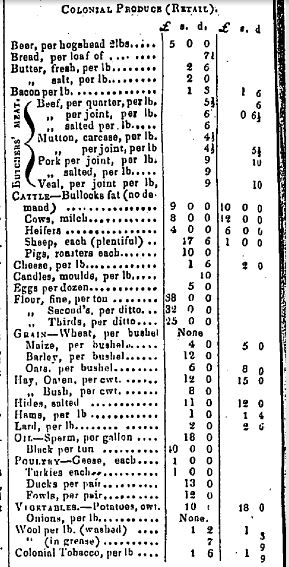
So, if this is what people earned, then what did things cost?  The Port Phillip Herald of 29 January 1841 listed the following prices for local goods:

priceslocal

Imported goods (as you might expect) were more expensive again

TO MARKET, TO MARKET

Speaking of buying and selling, there was a meeting at the Police Court on Friday 29 January 1841 to discuss a new location for the market. There had been a site set aside for a market in- you guessed it- Market Street, but the market wasn’t yet formally established at this time, and people weren’t happy with the proposed location. They didn’t actually get round to deciding where the market should be at this meeting, just that another spot other than the present market reserve should be found.

HOW’S THE WEATHER?

The 19th January was the hottest day, with a maximum of 91 degrees (33 celsuis) but the rest of the week was pretty mild.

weather29_1_41

The Government Gazette reports that the week had “dry weather, generally clear of clouds, but very hazy; strong winds from the south continuing.”


This Week in Port Phillip 1841: January 16-23 1841

RETURN OF THE CLONMEL SURVIVORS

On the 15th and 16th January, the two ships sent to rescue the Clonmel survivors arrived back in Port Phillip, after the wreck of the Clonmel a fortnight earlier.

MELBOURNE   THE CLONMEL. The Sisters, from the Clonmel, arrived on Friday, and the Will Watch on Saturday, bringing up the crew and passengers of that ill fated vessel. From what we can learn, it seems that the steamer having gone ashore during a spring tide, is now embedded in the sand at some considerable distance from the outer edge of the sand spit at low water mark; she is consequently comparatively safe from the waves. Her hull is sunk in the sand so that there is ten feet water in the hold, the cargo, it least so much of it as would damage from salt water, is consequently destroyed. As she swings at high water, and had not when the vessel left sustained any very material injury, sanguine hopes are entertained that she will ultimately be got off. We confess however, that there is but a remote possibility that a consummation so devoutly to be wished will ever be effected. The engines at all events are safe, and it may be that when the cargo is removed, the Clonmel will float again ; this. however, is rather to be hoped than expected. The rumours regarding the misconduct of the crew which have been afloat since the intelligence of her loss arrived have, we are glad to say, proved to be groundless. Some trifling peculations were committed, and one individual is in custody, charged with the commission of a petty theft but no robberies of such magnitude as were stated ever occurred. The natives made their appearance only once to the shipwrecked mariners, just before the Sisters and Will Watch sailed, but they offered no molestation of any description. What brought the steamer into such a predicament remains still unexplained. It is obvious even to persons unacquainted with nautical matters, that provided the vessel had been steered her course, she never could have been carried so far out of the way by the force of the current. We refrained from observations of this nature when Captain Tollervey and his officers were not present to answer for themselves, but we are conscious we are only giving utterance to the general feeling, when we say, that if as much attention had been paid to the navigation of the vessel as to the the comforts of the saloon, a catastrophe so very injurious to the interests of this community could not have occurred. The goods on board were chiefly the property of Messrs. J. M. Chisholm & Co., Mr. Cashmore & Co., Hamilton & Goodwin, Turnbull Orr & Co., and Capt. Cain. A small portion only, we fear, was insured

Geelong Advertiser 23 January 1841

THE CLONMEL– WINNERS!

But the wreck of the Clonmel wasn’t bad for everyone. Captain Lewis, who captained one of the ships that picked up the survivors, entered Corner Inlet and noticed a huge expanse of water.  In a reminder to us of how new the white settlement of Port Phillip was, hopes of the mythical inland sea were kindled:
Captain Lewis is all but certain that this Inlet communicates with a large inland sea, which he discovered and entered from shallow inlet, where the Clonmel at present lies. Time did not permit to examine the communication between corner inlet and the inland sea, but from his observations from the mast head, he is of opinion it is about a mile wide without a bar…. Thus, then, there is every probability of a most valuable tract of country being made available for colonial enterprise, should the Government order the necessary surveys.
Port Phillip Herald 19 January 1841
THE CLONMEL– LOSERS!
The wreck of the Clonmel wasn’t good for Mrs Beard though, who had previously worked as Superintendent on the vessel. She now had to find a new position.
Mrs Beard, lately Stewardess of the Steamer Clonmel begs to inform the respectable portion of Melbourne, that having, in consequent of the wreck of that vessel, lost all she possessed, and being a Widow without incumbrance, she will be most willing to engage herself as either a Lady’s Maid, Housekeeper, or Forewoman in a shop. The most respectable references can be given
Port Phillip Herald 19 January 1841

THE TRADESMEN’S BALL  After so much excitement in the last week (the regatta, the races, the cricket, the ball) , on Wednesday 18th January the inaugural Tradesmen’s Annual Ball was held at the Caledonian Hotel. This hotel, which was located somewhat out of town on the south-west corner of  Swanston and Lonsdale Streets, had originally been the large residence of the Rev.Clow and comprised 13 rooms as well as outhouses.  It was a commonly-used venue for large entertainments.  As might be deduced from the name of the ball, it was not a vice-regal occasion, and did not attract the clientele of ‘good’ Port Phillip Society. Nonetheless, a good time seems to have been had by all:

There were upwards of 80 couples present, dancing commenced at 9 o’clock, and after enjoying the pleasures of the ballroom until 12, the whole party partook of a rich banquet served up in that sumptuous and tasteful style for which my host of the Caledonians is so justly celebrated. Dancing, in all its varieties, was renewed and kept up with, if possible increased animation, until the golden tints which streaked the instant horizon proclaimed that the night was spent… Throughout the entire evening not the least commotion or unpleasant consequences took place.

Port Phillip Herald 19 January 1841

DEATH ON HOLIDAYS

But it was a very bad start of the year for Mr William Ker Senr. and his family when their New Year’s vacation was cut short by an untimely death on Saturday 16th January

SUDDEN DEATH.  On Saturday last, Mr Ker proceeded to the beach with his family intending to erect a tent for their temporary residence during the summer. He left his family at the Marine Hotel and went for the purpose of erecting the tent. Being absent for some time, Mrs Ker walked in the direction he went and not far from the Marine Hotel she discovered the body of her husband in the water, rolling about in the surf.”

Port Phillip Herald 19 January 1841

The Marine Hotel at this time was in Sandridge (Port Melbourne), and I’m rather amused by the description of the water there as ‘surf’.  A post-mortem was carried out by Dr Cussen, the colonial surgeon, who found “very extensive tubercular disease of the brain, accompanied by a serious effusion.”

At first I wondered whether this was a holiday-trip-gone-wrong, with Mr Ker the fore-runner of those Mornington Peninsula campers in their tents and caravans on the foreshore today? Or were Mr Ker and his family homeless and taking advantage of the balmy summer weather to live by the sea instead of in the township?  After all, as Bill Garner reminds us in his book Born in a Tent, living under canvas remained an important form of housing in Australia for much longer than we realize.  On reflection, I think the former. Some days later a well-attended funeral service was held for Mr Ker in the newly opened Independent Chapel, so it would seem that the family was well-established in Port Phillip and that it was likely to have been a beach-side holiday.

SCOTS PRESBYTERIAN CHURCH

On 22 January the foundation stone was laid for the Scottish Presbyterian Church on the corner of Collins and Russell Street, the site of the present Scots Church (constructed between 1871-1874 to replace this 1841 building). Although they had been in Port Phillip right from the start, the Presbyterians were the last to establish a permanent church, after holding services in several other locations (including this one) up until this time. See an image of the original church here and the plans and ground elevation here.

The Port Phillip Herald of 26th of January reported that it was a rainy day but that a “goodly concourse of the Presbyterian population and friends of the cause” attended, including several ladies who had come a considerable distance to be present. During the ceremony a bottle was deposited below the foundation stone with a copy of Mr Kerr’s Almanac for 1841, copies of the daily newspapers and a certificate.

HOW’S THE WEATHER?

No daily weather report this time, but the Meteorological Journal reprinted in the Government Gazette shows that the highest temperature for the week was 94 degrees (34.4 celsius) on the 19th January with the lowest recorded 55 (12.8 degrees). The week was described as “dry clear weather, but horizon seldom free from clouds; strong winds and squalls from South still frequent”.

This Week in Port Phillip 1841: January 8-15 1841

The habit of kicking back over January was established by 1841, and it was all happening this week! On Tuesday 12 January there was the Regatta on the bay.

High indeed were the expectations of our fellow colonists of every rank and age and bustling the scene of general preparation to celebrate the first Regatta, but the pleasure of the reality and the fond reflection upon its varied and enchanting amusements have eclipsed the brightest anticipations of its most sanguine admirers and rich and abundant is the fund which Memory has [?] stored up for future enjoyment (Port Phillip Herald 15 January 1841]

There were four races in all for different crafts:four-oared gigs; first class boats and five-oared whale boats.  As is the case today, there was just as much interest in watching the spectators as watching the spectacle:

regatta

(Port Phillip Herald 15 January 1841)

Then on Wednesday 13th it was the Hurdle Race at 1.00 p.m. “The course marked out is selected on the other side of the river Yarra Yarra, near the beach, and about half a mile to the left of Mr Liardet’s hotel“. (PPH 12 January 1841) Mr Liardet’s hotel was at Port Melbourne.

A “ vast assemblage had collected to witness the sports” at the beach where a limited number of horses competed against each other in three heats.  The writer for the Port Phillip Herald became very excited about the whole thing but it really doesn’t bear repeating 175 years later.  More interesting was the ball that was held that evening:

ball

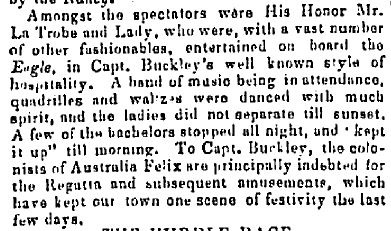
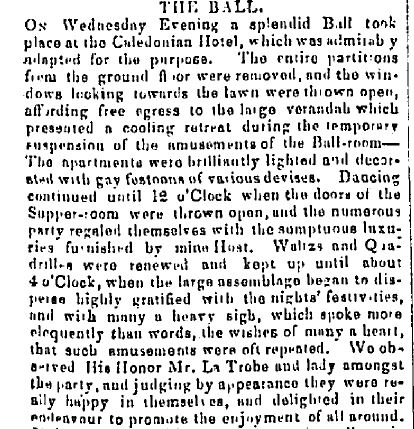
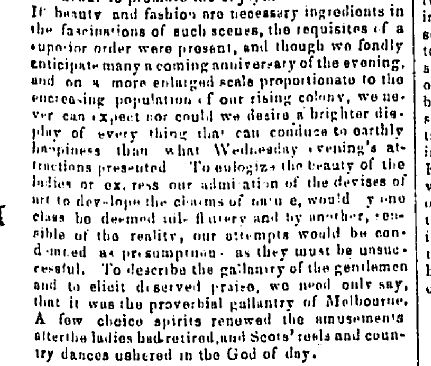
The presence of Superintendent La Trobe and Mrs La Trobe is important because they conferred an aura of respectability to the proceedings. If they were there, then all the Port Phillip worthies would have wanted to be there too.  Just like our clubs today, these balls went until late at night (or rather, early the next morning), with this one breaking up at about 4.00 a.m.

ball2

The cricket match was held on Thursday 14th January, “on the usual ground” .This was, at this stage, at the foot of Batman’s Hill, near the site of the present day Southern Cross station.  However, the match was abandoned “owing to the boisterous state of the weather“, to be continued on the following Saturday.

WEATHER REPORT

So how was the weather?  How frustrating- it doesn’t go up to 14th January!

PPH15Jan1841

Port Phillip Herald 15 January 1841.

It was 92 degrees (33 celsius) on 7th January, followed by a 67 degree (19 celsius) on the 8th.  How Melbourne!

And according the report of the week from the Meteorological Journal for Port Phillip, published some two months later (19 March 1841)  in the Government Gazette,

Weather generally dull and cloudy; rain in small quantities 9th, 10th and 14th; strong winds and squalls from S continuing frequent; N. W. gale 14th.

The highest temperature for the period 8th-14th January was 89 degrees (31.7 celsius) on 7th January, and the lowest was 51 degrees (10.6 celsius).

This Week in the Port Phillip District 1841: January 1-8 1841

COMING SOON….A RESIDENT JUDGE

Even though Superintendent La Trobe and the people of Port Phillip didn’t realize it, on 1 January 1841 Governor Gipps took up his pen to formally notify the Secretary of State at the Colonial Office in London that Justice John Walpole Willis had been appointed to Port Phillip as the first Resident Judge of the Supreme Court of NSW for the district. Gipps’ letter to La Trobe informing him of the appointment was actually written on 29th December, but it hadn’t arrived in Melbourne yet.  So, let the period of the Resident Judges begin!

THE WRECK OF THE CLONMEL.

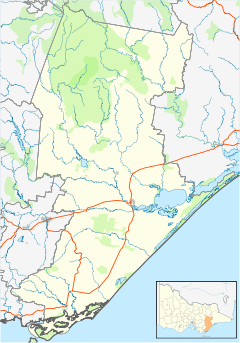
The year started with a bang, literally, for the steam-ship Clonmel which ran aground on a sand spit at the entrance to Corner Inlet  200km south-east of Melbourne, at 5.00 a.m. on the misty morning of 2 January 1841.

clonmelmap

See also: http://mapcarta.com/16688280

The five-year old Clonmel was a new addition to the shipping route   between Launceston, Port Phillip and Sydney, having only arrived in Sydney in October 1840. This importance of this intra-town communication through shipping at this time cannot be overstated.   A wooden-hulled, masted paddle steamer, it carried 75 passengers and crew, and this was only its second*  voyage on its circuit between the three ports.  Daybreak revealed that the beach was about half a mile away, and that a heavy surf was running. Several trips by whale boat initially, and then with the assistance of quarter boats, deposited every soul in safety on the beach by 2.00 p.m. that afternoon. Sail awnings were brought on shore and a camp of tents was established for the ladies.  Provisions sufficient for ten days were also brought from the boat, including livestock, hams, bread, flour, biscuit, rice, tea, sugar and wine.  A sketch by Robert Russell showing the huts of the Clomnel survivors can be seen here.  [Accession number: MS 9555]

Water was located, but found to be brackish.  Safely onshore, the Captain harangued the passengers about the need for discipline and the punctual obedience of orders. Two-hourly watches were posted and the provisions were securely stowed under a boat turned upside down to guard against petty depredations and the effect of the weather.

The next day,  two passengers Mr D.C. Simson and Mr Edwards and five unnamed seamen headed off to get help. First they inspected the wreck of the ship as they passed, and then headed towards Sealers Cove where they rested overnight. At 3.00 a.m. on 4th January, they awoke early to fill buckets with water to continue their journey when they observed “the natives coming down upon us.” They hurried on board and headed for Wilsons Promontory, which they sighted at about 10.00 a.m.  They arrived in a small bay at Westernport at 8.00 p.m. that night.  The following day they reached Port Phillip Heads by 2.00 p.m. but because there was a strong ebb tide, they needed to wait for a flood tide.  They were approached by a cutter The Sisters which towed them into Williamstown at 11.00 p.m. making a total of 65 hours since their departure from Corner Inlet.

All passengers were safe, although Mr Robinson lost the £3000 of Union Bank notes he had in his custody.  The newly-wed Mr and Mrs Cashmore lost a large quantity of goods that they were bringing for their new establishment to be opened on the corner of Collins and Elizabeth Street.  (Source: Port Phillip Herald 8 January 1841;  http://perdurabo10.tripod.com/ships/id296.html )

See the Victorian Heritage Database entry for the wreck of the Clonmel (which still lies on the ocean floor) here.

TICKETS OF LEAVE

Even though the people of Port Phillip prided themselves that they were not a ‘convict’ colony like Van Diemens Land or Sydney, there were convict gangs, ‘assigned servants’ and ticket-of-leave prisoners in Melbourne.

On New Years Day a general muster of the ticket of leave men of the district took place at the Police office. They presented the appearance of a clean and orderly set of men, and were each passed in review before the police magistrate; such of them as resided in the town were sworn in special constables, a very excellent and salutary arrangement (Port Phillip Herald 5 January 1841)

It’s hard to know what to make of the final sentence- sarcasm, most likely. Nonetheless, many of the early police in Melbourne were of convict background and many were quickly dismissed for drunkenness. Edmund Finn, writing as ‘Garryowen’ in his Chronicles of Early Melbourne describes the ordinary policemen of the first few years as “mostly convicts freed by servitude, with now and then a ticket-of-leave holder.” (p. 52)

A NEW CHURCH

On 1 January the new Independent Chapel was formally opened for Divine Worship. “The design of the Chapel is both neat and tasteful, and its internal fittings up render it extremely commodious.” Three sermons were preached on that day by Reverends Waterfield, Forbes and Orton.

A booklet called The Collins Street Independent Church (available here) shows a small brick church building 20 X 30 ft in size, erected at a cost of £231. It was later extended, but pulled down in 1866 to construct the current-day St Michael’s on the corner of Russell and Collins Streets.

HOW’S THE WEATHER?

According to the Port Phillip Herald, in the days between 29 December- 4th January, there was a fairly mild start to the year, with the first of January the warmest day with a top temperature of 86 degrees F (30 degrees C)

PPH5Jan41

The Abstract of the Meteorological Journal kept at Melbourne, Port Phillip was reprinted in the Government Gazette at roughly monthly intervals. The January report is in Gazette 22, Friday March 19 1841.  It reports that in the week 1st-7th January, there was “dry weather, frequently cloudy” with “strong southerly winds”. The highest temperature recorded on this week was 92 degrees on the 7th.

Notes:

*The Victorian Heritage Database and other sources say that it was its third journey. I can only find two.  The plan was for the Clonmel to run a circuit between Sydney, Melbourne, Launceston then return.  The first journey from Sydney was planned to terminate at Melbourne, but was extended to Launceston after all (which might be where the confusion lies between two and three journeys). The wreck occurred on the second journey from Sydney.

References:

Port Phillip Herald 1, 5 and 8 January 1841


‘Sir William’s Muse: The Literary Works of the First Chief Justice of Victoria, Sir William a’Beckett’ by Clifford Pannam

Judges may write poetry all the time- how would I know?- but I suspect that it’s not a particularly common judicial past-time.  William a’Beckett, the fourth Resident Judge of Port Phillip did, though, and this small book surveys his literary output from the early 1820s through to the early 1860s when he had retired back in England.  Forty years…so much poetry…such awful poetry. Well maybe not, if you like rhyming poetry because certainly Sir William did.  But these poems were of their time and fashion and should be read that way.

The author, Clifford Pannam QC starts his book with a reflection on the portrait of Sir William that hangs on the walls of the first floor of the Supreme Court library. Although a’Beckett’s writings have been dismissed as “sentimental, priggish and rather boring”, Pannam  decided to plunge into Sir William’s extra-judicial writings and found that:

[Sir William’s]  literary works reveal a romantic and passionate man who found no embarrassment at all in public confessions of his innermost feelings. (p. 4)

The first chapter deals with a travel book that Sir William wrote in 1854 on a 4000 mile European journey that he undertook with his wife and sons between August and November of 1853.  It’s a fairly conventional travel diary although he is moved to poetry in Naples. In a poem ‘At Naples- 1853’ he looks back to a poem that he was inspired to write there more than twenty years ago as a young man and compares his life then and now.  It’s quite biographical in places, especially when he writes about the death of his first wife.

In Chapter Two, Pannam moves to Sir William’s distress at his son’s marriage to Emma Mills, the brewery owner’s daughter.  Most of this short chapter deals with how this event was fictionalized in the works of Sir William’s great-grandson,  Martin Boyd, about his family (The Cardboard Crown and The Montforts).

Chapter Three tracks back to Sir William’s publication of his verse under the title ‘The Siege of Dumbarton Castle and Other Poems’, published in 1824. Between 1824 and his call to the Bar in 1829, Sir William had had hundreds of poems published in literary periodicals, and in 1829 he published them in a 200 page book ‘The Vision of Noureddin and Other Poems’ under the pen name Sforza.  There are long extracts of poems…such ‘rhym-y’ poems.  He also wrote a three volume biography of eminent people, where in the introduction Sir William admits that it was copied from other sources over four years.  Pannam notes that “It is difficult to imagine a more crushingly boring task for a young man.” (p.38) This was, however, a common way of compiling text books for young barristers waiting around for briefs.

Chapter Four sees Sir William now in New South Wales in 1838 where he delivered a series of three lectures at the Sydney Mechanic’s School of Arts entitled ‘Lectures on the Poets and Poetry of Great Britain’. Extracts appeared in the Temperance Advocate (he was a strong Temperance supporter) and he published the lectures separately, the first work of literary criticism published in Australia. He gave a similar lecture series at the Melbourne Mechanics Institute in 1856.  I must confess, reading them through, that they’re not exactly riveting reading and were probably even less riveting listening.

Chapter Five has assorted poems on varied topics: Christmas; his first wife; the conformity of the Anglican church; prize fighting; and the damaging effects of creeds- something that as a Unitarian he would have felt strongly about.

The sixth chapter examines a pamphlet that Sir William wrote under the pen name ‘Colonus’ titled “Does the Discovery of Gold in Victoria, viewed in relation to its Moral and Social Effects, as hitherto developed, deserved to be considered a Natural Blessing or a National Curse?”  As you can guess, by the length of the title, he came down pretty much on the latter.

He did do some professional writing as well, and Chapter Seven looks at the 100 page book that Sir William wrote in 1856: ‘The Magistrate’s Manual for the colony of Victoria’ (the title is longer, but you get the gist). But he also wrote current-events poems that he submitted to the Port Phillip newspapers (especially the Port Phillip Herald) under the pen-name Malwyn.  Pannam reproduces ‘Leichardt’s Grave’, written after the explorer Ludwig Leichardt disappeared the first time then re-appeared (less lucky the second time he disappeared….)

In Chapter 8 Sir William retired and returned to England in 1857 and published a “very long and marvelously romantic poem” under the title ‘The Earl’s Choice’ in 1863. It’s an apt description for this overwrought work, and at least he’s broken out of the straitjacket of rhyme.

Finally, in Chapter 9 Pannam leaves us with a poem on the future of Victoria “Advance Victoria!” also found in ‘The Earl’s Choice’ which you can download free as a Googlebook here.

Advance, Victoria!

From crowded cities severed far

Where glitters bright the southern star

There lies a land of wide domains,

Of golden rocks, and grassy plains;

Whose soil to till, and wealth unlock,

From distant climes, all people flock,

Whilst, canopied ‘neath cloudless skies,

They help a mighty nation’s rise.

If you have access to AustLit, his works are listed there.  If you’re a member of the State Library, you can view it online.

‘Imagining Early Melbourne’ Kathryn Ferguson

I just found an online article about Early Melbourne from 2004,  published in the very first edition of Postcolonial- an open source journal that is now in its eleventh year.

You can source the article at:

http://postcolonial.org/index.php/pct/rt/printerFriendly/294/780

In this article, I will examine three elements that were posited by Melbourne’s early surveyors as incompatible with the development of a city invested in post-Enlightenment commitments to the rational and orderly division of space: the indigenous population, the extant landscape, and the poor. Each of these ‘problematic’ features was, for the most part, posited as antithetical to the creation and sustainability of an ordered and orderly social space through which the settlement, the colony and the Empire invented and inhabits a place.  Each element was, ostensibly, addressed in the founding strategies of Melbourne, with varying degrees of success, between 1836 and 1839.  Thus, this article highlights the irrationality — the almost mythical foundations — of the city.

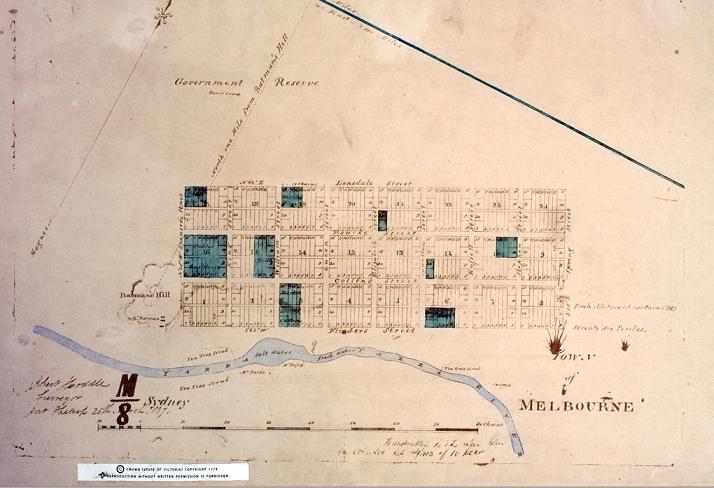
As she points out, Major Thomas Mitchell’s encomium of the beauties of Australia Felix and Robert Hoddle’s grid were both describing something that wasn’t there.  Mitchell feigned complete ignorance of the presence of indigenous people, while Hoddle just superimposed a public-service template onto the landscape. They were producing predictions, rather than describing extant realities.

There were, of course,  indigenous people right in the centre of Melbourne, and settlers had started building along their own natural contour lines, following the geography of the site before Hoddle got to it with his surveying tools. Even though the word ‘slum’ would not be used for another fifty years,  the Hoddle grid and the push to construct only wide streets was responding to a fear of the vice-ridden poor.

As you might guess from a journal called Postcolonial, there’s some fairly complex language in this article, but it’s an interesting reflection on map-making, symmetry and geographical fantasy.

Our very own new grassy knoll

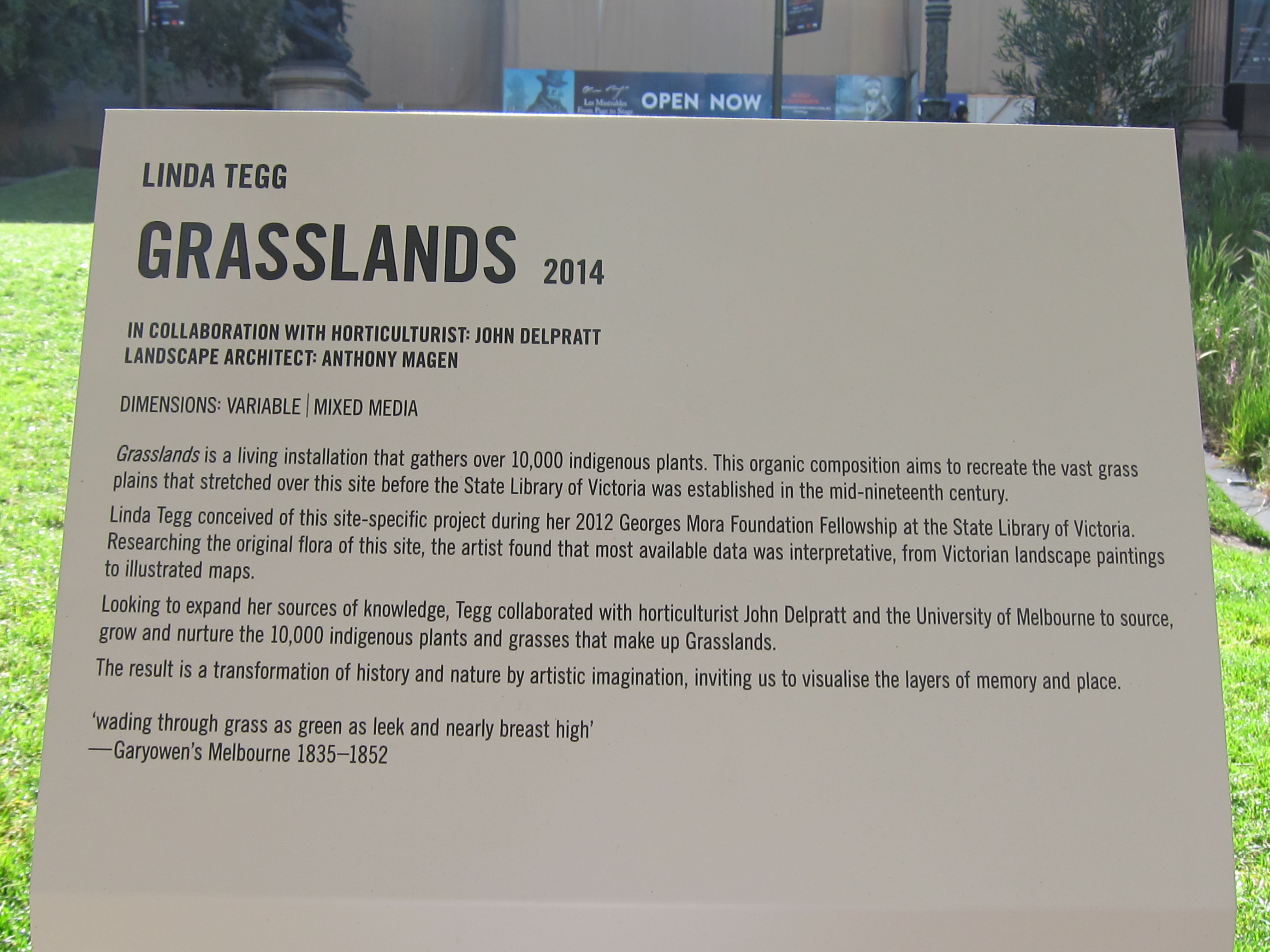
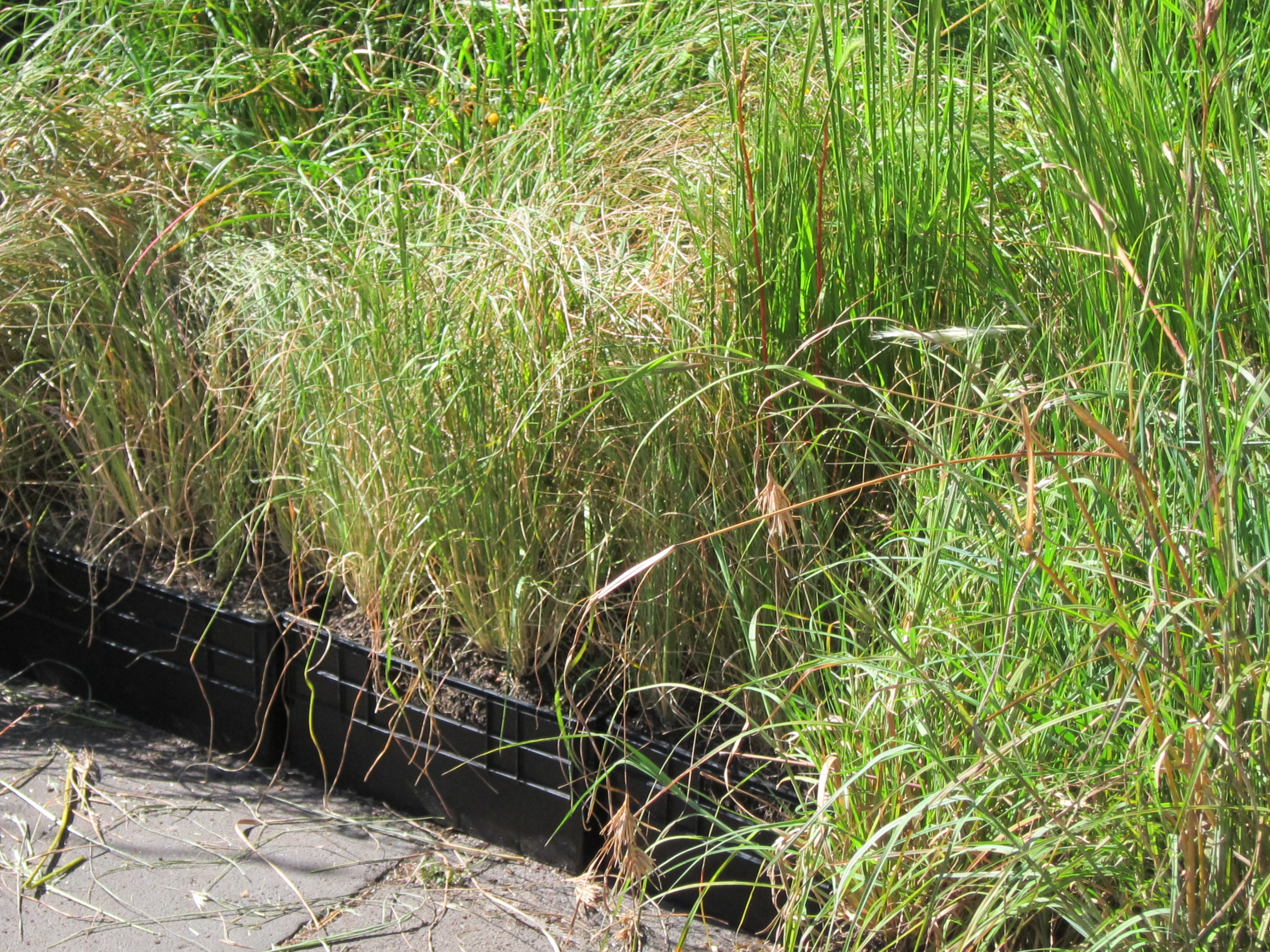
There’s an art installation on the steps leading up the State Library.  You might think of it as a garden, but it’s not.  (Click on the photos to embiggen)

Created by Linda Tegg and titled ‘Grasslands’, it is

a living installation that gathers over 10,000 indigenous plants.  This organic composition aims to recreate the vast grass plains that stretched over this site before the State Library of Victoria was established in the mid nineteenth century…. The result is a transformation of history and nature by artistic imagination, inviting us to visualize the layers of memory and place.

IMG_1121

It’s a good place for it.  I think of the grass outside the State Library as being the real heart of Melbourne.  As soon as the sun’s out, there we are, stretched out on the lawn with our shoes off, wriggling our toes.  The former City Square on the corner of Swanston and Collins opposite the Town Hall is now a gritty unpleasant desert since they sold half of it off and covered the rest with granitic sand.  And don’t get me started on Fed Square that alternates between icy blasts and baking heat.  I’m horrified that there could even be any consideration of letting high-rise buildings block the State Library forecourt: a planning restriction that we were told was sacrosanct (huh!). Just like the overshadowing of the south bank of the Yarra, which it seems is another no-go zone that becoming somehow negotiable.

Back to Grasslands.  It’s not intended to be a permanent installation. When you look at it closely, the grasses are still in their containers, laid out in pallets directly onto the concrete.

IMG_1134

It’s only intended to be there for six weeks.

There’s a fantastic little timelapse video of it being installed.  Watch it- it’s good! And just as I said, you can see people coming to sit and lie on the grass either side of the installation.

http://media.theage.com.au/news/national-news/timelapse-grasslands-by-linda-tegg-5868696.html

Having read Bill Gammage’s The Biggest Estate on Earth, I’m seeing my city differently.  A good history does that.  Gammage takes seriously the writings of early settlers when they described the land around them.

Here’s John Helder Wedge, Letter to Mr Frankland on settlement at Port Phillip, VDL Magazine, 1835 :

The country between the rivers [Maribyrnong and Yarra] extending to the north forty or fifty miles, and to the east about twenty-five miles… is undulating and intersected with valleys; and is moderately wooded, especially to the east and north-east; to the north there are open plains… The surface is everywhere thickly covered with grass, intermixed with rib-grass and other herbs. (cited in Presland, p. 27)

Or here’s the gardener James Flemming, who along with Acting-Lieutenant Charles Robbins and Charles Grimes the acting-surveyor-general sailed to Port Phillip in January 1803, prior to the Collins settlement at Sorrento.  They sailed right round the bay- the first of the British visitors to do so.

4th February 1803. Started at six and came to the branch we passed before [junction of Maribyrnong and Yarra] at the entrance the land swampy; a few miles up found it excellent water, where we saw a little hill [Batman’s Hill] and landed… went on the hill, where we saw the lagoon seen from the hill where we first landed.  It is a large swamp between two rivers; fine grass, fit to mow; not a bush in it [West Melbourne Swamp].  The soil is black rich earth about six to ten inches deep, when it is very hard and stiff. About two miles further went on shore again, the land much better and timber larger. (cited in Presland p. 13)

Although, then there’s George Arden’s report from his Latest Information with Regard to Australia Felix, the first book published in Melbourne.  He claims to be an eyewitness

When the writer first saw this settlement (Melbourne) in January 1838, a few months after its authorized establishment, it presented more the appearance of the villages he had seen in the interior of India; a nucleus of huts embowered in forest foilage and peering at itself in the river stream that laved the thresholds of its tenements, than any collection of buildings formed by European hands. (p. 68)

Hmmm. Don’t know quite what to do with that description.

And finally, good old Edmund Finn (writing under the pen-name ‘Garryowen’). Linda Tegg used this quotation on her explanatory panel:

From the spot whereon Melbourne was afterwards built to the Saltwater River confluence, the Yarra Yarra flowed through low, marshy flats, densely garbed with ti-tree, reeds, sedge and scrub.  Large trees, like lines of foliaged sentinels, guarded both sides, and their branches protruded so far riverwise as to more than half shadow the stream… As for herbage, it luxuriated everywhere, and two persons still living, who walked through un-streeted Melbourne in 1836, have informed me that in the places now known as Collins, Bourke, Elizabeth and Swanston Streets, they waded through grass as green as a leek and nearly breast high (Garryowen, Chronicles of Early Melbourne p. 497)

References:

Garryowen (E. Finn), The Chronicles of Early Melbourne, vols 1-2 (Melb, 1888)

T. O’Callaghan, ‘Fictitious History’, Victorian Historical Magazine, vol 11, no 1, Mar 1926, pp 6-37  (accessible through the SLV site)

Gary Presland Aboriginal Melbourne: The Lost Land of the Kulin People, 2001

A.G.L. Shaw A History of the Port Phillip District: Victoria Before Separation, 2003