Category Archives: Port Phillip history

An economic downturn 1840s style

What strange times we live in.  Each night, the news bulletin starts off with the financial report, extending over about ten minutes, then briefly the “other” news, then a return to the usual financial report, sport and weather.  Each morning I unwrap the paper and marvel at the increasing size of the headlines reporting on the latest falls on the Australian Stock Exchange, or Wall Street, or the FTSE,  or the Hang Seng.  How do I even know about such entities?  I think it’s probably indicative of the recent financial bubble that we’ve all been caught up in over the past 10 years,  that even before this crisis, every news bulletin has  the financial report as a staple item each night- I really don’t particularly remember it having such prominence, say, twenty years ago.  Ah, but we’re all investors now-unwittingly and sometimes unwillingly through our compulsory superannuation, and cajoled to “unlock the equity in your home” by drawing back on our mortgages to spend on the sharemarket.

And of course, it’s all on such a global scale.  There’s no shutdown period at all on a sharemarket somewhere- Australia wakes up and looks at what America has done overnight, responds by a rise or a fall on the ASX, the day moves on, that night the UK market responds, the US market responds to that, and it all goes around again.  There’s no sigh of relief of “thank God that’s finished”- although at least the weekend allows a global breather, until the whole merry-go-round starts again on Monday.

Our whole system is predicated on credit in a way that is largely unconscious and invisible to us.  With just-in-time manufacturing, there are no storehouses any more of goods waiting to be sold- instead the credit system balloons forward to buy in a consignment as it is needed right now, retracts when it’s sold only to balloon out again to replenish the shelves next week.  We’re bombarded with “buy now, no deposit!!” advertising; we’re asked as a matter of course for every transaction with a swipe card “will that be on credit?”

And so, conscious of all this, I’ve been thinking about the recession (depression?) in the early 1840s in Port Phillip, and the way it impinged on the worldview of people there at the time.  I surmise that, like me, their understanding at the time was incomplete:no doubt more so, given the four-month delay in any information from Britain compared to our instantaneous communications now, and the dependent state of a colonial economy within the Empire as a whole. What they understood of the financial situation was filtered through the newspapers, gossip, and lived economy of their own experience.

Contemplation of this- and I’m doing quite a bit of reading on this which I shall, dear reader, share with you- is not completely irrelevant to my Judge Willis thesis work.  As sole Resident Judge, he heard all of the civil cases that came to the Supreme Court; he oversaw (but was not directly involved in) the Insolvency Court, and his own propensity to “sift to the bottom of things” characterized his approach to the bankruptcy cases that crossed his bench.  I feel sure that the general ‘anxiety’ and ‘excitement’ of Port Phillip reflected both the economic and political currents of the day, and directly fed into his dismissal.

So how did the Port Phillip communications of the day portray the financial crisis?  Newspapers had always carried a column showing the price of goods on the local market -wheat,  bread, spirits, sperm candles, parsnips etc. (The parsnips have particularly taken my attention because at my local supermarket they have been $5.95 per kilo for the last few months.  For bloody parsnips!!!!! Fine words may butter no parsnips, but obviously $5.95 a kilo will!)  The shipping reports were often followed by correspondence from the wool agents in London, reporting on the wool sales- generally chiding the Australian suppliers for lack of quality, and sighing at the dearth of buyers.

Much of a four-page Port Phillip newspaper of the 1840s was devoted to Court reports, and as the judicial system expanded in Port Phillip, so did the scope for court reporting- the Supreme Court, the Insolvency Court, the Police Bench, Quarter Sessions, the Court of Requests.  The tales of drunkenness and violence that ran through these courts were increasingly supplemented by stories of insolvency, defections from debt, unemployed immigrants, forced sales etc. as we move from 1841 into 1842.

And increasingly as we move from late 1841 into 1842 there are also  the required advertisements of bankruptcy posted in the newspaper, notifying of the first, second or third creditors’ meeting of one bankrupt after another.  By April 1842 (which is where I’m up to at the moment), the Port Phillip Herald regularly published a table of insolvent debtors, their assets and liabilities, and the dates of their scheduled meetings with creditors.  Real estate advertisements spruiked  “we’re at the bottom of the market- so buy now!!” . Occasionally there would be a high-profile insolvency case that demonized a particular individual, surely read  and gossiped about with a sense of schadenfreude by the subscribers to the newspaper.

And all of this occurred within the bullishness and heightened expectations of people who thought they were coming to “Australia Felix” to make their fortunes!
On this day in September 1841

From the Port Phillip Herald 24th September 1841

CONJUGAL SCENE.

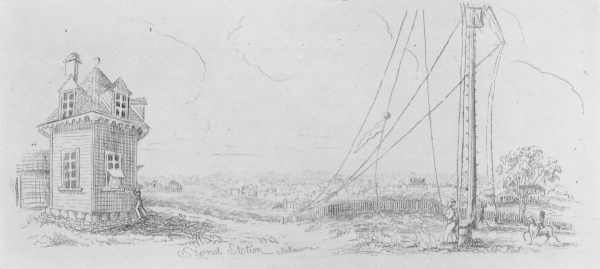
On Wednesday, one of the scenes which occur so frequently in this town and which tends to exemplify so strongly the dogma frequently advanced, that a great portion of the Emigrants landed on these shores are immoral, was to be witnessed in King street.  A female of rather prepossessing appearance, who arrived a short time since as an emigrant, was proceeding towards the Flag-staff enjoying the serenity of the morning in the company of a tall moustached being of the male gender.  Arm in arm the parties progressed along the streets now and then exchanging sundry symptoms of mutual affection.  Unfortunately however for the equanimity of all parties concerned, the scene was destined soon to be interrupted.  There was seen to advance from a contrary direction a two legged animal, one of that species expressively denominated “a man” but what kind of one our readers will soon learn.  A creature about four feet nothing, whose body was any thing but resembling that of our Melbourne Falstaff, whose frontispiece was a conglomeration of parts, more appropriate to the frame of larger beings.  With rapid but not extensive strides the little man sidled along, till a walk was changed to a run.  Fire flashed from his eyes and fury from his mouth, on a near approach to the loving couple, his feelings found vent in the following expressive words, “What! is it to be a witness of this, that I have come to Australia, to see my wife the leman of a false and ignorant puppy, oh! would that I was in England, I would have justice, but here these things are fashionable,  and I am to be a miserable being for the rest of my existence; oh! villian I will be revenged.”  A storm of words ensued, rapid as the gushing torrent, abuse fell from one party, and threats of vengeance from another, which at length was ended by the man wot wore the moustachios saying, “what! is it a diminutive creature like you that dares insult me in the street and endeavour to force from my society a lady; begone!”  Actions followed fast upon the words, the little man was seized, raised aloft, and hurled with impetuosity into one of those clean spots with which Melbourne abounds.  During the scene, the lady gave vent to her feelings in tears, but on the completion of the above mentioned feat of bravery, she seized the arm of her chere amie and hurried him affectionately from the spot, leaving her husband bruised, and injured both in body and mind, to console himself as he best might.

A couple of observations about this little vignette:

1. Although there are often descriptions of street scenes in the newspapers, there are very few describing women.  Where a woman appears at all, it is often a 2 or 3 line description of some accident and misadventure befalling her. In fact, this is the only lengthy article of its type that I have found,  where there is mention of public affection between a man and a woman, and where she seems to have some (albeit limited) agency in the episode.

2. It takes place in King Street, near Flagstaff Hill.  In the early 1840s, the centre of Melbourne was located more to the west than it is today, in the square roughly bounded by King, Lonsdale, Elizabeth and Flinders Lane, with a concentration around Market Steet and Collins Street.  By walking up King Street to the Flagstaff Hill, they were walking out of the city up to its highest point- the Flagstaff- where flags were displayed showing the ships that had come into harbour.

As Garryowen says, Flagstaff Hill

“was the pleasantest outside place in Melbourne for a Sunday or week-day evening stroll.  The reported incoming of an English ship would draw crowds there, and they stared with anxious, wistful gaze as the ship beat up the harbour, yearning for the home letters, of which she might be the bearer, of good or evil news, the harbinger. (p. 570)  … It was “where all the Melbourne ‘world and his wife’ used to take their outings on Sundays and holidays, and on every other day when they had the time or inclination to inhale the fresh country air (p. 9)

3. There’s moral judgements at work here.  Moustaches were viewed with some suspicion- certainly Judge Willis castigated the “dandified solicitor” Edward Sewell for wearing a moustache in his courtroom.  The public displays of affection would be frowned upon by respectable readers, and the description of the woman as “prepossessing” is ambiguous.  The language also slips between “female” and “lady”, suggesting uncertainty about her social status.

4. The article as a whole reflects the anxiety that Port Phillip inhabitants felt about emigrants.  While rejoicing in the fact that Port Phillip was not a convict settlement, the inhabitants – or at least the Port Phillip Herald- remonstrated when too many emigrant ships arrived at one time, particularly when their passengers embarked into an economic situation of unemployment and insolvency.  There were criticisms of the emigrants who hung around the emigrant tents for too long, disdainful of wages that they felt were too low- the 1840s version of “dole bludger”.  In particular, there was anxiety over unaccompanied female emigrants.  In general emigrants were encouraged to go ‘up country’ as soon as possible to work as farm labourers or domestic servants.  At the same time, though, the growth of the economy depended on the influx of new settlers and their demands for housing and consumer goods.  Come to think of it,  I think I hear echoes of the debate about Melbourne’s growth today…..

Retiring judges

One of my middle-of-the-night anxieties involves the degree of presumption I’m revealing in even attempting to comment on a judge’s career. After all, what would I know? Hell, I’ve only ever sat in the public gallery of a court!

So I was pleased to hear an appraisal of the retiring Chief Justice Murray Gleeson on Radio National’s Law Report the other morning by George Williams, from the Law School of UNSW. This is how Williams summed up the Chief Justice’s career

George Williams: I think you need to look at his role on the court in two different ways: one is as a judge, one amongst seven, and as a judge he’s well-known for writing judgments that are concise, that are direct, that really do get to the nub of the question of law, and he has a very strong reputation as being one of the leaders of the court over the last decade. As a Chief Justice, you can look at his public role, he’s someone who’s spoken strongly on behalf of important legal principles, he’s defended the court, and he’s been prepared to get involved in the media in discussing some of those issues.

Where he perhaps hasn’t had the same impact is perhaps changing the way the court operates internally. He’s been a good administrator, but we don’t have a court that’s perhaps made leaps and bounds in terms of moving towards more of a joint judgment system like the United States. It’s a court very similar to the court he inherited, and he hasn’t been a reformer in terms of changing those basic practices.

How do these criteria stack up with Judge Willis?

1. The quality of his judgments. Well, I’m not a lawyer, but it seems that his judgments were well thought through. Certainly he showed independence of thought- he was quite happy to go out on a limb and take a different stance from his brother judges- in fact, I suspect that he revelled in so doing.

2. Public role- speaking out on behalf of important legal principles. Certainly he was outspoken, but were they important legal principles or just a form of point-scoring? The scrutiny of the actions of public officers was important- but was it HIS role to do this? His stance on Aborigines- at a surface level contradictory, but on deeper reflection was based on important legal principles. But there’s always a “but” with Judge Willis. There’s a certain amount of ‘playing to the gallery’ in relation to settler rights in relation to Aborigines, the independence of Port Phillip from Sydney oversight, and the superior quality of Port Phillip without a ‘convict taint’. And his public role was certainly ambiguous- he absents himself from many of the public roles within Port Phillip Society e.g. patron, benefactor etc, and prides himself on holding himself separate. Yet the same man is heard gossiping loudly on street corners, and giving vent to political opinions in the shops.

3. Preparedness to get involved in the media. Probably too much. A bit of distance here would have been ‘judicious’ (groan)

4. Good administrator. He certainly was a good manager- ferocious in championing his own sphere of influence (BUT was that just a way of big-noting himself?) He resisted funding cuts strenuously (BUT ditto?); he was loyal to employees who were loyal to him (BUT did he need to shore up his position?). I’m sure that he volunteered to come to Port Phillip precisely because it gave him the opportunity to establish a court from scratch, based on his own principles and predilections. No doubt he had sniffed the political wind, too, and hoped that when Port Phillip became a separate colony, he would naturally become Chief Justice.

I don’t know if any of this has taken me any further, but it’s interesting to see what the criteria for judging judicial ‘success’ might be.

On Rhodomontade

It would seem that there is no longer a Melbourne Debating Society. I’ve found the Debaters Association of Victoria Inc. but no sign of a Melbourne Debating Society. Which is rather a shame, as it was one of the earliest civic and ‘intellectual’ societies of Melbourne.

Edmund Finn writing as ‘Garryowen’ tells us that the debating society commenced in 1841 with a Managerial Board consisting of President: Hon. James Erskine Murray; Vice-Presidents: Rev. James Forbes and Surgeon A. F. Greeves; Chairman: Mr J.G. Foxton; Committee: Messrs James Boyle, G.A. Gilbert, R. V. Innes, D.W. O’Nial and J. J. Peers; and Treasurers Messrs. Thomas B. Darling and E. C. Dunn. The Herald of 12 October 1841 reports its first meeting. It appears to have met weekly, on a Wednesday evening, although sometimes on a Friday.

In his book The Capacity to Judge: Public Opinion and Deliberative Democracy in Upper Canada 1791-1854, Jeffrey McNairn highlights the importance of voluntary organizations in the development of “democratic sociability” i.e. that it was possible for men to deliberate in public, using argument. In particular he highlights literary and debating societies as a site for this development. So perhaps it just wasn’t that there wasn’t anything on in Port Phillip on a Wednesday night….

Garryowen continues:

This Society attracted to its ranks most of the talent of the town. Weekly meetings were held at the Scots’ Schoolroom on the Eastern hill of Collins Street, and considerable debating power was rapidly developed. It was not a mere ordinary school-boy exhibition of vapid declamation and puerile rhodomontade, but an intellectual gathering, where questions of interest to the community were good-humouredly, intelligently, and patiently discussed.

Rhodomontade??!! Now there’s a word to conjure with!!! Merriam-Webster tells me that it means “bragging speech, vain boasting or bluster”. Well, there was certainly scope for some rhodomontade at the Melbourne Debating Society because here are the topics that I’ve found in the Port Phillip Herald so far

  • Topic in October: “The motives which actuated Brutus and other conspirators in the assassination of Caesar”. The meeting came to the conclusion that “the death of Caesar resulted from patriotic motives”
  • Next topic “Whether America or any other nation will ultimately supplant Great Britain in the scale of nations”. Conclusion- no, Britain reigns supreme
  • November topic “Whether India has been befitted by British Connexion?” No clear cut result here – the meeting adjourned after a long discussion.
  • The November topic“Was the conduct of Elizabeth towards Mary, Queen of Scots, justifiable?” provoked a “long an animated discussion” but the meeting was all but unanimous for the negative. I suspect that the strong presence of Scots emigrants held sway here- there’s a heavy preponderance of Scots on the committee (President, and both Vice-Presidents at least), and the meeting is being held in the Scots school room
  • December: “Whether the character of King Charles the First is entitled to respect? The question was decided in the affirmative.
  • January “Is the practice of dueling justifiable?” also decided in the affirmative
  • February “Are literary and scientific pursuits suited to the female character?”, again decided in the affirmative
  • “Is Phenology founded on reason and the evidence of acknowledged facts?”.

At the stage I’m up to in my reading, the Phrenology debate in late February was postponed because of the imprisonment for contempt of court of one of the members of the society, the young Port Phillip Gazette editor George Arden, on the orders of Judge Willis, the ‘real’ Resident Judge of Port Phillip. The night was spent discussing the imprisonment, and a petition and address signed to George Arden (although from what I can find at the moment, not actually made public)

Here the Melbourne Debating Society spilled over into Politics with a capital ‘p’. As McNairn pointed out in relation to the Canadian debating societies:

P. 90 “The political significance of debating societies thus lay more in their guiding principles and in the skills and sociability they fostered than in the content of their meetings. Since most brought together men from various religious and partisan affiliations, denominational and political controversy was shunned and, in most cases, prohibited. Societies provided a haven from the less-controlled debate of public politics, but as training grounds their political role was undiminished.”

The Melbourne Debating Society had been grappling with the issue of religious and partisan affiliation from its commencement.Within the first months, there was discussion over whether rules should be promulgated for the quoting of scripture, and one of the December meetings was turned over to a discussion of ‘the expediency of countenancing the discussion of polemical and political subjects by the society’. At its 31 December meeting (no New Years Eve frolics here!) it was decided to prohibit  religious and political discussions.

Am I surprised by the topics chosen? It seems that they draw on a shared knowledge of British and classical history (a knowledge that could by no means be assumed today) and an awareness of Britain’s wider empire- at least in the United States and India. It’s important to remember that these debates are conducted within the politics of their time: the 1857 Sepoy rebellion in India had not occurred; the United States at that time included the original 13 states and the states ceded through the Louisiana Purchase, but the western 1/3 of what we now know as the United States had not been annexed at this stage. Australia hadn’t seen the last of dueling: Sir Thomas Mitchell and the politician Stuart Donaldson fought a fuel over allegations of extravagance in the Surveyor-General’s department in September 1851!! (and I thought politics today was all theatre!)

I was fascinated by the “female question” debate, which was reported in some detail on 8th February 1842. It’s very hard to find reports of public activities of women in Port Phillip in the 1840s, but on 30th November, the Debating Society decided that in future ladies will be admitted, “their fair presence and patronage being secured, victory is certain.” They were certainly present for the Charles the First debate, which was “graced by the presence of ladies”. However, there is no further mention of a female audience in later reports, which seems odd given that the February debate centred on “Whether literary and scientific pursuits are suited to the female character?”. Certainly, if they were there, they didn’t contribute to the debate- only men ever spoke.

The Hon. President James Erskine Murray opened the debate in the affirmative by enumerating various females of literary distinction, and asserting that they were rendered “more sensible and conscientious in the discharge of their domestic duties” than women of limited capacity and neglected education- “in short, that it was easier to direct the intelligent than the ignorant”. The respondent, Mr Osbourne, contended that woman was not by nature intended mentally or physically to sustain the labour of acquiring that superior extent of knowledge, and that it would interfere with her devotion to domestic affairs. Women would no longer be fascinated by respected individuals of the other sex “upon whose opinions she rests with confidence as the safest code of general direction”- instead of being fascinated, they would actually take a part in literary and scientific discussion! Thoroughly modern SNAG as he was, however, Mr Osbourne commended the more beneficial system of education that has become prevalent in Britain, America and Europe where “all the pretty nothings which at one time formed the almost entire course of female education” had been replaced with general principles of science and useful literary studies. The Hon James Erskine Murray, in reply, decried this education that made women “in many instances as only fit to hearken to the insipid babblings of young men in preference to intelligence and rational conversation” He instanced Mrs Somerville, Lady Jane Grey, Mrs Clarke, Johanna Billie, Edgworth and others. Mr Smith, speaking for the negative, accounted for the difference in ability between men and women by a description of the respective skulls of the two sexes. Mr Stafford, for the affirmative, brandished Mary Stewart, Elizabeth, Catherine II and the Countess of Pembroke to shew that the sex gave evidence of genius , which no system of exclusion could obscure.

The warmest applause of the evening went to Mr Smith who “alluded to the domestic happiness to be experience by a Benedict, who, returning to dinner after the duties of the day, instead of finding the rump steak and oyster sauce &c. smoking a welcome to his appetite, finds his lady so deeply immersed in Euclid, or buried in the mysteries of Algebra, as to let him cater for himself.”

And so the evening ended. As the Herald concluded:

The subject of debate, as far as opinion went, had, we imagine, been decided in the breast of every one ere the discussion commenced. The question was too loosely and generally given for an advantageous discussion, and was decided in the affirmative.

So there you have it.

References:

 Finn, Edmund The chronicles of early Melbourne, 1835 to 1852 : historical, anecdotal and personal / by “Garryowen”, Melbourne, Fergusson and Mitchell, 1888

McNairn, Jeffrey, The Capacity to Judge: Public Opinion and Deliberative Democracy in Upper Canada 1791-1854, Toronto, University of Toronto Press, 2000.

Hey, I used to work there!!

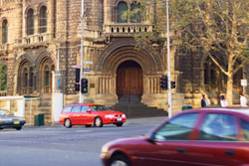
I see from an article in the Age that the Fitzroy artist Alexander Knox has created a light installation on the old Royal Mail building, on the corner of Bourke and Swanston Street.

Wow! That looks better! By light of day it really is a rather unprepossessing modernist building. Whenever I see that AC/DC film clip of the band travelling down Swanston Street on a flatbed truck, I notice ‘my’ building and try to imagine that it was ever viewed as anything except ugly.

What was there before? Apparently, the Royal Mail Hotel, built in 1848 and named because its owner E. B. Green had the contract for carrying mail by stagecoach throughout Victoria. Its second licencee was William Johnston Sudgen, previously Melbourne’s Chief Constable – nice little career shift there.

According to Robyn Annear’s A City Lost & Found, construction works to modify the building during the 1930s uncovered a wall containing bricks bearing thumbprints- generally considered to be a mark of convict manufacture. The brick-clay was examined by a visiting Tasmanian, who asserted that it was of Port Arthur origin, and the bricks were declared to be among Melbourne’s oldest.

(I am ashamed to confess that I have wasted nearly half an hour investigating when convicts were withdrawn from Port Phillip- a wild-goose chase prompted by my failure to finish reading the paragraph in Robyn Annear’s book! Stopping mid-sentence at the words “convict manufacture”, it struck me that 1848 was very late to have convicts still working in Melbourne. Half an hour later: I was right. Convict transportation from UK to New South Wales was suspended in 1840, and on 28 Oct 1843 Governor Gipps instructed LaTrobe to send the remaining convict gangs in Port Phillip up to Sydney. But they were still here 0n 13 December 1844 because Gipps again proposed withdrawing all the convicts, in exchange for the receipt of a cargo of Exiles- prisoners who had served 1-2 years in Pentonville prison before being issued with conditional pardons to take up as settlers (not prisoners) in New South Wales. A.G.L. Shaw writes that 1727 Pentonville exiles had landed in Port Phillip between 1844 and 1849 until popular protest against them culminated in the turning away of ships containing exiles and redirecting them to Sydney. So- Port Phillip convicts didn’t make the bricks in 1848. As, of course, Robyn Annear went on to say, had I read further.)

According to the excellent Walking Melbourne site, the old Royal Mail hotel was sold to the British company Hammerson Property and Investments Trust for 455,000 pounds. In October 1960 the hotel was demolished and this wonderful structure erected in its place.

I worked on both the fourth and third floors from about 2003-6. At first I was on the third floor in an office without windows located just behind the blue billboard at the bottom of the picture at the top of the page. At the time, there was a television screen mounted on the building, and I used to fantasize, in moments of extreme boredom, of sticking my head through the wall and emerging in the middle of the screen to survey the people below. I later moved onto the fourth floor to the rear of the building where my window overlooked the rooftops of the rather unsavoury cafe/restaurants fronting Swanston Street. However, it did give me a new appreciation for the copulatory habits of pigeons who inhabited the ‘pigeon brothel’ there.

On the other hand, working there did give a wonderful view of Melbourne. The Melbourne Cup march would go straight past, and political marches would stream by. Unfortunately the AFL Grand Final march turned up Collins Street instead, so I couldn’t watch that one. There’s a great little ‘structure’ of a pig with wings mounted on a pole on the corner which you can only see if you look up, but was directly in our line of sight. When the building across the road (that in my childhood had a rather evil Santa beckoning children onto the Foy’s rooftop garden each Christmas) was owned by Nike, we would watch spellbound as huge advertising posters were erected obscuring the building completely. However, the metal-man busker with his synthesizer loses his appeal after listening to him all day, and dog-lover though I am, a bait would be too good for the cattle dogs who bark twice at the end of each line of ‘How much is that doggie in the window?” sung ad nauseum for hours by the Slim-Dusty lookalike on the corner opposite.

So, good on you Alexander Knox. It looks beautiful, and I can’t wait to see it.

July 25 1842- a momentous day!

Today is the 166th anniversary of one of the most momentous ceremonies in Port Phillip up until that date- the laying of the foundation stone of the new court house. The 25th July 1842 was a “black and lowering day”, and the ceremony itself had been postponed because of inclement weather. But at 12.00 o’clock, just as the procession was about to begin “the sun burst forth with all his splendor and dissipated the clouds of mist and vapour, all nature seemed to rejoice, while contentment and happiness beamed forth from the countenances of the assembled multitude.”

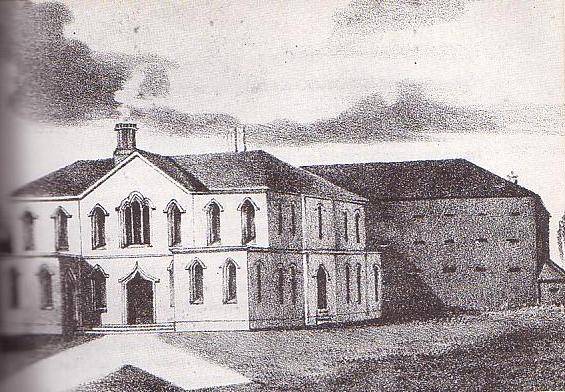
Starting off from the old court house (seen above in my header), this was some procession!

The Ranger on Horseback

Mounted Police

Melbourne Police

Band

The Schools

Odd Fellows

The Ancient and Honorable Fraternity of Free and Accepted Masons

Civil Officers of Government

Chief Constable on Horseback

Magistrates of the Colony (two and two)

Civil Officers of the Government who are heads of Departments (two and two)

Tipstaff of the Court

Members of the Bar

Police Magistrate and Staff

The Resident Judge (supported by the officers of his Court followed by members of the legal profession) (two and two)

Inhabitants

It was estimated that 4000 people were in attendance: quite a turn-up in a city of about 7000 people. The presence of the Masons is emphatic and striking. The involvement of the school children is heart-warming. But where was Superintendent LaTrobe??

The procession wended its way along Collins Street, up Elizabeth Street and turned right along Lonsdale Street to make its way to the site of what is now the closed City Court on the corner of Russell and LaTrobe streets. This location was in close proximity to the newly-completed Old Melbourne Gaol just behind it and was on the outskirts of the settlement.

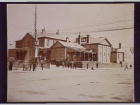
Peter Ackroyd, in his book London, described that city as a palimpsest where different iterations of buildings, often serving the same purpose, were built on the one spot. This is true here: the ‘new’ Supreme Court building built in 1842/3 was demolished by the end of the century, to be replaced by the City Court (which to my eye looks much older than that). It is no longer used as a court, and has been taken over by R.M.I.T.

The ‘new’ Supreme Court building was the most expensive erected in Port Phillip to that date, with an initial quote of 7480 pounds (Deas Thomson to LaTrobe 23 July 1842). There was professional jealousy and argy-bargy between Lewis, the Colonial Architect up in Sydney, and Rattenbury the Clerk of Works here in Melbourne over the size, design and cost of the building. In particular, Lewis was critical of the lancet windows that Judge Willis was particularly enamoured of.

Supreme Court 1843

Supreme Court 1843

The 'new' Supreme Court

The 'new' Supreme Court 1900s prior to demolition

There’s something rather ironic, and if I am to be charitable, bitter-sweet about Judge Willis’ oration to the assembled crowd:

He added that in all probability before its walls were grey with age he would long have left them; but that wherever and in whatever position he might be placed, his warmest wishes and best exertions would ever attend the colony, which if left to its own resources and own self-government, unshackled by other districts, would rapidly rise in general prosperity and be the first province of the crown in this hemisphere.

Port Phillip Herald July 26 1842.

A bit of playing to the gallery there: Port Phillipians were clamouring for self-government, and the Sydney/Melbourne rivalry that still exists today was there in 1842 as well.

Warmest wishes for the colony? Bah! He fulminated about Port Phillip and Gov. Gipps the whole way home.

And as for the walls being grey with age? Not likely. They hadn’t even finished painting the building when he headed off for home, after being dismissed. It opened for business as his ship sailed for South America. He’d laid the stone; he’d gone for a stroll each time to inspect the progress; he’d pushed for those lancet windows…but he never got to sit in ‘his’ court. It opened the week after he left, with his successor, Justice Jeffcott presiding.

Kangaroos?

My work for the last couple of weeks has been carefully reading the Port Phillip Herald.

I’ve been mystified by this advertisement which has been appearing regularly, issue after issue :

“WANTED. A Female Kangaroo. Apply at the Herald Office”

And now, on 10 December 1841 we have:

“FOR SALE. Two thorough-bred Kangaroo Pups, 5 months old.  Apply at Herald Office. Melbourne 6 Dec.”

What’s going on here?  I’m not sure if the advertisements refer to kangaroos (as in hopping marsupials) or whether they refer perhaps to kangaroo dogs?  James Boyce, in his excellent book ‘Van Diemen’s Land’ talks about the dogs used to hunt kangaroos, but in VDL they were known as the deerhound, the Irish wolfhound, Irish greyhound, Highland deerhound and Scottish greyhound.   Boyce writes:

Killing by the neck a full-grown kangoroo or emus was a difficult and dangerous affair, even for such powerful canines. Speed was of the essence, which led to the wolfhounds being crossed with greyhounds. One immigrant reported on the outcome of such breeding: “the dogs used here to hunt the kangaroo have the shape and general character of the greyhound, but are very much larger in size, and coarser all together, uniting great strength with speed. (James Boyce, Van Diemen’s Land p 24)

After all, how can a marsupial-Kangaroo be anything else other than pure-bred?  Did they know the term ‘joey’ for a young Kangaroo?  Why would anyone WANT a female kangaroo?

Farewell Judge Willis- July 1843

I seem to have missed the anniversary for Judge Willis’ departure from Port Phillip. After all, where else to start but at the end? It hasn’t just been inattention though: Behan (unreliable fellow that he is) dates the departure as the 18th July 1843 (Behan p. 285); The Patriot (13 July) dates his departure as that day; while the Gazette and Herald list the Glenbervie ‘clearing out’ on the 12th and ‘sailing’ on the 14th. I’m not really sure what the distinction is between the two terms: I assume that ‘clearing out’ involves moving from  moorings in Hobson’s Bay while perhaps ‘sailing’ denotes passing the Heads?

Nonetheless, it seems that on a wintry mid-July day, a crowd of people stood at the wharf, watching Judge Willis board the paddle steamer Vesta to be taken out to the barque Glenbervie anchored further out in the bay, headed for Valparaiso and home. I can assume that they left from Coles’ Wharf.

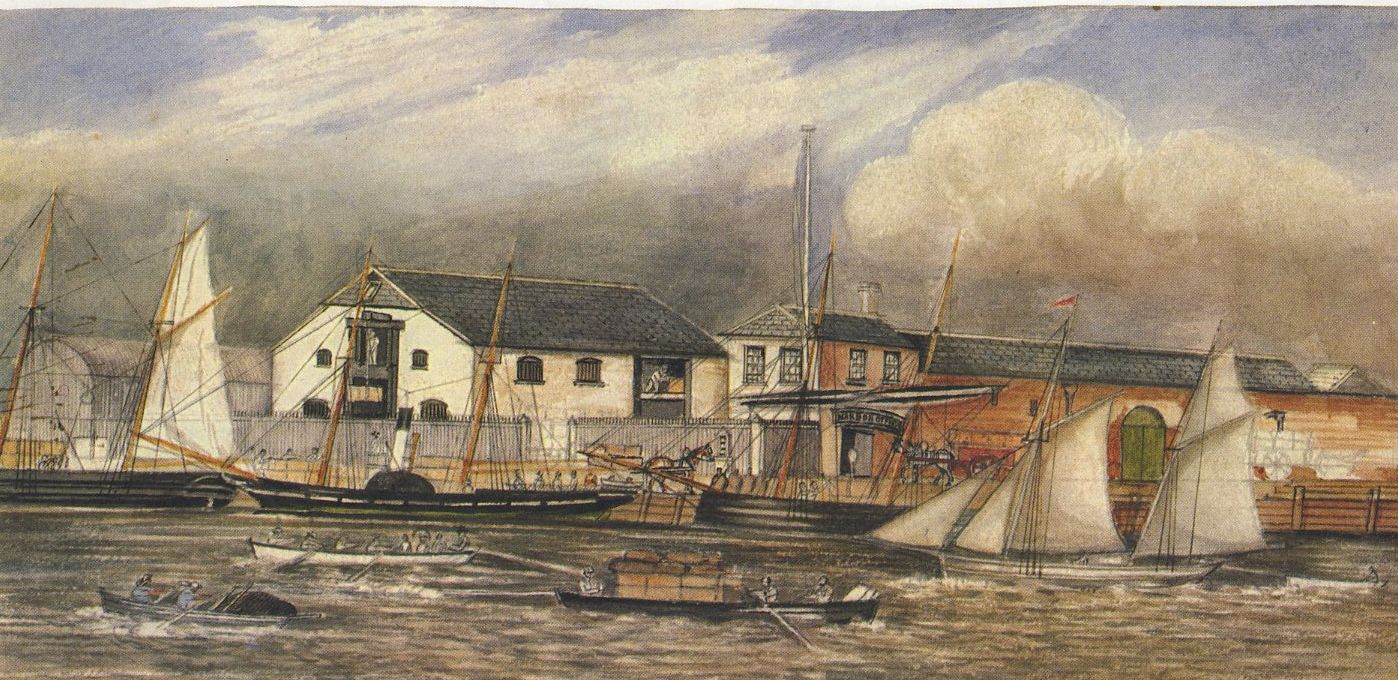
Coles Wharf was constructed between William and Queen Street by George Ward Cole (who later married into the McCrae family)in 1841 along the banks of the Yarra by building on sunken ships’ hulls (www.portaustralia.com/port-melb.htm) . At the time, the Yarra was bisected by falls roughly at the bottom of Queen Street. Above the Falls was fresh water- crucial to the small village, and below the Falls was saltwater. The maintenance of the falls to separate freshwater from saltwater was of vital importance initially, even though the presence of this chain of rocks across the river prevented ships from traveling further upstream. Much time and attention was to maintaining the Falls but by 1880 they were finally removed as part of river engineering works.

Here’s a description of Coles Wharf from The Times 22nd August 1853 that is perhaps a little less glowing than Liardet’s picture above.

There are two landing-places, and the steamers stop at the worst, called Cole’s Wharf. An enormous amount of traffic has certainly been thrown suddenly upon this spot; but, considering the revenue derived from it by the proprietors, something might have been done to redeem it from being, as it is, a disgrace and scandal to the city. Goods are tumbled on to the bank, and the drays back up to them to be loaded through pools of black mud, in which they stand nearly axle-deep. Boxes, cases, and bags (no matter what their contents) may roll into the slush, and stay there soaking till called for. Expensive as horseflesh is, half the power of the animals is wasted in getting out of these pits and the deep ruts of the roadway, which a few loads of stones would fill and level. There is no shed to protect goods liable to be damaged by rain. Reckless indifference to everything but collecting the enormously high freights up the river, and the still higher rate of carriage to the city, seems to be the rule. Combined, these charges have frequently amounted to more, for a distance of six or seven miles, than the freight of the goods from England. The other landing-place, the Queen’s Wharf, is a little higher up the river, and here the accommodation is much superior, a proof that improving is not so impossible as represented.

I stood where the wharf was today. It’s hard to picture it. The smell of chip oil is too strong as it wafts from Flinders Street Station and the roar of the traffic is a constant background noise. I’m sure that the air must have been saltier and tinged with wood smoke from the paddle steamer. Perhaps it sounded like Echuca, with the steam whistles, the shouts while loading and unloading goods and the sound of horses’ hooves in the streets behind. The sky would have seemed bigger with no high-rise towers, and the green of the bush would have crept up to the river banks in places, or formed a backdrop against the horizon. But today, like then, there is a stiff breeze that blows across from the water.

The Port Phillip Patriot (13 July) announced:

THE LATE RESIDENT JUDGE

His Honor Judge Willis embarks for England today by the Glenbervie, and will probably leave this port in the course of tomorrow. A large number of our fellow townsmen have signified their wish to accompany his Honor or board, and the Vesta steamer, has in consequence been engaged, to convey the numbers who are desirous of joining in this last tribute of respect before his Honor’s departure from our shore, whence he carries with him the esteem and veneration of nine-tenths of the whole community.

The steamer will leave the wharf at eleven o’clock; it will be necessary, therefore, to be in attendance punctually at that hour.

And a couple of days later, The Port Phillip Gazette (15th July) reported:

On Thursday last, at 12 o’clock, His Honor Mr Justice Willis took his departure from Melbourne, in the Vesta, steamer, which had been specially engaged for the purpose. About four hundred of the inhabitants were in attendance at the Wharf to bid His Honor farewell. Several gentlemen accompanied His Honor down the river, and saw him on board the Glenbervie. A general gloom seemed to prevail on the Vesta heaving her moorings with our late talented and injured judge on board.

Who were those gentlemen, I wonder? I can’t imagine that any of the men who had signed the petitions against him would have been in attendance. Probably those men who had supported him throughout- Verner and the Boldens, perhaps Rev Alexander Thomson from St James? Were there manly handshakes, throat-clearings and fine sentiments expressed?  Was there genuine pain, or did the bluster and bravado of injured feelings and outrage dominate?

Were their wives there, I wonder? Mrs Willis, who was to deliver her second child when the ship docked at Valpairaso- had she overcome the queasiness of morning sickness as the steamer throbbed towards the Glenbervie? What a tumultuous three weeks- their possessions were sold off in Heidelberg’s First Garage Sale, and they shifted into the Royal Hotel in Collins Street to make their final preparations. Did she have friends that she was leaving behind? When did they make their farewells? Like so much else of women’s experience in early Port Phillip, this is another male dominated performance. The women may have been there, but we just don’t know.

And what happened next, as the paddle steamer moved up along the river, out of sight with perhaps just a smudge of smoke to show that it had ever been there? Perhaps there was another round of cheers, but eventually the crowd would have to disperse, picking its way through the muddy Melbourne streets (Port Phillip Herald 18 July). And Judge Willis, his wife and child headed for home.

W.F.E Liardet and the documenting of history

You may wonder about the picture I’m using as my header at the moment. It’s a picture of Judge Willis and his legal officers entering the first Supreme Court building for the opening of the Supreme Court in Melbourne in April 1841. You may think that it’s a rather humble building, and you’d be right. It had previously been used as a government store, located on the corner of King and Bourke Streets. By the following year construction had commenced on a new Supreme Court building, on the site now occupied by the closed City Court Building on the corner of Russell and La Trobe streets. Although Judge Willis took a proprietorial interest in the “new” building, he had been dismissed by the time it opened.

This painting was one of a series produced by W.F.E. Liardet who himself is an interesting character.

Born in England, Wilbraham Frederick Evelyn Liardet had inherited a fortune of 30,000 pounds which he managed to fritter away- now, this is some frittering, because Judge Willis’ wage was 1500 pounds a year so we’re looking at 20-odd years worth of Judge’s wages. Once the fortune had been exhausted, he, his wife and nine children emigrated to Australia, with good contacts with Governor Bourke in his pocket and the intention to establish himself as a pastoralist. Wilbraham and his four older sons travelled steerage to save expense while his wife and younger children travelled intermediate class. On arrival and faced with the utter chaos of disembarking in Hobson’s Bay, he recognized the entrepreneurial opportunity to establish a ferry service to the ships in the bay, connected to a carriage route along the lagoon to the banks of the Yarra in Melbourne- a transport monopoly at the time as until then people had had to row the eight and a half miles upstream. He established a hotel on the Port Melbourne beach, started up a mail run and became a noted Melbourne personality.

However, he never actually obtained land title for his beachfront hotel, he lost the mail contract and by 1845- along with many other people in Port Phillip at the time- was declared bankrupt. His wife and youngest five children returned home to London to lobby the Colonial Office for compensation but they returned empty-handed. As a result Liardet and his family returned to England, but only until news of the Gold Rush reached them, when they returned yet again to Melbourne. It strikes me that this pattern of boomerang migration was unusual for the time. Colonial civil servants, like Judge Willis, would return to England in their retirement, never to return to the colonies. Wealthy pastoralists would shuttle back and forward with a base in both hemispheres. But this pattern of pack-up-everything-and-emigrate back and forth does not seem to be common.

Another financial depression in the late 1850s again saw him insolvent, so he shifted to New Zealand. However, before leaving he had heard Johnny Fawkner, one of the two claimants to be the founder of Melbourne, giving a public lecture in Collingwood of his reminiscences of the early days. Over in New Zealand, Liardet began painting his memories of early Port Phillip landscapes, prior to the Gold Rush. Returning yet again to Melbourne, he set about on a project to comprehensively record the past, using his paintings as the core of a history of Melbourne using old documents, newspapers and pioneers letters. The task was largely beyond him- his notes and paintings are in the State Library Victoria, but the book was never produced before he died, back in New Zealand yet again, in 1878.

This nostalgic concept of documenting the past was brought home to me while browsing the early editions Victorian Historical Journals, produced by the Royal Victorian Historical Society. This society was established in the early 1900s, and reflected a concern at the time to tell “what really happened” while the original settlers were still alive. I was amazed to see presentations to their meetings by people who had arrived, albeit as children, in the 1840s. A similar imperative drove Curr, Boldrewood, Westgarth and Garryowen (Finn) to chronicle the early days in their histories- all colourful, quirky, boosterish and idiosyncratic sources, redolent with nostalgia for a simpler time.