Category Archives: Port Phillip history

‘The Little Community’ by Robert Redfield

redfield2

1962, 168

I read this book alternating between a feeling of  “Toto,  I’ve got a feeling we’re not in Kansas anymore” and “Aha!!”.   I felt like Dorothy because this book is steeped in the language, methodology and publications of anthropology.  It took a number of important studies of little communities, including those written by the author himself, and examined the ethnographic methodology and questions  they utilized.  These studies were all unfamiliar to me, and because of the publication date of the book (1962), they were all fairly dated.  The book was not so much about the content of these studies, as of the role of the anthropologist and his/her methodology in that study.

But when I felt “aha!” was when he spoke about the nature and limits of the “little community”.   His “little community” has four qualities, that may exist in different degrees:

  1. it is distinctive-  where the community begins and ends is apparent
  2. it is small enough that it can be a unit of personal observation that is fully representative of the whole
  3. it is homogenous and slow changing
  4. it is self sufficient in that it provides all or most of the activities and needs of the people in it.

So does Port Phillip count as a “little community”? I’ve been conscious all along of the small size of Port Phillip- about 5000 people (although there’s no hard and fast population figures).  But was there a clear sense of “we?”. I rather think there was, in the push towards Separation from New South Wales, and distancing Port Phillip from the penal origins of Van Diemens Land and Botany Bay. Certainly, the Port Phillip press tried hard to foster a sense of  “we” (although I think that provincial presses always do this).  I think that the relatively late date of settlement indicates that geographically it was a separate entity to the two older colonies.

Redfield speaks about a “typical biography” among members of a little community- the life-path that most people in the community followed. Prominent, middle-class, public-oriented men can be traced quite easily through their involvement in different organisations in Port Phillip.  I think that you could probably construct a typical biography for Port Phillip during  the 1840s that would be triggered by a migration, involve an economic enterprise of some sort,  a financial setback, and the building of a home.  In fact, I’m about to embark on “Letters from Victorian Pioneers” and I’ll see if I can find the barebones  of a typical biography for Port Phillip there.

But Redfield warns that the descriptor of “little community” doesn’t fit comfortably with a society undergoing rapid change, especially a frontier society.   I think that whatever homogeneity there was in Port Phillip was challenged as the 1840s went on.   Change was rapid, and becoming even more so.  As such, perhaps the term “little community” is of limited usefulness in describing Port Phillip, but as he says, the question is not so much “Is this community a little community?” but “In what ways does this community correspond with the model of a little community?”

Christmas in Port Phillip 1840s

There is a rather rueful adherence to English Christmas customs in Australia even today. We have Christmas trees, holly, Santa and carols about dashing through the snow. Tomorrow my family will sit down to turkey, ham and plum pudding for Christmas dinner wearing our little paper hats unfurled from Christmas bon-bons; even as I am writing this I am eating a fruit mince pie. Although there is a shift to seafood and ice-cream plum pudding or berries, all the iconography of Christmas decorations evokes a winter Christmas that we just don’t have- unless you have “Christmas in July” which we have done occasionally just for fun.

But what about in Port Phillip in the early 1840s? I had assumed that these early immigrants would have brought over all these English customs intact. However, my suspicions were alerted when I found a letter dated 25 December 1841 that was part of a series of letters between J. B. Were and Farquahar McCrae over a dispute with Judge Willis. “Good grief”, I thought, “do these men have nothing to do on Christmas morning but exchange letters about Judge Willis?”  But, the more I think about, maybe they didn’t have anything else to do because Christmas didn’t have all the trappings that it does today.  This was confirmed looking through the newspapers at the time, which made very little mention of Christmas.

A warning here about methodology.  The three newspapers of Port Phillip were published on regular days throughout the week, and a fourth paper The Melbourne Times was published on a weekly basis during 1842-3.  I have only consulted the Port Phillip Herald (published on Tuesdays and Fridays) and The Melbourne Times, which depending on the day that Christmas fell, varied in their proximity to December 25.  Therefore, in 1840  the Port Phillip Herald was actually published on Christmas day itself; in 1841 the closest issue was 21/12/41; in 1842 it was 23/12/42 and in 1843 22/12/43.  I consulted two issues before Christmas and the one immediately after. The only pre-Christmas Melbourne Times available was dated 24/12/42.

Nonetheless, there does seem to be a dearth of Christmas good cheer.  I wasn’t looking for headlines as such, but I did expect some mention of church services, festivities, excessive drunkenness in the police court on the days following, advertisements for goods and effusive Christmas wishes from the editors.

1840

The Port Phillip Herald was published on Christmas Day itself.  No mention of Christmas at all, but there is a land sale scheduled for 1 January which is styled as a “New Year Gift”, and the Independent Chapel will be opened for services on New Years Day.

1841 (Judge Willis was in Melbourne by this time)

Captain Cole had a picnic and fishing party to which he invited 150 of his friends on 21 December, commencing at 11.00.  Lieutenant La Trobe and his wife were invited, but I’m not sure if they attended- or even if the picnic had anything at all to do with Christmas.

1842 (Judge Willis still in Melbourne)

Port Phillip Herald 23/12/42

A little more here.  There are advertisements for “Christmas Novelties” to be conducted at the Royal Victoria Theatre on  26th December- a Monday evening, which was a popular night to attend the theatre.  “The Vampire or Bride of the Isles” was the theatrical fare for the night.

“The Vampire, the name of the first piece for Monday night’s representation has taken nearly a month to prepare, and will be brought out with a degree of splendour only to be witnessed in the mother country at Christmas time.”

For something a little less secular,  the Independent church may have had something for you.

“Clifton Independent Chapel, Richmond.  On Saturday next (Christmas Day) two sermons will be preached on the occasion of the opening of the above place of worship. 3.00 p.m. Rev Waterfield.  6.30 p.m. Independent Chapel Melbourne Rev. John Ham. “

Meanwhile on 24th December, at the Town Council Proceedings, there was discussion about the timing of the next meeting.

The Mayor wished to gain the opinion of the Council as to whether it would be expedient to hold a meeting of Council next week, it being Christmas time.  He knew several members who had made engagements to go to the country and could therefore not be present.

The next meeting was scheduled for 2nd January 1843 as a result.

Melbourne Times 24/12/42

An advertisement advised that owing to Christmas falling on a Sunday, the following day Monday would be observed as a holiday at all the banks.

The TeeTotallers were to hold a meeting on 26 December

“…for the purpose of celebrating the festivities of the season over a bag of hyson skin…Who, fifty years since, would have contemplated the arrival of that day when the good old Christmas cheer of roast beef and plumb pudding, accompanied by the various spiritous and vinous drinkables, would be exchanged for the meagre fare of tea and toast?”

Even though the tee-totallers were missing out, this does suggest that others, at least, were enjoying good old Christmas cheer of some sort.

In Georgiana McCrae’s diary, she doesn’t mention Christmas Day 1842 at all, but does have an entry for 26th December that Captain Murchison,  Dr Thomas and his wife, Ward Cole, Donald Mackinnon,  Mr Simpson and Jones Agnew Smith all came for dinner.

1843 (Judge Willis was arriving back in England by this stage)

There’s quite a bit more mention of Christmas here.

From 15 December forward, there is a large advertisement for Annard, Smith and Co. for Fruits for Christmas- sultanas, muscatels, and pudding raisins; nuts, walnuts, figs, bottled fruit.  This advertisement appears each issue including 26/12/43.  There’s also an advertisement for currants and raisins by a competing merchant, but this is a small advertisement that only appears on the 15th.

The market report of the Melbourne Market printed on 26th December noted a good deal of animation on 24th December,

but there was not that bustling activity in all the various departments of buying and selling that might have been expected in a town boasting upwards of 10,000 inhabitants on the day previous to Christmas, when it might be supposed that many would be anxious to testify their joy on the advent of an occasion generally dedicated by almost immemorial custom to feasting and festive enjoyment.

On 26th December, the Herald has a bit of a dig at its nemesis, the Port Phillip Patriot which had been published on Christmas Day.

“The Patriot of yesterday, by way of a Christmas Box we presume, has obliginingly furnished its readers with a six column report of the proceedings of the Insolvent Court…”

The court case reported actually took place in August, which the Port Phillip Herald thought rather strange.

The Herald reported that Mr Geoghegan, the Roman Catholic priest, administered the holy sacraments to no less than 250 members of his congregation on Sunday and yesterday (Christmas Day).

The theatrical spectacular of 1842 must have been a success because the Victoria Theatre advertised that “this being Christmas week” the theatre would be open this evening (ie. 26th), Wednesday, Thursday and Saturday.  On 26th ‘The Two Queens or Policy and Strategem’; on Wednesday ‘Michael Erle or the Fair Lass of Lichfield’ and an appearance by The Somnabulist, on Thursday ‘The Bandit Host or  The Lone House of the Swamp’, then again on Saturday ‘The Two Queens’.

1844

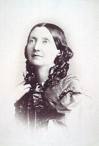
This doesn’t come from the Port Phillip papers, but it is  a report of Christmas in Sydney by Mrs Charles Meredith (Louisa Meredith) written in 1844 as part of her “Notes and sketches of New South Wales during a residence of that colony from 1839 to 1844.”
meredith

We now made a few weeks’ sojourn in Sydney, which, could we have laid the dust, moderated the heat, and dismissed the mosquitoes and their assistants, would have been very pleasant; but as it was, my colonial enjoyments were limited to our usual drives, and when able to walk at all, an idle languid stroll in the beautiful Government gardens.  For some days before Christmas, in our drives near the town, we used to meet numbers of persons carrying bundles of a beautiful native shrub, to decorate the houses, in the same manner that we use holly and evergreens at home.  Men, women and children, white, brown and black, were in the trade; and sometimes a horse approached, so covered with the bowery load he bore, that only his legs were visible, and led by a man nearly as much hidden; carts heaped up with the green and blossomed boughs came noddingly along, with children running beside them, decked out with sprays and garlands, laughing and shouting in proper Christmas jollity.  I liked to see this attempt at the perpetuation of some of our ancient homely poetry of life in this new and rather too prosaic Colony, where the cabalist letters L.[pound] S.[shilling]D [pence] and RUM appear too frequently the alphabet of existence.  It seemed like a good healthy memory of home, and I doubt not the decked out windows and bouquet-filled chimney in many a tradesman’s house gave a more home-like flavour to his beef or turkey, and aided in the remembrance of old days and old friends alike numbered with the past.

christmasbush

The shrub chosen as the Sydney ‘Christmas’ is well worthy of the honour (the rough usage it receives rendering the quality of the post it occupies rather problematical, by the way). It is a handsome verdant shrub, growing from two to twelve or fifteen feet high, with leaves in shape like those of the horse-chestnut, but only two or three inches broad, with a dark green, polished, upper surface, the under one being pale.  The flowers, which are irregularly star-shaped, come out in light terminal sprays, their chief peculiarity being, that they completely open whilst quite small, and of a greenish white colour; they then continue increasing in size, and gradually ripening in tint, becoming first a pearl white, then palest blush, then pink, rose-colour, and crimson: the consant change taking place in the, and the presence of all these hues at one time on a spray of half a dozen flowers, has a singularly pretty appearance.  Their scent when freshly gathered is like that of new-mown hay.  Great quantities of the shrubs grow in the neighbourhood of Sydney, or I should fear that such wholesale demolition as I witnessed would soon render them rare.

The ‘Christmas dinner’ truly seemed to me a most odd and anomalous affair.  Instead of having won a seasonable appetite by a brisk walk over the crisped snow, well muffled in warm winter garments, I had passed the miserable morning, half-dead with heat, on the sofa, attired in the coolest muslin dress I possessed, sipping lemonade or soda-water, and endeavouring to remember all the enviable times when I had touched a lump of ice or grasped a snowball, and vainly watching the still, unruffled curtains of the open window for the first symptom of the afternoon sea-breeze.

So, what then can I say about Christmas in Port Phillip?  It seems that the prominence of Christmas seems to be increasing as we get further into the 1840s.  I wonder if the Meredith extract reflects the influence of 1844 more than her experience five years earlier.  It’s important to remember that the trapping of Christmas as we know them- the trees, the carols etc- were themselves being constructed in Victorian Britain at the time.  The term “Christmas Tree”  was first used  in English in 1835; Prince Albert decorated the tree at Windsor Castle in 1841 thus bringing a German tradition to England; Christmas cards first appeared in 1843,  and many of the hymns we know we written in the 1840s and 50s onwards- O Come All Ye Faithful in 1848, or Once in Royal David’s City in 1851 for example.  And then, of course, we have Charles Dickens’  A Christmas Carol, published in 1843 which seems to exemplify everything we think of in a ‘traditional’ English Christmas.

And as for Louisa Meredith’s fear that the Christmas Bush would become extinct- well, I must say that I’m not at all familiar with the Christmas Bush and especially its use as a substitute for holly and evergreens today, but it still seems to grow in the Sydney area at least.  There are certainly other descriptions of Australian Christmases- Henry Lawson,  Edward Sorensen, and many engravings of Christmas activities but many of these seem to date from the 1880s onwards, and probably reflect the spread of the ideal of the Victorian English Christmas across the empire.  But 1840s Port Phillip was part of an early 1840s world with a lower profile of Christmas than in the years following, right up today.

References:

Geoffrey Rowell ‘Dickens and the Construction of Christmas’ History Today, 43, Dec 1993

‘Christmas in the Colonies’ Australian Heritage Summer 2007

The Australian Christmas In Days Gone By

Update:

I did find this reference to Christmas in South Australia in 1836 from The Diary and Letters of Mary Thomas. Mary Thomas wrote up the diary she had kept from early settlement days (Dec 1836) in 1867, expanding her entries with reminiscences- always a bit dangerous because later memories can overlay earlier ones, particularly of an event that occurs on an annual basis:

We kept up the old custom as far as having a plum pudding for dinner, likewise a ham and a parrot pie

Source: Michael Symons One Continuous Picnic: A history of eating in Australia.

(He also notes that Ken Inglis has a chapter about Christmas in  Australian Colonists)

Ships and Whales

Every edition of the Port Phillip Herald has a “Shipping Intelligence” column on Page 2.   We have to remember that Port Phillip was literally a “port” city, and the comings and goings of shipping was the communication thread to the rest of the world.

flagstaff_gardens

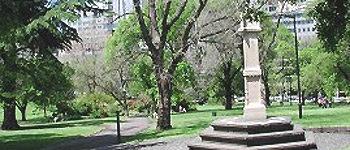
As it happens, I was in the Flagstaff Gardens on the weekend on an absolutely beautiful Melbourne afternoon.  I walked up to the top of the hill and even today you can see right across to the water, in between in the high-rise buildings.  I tried to imagine all the other people who must have walked up this same hill, straining their eyes to see the boats making their way up to Port Melbourne.  A flagstaff on the top of the hill, visible from the village down by the river below, notified of the progress of ships making their way up the bay.

The Shipping Intelligence for 15 July 1842 had no arrivals (which is a bit unusual), but three boats were listed for clearing out.

CLEARED OUT

July 12. Sally Ann, schooner, for Portland Bay and Port Fairy.  Passengers, Messrs Cameron, Phillips and Barnet; ten in the steerage.

14 Ellen and Elizabeth, schooner, for Launceston

14 Corsair, steamer, for Launceston. Passengers, Mrs Doddery, Mr and Mrs Lamb, Miss Gavon, Major Fraser, Messrs. Thompson, and Hill.

The steamers in particular are frequent visitors, plying back and forth across the Victorian coast (Portland and Port Fairy) and across to Launceston or Hobart in Tasmania (then known as Van Diemens Land), as well as up and down from Sydney.  Not a lot of privacy here- everyone knew where you were off to- unless, of course you were steerage. I wonder who these passengers were, going to Launceston. Did they already live there, I wonder?

SAILED

On Tuesday (12th) Adelaide for Hobart Town

On Wednesday (13th) for Portland.

To be honest, I’m not really sure at what point it was considered that a ship had finally ‘sailed’.  Perhaps when it had cleared the Heads at Port Phillip (a fairly treacherous stretch of water that separates the bay from Bass Strait)? There’s always a gap of at least a day- sometimes several- between ‘clearing out’ and ‘sailing’. Often ships had to wait some time to broach the Heads:  the  second shipload from the David Collins expedition down at Sorrento in 1803 had to wait weeks until the conditions were right to get through the Heads and sail on to Van Diemens Land.

EXPORTS

July 12- Sally Ann for Portland Bay and Port Fairy- 9 chests tea, 5 half chests ditto, 4 quarter casks wine, 1 bale slops, 12 cases gin, 16 bags flour, 7 bags bran, 2 cheeses, 1 box, 1 paper parcel, 12 casks porter, 17 bags oats, 16 bags potatoes, 2 tins turps., 1 barrel oatmeal, 1 ditto cheese, 7 cases slops, 10 bags sugar, 1 case split peas, 1 ditto pearl barley, 1 ditto rice, 1 ditto turpentine, 1 ditto oateal, 1 trunk apparel, 7 cases, a press and types, 1 case drugs, 9 cases geneva, 1 chest apparel, 2 trunks ditto, 1 can oil, 2 cans, 3 kegs, 1 case, 1 scraper, 1 keg tobacco, 1 case soap, 1 bag salt, 1 cask whisky, 2 cases glass, 1 keg, 1 case, 1 cask.  For Port Fairy: 4 bags flour, 1 bag sugar, 1 bag potatoes, 3 cans turps.

14- Ellen & Elizabeth, for Launceston- 7 bales wool

16 – Corsair- for Launceston- 310 sheep, 1 bale slops.

We’re seeing the internal economy at work here.  Many of these goods would have arrived earlier either direct to Port Phillip, or by steamer down from Sydney, or across from Van Diemen’s Land- especially things like sugar, tobacco and alcohol (of which there seems to be a great abundance).  The Port Phillip merchants would then forward them on to the smaller ports.  I’m a bit surprised by the sheep going to Launceston, given that during the early Port Phillip years, the sheep were coming from Van Diemens Land.  Perhaps someone bought up big at one of the auction sales.

Actually, this Shipping Intelligence is pretty boring because there’s no international shipping. When a ship comes bearing imports from overseas, the person who ordered the goods it is named, then the goods are listed.  Again- not a lot of privacy.

The real reason I’m writing up this one comes in the SYDNEY SHIPPING section!

ARRIVED- June 30 Rebecca Sims, from South Sea Fisheries

The Lord Saumarez was to have sailed from Sydney for Port Phillip on the 3rd inst.

The American whaler Rebecca Sims, of New Bedford, has been very fortunate, having in 24 months procured 1600  barrels sperm and 300 barrels black oil; but hs been obliged to put into this port in consequence of having lost her rudder and false keel in a severe squall, and for the purpose of having which replaced, she will have to hove down.  She reports of having spoken the following vessels:- October 1, 1841, the Ofley, of London, off Ocean Island, with 900 barrels sperm, out 25 months.  Oct 4, the Onyx of London, six weeks from Sydney, with 100 barrels of sperm oil.  November 22, the Caernarvon of Sydney, with 500 barrells, and a whale alongside, out 36 months (since which she has put into Hobart Town, discharged her cargo, and refreshed).  January 22, 1842, the American ship Francis Hussey, with 750 barrels sperm, out 17 months.  The Rebecca Sims touched at Rotumah, on the 8th February, where she found the American barque, Fortune, with 350 barrels sperm oil, out 17 months; the barque Louisa, Wright of London, with 40 barrels; and the Mary, of London, with 200 barrels, out 9 months.  She afterwards touched at Chatham Island, where she found the Gem, of Sydney, a total wreck, having ran ashone.  Heard of the American ship Franklin being at Chatham Island 22nd May, with 2300 barrels black oil, 10 months out; and of the American ship Chariot also being there,  April 20th, with 1400 barrels sperm; also of the American ship Omega, Captain Gardner, cruising off Chatham Island, 1st June with 1600 barrels sperm oil. Spoke the schooner Kitty, from Chatham Island, bound to Port Nicholson on the 25th May, having lost her anchor and part of the chain inthe same squall that she sustained the damage which caused her to put into this port.

The Victoria is at present refitting off the Commercial Wharf, and is about to proceed to Manilla to be sold; if not purchased there, she will proceed to China.  Her owners are fitting her out in a superior style, and we understand she will carry eight or ten brass guns.- Australasian Chronicle, July 2.

One of the problems of a catch phrase like Geoffrey Blainey’s ‘Tyranny of Distance’ is that it can obscure just how connected Australian ports and ships were into the seafaring, whaling and maritime culture.  The Shipping Intelligence often carries reports of which ships “spoke” to other ships, conveying news of yet other ships that they had each spoken to, wrecks, rough journeys etc.

Here, too, we’re seeing the internationalized  whaling oceans around Australia and New Zealand, with English and American ships, as well as Australian ones.  I can’t really find any hard and fast figures of how many barrels of oil the ‘average’ whale provides (after all, what’s an ‘average’ whale?).  I have figures from the 1900s that had 18, 660 barrels from 559 whales (about 33 barrels per whale); a figure of 60 barrels from the ‘right’ whale ( I’ve seen that they produced the ‘black’ oil, but then another website said that black oil came from the Arctic White Whale); and Save the Whales gave a figure of 47.6 barrels from a sperm whale.

No matter how much oil the whale produced, a load of 1600 barrels is pretty impressive, as is the amount of time that these ships stayed out at sea- up to three years!  But seeing the way that these ships communicated with each other, within the whaling fraternity it wasn’t a matter of sailing off into the wild blue yonder, even though it must have felt that way for the families left at home (shades of Ahab’s wife here).  The seas had their own communications channels.

Whalers had been plying the Victorian coastline since the very early 1800s, and the first temporary settlements were seasonal whaling stations.  It was generally believed that whalers often took Aboriginal women (especially those from Van Diemen’s land) as virtual slaves, but recent work by historians like Lynette Russell suggests that the women brought important survival skills to the whalers, and acted with more agency than previously thought.  (I suspect that this link takes you to a paid site, so I don’t know if you want to follow it).

Then that last little section reminds us that there was an important Asian trade going on between the colonial ports there as well.  There was a Chinese war going on at the time, hence the brass guns, I guess.

‘Men and Women of Port Phillip’ by Martin Sullivan

Reading this book evoked memories of undergraduate history out at La Trobe in the mid-70s:  sitting around the Agora drinking bad coffee from yellow and orange plastic handled mugs; peering through the smoky fug in tutorials held in the tutor’s own room; posters of  Splitz Enz playing on campus;  the sweet waft of marijuana; the opening up of the world in those halcyon Whitlamesque days.

When I see that Martin Sullivan submitted his  Ph D. thesis “Class and Society in the Port Phillip District” to Monash University in 1978, then I realize where all these 30 year old reminiscences are coming from.  The thesis, and this book that no doubt sprang from it in 1985, are all imbued with the language and frameworks of Marxist historiography that look rather – well-  strident, earnest and  somewhat dated today.   In fact, I was a little surprised by the late-ish publication date of this book (1985) because it had the fingerprints of the 1970s all over it.

Which is not to say that it’s not a useful book- on the contrary.  I’m finding myself frustrated that it is so difficult to ‘hear’ the people of Port Phillip who were not middle-class and socially and visible on the one hand, or thrown up from the stews of criminality into the courts on the other hand.  Surely there’s another group of people here.  I think of the school children who marched in the public parade for the laying of the foundation stone to the Supreme Court- who were their parents who no doubt craned their necks to see their children as they marched past?  Who were the people who mobbed around the first public hangings up on the hill above Lonsdale Street? It appears that it was a heterogenous group- who were they?

Sullivan has used much the same sources I have: court reports, newspapers, government dispatches, Garryowen and other contemporary writers.    His focus is different to mine, and he has struggled with it. He wants to draw out  his working-class men and women of Port Phillip from the vignettes of the middle class, public actors that I’m finding myself working with, but they are such shadowy figures that they are easily overshadowed and  don’t ever emerge fully.  So they remain fuzzy, largely unnamed (except for those who turn up in the courts) and largely undifferentiated from the group.

He argues that a capitalist, market-based system was not necessarily found in Port Phillip from its inception, but that it quickly developed once propertyless, wage-earning immigrants and former convicts came to the colony.  Classes emerged fairly quickly, whereby capitalists and wage earners lived out their lives in different ways according to their relationship to the means of production.   However, although the capitalists tried to control the law and the state, they never had complete control over them, or indeed over the labouring population which was, from the start, ungovernable and obstinate.   In this regard- and I don’t know how Martin Sullivan would feel about this- the book leans towards John Hirst’s view of the subversion of authority right from the inception of the colony.   He points out that after 1844 there was a more concerted and political program of protest, rather than the undirected dissatisfaction of  individual men and women previously. It also confirms the feeling that I have that there was a general heightening of the political climate around the mid 1840s, even before the Gold Rush.

This book felt a bit unbalanced in its structure. There is barely an introduction as such, as the book launches straight into an examination of the course of events that led to its settlement by the Port Phillip Association, and its relationship to a market economy.  This is followed by a 73 page chapter about the formation of a labour market, then a shorter 40 page chapter about convicts in Port Phillip which could have easily been a second chapter.  Chapter 4 is another long one- 86 pages, followed by a 26 page chapter on the stuctures of dominance, then a rather thin two page conclusion.  I felt as if the book was lumpy, and that it didn’t draw me along with a clear argument.  I don’t need each chapter to be a homogenized length, but the book felt as if it lacked unity.

Nonetheless, by consciously looking beyond the more easily-accessed public, middle-class realm, he has set himself an ambitious target: I know because I’m puddling around in the same sources as he did.   Those more sweeping “people’s history”-type books have the advantage of a larger timespan to draw and extrapolate from.  It’s much harder to start at the origins of a settlement, as he does, and know that you end up ten years later with a system that has been almost- not quite, but almost- undetectable in its emergence.   We’re only looking at a small society, for a small slice of time- why is it so hard to see it happening?

The Drunken Nurse

saireygamp

The Port Phillip papers are certainly full of drunkards.  Judge Willis himself has plenty to say about the perils of alcohol, and the Police Court is dominated by brawls and crimes connected with alcohol.  But I was particularly taken with this  Sairey Gamp character from the Port Phillip Herald 1 July 1842.

AN AFFECTIONATE WIFE.  For several months past, a man of the name of Henry Hayward a much valued servant of the firm of Campbell & Woolley, had been seriously ill, so much so that it was thought advisable by his medical attendant, Dr Campbell, to send for his wife to take charge of him, who, at the time, was following her occupation of monthly nurse in the family of his Honor Mr La Trobe.  This woman had hitherto been engaged as a nurse in some of the most respectable families- Captain Lonsdale’s, and many others.  The poor sufferer, whom we personally knew as an excellent and faithful servant, was at this time in a most precarious state, being attacked with that frightful disease, dysentry, and although a strong robust man, was evidently sinking fast: the attention of his wife, of course, became necessary, and his Honor the Superintendent being apprised of the circumstance, forthwith sent her to her husband, and himself kindly called to see how the sufferer was doing.  At this stage of the disease the doctor was sanguine of success; but to his extreme mortification he found on each visit that the wife, who had hitherto been supported by the first people in the colony in her vocation as nurse, was a confirmed drunkard; and that she was in the habit of not only getting beastly intoxicated and lying on the bed of her suffering husband, but made it a practice to drink the port wine and brandy, which the medical attendant had ordered for his patient, and thus leave the poor sufferer without succour.  Enraged at this atrocious conduct, Dr Campbell, at his own expense, engaged a respectable woman as nurse, to see that his orders were attended to, and that the wretched wife should not ill use her husband, which he had been informed she was in the habit of doing.  The nurse was unremitting in her attentions, but was frequently obliged to flee the house in consequence of the violent and drunken conduct of the dying man’s wife.  Often has Dr Campbell called upon his patient and seen the wife in a state of intoxication, lying almost senseless beside her husband! and often has he endeavoured, by every means in his power, to prevent such heartless conduct; but his exertions were all in vain; the poor man still lingered on, and the depraved wife pursued her unnatural conduct till the sufferer died! and this took place but a few days ago.  We have been particular in mentioning these circumstances to prevent ladies being imposed upon by such a wretch as the wife of Henry Hayward- a woman who has hitherto gained her living in the first circles as  “a monthly nurse” but who ought, in our opinion to be publicly and soundly whipped through the town for her fiendish conduct to her departed, and as far as she is concerned, her murdered husband.  We have the authority of the doctor for stating that had the wife performed her duty properly the deceased would in all probability have recovered!

There’s not many references in the papers of the time to women working- although how much work Mrs Hayward would gain after this exposure is doubtful! I was intrigued to find out what a “monthly nurse” was,  wondering if it was a nurse engaged for “that time of the month” but instead, it seems that a monthly nurse was a kind of mothercraft nurse who would move in after the baby’s delivery to care for the mother and baby for a month after confinement.  There’s a fascinating article called “The Remembrances of a Monthly Nurse”  in Fraser’s Magazine for Town and Country (1836)that manages to combine celebrity gossip with a quite affecting account of the birth of a baby with cleft lip and palate, all from the perspective of the monthly nurse.

I had seen advertisements placed in the Port Phillip Herald by doctors calling for wet nurses, but this was the first mention of a monthly nurse that I had seen.  It appears that she gained her work largely through word of mouth between the “first families” of the colony.  The reference to His Honor Mr La Trobe, the superintendent of Port Phillip, relates to the birth of his daughter Eleanor Sophia La Trobe born 30 March 1842.  It seems, therefore, that Mrs Hayward was still with the La Trobes longer than the usual month, but as Georgiana McCrae noted, her friend Mrs La Trobe was often in poor health, and the La Trobes would have been first among first families!

I wonder how this marriage between the employee of Campbell and Woolley, a prominent mercantile firm in Port Phillip at the time, and a monthly nurse would play out.  No doubt she would be absent from home for extended periods of time. There’s no mention of other family.

It’s hard to tell what the actual outrage is here.  Was it her drunkenness- taking the port wine and brandy meant for her husband, leading no less to her “murdering” him by not doing her “duty” for him?  Was it her slatternly behaviour, lolling around the bed drunk with the dying man?  Was it her violence to the respectable nurse paid for out of Dr Campbell’s own pocket? Or was it, perhaps, the scandal and trickery by which this drunkard had worked her way into the  domestic households of respectable families, placing them all unknowingly in peril?  Whatever- publicly and soundly whip the woman around the streets- that’ll teach her!

References

Dianne Reilly La Trobe: The Making of a Governor

It’s Council Election time

Ah democracy!  This weekend has been local election time in Victoria and my enthusiasm for compulsory voting EVEN extends to council elections, shabby and petty little events though they are.  Many councils opted for postal-vote only, but my council had ‘proper’ elections, complete with flyers, Victorian Electoral Commission staff, the little cardboard booths and the stubby pencils.  Although I could have probably survived without this exercise in local democracy, in general I’m very pleased that we have government-funded, compulsory elections.  I look at the queues of people at American elections, and the skewing of issues on all sides to “get out the vote” and I’m glad that there’s no question about it here: you just have to vote.  It only takes ten minutes out of your life because it’s funded on the knowledge that everybody will attend.

condell

Henry Condell, first mayor of Melbourne

The first council elections in the Port Phillip district were held in Melbourne on 1st December 1842. This was a time when the “anxiety” about Judge Willis was reaching a peak, before subsiding briefly to re-emerge the following year.  They were not the very first elections held in the district: there had been elections for the Market Commission in 1841, but few voted for it.

In Britain, the Municipal Reform Act of 1835 provided the first English municipal elections, and the Colonial Office was keen to extend this rudimentary form of ‘representative democracy’ to the colonies as well.  Given the influx of migration into Port Phillip after 1839, many people would have experienced  this new phenomenon of municipal elections ‘at home’, and certainly the English influence on the election process is very noticeable.

Even before the Government announced the final arrangements for the Melbourne Town Corporation election, there was jockeying between factions about how it would be managed.  There was one private meeting that sought to ensure that the ‘right’ sort of people were elected, drawing I suspect, on the British tradition of sorting it all out between gentlemen and avoiding an unseemly election at all costs.  In defiance of this concept of ‘hole and corner meetings’, a public meeting was held in opposition to proclaim the openness of the election to all qualified comers.

The bill for the Melbourne elections was passed in August 1842, providing for four wards.  Candidates had to possess real estate worth 1000 pounds or live in a residence with an annual rental value of 50 pounds. In order to vote, electors had to occupy property with an annual rental of at least 25 pounds.

On 12 September ‘collectors’ were dispatched to inspect properties to see if the rental value was worth 25 pounds.  As rental properties worth less than 25 pounds were exempt from taxation, the occupants were not qualified to vote.  Such a regulation also ensured that tenants had an incentive for downplaying their rental to avoid taxation.   After the Burgess List had been published, its valuations were challenged by a Committee, which heard appeals.

Prior to the election, all candidates were furnished with ‘queries’ – not unlike the questions posed today in more recent times by lobby groups today before an election.  However, these queries were not so much about policies, but more about establishing the integrity of the candidate.  The questions also reflect an intention, at least, to avoid the secrecy, patronage and jobbery of Old Corruption back in England.  Not all candidates answered the questions.  The questions were (roughly paraphrased)

1. Do you have the time and energy to devote to the position?

2. Will you vacate your position if requisitioned by 2/3 of the burgesses?

3. Will you vote for open-door proceedings? (one of the first actions of the newly elected council)

4. Will you select the mayor and aldermen from among the elected council? (because under the Act, outsiders could be appointed )

5. Will you stay in your seat unless faced with uncontrollable circumstances or requisitioned by 2/3 of the burgesses?

6. Will you oppose the election of any candidate to an office in the gift of countil unless their moral character will bear strict scrutiny ?

7. Have you pledged yourself or put yoursdelf under any obligation?

The election itself was treated as a ‘festival’, but not a public holiday as such.  A hotel in each ward was designated as an ‘alderman court’, and it opened at 9.00 a.m. Electors would take their ballot paper to the polling room in the hotel, check their name against the Burgess list, then their registered vote was read aloud to the gathered throng- thus reinforcing the ‘pledge’ that would often be given before the election to vote for a particular candidate.  Electors had more than one vote to bestow- for example, in the Lonsdale Ward each elector had three choices and could, if desired, spread the vote among three individual candidates, or ‘plump’ all three votes for the one candidate of their choice.  The tally was announced hourly and ‘treats’ were laid on.  At 4.00 p.m. the final total was declared, speeches delivered, bands playing and celebrations and commiserations all round.

And where does our Judge Willis fit into all this?  The newly elected town council trooped before him for a public reception followed by cold corned-beef sandwiches where he was noted for wearing a hat of remarkable construction (the mind boggles).  Garryowen has a good description:

“Judge Willis was fidgetting impatiently on the Bench, commanding the crier to keep order; and the Court, now thronged, to be cleared, commands impossible to be enforced, for the crier was irrepressible with excitement, the spectators were in no humour to be trifled with, and this was one of those occasions on which Willis condescendingly left his bouncing unnoticed.  The Judge as he appeared robed on the Judgement-seat cut a rather grotesque figure.  His coiffure was constructed upon an admixture of two or three orders of hat-architecture, a tripartition of the billy-cock, the shovel, and cocked-hat.  It was not unlike the “black cap” in which Judges pass capital sentences, but it was winged, padded, enlarged and ornamented in such a manner as to be unrecognisable. “

Judge Willis’ own contribution to this newly-minted representative democracy was rather equivocal. He declared that the elections were constitutionally invalid because they had not received the Royal assent, even though he was sure that it would be received in due course and even though the Colonial Office had strongly encouraged the holding of municipal elections.  As a result, the new Town Corporation was unable to levy rates for some time.  Furthermore, the candidates split quickly along class, sectarian and ‘party’ lines to the extent that cases were launched in Judge Willis’ court when disagreements amongst councillors reached such a pitch that they refused to sit together in the same room!

doyle

All in all, happy times.  Welcome to the Lord Mayorship, Robert Doyle (but don’t even THINK about reintroducing cars to Swanston Street!)

References:

David Scoullar’s uncompleted Ph D thesis in SLV

Bernard Barrett The Civic Frontier: the origin of local communities and local Government in Victoria

M. M. H. Thompson The Seeds of Democracy

Garryowen

Port Phillip Apostle No 6 James Purves, landowner

[Check in the comments below for more information about James Purves. As you will see by the end of my entry, I’m quite perplexed about all these Purveses]

James Purves was born at Berwick-on-Tweed on 25 May 1813 and arrived in Van Diemens Land in 1837, moving across to Phillip in 1839.   He commenced practising as an architect and building surveyor that year with an office in Bourke Street opposite Mr Allan’s (whoever he was).  He obtained an auctioneers license in the same year- possibly that’s where he met Welsh?  A different address is given for his office- Little Collins Street, next to McLeans store; then another notice that he moved into McLeans store itself.  Either way, he is located in the commercial centre of town.  He sold the auctioneers business to H. H. Atkinson in 1841, and maintained another architect office in Collins Street from 1840.  His private residence was in Newtown (now Fitzroy) in 1840, then Richmond in 1844 and 1845.  He married Caroline, the daughter of Thomas Guillod of London in October 1842.  His son, James Liddell Purves, who was a barrister, columnist, free trade parliamentarian and member of the Australian Natives Association, was born in Swanston Street in 1843.

purvesjames

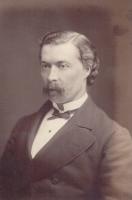
There’s his son.  A fine upstanding man he is too.

James Purves Snr. is listed as holding land with Chirnside at the Loddon River and Geelong in 1840, then took a license to run stock in the  Portland Bay district with Chisholm in 1842-3 (but I doubt if it is John Moffat Chisholm, who seems to have always used all three names; there are other Chisholms in Port Phillip) . He also held land in Western Port with Dixon 1842-3; and with E. W. Hobson.  He won a prize for a horse at the first show, held on 3 March 1842 at the cattlemarket on the corner of Elizabeth and Victoria streets- a “failure” of a show, according to Garryowen, where “the exhibits were a vast disappointment”.

There is no evidence of much connection with the other Twelve Apostles.  He seems to be quite active in leasing or purchasing properties in the early 1840s, especially during 1842 when the depression was kicking in, but there does not seem to be any further action after cutting his partnerships in 1843. Unlike the other Twelve Apostles, he had a profession to fall back on- perhaps this saved him from the insolvency that engulfed the others.  He joined with Fawkner and Chisholm in fighting the arrangements made to cover Rucker’s debt once it all went pear-shaped.  In September 1846 he helped fight a fire in a coach factory. By 1850 he was purchasing land again.  He had a licence at Tootgarook- or is it Toolgaroop?-  between 1850-69 where he became an importer and racehorse breeder and also at Traralgon between June 1853 and 1855.

He obviously had the money to send his son ‘home’ to England for his education, his law degree and his Grand Tour.  His son published the diary he wrote on the way home – A Young Australian’s Log. I wonder if that gives any more information?

This is all so disjointed.  There’s a Thomas and Henry Purves in Port Phillip at the time, who DO come out very strongly in Judge Willis’ favour, but I don’t know if they’re connected to James Purves at all.  There’s several mentions of Mr Purves in the newspaper, but I’m not sure which one it is.  And how and why did James Purves get involved in the Rucker scheme?  Search me.

References

Garryowen (again)

Billis and Kenyon Pastoral Pioneers of Port Phillip

Kenyon Index.

Port Phillip Apostle No. 5 John Moffat Chisholm

chisholm

Ah, now THIS Port Phillip Apostle seems well connected with some of the other ones.  As you’ll remember, I’m trying to work out the connections between this group of 12 men who agreed to become liable “jointly and severally” for the debts of one of their number, W. F. A. Rucker.  I’ve been surprised so far by how most  of them had traceable connections with  only one or two of the other men, which seemed strange given that they were throwing their lot altogether.  But, unlike the others, our John Moffat Chisholm seems to have links with several of them.

He was born in Edinburgh, Scotland (no date) and arrived in Melbourne in 1838 and set up business quickly as a merchant.  He married a Miss Osbourne in 1838, and purchased ‘Maryvale’ at Moonee Ponds in 1841.

His business was located in Collins Street, but in 1839 was burnt down. Garryowen hints at ‘mysterious gossip’ over the origin of the fire.   He was well insured, and rebuilt on the same frontage.  He joined with the other drapers in February 1841 to announce their agreement to their shop-assistants’ demands to close by 8.00p.m. except on Saturday nights.  He also made an appearance as employer when he took his servant to the Police Court, presided over by the police magistrate St John, over forfeited wages, and as was common at the time he handed the proceeds over to the hospital building fund.  The Master and Servants legislation of the time, which initially was used mainly against employees when times were good, worked more to the advantage of employees once the depression started to bite.   In April 1841 he sold his business to C. Williamson, then moved his office a month later to Hind and Co.  In January 1842 he bought land at a forced sale in Bourke Street at the very cheap price of 4 guineas per foot.   He fell victim to the “swindler” Barrett   who was execrated by many for skipping off to New Zealand rather than face his creditors.

He also had a property somewhere along the Plenty River where the Plenty Valley bushrangers moved freely, terrorizing the settlers in April 1842, but the exact location has not been determined.

He attended Debating Society meetings, where he signed a letter of support for George Arden when he was facing Judge Willis over libel charges.

He posted bail for H.N. Carrington when he, too,was confined to ‘the rules’ on Willis’ orders but when he found that Carrington was intending to break bail to travel to Sydney, he and his fellow guarantor Peers surrendered their bail, no doubt anxious that they were going to have to pay the penalty.  So here’s a connection with one of the Twelve Apostles- Carrington.

He was on the Committee of Management of the Mechanics Institute, and here we see a further strand of connections with other Twelve Apostles.  William Highett, who was fundamental to Rucker’s arrangement with the bank, was the Treasurer of this organisation, and Alexander McKillop and P.W. Welsh were fellow committee men and, more significantly, fellow Twelve Apostles.

He appeared in court, along with Fawkner and Purves as part of the court cases that fell out of the arrangement with Rucker in February 1843.  The other Apostles seem to have submitted quietly to their fates.

The Kenyon Index has entries showing that there were reports in the Port Phillip Gazette of his insolvency in May 1843, November 1844 and July 1845.  I have another date of 14 March 1843 for his insolvency- so who knows.  He was no stranger to the court- he’d appeared as defendant in six cases between 1841 and 1843 (i.e. in Judge Willis’ time).  He wasn’t alone in that though- when you read through the court lists, nearly every public person appeared in court one way or another.  Quite apart from the financial turmoil of these years, there was also the aspect of the court being the protector of reputation, as Kirsten McKenzie points out:

If personal status was protected and attacked in diverse ways, the law carried the most weight as a weapon against scandal.  For those who could afford it- and were undeterred by the publicity it inevitably involved- it was the final line of defence…  Kirsten McKenzie ‘Scandal in the Colonies’ p. 70

(Actually, I find myself wondering whether EVERYBODY, even today, has a court appearance of one sort of another in their life?  I haven’t yet….  Perhaps the establishment of bureaucracies to do the tasks of fining and penalizing as mere administrative acts have reduced the need to appear in court?)

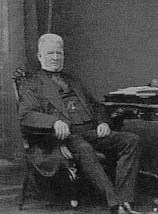
So what happened to John Moffat Chisholm for the rest of his life, I wonder?  He was obviously in Melbourne in 1872 to have his photograph taken by T. F. Chuck, and he died in Melbourne in 1874.

So, I’m really none the wiser.  He seemed to have social connections with Carrington, McKillop and Welsh.  He resisted the fallout from the Rucker arrangement, but had to declare himself insolvent in any event.  He must have recovered financially enough by 1845 to recommence business, and he breathed his last in Melbourne.

References

  • Kirsten McKenzie Scandal in the Colonies
  • Edmund Finn The Chronicles of Early Melbourne  1835-52:  historical, anecdotal and personal by ‘Garryowen’

Port Phillip Apostle No 3: John Pascoe Fawkner

fawkner

Now what on earth is John Pascoe Fawkner doing here?  He was probably Judge Willis’ most vocal supporter and yet here he is embroiled with some of  Judge Willis’ most vocal opponents in the guise of H. N. Carrington and J. B. Were.   The most plausible explanation that I can think of is that, given his propensity to be right in the thick of all things Melbourne, he became involved because other people were.  Perhaps there’s a proprietorial  element of protecting the civic reputation of  “his” Port Phillip?  Who knows??- but then again, there are many things that puzzle me about John Pascoe Fawkner- most of all,  the nature of the connection between Judge Willis and John Pascoe Fawkner,  a man who seemed to exemplify the things that Willis most strenuously derided.

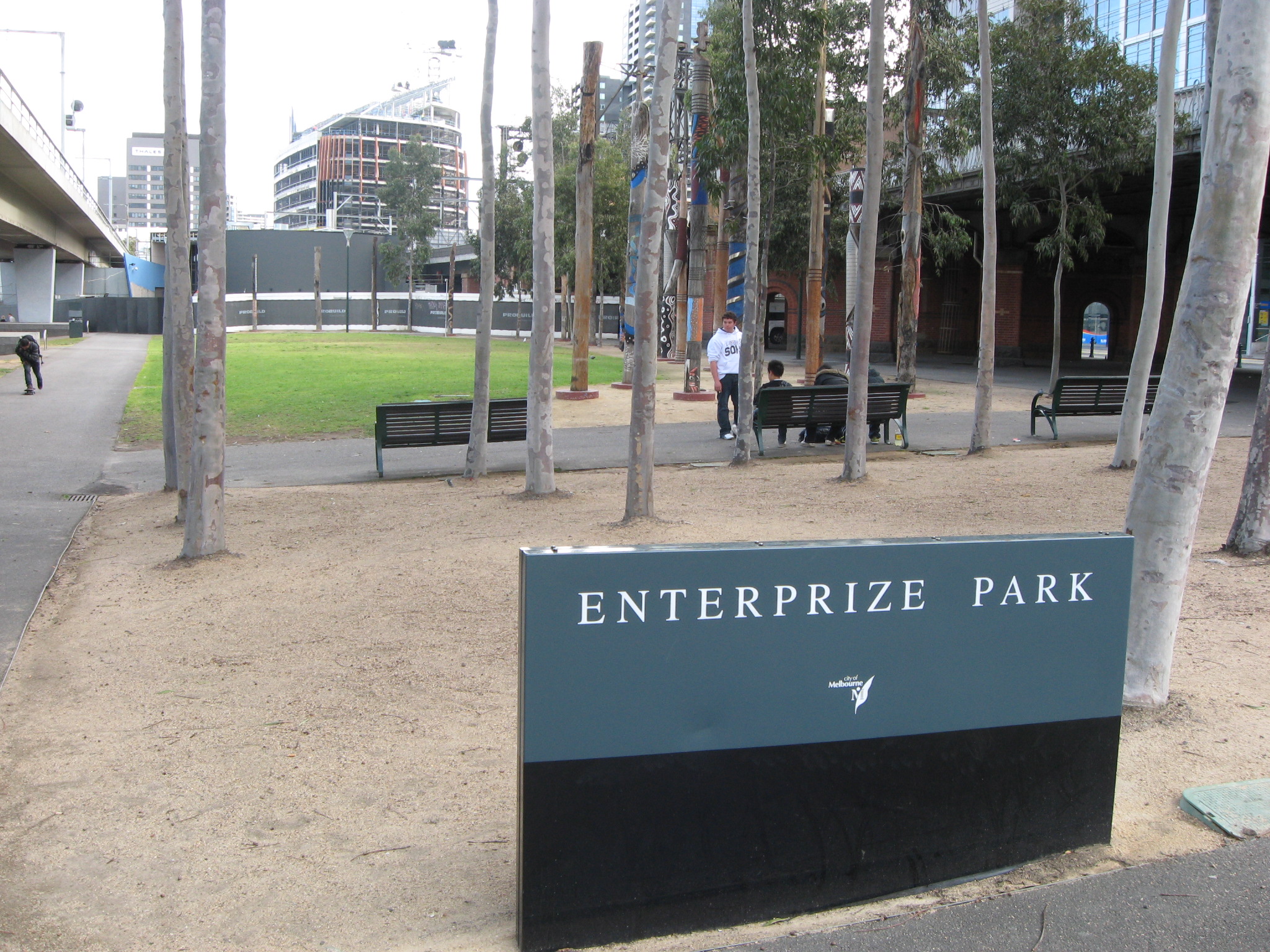
The two Johnnies- John Fawkner and John Batman have contested the title of “Founder of Melbourne” for about the past 100 years, and I notice that this year Capt Lancey nudged his way into contention as well.  Bain Attwood has written a fantastic paper describing the creation of the “founding of Melbourne” narrative that saw Batman championed as the founding father by James Bonwick, only to have this status questioned in recent years and more prominence given to Fawkner instead.  Attwood points particularly to the gradual disappearance of statues and commemorations to Batman and the increased visibility of Fawkner in the narrative, exemplified the recent creation of Enterprize Park (named for Fawkner’s ship The Enterprize)  opposite the Immigration Museum beside the river.

joe-william-street-012

Fawkner fits well into Ville’s “ex-convict and emanicipist” category of entrepreneurs, with their attendant desire for legitimacy, esteem and recognition.  He was the child of a convict and along with his free mother and sister, accompanied his father when he was transported for receiving stolen goods.   They were among the group of convicts and free settlers sent with Lieutenant Collins to establish a settlement at Sorrento until the struggling community was abandoned for Hobart Town instead.   John Pascoe Fawkner had his own brush with the law in 1814 when he was sentenced to 500 lashes and three years government labour for aiding and abetting the escape of seven convicts.  He returned to Hobart in 1816 where he opened a bakery, but shifted to Launceston a few years later after further problems over selling shortweight loaves and using illegal weights.  In Launceston he began anew as a builder and sawyer, then after some problems on character grounds in gaining a licence, opened a hotel and started the Launceston Advertiser newspaper.

Hearing positive reports of the coastal areas of Port Phillip, just across Bass Strait, he engaged a boat and launched an expedition of the area.  Well, that was the intention at least.  When the captain, John Lancey learned that he had violated a restraining order imposed on him because of debt, the ship turned back and deposited John Pascoe Fawkner back onto Van Diemen’s Land territory and sailed off without him.

Fawkner finally set foot on Port Phillip some two months later in October 1835, where he established a hotel, newspaper and bookselling and stationery shop.

patriotoffice_melbclub2

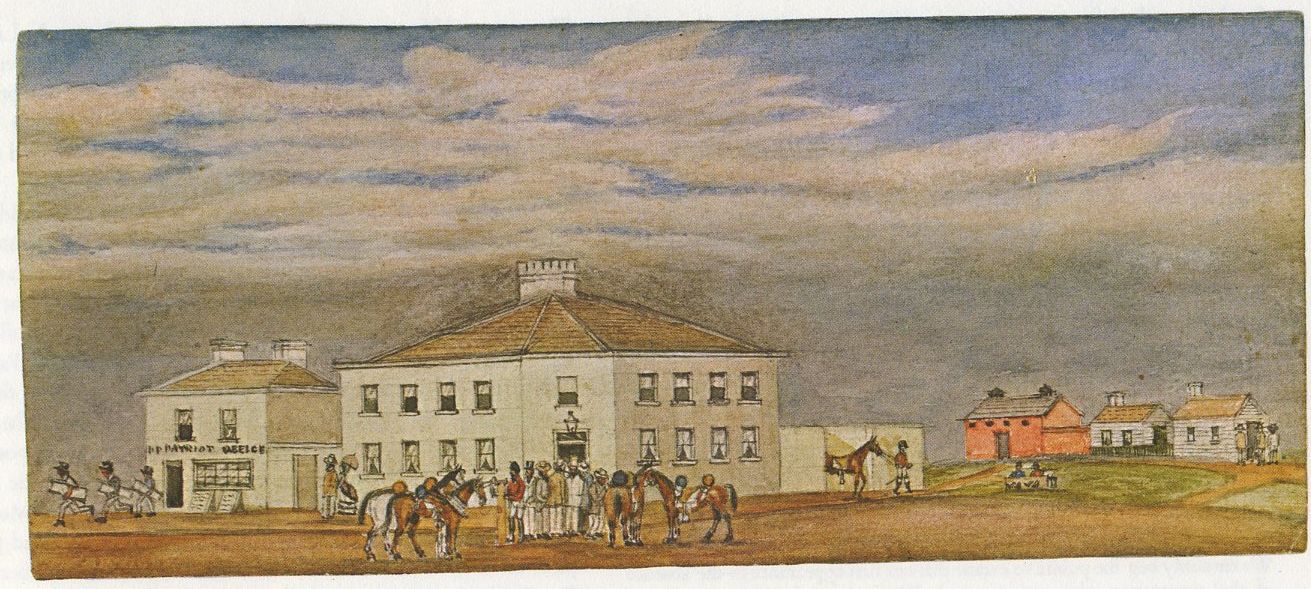
Patriot office and Fawkner’s hotel  in Collins Street, later leased to the Melbourne Club

At the first government land auctions he purchased 92 pounds worth of land.  At the 1839 land sale he purchased 780 acres along the Sydney Road for 1950 pounds.  Within a fortnight he advertised that the land was available for tenant farms with seed provided, or a total of 85 acres for sale at 10 pounds an acre.  He confided to the Reverend Waterfield that he had gathered 20,000 pounds in four years.  He became a squatter in 1844, taking up a licence for 12,800 acres near Mt Macedon.

He obviously wasn’t always flush with cash, because in 1841 he approached Montgomery, the Crown Solicitor,  as guarantor for a loan to assist his friends Kerr and Holmes to purchase the newspaper and stationery businesses from him.  The money made available to him came from the funds of Judge Willis himself, who had placed his money in Montgomery’s hands for investment.  While this investment was, indeed, through a third party, and although Fawkner no longer owned (but did continue to contribute to) The Port Phillip Patriot, the paper’s unfailing and strident support for Judge Willis is notable.

His financial success came undone in the financial depression of the 1840s,  largely through acting as guarantor for so many bad loans.  He was particularly damaged by his involvement in Rucker’s scheme as one of the Twelve Apostles.   He fought the action strenuously in the courts, but finally declared insolvency in March 1845 listing liabilities of 8,898 pounds and assets of 3184 pounds and claiming to have been stripped of 12,000 pounds and ten houses. He vented his hostility to Rucker and Highett the bank manager through his letters to the Port Phillip Patriot.  Mr Rucker, he wrote,

although he has placed several gentlemen in most perilous circumstances, can yet ride into town and sport his figure as of the first water…

Mr Highett, the ex-manager of the bank

had helped to melt many a piece of worthless paper under the sunny side of the bank screw, so upon a crusade he goes, and by dint of cajoling he did succeed in effecting an arrangement whereby ten or eleven persons bound themselves to pay Mr F. A. Rucker’s debts.

But John Pascoe Fawkner was not to be kept down for long.  He retained his Pascoe Vale properties through a settlement on his wife, and his interest in the Patriot was signed over to his father.  He discharged his insolvency quickly and used his wife’s property settlement as a qualification to stand for a vacancy on the Town Council in 1845, a position he had had to relinquish when declared bankrupt.  He went on to serve for many years on the Legislative Council and died “the grand old man of contemporary Victoria” in 1869.

There were many reasons why Judge Willis might despise him: the ex-convict origins of his fatherand his wife and his own crime in facilitating the escape of convicts; his “fortuitous” financial arrangements during his insolvency which exemplifed the sort of trickery Judge Willis was determined to strike down; his involvement in the hotel trade,  and the rabid nature of his rhetoric in the Patriot.  He was viewed as a radical for many of his ideas:  his plans for a Tradesman’s bank and  schemes for a co-operative land society.  But yet, even though Judge Willis would protest it vigorously,  the two men have qualities in common.  They were both ambitious men.  Willis might have applauded Fawkner’s aspirations to improve himself:

One comfort I have which the falsely proud can never achieve, viz, I have not sunk below, but on the contrary, have raised myself above the rank in which at finding myself of years of discretion I was placed in, and I glory that I have thus passed them.

Both Willis and Fawkner took pleasure in “hunting high game”.  And both Fawkner and Willis seemed to exhibit a similar hot temper and vindictiveness that, at a stretch, might explain why such an otherwise mis-matched couple of men often acted as each other’s supporter.

References:

Bain Attwood ‘Treating the Past: narratives of possession and dispossession in a settler country’  http://law.uvic.ca/demcon/documents/Attwood.pdf

Hugh Anderson Out of the Shadow: the Career of John Pascoe Fawkner

C.P. Billot  The Life and Times of John Pascoe Fawkner.

Simon Ville ‘Business development in colonial Australia’ Australian Economic History Review, vol 38, no 1 March 1998

Port Phillip Apostle No. 9 Abraham Abrahams

Now, here’s a  name that distinguishes itself from the other Twelve Apostles’ names by virtue of his strong Jewish associations.  Abraham Abrahams was a merchant, along with Rucker, Were and Welsh, so it is perhaps to be expected that he might have been caught up in the financial syndicate that Rucker formed to rescue himself from insolvency and disgrace.  But given that there were several Jewish merchants in Melbourne at the time (Michael Cashmore, and the Hart brothers spring to mind), it is strange that Abrahams is acting alone here.

So what do I know of Abraham Abrahams?  He was born at Sheerness, Kent in 1813. [update: maybe not- see comments below!]  He arrived in Sydney with his wife and seven children in 1839 at the age of 26 (fast work there!) and was in Melbourne by 1841.  He was described as a “merchant” of Lonsdale Street in 1841 when he donated the land for the first Jewish cemetery on what Garryowen described in 1888 as “a stony rise at the Merri Creek between the now Northcote and Merri Creek bridges”.  The land was found to be unsuitable for burial- the poor sexton dispatched to dig the first grave “found himself working on what nature designed for a quarry and made little or no progress downward” (Finn p. 695).   The grave was only half-dug when the burial party arrived to bury 19 year old Miss Davis, the young daughter of a Melbourne innkeeper, and in any event it was not her final resting place, as the body was exhumed and sent to Hobart.   Realizing that all subsequent funerals would face the same problem, the  Jewish community applied for land adjoining the general cemetery, and after a delay, their application was granted.

In September of 1841, Abraham Abrahams was admitted to the Chamber of Commerce.  Paul de Serville mentions that a “Mr Abraham” served as one of the stewards of the alternative public ball set up in opposition to the more exclusive private Turf Day ball in May 1841.  The battle of the balls exemplified the attempt of “good society” to define its boundaries by limiting attendance to the ball to those deemed suitable.   In defiance, a public ball was championed by the Gazette and Patriot newspapers who jeered the pretensions of the Turf Club stewards.  The “public” ball was held at the end of May 1841, but was apparently not a success.  The more “respectable” stewards eschewed any involvement with it, and on the night, rain kept many guests away (including perhaps those who were looking for an excuse to extricate themselves). Mr Abraham, however, remained as a steward but I am not absolutely sure that this is Abraham Abrahams.

On 7 March 1842 he was appointed Trustee to the estate of the Langhorne Bros, even though at the time his debts amounted to 3792 pounds while his assets were 3655 pounds.  By January 1843 he was listed as insolvent and shifted to Sydney.

Abraham Abrahams served on both general and special juries, alongside other Twelve Apostles. He publicly supported Judge Willis in March 1842, but did not sign the petition circulated in November 1842, and was resident in Sydney by the time that Judge Willis was dismissed in 1843.  Generally, Jewish citizens in Port Phillip publicly supported Judge Willis throughout.

So why and how did he get involved in the Twelve Apostles arrangement?  Hard to say.  As a merchant and through his involvement with the Chamber of Commerce, he would have come into contact with several of them socially.   If he was the Mr Abraham who served as a steward at the Public Ball, then this suggests some element of social visibility, and his jury duty and philanthropic gesture with the land donation indicates a level of civic involvement.  Ah, but who can tell.

Update: see the comments below

[This information below is not correct- see comments. It’s a different Abraham Abrahams!]

Anyway, all ended well. At some stage he moved to Adelaide where he founded the Executor, Trustee and Agency Co. of South Australia which he managed until 1891.  He was one of the original members of the Society of Arts in South Australia, a Governor of the Public Library, the Art Gallery and the Museum there.  He was described as “One of the most distinctive figures in Adelaide, a man most courteous in speech and courteous in manner”.

References:

  • Paul de Serville Port Phillip Gentlemen and Good Society
  • Edmund Finn, The Chronicles of Early Melbourne 1835-51: historical, anecdotal and personal by ‘Garryowen”
  • John S. Levi  These are the Names: Jewish Lives in Australia 1788-1850