Category Archives: Port Phillip history

Heat wave!

hot

You may be aware that Melbourne is undergoing a heatwave at the moment- in fact, a record breaking heat-wave with three consecutive days of temperatures over 43 degrees (that’s 113 degrees, folks).   We’re having electricity brown-outs, bushfires and the public transport system has collapsed completely.  And boy, are we complaining!

So it was rather fitting that last night I should be sitting reading through the Port Phillip Herald for 24 January 1843, when I found this little snippet in the court report:

McLaren v Chisholm.- His Honor, on this case being called, enquired if it would be long, for he was so overcome with the heat, dust and wind, as to doubt whether he could bestow upon it that strict consideration which its importance required.

This is one of the very few newspaper references that I have seen to extreme heat, which surprises me somewhat.  There was a mention that the courthouse in early Port Phillip  (seen at the top of the page) was stiflingly hot in summer and freezing in winter, but rather more was made of the brazier resembling a chestnut stall that Judge Willis used to warm himself by than any attempts to alleviate the extreme heat.  Much attention is directed towards flood and mud, which seems to be a constant topic of conversation.  But heat, which surely must have been unfamiliar to many emigrants,  does not seem to be particularly noteworthy.

The early newspapers do not have a regular weather report, and  meteorological records only began to be kept in 1855.  The tides and phases of the moon are given in the newspaper and would have been more useful information in a port-based town with no street lighting beyond that outside hotels.

Diaries, on the other hand, seem to be an ongoing chronology of the weather.  Georgiana McCrae, for example, gives us a running commentary of the temperature which she could obviously measure by thermometer:

November 1st 1841. A fine clear day.  Completed my small needlework.

2nd. Hot wind- then thunder with rain.  At noon thermometer 85 degrees, and all night at 72 degrees.  The closeness of the house and the heat of its wooden walls quite stifling.

However, perhaps this interest in the temperature had a novelty factor for her in 1841 as a newly-arrived immigrant that had worn off by 1843.     She doesn’t mention the weather at all on 20th January 1843, the day that Judge Willis complained of, but she did note “A hot wind” on the 17th, and noted that the 21st was an “oppressively warm day” with “a hot wind” again on the 25th.

Were people more stoic then? They must have been.  Judge Willis was sitting there in his wig and gown; no doubt his bar was similarly attired; women were covered and corsetted. Yet the weather- or more properly, hot weather does not seem to be newsworthy.  Try telling that to our newspapers- particularly our more tabloid Herald-Sun that somehow managed to make a whole front page out of this picture with 43 degrees superimposed over it!

hot2

Yep, that’s news.

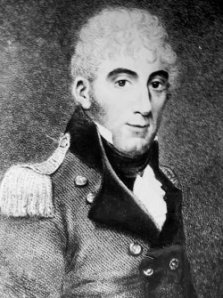
‘David Collins’ by John Currey

sillsbendjan2009-036

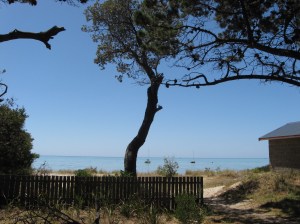
If my postings here have been a bit erratic lately, it’s because I’ve been going back and forth between home and my little caravan on the Mornington Peninsula.  It’s daggy and unsophisticated but as the sun sets over the bay, it’s a beautiful spot- here’s my view from outside the van, just up the track a bit.

Being in such close proximity to the 1803 settlement at Sorrento has prompted me to read John Currey’s biography of David Collins– the leader of the aborted settlement of a consignment of convicts direct to Port Phillip.  By sending the fleet straight to Port Phillip from England, the Colonial Office intended to both quickly create a British presence and to alleviate the moral corruption of the constant inflow of convict blood into Sydney.  The settlement only stayed in Port Phillip for eight months until it shifted to Risdon Cove (Hobart) in two separate journeys separated by months.

The author, John Currey, describes himself in his preface as “an independent scholar without access to the services and resources normally associated with an academic environment”.  He has written and edited  a number of works of early Australian settlement.  The epigraph that commences his preface is an admonition from Andre Maurois’ Aspects of Biography (1929):

Every biographer should write on the first page of his manuscript: ‘Thou shalt not judge”.

He draws heavily on Collins’ letters to family and patrons, family papers and official correspondence, supplemented by newspaper comments and other peoples’ observations and comments on their relations with Collins.  Currey is scrupulous in his search and documentation, and almost succeeds in following Maurois’ advice.  But even he, at the end of the book raises questions that verge on the edge of judgement:

“Essentially conventional in so many ways, Collins was at the same time a complex and enigmatic man.  His written legacy, despite some tantalising revelations, offers few answers to the questions his life provokes.  How could a man so attentive to minute detail in his public duties be so negligent of his own financial affairs?  By what circuitous route did the man who aspired to ascend the pulpit come to find himself reviled as a lecherer and an adulterer?  Why did a mind so receptive and alive with curiosity become so dulled and inactive?  How could a man so blessed with so many natural charms fail to find enduring love and companionship? Did Collins himself, for all his introspection have any insight into his actions?  The exhumation of  [Collins coffin in ]1925 removed some of the mysteries surrounding Collins’s death.  It offered no explanation of the profound mysteries of his life.” (p. 308)

I find it frustrating when an author raises the very questions you want answered, but draws back from actually risking an answer to them.  Currey’s conception of his role as historian constrains him from venturing his own response, informed by his research, to these questions.  He should not be so cautious.  He has read the documentation: he has spent years with this man; he is qualified to venture a judgement.

In fact, I’d add a couple of other questions.  Why was he so unsuccessful in negotiating the patronage networks that all colonial civil servants had to manage?  How exceptional or commonplace was his relationship with the various convict women he had relationships with over his time in New South Wales?  What was the public response to these relationships?

collins

Inga Clendinnen in her Dancing with Strangers is less squeamish about speculating and judging David Collins as one of her informants.   After reading his published journal about his time with the First Fleet she characterizes its author as ” the Master of Plod” (ouch!).  She describes him as a man “susceptible” to liaisons with convict women.  She notes that Collins is

…a perfect representative of the moral and material economy of European culture.  It was these assumptions he brought to his analysis of the convict condition, and which he initially brought to the encounter with the very different culture and economy of the nomad people of Australia…. But as the slow years pass we watch David Collins ripen into an absorbed observer of native conduct, and a man capable of recognizing, indeed of honouring, a quite different way of being.” (p. 55, 56)

In reading this book, I found myself thinking of James Boyce’s Van Diemen’s Land which, like Clendinnen’s book, carves out a small what-if lacuna of time where the dispossession which certainly, inevitably and inexorably occurred was not yet deepened with violence and bloodshed. I found myself wondering if Collins’ insecurity and unsteadiness in his own authority did not hold the seeds of the 1803 failure in Port Phillip, thus averting an alternative history of Port Phillip as another convict outpost of New South Wales.  Boyce’s book about Van Diemen’s Land describes a benign environment: Collins saw it as hostile.  Boyce sees plenty and food sufficiency: Collins sees starvation and abandonment.

Although Currey doesn’t say so, the  David Collins I drew from his biography was a flawed man, who failed to achieve the hopes he had for himself.  He was impotent in using patronage to his ends; his career sputtered then died out; in an environment where many others prospered financially he ended up almost penniless;  he displayed poor judgement in relation to importing cattle from Bengal at huge expense; he failed to settle an area which just over thirty years later sprang into activity; despite his cheerful exhortations and assessments to some of his correspondents, his world view was essentially pessimistic.

Anniversary Day/ Australia Day/ Invasion Day/Survival Day

flagraising

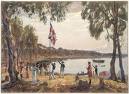
So, January 26th- Australia Day.  In the 1840s and indeed for a hundred years after that, 26th January was known as Anniversary Day or Foundation Day.  Different groups in different states made it their own in different ways. In Victoria in the late 1880s and 90s the Australian Natives Association -a group whose membership was restricted to Australian-born men of European descent- championed the choice of 26 January as the national day.  Adelaide always distanced itself from the convict origins of the day and did not celebrate it at all for many years.  In New South Wales, where it was always  (and perhaps still is?) more  prominently celebrated,  the first recorded celebrations were held in 1808, and the first official celebrations marking thirty years of settlement were held in 1818.   The First Anniversary regatta was held on Sydney Harbour in 1836, and the fiftieth anniversary of Phillip’s landing was marked by a public holiday for the first time in 1838.

So, how was Anniversary Day celebrated in Port Phillip between 1841-1843 while Judge Willis was here?   Well, not at all it seems.  There was no mention of it in the Port Phillip Herald, beyond a reference in February 1842 to the Sydney celebrations reported in the Sydney newspapers, but no further details were provided.

We associate Australia Day with 26th January but an earlier ‘Australia Day’ was celebrated on 30 July 1915 as part of a soldier parade to honour soldiers who had served and to stimulate further enlistment.  It was not until 1946 that all states and territories adopted ‘Australia Day’ as the name for the 26th January celebrations, and it was only actually celebrated on the actual day itself, rather than as a long weekend, in 1994.

There is a degree of discomfort over the choice of 26th January as our national day.  Aboriginal groups have increasingly designated it as Invasion Day, or more recently Survival Day and I think that there’s a growing squeamishness over the knowledge that the aboriginal world fractured from that day onward.

So what alternatives are there?  There is the date of Federation, but on 1 January it would be overshadowed by New Years Day (and besides, it’s already a public holiday).   There’s the 9th May for the opening of Parliament in Melbourne in 1901, then the provisional Parliament House in 1927 and finally the new Parliament House in 1988.  But -oh yawn- there’s not much colour and movement there.  There’s the 27 May 1967 referendum that is the popular (but technically incorrect) date given for aboriginal citizenship.  The government tried to whip up enthusiasm for a Battle for Australia Day, but it’s an historically dubious concept based on public panic over a period of months, rather than one particular day. There have been suggestions that there could be a day to celebrate the end of White Australia, but that occurred in a piecemeal fashion over a long period of time.  Likewise the introduction of multiculturalism did not occur on one specific day.

My suggestion?  Well, perhaps we could look at early February to commemorate the drunken free-for-all in a thunderstorm,  once the convicts were unloaded at Sydney Cove about a week after arrival in 1788.  The date has got a lot going for it.  It’s at the height of summer; daylight saving is still in operation; it might get the kids another weeks holiday before the school year starts; it defers the knuckling down for the rest of the year for a couple of days more. It seems particularly apposite- alcohol, sex, beaches- but perhaps the multiple sexual couplings were not so much fun for the women so outnumbered in a complete break-down of order. On second thought perhaps commemorating mass rape on Orgy Day is not the way to go. I suspect that Sorry Day to mark Rudd’s apology to the Stolen Generations might take on a life of its own, although once we return to coalition government it will no doubt become even more politicized than it already is.

I propose that instead of looking backward, why not plan an Australia Day in the future?  I think we should start planning very carefully for Republic Day, and choose the day to suit the holiday.  The criteria:

1. must be in summer

2. must be a moveable day to ensure that we have a long weekend every time

3. must be irreverent

4. preferably break up the working year somewhat (although Criteria 1 militates against it a bit)

5. must promote at least a little consensus and enthusiasm amongst us all.

Update

In his chapter called ‘The Arrival of the First Fleet and the ‘Foundation of Australia’, in Turning Points in Australian History, David Andrew Roberts picks up on a suggestion by C.H. Currey that perhaps 7th of February should be THE DAY.  Currey, and Roberts later,  argue that it was on 7th February, the day after the orgy, that the judge advocate David Collins opened his leather cases containing the Commissions of the officers of the First Fleet and read them before the entire contingent, with the soldiers in full regalia, and the convicts no doubt feeling rather worse for wear.  The reading aloud of these documents finally proclaimed the extent of Britain’s territorial claim, activated the legal jurisdiction of the colony and revealed the broad scope of the Governor’s powers.  The ceremony ended with ‘God Save the King’, a discharge of muskets, and a dinner for the officers.  Hmmmm….works on several levels, but it is a little reminiscent of being harangued by the Headmaster.

Another update:

Look here.

The Aboriginal Executions on 20 January 1842

Joseph Toscano, well known anarchist and correspondent to The Age yesterday convened a commemoration ceremony of the 167th anniversary of the execution of two “indigenous resistance fighters”  who were  found guilty of murder by Judge Willis, the Resident Judge of Port Phillip.

It is striking that there were six executions in Port Phillip during 1842, and then none for several years.   This does not necessarily denote, though, that Judge Willis was a particularly vicious ” hanging judge”.  Until his arrival in Port Phillip in March 1841, all Supreme Court trials were conducted in Sydney. After Judge Willis’ removal in mid 1843, his replacement Justice Jeffcott refused to order the death sentence in his own right until the legality of Willis’s dismissal had been confirmed.  However, during 1842 there were six executions in total- two Aborigines in January 1842, three bushrangers in June 1842 and another Aborigine (Roger) in September 1842.  For that year, it must have seemed that the execution parade through the streets of Melbourne to the gallows outside the new gaol was becoming a regular feature.

It’s significant that both aborigines and bushrangers were the real hot-button issues for white settlers.  Judge Willis did pass another death sentence for murder on Thomas Leahy for murder of his wife, but the the sentence was commuted to transportation.  However, there was no mercy for aborigines or bushrangers found guilty of murder: their crimes challenged power and authority more generally.

The passage of 167 years certainly changes the language that we use to conceptualize this event.  Toscano speaks today of their execution as “a great Melbourne story of love, resistance, passion and violence”.   Judge Willis wrote to La Trobe describing the case as “one of great atrocity”.  Toscano today identifies them as Tunnerminnerwait and Maulboyheenner; at the time their names were recorded by the Aboriginal Protector as “Tuninerparevay: Jack, Napoleon” and “Small Boy: Robert, Timmy, Jimmy”  (Mullaly, p. 255)

“Bob” and “Jack”, as they were popularly known at the time,  were part of a group of Aborigines brought across from Van Diemen’s Land by the Aboriginal Protector G. A. Robinson when he was appointed to his post in Port Phillip, with the intent of using them as intermediaries when conciliating the local tribes. This seems a rather ill-informed intention on Robinson’s part,  given the language and territory differences.  After a time they were no longer staying with Robinson. When two white whalers were murdered, this group of five aborigines, two men and three women (including Truganini) were reported to have been seen in the location of the murder scene , and said to have committed other depredations in the area.

This complicates the picture somewhat.  Coming from Van Diemen’s  Land, it was not a simple matter of protecting traditionally-owned territory from invading settlers.  On the other hand, their transplantation from Van Diemen’s Land across the sea was an absolute dispossession, and resistance moved from the particular to the generalized- not a particular settler on a particular river, but white men in general.

The Port Phillip Herald of 21 January 1842 reported that there was no doubt about the justness of the sentence, and that their execution was the imperative duty of the authorities to vindicate the impartiality of British law.   It is interesting to note the objections raised by Redmond Barry in their defence.  At first he argued that half the jury should consist of people able to speak the language of the defendants which, not unsurprisingly, Justice Willis overruled.   In  his address to the jury, Barry referred to the ‘peculiar situation’ of ‘circumstantial evidence of dubious character’.    Likewise, it is interesting to note the issues that did not arise.  The amenability of these particular Aborigines to European law was not questioned.  It was ascertained from Robinson that the men had knowledge of the existence of a Superior Being and knew right from wrong, and that they could speak English.  These grounds were later used by Judge Willis in other cases to acquit Aboriginals in his court who were not deemed to understand English or have an understanding of a Supreme Being.

In his address to the jury, Judge Willis is reported to have commented on the criminal activities of the armed men prior to the attack on the unarmed whalers, and he distinguished between the role of the men as murderers and the women as accomplices.  He emphasized the necessity to prevent the ‘recurrence of similar acts of aggression’.  After a recess of half an hour, the jury returned with a conviction for the men with a recommendation of mercy ‘on account of general good character and the peculiar circumstances under which they are placed’ (Mullaly p 257). The more than I think about it, this recommendation of mercy arising from a community truly anxious about ‘depredations’ and its consequent dismissal by the authorities is perhaps the most surprising aspect of the trial.

This recommendation, however, was not strongly supported by Justice Willis, and the sentence was confirmed by Governor Gipps. Their executions were the first in Port Phillip.  Public executions at the time were understood by the white participants and specatators  (as distinct from the Aboriginal prisoners)  to represent authority, religion and humanity (Castle 2007).    It was a highly ritualized degradation ceremony, with specific clothing and practices and designated roles for the clergy, the judge, the governor and the prisoners to play.  The newspaper descriptions of the time reflected the traditional  narratives of repentance, scaffold confessions and fear,  well-known from similar practices in England.

However, this was mixed with a degree of sympathy and uneasiness among some- but certainly not all- spectators.   This was a ‘first’ for everyone, and it was generally agreed that the execution itself was botched and unpleasant.  Although this first execution attracted large crowds, by the time another Aborigine, Roger, was executed in September 1842 there was newspaper disapproval of the character of the spectators who attended- particularly women- and calls for the scaffold to be removed as quickly as possible and executions to be carried out within the gaol walls rather than in public view.  However, this  squeamishness needs to be balanced against the fear of  Aboriginal depredations  voiced by small settlers and more influential squatters and landowners in the outlying frontier areas.   In such an environment, and given the legal restrictions on Aboriginal testimony, it is perhaps not surprising that there were so very, very few executions of white settlers when it was Aborigines who were murdered.

Update: An interesting article by Marie Fels with David Clark and Rene White called ‘Mistaken Identity, Not Aboriginal Heroes’ in Quadrant October 2014 looks closely at the coal-mine manager William Watson. The only words uttered by Tunnerminnerwait and Maulboyheener in their own defence pertained to William Watson-  “We thought it was Watson”. This article looks carefully and critically at William Watson and carefully reconstructs the movements of the Van Diemens Land aborigines immediately before the murder.  Well worth reading.

References:

Paul R. Mullaly  Crime in the Port Phillip District 1835-51,

Ian Macfarlane  The Public Executions at Melbourne 1842

Tim Castle ‘ Constructing Death: Newspaper reports of executions in colonial NSW 1826-1837’ Journal of Colonial History, vol 9, 2007 p. 51-68.

On the road from Heidelberg

From the Port Phillip Herald 6 Dec 1842

BLACK OUTRAGE. As a woman was coming to town the other day from Heidelberg, carrying a bundle in her hand, she was met by two black lubras, who attempting to take the bundle from her, the woman screamed out for assistance, whereupon she received a severe blow over the temples with a waddy, and the two blacks made off.  She complained of the assault at the police office, but no redress could be afforded, as she declared she could not identify the offenders.

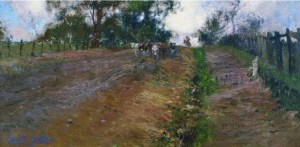
Heidelberg was about seven miles out from the centre of Melbourne, but generally viewed as being ‘in the country’.   There was a road out to Heidelberg by this time built from donations and public subscription lists by the Heidelberg Road Trust , representing the interests of  the gentlemen who lived there (Judge Willis himself, Verner, the Boldens, Wills, Porter etc).  Heidelberg Since 1836 describes the route as:

…an extension of the great Heidelberg Road, which commenced in present day Smith Street Collingwood, winding through the Edinburgh Gardens and then crossing a ford in the Merri Creek.  The track to the village was approximately along the present Heidelberg Road, along Upper Heidelberg Road, and then branched off down to the village from the top of the hill at Heidelberg.  The road continued on along the ridge of the hill, down to the Lower Plenty and then on to the Upper Yarra.  (p. 12)

heidelbergroad1

By 1842, over 500 pounds of local money had been spent on the road, and log bridges were built at the Darebin Creek and the Plenty River.  Late in 1842 the Government paid the wages of unemployed labourers to clear stones and stumps from the road.  From 1845, as a result of the deterioration of the road, a levy was placed on landowners and a toll was established.

Not that our “woman” (note- not a lady) would necessarily be using the road.  I’m astounded by the distances that even ladies would walk- Georgiana McCrae seemed to think nothing of walking across the paddocks into the city from her house ‘Mayfield’ near the corner of present-day Church and Victoria Streets Abbotsford.  Abbotsford is of course much closer to the city than Heidelberg, but even a lady of one of the most prominent families in Melbourne would be prepared to hoof it through the bush.

This is also a reminder that the “blacks” were not only up-country but relatively close to Melbourne .  In fact, there are fleeting mentions of aboriginal people still visible on the streets of Melbourne itself.  I’m not sure what the significance is- if any- of these two women accosting another woman. Would they, I wonder, have approached a man, who was more likely to defend himself?

References:

C. Cummins Heidelberg Since 1836: A Pictorial History.

Those party animals of 1842

Port Phillip might have been on the other side of the globe and its seasons might have been the wrong way round, but when it came to the expression of status, the ‘respectable’ citizens of Port Phillip looked, at least in this pre-Gold Rush period,  to the practices of ‘home’.

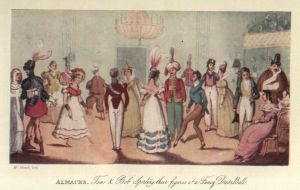
almacks

Private Quarterly Assemblies were a normal part of English social life.   Hundreds of people would flock to assembly rooms in London and the provincial cities like York and the spa town of Bath.  They were formal events where entry was by subscription, and attendees were screened to ensure the quality of those who gained admittance.  The most aristocratic was Almacks while Jane Austen’s books describe the famous Bath Assemblies and more humble affairs at provincial level.

And so to the Port Phillip Assemblies.  They were established in the midst of controversy over celebrations for the Queens Birthday ball, which culminated in two balls- a public one and a private one.  The success of the private ball prompted the establishment of a committee of twenty men to arrange Private Quarterly Assemblies.  Membership, vetted by the committee, was limited to gentleman colonists and their families.  Merchants were included, but tradesmen were not. As Edward Curr was to find out, squabbles between gentlemen settlers could bubble over into the Assembly committee.  He had argued with Lyon Campbell over the hiring of a cook, and the matter was brought before the Assembly Committee which, much to his gratification,  refused the demands to strike him from the subscriber list.

The Port Phillip Herald of 21 October 1842 has a report of the Assembly Ball held on 19th October in the long room of the new Mechanics School of Arts on Eastern Hill.  I assume that this was the original Atheneum building in Collins Street, although it was not officially opened until December.  Certainly the new building was a source of great pride, described as a building “that would do credit to a town three times as old as our metropolis” (PPH 11 Oct 1842).  Tickets for the ball had been available from the Melbourne Club.

DOMESTIC INTELLIGENCE.  ASSEMBLY BALL. (PPH 21 Oct 1842)

The second private assembly ball of the season took place at the Mechanics’  School of Arts, on the evening of Wednesday last; and, notwithstanding the wetness of the weather, the coldness of the air, and the almost impassable state of the streets prevented so numerous an attendance as was expected, at eleven o’clock eighty guests had assembled, one half being ladies.  The noble long room of the Institution was set apart for the ball, leading from which was an ante-room plentifully supplied throughout the whole evening with refreshments.  Three large chandeleers [sic] with oil burners suspended from the ceiling, and innumerable wax-candles fixed in branches fastened all round the room, threw a brilliant light upon the handsome faces and splendid dresses of the ladies, and the happy countenances of all.  A temporary orchestra was erected at the further corner of  the room, containing seven musicians, who, to do them justice, played admirably from the first quadrille to the closing country dance.  The waltz tunes were very well selected, and the time excellently marked.  At half-past one o’clock the company went below to partake of a substantial supper, provided by Mr Howe, in the two left-hand rooms, which having been done ample justice to, the ball-room was again the scene of the stirring dance till daylight, when the company separated highly gratified at the evening’s festivities, which were considerably enhanced by the excellent arrangements of the stewards.

My, these Port Phillipians knew how to party! I thought that it was only clubbers of the late twentieth century who arrived just before midnight and continued on until daybreak.  This is October, so it would have been completely dark when they arrived.  And supper at 1.30 a.m.!!

References

Paul de Serville  Port Phillip Gentlemen

A day at Sills Bend

sillsbendjan2009-002

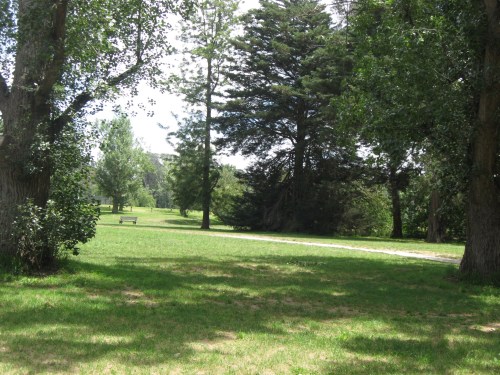
One of my favourite places to take a deck chair, picnic, glass of wine and good book on a warm afternoon is down to Sills Bend, beside the Yarra River in Heidelberg.  I’m a Heidelberg gal at heart, and down at Sills Bend I feel particularly close to the early settlers, including the Resident Judge Willis, whose rented property was on the ridge overlooking these river flats. As Alexander Sutherland was to describe it in 1888,

Heidelberg was scarcely a suburb; it was rather a favourite district for those who desire to have ample domains around their dwelling.  Until 1850 it was regarded as the distinctly aristocratic locality; the beauty of the river scenery, the quiet romantic aspect of the place, gave it an early reputation among the Melbourne men of means as the site for country residence – Alexander Sutherland Victoria and Its Metropolis 1888

The land that is now Heidelberg was offered for sale at the first land sales, conducted in Sydney. The fact that the sales were held in Sydney, meant that unless locals or their agents were prepared to travel up to Sydney, then most of the sales were to Sydney investors.  Thomas Walker, the Scottish investor, purchased several of  the available lots.  However, as is usual in land boom conditions, the estates changed hands several times in a short period of time.  And why wouldn’t they- prime land, water access through the Yarra, Darebin and Plenty rivers, and all within ten miles of the centre of Melbourne.

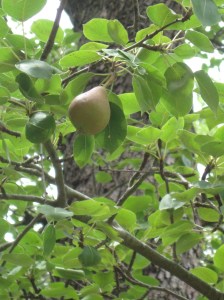
The river flats, with a good source of water were turned over to tenant farmers like Peter Fanning (1827-1905), who farmed the next bend of the river (Fanning’s Bend) , or subdivided from the larger estates and sold as small holdings to farmers like Mark Sill (1818-1885) who planted an orchard.  Several of the pear trees are still alive.

sillsbendjan2009-006sillsbendjan2009-007

The gold rush had little effect on Heidelberg beyond stimulating market gardens and agriculture to supply the increased population moving to the diggings at Queenstown (St Andrews) and Warrandyte. However, during the 1860s there was a succession of ‘droughts and flooding rains’ that made sustainable farming very difficult.  As the agent for the Banyule Estate, James Graham wrote on 12 January 1865

I am quite concerned about the low rents from Banyule area the tenants are doing no good. What with this very dry season and rust and caterpillars, the crops are very poor indeed.  Fanning is both losing money and rent altogether and he has been at me several times to let him off the lease. He had worked hard poor fellow but I see and I know that he is losing money.  His wife is in very bad health, which helps to make matters worse.

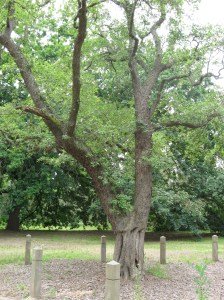
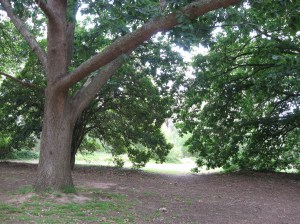
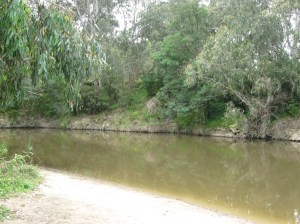
The dominance of English-style estates around the Heidelberg areas means that there are quite a few stands of oak and hawthorn trees.  The oak trees down at Sills Bend are spectacular, with branches that reach right down to the ground.  There’s a little beach (very little) down on the Yarra bank

sillsbendjan2009-008

sillsbendjan2009-013

The small size of Heidelberg militated against the provision of infrastructure like water and rail, which in turn hampered growth.  It was really only with the Depression of the 1890s that the large estates began to be broken up.  Land subdivision progressed in a piecemeal fashion right up until the 1960s.

So, Melburnians, when you read of the “missing link” between the Western Ring Road and the Eastern Freeway, look very carefully at what is proposed when they start talking about the Bulleen option.  You might want to join me on the barricades.

References:

Don Garden, Heidelberg: The Land and Its People

Plaque at Sills Bend

Good on you, Mrs Mac

From the Port Phillip Gazette 1/1/42

BIRTH EXTRAORDINAIRE! On Thursday Mrs McDonald, the wife of a respectable settler, presented her husband at Mr Mortimer’s Crown Hotel, with a Christmas box consisting of two girls and a boy, whom with the mother, are doing well. Advance Australia Felix.  The girls were christened Victoria and Adelaide, the boy Albert.

My, what regal names!  The Port Phillip Herald of 4/1/42 adds the alarming detail that Mrs John McDonald of River Plenty had presented her husband with twins about 12 months earlier!! Five under about eighteen months……

I wonder whether she came into the Crown Hotel specially for the birth or whether she just happened to be there.  Ironic, really, that maternity hospitals today shove their new mothers off into hotel suites to clear the hospital beds.

There were only occasional birth notices in the Port Phillip newspapers of the 1840s, and generally only for the wives of “highly respectable” professional men, rather than the wives of  humble “respectable settlers” like Mrs McDonald.   I noticed that the Insolvency Commissioner’s wife Mrs Verner had a baby, then about two weeks later there was an advertisement for a wet nurse with the instruction to apply at the Insolvency Court- surely not the first place one would think to make such a contract. [I feel a bad joke about milking people dry coming on…..]

Well, I wonder what happened to Mr and Mrs McDonald and their little ones?

Happy New Year!

nyeve2

Well, New Years Eve in Melbourne came and went, as it always does, last night.  Many police in the city, and just a handful of arrests apparently.

(Update: Well, more than a handful.  The Age today reports that there were 1147 arrests across the state, double that of New Years Eve 2007 when there were 511 arrests.  “The tougher stance produced ‘the quietest New Year’s Eve on record’, with no repeat of the riots that marred past New Year’s Eves at Rye and St. Kilda.”  136 people were taken off the street for offensive behaviour, indecent language and minor assaults, and 485 motorists were booked for a range of traffic offences, well up on 248 last year).

What about in Port Phillip in 1841?  Here we are, in the Port Phillip Gazette of 1/1/41 in the Police Intelligence column- where else?

POLICE INTELLIGENCE. William Porter, Charles Aldgate, David Holmes, John Walsh, John Percival, Charles Major and Richard Bennet were driven into the box like a flock of sheep, having been found suffering from the effects of the season.

Bench: Well, what have you to say?

Chorus: Christmas, Your Honor, Christmas!

Bench: Silence! We neither countenance nor approve of drunkenness, but making a little allowance for the season, we discharge you all

Chorus: Thank you, Your Honor: hurrah! a merry Christmas and a happy new year!!

The Port Phillip Patriot was a little less charitable about the lads hauled in a couple of days later:

The first day of the year 1841 must evidently have been auspicious to the publicans of Melbourne if we may judge from the number of persons, amounting to twelve who made their appearance at the bar of the Police Office on Saturday morning.  Nor was the offence confined to the male kind solely, one female being charged for the fifth time.  If we may judge from appearances, we should say that the potations of many were not pacifically concluded, the physiognomies of many bearing sanguine and sable traces of having done battle ( Patriot 4/1/41)

Given that Christmas seemed such a fizzer, I thought I’d look up to see if New Year was celebrated with any more gusto.  I checked out the chapter on Christmas in Ken Inglis’ Australian Colonists (1974) to see if my hunch about the relatively low-key, domestic nature of Christmas was sound.  He took a wider chronological sweep than I did and so includes information from later in the century (as well as the sources I found) but he  did note the prominence of New Year. He speculated whether it was the influence of the Scots and their emphasis on hogmanay but was aware of the relatively low proportion of Scots in Australia generally. However, there were proportionally more Scots in Port Phillip (40%)  than elsewhere in New South Wales (30%)  so perhaps that explains why the extended pieces I found on Christmas came from Sydney and South Australia respectively, rather than Port Phillip.

Inglis writes of Australia as a whole:

Here as at home the new year was welcomed with church bells, and people resolved to do and be better for the next twelve months.  Governors held levees, citizens played or watched games, went for picnics, listened to bands.  From the first years of the settlement it was customary for men to stay in towns, to stay out late carousing and larking, lighting bonfires and fireworks.  (p. 113)

The Port Phillip Gazette celebrated New Year by presenting its town subscribers with “an engraving by our late talented and eccentric friend John Adamson” which although falling short in conveying the size of Melbourne, “will help to convey to distant friends the position, appearance and style of the town of Melbourne.”  I think you can see the engraving here. All three papers made much of the coming of 1842,  far more than they did in 1843 when the depression was obviously biting and press columns were preoccupied with elections and politics.  All three papers in 1841/2  indulged in a bit of backward-gazing self-congratulations and worthy and jovial exhortations for the coming year, but there was none of this the following year.

So, what was there to do on New Years Eve and the following New Years Day in that party-year 1842?  On New Years Eve, you could have gone to a concert at the Pavilion

The concert held on Saturday evening last to welcome in the new year, was numerously attended and came off with considerable eclat. Although, as might have been anticipated at the season of  general jubilee, a number of rather suspicious characters were loitering about the Pavilion, many of whom endeavoured to obtain admittance, yet they were very properly excluded, and in consequence, if those favored with an entre were not all of the upper ranks of society they were respectable and conducted themselves with the greatest propriety.  The evening’s entertainment was, upon the whole, little, if any thing inferior to any similar display in the colonies and if equal attention for the future be paid to the general arrangements by the Manager, and the performers exert themselves in an equally laudable manner for the gentrification of the audience, the Pavilion will soon be a most fashionable place of resort as it is as yet the only one of rational amusement.  The “star” Miss Sinclair, fully realized the most sanguine anticipations, she has an excellent command of a good voice, and with a little more practice her success as a vocalist is certain.  Her “Kate Kearney” was sung with a spirit and national feeling which told she was at home in giving effect to an Irish air.  Miss Lucas’ “Meet me by moonlight” was good, but it was evident she labored under the effects of a bad cold; but although in consequence she had been previously recommended to resign her part, she preferred making her appearance to disappointing her previous admirers. Master Eyles’ performance was generally good, but the concluding part of the “Bay of Biscay” was excellent and promised well for future fame.  Mr Miller, as a comic singer, would not disgrace the provincial boards of the first class in Britain, and was no better received than he deserved.  In all his actions he was happy, but particularly in “Biddy the Basket Woman”.  To supply the hiatus in the performance caused by the necessary retirement of Miss Lucas, an amateur entertained the audience with a variety of dances, expert gesticulations &c. and deservedly stands a favourite.  Port Phillip Herald 4 Jan 1842

The next day, you might have attended a cricket match where “a party of civilians were duly stumped out by their opponents the government officials”. But it sounds as if THE place to be was Williams Town beach, attracting crowds from Melbourne arriving by steamer with bands playing, and spilling onto the beach to enjoy sail boat races, whale boat races, sack races, footraces,  shimmying up a greasy pole, blindfold wheelbarrow races and a greasy pig chase.
williamstown

At 1.30 a free lunch was served for 200-300 people- sheep, beef, cabbage- (mmm, mmm) accompanied by the popping of corks and music.  The crowds had all melted away by 6.00 when the town worthies had their own, more select gathering of fifteen gentlemen who sat down for a much more dignified dinner.

Of course, if you were of a more spiritual bent, you could have attended the opening of the Independent Chapel on Eastern Hill- a building that could accommodate 500-600 people, splendidly lit with chandeliers.

And so, “Thus ended the amusements of a New Years Day in Australia Felix”

References:

Ken Inglis  Australian Colonists

A. G. L. Shaw The Port Phillip District.

The Yarra in flood August 1842

img135-correction3

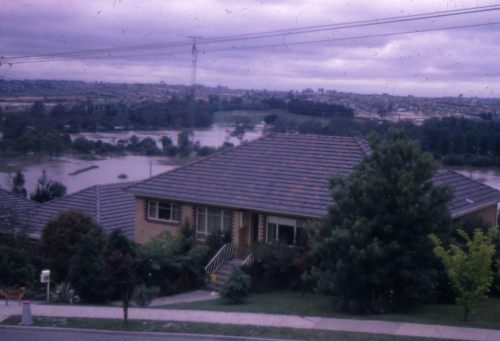
View from Dalvey Street Heidelberg showing Yarra in flood

It’s been a long, long time since I’ve seen the Yarra in flood.   As a child, we lived in a house on top of the hill overlooking Warringal Park in Heidelberg.  Justice John Walpole Willis- the first resident Supreme Court judge-  would have walked around our very site because that is where he lived (and hence my first spark of interest in him).  We could always see when the Yarra flooded from our front garden, as you can see from the photo above, taken probably in the late 60s-early 70s.   I can remember the school buses having to slosh through the floodwaters to get to my now-demolished school, Banyule High School.

The Yarra has always been a focal point for the village of Melbourne.  It was the availability of fresh water above “the falls” at the bottom of William Street that determined the location of the settlement.  It’s been a major transport route to Port Phillip Bay; it’s been an industrial sewer; it’s still used recreationally (although I wouldn’t swim in it), and it’s now the site for the casino, exhibition centre, restaurants etc.

Until it was so heavily dammed and flood mitigation works completed, the Yarra used to flood quite regularly.   Although the worst flood was in 1891, the last great flood was in 1934. My father, who lived in Hawthorn, recalls the houses beside the river being flooded up to their roofline, and seeing the four legs of a dead horse being bashed by the floodwaters against the top of  the Wallan Road bridge which only just escaped inundation.

The first recorded flood of the Yarra River was in 1839, but Judge Willis would have also seen the flood in August 1842.  Here’s what the Port Phillip Herald of 2 August 1842 had to say:

During last week, owing to the very heavy rains of Monday and Tuesday, the Yarra has risen to a height altogether unknown to the oldest resident, and overflowed its banks, inundated the wharf, and substituted one sheet of water on the other side of the river for the green grassy fields, which [indistinct] that locality have hitherto opened up to view and even the new road from the Beach to the bridge, which, it was supposed, from its elevation, to be free from inundation, was flooded in many places.

Mind you, “the oldest resident” would only have been in Port Phillip for seven years anyway, so this is no great claim.  In an interesting twist on public memory, the Port Phillip Herald of 6th September 1842 reported that the aborigines of the town designated this particular flood as only a ‘picaninny’ with worse to come, and indicated that a flood about twenty years ago had flooded the area occupied by the Market Square.  The elevated, but flooded road was being built by the labour of unemployed workers as part of the limited public works program.

On Sunday crowds of the inhabitants were to be seen promenading on the new wharf looking with intense interest to the breakwater overflowing in rushing torrents, in humble imitation of the falls of Niagara.

Very humble imitation , I’d say.  The “falls” were not particularly high-  more a ridge that separated the fresh water from the salt.   The governor, George Gipps, even harked back to his engineering background in the military by drawing up plans to build a larger breakwater across the falls.  But Niagara?  “Tell ’em they’re dreamin'” (Source: The Castle)

The damage to the brickmakers has been very great, all of them having been compelled to seek other habitations at a moment’s notice, their houses being now flooded three feet deep.

The brickfields were on the south side of the Yarra.  The location was derided by the more respectable inhabitants of Port Phillip as being the source of vice and degradation.  You sometimes see “the brickfields” given as the address for people facing the Police or Supreme court.

All the beautiful gardens on the banks, including Messrs. Orr, Curr, Welsh, the Hon Mr Murray, and Major St John &c &c are also completely under water, as well as those at Heidelberg.  Captain Cole’s wharf, which has been raised several feet by the earth cut out from the dock, presents the extraordinary appearance of a “dissolute island”, being completely surrounded with water.

The floodwaters at Heidelberg meant that Judge Willis could not make it into town from Heidelberg to attend court.  And somehow, I don’t think I’ll ever see the Yarra in flood again.

Update

It would seem that the Aborigines were right when they predicted even higher flooding.  The Port Phillip Herald of October 28 1842 reports:

The prediction of the blacks that the flood of August was but a picanniny one compared with that yet to come, by which the water would reach the custom house was nearly realized, the water reaching within a few feet of that building, and we hear that it rose to the amazing height of fifty feet at Heidelberg.