Category Archives: Port Phillip history

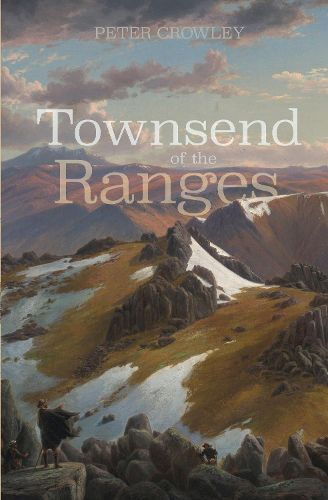
‘Townsend of the Ranges’ by Peter Crowley

2024, 312 p. & notes

As I remember, it was in about Grade 5 that we “did” Australian history – the first taste of ‘aborigines, explorers, gold and Eureka’- and we used a plastic template to draw Australia. Poor old Tasmania didn’t even get a look-in, but I was also disconcerted by the borders of Victoria, which started with off the solid line of the Murray River before trailing off into dotted lines, like the other state boundaries. Not that the dotted lines were any use: they were impossible to fit a pencil point into, anyway, but they did give a visual sense of state borders. (And emphasized the importance of water compared to boundaries, even though that water might disappear completely from time to time).
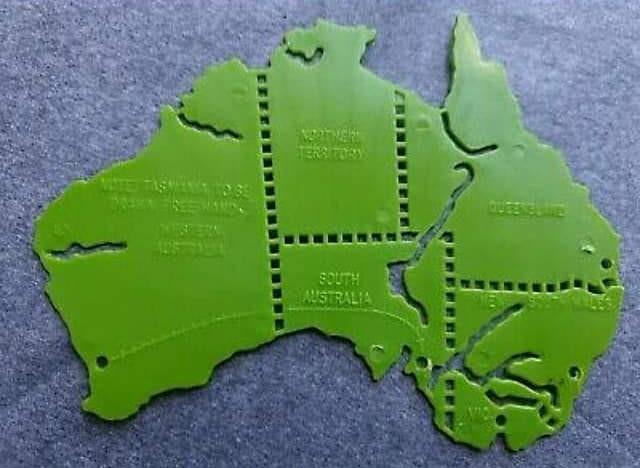
Source: Reddit

Australians are not unaware of surveyors in their history. Travelling around South Eastern Australia, one often encounters the ‘Major Mitchell Trail’, or markers of the trail of Hume and Hovell, more often described as ‘explorers’ but at early stages of Australia’s colonization, the distinction was perhaps less clear cut. Many Australians are aware of Goyder’s Line that separates arable from drought land in South Australia, and the final proclamation of the Black-Allan line in 2006, more than 130 years after it was surveyed, brought the names of surveyors Alexander Black and Alexander Allan to (somewhat) public notice. But I must confess that I had never heard of Thomas Scott Townsend, the subject of this biography, although his name was given to the second-highest mountain in Australia and Townsend Corner marks where that solid line dissolved onto dots on my plastic school template. The author of this book, Peter Crowley, felt that Townsend had been short-changed:

As far as I am aware, this is the first biography dedicated to Townsend, a man who was the pre-eminent field surveyor of the south-east during the squatter age…I felt for Townsend and his family and wanted to restore his memory to the place it deserved. His triumphs and his travails were of compelling human interest, a tale of suffering and sacrifice endured in service to the public, and they were always going to be the backbone of this narrative. (p.18)

Narratively, Crowley gets you in from the outset. He starts with a suicide in 1869, more than twenty years after most of the action in this story, when the reclusive and belligerent Townsend kills himself by cutting his own throat. What could have led to this “pre-eminent field surveyor” taking his own life?

Thomas Scott Townsend was born in England in 1812. He, along with his parents and 10 siblings, lived at Woodend House in Buckingham Shire. His older brother Joseph was apprenticed to a land surveyor and then began his own surveying business, and it was later noted by Major Thomas Mitchell, the explorer and Surveyor General of New South Wales that Thomas Townsend had been “bred in a surveyor’s office in England”. Thomas had arrived in NSW at the age of 17, and after being unable to find employment, was the recipient of a recommendation to the Surveyor-General from the MP for Oxfordshire, generated no doubt as part of the lobbying and patronage network which underpinned colonial mobility around the empire. He was initially appointed as a draftsman in a temporary capacity in 1831, but remained an employee of the survey department for over 20 years. Those same patronage networks, deployed to the advantage of other new arrivals, were to stall his progress up the career ladder when other aspirants were appointed over him on the basis of similar recommendations from ‘home’. He had to wait under 1845 to be promoted to the position of ‘surveyor’ and the highest position he reached was Acting Deputy Surveyor General of New South Wales.

In these twenty years he was appointed to various projects: laying out towns in Albury, Geelong, Eden; acting as Surveyor-in-Charge of the Port Phillip District; surveying coasts in Gippsland and the South Coast; ascertaining the source of the Murray River; and traversing the Main Range of the Snowy Mountains, making an ascent of the then-unnamed Mt Kosciuszko. Even though the Surveyor-General, Major (Sir) Thomas Mitchell, was able to inveigle long periods of leave for himself to return ‘home’, it seemed that each time the opportunity for a voyage or desired excursion arose, the government found Townsend indispensable and directed him to another suddenly-urgent project. Located far from Sydney and beyond the reach of official orders, he devised his own surveying activities as well, using the time when snow and floodwaters made surveying impossible to go back over areas that had been surveyed in haste earlier. He was ridden hard by the government, but he was a self-driven man as well : perhaps there is a streak of madness in all explorers and surveyors? He was not the first man to enter these areas – he found that squatters had preceded him nearly everywhere he went, following generations-old indigenous paths to find open pastures – but the methodical, documented act of surveying was a form of exploration in its own right.

Surveying involved long periods living in tents in the bush, unless the territory was so impenetrable that supplies had to be left with the oxen and horses so that the surveying party could move unencumbered, sleeping in the open at night – surely a daunting prospect in south-east Gippsland and in the Great Dividing Range. Surveyors used the ‘chain and compass’ method, using a Gunter’s chain to measure distance and taking bearings and angles with a compass. Sometimes they had access to a circumferentor, a compass mounted on a tripod with a sighting arm, or later a theodolite to measure angles. They recorded information in field books, from which they later plotted their data onto maps. At this stage they did not use contour lines, but instead depicted ridges, spurs and valleys by parallel lines known as hachures. Thus, those early maps look quite different to the contour maps we are accustomed to today, and certainly they have their own beauty.

Townsend was instructed to record the indigenous names for the geographical features he surveyed, even though those other names were later overlaid by British names awarded as an act of homage to patrons at ‘home’. Crowley emphasizes throughout the presence of indigenous clans and nations across the whole area that Townsend surveyed. Indigenous guides could easily be procured from squatting stations, and Charley Tarra (or Tara) was a member of several surveying parties. Crowley notes the massacres associated with various squatters, although he does not interrogate the role of the surveyor in a political and legal sense. Certainly guns and violence led to appropriation of the land on-the-spot by the squatters, but it was the legal act of survey and resultant gazetting that imposed British title and sovereignty over Aboriginal land.

Townsend’s work was directly impacted by colonial politics. When he first arrived, the NSW government had already lost control of the squatters outside the Nineteen Counties, and pastoralists were moving into the Port Phillip district from across Bass Strait. When he arrived in Port Phillip as Surveyor-in-Charge, there was already a large backlog of work awaiting him, which only increased further with the influx of population during the gold rush. With the cessation of transportation, the source of cheap surveying teams dried up, and it became difficult to find men prepared to face the isolation and sheer hard work of the task. Squatting regulations introduced a degree of urgency into surveying work, with the imperative to mark out town reservations close to water supplies, to avoid them being swallowed up into large estates. Separation in 1851 brought politics into surveying, with suggestions of a border on the Murrumbidgee which would have placed the Riverina and the later Canberra district within Victoria. Townsend had his own opinion about where the boundary should be, suggesting that instead of rivers being used (which can, after all, expand and shrink depending on climate), mountain ridges and port access should guide the decision.

Crowley depicts well the arduousness of surveying work. It seems that Townsend suffered more from the heat of surveying the Murrumbidgee than he did the snowdrifts and dankness of the south-east. Men could get lost just when stopping aside to relieve themselves; sometimes ticket-of-leave and convict team members were unruly or absconded; and the sad death of Major Mitchell’s son 18 year old son Murray, who accompanied Townsend on his survey of the lower Snowy River, highlighted the isolation and dearth of medical assistance out on the field.

The isolation, the incessant work and the rootlessness of surveying work over such a long period of work did not augur well for a desk-bound job in Sydney once Townsend finally achieved the promotion he craved. In fact, he was quite clear with the governor that he felt that he still needed to be in the field to ensure the accuracy of the surveys conducted by men under his supervision. He married, but seemed unsettled and increasingly paranoid about his wife’s fidelity and sure that he was being ‘watched’. Many people were concerned about him, and felt that a trip back ‘home’, which had been postponed for so many years might alleviate his mental distress. This was not to be… and here we are back at the start of the story, with Townsend’s suicide. I had felt at the start of the book that Crowley had laboured the ‘ignored hero’ point a bit, but by the end, I no longer felt that way. Townsend has been overlooked. Strezlecki has garnered most of the praise for his exploration of the Great Dividing Range, and Alexanders Black and Allen received acknowledgement for tracing the Murray River that Townsend had surveyed twenty years earlier.

Crowley tells the story well, interweaving the biographical with the historical. He draws on official correspondence between Townsend and his colleagues and superiors, Colonial Office files with and about Townsend (which reflect the usual aggrieved tone of correspondents and pompous tone of Colonial Office officials), Townsend’s maps and drawings, and in quite a coup, family correspondence that fills in the last years of Townsend’s life. At times, particularly at the start of the book, I felt that he was distracted by the weeds a bit, giving more context and background information than was necessary. The book does not have an index, which would have been appreciated, but the old fashioned chapter summaries at the start of each chapter helped you to locate information. There was a single list of footnotes that spanned across all chapters. The book did seem to take an inordinately long time to get started, with a note about measurements, geographical notes about what constituted the Great Dividing Range, or the Murray River, a cast of characters, a timeline, acknowledgments and an introduction- all before we get to chapter one. Much of this could have gone at the end of the book.

The one thing that I cannot understand, however, is the dearth of clear, modern maps in this book. With the National Library of Australia as publisher, use of historic maps and documents is to be expected but they were virtually illegible once reduced in size and rendered into grayscale. For much of the book I had no idea where Townsend was or where he was going and no sense of distance or remoteness. This was a book that cried out for a visual representation of land: something to which Townsend devoted his whole life.

But these are quibbles about decisions that may well have been beyond the author’s control. Crowley captures well the incessant demands of the work, the beauty and intimidation of the lands he was surveying, and Townsend’s inexorable spiral into mania. It is both a very human story, and yet one placed within the vastness of unsurveyed territory. Townsend may have had to have wait more than 150 years for his biographer, but with Crowley’s book he receives the recognition earned and withheld for so many years.

Sourced from: review copy from Scott Eathorne, Quickmark Media
Article: Artists in Society 1850-1880

I enjoy reading essays and articles and so I’ve decided to briefly review them here. My criteria for selection is that they are available online, either freely or through membership of one of our State Libraries (in my case, the State Library of Victoria). Membership of a State Library is free, and it often gives you access to online journals that you would not otherwise have. Not the most recent edition, admittedly, but free nonetheless.

Caroline Clemente ‘Artists in Society: a Melbourne circle 1850s- 1880s’ Art Bulletin of Victoria, 30,  (2014) freely available online here.

The focus of this article is on three colonial artists whose works can be found in the NGV’s collection of colonial period art: Edward La Trobe Bateman (1815-97), Louisa Anne Meredith (1812-95) and Georgiana McCrae (1804-90). Although the works discussed in this article were all created during the period 1850-1880s, the networks and family/friendship connections between the artists reach back into 1840s Port Phillip.  The Howitt family are the linch-pin here as the centre of cultured Port Phillip society, in their large house at No 1 Collins Street and  at Barragunda, their retreat at Cape Schank. [See a photograph of their Collins Street residence here in 1868, showing the presence of large residences and gardens in what is now the centre of the city.]

At the same time, the links between these artists and their works and the cultural influences in the metropole are clear.  Bateman‘s work featured at the Pre-Raphaelite exhibition held in Melbourne in 2015 and Louisa Anne Meredith’s books and illustrations attracted attention in London as part of the empire’s fascination with the flora and fauna of ‘the colonies’.  Even Georgiana McCrae, whose professional life was largely stifled by her emigration to Port Phillip,  was trained by some of the best masters in England and, thankfully, continued her work within her family circle even though it was deemed unseemly for her to work commercially.

This article takes each of the three artists in turn, highlighting the links between them. As the closing sentence of this essay notes:

This circle of friends and artists thus provides a unique insight and testifies to the breadth and vigour of the cultural life of early Melbourne.


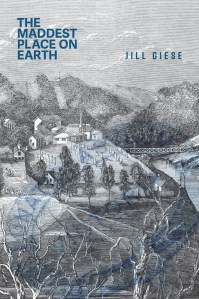
‘The Maddest Place on Earth’ by Jill Giese

Giese_The-Maddest-Place-on-Earth

2018, 220 p.

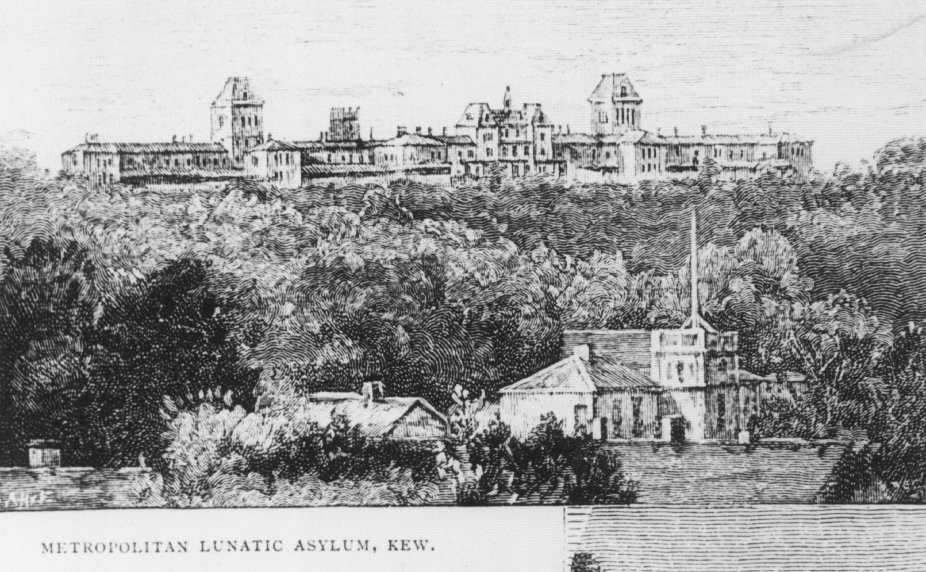
In the Epilogue of this book, clinical psychologist and author Jill Giese  writes that she jumped at the rare opportunity of an Open Day at Willsmere, the site of the old Kew Asylum. A little girl asked in that unfettered way that children do, ” If they were all crazy, why did they build them such a nice place to live?” As Giese notes, the most (and increasingly) visible sign of mental illness today is people lying on the streets of Melbourne, wrapped in blankets, begging for small change. Interestingly, it was the urge to give mentally ill people a shelter – an asylum- from the homelessness and penury of living in a blanket, that led to the construction of first the Yarra Bend Lunatic Asylum, and within six years, the construction of Kew Asylum, the first purpose-built asylum in Victoria. Both institutions – though plagued with overcrowding – were not established as the ‘Bedlam’-type places of horror that we might assume them to be.

KEWdraw

English: Engraving of the Metropolitan Lunatic Asylum, Kew. Buildings of Yarra Bend Asylum are seen in the foreground. c 1880. Source: Wikipedia

Victoria had what was perceived to be the highest level of mental illness in the world, hence the title “The Maddest Place on Earth”. In fact, at one of the numerous Royal Commissions held into asylums in Victoria during the 19th century, it was predicted that by 2050 every inhabitant of Victoria would be mad. A number of reasons were put forward: our meat-rich diet, the climate, the effect of the Gold Rush, excessive masturbation (although why Victorians would be especially prone to this was not explained) and the success of the Salvation Army in turning people’s minds to God.  Perhaps a better explanation was the “imported insanity” that arose from families ‘back home’ shipping their mentally-ill family members off to the colonies to avoid the scandal of madness. The Gold Rush could have both attracted and elicited madness in men who threw in everything to travel to the other side of the world, with failure more likely than success.

Giese tells the story of the Yarra Bend Asylum and the Kew Asylum but this is not your usual institutional history. Instead of taking a top-down approach, she uses  two main characters as the lens through which to view the asylum system in Victoria. Her first character, George Foley, was the son of an eminent artistic family in England. He suffered his first episode of mental illness while in art school, and suddenly “found himself” on a ship headed for Melbourne. He moved in and out of Yarra Bend and Kew Asylums, continuing to draw while incarcerated, and trying to hold together a precarious artistic existence when he was “outside”. The second character was journalist  Julian Thomas who, working under-cover as a ward attendant, wrote a series of columns for the Argus under the pen-name of “The Vagabond”.  He writes vividly and with humour, every bit the equal of a Mark Twain, or a nineteenth-century Louis Theroux.  Julian Thomas is well-known to historians of Australian (and particularly Victorian) history, but I hadn’t read his work before, and obviously Giese herself – a psychologist herself, rather than a historian-  was delighted to discover him for the first time.

Through George Foley, we catch a glimpse of the sharp edges of the itinerant artist’s life, even for a man clutching the slender thread of family reputation. At a time when there was no treatment for mental illness, he would be housed, fed and given meaningful work while in the asylum, only to flounder once he was released to his own resources again. He drew portraits of personnel within the asylum, including ‘The Vagabond’, who used a touched-up version of the portrait when he finally revealed his identity.  Through ‘The Vagabond’ we learn of meal-times with poorly cooked food, the dissonant music of the asylum band at the fortnightly balls held for inmates and staff, and the brutalizing effects of institutional life on the Kew Asylum attendants in particular.

Right from the establishment of Port Phillip, the presence of mentally ill people on the unmade streets of Melbourne was noted. Until the changes in asylum practice encouraged by the Quakers in the early 19th century in England, asylums had been dire places. Based on the new philosophy that asylums for the mentally ill should be built out of town, on hills in the fresh air, Yarra Bend quickly outgrew its construction in 1848 and was soon surrounded by a mosaic of cottages and even tents. The nearby Kew Asylum was opened in 1872 in a much grander E-shaped Italianate building,  Within five years Kew was the subject of a Royal Commission, which found overcrowding, disease and mistreatment. This was largely caused by a change in the criteria by which patients could be admitted to a ‘lunatic asylum’, which swelled the numbers of mentally ill patients with chronic patients with intellectual disabilities or dementia.  Despite the grandness of Kew Asylum, Yarra Bend stayed largely unchanged with its small cottage structure and more domestic, less institutionalized approach.  As Giese points out, Yarra Bend (despite its age and comparative neglect) came to be seen as the better model for dealing with mental illness with features like shelter, home-cooked food and meaningful, routinized work, that our mental health system could well emulate today.

Giese’s decision to use Foley and the Vagabond as her focus – one a patient, the other a staff member- is inspired. It would have been easy to have taken a patchwork approach, with small stories and vignettes stitched together into a fairly conventional institutional history, but for most of the book she avoids this methodology.  While she also traces through the career of Edward Paley, Inspector of Asylums, and recounts the numerous commissions of enquiry that, as too often happens today, masqueraded as action in themselves, she maintains her gaze on two individuals.  As a reader, you become invested in these two men. You read with a sinking heart of Foley’s struggle for mental stability and you see through the eyes of The Vagabond, in lengthy italized extracts from his columns.  Moreover, The Vagabond, too, has his secrets as Giese discovers at the end of the book.

This book won the Victorian Premier’s History Award for this book, and it fully deserves it. It is beautifully written, although perhaps a little fervent at times, and it is a deeply compassionate book. By foregrounding the long-term experience of George as patient, the Vagabond as attendant and journalist, and to a lesser extent Dr Paley as administrator, she gives a human face to mental illness as a lived experience. It’s a wonderful read.

My rating: 10/10.

Source: review copy from Australian Scholarly Publishing

AWW2019 I have included this book in the Australian Women Writers Challenge.

Dollies

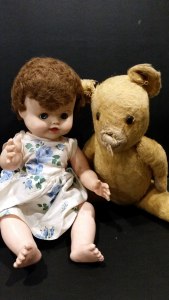
Meet Susan and Teddy.

Debbie_and_Teddy

It’s funny the things that survive sixty years. Teddy looks chewed because he was chewed, especially that nice sawdust-filled nose, and his ear has fallen off several times. Susan is a wetting doll, which seems a particularly perverse thing to give a child. You’d squirt water into her mouth and it would instantly come out a hole at the other end.

In fact, Susan wasn’t even my favourite doll. That honour went to Debbie, who was made of a type of china, with closing eyes with eyelashes, and Jenny who was an early transgender doll whose head could be pulled off to transform her into Peter (what Anglo names!) She/he was made of a rather unfortunate orange rubber.  I still have Peter’s head somewhere but the body seems to have gone missing.

As has Sindy, the British version of Barbie. I never liked Barbie with her pointy boobs and mutilated feet. I saved up for Sindy myself over a year – a whole $7.99 – but tragically her head fell off. (There is a bit of a theme here- what is it about heads detaching themselves??) My cousin Wayne took her to the doll hospital because he worked in the city, and she came back with a rod stuck up her neck giving the distinct appearance of goitre. She had auburn hair, and I think I even had the houndstooth skirt set worn by blonde Sindy here. I can remember being fascinated by the word “houndstooth”.

So why am I indulging in all this nostalgia? Well, the State Library of Victoria has a fascinating post about Elizabeth Batman’s doll, which it holds as part of their collection. John Batman moved to Port Phillip with his family, including six-to-seven year old Elizabeth, in 1836. He died three years later, leaving a complex will that ended up in the courts for years, splitting the family.

Anyway, have a look at Elizabeth Batman’s dolly and her clothes, which although fragile, prefigure Sindy and Barbie by some 125 years. You’ll find the post here.

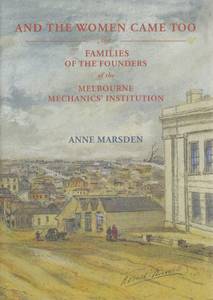
“And the Women Came Too: the Families of the Founders of the Melbourne Mechanics’ Institution” by Anne Marsden

marsden

2018, 187p.

This book is one of a pair, the author having released The Making of the Melbourne Mechanics’ Institution some two years ago. In that earlier book, Anne Marsden looked at the men who were elected to the committee of what later became (and still is) the Melbourne Athenaeum. The Melbourne Mechanics’ Institution (established 1840) was one of the very early cultural and educational institutions in Melbourne. Through her enquiry into the men who were movers and shakers in pre-Gold Rush society, we see the networks and practices that supported nineteenth-century masculine respectability in a new colony.

It’s not hard to find many of the most prominent of these men in the newspapers, churches and business world of Port Phillip: indeed, many of them are interlaced through the pages of this blog that relate to Port Phillip.  Ah- but the women and families of these men! There‘s another degree of difficulty altogether.  In a very few cases there are diaries and letters, as in Georgiana McCrae’s family, but much of Marsden’s information has had to be gleaned from snippets of information. There are brief allusions to the women in the biographies of their husbands and sons, or tangential mentions in newspaper articles and personal notices. Marsden’s challenge has been to integrate these biographies of the families of the founders of the Melbourne Mechanics’ Institution into a perspective on the lives of women and children in Port Phillip. It’s a task long overdue.

The book is divided into two parts. Part I, ‘The Challenges faced by immigrant women’ looks at early Port Phillip from the perspective of women, who were expected to operate within the domestic sphere, support without question her husband’s career aspirations and performance, and most of all, have children. Many of these women had travelled to Port Phillip either from Sydney or Van Diemen’s Land, or had emigrated with their husbands or families.

The book takes a little while to get going with an introduction, a second introduction,  and a prologue addressed in the second person to Barbara Dalrymple, who will marry Dr Alexander Thomson and arrive in Port Phillip in 1836, the first of the women of the Melbourne Mechanics’ Institution.  Introductions over, the text starts off with leaving home and follows the women on the journey, generally cabin class rather than steerage. There is a short chapter about Port Phillip’s brief European history ‘The Settlement’s Early Months’ to set the scene, then she moves onto the ‘Growth of Early Melbourne’. This is in two parts:  (i) the administrative and physical environment, and (ii) the people and community. The final chapter of this section is titled ‘The Early Melbourne Community: divisions and diversions’.  Each chapter is headed with a quote from either Finn’s Chronicles of Early Melbourne, a letter, or a contemporary newspaper.

This section does tend to be rather ‘bitty’. Marsden has used subheadings liberally, and while it makes information easy to locate, it does interrupt the flow of the narrative.  The chapter headings, complete with numbering (i) and (ii) and numerous subheadings give the sense that you are reading from notes, rather than an integrated text. Nor are the separate chapters conceptually distinct from each other.  ‘Community amenities and pleasures’ could fit equally suitably in the ‘Growth’ chapter (where she has, indeed placed it) or the ‘Early Melbourne Community’ chapter.   Nonetheless, there is a life-cycle logic to the information that she has selected, with its focus on finding housing and making it bearable, health and the bearing of children, and educating children – thus bringing to the fore the issues that Port Phillip women had to negotiate.

In the second part of the book ‘The Women’s Stories’, Anne Marsden looks at individual women whose husbands were influential in establishing the Melbourne Mechanics’ Institution. She starts chronologically, with Martha Lonsdale, who accompanied her husband Capt Lonsdale down from Sydney to be the first police magistrate in Melbourne, the earliest form of administration from Sydney. Her second chapter involves Sophie La Trobe, the French-born wife of Port Phillip’s first superintendent. Much of the information (and scuttlebutt) about Sophie La Trobe comes from the (compromised) but very useful journals of Georgiana McCrae, who is dealt with in the third chapter. Familial relations are also important in her chapter ‘A tale of two sisters’ which covers Henrietta Yaldwyn and Caroline Simpson/Braim.  The fifth chapter ‘The minister’s wife’ involves Margaret Clow, whose husband the Rev James Clow arrived in 1839. Mamie Graham, ‘The merchant’s wife’, also had a connection with the McCrae family, thus highlighting the familial as well as professional networks within this small community. She married James Graham, whose extensive archives of correspondence give us  an insight into the family’s domestic life. This is followed by another chapter about sisters – or at least sisters-in-law, Caroline Wright and Elizabeth Kirby, who married brothers David and Donald McArthur. Their husband’s (and thus their own) fortunes varied, with David becoming a highly-prominent banker, while Donald’s  career as a surveyor faltered. So too did the marriage, and Elizabeth McArthur became a well-known and respectable school proprietor.  The final two stories are of more shadowy relationships: Celia Reibey (daughter of Mary Reibey who featured on the $20 note) who died soon after marrying Thomas Wills, then his two partners Mary Ann Barry and Mary Anne Mellard.  Four ‘more elusive women’ complete the analysis: Mary Anne Peers, Mary Wintle (the jailer’s wife), Elizabeth Beaver and Hester Hurlstone. These brief biographies highlight the difficulties of finding sources and reading between the lines of the public record. The final chapter ‘Out of the shadows and into the half-light’ serves largely as a summary of the book.

Marsden has been very faithful to her sources. While speculating and assuming in places where the documentary record falls silent, she has tethered her analysis of early Port Phillip society to the lives and experiences of these women. While I respect her fidelity to primary sources, I wish that she’d roamed a little further into the secondary literature. She cites Penny Russell’s Savage or Civilized, but I think that she could have used Russell’s analysis of ‘manners’ more fully and explored the meaning of ‘the visit’ and the nature and implication of chain migration in family clusters. As a British colonial outpost, Port Phillip did not differ greatly from other such port towns, and she could have drawn on Kirsten Mckenzie’s work, and sources from Upper Canada that also explore the women’s world, with its own stringent expectations, that existed underneath the more publicly-documented world of their husbands.  In addition, by tethering her analysis of Port Phillip in Part I to the experience of these particular women, there is also a fair bit of repetition when the same details are retold in Part II. The final chapter summarized the preceding text, but did not prod the reader into new questions.

Notwithstanding, Anne Marsden’s book is a testament to her patient digging as a historian and her recognition that all these ‘mover and shaker’ men starting up new enterprises and institutions in an infant colonial town, had women behind them. It reminds you that Port Phillip was a town for women and children as well as for the ambitious new arrivals, and that even though it might not be readily visible in the public record,  the domestic always underpins the civic.

Sourced from: Melbourne Athenaeum Library. $20.00 – well worth it.

AWW-2018-badge-rose-199x300

I have posted this review to the Australian Women Writers Challenge Database.


‘Jetties and Piers: a background history of maritime infrastructure in Victoria’ by Jill Barnard

jetties-and-piers

2008, 65 p. & notes

I came upon this publication by chance a few months back, while I was looking up ‘quarantine’ for my  posting about Port Phillip during March 1842.  The report had been divided up into separate PDF files, and my interest piqued, I set about finding the rest of the publication.

Update: The author has since made the whole publication available on their website. Thank you! You can find it at http://livinghistories.net.au/our-work/commissioned-histories/

The author, Jill Barnard, is one of the team from the Living Histories group of professional historians. As part of her conclusion, she  cites the  founding member of the Australian Association for Maritime History  historian Frank Broeze , who pointed out that Australia’s maritime identity is as important as “sheep and land, railways and goldmines, bushrangers and bankers” in shaping Australia’s identity. It’s certainly an argument that has been reinforced for me in reading about Melbourne’s earliest days through the three Melbourne newspapers. The shipping news took up nearly 3/4 of one of the four pages in each issue; people were constantly falling off boats and jetties; and overseas news finally arrived long after the event, on account of the vast sea distances being covered.

This publication, sponsored by the Heritage Council of Victoria focuses as its title denotes, on maritime infrastructure and thus reflects a ‘heritage’ approach, based mainly on structures and their usages. The report is divided into two parts: Part 1 deals chronologically with 1800-1850, then Part 2 adopts a thematic approach, adopting the Australian Framework of Historical Themes (2000, 2001). No longer being involved in curriculum development and coming from a historical rather than heritage perspective, I was completely ignorant of such frameworks. The Framework is explained in detail here, and the Victorian Framework (2010) which was developed to respond to it is here (ah- Federation at work!)  I suspect that the impetus for ‘frameworks’ reflects the late 20th-early 21st century desire for checkboxes,  wall charts and verb-driven, economy-focussed competencies and I must confess that the whole process passed me by completely. Will I live long enough to see this whole approach to conceptualizing history itself historicized? I wonder.

I suspect that the two-part structure of this report reflects the constraints that such a framework placed on the author. As she points out, during the earliest years of Victoria’s white settlement there was a scramble by both private investors and governments to provide sufficient infrastructure to keep pace with the ever-increasing needs, and such infrastructure served a variety of purposes for immigrants, merchants, fishermen, postal services and customs officers. Her Part 1, reflecting the years 1800-1850 progresses chronologically. In Part 2 she adopts a thematic approach, with the chapters directly linked into one of the categories or subcategories of the Australian framework:

1. Improving Victoria’s Ports and Harbours (Theme 3 Developing local, regional and national economies)

2. Migrating to Victoria (Peopling Australia)

3. Moving People ( Theme 3.8 Moving Goods and People)

4. Moving Goods and Cargo (ditto)

5. Defending Our Shores (Theme 7.1 Governing Australia as a Province of the British Empire and Theme 7.7 Defending Australia)

6. Commercial Fishing (Theme 3.4  Utilizing Natural Resources)

7. Making Ports and the Coast Safe (Theme 3.16.1 Dealing with Hazards and Disasters)

8. Boat and Ship Repair and Building (Theme 3.8 Moving Goods and People)

9. Accommodating Seamen (Theme 3.22 Providing Lodgings)

10. At the Beach: Using the Sea for Recreation (Theme 8 Developing Australia’s Cultural Life)

As Barnard points out in her introduction, this thematic approach does not necessarily serve her well. Different sites have changed their functions over time and do not fit into the neat themes of ‘recreation’ or ‘moving people’ that she has selected. Moreover, the thematic approach gave rise to a degree of repetition. As she admits, “it is difficult for the reader to simply follow particular sites or themes through from the beginnings of European settlement to the present day”. She’s right.

Notwithstanding  the author’s own misgivings , I found this an interesting read. Although Victoria has a long coastline, there are few deep-water harbours. The Heads made the whole entry to Port Phillip treacherous, and both Melbourne and Geelong ports were ringed with sandbars. The settlement of Melbourne  on the Yarra River up on the Falls (which I’ve often mentioned in this blog ) meant that there was no direct connection to the ocean, although a canal was mooted for some time. She doesn’t just deal with Melbourne and Geelong: she also discusses  Portland, Port Fairy, Port Albert, Warrnambool and Lakes Entrance, as well as fishing and boat-building ports along the Bay.   Coastal shipping remained dominant for a long time because overland transport was so slow to develop, and the development of railways often bolstered port activity.  Nonetheless, the infrastructure for getting goods on and off ships remained primitive for some time. She cites the example of timber-loading at Mt Martha (on the Mornington Peninsula) where logs would be tossed off the cliff-face, where they fell to the beach to be loaded onto small boats and from there, onto larger ships. No wonder the container, which reduced double- and triple- handling, made such a difference to maritime transportation.

Most immigrants and passengers arrived at Melbourne, although during the 1840s and 50’s  there were attempts to channel immigrants directly to the pastoral stations that were crying out for their labour by landing them at Geelong and to a lesser extent Portland. Vessels for specifically inter-state travel continued until 1961 when they were replaced by international liners who had several ports on their itinerary. Her analysis extends up to the mid-twentieth century as she traces the demise of Station Pier and other passenger wharfs, especially after the opening of Tullamarine Airport in 1970.

It was fascinating to read about the early defence arrangements for the gold-rich Port Phillip Bay, in what are now inner suburbs like South Melbourne and St Kilda. Although sometimes the fortifications took so long to construct that military technology rendered them largely redundant, by 1890 Victoria was assessed as being “the best defended commercial city of the empire” (p.42)  Fort Nepean has the dubious distinction of being the site for the first British shots fired in both the First and Second World Wars.

I’d heard of Sir John Coode and the straightening of the Yarra, but I hadn’t realized how much of a ‘go-to’ man he was for infrastructure works on all Victorian ports.  The cost for infrastructure like beacons and lighthouses was borne by the colonies because they benefitted directly from the port activity, but after Federation the Commonwealth government took responsibility for ocean or ‘highway’ lights. I’ve seen sheds cantilevered over the water on the side of jetties and didn’t realize that they were rescue boats, and now I have a new appreciation for the rocket and mortar sheds where a ‘breeches buoy’ , similar to a pair of trousers, allowed a person to sit in them to be winched to shore.

My favourite part was the final chapter ‘At the Beach’ which reflected popular cultural use of the beach, as distinct from the largely economic focus of the other chapters.  Promenading at the beach was more important than swimming at it during the middle of the 19th century. At first sea bathing was forbidden between 6.00 a.m. and 8.00 p.m. because men swam nude, although this restriction was relaxed in 1917.  I’ve long been amused at the presence of life saving clubs at the mill-pond like bay beaches (e.g. 1912 Black Rock, Elwood and Hampton) and ‘baths’ separated out from the sea but these no doubt reflect the change from ‘taking the waters’ for health reasons to recreational swimming. The seawall that runs along Sandringham, Brighton etc. was constructed between 1935 and 1939 using stone recycled from city buildings including the old Melbourne gaol.  Other fences were made of ‘basketwalling’ made of ti-tree (which I can just remember). Boat sheds and private jetties reflect the purchase of beach-houses by well-to-to Melburnians.

All in all, an informative and well-told read for those of us interested in Victorian history.  It does assume a familiarity with the ports and places under examination, so it’s a fairly localized publication. It’s an interesting exercise to see the narrative limitations when a thematic framework is imposed onto a narrative, especially when dealing with an extended 150 year timeline.  I also found it a challenging idea to restrict the focus to activities that leave a physical presence in the form of infrastructure.  This object-based,  heritage-focussed approach is not one with which I’m particularly familiar (or, I admit, completely comfortable), but is is one that probably reflects the economic and public uses to which history is put today.

aww2017-badgeI have posted this review to the 2017 Australian Women Writers Challenge website.


This Month in Port Phillip 1842: June 1842 Part 2

You might remember that during May there had been the trial of the Plenty Valley Bushrangers and having been found guilty, three of the four remaining bushrangers were sentenced to hang (one was killed during capture). Even though Judge Willis urged immediate execution as a lesson to all would-be bushrangers, this was a highly improper suggestion as the Governor in Sydney had to give his approval first. So much of June 1842 was spent waiting to hear from Sydney whether the prerogative of mercy would be exercised, and if not, when the execution would take place.

It has been fifty years since there has been an execution in Australia, the last being Ronald Ryan‘s hanging on 3 February 1967. However, Australians had a taste of the detailed reporting and in my view, the sheer bloody-mindedness of state execution with the executions of Andrew Chan and Myuran Sukumaran in Indonesia in 2015. Although 173 years separate the executions, many of the narrative tropes about execution – particularly those related to penitence and religious conversion –  were just as present in 2015 as they were in Port Phillip in 1842.

In June 1842, although the excitement of the trial had abated, there were ongoing short reports about the condemned men in jail.  On 20th May the Port Phillip Herald reported that the condemned criminals were visited daily by three different clergymen, the Anglican minister Rev Thomson,  Rev James Forbes the Presbyterian minister, and Rev. Stephens, the Catholic priest. The paper reported that the culprits had not, as yet, shown the slightest sign of repentance. In fact, one was annoyed at his spiritual instructor questioning him about the number of robberies he had committed. They were confined together in a room about 10 feet square, the same as occupied by the “black murderers”recently executed in January. They were heavily ironed, with a constable in the room day and night and a guard at the door.

On 24th May, the Herald reported:

Since our last notice of these unfortunate men, we are happy to learn from the Rev.  Mr Forbes, who is unceasing in his visits at their cell, that they are shewing a marked improvement in their conduct, and attend now with much interest to their religious exercises. [PPH 24/5/42 p 3]

By June 7, they were reported as being “all truly penitent”. They sent for Mr Fowler, who had been shot through the cheek and ear during the capture of the bushrangers. They “fell on their knees and begged his forgiveness. Mr Fowler of course forgave them” [PPH 7/6/42]. Eventually the overland mail brought the news that the men were to be hanged on 28th June.

On the day of execution, the men were woken before day break by Rev Forbes, and Rev Wilkinson, the Wesleyan minister who was now included in the clerical contingent. The sacrament was administered to Jepps and Ellis by the Rev Mr Thomson. Just before 8.00 a.m. they were taken into the yard and their irons were struck off.  Jepps and Ellis undertook this with fortitude, but Fogarty wept bitterly for friends left behind rather than for despair of death.  The open cart drew up to the door, bearing the three cedar coffins. The men, who were “decently clothed” did not wear the white gowns worn by the indigenous prisoners Tunnerminnerwait and Maulboyheener who had preceded them to the gallows four months earlier. They did, however, wear white caps.  At 8.00 a.m. the order was given to ‘mark’ and the procession headed off with the military at the front and the mounted police at the rear.  Reverends Thomson, Forbes and Wilkinson walked arm-in-arm in front of the soldiers, while Rev Mr Stephens was on horseback.  The route was a mile in length, and unlike with the aboriginal prisoners who travelled in a covered wagon, the men were visible to all on the back of the cart, sitting on their own coffins, during the half-hour trip.  At the top of Lonsdale Street, the prisoners were ordered to look over their right shoulders to see “the fatal spot where their career of life was to be closed”.  Jepps and Ellis knelt on the ground with the “three reverend gentlemen” and prayed, while Fogarty was engaged with the Catholic priest at a short distance. [PPH 1/7/42]

The Rev. Mr Forbes appeared more painfully distressed than the poor victims of misdirected talents themselves; he had been led to take a great interest in the fate of Ellis, and had been unceasing in his endeavour to bring him to that sincere state of repentance which is the mainstay of the Christian creed [PPG 29/6/42].

One of the tropes of execution scenes is the ‘last dying speech’ ritual, conducted at the base of the scaffold.  In this heavily orchestrated performance, the speech was always a moment of  unpredictability because neither the clergy nor the authorities could control what the condemned prisoner was about to say.  But they need have had no fears about Jepps.

About nine o’clock, the prisoners having concluded the prayers, Jepps, taking a final adieu of his spiritual advisers, turned to the assemblage, and in a short but emphatic appeal to young men, exhorted them to take warning by his untimely end, of the fearful consequences of bad company, and the wretched end that awaits all who like him, deviate from the path of rectitude. He expressed himself resigned to his fate, and died in the belief of the Lord Jesus Christ. [PPG 29/6/42]

The Catholic Priest administered the sacrament to Fogarty on the drop, after which “he seemed more composed” while the Episcopalian minister read aloud the service for the dead. At the appointed signal the executioner pulled away the platform and the men were “ushered into eternity”. The Gazette reported that the men died in less than a minute, the scaffold having been “under the Sheriff’s directions, been constructed so as to avoid any of the extremely painful incidents which marked the last execution in the province.” [PPG 29/6/42] . However, the Patriot reported that Fogarty  suffered about three minutes after the drop fell,  in consequence of the knot of the rope shifting. [PPP 30/6/42]. According to the Patriot,

a company of the native police under the command of Messrs. Dana and Le Soeuf arrived from the station on the Merri Creek shortly after the drop fell. The men looked clean and well, and appeared to observe the awful sight before them with terror and dismay [PPP 30/6/42]

Reports of the numbers in the crowd varied between 1000 and 2000. The Patriot reported that very few women were present, while the Herald was shocked that so many females were present, although they were of the “rank of servant”. The Herald also complained that the men remained on the scaffold until the burial service had been concluded so that the crowd could see “the recumbent position of Ellis, the convulsive start of Jepps and the open and closing of the hand of Fogarty.”[PPH 1/7/42]

And so, the second batch of executions in 1842 were completed.  It was not to be long until the next execution was to occur, the last in Port Phillip for several years.

This Month in Port Phillip in 1842: June 1842

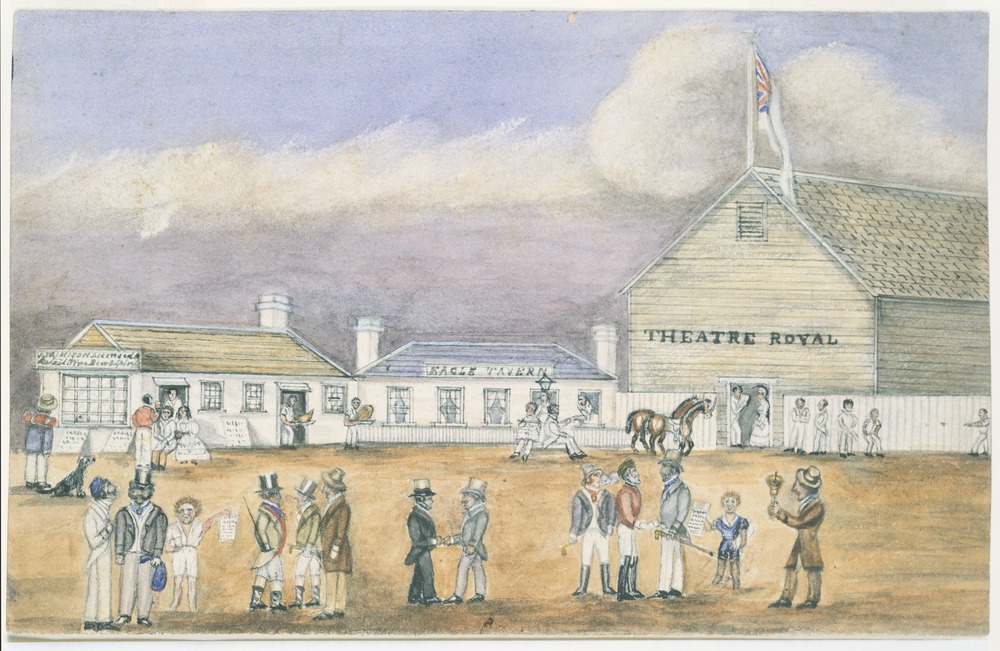
In my report for April 1842 I mentioned that a three-month licence had been granted for the performance of amateur theatricals at the Pavilion Theatre (also known as the Theatre Royal). There was always official squeamishness about the raffishness of the theatre and those who trod its boards.  In a valiant attempt to keep the theatre as ‘respectable’ as possible, this licence was for Monday night performances only, using amateur thespians (albeit under the directorship of Mr Buchanan). The whole proceedings were overseen by a board of stewards, most of whom were entrepreneurs or newspaper editors.

The Eagle Tavern and Theatre Royal

The Eagle Tavern and Theatre Royal’ by W. F. E. Liardet (1799-1878) Source: State Library of Victoria

By June this three-month opportunity was drawing to a close. The Port Phillip Gazette reported a meeting of the stewards on 18 June in order to make plans for the future operation of the theatre:

The stewards of the Amateur Theatricals held a meeting in the Pavilion, at noon, on Thursday last, to audit the accounts, take steps for the renewal of the license, and order the entertainments for the closing weeks of the season, so as to invest them with the greatest amount of attraction. His Honor the Superintendent will be solicited to patronize the theatre on one night; the St. Andrew’s Society are prepared to support it on another occasion; the Odd Fellows and the Sons of St. Patrick will be called upon in turn; and the whole is expected to close with a grand amateur performance, in which histrionic talent will be displayed to an advantage hitherto unwitnessed in the province.[PPG 18/06/42]

Unfortunately for the stewards and their claims to respectability for the theatre, there was another little contretemps in the theatre-pit the very evening of the stewards’ meeting.

On Thursday night last, the Pavilion was made the scene of a confusion which has been unparalleled in the district. During the course of the afterpiece in which Miss Sinclair was taking the part of Mannette, some parties in the pit, sitting close to the stage, made use of offensive expressions, accompanied by notes of purposed disapprobation, that obliged the actress to stop and complain of the interruption ; Mr. Stephen, the honorary manager, observing one of the young men attempting to repeat his sallies, ordered a constable down into the pit to take him into charge. A number of gentlemen gathered round the offender, and prevented his capture ; the pit, boxes, and gallery immediately rose, and the uproar became general : the constables dealt blows; and the parties attacked, grappled with the peace officers: the throng in the pit, prevented any egress; and the performers, driven off the stage, dropped the curtain. One or two gentlemen having at length got order, Mr. Stephen addressed the audience; defended his own course in having given the party into custody, and expressed the determination of the Stewards, not to allow these repeated insults to themselves and the attendants to pass over. He begged them all to recollect, that the renewal of the license given to them for charitable purposes, was under discussion by a bench of Magistrates ; and, now that the principals of the riot were known, and would be dealt with at the Police Office, he trusted that they would not prolong the confusion. The performers, headed by Mr. Buckingham and Miss Sinclair, coming on again, sung a finale chorus, and the house was dismissed. Parties who have been in the habit of frequenting the Theatre, and exhibiting uproarious demonstrations of criticism, have been more than once warned not to push their conduct beyond the verge of decency. Had, however, the offenders in this instance, contented themselves with the common motions of inebriety, we should have considered a little wholesome exposure at the Police Office, next morning, quite sufficient ; but, what excuse is there for such an unmanly attack upon a woman? The pot valiancy, which led a number of gentlemen to shield the offenders, was not unexpected ; but, they never could have meant intentionally, to defend the cowardly attack which was made by their friends. [PPG 18/06/42]

The matter ended up before the Police Court the next day

A lengthened investigation took place at the Police Office yesterday forenoon, into the riot which had been occasioned at the theatre on the previous evening. The stewards representing that they were not anxious to press the charge, if a proper apology were made, Mr. Graves, who with Mr. Moles, were very conspicuous in annoying the ladies, took advantage of the reprieve opened to him. Mr. Davies, however, on the part of the performers, not thinking that an apology to the Court was sufficient to satisfy their interests, pressed the charge against the latter gentleman as having headed the fray. Upon the charge being substantiated, Mr. Moles was fined £5. The stewards will be justified, we consider, in denying these parties admission for the future. Several gentle men were also brought before the bench upon informations laid by the constables, for having both in the theatre, and subsequent to the performance, out of the theatre, assaulted the constables, opposed them in their duties, and otherwise acted in a disorderly manner. [PPG 18/06/42]

Mr Moles was fined, but a Mr McLauren, whom the actors also thought culpable, seemed to have escaped punishment.  The actors brought his actions before the public through a letter placed in the newspapers:

Letter to Mr McLauren. “We the members of the Amateur [Players?] feel it our duty to call upon you, in consequence of your gross conduct during the progress of the performance on Thursday evening last, to apologize to us [..iting?] for the very ungentlemanly manner you insulted the ladies of this company by your drunken remarks, otherwise, we shall feel it our duty to charge you before the Police Magistrate with obstructing the constables in the execution of their duty, also creating a disturbance in the Theatre. And we beg to call your attention to Major St John’s upright decision in the [?] of Mr Moles, and we shall also deem it expedient to publish an account of your conduct in the Melbourne journals. Your immediate reply is required. We are, Sir, Yours &c &c, George Buckingham, John Davies, James Southall, William John Miller, Richard Smith, James Warman, H. S. Avins, Robert Staisby, Richard Capper, Joseph Harper. [PPG 18/06/42]

Mr McLauren, however,  was snippy in his reply:

MR McLAURENS REPLY.  If I am called upon by the Stewards of the Amateur Theatricals, I may favour them with an apology, but I do not intend in the [?] instant to confer with subordinates. J. M. McLauren.  [PPG 18/06/42]

There was another letter of apology, but this was from the theatre manager, Mr Buckingham, who had come on stage to remonstrate with the rowdies and to protect the feelings of his actors:

To the Editor of the Port Phillip Gazelle.
Sir, — I trust that I may be permitted, through the medium of your journal, to reply to the observation made by the Patriot and Herald with reference to my addressing the audience at the theatre during the performance of “Therese” on Thursday week. The apology I made upon the occasion, I had hoped would have saved me from further animadversion, nor should I again advert to the circumstance, did not the censure appear to be unaccompanied by any palliation. It therefore is due from me to the public generally to remark, that the frequent interruptions from a portion of the audience, who seemed bent on annoying the performers by remarks which, from the propinquity of the stage to the seats in the pit, could not fail to he heard, compelled me to adopt the only course which at the moment presented itself. However ” improper and unusual” it may be for a performer to destroy the illusion of his character by a personal appeal to the auditory, still it should be borne in mind that the actor whose mind is wholly absorbed in the study of his performance, upon the recurrence of disapprobation, such as that complained of, is placed in a trying and difficult position. The fault, however, in this instance, was atoned for by the expression of my regret, and the public who received the ‘amende’ favourably, might have been spared any further appeal to their indignation. I have the honor to be, Sir, Your most obedient Servant,
GEO. BUCKINGHAM.

However, he didn’t get much joy from the editors of the Port Phillip Patriot who issued an editorial response to his letter directly underneath:

Mr. Buckingham has been too long on the stage to be ignorant that his very intemperate conduct on the occasion referred to, was calculated rather to augment than allay the mischief he com-plains of. However annoying the expression of disapprobation, deserved or undeserved, may be to a performer it is his ‘weird’, and he must ‘dree’ it in silence, relying, as he may safely do, that if it is unjust it will not be tolerated by any well disposed audience. The practice of interrupting the performance and addressing the audience whenever a solitary hiss, or other mark of disapprobation is heard, is altogether intolerable, and would not be permitted to occur a second time by any less good-natured audience than that which assembles at the Melbourne Theatre. If the occasion in question had been the first on which Mr. Buckingham was guilty of this decorum, we should have considered his apology sufficient, but it was matter of complaint before, and it was necessary that steps should be taken to prevent its recurrence in future. The Stewards will, doubtless, to the extent of their ability, protect the performers from insult, and put a stop to the unseemly interruptions by the blackguards in the disguise of gentlemen, which have given rise to this discussion; but if Mr. Buckingham, or Mr. any body else, so far forgets himself in future as to address himself to the audience without a legitimate cause for so doing, he may lay his account-with being hooted off the stage, and the verdict of any impartial jury in the world will be “served him right,”— Ed. P.P.P. [20/6/42]

On 20th June the Port Philip Patriot published an editorial of support for the extension of the licence, which would be decided the next day.

THE AMATEUR THEATRE.

The Magistrates meet in Petty Sessions, to-morrow, to determine as to the propriety of granting an extension of the license of the Melbourne Amateur Theatre. The Theatre has now been open for a period of three months, and, we believe, every person who has visited it, will admit that the performances have far surpassed his expectation, and that the audiences have been in every respect orderly ; indeed with the solitary exception of the disturbance referred to in another column, we have never in any part of the world seen an audience so uniformly quiet and orderly. The persons who occasioned the disturbance referred to, have been shewn that they will not be suffered so to misconduct themselves in future, and we doubt not the lesson will prove a salutary one. As there can be no reason why the inhabitants of Melbourne should be deprived of this their only public amusement, while the authorities have assurance that no evil consequences are to be apprehended from the Theatre being kept open, it would be hard if the extension of the license asked for should be refused. We do not, however, apprehend any such refusal, for we know that every magistrate who has visited the Theatre, has expressed himself most agreeably surprised and entertained, and it is not likely that those who have not been present will oppose the renewal of the license which the others are disposed to grant. [PPP 20/6/42]

However, by the end of June the stewards needed to wind up the season.

The Amateur Theatre — The performances at the Theatre on Friday night, the last night of the season, were under the patronage of the St. Andrew’s Society of Australia Felix, and the house being both very numerously and fashionably attended, the whole affair came off with great eclat. The former license having expired, the Theatre will be closed for a month or six weeks, within which period the renewal recommended by the Bench of Magistrates at the late Petty Sessions, is expected to arrive. In the interim the Stewards purpose effecting extensive alterations in the house, with the view of affording increased accommodation. The pit and the stage will be lowered so as to cut off all communication between the former and the boxes, and slips will be put on a level with, but separate from the gallery, thus enabling family parties to attend without being subject to the risk of annoyance of any kind. Care will also be taken to secure an efficient body of performers, so that in every respect the Theatre may be rendered deserving of the public support. [PPP 4/7/42]

 It took until 29 July for the permit  for the next season to arrive. This time it was a permit for twelve months, and the theatre was planned to reopen on Monday 7th August.

What happened in Port Phillip in 1842: May 1842 Pt.II

Feting the gentleman captors

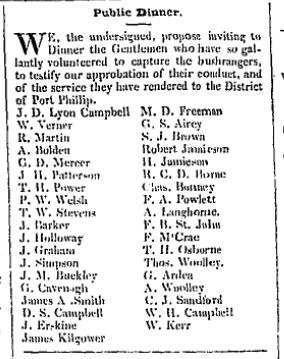
Not a lot else happened in May, other than the excitement of catching the Plenty Valley bushrangers. So grateful were the good people of Melbourne to the ‘young gentlemen’ who  were feted with capturing them, that it was proposed to hold a dinner in their honour:

it is proposed to give the brave little band of amateurs who succeeded in capturing the bushrangers, a public dinner.  This is as it should be: no men more honorably deserve such a mark of public respect.[PPH 3/5/42]

A venerable list of Port Phillip Gentlemen put their names to the proposal (including Cavenagh, Arden and Kerr – the editors of the Herald, Gazette and Patriot respectively)

Bushrangerdinner

The Port Phillip Herald reported that

The Forthcoming Dinner for the captors will take place Thursday next 26th May at Royal Hotel, tickets 35 shillings each, can be obtained until Wed evening from the stewards. His Honor, Judge Willis, had signified his intention of being present, but has declined on account of the sentence not having yet been carried into effect upon the unfortunate men.   The partition wall between the large front room above stairs and an adjoining back apartment will be removed [PPH 24/5/42]

But then, as the night of the dinner drew near, the editors of the Press learned that the Stewards of the dinner had decided to omit a toast to ‘The Press’, the same insult that had been levelled at them at the Governor’s Dinner as well.  As a group, the editors decided to boycott the dinner.  They wrote to the guests of honour:

To Messrs Snodgrass, Fowler, Gourlay, Chamberlain and Thomson.  Monday 25 May 1842. GENTLEMEN As the absence of every one connected with the Melbourne Press from the dinner to be given to you tomorrow by your fellow-colonists cannot fail to be observed and commented upon, we are desirous that our absence should not be considered as indicating any want of respect for you, or any disinclination to join in a tribute we think you have well deserved. We feel it due to ourselves, however, as the representatives of the Press of the Province, to shew, by our absence from the dinner our sense of the indignity (a second time offered to us) in the exclusion of “The Press” from the list of toasts to be given, under the authority of the stewards, every other toast of a public nature which it is customary to give on such occasions, being inserted in the list which has been furnished to us.  We have the honor &c  Wm Kerr Ed. Patriot, Geo Cavenagh Ed. Herald, A.F.A Greeves Ed. Gazette, T. H.Osbourne, Ed. Times.

And the gentleman guests wrote back:

To Mr Kerr and the Editors of the Melbourne Journals.  Wednesday evening.

GENTLEMEN- In the names of Messrs Gourlay, Fowler, Thomson and myself, I beg leave to acknowledge the receipt of your communication, and to inform you that our position, as guests to the gentlemen who have tendered us so handsome a testimonial, prevents us interfering in any way with the arrangements they may have made with the Editors of the Melbourne papers for our entertainment.

Permit me to express our regret on our hearing, for the first time, your intention to deprive us of the pleasure of your society on the forthcoming occasion, which we were led to expect from having observed the names of Messrs Kerr and Cavenagh- two of your body- on the list of those gentlemen who offered us so flattering a compliment. I have the honor to be, Gentlemen, Your obedient humble servant, Peter Snodgrass. N. B. Mr Chamberlain being absent from town prevents his replying to your letter. P. S.  [PPP 26/5/42]

After the publication of the correspondence, there was a meeting of “a large number of gentlemen” who intended going to the dinner, who resolved that the toast would be proposed in defiance of the Stewards. Then the Stewards had a meeting behind closed doors on the afternoon of the day on which the dinner was to take place and they decided to propose the toasts themselves, and issued cards of admission to the reporters at 5.30 with the dinner to start at six. The editors returned the tickets with the intimation that “the Editors could not think of exposing their Reporters to an indignity, they were themselves staying away from the Dinner to avoid” [PPP 30/5/42]

And so, avoid it they did, but being newpaper men after all, the Port Phillip Herald  did publish a report of the dinner after all.

THE PUBLIC DINNER Pursuant in the previously notified general meetings at the Royal Exchange Rooms, as fully reported in the columns of the Melbourne Press, a public dinner was given on the evening of Thursday, to the gallant captors of the bushrangers now in the condemned cells awaiting execution – more especially to do well deserved honor to Messrs Fowler, Gourlay, Snodgrass, Chamberlain and Thompson, to whose heroic conduct the inhabitants of the province owe such deep gratitude for the early termination of the career of as desperate a gang of banditti as ever infested the Middle District. [PPH  31/5/42]

The Port Phillip Gazette wasn’t too impressed with this break in editorial solidarity:

 Our contemporary the Herald diminishes our regret at the inability to report the dinner, having published yesterday a full account of the proceedings, by its own reporter.  As the note to Messrs Snodgrass, Gourlay, Fowler, Chamberlain and Thompon, signed by all the Editors, commences with these words- “Gentlemen, The absence of everyone connected with the Melbourne Press &c“- we presume it was not read by the Editor of the Herald, or it is obvious that he neither could consistently attend the dinner, nor give a report of it, because he would not have exposed his reporter to an indignity he would avoid himself. [PPG 1/6/42]

But the celebrations didn’t finish with just a dinner.

MASONIC COMPLIMENT- On Wednesday evening last, at a meeting of the Lodge of Australia Felix, Mr Stephen proposed that a token of regard should be offered to Messrs Gourlay, Fowler and Snodgrass for their heroic conduct in capturing the bushrangers. It was consequently resolved, unanimously, that Masonic Medals, according to their rank held in the order, should be presented to the above named gentlemen upon which should be engraven an appropriate inscription. Although unusual for the Masonic body to take cognizance of [indistinct] circumstances, yet from the fact of there being no less than three out of four of the “intrepid band” freemasons, the [indistinct] deem it a fitting occasion, in no way opposed to the constitution or traditions of the craft, to mark their [appreciation?] of the service rendered to the community; and the public will learn from this …that whilst Masons acknowledge [?benefits?], the fraternity are ever ready to [indistinct] their lives in protecting…their country when duty calls them into action.  [PPH 28/5/42]

Duello

It was a rather propitious time for Peter Snodgrass to be revelling in all this public adulation, because there was the little matter of an appearance in the Police Court which might otherwise dimmed his lustre. I find it really strange to juxtapose boggy, unmade Collins Street, with its tree stumps still visible, and all the aristocratic geegaws of ‘cutting’ someone dead and challenging to a duel, as if they were in the streets of London.

THE DUELLO. At the Police Office on Friday last, Messrs Peter Snodgrass and John Maude Woolley were bound over to keep the peace towards all her Majesty’s subjects, but particularly towards Captain George Brunswick Smyth. From the evidence of Captain Smyth, it appeared that one the previous day he met Mr Snodgrass in Collins-street, but not being desirous to rank any longer in the list of that gentleman’s acquaintances, he had given him “the cut direct”. In the evening of the same day Captain Smyth received a visit from Mr John Maude Woolley, whom he described as anything but sober; Mr Woolley announced himself commissioned by Mr Snodgrass to demand an explanation from Captain Smyth, touching his reasons for shunning Mr Snodgrass, and in the event of his inability to assign a satisfactory reason, to name a friend with whom to arrange the preliminaries of a hostile meeting on the following morning. Captain Smyth, however, declined acceding to either course, and hinted his desire to be freed from the presence of a visitant in Mr Woolley’s condition, whereupon Mr Woolley, threatening postings, horsewhippings and all the other numerous ills a club life is heir to, left the house. In the morning Captain Smyth brought the parties before Major St John, at the Police Office, and they were bound over to keep the peace [PPP 23/5/42]

Two views of the hospital

A temporary hospital was opened in Bourke Street when it became clear that the very first hospital in William Street, open only to convicts and new immigrants, was inadequate.  The Port Phillip Gazette was full of praise for the institution:

THE TEMPORARY HOSPITAL. On Tuesday last an opportunity was afforded the writer of inspecting the temporary hospital in Bourke-street, in the company of Dr O’Mullane, one of the visiting surgeons. This institution, it may not be generally known, is supported entirely on casual charity, and the funds are hardly sufficient to enable it to drag on its existence. It was originally proposed to build a permanent hospital, towards the maintenance of which it was intended to apply for the appropriation of certain revenues which are in like manner afforded to a similar institution in Sydney. A public meeting of its supporters decided that the building should not be opened until £800 had been collected by subscription; the great distress prevalent during the past hot season induced the same parties to consent to the establishment of a temporary hospital, which was placed under the control of an interim committee. The ministers of the various congregations in Melbourne, who were appointed on the committee, have been using the greatest exertions- especially, we are warranted in saying, the Rev Mr Thomson- to incite the charitable feelings of the more wealthy inhabitants in its behalf; but at various times the funds have run so short as to leave not enough even to defray the purchase of bandages and other trifling articles of daily use.  The object of our personal notice is both to record the public thanks which are due to the gentlemen in the management of the institution, and to raise more abundant means for the continuance of their services.  The professionalists who have charge of the patients are Drs O’Mullane, Wilkie, Meyers and Thomas; these gentlemen, as well as either of the resident clergymen, will receive the donations of the charitably inclined, and apply the receipts to their proper purposes  [PPG 11/5/42]

The Port Phillip Patriot was somewhat less charitable

Several worthless characters in town, keeperss of houses of ill-fame and persons of a similar description, have taken it into their heads that the temporary hospital (towards the maintenance of which they have never contributed a farthing exception in the shape of drunken fines) is quite at their disposal whenever any of their unfortunate inmates have become incapacitated by disease or sickness from following their loathsome trade. Some of these fellows will take no refusal, but will hurry the patients up to the hospital door, bundle them in and then off, and leave them. Some days ago a trick of this kind was played by a worthless fellow named Hyams, well-known in the police records, who left at the door of the hospital in a dying condition an unfortunate woman named Maxwell, who after running a career of dissipations for several years in Hobart Town, had come here to perish. On Wednesday week another worthless fellow of the name of Young who keeps a house of very questionable fame in Bourke street, nearly opposite the Southern Cross Hotel brought a young girl, one of the inmates of his house, who was suffering severely from erysipelas in the leg, and bundled her down at the door of the hospital in the midst of all the rain, and there abandoned her. The Committee would do well to being some of these worthies before the police, and Major St John we daresay would contrive to read them a lesson they would not forget for some time. [PPP 5/5/42]

Another indigenous execution on the way

The newspapers carried news that three indigenous men were being brought to Melbourne from the Port Fairy district to face the court. It was a rather indirect route to Melbourne from Port Fairy via Launceston.

THE ABORIGINES Three aborigines from Port Fairy arrived in town, via Launceston, on Tuesday evening last, having been forwarded by Capt Fyans, from Port Fairy in charge of a trooper of the Border Police. Their names are Rogers [sic], Cock Nose and Jupiter; the former is charged with the murder of Mr Clement Codd, in the neighbourhood of Port Fairy, about 18 months ago, and the two latter with stealing and spearing sheep and cattle. Mr Seivewright, the Protector, it is said, had thrown the shield of his protection around Roger, though there is abundant poof of his guilt, and Capt Fyans had actually to resort to stratagem to get the murderer taken into custody  [PPP 19/5/42]

This story has further to go.

How’s the weather?

I’m missing the first week of May, but for the rest of the month the warmest temperature was 65(17.8)  on 13th of May   and the coldest temperature was recorded on 24th May with a high of  48 (8.9) and a low of 39 (3.9)

This Month in Port Phillip: May 1842 (Pt.1)

In May 1842 the talk of the town was BUSHRANGERS!  There had been reports filtering into the newspapers from late April about a spate of holdups and invasions and by early May it was clear that the same gang was involved. They were dubbed the Plenty Valley Bushrangers.  I wrote about them at length here, (complete with map!) so follow the link and read about their spree and capture before coming back here to follow up with the trial.

Reenactment of a bushranger robbing some travellers on a country road

Re-enactment of a bushranger robbing some travellers on a country road. Photograph taken by J.W. Lindt 1845-1926, State Library of Victoria http://handle.slv.vic.gov.au/10381/290418

Are you back?  On 3rd May an inquest into Williams’ death was held and the three surviving bushrangers were committed to trial.  Willis scheduled a special sitting on 11 May (even though the usual criminal session would be held on 16th anyway).

Rather controversially, Willis wrote to La Trobe immediately following the committal hearing but prior to the bushrangers’ trial, noting that should the death sentence be passed, “it would have a much more effectual example were that sentence carried into execution within a very short period instead of delaying it until the proceedings could be sent to Sydney and returned”. He suggested that La Trobe request permission from Governor Gipps to make the arrangements at the local level, and that Willis would announce the time and place from the Bench.[1] Governor Gipps in Sydney, however, would have nothing of it.  A terse letter reiterated the necessity, under the Queen’s instructions to the Governor, to bring every sentence of death before the Executive Council.[2]

The courtroom trial itself was unremarkable, beyond Willis’ alacrity in scheduling the  unnecessary special sitting on May 11.  His opening comments congratulating the captors for their services to the community do not seem to have attracted attention or criticism at the time. [3]  The three surviving prisoners faced twenty-four counts, all related to the shooting and wounding of Henry Fowler, the leader of the “gay and gallant Five”. There were other charges that could have been laid from the five-day outbreak of violence but only the charge of shooting with intent to maim, disfigure or disable carried the death penalty.  Given that the wounding occurred during a shoot-out, there was a heavy reliance on forensic evidence and crime reconstruction to prove that it was the bushrangers, and not the captors, who had fired at close range and at particular angle to cause the injuries sustained by Henry Fowler.  The prominence given to scientific evidence is striking, given the usual reliance on character evidence and eyewitness reports that was usually tendered to the courts. [4] The jury retired for an hour and returned with the guilty verdict.

Willis then held sentencing over for two days until the following Friday, perhaps in the expectation that a reply to his request to announce the date and time for execution might arrive.  The audience for the sentencing was more than sufficient: the crowd rushed into the courthouse as soon as it was opened and “both ingress and egress were forcibly prevented”. In the tumult a window was broken, and Willis threatened to clear the court if a “more discreet and distinct silence were not maintained.” [5] He ordered the three bushrangers to remain in jail “until such day as His Excellency the Governor shall appoint for your execution”.

This, however, was not the end of Judge Willis’ involvement with the bushrangers. The Port Phillip Herald of 24 May carried a startling report that Ellis, Fogarty and the now-deceased Williams had planned to murder Judge Willis as he crossed the creek on the way into Melbourne, but had been dissuaded from the plan by their colleague Jepps.  News of this reached Judge Willis, possibly through petitions that were forwarded to him by three settler victims of the bushranger, each mentioning Jepps by name as instrumental in restraining his partners in crime.  No doubt relieved at his reprieve from the fate of being a kidnap hostage, Willis wrote to La Trobe, enclosing the petitions of the settlers and submitting them “for your serious consideration, and that of His Excellency the Governor.” [6]

But too late, too late – the report had gone up to Sydney and now everyone just had to wait until June when the bushranger story met its sorry end.

oldtreasury

You can see an exhibition about Victoria’s Bushrangers, including the Plenty Valley Bushrangers at the Old Treasury Building Museum in Spring Street in the city.  It’s called Wild Colonial Boys:Bushrangers in Victoria and it’s on until August. It’s closed on Saturdays, but it’s open every other day of the week between 10.00 and 4.00 and entry is free.  While you’re there, check out the terrific ‘Melbourne Foundations of a City’ exhibition and the Melbourne Panorama- a display to spend hours looking at.


Notes

[1]Willis to La Trobe 3 May 1842, PROV 19 Unit 31 Encl to 42/1163

[2] E. D. Thomson to La Trobe 16 May 1842 PROV 16 Unit 31 42/1163

[3] Port Phillip Herald 13 May 1842

[4] Especially the evidence of Dr Charles Sandford, Judge’s notes enclosed in Willis to La Trobe 3 May 1842 PROV 19 Unit 31  42/1163

[5] Port Phillip Herald 17 May 1842.

[6] Willis to La Trobe 25th May 1842 PROV 19 Unit 31 42/966 enclosure to 42/1163.