
Category Archives: Podcasts 2022

I hear with my little ear: Podcasts 16-23 January 2022

The Forum (BBC) In some of my Roman history podcast listening, there was mention of someone called Boo-dicker. I’d never heard Boadicea’s name pronounced Boudica (Boo-dicker) and it took me a while to work out who they were talking about. Boudica, warrior queen features Professors Richard Hingley and Miranda Aldhouse-Green and Dr. Jane Webster. Boudica was the wife of the leader of the Iceni people. When he was killed in around 60AD and her daughters (and probably she, too) were raped, Boudica, driven by Roman brutality, led a rebellion against the Roman army and marched on London. The Romans were completely unprepared for the uprising, and even though she was defeated, she has gone down in history. She was ‘recovered’ in Elizabethan England, where parallels were drawn between these two female red-headed leaders, and again in Victorian imperial times (although if they thought about it, she was a guerilla insurgent, not the Victorian imperialists’ favourite person). The Suffragettes adopted her too.

How It Happened (Axios) In the midst of COVID and Black Lives Matter, the Abraham Accords seem to have fallen from view. In this two-part series Trump’s Big Deal, Jonathan Swan talks with Axios Middle East correspondent Barak Ravid about how seemingly out of thin air, all of a sudden Arab countries decided that they wanted to have treaties with Israel. I didn’t trust it then, and I don’t trust it now. In Trump’s Big Deal Part I: May Your House Be Destroyed, we learn how Donald Trump, through his son-in-law Jarrod Kushner, wanted to “deal” to make the West Bank an international meeting place. After moving the American Embassy to Jerusalem, and siding with the extreme right-wingers of both the Republicans and Israeli politics, Trump was blindsided by Netanyahu’s annexation of the West Bank announced at a public meeting. In Trump’s Big Deal Part II: From Secret Alliance to the Abraham Accords sees how these accords were leveraged to stop Netanyahu from annexing the West Bank, thus scuppering forever a two-state solution. Apparently there were always links between Arab states and Israel, and this has just formalized them. I can’t see this ending well.

Rough Translation (NPR) It was appropriate that I listen to May We Have This Dance, given that I had just finished reading Deirdre O’Connor’s Harlem Nights, about the introduction of Jazz into Australia through Black American bands during the 1930s. This program is about Lindy Hop, which originated in Harlem in the 1920s and 1930s and has since gained a following across the world, with large communities in Sweden and South Korea. It’s now being reclaimed by Black communities in the United States.

History of Rome podcast. I’m getting there- this is episode 103 out of 189. Maybe I’ll finish this in 2022! Episode 103 The Equestrian looks at Caracella (formally known as Marcus Aurelius Antoninus), who Mike Duncan sees as being as bad as they come, but only an extension of his father’s behaviour. Caracella was a nick-name, just as Caligula was a nick-name, and it actually means ‘Cloak’. No one called him Caracella in front of him. In order to increase the tax base, he extended citizenship to every free man in the empire (except women and slaves of course). An oracle in North Africa prophesied that the praetorian prefect Macrinus would wear the purple, so in Caracella’s mind it was a matter of ‘kill or be killed’. It’s not really certain how the assassination of Macrinus occurred (except that he had stopped for a piss on the side of the road) and was stabbed. Macrinus, who took over never actually set foot in Rome. He heard that the Severins were plotting to overthrow him, and so he really should have killed the whole family (if he was a proper Roman) but he just exiled them instead. Big mistake. Caracella’s aunt Julia Maesa started championing her grandsons Elagabalus and Severus Alexander.

Emperors of Rome Episode CXIII – Fratricidal Discord (Caracalla I) sees Severus dead in York and not one but two sons primed to take over. Well, Caracella was much better primed than Geta because he was the elder son. Caracella was ruthless in killing off his opposition by killing him personally with his own two hands in front of their mother. He claimed that Geta was a traitor and had his image expunged from images, coins and the public record. Episode CXIV – Mutilating Rome (Caracalla II) Now that Caracella was the sole emperor of the Roman empire he was able to act as he wished. The army liked him, but that’s about all. He embarked on lots of killing of family, although he didn’t get rid of all of his father’s advisors. The extension of citizenship throughout the empire increased the tax take and meant that Roman law became even more widespread. Instead of the citizen/non-citizen distinction, there was now ‘more honourable’ citizen and ‘more humble’ citizen, which played out in the types of punishments meted to them. The granting of widespread citizenship really rankled with many people. Episode CXV – Ausonian Beast (Caracalla III) sees Caracella travelling the provinces, wanting to be seen as a military leader in his own right. His mother, Julia Domna travelled with him, leading to rumours of incest. He forestalled conflict by paying off potential uprisings. He styled himself as a latter-day Alexander the Great, but he was very thin-skinned when the Alexandrians cracked jokes about him. Episode CXVI – Red Wedding (Caracalla IV)The Roman Empire had engaged in Parthian wars for generations, stretching back, off and on, to the days of Pompey the Great. It was a bit like Russia and the US Cold War- and now Caracella was going to have his shot at Parthia. There was a proposal that Caracella would marry a Parthian princess, but it was a trick- he actually had amassed 80-90,000 troops – and during the ceremony he ordered that the troops invade and kill everyone. Nice. Episode CXVII – Disgraced Human Nature (Caracalla V)The historian Edward Gibbon perhaps summed up Caracalla quite succinctly, when he used this phrase to describe his demise while answering a call of nature on the side of the road: “Such was the end of a monster whose life disgraced human nature, and whose reign accused the patience of the Romans.” Dr Caillan Davenport doesn’t think much of him either, designating him as one of the worst emperors, although he did leave buildings e.g. the Caracella Baths. But get this- you can actually get married at Caracella Hall at the Caracella Baths. Lots of nice red carpet. Ugh. Episode CXXII – Purple by Merit in steps Macrinus- the wrong position, the wrong class, the wrong man. Well, Caracella was killed having a slash (to put it colloquially)- but now what? The soldiers had murdered the emperor and they needed to replace him quick, so they looked to a man on the spot. Macrinus was proclaimed emperor on Severus’ birthday, hoping to portray continuity and he took the names of Severus. He needed to consolidate his empire, so he was happy to bring wars to a close and make peace payments. Macrinus embodied the tension between a hereditary system and the ‘best man’ argument. Heredity was to win out.

History Extra Podcast America’s Roaring Twenties: Everything you wanted to know. I’m on a bit of a 1920s kick at the moment. My grandmothers (who I never met) were young women during the 1920s and I’d like to understand the era better. This podcast, featuring American historian Sarah Churchwell, was a little too American for my liking- although she is careful to distinguish when she is talking about American, as distinct from British or European, experience. She points out that America only really experienced one year of war, which boosted its feelings of invincibility, and that the experience of the ‘roaring twenties’ depended on class and place. Nonetheless, the emphasis on youth, the presence of party generations (think Gatsby, or the Bright Young Things), invention and theatre did mark a real change from Victorian and Edwardian life.
I hear with my little ear: Podcasts 8-15 January 2022

I’ve been catching public transport to travel down onto the Mornington Peninsula and so I have had hours and hours to listen to podcasts! Many, many hours. Add to that long walks along the beach, and I’ve listened my ears off!

Emperors of Rome My, there’s a lot of episodes about Septimius Severus. Obviously Dr Caillan Davenport (Roman History, Macquarie University) is a bit of a fan. He calls him ‘Septimius’ so I’ll go with that in this summary. Anyway, in Episode LXXXVI – Ascent to Greatness, However Steep and Dangerous Septimius goes off to fight the second Parthian war, which he wins, enabling him to add that to his very long name. In 10 years, he only spends 6 months in Rome. As part of his rewriting history to make him part of the Nerva-Antonine dynasty, Septimius renames his son Marcus Aurelius Antoninus and at the age of nine gives him the title of Augustus and makes him co-emperor. He also marries Marcus Aurelius Antoninus off to his right hand man Plautianus’ daughter Plautilla but they hated each other.

Episode LXXXVII – Severan Stories I takes an ‘episodes’ approach. Act I – A hair of the beard looks at Plautianus and his rise to prominence as Septimius’ close advisor. But the family hated him, and when his downfall came at the hands (though not the sword) of Antoninus, they cut off a hair from his beard. Act II – Princes who adore you looks at Septimius’ sons Antoninus and Geta. Antoninus was definitely the favourite, and being only 9 months older than Geta, that must have really rankled. Act III – Cordially detested. Septimius had a close relationship with his wife Julia Domna, and the empire respected her as the mother of the dynasty. She is remembered as having a keen political mind and being a patron of thinkers, but there were always rumours about her (as was the case with most Roman empresses).

Episode LXXXVIII – Severan Stories II continues the ‘episodes’ approach. Act I – If you build it they will come talks about Septimius Severus’ building programs. There had been a fire at the end of Commodus’ reign, so rebuilding was in order. He rebuilt the Pantheon, and also took advantage of the opportunity to put his names (many names) and accomplishments onto buildings everywhere. Act II – The superfluous senators of Septimius Severus looks at how he thinned out the ranks of senators and got rid of perceived threats throughout his reign. Act III – I beg of no man looks at dissatisfaction amongst the people of Rome and the rise of Bulla the Brigand, who seemed to be a bit of a Robin Hood character.

Episode LXXXIX – A Man the World Could Not Hold sees Septimius head 25000 trooops over to Brittania, an island that had never completely been under Roman control. Perhaps he wanted a last victory, or maybe he wanted to toughen up his sons, or perhaps he wanted to prove that he still had ‘it’ even though Bulla the Brigand had been so hard to control. He won (a rather diffident victory) so he could add that name too. He told his feuding sons to live in harmony, look after the army, and pay no attention to anyone else. They did two out of three. Summing up his reign, Dr Caillan Davenport thinks that it’s unfortunate for Severus that he wasn’t included under the ‘Five Good Emperors’ label because he thinks that he was a good emperor, even though he gained power under messy circumstances.

Episode LXXXI – Livy I was driving, and this was the next podcast to come up so I listened, even though it has nothing to do with emperors. It features Professor Ronald Ridley (Honorary,Historical and Philosophical studies, University of Melbourne) who is a big fan of the historian Livy, who wrote an extensive and exhaustive history, spanning 142 books. The books were published in groups of 5, 10 or 15 and so ending at 142 is strange, unless he was making a statement that the death of Augustus was an end point. Any collection of 142 books is too big for a private library, so they were summarized. They have located only the first quarter. Ridley admires him for being the first historian, from which all other historians have drawn.

History Hit In the UK they have a 100 year privacy provision on their census (I’m not sure what the situation is here in Australia). The digitized census records were released late last year and are available through Findmypast. (Hmm. A private company). 1921 Census: Revealed features Audrey Collins, from The National Archives, and Myko Clelland, from Findmypast. It was the first census after WWI and there won’t be another release for 30 years because the 1931 Census was lost in a fire and the 1941 Census was never taken.

Travels Through Time As well as listening to podcasts about Rome, I write a feature for the Heidelberg Historical Society’s newsletter that looks at what was happening in Heidelberg one hundred years earlier. So I’m interested in the 1920s and looking for books about the decade. 1922: Scenes from a Turbulent Year features Nick Rennison who has recently released 1922: Scenes from a Turbulent Year where he goes through the year of 1922 month by month, taking a world history approach. His three scenes from 1922 were the discovery of Tutankhamun’s tomb, the assassination of the Weimar Republic politician Walter Rathernau and the trial of Hollywood comedian ‘Fatty’ Arbuckle for the murder of young starlet Virginia Rappe.

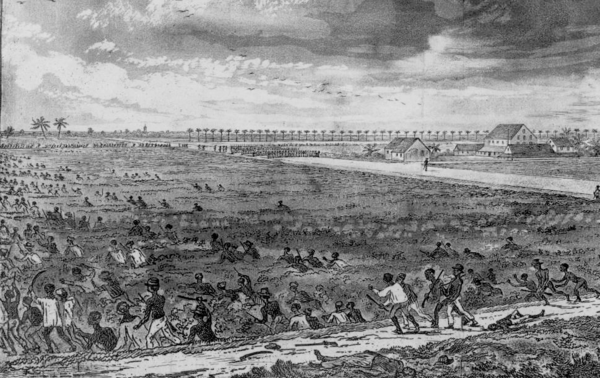
Demerara Rebellion 1823. Wikimedia

History Extra Podcast The Demerara Slave Uprising is advertised as being about a ‘little known’ uprising, but I actually am familiar with it because ‘my’ Judge Willis was one of the judges of the Court of Civil and Criminal Justice in British Guiana (i.e. Demerara) in 1831, eight years after the 1823 uprising. It had been strongly put down, but the tiny white minority had been unnerved by this uprising of enslaved people who vastly outnumbered them. The interview featured Thomas Harding, the author of White Debt: The Demerara Uprising and Britain’s Legacy of Slavery. He writes ‘narrative non-fiction’ but he acknowledges the assistance of Caribbean historians and seems to have stayed fairly close to the court records, diaries and correspondence.

This Union: A Sea Between Us (BBC) I enjoyed the series on Scotland, and so here I launched into Northern Ireland. This series had less of a historical emphasis, focussing mainly on current events since the Good Friday Agreement, from a Loyalist perspective. In Episode 1 Andrea Catherwood returns to her homeland in Northern Ireland, and interviews 19 year old Joel Keys who wasn’t even born when the Good Friday Agreement was signed in 1998. He spoke of the Loyalists sense of grievance since Brexit in particular, and the links between the paramilitaries and the drug trade. He explains his ambitions for a career in politics and determination to help his community tackle its social problems while retaining its British identity. Episode 2 starts at a Unionist march, where the men are wearing balaclavas again, evoking the sectarian Troubles of the 20th century. Many felt betrayed when Boris shifted the goalposts on Brexit, leading to the re-emergence of Loyalist violence. Episode 3 looks at the political instability in recent times, with a succession of leaders in both the DUP and the UUP. Unionists are no longer the majority in Northern Ireland, and many feel betrayed by Boris Johnson and the Sea Border. Young people are more concerned about rights (e.g. gay marriage) and many former Unionist are now agnostic about Northern Ireland’s place in the UK. They are the ‘middle’ who can only be swayed by moderates, not hardliners.

This Union: The Ghost Kingdoms of England. This four part series features Ian Hislop. I was a bit out of my depth because I didn’t have a very clear understanding of exactly where they were talking about. Episode 1: East Anglia- Sutton Who starts in Colchester, a Roman stronghold which the arriving Angles and Saxons chose to leave alone. He points out that the lights didn’t just go out when the Romans left in 409-410 A.D.- that the Romans are “us”. He then goes on to talk about Sutton Hoo, uncovered just before WW2. We still don’t really know what it is: is it the burial of one of the earliest of the great Kings of the Anglo-Saxon period in East Anglia’s golden age? Episode 2: Northumbria- The Great Divide focuses on the Venerable Bede who wrote about Northumbria in the early 8th century. The Humber was the dividing line. He also interviews the writer Bernard Cornwall, who wrote The Last Kingdom. Episode 3: Mercia- Where is Mercia? Good question- apparently it’s what’s known as the Midlands. The great Mercian Kings had European ambitions but were subsumed and written out by the story of Alfred the Great. Episode 4: Wessex: The Only Way is Wessex ends up with Alfred the Great. They started off after the other kingdoms, but in the end they dominated not only by the legend of Alfred, but also Thomas Hardy’s novels. This whole series was a bit beyond my limited geography and Anglo-Saxon history.

Heather Cox Richardson I haven’t listened to Heather Cox Richardson in ages, and now that the anniversary of 6 January has passed, I thought I might look to see what she had to say about the anniversary. What she gave was a really good lecture about Why does Democracy Matter? Nothing new, but really worth listening to. If you haven’t listened to her before, this is a good potted version.

I hear with my little ear: Podcasts 1-7 January 2022

Well, another year of podcasts. And just think- a few months down the track, I will have finished listening to my Roman podcasts!

History of Rome Podcast In the last episode, we left Commodus dead in the bath. In Episode 98- Purchasing Power we meet Pertinax, who was presented as a fait accompli to the Senate and a ‘safe pair of hands’ to repair the damage that Commodus had wrought. He was the son of a freedman (which the Senate wasn’t too happy about) and he served in lots of battles and was experienced as a governor of important provinces. He was a strong disciplinarian, but he found that he had to ‘buy off’ the Praetorian Guard to get them to support him. But he only coughed up half of what he promised, and he was confronted by 300 angry Praetorians who stabbed him. He had a short ‘reign’- only 86 days. So what next? Well, find a new emperor who won’t try to wriggle out of his bribes. And so, there was an auction to work out who would come up with the goods! Didius Julianis ‘won’ the auction but he only lasted 66 days. Even though Didius Julianis had been raised in the house of Marcus Aurelius’ mother, and fought in Germany, he always lacked legitimacy and the troops wouldn’t support him. Episode 99 What Evil Have I Done? was his plaintive cry as he was killed in the palace after Severus took control in 193CE which was known as the Year of Five Emperors. There weren’t actually five emperors – only three because Severus triumphed- but there were five contenders to be Emperor- all army men. In Episode 100 Black and White and Severus All Over we meet the other two: Pescennius Niger (who people really expected to take over) and Clodius Albinus. Niger was older than Severus and Albinus, and he was upwardly mobile. He had been Governor of Syria and was pretty laid back about it all. Too laid back really, because Severus was closer to Rome and declared himself emperor while Niger’s troops were still marching. Clodius Albinis was chosen by Severus as a ‘Caesar’ to co-rule with him. Albinis had the support of the troops in Brittania and Gaul. When Severus appointed his elder son Caracalla as his successor with the title of Caesar, civil war broke out. After a hard-fought battle, Albinis was defeated and killed himself (or maybe was killed). And so in Episode 101 And All Was of Little Value Severus embarked on his 18 year reign. His major concern was keeping the support of the army (who had put him in his position) and he wasn’t really interested in governing, which he left to his prefect Plautianus. It had been prophesied that there was a woman in the East who would marry a King, so he sought her out and found Julia Doman in Syria and married her. He invaded Parthia and Britain, but in his absence Plautianus became more unscrupulous and powerful. Severus’ sons Caracalla and Geta hated each other, and they stitched up Plautianus and had him executed. In Episode 102 The Common Enemy of Mankind sees Severus invading Brittania and reinforcing Hadrian’s Wall as part of ‘pacifying’ the Caledonians. But when the Caledonians adopted guerilla warfare instead of ‘proper’ war, he embarked on a genocidal campaign. After his death, he appointed his sons as co-heirs but they hated each other. They divided the palace in half so that they didn’t have to see each other, and were contemplating doing the same thing to the Empire, but Caracalla got in first and had Geta killed in front of his mother, who had planned a meeting to ‘reconcile’ them. Then came a huge purge, and another invasion of Parthia on the false excuse of a ‘peace’ marriage. My God. I knew none of this. No wonder it’s the ‘decline and fall’ of the Empire.

This Union: Two Kingdoms (BBC) This is a fairly recent (Sept 2021) three-part series about the relationship between Scotland and England. Episode 1 Creation of the Union goes through the Act of Union in 1717 as a way of solving the succession crisis after Queen Anne. Apparently the English weren’t too keen about it either because Scotland was pretty much bankrupt after the Darien disaster, an attempt to establish a Scots colony in Panama. (I’d never heard of it). Episode 2 Cementing the Union sees Scotland sharing in the post-WWII welfare state with its state-owned enterprises in heavy industry. But we know what Maggie Thatcher did with those, don’t we. With the discovery of North Sea oil, Scotland felt even more miffed. Episode 3 Crossroads sees the creation of the Scottish Parliament facilitated by Labour governments in both England and Scotland. But the rise of the Scottish Nationalist Party saw Labour eclipsed in Scotland, and the push towards a referendum. Even though the referendum (which was subject to a strong scare campaign about the economy) voted against independence, Brexit has changed things, and most young people, who do not have the nostalgia for big state-owned industry, are strongly in favour of independence. And as they say, demography is destiny. I really enjoyed this series.

Big Ideas (ABC) I’ve just finished reading Kate Holden’s The Winter Road (review to come!) and this July 2021 interview with the author How a dispute over land clearing turned deadly gives you a good idea of what the book is about. But read the book, because this interview doesn’t do justice to Holden’s beautiful prose and thoughtful meditations on themes wider than the true crime aspects of her story.

Emperors of Rome I’m continuing on with the series of episodes about the empresses. Episode CLVIII – Plotina deals with Trajan’s wife, who came from the provinces just like her husband did. She had to share the ‘Augusta’ title with Trajan’s sister Marciana, and then when Marciana died, Marciana’s daughter was made an Augusta instead. So she was never the sole Augusta, even though she and Trajan worked well as a unit. She was very fond of Hadrian and championed him after Trajan’s death. She was in the public eye for a long time. The episode features Professor T. Corey Brennan (Classics, Rutgers University). Episode CLIX – Sabina features Professor Brennan as well. Sabina was a grand-niece of Trajan, so when she married Hadrian, she lent legitimacy to his reign. She travelled with Hadrian, who as we know, loved to travel around, which made her very visible, and there are many coins featuring her image.There is some scandal concerning her, but we don’t know much about it. There are negative anecdotes about her being morose and irritable, and she took steps to make sure that she didn’t get pregnant. Brennan suggests that she was forced into suicide, because Hadrian had a view to his successor that he didn’t want her to change if he predeceased her. She was friends with the court poet Julia Balbilla.

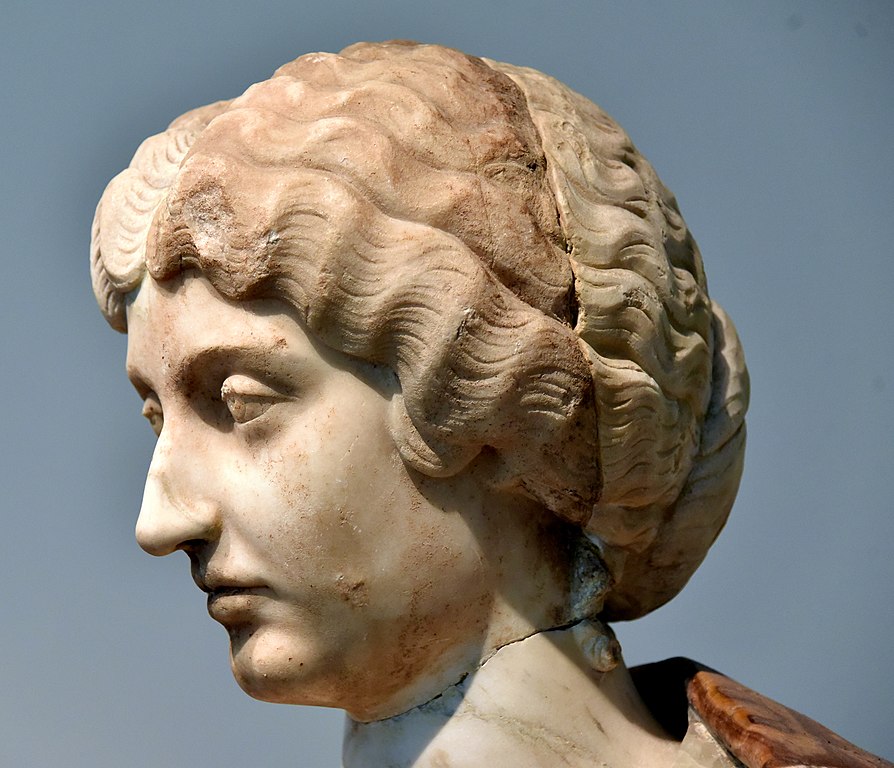
Faustina. Source: Wikimedia

Episode CLX – Faustina was the mother of Commodus and as the daughter of the previous Emperor, Faustina provided her husband, Marcus Aurelius, with a solid link to the imperial throne. She was eight when her father Antoninus became emperor, and at first she was engaged to Lucius Verras, but then the betrothal was changed to Marcus Aurelius. She and Marcus Aurelius had at least 14 children, of whom five daughters and Commodus survived. The sources aren’t very complementary about her, but perhaps that’s because they blame her for Commodus, suggesting that he might have been the product of adultery.

And then….back to the Emperors. Episode LXXXII – Pertinax follows much the same material as the ‘History of Rome’ above. Dr Caillan Davenport (Roman History, Macquarie University) points out that it is known as the Year of Five Emperors but there were actually only three (the other two claimed themselves to be Emperors but were not recognized as such beyond their troops). In Episode LXXXIII – Didius Julianus I still just can’t believe that the Praetorian Guard held an auction between the aspirants to role of emperor- an auction! Didius Julianus was 60 years old and an experienced governor and soldier, but when he turned up at the Senate with soldiers, people knew who had bought and paid for him. There were protests, but Didius killed the protestors. He tried to fortify Rome and even brought in the elephants to help him. By this time he was encircled by Severus, Albinus and Niger. The Senate had him killed. Episode LXXXIV – The African Emperor brings us Severus, born in Libya and known as the African emperor. He offered Albinus, whose support base was in Gaul, Spain and Brittania the junior rank of consul because he didn’t want him invading Rome too, forcing him to fight on three fronts. Severus arranged for big celebrations in Rome when he was proclaimed emperor. Episode LXXXV – Black and White looks at Severus’ early actions as emperor. It took him a year to defeat Niger, and afterwards he divided Syria in two in order that no other governor from the east could draw on 3 legions to threaten the emperor. He needed a foreign war so he provoked one with the Parthian vassals, although not Parthia itself. Then he indulged in some FAKE NEWS by proclaiming that Marcus Aurelius had adopted him, and that Commodus was his brother and demanding that Commodus should be deified (short memories here). Severus proclaimed his son his co-consul, which of course put Albinus (who was already co-consul) on the outer, so Severus turned on him too. Albinus was either forced to commit suicide or was trampled by a horse but either way, Albinus was out of the way too, leaving Severus the only emperor standing. He had the Senate ratify his spurious ‘sonship’ with Marcus Aurelius, and demanded that Commodus be deified, arguing that the Senator were just as bad as Commodus had been. Purges followed and by now he had got rid of all his enemies, and he raised the army pay by 50% or 100% to reward his friends.

Book It In (The Guardian) I quite enjoy Tony Birch’s stories and I enjoyed this interview with Paul Daley. Tony Birch on writing true characters in fiction discusses his childhood in 1960s Fitzroy and the nature of the relationship between off-the-books businesses (SP bookies, pawn shops, bars etc) and the police. He talks about the rock-like strength of the women in his childhood, the masculine violence that surrounded him, and the way that if the characters are right in fiction, the politics comes through anyway. In relation to non-indigenous writers creating indigenous characters, he argues that if they do so, they need to take responsibility and defend what they are doing. Aboriginal people need to own their stories, and white writers need to own their own stories of colonialism. He speaks about Gary Foley, who has never been represented in the Schwartz empire, and his contribution to politics and community.