Category Archives: Melbourne history

The Elizabeth Street Creek

Melbourne has experienced two earthquakes in recent weeks.  They tell us that it’s due to geological activity around Korumburra, but don’t believe a word of it.  It’s not an earthquake: instead, it’s the sound of the Port Phillip fathers turning in their graves as they hear of a proposal to return Elizabeth Street in Melbourne to a creek bed.

The Age on Saturday invited a number of Melbourne worthies to respond to the question “What would you do for this city if you could?” releasing them from those pesky considerations of economic and political constraints.  Gilbert Rochecouste, described as a “planning mastermind” (who has escaped my radar completely, but apparently he’s the man who led the rejuvenation of Melbourne’s laneways), suggested opening up the concrete on Elizabeth Street and letting Williams Creek underneath flow free.

Actually, I hadn’t heard it referred to as “Williams Creek” before, but William Westgarth’s recollections confirm that it was previously known by this name.  The people of early Melbourne had other names for it too- “a jungly chasm” is particularly evocative.   The corner of Collins and Elizabeth Street seems to have been particularly treacherous.  Thomas Strode the newspaperman recalled in 1868

At almost every hour of the day may be viewed the interesting spectacle of drays being bogged in the muddy depths of Collins-street…We remember on [one] occasion a dray of bullocks were so hopelessly imbedded in a hole in Elizabeth-street, that the animals were allowed to stifle in the mud, and its being nobody’s duty to remove the nuisance, their remains with that of the dray, lie buried in that extemporary graveyard to the present day.  (cited in Annear p. 41)

Perhaps the reclamation of “Williams Creek” may uncover them!  It was obviously a pretty boggy area. Apart from Williams Creek, two other tributaries  ran  into Yarra.  “River Townend” which ran from the corner of Collins and Elizabeth Streets  was named after Michael Townend, the ‘fat, comfortable-looking grocer’ on the south-west corner. “River Enscoe” ran from the north-west corner of William and Flinders street, and was named for the merchant John Enscoe who very nearly drowned in it.

Each winter “Lake Cashmore” would form on the doorstep of Michael Cashmore the draper who owned the shop on the northeast “Block” corner of Collins and Elizabeth Streets, described by Garryowen as “a large pool of stagnant water, not sufficiently deep to drown a man, but quite sufficient to half do it. ” (Garryowen p. 457)

During downpours of rain,  litter from the surrounding streets would pour into Elizabeth Street gully:

Pieces of timber, wisps of straw, waste paper, and corks, as they are borne past and beyond carpenter’s shops, stable yards, printing offices, or hotels, sufficiently indicate the character of the neighbourhoods from which they have been carried; corks come down into the main stream from every side.  From all the ‘rights-of-way’ they pour in crowds.  They rush out of the lower slums of Little Bourke Street, and from both ends of every street in the town, until they collect in a dense mass in the wide space between Collins Street and Flinders Lane, where they form a closely-packed army of bobbing bedouins… (cited Brown-May, p. 75)

Somehow the ‘bobbing bedouins’  of wine and champagne corks is a quainter image than a congealed mass of Big Mac wrappers.  Melburnians of a certain age will remember when Elizabeth Street flooded in 1972:  looking back, it seems remarkable that no-one drowned given the number of basement shops and subways there.
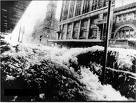
elizabethflood

When the ravine was in full flood during the early years, the only safe place to cross it was at Lonsdale Street.  In 1880s Elizabeth Street became one of the first stormwater drains, carrying water from Carlton down to the river.   In the Stork Hotel at the top of Elizabeth Street (much loved for the late Dennis Prior’s dramatizations of the Greek myths), there used to be a series of photographs on the wall showing the raising of Elizabeth Street so that what had previously been the street-level bar became the basement.

All that engineering; all that technology!  What would the city fathers say?

Well, actually, one of them thought of it first. William Westgarth in his Personal Recollections of Early Melbourne wrote in 1888:

Melbourne missed a great chance in filling up with a street this troublesome, and as a street, unhealthy hollow… A reservation of the natural grass and gum-trees between Queen and Swanston street would have redeemed Melbourne up to the first rank of urban scenic effect and the riotous Williams might, with entire usefulness, have subsided into a succession of ornamental lakes and fish ponds.

Maybe all this earthquake activity is not the city fathers turning in their graves; perhaps it’s old Willie Westgarth slapping his knees and roaring with laughter that it has taken us 121 years to embrace his vision.

References:

Robyn Annear, Bearbrass: Imagining Early Melbourne, 1995

Andew Brown-May Melbourne Street Life 1998

Garryowen Chronicles of Early Melbourne

Kirsten Otto Yarra: A Diverting History of Melbourne’s Murky River,  2005

William Westgarth Personal Recollections of Early Melbourne (e-text)

‘Crime in the Port Phillip District 1835-51’ by Paul R Mullaly

You can get all excited about the latest, contentious, revisionist contribution to those ‘big’ historical questions (those questions that somehow fail to capture the public interest!).  My wordy, I know I do!  But there’s something quite humbling about the labour-of-love, extended type of research that provides the building block foundations for this other more controversial, more debated but somehow more ephemeral work.  I’m thinking about the edited series of documents, the painstaking deciphering of a diaries, the compilation of administrivia into a logical process after it has been distributed across multiple bureaucracies.  There’s a danger, of course, that it can descend into mere list-making, and the hunt become more seductive than the actual capture.  But thank you to those historians who share the nuts and bolts of their research with others.

In relation to my own research, I’m thinking of A.G.L. Shaw’s Gipps-La Trobe Correspondence with its wide-ranging footnotes that make me realize I’m following a well-trodden path.  I’m thinking of Ian D Clark’s persistence in deciphering George Augustus Robinson’s diaries- ye gods: that handwriting! I’m thinking of Paul de Serville’s typography of Port Phillip ‘gentlemen’ before and after the gold rushes. And now, too, I’m thinking of Judge Paul R Mullaly’s book Crime in the Port Phillip District 1835-51.

This is a big book- 763 pages- so big in fact that the subject and names index has to be downloaded from the publisher’s website separately-  a costly compromise when dealing with such an exhaustive work.  The author, a judge and Q. C. with a long history of involvement in the Supreme Court of Victoria, undertook this huge endeavour in his retirement, drawing on material at the Public Records Office of Victoria, newspapers, and both Redmond Barry’s and Judge Willis’ own case books.  Here is where his experience comes into its own.  For the non-lawyer, many of these documents are fragmentary and utilitarian, and all too often opaque.  But  Mullaly can cast his legal eye over them, piece them together into a narrative and contextualize them into a standardized legal process.

The book is divided into three themes, although the table of contents doesn’t reflect this.  He starts with a snapshot of Port Phillip itself and its legal system, with an emphasis particularly on the status of Aborigines under colonial law.  He then moves to a step-by-step description of the legal process, from arrest through to sentence, highlighting along the way where practices differ from those today. Finally- and this is the largest section of the book- he analyses different types of offences e.g. those against the person, against property, against justice, miscellaneous and sectarian offences,  with a selection of chronologically-presented vignettes of particular cases.  The regularity of his structure was helpful.  I was concentrating on judgments between 1841-3, and the chronological presentation made it easy to locate the material I wanted.

There is not an argument as such in this book,  beyond his long-held belief expressed in his introduction that “the elite in society tended to be far too ignorant of the realities of much criminal activity and were much too judgmental in attributing a high degree of moral culpability to many offenders” (p. vii).  This is, instead,  a descriptive work, focussing on the administration of the criminal law, which he hoped would “help the present community understand many aspects of our present culture and give many citizens an insight into the community in which their ancestors lived.” (p.viii).  Perhaps because of its descriptive intent, the ending of the book felt a little abrupt.  I found myself wishing that he’d made an overall assessment of crime at that particular time- was it any more or less violent then? did the nature of crime change? was society well served by its criminal justice system?  I really enjoyed the parts where he tried to explain some anomaly that he had detected, or fill in the gaps that had been left in the documentary record.

There’s just so much that can be done with the material he has assembled here.  I’ve been frustrated by the elusiveness of women in my study of Port Phillip but here they are- not just as victims but also as witnesses, neighbours, people just going about their lives.  There’s a fascinating study of childhood glimpsed in these cases; there’s a geography of the streets and pasttimes.   There’s another economy here- not that of the Blue Books or Select Committees into Monetary Confusion, but the economy of buying and selling and just getting by.

This book provides well-dug, solid foundations. Thank you.


Letters from Victorian Pioneers (or “It wasn’t me Guv’nor, it was him”)

victorian_pioneers

When Lieutenant-Governor La Trobe sailed home  for England on 6 May 1854, he carried with him a series of letters which he hoped to use when writing a history of the Port Phillip district in his retirement.  He had officially approached a number of the early pastoral pioneers and asked them a number of questions, and as you might expect, they answered his survey letter fairly promptly.  I’m not sure what the official letter said-  one of his respondents referred to a section that asked  “If preceded, accompanied or immediately followed, by whom and when, and the general state of the district around and in advance of me at that period.”  He obviously also specifically asked about encounters they had had with aborigines in their area, and their opinion of the future facing the aboriginal tribes.

He had big plans for these letters.  He intended his book to start with Captain Cook’s discovery of the Gippsland coast, then move to the early futile attempts at settlement.  It would then go on to record the effective colonization of the region by pastoralists, ending with the discovery of gold in 1851.  Part II would deal with the geology, botanty and zoology of the land; the aborigines and the human aspects of the spread of settlement.  He would then pass on to separation and the consequences of gold discovery, where he would rebut the criticisms that had been levelled against him for his administration of the gold fields.  He would then finish with ‘My Australian Home, a walk around my garden’.  (Gross, p. 131)

It was not to be.  He was increasingly afflicted with blindness, and realizing that he would never write this book, he returned the letters to Victoria in 1872 , where they were preserved in the public library.  Times had moved on: people were ‘moving forward’ then too, and not all that interested in the preceding generation. It was not until 1898 that the 58  letters were published by the Trustees of the Library under the name ‘Letters from Victorian Pioneers’.

Because they were responding to an official request with guiding questions, there is a sameness about the responses of his correspondents.  But there’s also quite a bit of similarity in their experiences as well, which is what I expected.  In fact, my impetus for reading this book was the suggestion in Robert Redfield’s book that people living in a small community often held a common biography.  Even though Redfield specifically states that his approach does not hold for frontier communities (which of course Port Phillip was), I was interested to see if the early pastoral settlers of Port Phillip could be said to have a common life story.

And yes, they could.  All his respondents were male, and many of them were young when they settled in Port Phillip- usually in their early to mid 20s.  Many of them came over from Van Diemens Land  from where they had initially emigrated (none admits to convict origins).  Many of them had brothers with them.  And they held in common sheep and cattle– hundreds and hundreds of them, trotting along, being slaughtered by marauding natives (and  what a dispiriting and expensive loss of life that must have been), moving from run to run.  Some time ago I read Roger McDonald’s book  The Ballad of Desmond Kale, and was frustrated by the sheep-sheep-sheep  emphasis of it, but sheep-fever is amply demonstrated here too.  It’s not as exotic and alluring as gold, but the sheep-rush  obviously drove the early settlers of Port Phillip.

They all mention the 1840s depression- although one canny Scotsman seems to have escaped it because he had savings still in Van Diemens Land.  There are names of landholders that spring up again and again- obviously big stockholders held land in several districts.  Many of them moved from station to station.

Some of them were quite observant about the changes wrought on the land after settlement.  Several mentioned that it was very dry when the area was first opened up, and that the rainfall had  improved in the last few years of the 1840s, drawing later settlers to land that had seemed uninviting when the first settlers passed it initially.  One or two mentioned changes in the grasslands, and some were quite nostalgic for the beauty of the unsettled areas.

Most fascinating of all was the range of responses to the question about aborigines.   Most of them knew of “other people” who had gone on shooting reprisals- as perhaps might be expected when the Lieutenant-Governor asked you such a question.  Several of them mentioned the Whyte brothers by name as being particularly responsible for aboriginal deaths, one respondent attributing 51 deaths to them compared with the official count of 30 aboriginal deaths.  A couple of respondents mentioned that they had shot aborigines in reprisal-  just one or two, mind you, and always because the aborigines started it first.   Another settler was named as responsible for several deaths, but he protested (too much?) his innocence. George Faithful of Wangaratta, however, reported quite openly his actions after suffering several attacks from surrounding natives:

At last, it so happened that I was the means of putting an end to this warfare.  Riding with two of my stockmen one day quietly along the banks of the river, we passed between the anabranch of the river itself by a narrow neck of land, and, after proceeding half a mile, we were all at once met by some hundreds of painted warriors with the most dreadful yells I had ever heard.  Had they sprung from the regions below we could have hardly been more taken by surprise.  Our horses bounded and neighed with fear- old brutes, which in other respects required an immense deal of persuasion in the way of spurs to make them go along.  Our first impulse was to retreat, but we found the narrow way blocked up by natives two and three deep, and we were at once saluted with a shower of spears.  My horse bounded and fell into an immense hole.  A spear just then passed over the pummel of my saddle.  This was the signal for a general onset.  The natives rushed on us like furies, with shouts and savage yells; it was no time for delay.  I ordered my men to take deliberate aim, and to fire only with certainty of destruction to the individual aimed at.  Unfortunately, the first shot from one of my men’s carbines did not take effect; in a moment we were surrounded on all sides by the savages boldly coming up to us.  It was my time now to endeavour to repel them.  I fired my double-barrel right and left, and two of the most forward fell; this stopped the impetuosity of their career.  I had time to reload, and the war thus continued from about ten o’clock in the morning until four in the afternoon.  We were slow to fire, and I trust and believe that many of the bravest of the savage warriors bit the dust.  (p. 220)

Several of the respondents noted that they had taken young aboriginal girls and boys to live with them, but that once they reached adulthood, their tribes came and took them away.   One settler commented that  he gave a baby back to its mother after he had taken it because the servant wasn’t prepared to look after it, and  seemed rather put out that she refused to give it to him a second time.  Several reported infanticide, especially where there was a white father and a black mother.  There were several allegations of cannibalism, although interestingly one settler reported that the aborigines thought that the whites were cannibals!

Where aboriginal deaths had occured, several claimed, it was because the blacks had become over-familiar.   White men didn’t take lubras, they claimed- the black men offered their wives to them freely.

Even amongst those who were most positive about the aborigines working for them on their stations, or their quickness and willingness to forgive, there was overall a deep sense that influenza, smallpox, VD or alcohol would decimate their numbers.  They all reported that there weren’t as many aborigines on their stations as there had been years earlier- strange that.

References

‘Letters from Victorian Pioneers: being a series of papers on the early occupation of the colony, the aborigines etc addressed by Victorian pioneers to His Excellency Charles Joseph La Trobe Esq. Lieutenant-Governor of the Colony of Victoria’. Edited with an introduction and notes by C. E. Sayers from the original edition edited for the Trustees of the Public Library by Thomas Francis Bride L.L.D during his period of office as Librarian of the Public Library of Victoria. (Phew!), 1969.

Alan Gross ‘Charles Joseph La Trobe, Superintendent of the Port Phillip District 1839-1851 Lieutenant-Governor of Victoria 1851-1854’. Melbourne, Melbourne University Press, 1956.

1851 Black Thursday

The Royal Historical Society of Victoria is having its centenary this year.  One of the aims of the founders of the society was to capture the stories of the early colonists of Port Phillip before they died.  I was flipping through some of the earliest volumes of its journal, and it is impressive to see papers given by people at their meetings who had been here (albeit as children) right from the start of Victoria’s settlement- just think of it: they would have seen and met these people of Port Phillip that I’ve read so much about.

At the 25th June and 3rd September meetings of the society in 1923,  a paper was read called “Reminiscences from 1841 of William Kyle- a pioneer. Communicated to and transcribed by Chas Daley”.    I hadn’t heard of William Kyle and I know nothing more about the paper than just this.  William Kyle was born in Greenock, Scotland in 1832 and came out to Port Phillip as a child with his father.  The paper extended over two editions of the Victorian Historical Magazine and traced through his arrival, life in the country and in Melbourne pre-gold rush with some fascinating descriptions of Aboriginal life on the edges of what are now the inner-city suburbs of Melbourne, then right through to the latter years of the century (I’ll admit that I didn’t read the whole thing).

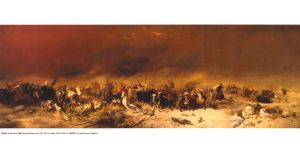
I was drawn to this description of Black Thursday of 1851, and perhaps to get yourself in the mood you should visit the State Library of Victoria page and have a good look at William Strutt’s painting.

And here’s how William Kyle remembered Black Thursday of 1851:

The floods of 1849, which were the result of a general rainfall throughout the colony, caused an excessively dense growth of vegetation, and much grass.  Little clearing had been done in the forests, and ring-barking trees was not yet in vogue, so that, after a very hot summer, the outbreaks of fire which swept throughout the land under the stimulus of a fierce hot wind caused the conflagration known as Black Thursday.  The fire spread with amazing rapidity.  Three-quarters of the colony was in a blaze.  The flames were so intense that trees two or three hundred yards away from the advancing wall of flame were shrivelled before the flames reached them.  In the unsettled districts there was little loss, but thousands of sheep and cattle succumbed.  The native game was almost annihilated.  The fire was so near Melbourne that the sky seemed to be a mass of floating fragments of bark and leaves ablaze with the intense heat.  Many people thought the Day of Judgment had surely come.  We could hardly breathe the stifling air.  The floating embers even set on fire some of the ships in the bay.

After the conflagration had exhausted itself the scene was one of intense desolation.  Nothing was visible but charred stumps and blackened smoking trees, bereft of all foliage.  No sound of bird, insect or animal was to be heard.  It was years before game was plentiful, and it was never so again near the settled districts after Black Thursday.  Fortunately, although there were the most wonderful escapes from death, there were not many human lives lost, owing to the sparseness of the population.

Sounds very, very familiar.

Reference:

Reminiscences from 1841 of William Kyle, a pioneer’ Victorian Historical Magazine, Vol X, Dec 1925 No 4.

Bushfires

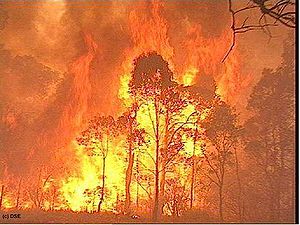
Australia Felix, as Victoria used to be designated, is in shock and disbelief at the loss of life and property in the bushfires over the weekend- 103 lives lost and still counting.  Shock at the sheer numbers;  and disbelief, at least sitting here in the north-east suburbs of Melbourne that all this destruction was occuring in areas that we might drive through on a leisurely Sunday afternoon drive less than fifty kilometres away.  It’s a cool morning: there’s not even a whiff of smoke on the air; the sky is clear; the sun has none of that sullen reddened glow that indicates that there’s fire somewhere.

The people of Port Phillip in the 1840s would have been aware of fires, but not fires of the magnitude we’ve seen this past weekend.   Most reports of fire  in the Melbourne newspapers of the early 1840s  related to house and shop fires fires within the town boundaries. For settlers further out, fires started through lightning or were lit by the aborigines either as an act of depredation against a particular settler, or as part of  land and food management.  Looking through my summaries of two years of the Port Phillip Herald, I can find only two mentions of bush-fires – both in January 1842- and interestingly both involve the natives.   The first report was of a fire at Port Lincoln in South Australia, which was caused when the Resident Magistrate there asked the natives into town at the full of the moon to receive rations of flour; some arrived with fire-sticks and a fire was started, although it was not clear whether the fire was accidental or not.  The second report, also in January 1842, made a correction to earlier reports that the blacks at Mr Bathes’ property in Westernport had fired four acres of barley and fencing.  In fact, instead of causing the fire, they had tried to extinguish it, and chief Gellibrand in particular was singled out for conducting himself in the most praiseworthy manner.

Bushfire seasons come and go- I can, for instance, remember driving with my mother up to Warrandyte in 1962 to collect my father who had been working on fire-breaks with his earthmoving machinery in the fires there.   Every time I drive past Lara on the way to Geelong, I remember the people who died in their cars on the Princes Freeway in 1969. But every few decades in Victoria, there are huge, state-wide conflagrations of a completely different magnitude.  This weekend was such a conflagration.

When reading through the newspapers of 1840s Port Phillip, it is instructive to remember that  for white settlers, this was a new colony, and the vagaries of temperature, rain, snow, bushfire were still largely unknown.  Black Thursday on 6 February 1851 was the first recorded widespread blaze,  covering a quarter of what is now known as Victoria including Portland, the Plenty Ranges, Westernport, the Wimmera and Dandenong districts.  Twelve lives are recorded lost, along with over a million sheep.

struttblackthursday1

People of my parent’s generation still speak of  “Black Friday” of 13 January 1939, the day that until last Saturday held the record for the highest recorded temperature.  My father recalls seeing the ranges surrounding Healesville silhouetted with fire; just last week I was speaking to someone who  mentioned that her mother, having just given birth, was wheeled out onto the balcony of the city hospital, from where she could see the Dandenongs alight.  Seventy-one people died in the fires which devastated Noojee, Woods Point, Omeo, Warrandyte and Yarra Glen.

300px-ashwednesday1

And then Ash Wednesday, 16th February 1983- well within my memory.  A few days earlier there had been a huge dust-storm that rolled across Melbourne, then Ash Wednesday itself.  I recall watching, transfixed, the unfolding disaster on television, hour after hour, then walking out into the front garden in the dark with the sky glowing, ashes falling, and wondering if the whole world was going to combust.

And so, onto this last weekend.  On the Friday night, after a day of about 30 degrees, we watched the news where authorities were warning of extreme heat and fire danger on Saturday and worst bushfire conditions in Australia’s history.  It was difficult to believe- it was still with no breeze at all, and not unduly hot.  But, oh, things are so dry: Melbourne has been in drought for many years and has had the second-driest January rainfall figures on record- just one millimetre of rain compared to a January average of  48 mm.   The Saturday itself was oppressively hot, reaching the highest ever recorded  temperature of  46.4 degrees.  When you opened the door, it was like opening a fan-forced oven with the rush of dry heat and wind.  The wind got stronger and stronger with trees bending, dust whipping, but there was still no sign or smell of fire.  We did notice a large, towering white cumulus cloud to the north, but by then it had clouded over, and we thought that it must have been a storm cloud. Then, at about six o’clock, the cool change came through- even a few spatterings of rain.  We went to bed aware that there were still fires, that there were fears that what had been the fingers of the blaze would become the palm of the blaze on a much wider front once the wind swung around, but that perhaps it hadn’t been quite as bad as they predicted.

By the next morning, things had changed completely.  Fires that we hadn’t even been aware of, at Kinglake, at Marysville had wiped out the towns; 27 dead, maybe 40, then 65, then 93 and now over 100.   These are much-loved places.  Kinglake, some 20 kms away was where we had a camp every year in my long-ago born-again Christian days; I fell off a motor-bike there and still have the scar on my ankle; I drove there at about 50 kms a hour in my old Morris Major with a couple of girlfriends as my first foray as a new driver on country roads.

Marysville, home of all the Mary-guesthouses (Marylands, Mary-Lyn etc) built in the 1920s in mock-tudor style and the prettiest little main street with huge deciduous trees, with a crystalline creek  fringed with tree-ferns running through it.  We went there for September holidays at Marylands when I was a child in the 1960s;  I’ve camped beside the Steavenson River;  walked through the bush bird-watching,  my husband and I went there about five years ago, stayed at a guest-house,  ate at the pub, visited their historical society.

marysville

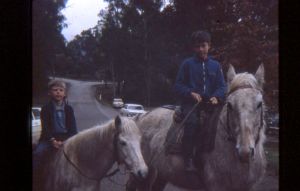
My brothers horse-riding at Marysville, 1960s

And St Andrews- famed for its weekend market; Sunday lunch at the pub.    Chum Creek near Healesville- my father spent a couple of years up there in the 1930s/40s with his grandparents, attended the primary school,  lived through bushfires there, battled the blackberries and bracken there.  I wonder if his house is still standing?

There’s grief, disbelief, and a degree of helplessness about it all.  In recent years there’s been a change of attitude about staying to defend your house- they no longer force people to evacuate, but encourage householders to develop a fire-plan of clearing around their houses, dealing with ember attacks, wetting down the house etc.  The common wisdom is to evacuate early if you’re going to leave, or else stay and defend a well-prepared house from fire after the main front has gone through.  People know all this;  the whole state was in a heightened sense of readiness, fire-plans were made, people were ready to stay and defend and yet, in the middle of the noise, smoke, heat obviously the fear is just too much to bear and people flee.  There’s much more sadness to come.

‘Redmond Barry: An Anglo-Irish Australian’ by Ann Galbally

barry3

1995, 228 p.

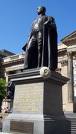
As a Melburnian, it’s difficult to get past the image of Redmond Barry as a strong, imperious philanthropist.  He is still very much a visible presence:  a large statue of him rears up in front of the State Library (one of his projects); his name adorns prominent buildings at the University of Melbourne (another of his projects), and of course his reputation has been forever intertwined with that of Ned Kelly, whom he sentenced to death.  This is the stuff of myth-making: the pompous Supreme Court judge cursed by the fearless bushranger “I will see you there when I go” (or words to that effect), only to die 12 days later of “congestion of the lungs and a carbuncle in the neck”.  [ Can you die of carbuncle? Dear Lord, if I should die, please let it NOT be of a carbuncle!]

Ann Galbally’s biography covers, of course, his whole life but my interest is mainly on his early years in Port Phillip and his relationship with Judge Willis.  Barry was born into the Anglo-Irish ascendancy.  The peace that followed the Napoleonic Wars cruelled his chances for a military career, so he entered the law instead only to find the Bar crowded with other young men who had made the same vocational choice.   When his father died in 1838, he emigrated to Sydney where there was less competition.

barry4

On the journey out, he embarked on a relationship with a Mrs Scott- and worse still, continued it when he reached Sydney.  News of the affair reached the ears of Governor Gipps, and he was awarded few government briefs as a result.  He continued to suffer from disapprobation even after leaving Sydney for the small town of Melbourne because, although he socialized and got on well with Superintendent La Trobe, the more prominent legal positions were in the gift of Gipps rather than La Trobe.   His unorthodox relationships with married women seem to be an ongoing theme: in 1846 he took up with a Mrs Louisa Barrow, with whom he had four children, in a  public, lifelong relationship that was never regularized by marriage.

Barry was only 26 when he arrived in Melbourne, and Galbally paints an engaging picture of Barry socializing with the other predominantly-Irish members of the Bar:  his good friends Sewell, Foster and Stawell and fellow Trinity-college and King’s Inn  graduates Brewster and Croke.  Although a member of the Melbourne Club and welcomed to all the vice-regal social occasions, he had little capital behind him and thus was not caught up in the land speculation of the early 1840s and  “perhaps for this reason his managed to maintain civilized relations with Willis for longer than most of the legal fraternity” (Galbally p. 49).

Not that Barry found Willis easy.  His diary records a succession of entries where he “argued with Willis“, “fought with Willis” or had a “blow-up with Willis who threatened to suspend me“.  He greeted the news of Willis’ suspension with relief  “Supreme Court Willis suspended + removed, Te Deum Laudamus” (24 June 1843).

In spite of this, Barry did not seem to have been exposed to the same personal insults or attacks that other barristers and officers of the court suffered.  Willis seemed to greet his appointment as the Commissioner for the Court of Requests in January 1843 with genuine approval, and at times their sparring in court (complete with historical allusions and Latin jests)  seemed to be equally relished by them both.   Although Barry had a reputation as a bit of a dandy who wore an old-fashioned Beau Brummel style suit, obviously Judge Willis did not take exception to this as much as he did the trimmed moustaches of Edward Sewell, Barry’s friend and erstwhile housemate.

barry1

Unlike Judge Willis, Barry was noted for his “dignified deportment and invincible politeness” (Garryowen p. 867). Galbally captures this quality well.   Against such a man, Willis’ own failings of temper and demeanour would have been even more marked.

References

Ann Galbally  Redmond Barry: An Anglo-Irish Australian

Barry, Sir Redmond, Australian Dictionary of Biography (online)

Heat wave!

hot

You may be aware that Melbourne is undergoing a heatwave at the moment- in fact, a record breaking heat-wave with three consecutive days of temperatures over 43 degrees (that’s 113 degrees, folks).   We’re having electricity brown-outs, bushfires and the public transport system has collapsed completely.  And boy, are we complaining!

So it was rather fitting that last night I should be sitting reading through the Port Phillip Herald for 24 January 1843, when I found this little snippet in the court report:

McLaren v Chisholm.- His Honor, on this case being called, enquired if it would be long, for he was so overcome with the heat, dust and wind, as to doubt whether he could bestow upon it that strict consideration which its importance required.

This is one of the very few newspaper references that I have seen to extreme heat, which surprises me somewhat.  There was a mention that the courthouse in early Port Phillip  (seen at the top of the page) was stiflingly hot in summer and freezing in winter, but rather more was made of the brazier resembling a chestnut stall that Judge Willis used to warm himself by than any attempts to alleviate the extreme heat.  Much attention is directed towards flood and mud, which seems to be a constant topic of conversation.  But heat, which surely must have been unfamiliar to many emigrants,  does not seem to be particularly noteworthy.

The early newspapers do not have a regular weather report, and  meteorological records only began to be kept in 1855.  The tides and phases of the moon are given in the newspaper and would have been more useful information in a port-based town with no street lighting beyond that outside hotels.

Diaries, on the other hand, seem to be an ongoing chronology of the weather.  Georgiana McCrae, for example, gives us a running commentary of the temperature which she could obviously measure by thermometer:

November 1st 1841. A fine clear day.  Completed my small needlework.

2nd. Hot wind- then thunder with rain.  At noon thermometer 85 degrees, and all night at 72 degrees.  The closeness of the house and the heat of its wooden walls quite stifling.

However, perhaps this interest in the temperature had a novelty factor for her in 1841 as a newly-arrived immigrant that had worn off by 1843.     She doesn’t mention the weather at all on 20th January 1843, the day that Judge Willis complained of, but she did note “A hot wind” on the 17th, and noted that the 21st was an “oppressively warm day” with “a hot wind” again on the 25th.

Were people more stoic then? They must have been.  Judge Willis was sitting there in his wig and gown; no doubt his bar was similarly attired; women were covered and corsetted. Yet the weather- or more properly, hot weather does not seem to be newsworthy.  Try telling that to our newspapers- particularly our more tabloid Herald-Sun that somehow managed to make a whole front page out of this picture with 43 degrees superimposed over it!

hot2

Yep, that’s news.

‘David Collins’ by John Currey

sillsbendjan2009-036

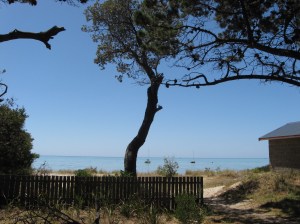
If my postings here have been a bit erratic lately, it’s because I’ve been going back and forth between home and my little caravan on the Mornington Peninsula.  It’s daggy and unsophisticated but as the sun sets over the bay, it’s a beautiful spot- here’s my view from outside the van, just up the track a bit.

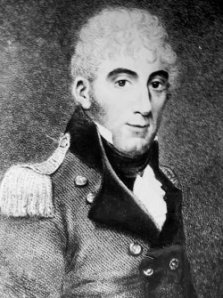
Being in such close proximity to the 1803 settlement at Sorrento has prompted me to read John Currey’s biography of David Collins– the leader of the aborted settlement of a consignment of convicts direct to Port Phillip.  By sending the fleet straight to Port Phillip from England, the Colonial Office intended to both quickly create a British presence and to alleviate the moral corruption of the constant inflow of convict blood into Sydney.  The settlement only stayed in Port Phillip for eight months until it shifted to Risdon Cove (Hobart) in two separate journeys separated by months.

The author, John Currey, describes himself in his preface as “an independent scholar without access to the services and resources normally associated with an academic environment”.  He has written and edited  a number of works of early Australian settlement.  The epigraph that commences his preface is an admonition from Andre Maurois’ Aspects of Biography (1929):

Every biographer should write on the first page of his manuscript: ‘Thou shalt not judge”.

He draws heavily on Collins’ letters to family and patrons, family papers and official correspondence, supplemented by newspaper comments and other peoples’ observations and comments on their relations with Collins.  Currey is scrupulous in his search and documentation, and almost succeeds in following Maurois’ advice.  But even he, at the end of the book raises questions that verge on the edge of judgement:

“Essentially conventional in so many ways, Collins was at the same time a complex and enigmatic man.  His written legacy, despite some tantalising revelations, offers few answers to the questions his life provokes.  How could a man so attentive to minute detail in his public duties be so negligent of his own financial affairs?  By what circuitous route did the man who aspired to ascend the pulpit come to find himself reviled as a lecherer and an adulterer?  Why did a mind so receptive and alive with curiosity become so dulled and inactive?  How could a man so blessed with so many natural charms fail to find enduring love and companionship? Did Collins himself, for all his introspection have any insight into his actions?  The exhumation of  [Collins coffin in ]1925 removed some of the mysteries surrounding Collins’s death.  It offered no explanation of the profound mysteries of his life.” (p. 308)

I find it frustrating when an author raises the very questions you want answered, but draws back from actually risking an answer to them.  Currey’s conception of his role as historian constrains him from venturing his own response, informed by his research, to these questions.  He should not be so cautious.  He has read the documentation: he has spent years with this man; he is qualified to venture a judgement.

In fact, I’d add a couple of other questions.  Why was he so unsuccessful in negotiating the patronage networks that all colonial civil servants had to manage?  How exceptional or commonplace was his relationship with the various convict women he had relationships with over his time in New South Wales?  What was the public response to these relationships?

collins

Inga Clendinnen in her Dancing with Strangers is less squeamish about speculating and judging David Collins as one of her informants.   After reading his published journal about his time with the First Fleet she characterizes its author as ” the Master of Plod” (ouch!).  She describes him as a man “susceptible” to liaisons with convict women.  She notes that Collins is

…a perfect representative of the moral and material economy of European culture.  It was these assumptions he brought to his analysis of the convict condition, and which he initially brought to the encounter with the very different culture and economy of the nomad people of Australia…. But as the slow years pass we watch David Collins ripen into an absorbed observer of native conduct, and a man capable of recognizing, indeed of honouring, a quite different way of being.” (p. 55, 56)

In reading this book, I found myself thinking of James Boyce’s Van Diemen’s Land which, like Clendinnen’s book, carves out a small what-if lacuna of time where the dispossession which certainly, inevitably and inexorably occurred was not yet deepened with violence and bloodshed. I found myself wondering if Collins’ insecurity and unsteadiness in his own authority did not hold the seeds of the 1803 failure in Port Phillip, thus averting an alternative history of Port Phillip as another convict outpost of New South Wales.  Boyce’s book about Van Diemen’s Land describes a benign environment: Collins saw it as hostile.  Boyce sees plenty and food sufficiency: Collins sees starvation and abandonment.

Although Currey doesn’t say so, the  David Collins I drew from his biography was a flawed man, who failed to achieve the hopes he had for himself.  He was impotent in using patronage to his ends; his career sputtered then died out; in an environment where many others prospered financially he ended up almost penniless;  he displayed poor judgement in relation to importing cattle from Bengal at huge expense; he failed to settle an area which just over thirty years later sprang into activity; despite his cheerful exhortations and assessments to some of his correspondents, his world view was essentially pessimistic.

The Aboriginal Executions on 20 January 1842

Joseph Toscano, well known anarchist and correspondent to The Age yesterday convened a commemoration ceremony of the 167th anniversary of the execution of two “indigenous resistance fighters”  who were  found guilty of murder by Judge Willis, the Resident Judge of Port Phillip.

It is striking that there were six executions in Port Phillip during 1842, and then none for several years.   This does not necessarily denote, though, that Judge Willis was a particularly vicious ” hanging judge”.  Until his arrival in Port Phillip in March 1841, all Supreme Court trials were conducted in Sydney. After Judge Willis’ removal in mid 1843, his replacement Justice Jeffcott refused to order the death sentence in his own right until the legality of Willis’s dismissal had been confirmed.  However, during 1842 there were six executions in total- two Aborigines in January 1842, three bushrangers in June 1842 and another Aborigine (Roger) in September 1842.  For that year, it must have seemed that the execution parade through the streets of Melbourne to the gallows outside the new gaol was becoming a regular feature.

It’s significant that both aborigines and bushrangers were the real hot-button issues for white settlers.  Judge Willis did pass another death sentence for murder on Thomas Leahy for murder of his wife, but the the sentence was commuted to transportation.  However, there was no mercy for aborigines or bushrangers found guilty of murder: their crimes challenged power and authority more generally.

The passage of 167 years certainly changes the language that we use to conceptualize this event.  Toscano speaks today of their execution as “a great Melbourne story of love, resistance, passion and violence”.   Judge Willis wrote to La Trobe describing the case as “one of great atrocity”.  Toscano today identifies them as Tunnerminnerwait and Maulboyheenner; at the time their names were recorded by the Aboriginal Protector as “Tuninerparevay: Jack, Napoleon” and “Small Boy: Robert, Timmy, Jimmy”  (Mullaly, p. 255)

“Bob” and “Jack”, as they were popularly known at the time,  were part of a group of Aborigines brought across from Van Diemen’s Land by the Aboriginal Protector G. A. Robinson when he was appointed to his post in Port Phillip, with the intent of using them as intermediaries when conciliating the local tribes. This seems a rather ill-informed intention on Robinson’s part,  given the language and territory differences.  After a time they were no longer staying with Robinson. When two white whalers were murdered, this group of five aborigines, two men and three women (including Truganini) were reported to have been seen in the location of the murder scene , and said to have committed other depredations in the area.

This complicates the picture somewhat.  Coming from Van Diemen’s  Land, it was not a simple matter of protecting traditionally-owned territory from invading settlers.  On the other hand, their transplantation from Van Diemen’s Land across the sea was an absolute dispossession, and resistance moved from the particular to the generalized- not a particular settler on a particular river, but white men in general.

The Port Phillip Herald of 21 January 1842 reported that there was no doubt about the justness of the sentence, and that their execution was the imperative duty of the authorities to vindicate the impartiality of British law.   It is interesting to note the objections raised by Redmond Barry in their defence.  At first he argued that half the jury should consist of people able to speak the language of the defendants which, not unsurprisingly, Justice Willis overruled.   In  his address to the jury, Barry referred to the ‘peculiar situation’ of ‘circumstantial evidence of dubious character’.    Likewise, it is interesting to note the issues that did not arise.  The amenability of these particular Aborigines to European law was not questioned.  It was ascertained from Robinson that the men had knowledge of the existence of a Superior Being and knew right from wrong, and that they could speak English.  These grounds were later used by Judge Willis in other cases to acquit Aboriginals in his court who were not deemed to understand English or have an understanding of a Supreme Being.

In his address to the jury, Judge Willis is reported to have commented on the criminal activities of the armed men prior to the attack on the unarmed whalers, and he distinguished between the role of the men as murderers and the women as accomplices.  He emphasized the necessity to prevent the ‘recurrence of similar acts of aggression’.  After a recess of half an hour, the jury returned with a conviction for the men with a recommendation of mercy ‘on account of general good character and the peculiar circumstances under which they are placed’ (Mullaly p 257). The more than I think about it, this recommendation of mercy arising from a community truly anxious about ‘depredations’ and its consequent dismissal by the authorities is perhaps the most surprising aspect of the trial.

This recommendation, however, was not strongly supported by Justice Willis, and the sentence was confirmed by Governor Gipps. Their executions were the first in Port Phillip.  Public executions at the time were understood by the white participants and specatators  (as distinct from the Aboriginal prisoners)  to represent authority, religion and humanity (Castle 2007).    It was a highly ritualized degradation ceremony, with specific clothing and practices and designated roles for the clergy, the judge, the governor and the prisoners to play.  The newspaper descriptions of the time reflected the traditional  narratives of repentance, scaffold confessions and fear,  well-known from similar practices in England.

However, this was mixed with a degree of sympathy and uneasiness among some- but certainly not all- spectators.   This was a ‘first’ for everyone, and it was generally agreed that the execution itself was botched and unpleasant.  Although this first execution attracted large crowds, by the time another Aborigine, Roger, was executed in September 1842 there was newspaper disapproval of the character of the spectators who attended- particularly women- and calls for the scaffold to be removed as quickly as possible and executions to be carried out within the gaol walls rather than in public view.  However, this  squeamishness needs to be balanced against the fear of  Aboriginal depredations  voiced by small settlers and more influential squatters and landowners in the outlying frontier areas.   In such an environment, and given the legal restrictions on Aboriginal testimony, it is perhaps not surprising that there were so very, very few executions of white settlers when it was Aborigines who were murdered.

Update: An interesting article by Marie Fels with David Clark and Rene White called ‘Mistaken Identity, Not Aboriginal Heroes’ in Quadrant October 2014 looks closely at the coal-mine manager William Watson. The only words uttered by Tunnerminnerwait and Maulboyheener in their own defence pertained to William Watson-  “We thought it was Watson”. This article looks carefully and critically at William Watson and carefully reconstructs the movements of the Van Diemens Land aborigines immediately before the murder.  Well worth reading.

References:

Paul R. Mullaly  Crime in the Port Phillip District 1835-51,

Ian Macfarlane  The Public Executions at Melbourne 1842

Tim Castle ‘ Constructing Death: Newspaper reports of executions in colonial NSW 1826-1837’ Journal of Colonial History, vol 9, 2007 p. 51-68.

On the road from Heidelberg

From the Port Phillip Herald 6 Dec 1842

BLACK OUTRAGE. As a woman was coming to town the other day from Heidelberg, carrying a bundle in her hand, she was met by two black lubras, who attempting to take the bundle from her, the woman screamed out for assistance, whereupon she received a severe blow over the temples with a waddy, and the two blacks made off.  She complained of the assault at the police office, but no redress could be afforded, as she declared she could not identify the offenders.

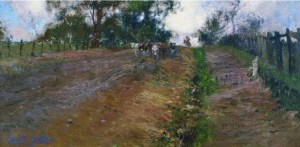
Heidelberg was about seven miles out from the centre of Melbourne, but generally viewed as being ‘in the country’.   There was a road out to Heidelberg by this time built from donations and public subscription lists by the Heidelberg Road Trust , representing the interests of  the gentlemen who lived there (Judge Willis himself, Verner, the Boldens, Wills, Porter etc).  Heidelberg Since 1836 describes the route as:

…an extension of the great Heidelberg Road, which commenced in present day Smith Street Collingwood, winding through the Edinburgh Gardens and then crossing a ford in the Merri Creek.  The track to the village was approximately along the present Heidelberg Road, along Upper Heidelberg Road, and then branched off down to the village from the top of the hill at Heidelberg.  The road continued on along the ridge of the hill, down to the Lower Plenty and then on to the Upper Yarra.  (p. 12)

heidelbergroad1

By 1842, over 500 pounds of local money had been spent on the road, and log bridges were built at the Darebin Creek and the Plenty River.  Late in 1842 the Government paid the wages of unemployed labourers to clear stones and stumps from the road.  From 1845, as a result of the deterioration of the road, a levy was placed on landowners and a toll was established.

Not that our “woman” (note- not a lady) would necessarily be using the road.  I’m astounded by the distances that even ladies would walk- Georgiana McCrae seemed to think nothing of walking across the paddocks into the city from her house ‘Mayfield’ near the corner of present-day Church and Victoria Streets Abbotsford.  Abbotsford is of course much closer to the city than Heidelberg, but even a lady of one of the most prominent families in Melbourne would be prepared to hoof it through the bush.

This is also a reminder that the “blacks” were not only up-country but relatively close to Melbourne .  In fact, there are fleeting mentions of aboriginal people still visible on the streets of Melbourne itself.  I’m not sure what the significance is- if any- of these two women accosting another woman. Would they, I wonder, have approached a man, who was more likely to defend himself?

References:

C. Cummins Heidelberg Since 1836: A Pictorial History.