Category Archives: Melbourne history

Thomas Wills at Heidelberg Historical Society

For those of us interested in early Port Phillip society, there will be a presentation at Heidelberg Historical Society tomorrow night (Tuesday 9 April 2013) on one of the early settlers of the Port Phillip District.  Thomas Wills (1800-1872) is associated with the Heidelberg district through his purchase of 176 acres in 1840 to the west of Darebin Creek, in what is now Alphington, for 3784 pounds.  There he established Lucerne Farm, a double storey, stuccoed house built of locally hand-made bricks and bluestone.  Richard Howitt, a neighbour described the house as:

delightfully situated on pleasant knolls and slopes.  Seen from the south of the Yarra, with the garden like an English one, the widening Yarra at a distance from it and the gleam of the natural pond near it, partly hidden by trees, the landscape is very picturesque.  Walking in the garden, you see natural birds which have become almost tame, so well are they protected by the owner.  (Cited in Heidelberg Since 1836 p. 20)

Governor La Trobe is said to have been a frequent visitor, and the house was well known as one of the social centres of the district.  Unfortunately, despite its ‘A’ classification, the house was demolished in 1960 as a car park for the La Trobe Golf Club.

Thomas Wills was a J.P. and a founding member of the Melbourne Mechanics Institute in 1839.  He was no fan of the judge’s despite the ‘neighbourly’ connection and he signed a petition against Willis.

On Tuesday 9th April, Anne Marsden will speak to the Heidelberg Historical Society about Thomas Wills.  She was awarded a 2013 Honorary Creative Fellowship at the State Library of Victoria to research the founding committee of the Mechanics’ Institution, which included many of the most prominent Port Phillip men of the time.

The meeting commences at 8.00 pm, Tuesday 9th April 2013 at the Ivanhoe Uniting Church Community Centre, Seddon Street Ivanhoe. Visitors are more than welcome.

Update: I’ve just found five  photos of Lucerne, taken in the 1950s, when it was in very poor condition.  You can see them at:

http://trove.nla.gov.au/version/182142672

There’s other photos of Lucerne surrounded by floodwaters from the 1930s too

Love and death: The Springthorpe Memorial at Boroondara (Kew) Cemetery

On a beautiful 24-degree summer afternoon, where more perversely pleasant to visit than a cemetery?  So off we went to Boroondara Cemetery in High Street Kew, primarily to see the Springthorpe Memorial which I’d seen many times in photographs but never actually visited.

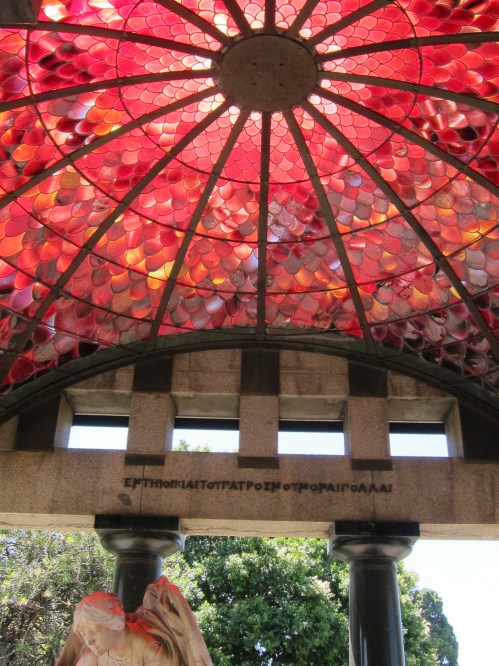
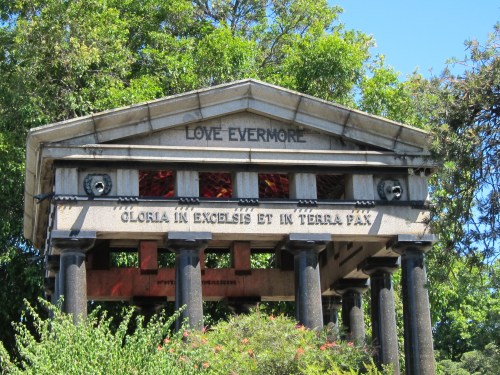
Boroondara Cemetery was established in 1858 as a garden cemetery and, with imagination, you can just sense the Victorian conceptions of death and mourning that underpinned its design.  The original plan, since abandoned, was for curved paths and winding roads, but it nevertheless maintains its rather forbidding red brick perimeter wall, caretaker’s lodge with slate roof and a clocktower, and rotunda.  Its most famous monument is the Springthorpe Memorial, completed in 1907 after ten years’ construction and described in 1933 in The Age as “one of the most beautiful and most costly in the commonwealth”.

It was erected by Dr. John Springthorpe to commemorate his wife Annie, who died in childbirth with her fourth child, Guy, who survived to become a well known Melbourne psychiatrist, following in his father’s footsteps.  Dr. John Springthorpe had arrived in Australia as an infant and had a successful career with positions at the Beechworth Lunatic Asylum, the Alfred and the Melbourne Hospitals. He enlisted during World War I with the Australian Army Medical Corps, and on his return to Australia after the war, worked on post-war repatriation and psychiatric care (hence his commemoration in the name of ‘Springthorpe’ housing estate on the site of the old Mont Park/Bundoora Repatriation hospital). The breadth of his professional involvements is wide: training and registration of dentists, nurses, masseurs, ambulance work, maternal and child welfare. He was very much the clubbable man, and a supporter and collector of the nascent Australian artist scene of the turn of the twentieth century.  It’s ironic, then, that a man who had such a rich life should be best known for a memorial that he created to commemorate death.

As a thirty-one year old, he had married the 20-year- old Annie Inglis on Australia Day 1887 and they moved into a house at 83 Collins Street east- the fashionable, doctors’ end of town.  She was a first cousin to the a Beckett family, and hence the Boyd family who are so interwoven into Melbourne cultural life.  Ten years later she died, giving birth to her fourth child.  Disconsolate with grief, Dr Springthorpe sent his children away to live with relatives, and poured his sorrow into his diaries, transforming his house into a shrine to Annie with photographs and paintings to commemorate their married life, and leaving the house just as it was- even to the blood stain where his wife hemorrhaged to death.  In the days immediately following her death, he turned to the artistic circle of Melbourne and commissioned the sculptor Bertram Mackennel to design

a piece of sculpture, all in white marble, a sarcophagus, richly traced, with certain inscriptions on the sides; on the top, a sculptured figure, as much like Annie as she lay in the drawing room as possible

And here it is

IMG_0163

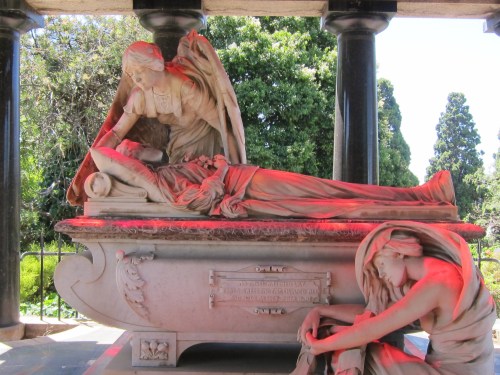
The memorial took nearly ten years to complete.  The roof, made of red glass that bathes the marble in a rosy glow, was designed by Harold Desbrowe Annear.

IMG_0164

The memorial was originally surrounded by gardens designed by William Guilfoyle, the designer of the Botanic Gardens.  Later work on the garden saw the installation of two works by Charles Web Gilbert- my husband’s grandfather (and to be honest, our main reason for seeking out the Springthorpe Memorial in the first place).  One of these was of a brolga defending her chicks against a snake rearing up to strike, and the other of a monk.  Neither of these sculptures have survived, and it is unsure whether they were ever positioned where they were intended.  However, this picture from 1929 seems to show some sort of bird with outstretched wings, and interestingly, the marble figures seem to be enclosed in a glass case.  The gardens were subsumed into the rest of the cemetery when, after Springthorpe’s death, it was found that the transactions for the land had not been completed.

[Later insertion: please see the comments below regarding the further design of the gardens surrounding the memorial by Luffman/Loughman]

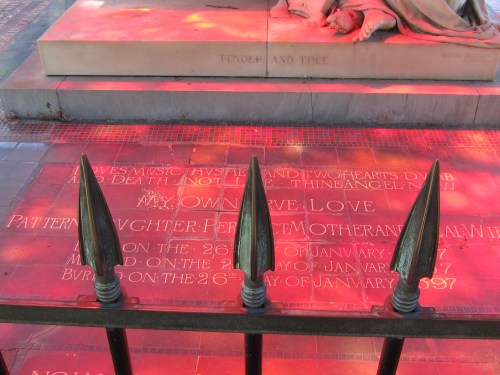
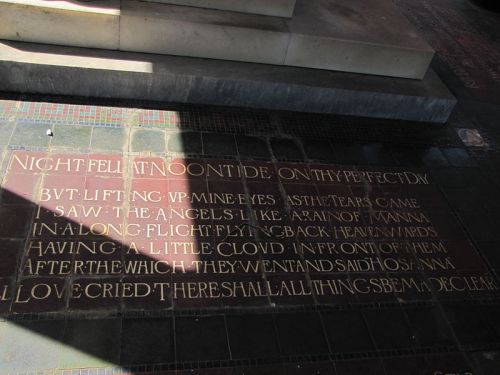
The whole memorial is heavily freighted with symbolic references, including quotations and adaptations from the Bible, the Greek classics, Walt Whitman, Wordsworth, Dante, Browning, Riley, and Dante Gabriel Rossetti.  There’s something just a little bit creepy about the idealization of his wife- especially given that she is not named anywhere on the memorial:

My own true love
Pattern daughter perfect mother and ideal wife
Born on the 26th day of January 1867
Married on the 26th day of January 1887
Buried on the 26th day of January 1897
IMG_0165
It is a memorial deeply engraved by text:
springthorpe_inscription
I found myself thinking of the pre-Raphaelites and their heavy emphasis on beauty and death.  To our eyes today, there’s something rather unhealthy about it all.  Maybe people even then were discomfited by such fervent obsession as well: apparently Mackennell himself warned Springthorpe that the etching of deeply symbolic and overwrought text on every possible surface might be over the top.  The Bulletin concurred:

Turning for a last look, the tremendous monument loads the emotions, insistent, almost blatant, one thinks dully of the dead woman, ten feet below, on whose brow it must press so heavily. Only its artistic beauty, only Mackennal’s consummate genius, could have saved it from descending to the level of a gorgeous advertisement.

The monument cost a huge amount, although it is uncertain what the final cost amounted to with figures ranging  from £4,500 to £8,000-£10,000 bandied about:  in today’s currency, somewhere between $700,000 and $1.3M.
IMG_0178
There’s a fascinating article by Pat Jalland exploring the Springthorpe Memorial as a masculine expression of grief. She wrote Australian Ways of Death. A Social and Cultural History 1840-1918  and you can access her article from The Age here.    And Anne Sanders from the National Portrait Gallery delivered a wonderful presentation on Springthorpe himself and the video and transcript are well worth a look.

For the benefit of Pablo Fanque

I called in today to the Royal Historical Society of Victoria, where they are showing an exhibition called “Melbourne Theatres in Transition: 1840 to 1940s An Idiosyncratic View”. This small exhibition at the RHSV has pictures, programs and clippings relating to Melbourne’s theatre industry from the earliest days of the Port Phillip settlement up to the war years.

In his book London, Peter Ackroyd described the palimpsest effect of multiple reincarnations of the particular urban functions found in cities.  Markets, eating places, theatres, charities often tend to be located in particular places, and are constantly renewed as older buildings and enterprises are replaced by newer ones, offering much the same wares. This is largely true of Melbourne’s theatre district.  Theatres particularly in Bourke Street and Exhibition Street were built, knocked down, burnt out, then replaced again.

My attention was attracted to a small scrap book that had press clippings about theatre in Melbourne.  One unattributed clipping looked back fifty years and described the entertainment at Cremorne Gardens in Richmond to celebrate the first anniversary of the Eight Hour Day.  Among the acts described was ‘Pablo Fanque’.

And all of a sudden, the Beatles’ song  ‘For the Benefit of Mr Kite’ began drifting through my head

For the benefit of Mr Kite

There will be a show tonight- on trampoline

On trampoline/

The Hendersons will all be there

Late of Pablo Fanque’s fair- what a scene

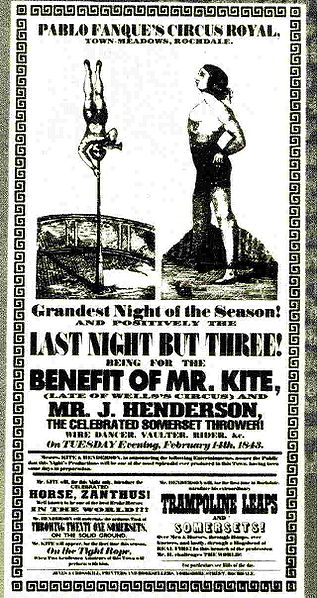
The original circus poster from which the inspiration for the song was drawn.

Pablo Fanque was the first black circus proprietor  in Britain.  He was born in England in 1796 and operated his circus for over thirty years. His own acts included rope dancing and equestrian feats. He toured England , Scotland and Ireland. But did he come to Australia?

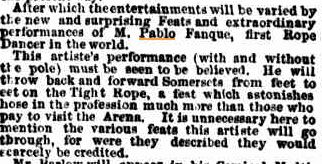
He was certainly advertised as being here….

Advertisement ‘The Argus’ 8 January 1855

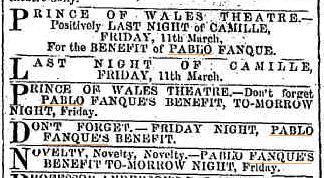
But, alas, it was not THE Pablo Fanque. Instead it was his nephew Billy Banham, who took his uncle’s name and toured Australia and New Zealand in the 1850s and 1860s.  This is the Pablo Fanque who appeared at the Cremorne Gardens (interesting article about the gardens here) and this is the Pablo Fanque for whom a benefit was held in March 1859.

Sydney Morning Herald 10 March 1859

Somehow I think that they really, really, wanted you to attend.

The Melbourne Theatres in Transition exhibition is on at the RHSV, corner a’Beckett and William St until 31 August.  Open 10.00-4.00 Monday to Friday, gold coin donation.

Duelling lads

The district of Port Phillip seems an overwhelmingly Victorian city. [There’s a little pun there, for those of you not familiar with Melbourne, because the Port Phillip District later came to be known as ‘Victoria’.]  Queen Victoria ascended to the throne in 1837, when Port Phillip was in its infancy, and the influx of immigrants which became a tsunami in the 1850s gold-rush, embedded the ideas and mindset of Victorian Britain along with the foundation-stones of many Gold Rush era buildings.  But there is one manifestation of an older, Georgian-era mindset in Port Phillip during the late 30s/early 1840s – duelling.

There had been a late 18th century revival in duelling in Britain, especially amongst army officers.  In 1777 at the Clonmel Assizes a group of Anglo-Irish gentlemen drew up the ‘Clonmel Code’ which comprised 26 rules for duelling. Although it was becoming less popular in Britain in the early decades of the 19th century, it continued in the colonies for longer, especially in Upper Canada, Sydney and Hobart which could perhaps be explained by the heavy presence of army officers in those locations.

It existed alongside, and was often inter-twined with the legal system.  Indeed, lawyers were frequent participants.  It was both a supplement to the legal system, and was supplemented by it, with disputes involving duelling often being played out through placards, newspaper letters and court cases as well.  Hence, while he was serving in Upper Canada in 1828 Judge Willis heard a court case that emerged from a duel that had occurred more than ten years previously, that had been reignited by a letter published in the newspaper.

There were several duels in Melbourne.  One famous one involved Peter Snodgrass (good name, eh?) and Redmond Barry who was later to become Chief Justice, and famously acted as the judge in the Ned Kelly trial.  Peter Snodgrass had been involved in an earlier duel as well.

As Edmund Finn tells it in The Chronicles of Early Melbourne (p. 776)

On the evening of the 1st January 1840, a select dinner-party assembled in one of the club-rooms to bid hearty welcome to the newly-arrived year, and here gathered as choice a dozen of exuberant spirits as could well be found from that day to this. They sat round a table of “full and plenty” where no stint was imposed upon the animal enjoyment of eating and drinking; and after dinner there was no disposition to bring the convivialism to anything like a premature termination, so there they stayed without giving a thought to an early breakup….When the wine, or rather the brandy, was in the wit flew out.  “A cup difference” arose between Mr Peter Snodgrass and Mr. William Ryrie, and heated words and offensive insinuations followed.  Snodgrass was the son of a Lieutenant-Colonel of distinction, and may be supposed to have inherited a martial ardour, which , which he was never reluctant to suppress when any occasion arose to excite it, and accordingly, a circumstance not surprising to those who knew his temperament, he forthwith challenged  Ryrie to mortal combat.  The verbal cartel was accepted as willingly as it was offered…

The shooting match was fixed for daybreak the following morning, on the western slope of Batman’s Hill, now the site of the Spencer Street [Southern Cross] Railway Station, and there was not much time for effecting the preliminary arrangements.

But an unexpected and formidable difficulty interposed…Strange and unaccountable omission! The Club was not provided with such gentlemanly indispensables as duelling pistols; and worse too, it was impossible to procure any in town without exciting a curiosity which might spread the matter abroad, and conduce to its interruption by police or other interference.

What to do?  Then someone remembered-

Mr Joseph Hawdon, of Heidelberg, was the possessor of a splendid case of hair-triggers, which could be got, if only their owner could be got at; but he was enjoying the pleasures of his peaceful home, and that was eight miles in the country.  This was a gloomy and disheartening look-out…Fortunately, there was present a man worthy of, and equal to the occasion.  H-lt-n, Ryrie’s second, had a good horse in the Club stable, and fresh from the “land of green heath and shaggy wood” was an expert plucky rider, as firm in the pigskin as on the solid ground, and jumping up, proclaimed his readiness to ride… to Heidelberg, storm the Hawdon domicile, and either return with the pistols, or never show his honest face amongst them.  The offer was rapturously applauded…

And so off he rode-

Arriving at his destination, the dreaming Hawdon was broken in upon, the pistols obtained, and the eight miles back were thundered over again in a double-quick time never out-paced since.  It was about 1 o’clock when the courier galloped up Collins Street, flourishing a pistol in each hand…

Lack of ammunition was the next problem, again solved by the enterprising second Mr H-lt-n, who sweet-talked the Military Commandant into handing over the needful.  On the way back to the club, he called in on Mr D. J. Thomas the surgeon, who agreed to accompany them.

Every obstruction now removed, the party moved off to the convincing ground, a grassy common on the verge of the swamp northwardly adjoining Batman Hill.  By this time it was clear daylight, as fine and fresh a summer morning as could be decided.  The distance was measured, the pistols primed, and the men placed; but just as the fatal signal was about to be given, Snodgrass, who was always a victim to over-impatience, or ultra excitement on such occasions, so mismanaged his hair-trigger that it went off too soon; so, instead of slaying his antogonist, he wounded himself in the toe, and came to grief.  Ryrie, as a matter of course, could not think of behaving so unhandsomely as to shoot a man down, and forthwith flared up in the air.  Thomas was immediately at work with the wounded patient, who, though literally prostrated, was found to have sustained no serious injury…

And what became of the Hawdon Duelling Pistols? As Garryowen tell us, Hawdon had a contract with the New South Wales government to convey the mail overland to and from Yass.  The pistols were placed in the hands of the first mailman, John Bourke, one of Hawdon’s employees, to be used as a means of defence against “possible bushrangers and probable Aboriginal assailants”.  Garryowen did not know if the pistols were ever deployed, but as Bourke was a good marksman, he was sure that he wouldn’t ‘toe’ himself as the first duellist did.

Sources:

Edmund Finn (Garryowen) The Chronicles of Early Melbourne

Penny Russell Savage or Civilized? Manners in Colonial Australia

Cecilia Morgan ‘In Search of the Phanton Misnamed Honour’: Duelling in Upper Canada Canadian Historical Review , Vol 76, No. 4 Dec 1995 pp 529-562

Crossposted (partially) at BanyuleHomestead because the aforesaid Joseph Hawdon later lived at Banyule Homestead in Heidelberg

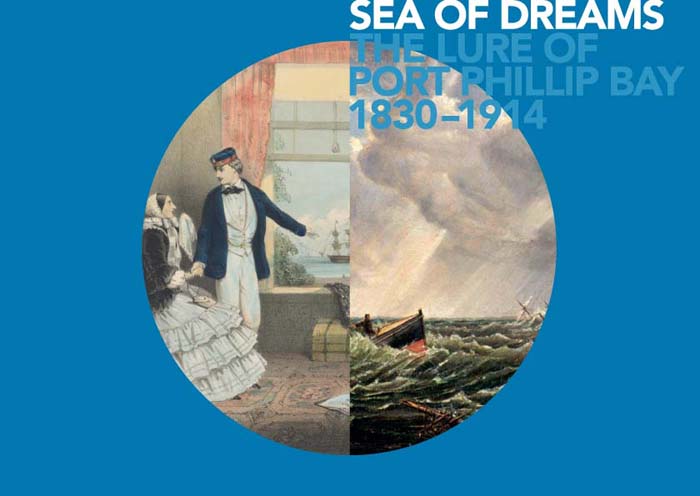
‘Sea of Dreams: The Lure of Port Phillip Bay 1830-1914’ at Mornington Peninsula Regional Gallery

Update 2013

I see that the Mornington Peninsular Gallery will be hosting a follow-up exhibition ‘Sea of Dreams: Port Phillip Bay 1915-2013’.  It will be on between 14 December and 2nd March 2014.  I must try very hard to attend before the closing week this time!

Review of 2012 exhibition

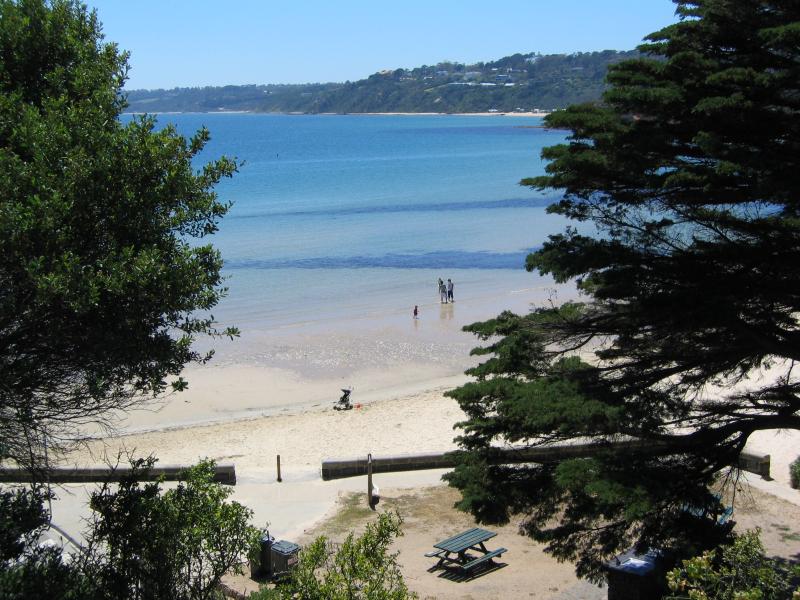
If, like my husband, your appreciation of the beach is best bolstered by being in an air-conditioned building, far from the sand and the water, then you too might like this exhibition at the Mornington Peninsula Regional Gallery.  It’s on until 19 February 2012 so you still have time to get there (just!), have lunch at Mornington, and if you feel so inspired, even walk down to Mother’s Beach, as we did on a beautiful warm summer afternoon.

Source: http://www.travelvictoria.com.au/mornington/photos/

The exhibition has been divided into five themes which highlight different aspects of Port Phillip Bay.  I can hear my uncle Peter reproving me for the tautology, but Melburnians generally call it Port Phillip Bay and I’m not absolutely convinced that a port and a bay are the same thing. (Did you know that it was originally named Port King (after King George)  by Lieutenant Grant? It was renamed Port Phillip by Governor Phillip Gidley King to commemorate NSW’s first Governor, Arthur Phillip “my worthy and dear friend, the Admiral, who, until now has not had his name bestowed on either stick or stone in the colony” [King to Murray, 31 Oct. 1801 HRNSW, iv, p. 602]  Although I wonder if King was being a bit bashful, thinking that people would think it was named after him?).

I digress.  The exhibition is divided up into five themes, which are arranged in different sections of the gallery.  The gallery, which is not large, has a long ribbon of the names of different spots along bay displayed just about the skirting board, spooling  from room to room.  I think that Melbourne people tend to be rather parochial over ‘their’ beach, identifying more with the Mornington Peninsula side or (for me) the other side over at Queenscliff. Seeing the scroll of names brought home to me just how many there are.

The first theme, “Land of Promise” examines emigration- both the experience for the emigrants themselves and for the families they left behind.  As well as emigration literature painting for a British market, it had paintings of the landing at Queenscliff, and a painting that one would hope the “home” audience didn’t see: the wreck of the ‘Asa Packer’ c. 1861 at Point Nepean as it was passing through the heads.  Although not directly related to Port Phillip, there was also a depiction of the wreck of the Loch Ard– after all, who can resist that story?- although I think that it undermined the focus of the exhibition somewhat to include it.

The second theme “Unsettling the Land” examined early depictions of the Port Phillip settlement.  A printed notice on one of the pillars was the Gallery’s response to criticisms that there was no Aboriginal representation of what we know as Port Phillip.  It explained that approaches had been made to the local Aboriginal community to become involved with the exhibition, but no response was received.  It reveals an interesting twist on the politics of depiction of indigenous presence, and the expectation that it will be represented- and what is to be done if the local community chooses not to become involved.   It pointed to the Tommy McRae painting of a corroboree (1890) included in the exhibition, but admits that otherwise the depictions of Aboriginal people in the paintings were executed by white painters.  I found it interesting that George Gordon McCrae, the son of Scottish painter Georgiana McCrae, painted a corroboree at Arthur’s Seat on the Mornington Peninsula in 1844-9 that looked very similar to the indigenous Tommy McRae painting (no relation or contact, despite the similarity of their names).  I had seen quite a few of the early Port Phillip paintings in this section of the exhibition before, but there was one Robert Russell sketch in particular that reinforced how scrappy and primitive that first white settlement on the Yarra was.

“Defending our Shores”, the third theme, highlighted the strategic importance of the Heads and their fortification, but also the ceremonial aspects of military and government display with visiting royalty, and navy and military manoeuvres intended to reinforce sovereignty.

The fourth theme picked up on trade and commerce, especially in the wake of the gold rush.  “Riding the wave” depicts the presence of American ships after the repeal of the Navigation Acts from the mid 1850s, and highlights the activity and wealth generated  around the bay.  Several of these paintings were themselves commissioned as a way of advertising the prosperity of ship-owners and entrepreneurs.

The final theme, “Whiff of the Briny” was perhaps my favourite, with paintings that showed the pursuit of leisure around the bay.  Artwork from different eras is placed side by side, so that you can move from a very detailed, almost draftsmanlike rendering of clothes and ships from the mid 19th century to the adjacent painting that might be a bolder, brighter and more impressionistic piece by one of  the Australian Impressionists. Conder, in particular, painted several works down at Mentone and Rickett’s Point, but other Australian Impressionists are represented too.

So, as is often the case, here I am telling you about an exhibition that is in its closing stages- so if you want to catch it, you’d better go soon!


Frocking up for the theatre

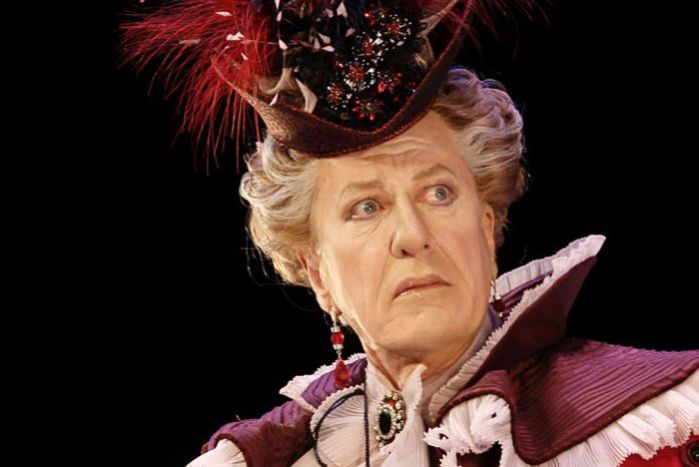
For a little treat the other night (well…a rather expensive treat actually) it was off to see the MTC production of The Importance of Being Earnest.  To get ourselves in the mood we watched Wilde starring Stephen Fry the night before, and sitting in the Sumner Theatre on Tuesday night, I was very much aware that we were laughing away at the same lines, probably delivered in much the same way to the audience at its opening night on St Valentine’s Day 1895.  It was a very traditional performance- no postmodern trickery or contemporary insertions here- and I felt rather overawed to be three rows away from one of the world’s greatest actors, Geoffrey Rush, right here in our shared home town.

What a striking, imperious and handsome Lady Bracknell he makes! (even though I don’t particularly think of Geoffrey Rush as handsome.)  He clearly relished rolling around in  the language, and being so close, we could see every raised eyebrow and every moue.  The rest of the cast was very good too, although if I had to name any criticism it would be at the slightly over-rehearsed delivery of Algernon’s lines. I recall Fry’s character in Wilde issuing the injunction that the lines should be delivered as sparkling, off-the-cuff repartee, rather than something that had been memorized and enunciated, and I think that the same observation could be made here too.

Two odd things about our night at the theatre though.  One was the sight of a very pushy woman, approaching everybody in the front row, asking them if instead of enduring their front row seat, they would be willing to swap with her seat at the back (“See, where the man is waving?”). When someone asked her if there was a particular reason, she said that she liked to be able to see their faces close up- well, don’t we all?  What amazed me was that someone actually did swap with her.

The second odd thing was an email we received a couple of days prior to the performance.  We have just endured a couple of hot days, and the email cautioned that the stage was heavily airconditioned for the comfort of the actors on stage in heavy costumes, and that as we were sitting in the front rows, we might want to bring a jacket or shawl.  It was good advice- it did get chilly after a while.

Patrons might have appreciated advice about their big night out at at Melbourne’s first theatre during the 1840s too.  The Pavilion, later renamed the Theatre Royal, was located on the east side of Bourke Street, between Elizabeth and Collins Street.  Garryowen describes it as:

one of the queerest fabrics imaginable.  Whenever the wind was high it would rock like an old collier at sea, and it was difficult  to account for it not heeling over in a gale.  The public entrance from Bourke Street was up half-a-dozen creaking steps; and the further ascent to the “dress circle” and a circular row of small pens known as upper boxes or gallery, was by a ladder-like staircase of a very unstable description. Internally it was lighted by tin sconces, nailed at intervals to the boarding filled with guttering candles, flickering with a dim and sickly glare. A swing lamp and wax tapers were afterwards substituted, and the immunity of the place from fire is a marvel.  It was never thoroughly water-proof, and, after it was opened for public purposes, in wet weather the audience would be treated to a shower bath. Umbrellas were not then the common personal accompaniment they are now in Melbourne, but such playgoers as could sport a convenience of the kind took it to the theatre, where it was often found to be as necessary within as without. The expanded gingham would of course, very seriously incommode the comfort and view of the adjacent sittings, but that was a consideration so trifling as to be scarcely thought about.  (Garryowen ‘Chronicles of Early Melbourne’ p. 452)

I know that we often complain about people with their mobile phones in the theatre, but there are worse things:

… the Pavilion would at times be turned into a smoking saloon, and even when some of the more mannerly persons in the pit would take off their hats and place them on the floor, the bell-topper, cabbage-tree, or pull-over, whichever it was, would be utilized as a spittoon for shots expectorated with sure aim from the dress circle.  If any of the unhatted individuals happened to present a bald pate, the spot was regarded as a justifiable target for hitting at short range, and terrible would be the indignation with which an unoffending spectator, somewhat sparse in hair, would find himself patted on the bald crown-piece with something analogous to a molluscous substance “shelled” at him from one of the side boxes.  In hot weather or cold the moist application was an unpleasant sensation, and naturally resented. The person so “potted” would pull out his handkerchief, wipe his head, jump up, and “rush the batter” whence he would be probably repelled with a black eye or enlarged nose. (Garryowen, p. 456)

So, are we ready and all frocked up for our night at the theatre? Let’s see …  umbrella, hat, handkerchief….I’ll settle for the shawl or jacket thank you.

‘Pioneers of Bushwalking’ Exhibition at the RHSV

I’m up to my habitual practice of catching an exhibition in its closing days again. This time it is the ‘Pioneers of Bushwalking’ exhibition at the Royal Historical Society of Victoria.  It was officially launched on the 24th of October by that intrepid bushwalker, Tim Holding M.P. and closes this coming Friday 9 December.

Between 2004 and 2010 the RHSV was donated archival material from the Melbourne Walking Club  including photograph albums, maps and archival material. The club was founded in 1894 as a male-only enterprise: a status which it (rather surprisingly)  still holds today, although women are welcome to attend ‘many’ of their events as ‘visitors’.  Early on it encouraged race-walking, and the exhibition shows two Edwardian gentlemen strutting along in that curious gait. However, it seems that a major part of their activities involved bushwalking, particularly in the high country mountain areas.

The photograph albums in particular are fascinating.  They are beautifully presented and labelled, and they document trips particularly in the 1930s around Healesville, Gippsland and the snowfields.  It looks to be a damned uncomfortable hobby, sleeping on groundsheets under the stars, or under tents with do-it-yourself waterproofing.  There’s a curious flavour to the exhibition though- lots of jolly-ho, rather private-boys’-school humour, and an unsettling hint of homophobia in one particular publication discreetly placed on a lower display shelf.

Looking at the names of the stalwart members, I was attracted by the name ‘Chris Bailey’, a now-deceased but well known Ivanhoe resident who was, among many other things, President of the Heidelberg Historical Society and heavily involved in conservation of the Yarra River. My husband noted R. H. Croll, prominent in athletic, literary and arts circles.

I thought of both these men whose names seem to pop up in varied contexts as I browsed the glossy magazine that came with The Age this morning.  It lists Melbourne’s 100 most “influential, inspirational, provocative and creative” people for 2011.  The 100 are arranged by theme: ‘provocateurs’ (the men and women shaking things up around this place); ‘power partnerships’ (when two heads are much better than one); ’cause and effect’ (the people encouraging us to give a little bit- or a lot; ‘social glue’ (Who brings everybody together to make things happen?); ‘bright ideas’ (Why didn’t we think of that?) ; ‘My first time’ (i.e. people’s debut events);   ’20/20′ (twenty inspirational people all in their twenties); ‘global sensations’; ‘changing lives’ (making a difference to people’s lives; ‘music’ and ‘from these hands’ (creative people).  Just flipping through, there is a strong entrepreneurial theme running through them, along with activism, sport, politics,and an emphasis on youth- although that may well just be me getting older!

I wonder what themes a similar list for the early 1900s would emphasize?  I think that early 1900s examples could be found under each of these headings- for example, there would be examples of young men, clever inventions, and provocateurs- but I think that the language to talk about them would have been different.   I’m sure that formal clubs and societies, organized with archives and meetings (just like the Melbourne Walking Club), would be far more prominent than the more ephemeral and individual-based networks that we see today.

The great Great Melbourne Telescope

When I hear the term ‘GMT’, I automatically think of Greenwich Mean Time.  Those of an astronomical bent, apparently, think of the Giant Magellan Telescope, four times more powerful than existing telescopes, and scheduled for completion in 2018.   But there’s another GMT too- The Great Melbourne Telescope, which I heard about at a lecture at La Trobe last week given by Richard Gillespie, the author of a recently-released book of the same title.  And a great little story it is too.

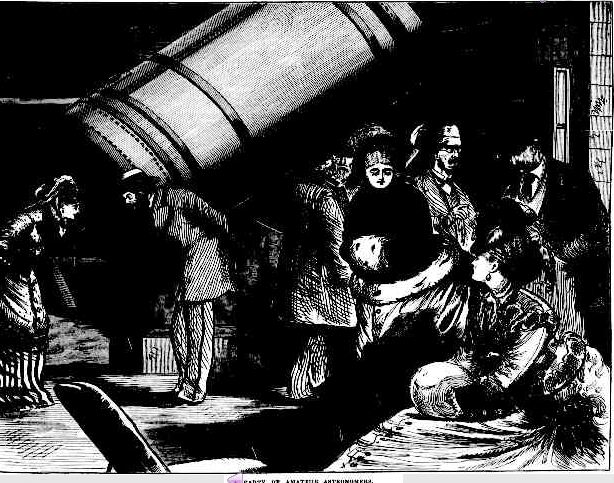
John Herschel, the son of the inventor William Herschel, first turned the telescope to the southern skies at the Cape of Good Hope in 1834-8, and in 1849 the British Association for the Advancement of Science called for a large reflecting telescope to be erected in the southern hemisphere.  Four years later they teamed with the Royal Society to create the Southern Telescope Committee to assess designs and seek funding.   The Cape of Good Hope, Sydney and Tasmania were considered as possible sites, but thanks to effective lobbying by William Parkinson Wilson of the University of Melbourne and support from the Victorian Government flush with post-Gold Rush wealth, the telescope was placed in Melbourne.  It was not the largest telescope in the world- that honour went to Lord Rosse’s ‘Leviathan of Parsontown’ in Ireland until 1917 but it was the second largest telescope at the time, and more importantly it was the largest steerable equatorial telescope, scanning not just up and down but across the skies as well.

It was the pride of Melbourne- and why shouldn’t it be.  The Irish-built telescope opened in a purpose built house in the grounds adjacent to the Botanic Gardens in June 1869. Its close proximity to Government House meant that the governor and visiting dignitaries and their ladies could pop in for a squizz (literally).  A brilliant image of the moon captured by the camera attached to the telescope in the 1870s was distributed to schools, libraries and Mechanics’ Institutes  throughout Victoria.  The “Great Melbourne” referred not only to the telescope, but to the self-image of Melbourne itself at the time as a centre of learning and civilization in an international context.

But technology and invention does not stand still, and other telescopes were devised with superior design and capacities surpassed the GMT.  Its lens became tarnished and by the 1940s the telescope was dismantled and moved to Mt Stromlo Observatory where it formed the skeleton of a new improved telescope, overlaid with new technology and materials.  This updating was an ongoing process and more than half of the original telescope was harvested in 1984 by Museum Victoria as a historical artefact.  The GMT was barely recognizable, visually at least, as the technology that had evoked such pride seventy years earlier.

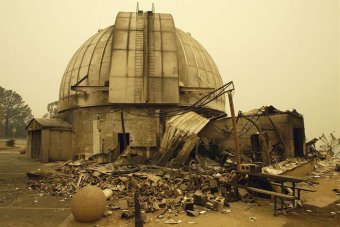
In 2003 the Mt Stromlo Observatory was destroyed by fire, including the cannabalized remnants of the GMT. But,- and here there’s a flush of parochial pride- the fire stripped away all the plastic and modern metal, leaving the original cast iron skeleton of the telescope. Alongside the parts that had been harvested earlier, 90% of the original telescope still exists in one form or another.

The original telescope house still exists on the grounds of the former Observatory side, now part of  the Botanic Gardens.  There are plans to restore the house and the telescope and make it available again to the public which involves a balancing act between restoration and the re-creation of a :century telescope.  They won’t, for example, be using a speculum lens again that caused so much grief and expense in the original telescope.  They’re trying to raise a million dollars- which seems chicken-feed in these corporation days- hence the publication of this book (which I assume will be available at Museum Victoria even though it doesn’t seem to be in the bookshop yet).

Marvellous Melbourne: Queen City of the South

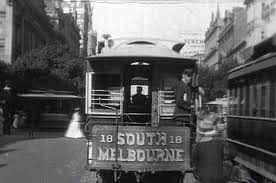
What a fantastic video! A horse-drawn Melbourne c.1910; verandah-ed shops; a stuffed-full museum; Federal Government house; a footy match; cable cars; ships in the Yarra.  I’ve seen snippets of it before, but never the whole thing.

There are certainly worse ways to waste 14 minutes of your life.

Marvellous Melbourne

‘The River’ at Bundoora Homestead

A wet, humid day and nothing to do on a Saturday afternoon so up we went to Bundoora Homestead to see their current exhibition ‘The River’. I’ve written about Bundoora Homestead previously.  It’s a beautiful Federation-era house, well worth seeing in its own right.

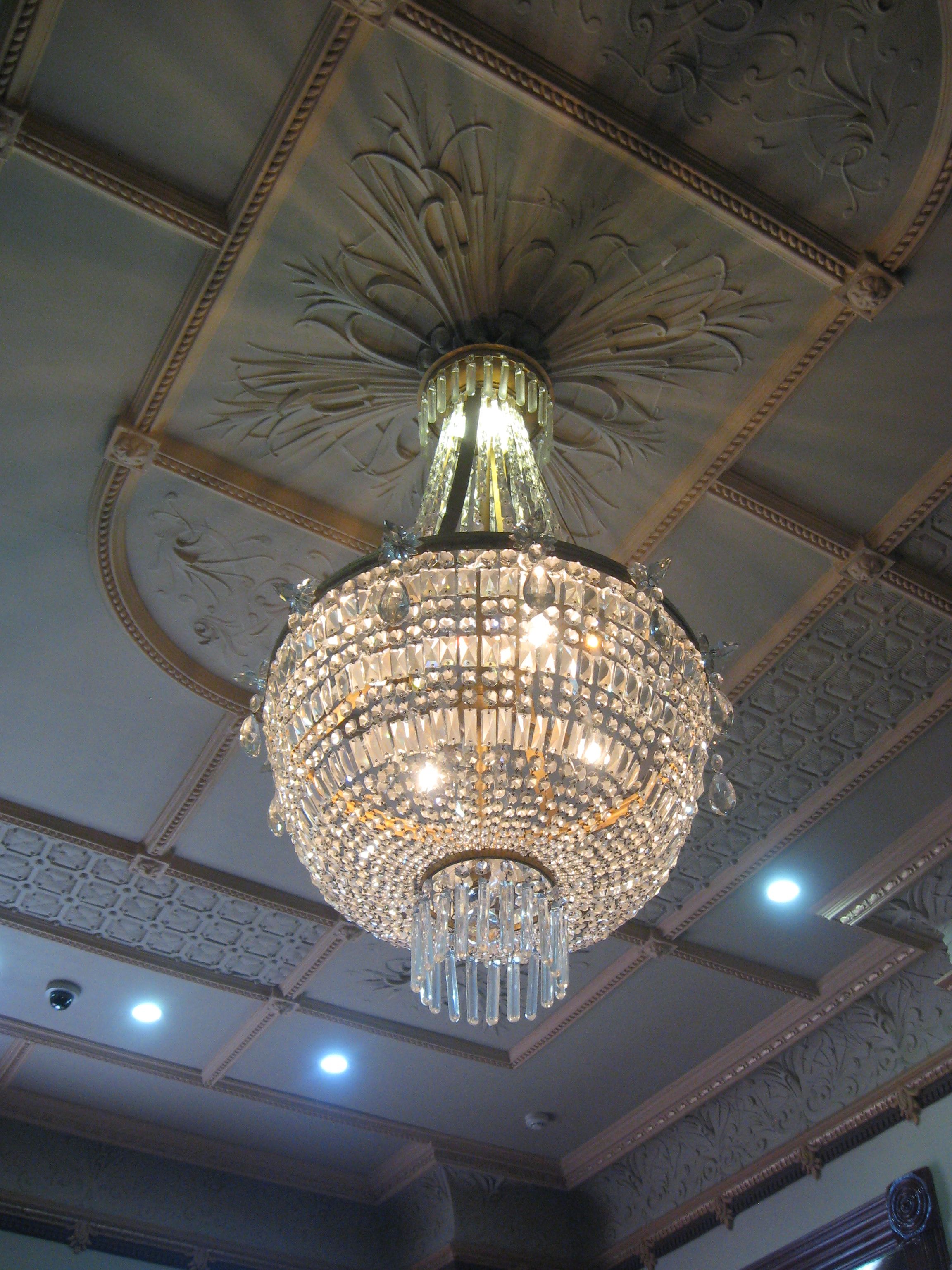
Chandelier in dining room, Bundoora Homestead

Another homestead that was once a gallery, Banyule Homestead, is very much in my thoughts at the moment.  More than ever I realize that if you value a gallery or a library or a museum,  then you need to visit it- you need to walk right through that door and go in.  In the case of Bundoora Homestead, it’s free and it literally costs you nothing: the gain is all yours.

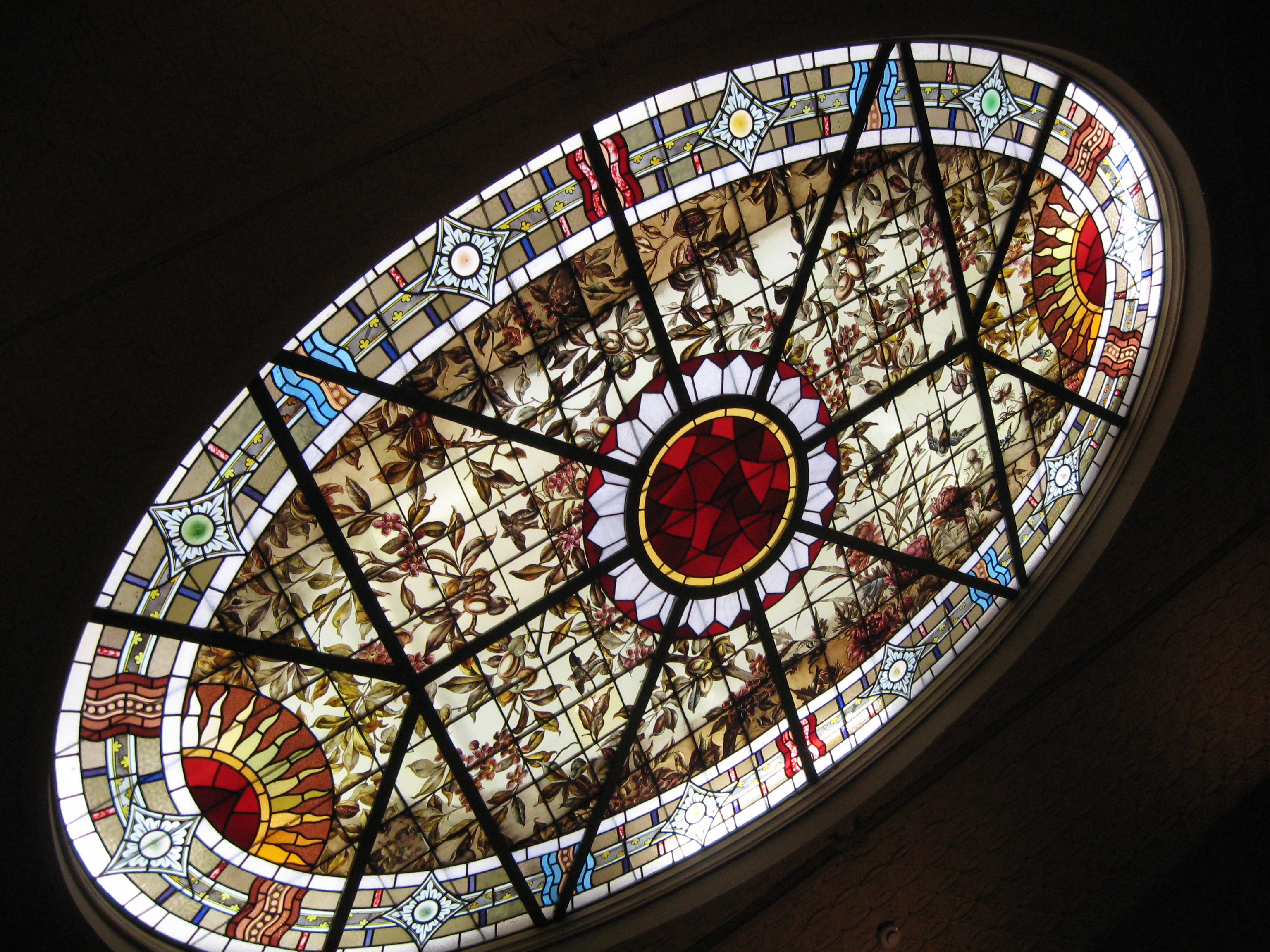
Stained glass skylight, Bundoora Homestead

The current exhibition is called ‘The River’ and it centres on Melbourne rivers (well, creeks) the Merri  and the Darebin Creeks. In recent years of drought these creeks have dwindled to small puddles connected by a fitful ribbon of water.   One of the joys of the recent rains this year has been to look down from a train into the city, as you cross over the creek, and to see the water gushing and tumbling along waterways that had seemed so dismal just a few years ago.

The exhibition contains well-known works, most particularly Burtt’s depiction of the purported signing of the Batman treaty and several Heidelberg school paintings of river scenes around Melbourne, as well as 19th century photographs and engravings.  These are juxtaposed against more recent works on the Merri and Darebin Creeks, including reflections on the ‘treaty’ painting and more surreal and threatening depictions of these urban places.  There will be a lecture panel this coming Thursday 24th November at 2.00 discussing Burtt’s painting.

This is a terrific exhibition. I’ve seen reproductions of the Batman painting before, but not the original, and I was delighted to see Sarah Susannah Bunbury’s painting of her house on the Darebin Creek in 1841.  I liked the sense of fun in many of the modern depictions, and it was lovely to see it in a beautiful suburban gallery, close by to the two rivers featured in the exhibition itself.