Category Archives: Life in Melbourne

A bloke I met last Saturday

Last Saturday morning I decided to go down to the shops to buy bread rolls for lunch.  The weather forecast was for horrendous conditions that afternoon, so I thought I’d nip down before it got too hot.  The shops are only two blocks away, and I decided to walk rather than worry about the car, even though it really was pretty hot- I was glad of my daggy hat and found myself walking in the shade when ever I could find it.

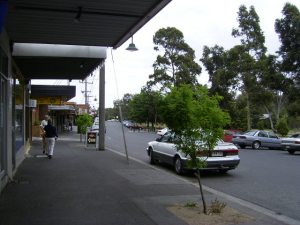
Macleod shops a few years ago

Macleod shops a few years ago

“Down the shops” is a little strip shopping centre, overlooking a large park.  It’s old-fashioned, but has everything there-  a baker, butcher, fruitshop, one  hairdresser, 2 milk bars, small grocer, one restaurant, one coffee shop, and a couple of gift shops.  I stopped at the gift shop- they’d redone their window display and then I noticed that it was under new management as well.  The window looked beautiful- really tastefully laid out with things that made you look twice and check out the price- quite reasonable too.

There was a man in overalls, reaching up across the door.  I didn’t know if he was a workman or the owner.  “Doesn’t the window look great?” I said.  “It’s my wife’s shop” he said, “we only did the display last night”.   They’d bought the business before Christmas, he said, but had only just opened up a room upstairs and at the back.  “Well, tell your wife  it looks great” I said, then headed up to the bakery.

The man is dead now.  So is his wife.  Their photos were on the front page of the Age in a montage of photographs of people who died in the bushfires.

I don’t know this man- he was just someone I spoke to that morning.  There are people who know him, them, and love them: I’m just someone who passed by the shop that morning and passed a quick greeting.   I can’t believe that they worked that morning; he fixed the airconditioner or door closer or whatever it was that he was fiddling with; they shut up the shop at 1.00 and then they went home for the last time.

Perhaps it’s because I live in the north-east suburbs that many of these outer-suburban people commuted to, but this is hitting hard.  A woman who worked where my husband used to is dead- in the photo she’s leaning over her son at his 18th birthday last Thursday, smiling into the camera.  A colleague at work has lost his house; a fellow student escaped with his laptop and thesis from a house that is now destroyed.  Everyone knows someone, or knows of someone.

I was looking at messages in the paper from other places in the world- I am praying for you; I am praying for you.  Even Barak Obama is praying for us.  I wish there was another word than “praying”.  I’m not praying: I think of them often; everyday things seem inconsequential, irrelevant and even blasphemous;  I hear the helicopters go over- there’s one just now- and realize with a shock that even though it’s quite cool today, the fires are still flickering; I  flip over to the weather forecast and see with some trepidation that the wind will shift round to the north and the temperature go back up into the low 30s early next week.   I realize that we are not immune from another day or days over 40 degrees again in 2 or 3 weeks time, and that it won’t be Marysville, Strathewen or Kinglake this time but somewhere else.

I’m not praying, but there’s a stab each time I think of all this loss.

The politics of grieving

There was a letter by my colleague Patrick Wolfe in today’s Age:

Cuddles not required

MY HOUSE was on 4.8 hectares of bush outside Healesville, above Chum Creek. It went up in flames on Saturday. There’s nothing left but some unusable steel framing and a cracked concrete slab. Friends, neighbours, family, colleagues, strangers have all been wonderful. Alongside the sadness and the not knowing what’s going to happen, their humanity has been truly uplifting.

I wasn’t impressed to see the Prime Minister cuddling a crying man on camera. If he’d come across me while I was crying, I would have resisted his embrace, especially if the media had been present.

I don’t need a public show of empathy from the Prime Minister. I need him to do something meaningful about climate change so that fewer of us will have to lose our houses, our animals and each other.

Prime Minister, unless your Government seriously commits itself to a carbon emission reduction target of at least 50 per cent, and within the next 20 years at the longest, then you can keep your arms to yourself.

Patrick Wolfe, Healesville

I, too, saw the footage of Kevin Rudd trying to hug and console a man who had lost his house- and who knows, maybe more- in the bushfires in Victoria this weekend.  What an awkward embrace it was- the small politician reaching up over a huge, broken block of a man, and as I saw it I hoped that it wasn’t just a response to the politician’s antenna for a photo opportunity.  I want to believe that it wasn’t.  His hollow-eyed, tentative piece to the camera later suggests that perhaps it wasn’t, too.

And I watched Julia Gillard, the deputy Prime Minister giving her short, quavery speech in Parliament- and yes, it is beyond words.  But words, words we got from Malcolm Turnbull in response (on the same link as Julia’s) – crafted and polished words, which had no doubt gone through the same drafting process as Gillard’s had, but too many of them, on and on, delivered as a performance fit for the stage or courtroom.  Oh, just shut up.  It is beyond words.

There’s time enough for blame and recrimination and politicization- I note that the same Letters page of the Age made the jump from the fires to the north-south pipline.  But, like Patrick,  I want bigger questions- and responses- to come from this.  I don’t want to experience 50 degrees, I don’t want February 2009 to be followed by January 2010 and February 2011.  I don’t want to see my bush, my coastline, as hostile forces.

Some time ago I read a book by T. C. Boyle A Friend of the Earth , set in 2025 when the succession of ‘extreme weather events’ made insurance impossible.    Only now 14 years away,  Boyle portrayed a world clearly recognizable as our own but where pride in architecture and structures was abandoned after floods, fires and cyclones had rendered rebuilding and refurbishment uneconomic  and pointless; and where the concept of either governments or private companies providing and maintaining infrastructure had become unsustainable.  They were a people cowed, defenseless and belligerent towards an environment that had turned on them.  How many of the people  burnt out this past weekend will go back to their bush blocks?  How many other people, unnerved by the knowledge that next weekend, or the weekend after, it could be them and their house, will decide to move out into the relative safety of suburbia.

I want my government to stand up to the energy and water lobbies.  If there are to be subsidies for solar power at all, then I want it to be for a meaningful, worthwhile contribution to the power grid.  I don’t want my action to be a free kick for the coal producers when they snaffle up my solar output in carbon trading permits  to allow them to pollute even more.  I don’t want a water desalination plant that itself gobbles up even more coal-based electricity, and I don’t want to be fobbed off with tree-planting schemes.  If I do put in a tank, I don’t want the government two years down the track to capitulate to the privatized water supply companies and ban their use on ‘health ground’ because they need to guarantee return on investment for plants and pipelines.

The news that it’s now 173 people dead, with fears of the toll rising up to 300 makes every day things seem insignificant.  The financial stimulus package? Who cares… put it towards the bushfire communities.   The launch of Underbelly… the greed and avarice and ego of scum.   My bookshelves that took days to arrive much to my rather pointless chagrin and consumer-blustering…inconsequential. Jessica Alba’s weight loss secret…not worth commenting.

Bushfires

Australia Felix, as Victoria used to be designated, is in shock and disbelief at the loss of life and property in the bushfires over the weekend- 103 lives lost and still counting.  Shock at the sheer numbers;  and disbelief, at least sitting here in the north-east suburbs of Melbourne that all this destruction was occuring in areas that we might drive through on a leisurely Sunday afternoon drive less than fifty kilometres away.  It’s a cool morning: there’s not even a whiff of smoke on the air; the sky is clear; the sun has none of that sullen reddened glow that indicates that there’s fire somewhere.

The people of Port Phillip in the 1840s would have been aware of fires, but not fires of the magnitude we’ve seen this past weekend.   Most reports of fire  in the Melbourne newspapers of the early 1840s  related to house and shop fires fires within the town boundaries. For settlers further out, fires started through lightning or were lit by the aborigines either as an act of depredation against a particular settler, or as part of  land and food management.  Looking through my summaries of two years of the Port Phillip Herald, I can find only two mentions of bush-fires – both in January 1842- and interestingly both involve the natives.   The first report was of a fire at Port Lincoln in South Australia, which was caused when the Resident Magistrate there asked the natives into town at the full of the moon to receive rations of flour; some arrived with fire-sticks and a fire was started, although it was not clear whether the fire was accidental or not.  The second report, also in January 1842, made a correction to earlier reports that the blacks at Mr Bathes’ property in Westernport had fired four acres of barley and fencing.  In fact, instead of causing the fire, they had tried to extinguish it, and chief Gellibrand in particular was singled out for conducting himself in the most praiseworthy manner.

Bushfire seasons come and go- I can, for instance, remember driving with my mother up to Warrandyte in 1962 to collect my father who had been working on fire-breaks with his earthmoving machinery in the fires there.   Every time I drive past Lara on the way to Geelong, I remember the people who died in their cars on the Princes Freeway in 1969. But every few decades in Victoria, there are huge, state-wide conflagrations of a completely different magnitude.  This weekend was such a conflagration.

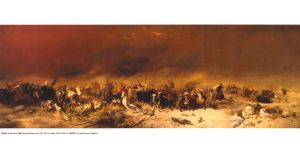
When reading through the newspapers of 1840s Port Phillip, it is instructive to remember that  for white settlers, this was a new colony, and the vagaries of temperature, rain, snow, bushfire were still largely unknown.  Black Thursday on 6 February 1851 was the first recorded widespread blaze,  covering a quarter of what is now known as Victoria including Portland, the Plenty Ranges, Westernport, the Wimmera and Dandenong districts.  Twelve lives are recorded lost, along with over a million sheep.

struttblackthursday1

People of my parent’s generation still speak of  “Black Friday” of 13 January 1939, the day that until last Saturday held the record for the highest recorded temperature.  My father recalls seeing the ranges surrounding Healesville silhouetted with fire; just last week I was speaking to someone who  mentioned that her mother, having just given birth, was wheeled out onto the balcony of the city hospital, from where she could see the Dandenongs alight.  Seventy-one people died in the fires which devastated Noojee, Woods Point, Omeo, Warrandyte and Yarra Glen.

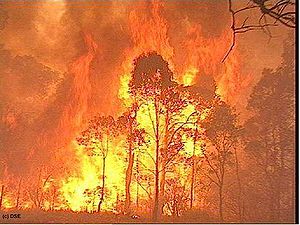
300px-ashwednesday1

And then Ash Wednesday, 16th February 1983- well within my memory.  A few days earlier there had been a huge dust-storm that rolled across Melbourne, then Ash Wednesday itself.  I recall watching, transfixed, the unfolding disaster on television, hour after hour, then walking out into the front garden in the dark with the sky glowing, ashes falling, and wondering if the whole world was going to combust.

And so, onto this last weekend.  On the Friday night, after a day of about 30 degrees, we watched the news where authorities were warning of extreme heat and fire danger on Saturday and worst bushfire conditions in Australia’s history.  It was difficult to believe- it was still with no breeze at all, and not unduly hot.  But, oh, things are so dry: Melbourne has been in drought for many years and has had the second-driest January rainfall figures on record- just one millimetre of rain compared to a January average of  48 mm.   The Saturday itself was oppressively hot, reaching the highest ever recorded  temperature of  46.4 degrees.  When you opened the door, it was like opening a fan-forced oven with the rush of dry heat and wind.  The wind got stronger and stronger with trees bending, dust whipping, but there was still no sign or smell of fire.  We did notice a large, towering white cumulus cloud to the north, but by then it had clouded over, and we thought that it must have been a storm cloud. Then, at about six o’clock, the cool change came through- even a few spatterings of rain.  We went to bed aware that there were still fires, that there were fears that what had been the fingers of the blaze would become the palm of the blaze on a much wider front once the wind swung around, but that perhaps it hadn’t been quite as bad as they predicted.

By the next morning, things had changed completely.  Fires that we hadn’t even been aware of, at Kinglake, at Marysville had wiped out the towns; 27 dead, maybe 40, then 65, then 93 and now over 100.   These are much-loved places.  Kinglake, some 20 kms away was where we had a camp every year in my long-ago born-again Christian days; I fell off a motor-bike there and still have the scar on my ankle; I drove there at about 50 kms a hour in my old Morris Major with a couple of girlfriends as my first foray as a new driver on country roads.

Marysville, home of all the Mary-guesthouses (Marylands, Mary-Lyn etc) built in the 1920s in mock-tudor style and the prettiest little main street with huge deciduous trees, with a crystalline creek  fringed with tree-ferns running through it.  We went there for September holidays at Marylands when I was a child in the 1960s;  I’ve camped beside the Steavenson River;  walked through the bush bird-watching,  my husband and I went there about five years ago, stayed at a guest-house,  ate at the pub, visited their historical society.

marysville

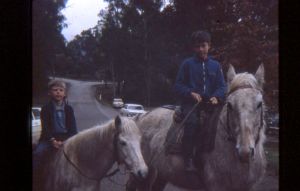
My brothers horse-riding at Marysville, 1960s

And St Andrews- famed for its weekend market; Sunday lunch at the pub.    Chum Creek near Healesville- my father spent a couple of years up there in the 1930s/40s with his grandparents, attended the primary school,  lived through bushfires there, battled the blackberries and bracken there.  I wonder if his house is still standing?

There’s grief, disbelief, and a degree of helplessness about it all.  In recent years there’s been a change of attitude about staying to defend your house- they no longer force people to evacuate, but encourage householders to develop a fire-plan of clearing around their houses, dealing with ember attacks, wetting down the house etc.  The common wisdom is to evacuate early if you’re going to leave, or else stay and defend a well-prepared house from fire after the main front has gone through.  People know all this;  the whole state was in a heightened sense of readiness, fire-plans were made, people were ready to stay and defend and yet, in the middle of the noise, smoke, heat obviously the fear is just too much to bear and people flee.  There’s much more sadness to come.

Heat wave!

hot

You may be aware that Melbourne is undergoing a heatwave at the moment- in fact, a record breaking heat-wave with three consecutive days of temperatures over 43 degrees (that’s 113 degrees, folks).   We’re having electricity brown-outs, bushfires and the public transport system has collapsed completely.  And boy, are we complaining!

So it was rather fitting that last night I should be sitting reading through the Port Phillip Herald for 24 January 1843, when I found this little snippet in the court report:

McLaren v Chisholm.- His Honor, on this case being called, enquired if it would be long, for he was so overcome with the heat, dust and wind, as to doubt whether he could bestow upon it that strict consideration which its importance required.

This is one of the very few newspaper references that I have seen to extreme heat, which surprises me somewhat.  There was a mention that the courthouse in early Port Phillip  (seen at the top of the page) was stiflingly hot in summer and freezing in winter, but rather more was made of the brazier resembling a chestnut stall that Judge Willis used to warm himself by than any attempts to alleviate the extreme heat.  Much attention is directed towards flood and mud, which seems to be a constant topic of conversation.  But heat, which surely must have been unfamiliar to many emigrants,  does not seem to be particularly noteworthy.

The early newspapers do not have a regular weather report, and  meteorological records only began to be kept in 1855.  The tides and phases of the moon are given in the newspaper and would have been more useful information in a port-based town with no street lighting beyond that outside hotels.

Diaries, on the other hand, seem to be an ongoing chronology of the weather.  Georgiana McCrae, for example, gives us a running commentary of the temperature which she could obviously measure by thermometer:

November 1st 1841. A fine clear day.  Completed my small needlework.

2nd. Hot wind- then thunder with rain.  At noon thermometer 85 degrees, and all night at 72 degrees.  The closeness of the house and the heat of its wooden walls quite stifling.

However, perhaps this interest in the temperature had a novelty factor for her in 1841 as a newly-arrived immigrant that had worn off by 1843.     She doesn’t mention the weather at all on 20th January 1843, the day that Judge Willis complained of, but she did note “A hot wind” on the 17th, and noted that the 21st was an “oppressively warm day” with “a hot wind” again on the 25th.

Were people more stoic then? They must have been.  Judge Willis was sitting there in his wig and gown; no doubt his bar was similarly attired; women were covered and corsetted. Yet the weather- or more properly, hot weather does not seem to be newsworthy.  Try telling that to our newspapers- particularly our more tabloid Herald-Sun that somehow managed to make a whole front page out of this picture with 43 degrees superimposed over it!

hot2

Yep, that’s news.

Things that make me laugh #1 for 2009

Surely the shiny new padlock isn’t necessary?

sillsbendjan2009

A day at Sills Bend

sillsbendjan2009-002

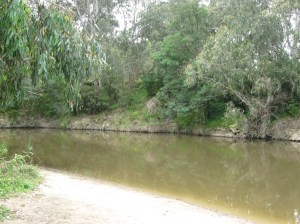
One of my favourite places to take a deck chair, picnic, glass of wine and good book on a warm afternoon is down to Sills Bend, beside the Yarra River in Heidelberg.  I’m a Heidelberg gal at heart, and down at Sills Bend I feel particularly close to the early settlers, including the Resident Judge Willis, whose rented property was on the ridge overlooking these river flats. As Alexander Sutherland was to describe it in 1888,

Heidelberg was scarcely a suburb; it was rather a favourite district for those who desire to have ample domains around their dwelling.  Until 1850 it was regarded as the distinctly aristocratic locality; the beauty of the river scenery, the quiet romantic aspect of the place, gave it an early reputation among the Melbourne men of means as the site for country residence – Alexander Sutherland Victoria and Its Metropolis 1888

The land that is now Heidelberg was offered for sale at the first land sales, conducted in Sydney. The fact that the sales were held in Sydney, meant that unless locals or their agents were prepared to travel up to Sydney, then most of the sales were to Sydney investors.  Thomas Walker, the Scottish investor, purchased several of  the available lots.  However, as is usual in land boom conditions, the estates changed hands several times in a short period of time.  And why wouldn’t they- prime land, water access through the Yarra, Darebin and Plenty rivers, and all within ten miles of the centre of Melbourne.

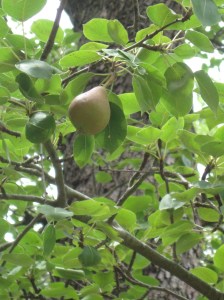
The river flats, with a good source of water were turned over to tenant farmers like Peter Fanning (1827-1905), who farmed the next bend of the river (Fanning’s Bend) , or subdivided from the larger estates and sold as small holdings to farmers like Mark Sill (1818-1885) who planted an orchard.  Several of the pear trees are still alive.

sillsbendjan2009-006sillsbendjan2009-007

The gold rush had little effect on Heidelberg beyond stimulating market gardens and agriculture to supply the increased population moving to the diggings at Queenstown (St Andrews) and Warrandyte. However, during the 1860s there was a succession of ‘droughts and flooding rains’ that made sustainable farming very difficult.  As the agent for the Banyule Estate, James Graham wrote on 12 January 1865

I am quite concerned about the low rents from Banyule area the tenants are doing no good. What with this very dry season and rust and caterpillars, the crops are very poor indeed.  Fanning is both losing money and rent altogether and he has been at me several times to let him off the lease. He had worked hard poor fellow but I see and I know that he is losing money.  His wife is in very bad health, which helps to make matters worse.

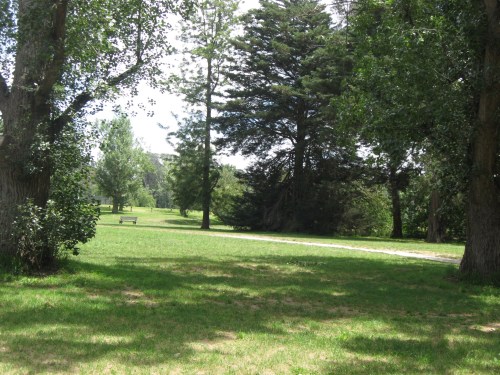
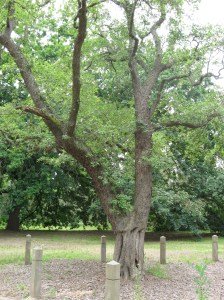
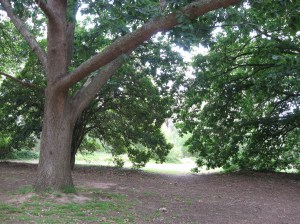
The dominance of English-style estates around the Heidelberg areas means that there are quite a few stands of oak and hawthorn trees.  The oak trees down at Sills Bend are spectacular, with branches that reach right down to the ground.  There’s a little beach (very little) down on the Yarra bank

sillsbendjan2009-008

sillsbendjan2009-013

The small size of Heidelberg militated against the provision of infrastructure like water and rail, which in turn hampered growth.  It was really only with the Depression of the 1890s that the large estates began to be broken up.  Land subdivision progressed in a piecemeal fashion right up until the 1960s.

So, Melburnians, when you read of the “missing link” between the Western Ring Road and the Eastern Freeway, look very carefully at what is proposed when they start talking about the Bulleen option.  You might want to join me on the barricades.

References:

Don Garden, Heidelberg: The Land and Its People

Plaque at Sills Bend

Happy New Year!

nyeve2

Well, New Years Eve in Melbourne came and went, as it always does, last night.  Many police in the city, and just a handful of arrests apparently.

(Update: Well, more than a handful.  The Age today reports that there were 1147 arrests across the state, double that of New Years Eve 2007 when there were 511 arrests.  “The tougher stance produced ‘the quietest New Year’s Eve on record’, with no repeat of the riots that marred past New Year’s Eves at Rye and St. Kilda.”  136 people were taken off the street for offensive behaviour, indecent language and minor assaults, and 485 motorists were booked for a range of traffic offences, well up on 248 last year).

What about in Port Phillip in 1841?  Here we are, in the Port Phillip Gazette of 1/1/41 in the Police Intelligence column- where else?

POLICE INTELLIGENCE. William Porter, Charles Aldgate, David Holmes, John Walsh, John Percival, Charles Major and Richard Bennet were driven into the box like a flock of sheep, having been found suffering from the effects of the season.

Bench: Well, what have you to say?

Chorus: Christmas, Your Honor, Christmas!

Bench: Silence! We neither countenance nor approve of drunkenness, but making a little allowance for the season, we discharge you all

Chorus: Thank you, Your Honor: hurrah! a merry Christmas and a happy new year!!

The Port Phillip Patriot was a little less charitable about the lads hauled in a couple of days later:

The first day of the year 1841 must evidently have been auspicious to the publicans of Melbourne if we may judge from the number of persons, amounting to twelve who made their appearance at the bar of the Police Office on Saturday morning.  Nor was the offence confined to the male kind solely, one female being charged for the fifth time.  If we may judge from appearances, we should say that the potations of many were not pacifically concluded, the physiognomies of many bearing sanguine and sable traces of having done battle ( Patriot 4/1/41)

Given that Christmas seemed such a fizzer, I thought I’d look up to see if New Year was celebrated with any more gusto.  I checked out the chapter on Christmas in Ken Inglis’ Australian Colonists (1974) to see if my hunch about the relatively low-key, domestic nature of Christmas was sound.  He took a wider chronological sweep than I did and so includes information from later in the century (as well as the sources I found) but he  did note the prominence of New Year. He speculated whether it was the influence of the Scots and their emphasis on hogmanay but was aware of the relatively low proportion of Scots in Australia generally. However, there were proportionally more Scots in Port Phillip (40%)  than elsewhere in New South Wales (30%)  so perhaps that explains why the extended pieces I found on Christmas came from Sydney and South Australia respectively, rather than Port Phillip.

Inglis writes of Australia as a whole:

Here as at home the new year was welcomed with church bells, and people resolved to do and be better for the next twelve months.  Governors held levees, citizens played or watched games, went for picnics, listened to bands.  From the first years of the settlement it was customary for men to stay in towns, to stay out late carousing and larking, lighting bonfires and fireworks.  (p. 113)

The Port Phillip Gazette celebrated New Year by presenting its town subscribers with “an engraving by our late talented and eccentric friend John Adamson” which although falling short in conveying the size of Melbourne, “will help to convey to distant friends the position, appearance and style of the town of Melbourne.”  I think you can see the engraving here. All three papers made much of the coming of 1842,  far more than they did in 1843 when the depression was obviously biting and press columns were preoccupied with elections and politics.  All three papers in 1841/2  indulged in a bit of backward-gazing self-congratulations and worthy and jovial exhortations for the coming year, but there was none of this the following year.

So, what was there to do on New Years Eve and the following New Years Day in that party-year 1842?  On New Years Eve, you could have gone to a concert at the Pavilion

The concert held on Saturday evening last to welcome in the new year, was numerously attended and came off with considerable eclat. Although, as might have been anticipated at the season of  general jubilee, a number of rather suspicious characters were loitering about the Pavilion, many of whom endeavoured to obtain admittance, yet they were very properly excluded, and in consequence, if those favored with an entre were not all of the upper ranks of society they were respectable and conducted themselves with the greatest propriety.  The evening’s entertainment was, upon the whole, little, if any thing inferior to any similar display in the colonies and if equal attention for the future be paid to the general arrangements by the Manager, and the performers exert themselves in an equally laudable manner for the gentrification of the audience, the Pavilion will soon be a most fashionable place of resort as it is as yet the only one of rational amusement.  The “star” Miss Sinclair, fully realized the most sanguine anticipations, she has an excellent command of a good voice, and with a little more practice her success as a vocalist is certain.  Her “Kate Kearney” was sung with a spirit and national feeling which told she was at home in giving effect to an Irish air.  Miss Lucas’ “Meet me by moonlight” was good, but it was evident she labored under the effects of a bad cold; but although in consequence she had been previously recommended to resign her part, she preferred making her appearance to disappointing her previous admirers. Master Eyles’ performance was generally good, but the concluding part of the “Bay of Biscay” was excellent and promised well for future fame.  Mr Miller, as a comic singer, would not disgrace the provincial boards of the first class in Britain, and was no better received than he deserved.  In all his actions he was happy, but particularly in “Biddy the Basket Woman”.  To supply the hiatus in the performance caused by the necessary retirement of Miss Lucas, an amateur entertained the audience with a variety of dances, expert gesticulations &c. and deservedly stands a favourite.  Port Phillip Herald 4 Jan 1842

The next day, you might have attended a cricket match where “a party of civilians were duly stumped out by their opponents the government officials”. But it sounds as if THE place to be was Williams Town beach, attracting crowds from Melbourne arriving by steamer with bands playing, and spilling onto the beach to enjoy sail boat races, whale boat races, sack races, footraces,  shimmying up a greasy pole, blindfold wheelbarrow races and a greasy pig chase.

williamstown

At 1.30 a free lunch was served for 200-300 people- sheep, beef, cabbage- (mmm, mmm) accompanied by the popping of corks and music.  The crowds had all melted away by 6.00 when the town worthies had their own, more select gathering of fifteen gentlemen who sat down for a much more dignified dinner.

Of course, if you were of a more spiritual bent, you could have attended the opening of the Independent Chapel on Eastern Hill- a building that could accommodate 500-600 people, splendidly lit with chandeliers.

And so, “Thus ended the amusements of a New Years Day in Australia Felix”

References:

Ken Inglis  Australian Colonists

A. G. L. Shaw The Port Phillip District.

The Yarra in flood August 1842

img135-correction3

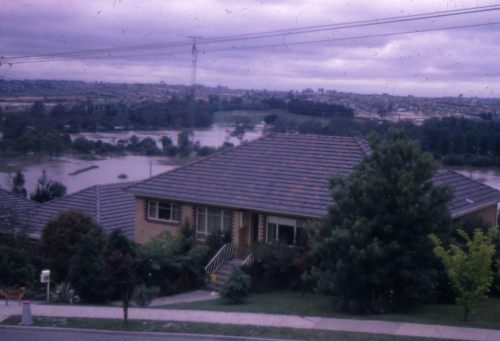
View from Dalvey Street Heidelberg showing Yarra in flood

It’s been a long, long time since I’ve seen the Yarra in flood.   As a child, we lived in a house on top of the hill overlooking Warringal Park in Heidelberg.  Justice John Walpole Willis- the first resident Supreme Court judge-  would have walked around our very site because that is where he lived (and hence my first spark of interest in him).  We could always see when the Yarra flooded from our front garden, as you can see from the photo above, taken probably in the late 60s-early 70s.   I can remember the school buses having to slosh through the floodwaters to get to my now-demolished school, Banyule High School.

The Yarra has always been a focal point for the village of Melbourne.  It was the availability of fresh water above “the falls” at the bottom of William Street that determined the location of the settlement.  It’s been a major transport route to Port Phillip Bay; it’s been an industrial sewer; it’s still used recreationally (although I wouldn’t swim in it), and it’s now the site for the casino, exhibition centre, restaurants etc.

Until it was so heavily dammed and flood mitigation works completed, the Yarra used to flood quite regularly.   Although the worst flood was in 1891, the last great flood was in 1934. My father, who lived in Hawthorn, recalls the houses beside the river being flooded up to their roofline, and seeing the four legs of a dead horse being bashed by the floodwaters against the top of  the Wallan Road bridge which only just escaped inundation.

The first recorded flood of the Yarra River was in 1839, but Judge Willis would have also seen the flood in August 1842.  Here’s what the Port Phillip Herald of 2 August 1842 had to say:

During last week, owing to the very heavy rains of Monday and Tuesday, the Yarra has risen to a height altogether unknown to the oldest resident, and overflowed its banks, inundated the wharf, and substituted one sheet of water on the other side of the river for the green grassy fields, which [indistinct] that locality have hitherto opened up to view and even the new road from the Beach to the bridge, which, it was supposed, from its elevation, to be free from inundation, was flooded in many places.

Mind you, “the oldest resident” would only have been in Port Phillip for seven years anyway, so this is no great claim.  In an interesting twist on public memory, the Port Phillip Herald of 6th September 1842 reported that the aborigines of the town designated this particular flood as only a ‘picaninny’ with worse to come, and indicated that a flood about twenty years ago had flooded the area occupied by the Market Square.  The elevated, but flooded road was being built by the labour of unemployed workers as part of the limited public works program.

On Sunday crowds of the inhabitants were to be seen promenading on the new wharf looking with intense interest to the breakwater overflowing in rushing torrents, in humble imitation of the falls of Niagara.

Very humble imitation , I’d say.  The “falls” were not particularly high-  more a ridge that separated the fresh water from the salt.   The governor, George Gipps, even harked back to his engineering background in the military by drawing up plans to build a larger breakwater across the falls.  But Niagara?  “Tell ’em they’re dreamin'” (Source: The Castle)

The damage to the brickmakers has been very great, all of them having been compelled to seek other habitations at a moment’s notice, their houses being now flooded three feet deep.

The brickfields were on the south side of the Yarra.  The location was derided by the more respectable inhabitants of Port Phillip as being the source of vice and degradation.  You sometimes see “the brickfields” given as the address for people facing the Police or Supreme court.

All the beautiful gardens on the banks, including Messrs. Orr, Curr, Welsh, the Hon Mr Murray, and Major St John &c &c are also completely under water, as well as those at Heidelberg.  Captain Cole’s wharf, which has been raised several feet by the earth cut out from the dock, presents the extraordinary appearance of a “dissolute island”, being completely surrounded with water.

The floodwaters at Heidelberg meant that Judge Willis could not make it into town from Heidelberg to attend court.  And somehow, I don’t think I’ll ever see the Yarra in flood again.

Update

It would seem that the Aborigines were right when they predicted even higher flooding.  The Port Phillip Herald of October 28 1842 reports:

The prediction of the blacks that the flood of August was but a picanniny one compared with that yet to come, by which the water would reach the custom house was nearly realized, the water reaching within a few feet of that building, and we hear that it rose to the amazing height of fifty feet at Heidelberg.

Evan Thornley resigns

So Evan Thornley has resigned- ah, I knew he was too good to last.  Politics is a seductive siren: on the one hand, it is in the arena big-p Politics that things actually get done, and yet the compromises and conflicting priorities mean that good people are emasculated once they get there.  Look at Peter Garrett– on a hiding to nothing.  I don’t know what he’s going to do about Gunns in Tasmania, where the politics with the state ALP are ugly.   My perception is that he rarely upholds environmental concerns about infrastructure developments, but I don’t really have any figures on that.  Even his interventions in the arts are rather equivocal: I guess that if the intent was to get rid of  the board of the Australian National Academy of Music in South Melbourne, then he succeeded but at a heavy public-relations cost.   I wonder whether he feels good about what he’s achieved in either the environment and the arts, and how he’ll look back on this time in politics.

And then on the other side we have Ian Campbell who always seemed to me to be rather wishy-washy and captive to the energy-company lobby groups- who would have believed that an ex- Liberal politician would throw his support behind Sea Shepherd’s anti-whaling campaign?

I guess that there are different ways of exerting pressure, but good people seem to be  hemmed in by a political career and less able to influence change than they would be outside.

Christmas in Port Phillip 1840s

There is a rather rueful adherence to English Christmas customs in Australia even today. We have Christmas trees, holly, Santa and carols about dashing through the snow. Tomorrow my family will sit down to turkey, ham and plum pudding for Christmas dinner wearing our little paper hats unfurled from Christmas bon-bons; even as I am writing this I am eating a fruit mince pie. Although there is a shift to seafood and ice-cream plum pudding or berries, all the iconography of Christmas decorations evokes a winter Christmas that we just don’t have- unless you have “Christmas in July” which we have done occasionally just for fun.

But what about in Port Phillip in the early 1840s? I had assumed that these early immigrants would have brought over all these English customs intact. However, my suspicions were alerted when I found a letter dated 25 December 1841 that was part of a series of letters between J. B. Were and Farquahar McCrae over a dispute with Judge Willis. “Good grief”, I thought, “do these men have nothing to do on Christmas morning but exchange letters about Judge Willis?”  But, the more I think about, maybe they didn’t have anything else to do because Christmas didn’t have all the trappings that it does today.  This was confirmed looking through the newspapers at the time, which made very little mention of Christmas.

A warning here about methodology.  The three newspapers of Port Phillip were published on regular days throughout the week, and a fourth paper The Melbourne Times was published on a weekly basis during 1842-3.  I have only consulted the Port Phillip Herald (published on Tuesdays and Fridays) and The Melbourne Times, which depending on the day that Christmas fell, varied in their proximity to December 25.  Therefore, in 1840  the Port Phillip Herald was actually published on Christmas day itself; in 1841 the closest issue was 21/12/41; in 1842 it was 23/12/42 and in 1843 22/12/43.  I consulted two issues before Christmas and the one immediately after. The only pre-Christmas Melbourne Times available was dated 24/12/42.

Nonetheless, there does seem to be a dearth of Christmas good cheer.  I wasn’t looking for headlines as such, but I did expect some mention of church services, festivities, excessive drunkenness in the police court on the days following, advertisements for goods and effusive Christmas wishes from the editors.

1840

The Port Phillip Herald was published on Christmas Day itself.  No mention of Christmas at all, but there is a land sale scheduled for 1 January which is styled as a “New Year Gift”, and the Independent Chapel will be opened for services on New Years Day.

1841 (Judge Willis was in Melbourne by this time)

Captain Cole had a picnic and fishing party to which he invited 150 of his friends on 21 December, commencing at 11.00.  Lieutenant La Trobe and his wife were invited, but I’m not sure if they attended- or even if the picnic had anything at all to do with Christmas.

1842 (Judge Willis still in Melbourne)

Port Phillip Herald 23/12/42

A little more here.  There are advertisements for “Christmas Novelties” to be conducted at the Royal Victoria Theatre on  26th December- a Monday evening, which was a popular night to attend the theatre.  “The Vampire or Bride of the Isles” was the theatrical fare for the night.

“The Vampire, the name of the first piece for Monday night’s representation has taken nearly a month to prepare, and will be brought out with a degree of splendour only to be witnessed in the mother country at Christmas time.”

For something a little less secular,  the Independent church may have had something for you.

“Clifton Independent Chapel, Richmond.  On Saturday next (Christmas Day) two sermons will be preached on the occasion of the opening of the above place of worship. 3.00 p.m. Rev Waterfield.  6.30 p.m. Independent Chapel Melbourne Rev. John Ham. “

Meanwhile on 24th December, at the Town Council Proceedings, there was discussion about the timing of the next meeting.

The Mayor wished to gain the opinion of the Council as to whether it would be expedient to hold a meeting of Council next week, it being Christmas time.  He knew several members who had made engagements to go to the country and could therefore not be present.

The next meeting was scheduled for 2nd January 1843 as a result.

Melbourne Times 24/12/42

An advertisement advised that owing to Christmas falling on a Sunday, the following day Monday would be observed as a holiday at all the banks.

The TeeTotallers were to hold a meeting on 26 December

“…for the purpose of celebrating the festivities of the season over a bag of hyson skin…Who, fifty years since, would have contemplated the arrival of that day when the good old Christmas cheer of roast beef and plumb pudding, accompanied by the various spiritous and vinous drinkables, would be exchanged for the meagre fare of tea and toast?”

Even though the tee-totallers were missing out, this does suggest that others, at least, were enjoying good old Christmas cheer of some sort.

In Georgiana McCrae’s diary, she doesn’t mention Christmas Day 1842 at all, but does have an entry for 26th December that Captain Murchison,  Dr Thomas and his wife, Ward Cole, Donald Mackinnon,  Mr Simpson and Jones Agnew Smith all came for dinner.

1843 (Judge Willis was arriving back in England by this stage)

There’s quite a bit more mention of Christmas here.

From 15 December forward, there is a large advertisement for Annard, Smith and Co. for Fruits for Christmas- sultanas, muscatels, and pudding raisins; nuts, walnuts, figs, bottled fruit.  This advertisement appears each issue including 26/12/43.  There’s also an advertisement for currants and raisins by a competing merchant, but this is a small advertisement that only appears on the 15th.

The market report of the Melbourne Market printed on 26th December noted a good deal of animation on 24th December,

but there was not that bustling activity in all the various departments of buying and selling that might have been expected in a town boasting upwards of 10,000 inhabitants on the day previous to Christmas, when it might be supposed that many would be anxious to testify their joy on the advent of an occasion generally dedicated by almost immemorial custom to feasting and festive enjoyment.

On 26th December, the Herald has a bit of a dig at its nemesis, the Port Phillip Patriot which had been published on Christmas Day.

“The Patriot of yesterday, by way of a Christmas Box we presume, has obliginingly furnished its readers with a six column report of the proceedings of the Insolvent Court…”

The court case reported actually took place in August, which the Port Phillip Herald thought rather strange.

The Herald reported that Mr Geoghegan, the Roman Catholic priest, administered the holy sacraments to no less than 250 members of his congregation on Sunday and yesterday (Christmas Day).

The theatrical spectacular of 1842 must have been a success because the Victoria Theatre advertised that “this being Christmas week” the theatre would be open this evening (ie. 26th), Wednesday, Thursday and Saturday.  On 26th ‘The Two Queens or Policy and Strategem’; on Wednesday ‘Michael Erle or the Fair Lass of Lichfield’ and an appearance by The Somnabulist, on Thursday ‘The Bandit Host or  The Lone House of the Swamp’, then again on Saturday ‘The Two Queens’.

1844

This doesn’t come from the Port Phillip papers, but it is  a report of Christmas in Sydney by Mrs Charles Meredith (Louisa Meredith) written in 1844 as part of her “Notes and sketches of New South Wales during a residence of that colony from 1839 to 1844.”
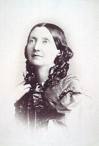
meredith

We now made a few weeks’ sojourn in Sydney, which, could we have laid the dust, moderated the heat, and dismissed the mosquitoes and their assistants, would have been very pleasant; but as it was, my colonial enjoyments were limited to our usual drives, and when able to walk at all, an idle languid stroll in the beautiful Government gardens.  For some days before Christmas, in our drives near the town, we used to meet numbers of persons carrying bundles of a beautiful native shrub, to decorate the houses, in the same manner that we use holly and evergreens at home.  Men, women and children, white, brown and black, were in the trade; and sometimes a horse approached, so covered with the bowery load he bore, that only his legs were visible, and led by a man nearly as much hidden; carts heaped up with the green and blossomed boughs came noddingly along, with children running beside them, decked out with sprays and garlands, laughing and shouting in proper Christmas jollity.  I liked to see this attempt at the perpetuation of some of our ancient homely poetry of life in this new and rather too prosaic Colony, where the cabalist letters L.[pound] S.[shilling]D [pence] and RUM appear too frequently the alphabet of existence.  It seemed like a good healthy memory of home, and I doubt not the decked out windows and bouquet-filled chimney in many a tradesman’s house gave a more home-like flavour to his beef or turkey, and aided in the remembrance of old days and old friends alike numbered with the past.

christmasbush

The shrub chosen as the Sydney ‘Christmas’ is well worthy of the honour (the rough usage it receives rendering the quality of the post it occupies rather problematical, by the way). It is a handsome verdant shrub, growing from two to twelve or fifteen feet high, with leaves in shape like those of the horse-chestnut, but only two or three inches broad, with a dark green, polished, upper surface, the under one being pale.  The flowers, which are irregularly star-shaped, come out in light terminal sprays, their chief peculiarity being, that they completely open whilst quite small, and of a greenish white colour; they then continue increasing in size, and gradually ripening in tint, becoming first a pearl white, then palest blush, then pink, rose-colour, and crimson: the consant change taking place in the, and the presence of all these hues at one time on a spray of half a dozen flowers, has a singularly pretty appearance.  Their scent when freshly gathered is like that of new-mown hay.  Great quantities of the shrubs grow in the neighbourhood of Sydney, or I should fear that such wholesale demolition as I witnessed would soon render them rare.

The ‘Christmas dinner’ truly seemed to me a most odd and anomalous affair.  Instead of having won a seasonable appetite by a brisk walk over the crisped snow, well muffled in warm winter garments, I had passed the miserable morning, half-dead with heat, on the sofa, attired in the coolest muslin dress I possessed, sipping lemonade or soda-water, and endeavouring to remember all the enviable times when I had touched a lump of ice or grasped a snowball, and vainly watching the still, unruffled curtains of the open window for the first symptom of the afternoon sea-breeze.

So, what then can I say about Christmas in Port Phillip?  It seems that the prominence of Christmas seems to be increasing as we get further into the 1840s.  I wonder if the Meredith extract reflects the influence of 1844 more than her experience five years earlier.  It’s important to remember that the trapping of Christmas as we know them- the trees, the carols etc- were themselves being constructed in Victorian Britain at the time.  The term “Christmas Tree”  was first used  in English in 1835; Prince Albert decorated the tree at Windsor Castle in 1841 thus bringing a German tradition to England; Christmas cards first appeared in 1843,  and many of the hymns we know we written in the 1840s and 50s onwards- O Come All Ye Faithful in 1848, or Once in Royal David’s City in 1851 for example.  And then, of course, we have Charles Dickens’  A Christmas Carol, published in 1843 which seems to exemplify everything we think of in a ‘traditional’ English Christmas.

And as for Louisa Meredith’s fear that the Christmas Bush would become extinct- well, I must say that I’m not at all familiar with the Christmas Bush and especially its use as a substitute for holly and evergreens today, but it still seems to grow in the Sydney area at least.  There are certainly other descriptions of Australian Christmases- Henry Lawson,  Edward Sorensen, and many engravings of Christmas activities but many of these seem to date from the 1880s onwards, and probably reflect the spread of the ideal of the Victorian English Christmas across the empire.  But 1840s Port Phillip was part of an early 1840s world with a lower profile of Christmas than in the years following, right up today.

References:

Geoffrey Rowell ‘Dickens and the Construction of Christmas’ History Today, 43, Dec 1993

‘Christmas in the Colonies’ Australian Heritage Summer 2007

The Australian Christmas In Days Gone By

Update:

I did find this reference to Christmas in South Australia in 1836 from The Diary and Letters of Mary Thomas. Mary Thomas wrote up the diary she had kept from early settlement days (Dec 1836) in 1867, expanding her entries with reminiscences- always a bit dangerous because later memories can overlay earlier ones, particularly of an event that occurs on an annual basis:

We kept up the old custom as far as having a plum pudding for dinner, likewise a ham and a parrot pie

Source: Michael Symons One Continuous Picnic: A history of eating in Australia.

(He also notes that Ken Inglis has a chapter about Christmas in  Australian Colonists)