Category Archives: Judge Willis

Synchronicity!

I’m reading Sebastian Barry’s The Secret Scripture at the moment- borrowed from Trish (thank you Trish!) and short-listed for the Booker Prize.  And here I am, reading away, thoroughly enjoying it all when all of a sudden the REAL Resident Judge of Port Phillip- John Walpole Willis- comes bursting into the story!  Well, not so much him as his son, also named John.

The main character of the book, Roseanne, is a 100 year old woman, who has been incarcerated in an asylum for longer than anyone can remember.  Her psychiatrist, Dr Grene, comes into her room and picks up a book that used to belong to her father.

Because I knew the book so well, I could guess what Dr Grene was looking at.  It was a picture of Sir Thomas Browne, with a beard…Sampson Low, Son and Marston were the printers. That ‘Son’ was beautiful.  The son of Sampson Low.  Who was he ? Who was he? Did he labour under the whip of his father, or was he treated with gentleness and respect. J.W. Willis Bund supplied the notes.  Names, names, all passed away, forgotten, mere birdsong in the bushes of things.  If  J. W. Willis Bund can pass away forgotten, how much easier for me?  We share in that at least (p. 98)

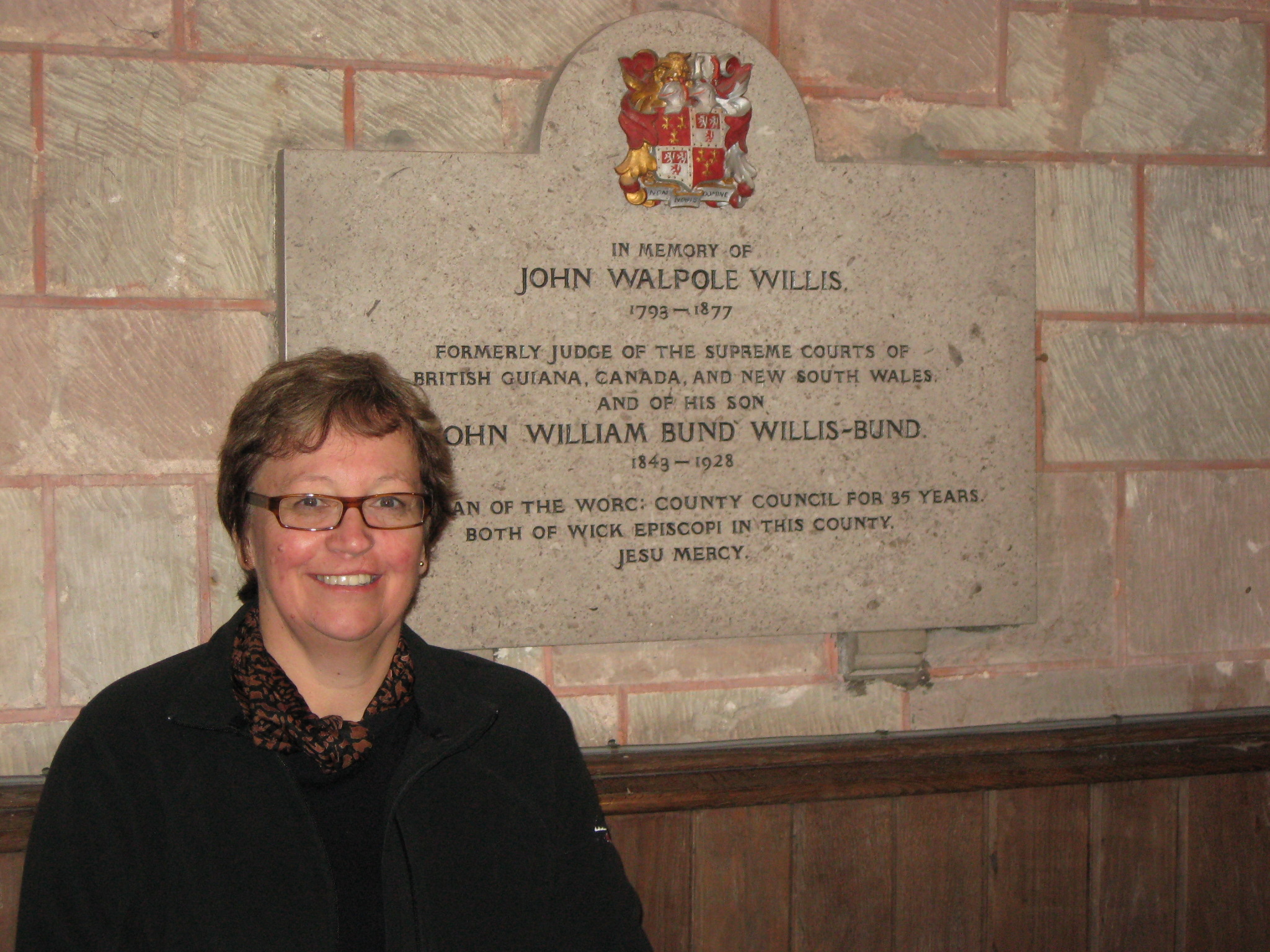
Ah- but J. W. Willis Bund hasn’t been forgotten- or at least his father hasn’t been.  They have been pursued all the way to Worcestershire by a woman from Melbourne, in the district of Port Phillip, Australia! And here she is (looking suitably maniacal) in the small local church in Powick, near the Wick Episcopi estate- found them at last!

(In case you can’t decipher the inscription, it reads:

In memory of John Walpole Willis 1798-1877, Formerly Judge of the Supreme Courts of British Guiana, Canada and New South Wales, and of his son John William Bund Willis-Bund 1843-1928 Chairman of the Worc. County Council for 35 years, both of Wick Episcopi in this county. Jesu Mercy.)

So who was J. W. Willis Bund?  He was born at Valparaiso (the usual stopping place on the western South American coast for ships returning from Australia to England), on the trip home from Port Phillip, after his father,  John Walpole Willis, the Resident Judge of Port Phillip had been removed from office in 1843.  His mother was the daughter and heiress of Colonel Bund who lived at Wick Episocopi in Worcestershire, and on return from Port Phillip, Judge Willis and his family lived there on the maternal family estate too.  In order to inherit the estate, it was necessary for Judge Willis’ son to take his mother’s name as well- hence the Willis Bund  (although the Bund Willis Bund seems a trifle excessive). He was prominent in local affairs in Worcestershire: he sat on the County council, he established the local historical society, and he was a prolific historian and writer.  And yes, he did write the foreword to the Religio Medici mentioned in Sebastian Barry’s book.

So, how about THAT!

On this day in September 1841

From the Port Phillip Herald 24th September 1841

CONJUGAL SCENE.

On Wednesday, one of the scenes which occur so frequently in this town and which tends to exemplify so strongly the dogma frequently advanced, that a great portion of the Emigrants landed on these shores are immoral, was to be witnessed in King street.  A female of rather prepossessing appearance, who arrived a short time since as an emigrant, was proceeding towards the Flag-staff enjoying the serenity of the morning in the company of a tall moustached being of the male gender.  Arm in arm the parties progressed along the streets now and then exchanging sundry symptoms of mutual affection.  Unfortunately however for the equanimity of all parties concerned, the scene was destined soon to be interrupted.  There was seen to advance from a contrary direction a two legged animal, one of that species expressively denominated “a man” but what kind of one our readers will soon learn.  A creature about four feet nothing, whose body was any thing but resembling that of our Melbourne Falstaff, whose frontispiece was a conglomeration of parts, more appropriate to the frame of larger beings.  With rapid but not extensive strides the little man sidled along, till a walk was changed to a run.  Fire flashed from his eyes and fury from his mouth, on a near approach to the loving couple, his feelings found vent in the following expressive words, “What! is it to be a witness of this, that I have come to Australia, to see my wife the leman of a false and ignorant puppy, oh! would that I was in England, I would have justice, but here these things are fashionable,  and I am to be a miserable being for the rest of my existence; oh! villian I will be revenged.”  A storm of words ensued, rapid as the gushing torrent, abuse fell from one party, and threats of vengeance from another, which at length was ended by the man wot wore the moustachios saying, “what! is it a diminutive creature like you that dares insult me in the street and endeavour to force from my society a lady; begone!”  Actions followed fast upon the words, the little man was seized, raised aloft, and hurled with impetuosity into one of those clean spots with which Melbourne abounds.  During the scene, the lady gave vent to her feelings in tears, but on the completion of the above mentioned feat of bravery, she seized the arm of her chere amie and hurried him affectionately from the spot, leaving her husband bruised, and injured both in body and mind, to console himself as he best might.

A couple of observations about this little vignette:

1. Although there are often descriptions of street scenes in the newspapers, there are very few describing women.  Where a woman appears at all, it is often a 2 or 3 line description of some accident and misadventure befalling her. In fact, this is the only lengthy article of its type that I have found,  where there is mention of public affection between a man and a woman, and where she seems to have some (albeit limited) agency in the episode.

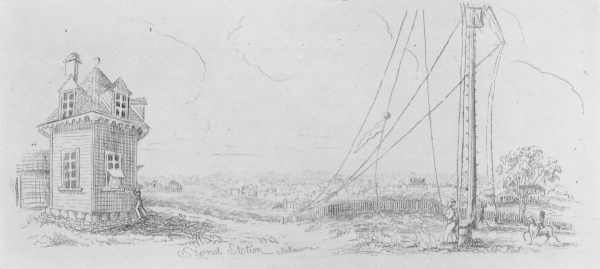
2. It takes place in King Street, near Flagstaff Hill.  In the early 1840s, the centre of Melbourne was located more to the west than it is today, in the square roughly bounded by King, Lonsdale, Elizabeth and Flinders Lane, with a concentration around Market Steet and Collins Street.  By walking up King Street to the Flagstaff Hill, they were walking out of the city up to its highest point- the Flagstaff- where flags were displayed showing the ships that had come into harbour.

As Garryowen says, Flagstaff Hill

“was the pleasantest outside place in Melbourne for a Sunday or week-day evening stroll.  The reported incoming of an English ship would draw crowds there, and they stared with anxious, wistful gaze as the ship beat up the harbour, yearning for the home letters, of which she might be the bearer, of good or evil news, the harbinger. (p. 570)  … It was “where all the Melbourne ‘world and his wife’ used to take their outings on Sundays and holidays, and on every other day when they had the time or inclination to inhale the fresh country air (p. 9)

3. There’s moral judgements at work here.  Moustaches were viewed with some suspicion- certainly Judge Willis castigated the “dandified solicitor” Edward Sewell for wearing a moustache in his courtroom.  The public displays of affection would be frowned upon by respectable readers, and the description of the woman as “prepossessing” is ambiguous.  The language also slips between “female” and “lady”, suggesting uncertainty about her social status.

4. The article as a whole reflects the anxiety that Port Phillip inhabitants felt about emigrants.  While rejoicing in the fact that Port Phillip was not a convict settlement, the inhabitants – or at least the Port Phillip Herald- remonstrated when too many emigrant ships arrived at one time, particularly when their passengers embarked into an economic situation of unemployment and insolvency.  There were criticisms of the emigrants who hung around the emigrant tents for too long, disdainful of wages that they felt were too low- the 1840s version of “dole bludger”.  In particular, there was anxiety over unaccompanied female emigrants.  In general emigrants were encouraged to go ‘up country’ as soon as possible to work as farm labourers or domestic servants.  At the same time, though, the growth of the economy depended on the influx of new settlers and their demands for housing and consumer goods.  Come to think of it,  I think I hear echoes of the debate about Melbourne’s growth today…..

‘An Unruly Child’ by Bruce Kercher

1995, 205p.

Lest you think I do absolutely no work on my thesis at all, last night I finished reading Bruce Kercher’s ‘An Unruly Child’. The  blurb on the back of the book describes it as “a provocative re-examination of our legal history, appearing at a time when Australians are reconsidering both their past and their future”.

Kercher’s intent is to critique the official view as taught to law students that Australian law is English law with minor adaptations to meet local circumstances.  His book examines the contest over the nature of the law in Australia, the struggle between local and imperial officials, and between popular ideas and the official law. Kercher probably leans towards John Hirst’s view that right from its inception, the NSW colony developed practices that subverted imperial intentions for a purely penal society.  He argues that particularly between the introduction of the Supreme Court in the 1823 NSW Act, (and even more in the 1828 Australian Courts Act),  and the mid-19th century, there was a period in which colonial law officers were authorized and even encouraged to consider the applicability of English law to local conditions, and to modify it where necessary.  More liberal judges embraced this opportunity: more conservative judges resisted it.   At the same time, colonists themselves subverted legislation that hampered them- for example, squatters in the Legislative Council protected their privilege and opportunities for expansion through the Squatting Acts; they insisted on Bushranger Acts that have some parallels with anti-terror legislation today, and in some regards  e.g. insolvency legislation, Australian colonial legislation predated changes made in later decades to English law.

John Walpole Willis is mentioned in this book, but is given less consideration than Montagu in Van Diemens Land and in particular Boothby in South Australia- the two other “bad boy” Australian colonial judges.  Possibly Montagu’s actions were more overtly intransigent or complicated by financial scandal, while Boothby in the 1860s was an anachronism in post-responsible-government times.  As with so much with Willis, I’m still not absolutely sure that he fits entirely into a ‘conservative’ pigeon-hole.  But as Kercher points out, conservative and liberal legal beliefs  could have ironic  consequences.  For example, the ‘liberal’ Francis Forbes quelled his misgivings over the highly repressive bushranger legislation because he strongly supported local law making powers, while the ‘conservative’ William Burton imposed the death sentence on white attackers at the Myall Creek massacre in a radical letter-of-the-law interpretation that outraged white settlers.  As Kercher notes “Liberalism and conservatism did not always have predictable results” (p.107).

Retiring judges

One of my middle-of-the-night anxieties involves the degree of presumption I’m revealing in even attempting to comment on a judge’s career. After all, what would I know? Hell, I’ve only ever sat in the public gallery of a court!

So I was pleased to hear an appraisal of the retiring Chief Justice Murray Gleeson on Radio National’s Law Report the other morning by George Williams, from the Law School of UNSW. This is how Williams summed up the Chief Justice’s career

George Williams: I think you need to look at his role on the court in two different ways: one is as a judge, one amongst seven, and as a judge he’s well-known for writing judgments that are concise, that are direct, that really do get to the nub of the question of law, and he has a very strong reputation as being one of the leaders of the court over the last decade. As a Chief Justice, you can look at his public role, he’s someone who’s spoken strongly on behalf of important legal principles, he’s defended the court, and he’s been prepared to get involved in the media in discussing some of those issues.

Where he perhaps hasn’t had the same impact is perhaps changing the way the court operates internally. He’s been a good administrator, but we don’t have a court that’s perhaps made leaps and bounds in terms of moving towards more of a joint judgment system like the United States. It’s a court very similar to the court he inherited, and he hasn’t been a reformer in terms of changing those basic practices.

How do these criteria stack up with Judge Willis?

1. The quality of his judgments. Well, I’m not a lawyer, but it seems that his judgments were well thought through. Certainly he showed independence of thought- he was quite happy to go out on a limb and take a different stance from his brother judges- in fact, I suspect that he revelled in so doing.

2. Public role- speaking out on behalf of important legal principles. Certainly he was outspoken, but were they important legal principles or just a form of point-scoring? The scrutiny of the actions of public officers was important- but was it HIS role to do this? His stance on Aborigines- at a surface level contradictory, but on deeper reflection was based on important legal principles. But there’s always a “but” with Judge Willis. There’s a certain amount of ‘playing to the gallery’ in relation to settler rights in relation to Aborigines, the independence of Port Phillip from Sydney oversight, and the superior quality of Port Phillip without a ‘convict taint’. And his public role was certainly ambiguous- he absents himself from many of the public roles within Port Phillip Society e.g. patron, benefactor etc, and prides himself on holding himself separate. Yet the same man is heard gossiping loudly on street corners, and giving vent to political opinions in the shops.

3. Preparedness to get involved in the media. Probably too much. A bit of distance here would have been ‘judicious’ (groan)

4. Good administrator. He certainly was a good manager- ferocious in championing his own sphere of influence (BUT was that just a way of big-noting himself?) He resisted funding cuts strenuously (BUT ditto?); he was loyal to employees who were loyal to him (BUT did he need to shore up his position?). I’m sure that he volunteered to come to Port Phillip precisely because it gave him the opportunity to establish a court from scratch, based on his own principles and predilections. No doubt he had sniffed the political wind, too, and hoped that when Port Phillip became a separate colony, he would naturally become Chief Justice.

I don’t know if any of this has taken me any further, but it’s interesting to see what the criteria for judging judicial ‘success’ might be.

David Roberts PATERNALISM IN EARLY VICTORIAN ENGLAND

1979, 278 p

One of the frustrations that I’ve faced in trying to understand Judge Willis has been to try to understand his mindset. Why did Port Phillip society of the time find him so unacceptable and demand his dismissal? Was he too radical? Was he too conservative? Was he neither of these things? This book focusses on early Victorian England which, although a hemisphere away from Port Phillip, was the milieu that informed the thinking of colonial judges and civil servants and was the lens through which their patrons and superiors back in the metropole viewed their actions.

In this book, Roberts attempts the heroic in trying to define and illustrate the workings of an unnamed-at-the-time set of varying beliefs and attitudes which he, along with other 20th historians, identifies as ‘paternalism’. He argues that, bolstered by Romanticism and literature, paternalism reached its apogee in 1844. It’s a slippery concept, though, despite his attempts to pin it down through analysis, for example, of the backgrounds of the contributors to the major ‘paternal’ journals and quarterlies of the day, or by the speeches and voting patterns of ‘paternalist’ MPs in the 1840s. He divided these parliamentarians into 6 categories: the Romantics, The Peelites, The Churchmen; the Country Squires; The Whigs and the Anglo-Irish, but even he admits that there is no consistency between their espoused position in speeches, and their actions. Paternalism, it seems, is only one of several influences. In fact, his concept is so hemmed in by qualifications and disclaimers that you start to wonder if what he is describing exists at all.

But, despite his difficulties in defining it, he posits that after 1848 ‘it’ was no longer functional: rendered less relevant by the rise of urbanisation, a self-conscious middle and working class and the mid-century intellectual developments of science, rationalism, empiricism and belief in progress.

I’m not sure that this book has taken me much further in understanding Judge Willis. It’s interesting that his major patrons are categorized as either Peelites or Whig paternalists- but I’m not really sure yet what, if anything, that means.

July 25 1842- a momentous day!

Today is the 166th anniversary of one of the most momentous ceremonies in Port Phillip up until that date- the laying of the foundation stone of the new court house. The 25th July 1842 was a “black and lowering day”, and the ceremony itself had been postponed because of inclement weather. But at 12.00 o’clock, just as the procession was about to begin “the sun burst forth with all his splendor and dissipated the clouds of mist and vapour, all nature seemed to rejoice, while contentment and happiness beamed forth from the countenances of the assembled multitude.”

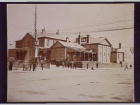
Starting off from the old court house (seen above in my header), this was some procession!

The Ranger on Horseback

Mounted Police

Melbourne Police

Band

The Schools

Odd Fellows

The Ancient and Honorable Fraternity of Free and Accepted Masons

Civil Officers of Government

Chief Constable on Horseback

Magistrates of the Colony (two and two)

Civil Officers of the Government who are heads of Departments (two and two)

Tipstaff of the Court

Members of the Bar

Police Magistrate and Staff

The Resident Judge (supported by the officers of his Court followed by members of the legal profession) (two and two)

Inhabitants

It was estimated that 4000 people were in attendance: quite a turn-up in a city of about 7000 people. The presence of the Masons is emphatic and striking. The involvement of the school children is heart-warming. But where was Superintendent LaTrobe??

The procession wended its way along Collins Street, up Elizabeth Street and turned right along Lonsdale Street to make its way to the site of what is now the closed City Court on the corner of Russell and LaTrobe streets. This location was in close proximity to the newly-completed Old Melbourne Gaol just behind it and was on the outskirts of the settlement.

Peter Ackroyd, in his book London, described that city as a palimpsest where different iterations of buildings, often serving the same purpose, were built on the one spot. This is true here: the ‘new’ Supreme Court building built in 1842/3 was demolished by the end of the century, to be replaced by the City Court (which to my eye looks much older than that). It is no longer used as a court, and has been taken over by R.M.I.T.

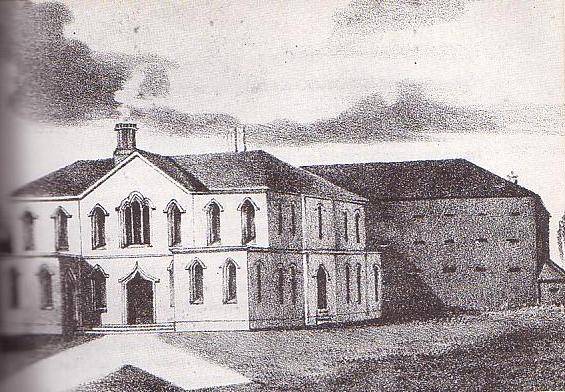
The ‘new’ Supreme Court building was the most expensive erected in Port Phillip to that date, with an initial quote of 7480 pounds (Deas Thomson to LaTrobe 23 July 1842). There was professional jealousy and argy-bargy between Lewis, the Colonial Architect up in Sydney, and Rattenbury the Clerk of Works here in Melbourne over the size, design and cost of the building. In particular, Lewis was critical of the lancet windows that Judge Willis was particularly enamoured of.

Supreme Court 1843

Supreme Court 1843

The 'new' Supreme Court

The 'new' Supreme Court 1900s prior to demolition

There’s something rather ironic, and if I am to be charitable, bitter-sweet about Judge Willis’ oration to the assembled crowd:

He added that in all probability before its walls were grey with age he would long have left them; but that wherever and in whatever position he might be placed, his warmest wishes and best exertions would ever attend the colony, which if left to its own resources and own self-government, unshackled by other districts, would rapidly rise in general prosperity and be the first province of the crown in this hemisphere.

Port Phillip Herald July 26 1842.

A bit of playing to the gallery there: Port Phillipians were clamouring for self-government, and the Sydney/Melbourne rivalry that still exists today was there in 1842 as well.

Warmest wishes for the colony? Bah! He fulminated about Port Phillip and Gov. Gipps the whole way home.

And as for the walls being grey with age? Not likely. They hadn’t even finished painting the building when he headed off for home, after being dismissed. It opened for business as his ship sailed for South America. He’d laid the stone; he’d gone for a stroll each time to inspect the progress; he’d pushed for those lancet windows…but he never got to sit in ‘his’ court. It opened the week after he left, with his successor, Justice Jeffcott presiding.

Farewell Judge Willis- July 1843

I seem to have missed the anniversary for Judge Willis’ departure from Port Phillip. After all, where else to start but at the end? It hasn’t just been inattention though: Behan (unreliable fellow that he is) dates the departure as the 18th July 1843 (Behan p. 285); The Patriot (13 July) dates his departure as that day; while the Gazette and Herald list the Glenbervie ‘clearing out’ on the 12th and ‘sailing’ on the 14th. I’m not really sure what the distinction is between the two terms: I assume that ‘clearing out’ involves moving from  moorings in Hobson’s Bay while perhaps ‘sailing’ denotes passing the Heads?

Nonetheless, it seems that on a wintry mid-July day, a crowd of people stood at the wharf, watching Judge Willis board the paddle steamer Vesta to be taken out to the barque Glenbervie anchored further out in the bay, headed for Valparaiso and home. I can assume that they left from Coles’ Wharf.

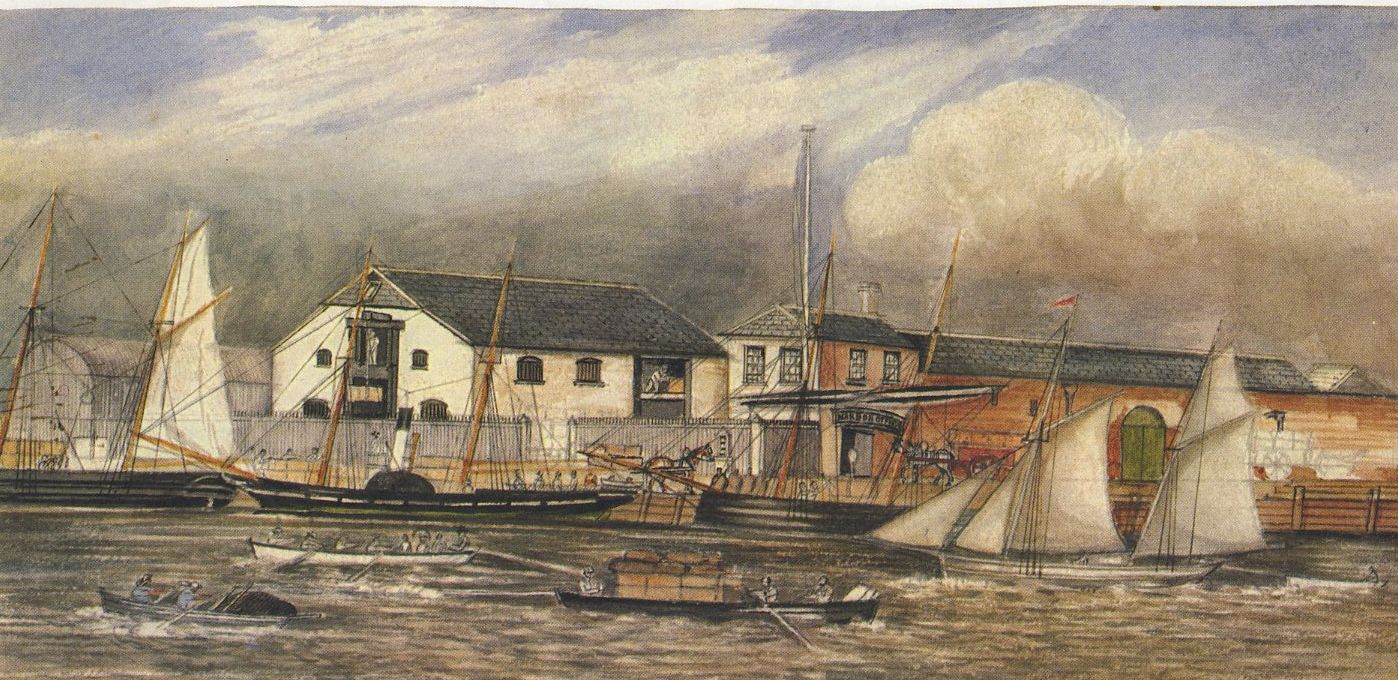
Coles Wharf was constructed between William and Queen Street by George Ward Cole (who later married into the McCrae family)in 1841 along the banks of the Yarra by building on sunken ships’ hulls (www.portaustralia.com/port-melb.htm) . At the time, the Yarra was bisected by falls roughly at the bottom of Queen Street. Above the Falls was fresh water- crucial to the small village, and below the Falls was saltwater. The maintenance of the falls to separate freshwater from saltwater was of vital importance initially, even though the presence of this chain of rocks across the river prevented ships from traveling further upstream. Much time and attention was to maintaining the Falls but by 1880 they were finally removed as part of river engineering works.
Here’s a description of Coles Wharf from The Times 22nd August 1853 that is perhaps a little less glowing than Liardet’s picture above.

There are two landing-places, and the steamers stop at the worst, called Cole’s Wharf. An enormous amount of traffic has certainly been thrown suddenly upon this spot; but, considering the revenue derived from it by the proprietors, something might have been done to redeem it from being, as it is, a disgrace and scandal to the city. Goods are tumbled on to the bank, and the drays back up to them to be loaded through pools of black mud, in which they stand nearly axle-deep. Boxes, cases, and bags (no matter what their contents) may roll into the slush, and stay there soaking till called for. Expensive as horseflesh is, half the power of the animals is wasted in getting out of these pits and the deep ruts of the roadway, which a few loads of stones would fill and level. There is no shed to protect goods liable to be damaged by rain. Reckless indifference to everything but collecting the enormously high freights up the river, and the still higher rate of carriage to the city, seems to be the rule. Combined, these charges have frequently amounted to more, for a distance of six or seven miles, than the freight of the goods from England. The other landing-place, the Queen’s Wharf, is a little higher up the river, and here the accommodation is much superior, a proof that improving is not so impossible as represented.

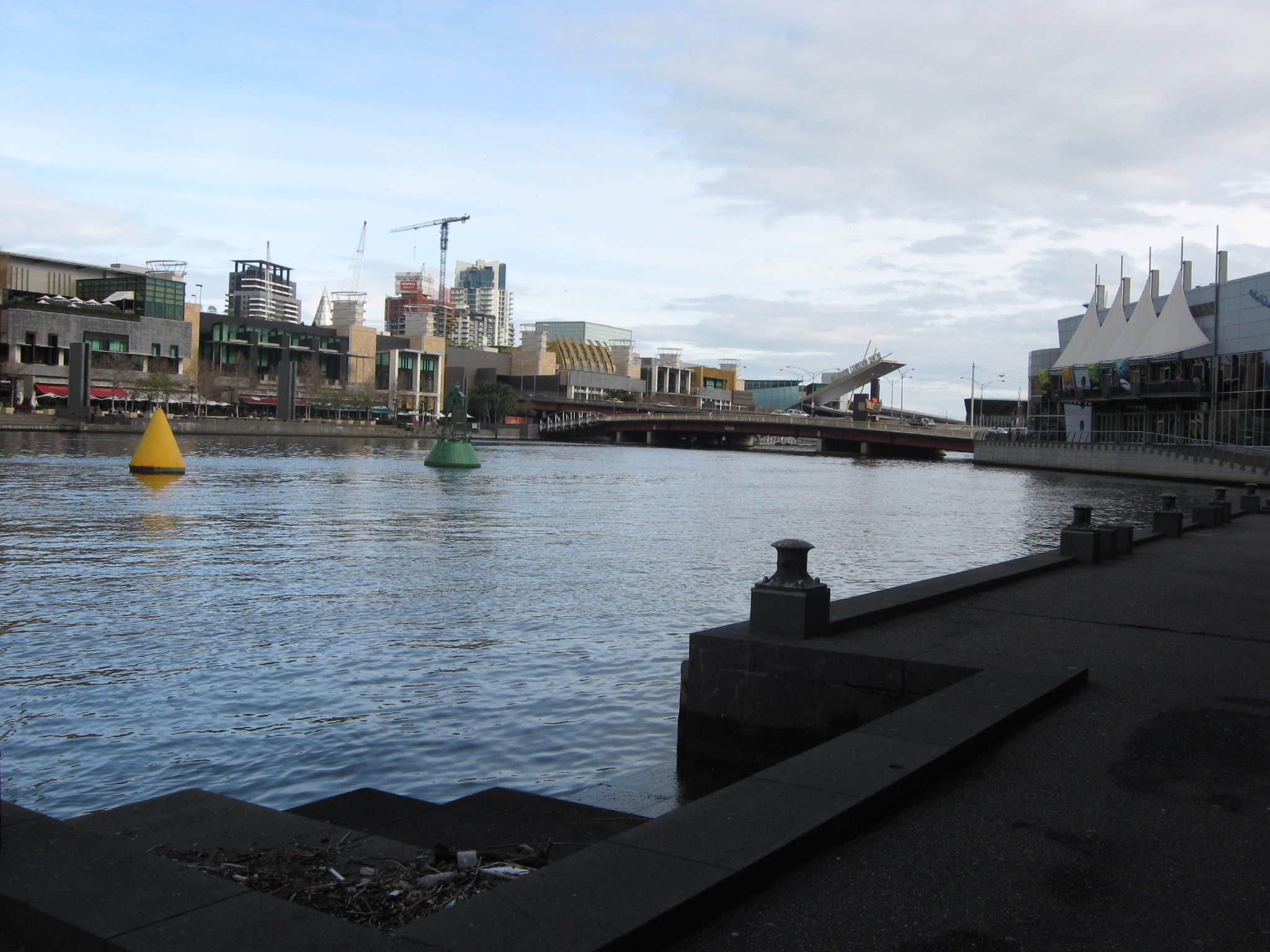
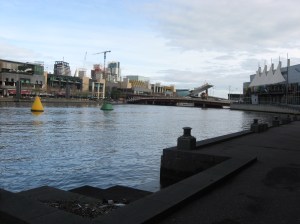
I stood where the wharf was today. It’s hard to picture it. The smell of chip oil is too strong as it wafts from Flinders Street Station and the roar of the traffic is a constant background noise. I’m sure that the air must have been saltier and tinged with wood smoke from the paddle steamer. Perhaps it sounded like Echuca, with the steam whistles, the shouts while loading and unloading goods and the sound of horses’ hooves in the streets behind. The sky would have seemed bigger with no high-rise towers, and the green of the bush would have crept up to the river banks in places, or formed a backdrop against the horizon. But today, like then, there is a stiff breeze that blows across from the water.
The Port Phillip Patriot (13 July) announced:

THE LATE RESIDENT JUDGE

His Honor Judge Willis embarks for England today by the Glenbervie, and will probably leave this port in the course of tomorrow. A large number of our fellow townsmen have signified their wish to accompany his Honor or board, and the Vesta steamer, has in consequence been engaged, to convey the numbers who are desirous of joining in this last tribute of respect before his Honor’s departure from our shore, whence he carries with him the esteem and veneration of nine-tenths of the whole community.

The steamer will leave the wharf at eleven o’clock; it will be necessary, therefore, to be in attendance punctually at that hour.

And a couple of days later, The Port Phillip Gazette (15th July) reported:

On Thursday last, at 12 o’clock, His Honor Mr Justice Willis took his departure from Melbourne, in the Vesta, steamer, which had been specially engaged for the purpose. About four hundred of the inhabitants were in attendance at the Wharf to bid His Honor farewell. Several gentlemen accompanied His Honor down the river, and saw him on board the Glenbervie. A general gloom seemed to prevail on the Vesta heaving her moorings with our late talented and injured judge on board.

Who were those gentlemen, I wonder? I can’t imagine that any of the men who had signed the petitions against him would have been in attendance. Probably those men who had supported him throughout- Verner and the Boldens, perhaps Rev Alexander Thomson from St James? Were there manly handshakes, throat-clearings and fine sentiments expressed?  Was there genuine pain, or did the bluster and bravado of injured feelings and outrage dominate?

Were their wives there, I wonder? Mrs Willis, who was to deliver her second child when the ship docked at Valpairaso- had she overcome the queasiness of morning sickness as the steamer throbbed towards the Glenbervie? What a tumultuous three weeks- their possessions were sold off in Heidelberg’s First Garage Sale, and they shifted into the Royal Hotel in Collins Street to make their final preparations. Did she have friends that she was leaving behind? When did they make their farewells? Like so much else of women’s experience in early Port Phillip, this is another male dominated performance. The women may have been there, but we just don’t know.

And what happened next, as the paddle steamer moved up along the river, out of sight with perhaps just a smudge of smoke to show that it had ever been there? Perhaps there was another round of cheers, but eventually the crowd would have to disperse, picking its way through the muddy Melbourne streets (Port Phillip Herald 18 July). And Judge Willis, his wife and child headed for home.