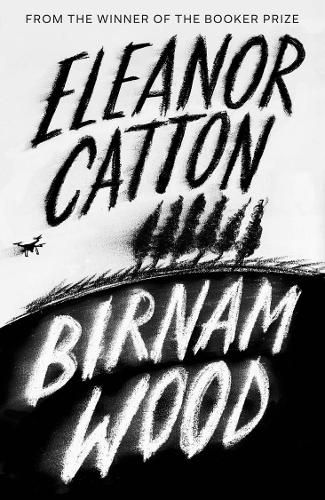
Silly me. Here I was assuming that this book, with a title referencing Macbeth, would be an updated telling of the Macbeth story – but any connections with Macbeth are rather tangential. You may remember that in Shakespeare’s Macbeth, he took comfort in his security as King from the prediction that “Macbeth shall never vanquished be until / Great Birnam Wood to high Dunsinane Hill / Shall come against him”. Assuring himself that trees could not move, he later realized the true meaning of the prediction when his enemy and his army advanced on Macbeth’s castle under the protection of the tree branches they carried, thus appearing to be a forest moving up the hill.
‘Birnham Wood’ was the name that a gardening co-operative adopted for themselves as they engaged in organic ‘guerilla gardening’ on unattended plots and spaces, living on the food grown as they squatted on disused sites, using water if it was available, carting their own if it was not. There’s elements of humour in Catton’s book, and this is one of them: in a world of terrorists and rogue militias, guerrilla gardening seems rather incongruous. [Having said that, the son of one of my distant relatives is a hard-core forager and dumpster-diver, and his parents have found it very difficult to cope with his subversion of all of their expectations for his career and future in his outright rejection of the capitalist economy.]
Acting as a collective, there are nonetheless power differentials between the members of Birnam Wood. The group was founded by 29 year old Mira Bunting who is approached by Robert Lemoine, a shadowy multi-millionaire attracted to New Zealand as part of the wave of ultra-rich Westerners looking for a bolt-hole in the event of nuclear war. His true intent is the surreptitious mining of rare-earth minerals in a remote national park, carried out under the cover of his pest-eradication drone company. He offers the Birnam Wood collective the opportunity to farm on his property and funding, and takes on the ‘conquest’ of Mira as a personal challenge. At the meeting of the collective to decide whether to accept Lemoine’s offer, Mira is confronted by Tony, with whom she had had a drunken sexual encounter before Tony left for overseas, four years earlier. He has now returned to the collective and rejects Lemoine’s offer as blood money. When his objection is voted down, he leaves, suspicious – correctly as it turns out- that there is more to Lemoine’s proposal to the group. The group meeting to decide the matter evoked brilliantly the interminable earnest university meetings I remember, overlaid with a 21st century patina of political correctness. In the meeting, Mira was backed up by her best friend Shelley, who was actually thinking of leaving the collective.
The book is quintessentially New Zealand, with its ‘pure’ image, green and fertile national parks, and propensity for earthquakes and landslips that has rendered the wider Christchurch area largely inaccessible after the main highway is cut. There is something slightly ‘woolly jumper’ about the collective which includes sincere and rather unworldly workers, inspired by ideas of conservation, ecology and rejection of capitalism.
Against this bucolic background, Robert Lemoine stands out as a 21st century James Bond villian/ Egon Musk type caricature. His sheer evilness is made more believable by his control over the electronic communications channels of mobile phone and internet and his surveillance of the members of the collective, which keeps him one step ahead of Mira, Shelley and Tony as they each think that they are acting autonomously, competing to come out on top in dealing with Lemoine.
The satire drops away and the book ramps up in the second half to become a page-turning, cat-and-mouse thriller, something I would have thought impossible in a story about an idealistic group of guerilla gardeners (of all things!). It’s to Catton’s credit that she’s able to carry this off at all. I won’t give away the ending, except to say that the ending probably had more to do with Macbeth than anything else in the book.
I read this book with the Ivanhoe Reading Circle as their June selection. Many of the members were disappointed with the ending: I was perhaps less critical, seeing any other possible ending as a cop-out, and spying a few loose ends that Catton may left dangling that could presage a different outcome.
Most of all with this book, I was so impressed with Catton’s ability to switch so skillfully into a completely different genre to that of the historical fiction The Luminaries, the only other Catton book that I have read. So many writers ‘stick to their lane’ after having a book as successful as The Luminaries was, but Catton has upended these expectations completely. It is a book that surprised with its completely modern setting and its morphing from a somewhat prickly social satire into a page-turning thriller. Eleanor Catton is completely in charge of her narrative, and has the flexibility of a very skilled writer with decades of writing ahead of her!
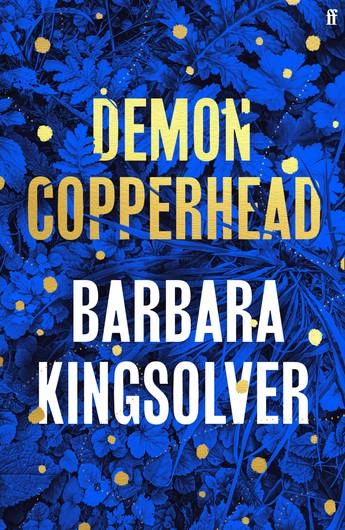
Before I read this book I already knew that Barbara Kingsolver wrote it as a homage and 21st century take on Charles Dickens’ David Copperfield. Kingsolver’s book at 548 pages is certainly seen as a ‘big baggy monster’ by today’s standards, but because I am a complete glutton for punishment I read the original David Copperfield as well, and you can see my review here.
I’m so pleased that I read the original before I read Demon Copperfield because, even though Kingsolver’s book stands on its own two feet perfectly well, I enjoyed seeing parallels between the two books, and how she gave the events of the original book a 21st century twist. Quite amazingly, I think, these allusions to the original (which would only be obviously to readers who had read it) did not propel the modern book into farce or melodrama, which a homage to a 19th century, somewhat dated, book could easily do. Instead, they made perfect sense within a modern context.
In Dickens’ time, child labour blighted the childhoods of children. In the 21st century, drug addiction blights the children of users, who often end up using themselves. Vicious and avaricious stepfathers and childbirth deaths could orphan a child in the past: now it is overdoses, particularly of prescription drugs like Oxycontin which spring from, and in turn, corrupt the medical/pharmaceutical/crime network that have made them the scourge they are in America. (Thank God and successive Australian Governments for the Pharmaceutical Benefits Scheme and drug detection schemes that have prevented the same thing happening in Australia). The original David Copperfield was left to the mercy of unscrupulous employers: Demon Copperhead was the plaything of a welfare bureaucracy that worked more to the interests of unscrupulous ‘care’-givers playing the system for profit. Sport and his ability to draw became Demon’s means of escape.
The Wikipedia page for Demon Copperhead shows the pairing of original characters with Kingsolver’s characters. The names have resonances, but the judgements you make of them as a reader do differ. Dori (Dickens’ Dora) is addicted to Oxycontin, and although she is passive and in thrall to her addiction, she is not the airhead that Dora was. Mr Micawber in Dickens’ book was a larger-than-life, loveable perennial optimist: Mr and Mrs McCobb are grifters and schemers, just as reprehensible as Mr Creakle who fosters boys as a cheap labour source and in order to get their welfare payments. U-Haul does not have the same sinuous oiliness of Dickens’ original Uriah Heep, who made so much of his purported ‘umbleness – there is no 21st century equivalent of ‘humility’ as a virtue- and he seems to play a less important role in Kingsolver’s plot. Dickens is coy about Steerforth’s corruption of Emily: Kingsolver is upfront about the prostitution and sex trafficking into which Sterling Ford drags Emmy, Demon’s childhood friend.
In Dickens’ books, London and the large Victorian cities provide a backdrop to the plot. Kingsolver, who is from Appalachia herself, sets her book in the southern Appalachian mountains of Virginia. She knows these places (as did indeed Dickens know London and England), and both writers use their books as a critique of their own society. I did find myself thinking of Shuggie Bain or J.D. Vance’s Hillbilly Elegy, and there has been some critique of Demon Copperhead as being ‘poverty porn’. I didn’t see it that way. I was driven to finish the book, fearful that Kingsolver would do something very smart-alecky and postmodern to the ending. Did she? You’ll have to read it to find out.
This book garnered many prizes including the Pulitzer and the Women’s Prize for fiction. It well deserved them. It was a brilliant re-telling of David Copperfield, with many winks and nudges for those familiar with the original, and a perfectly independent story on its own terms.
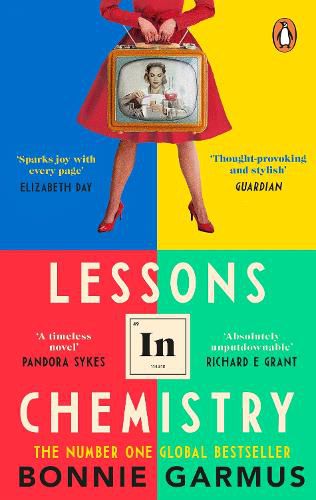
If I were better versed in chemistry, I would start off with drawing parallels between this book and some sort of chemical reaction where there’s a big confident beginning, petering off into a spluttering little anti-climax. Alas, although I can think of parallels in other spheres (political movements? relationships?), I don’t have the chemical knowledge to think of a chemical metaphor. But that’s how I felt about this book: it started off well, then just sagged into a gloopy sentimental mess.
Elizabeth Zott is a research chemist working at the Hastings Research Institute in the early 1960s, the only woman in an all-male working environment (except, of course, for the admin). We now know enough about the side-lining of women in science through Rosalind Franklin and movies like ‘Hidden Figures‘ to recognize the institutionalized injustices that see Elizabeth’s work appropriated and assumed to be the work of the men surrounding her. Almost against her own better judgement, she falls in love with her co-worker Calvin Evans and when her life suddenly falls apart, she finds herself unemployed, unmarried and with a fractious baby. Fiercely independent, she has to learn to accept help from an older neighbour and the father of her daughter’s school friend when he offers her a job to host a TV cooking show. She makes this job her own by introducing the chemistry that she is shut away from professionally to her viewers, housewives at home watching afternoon television. She does not talk down to her viewers and she attains a cult following.
And at this point, my own chemical reaction starts to fizzle out. Yes, we had our professor Julius Sumner Miller in the 1960s, but it stretches credulity to think about a cooking show veering into academic territory like Elizabeth’s ‘Supper at Six’ does. Then there’s the dog (yes, the dog) Six Thirty who is anthropomorphized to the point of having his own dialogue. And the precocious child. And the angelic neighbour. And the mysterious benefactor. Oh stop.
I liked the tone of this book at the start, but it seemed to get lost by the end. The narrative voice was one of those ‘Voices of God’ commentaries, slightly ironic and comforting and imbuing the book with the sense of being a morality tale, or a fairy-tale. There were many one-liners which were sharp and pointed, and certainly coming from a 21st century feminist-ish perspective. But the ending was just a sentimental ‘everything-works-out-in-the-end’ hash. Elizabeth deserved more.
My rating: 6/10
Sourced from: purchased (!) Only because there were too many holds on it at the library
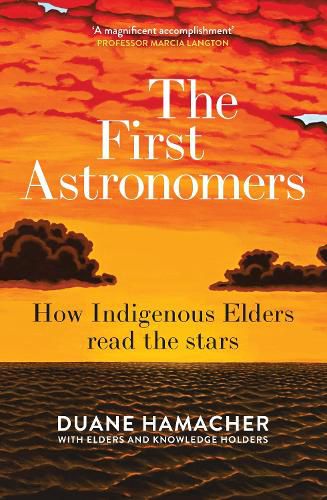
The very first sentence in the preface of the book puts its argument right there, up front. “The First Astronomers challenges commonly held views that Indigenous ways of knowing do not contain science” (p.1). For me, I don’t know if it achieved this aim, although as the most un-science-y person you could ever meet, I’m probably not the right person to discuss the philosophies of science, or philosophies of knowledge. I was not at all surprised that indigenous people have knowledge of the skies – that they ‘read’ (both in past tense and present tense sense of the word)- the stars,moon and climate phenomena. This is knowledge in terms of making sense of the universe and man’s place in it; of finding the rhythms of the universe, and of marking time and making predictions. But is it science? I guess it depends how you define ‘science’, and I probably lean towards the post-Enlightenment and western idea of science being replicable, falsifiable, separate from the individual, and systematic. I’m not sure that the knowledge Hamacher provides, through his indigenous informants, matches these adjectives. I find myself wondering if the question is not so much ‘Is indigenous knowledge scientific?’ but more ‘is our definition of knowledge broad enough?’
He uses ‘indigenous’ broadly supplementing the Torres Strait knowledge which he gathered as part of his own academic career, with indigenous knowledge drawn from cultures across the globe and history. Again, not surprisingly, there are similarities in the stories that pre-modern cultures world wide have developed and read into the star patterns- for example the ‘dark emu’ formed by the dark nebulae clouds of the Milky Way amongst Australian indigenous people is mirrored by the celestial rea (a bird similar to an emu) amongst the Tupi people of the Brazilian Amazon and the Moquit people in Argentina.
The book is simply written, which I appreciated in the more technical parts, although even then my eyes tended to glaze over. However, this simplicity also contributed a flatness to the narrative which, although broken up at times with Hamacher’s own anecdotes (e.g. losing his bearings in the outback despite being quite close to his base camp), felt rather prosaic and far removed from the splendour above that was inspiring his work.
The work is valuable in terms of presenting a breadth of knowledge that has been largely discounted as ‘myth’, and the exploration of the same phenomena explained by different stories across the globe highlighted our common humanity. But I feel as if he was trying too hard on proving its scientific (in the formal, academic sense of the word) credentials, instead of perhaps exploring whether the term ‘scientific’ is broad enough to capture the nature of knowledge more generally.
My rating: 6/10
Read because:Ivanhoe Reading Circle selection for September 2023. Their open meeting featured Duane Hamacher himself, attracting a large audience.
Translated from the Norwegian by Paul Russell Garrett
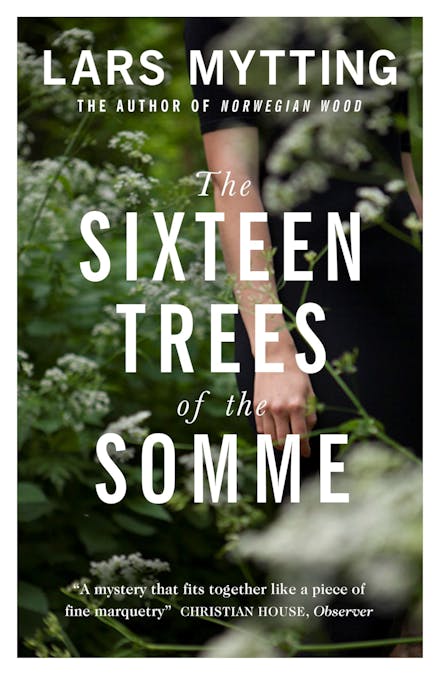
“Oh, a WW I book. Mud, blood and trenches,” I thought when I saw that this was on the reading list for the Ivanhoe Reading Circle. But it’s not at all. The events mainly take place in the early 1990s as twenty-something Edvard Hirifjell buries his grandfather Sverre. Grandson and grandfather had been potato farmers in rural Norway, living together since 1971 when at the age of three, Edvard’s parents had been killed. Their deaths were shrouded in mystery: they died of apparent gas poisoning from unexploded ordnance from WWI in a copse of trees on a former battlefield on the Somme. Edvard had been there too, but has no memory of what occurred: all he knows is that he turned up four days later over 120 kilometres away. As he begins to arrange his grandfather’s funeral with the local priest, he gathers snippets of knowledge of his family: that there was an estranged great-uncle Einar who fought with the French Resistance in WW2 while his grandfather Sverre served with the Germans on the Eastern Front; that his mother was born in Ravensbruck concentration camp; and most intruigingly, that his great-uncle Einar, a skilled timber craftsman, might not have been executed during WW2 as he thought, but may have instead having been living in the Shetland Islands until the 1970s. He had sent a beautifully crafted wooden coffin to Sverre in the small village of Saksum back in 1979 and when it is finally delivered to Edvard for his grand-father’s body over ten years later, it triggers in him an urge to make sense of his memories and his family history.
And so, his grand-father dead, and much to the frustration of his ex-girlfriend Hanne, Edvard travels to the Shetland Islands, and later to the village of Authuille in France, where his parents died, in his search for the past. On the peninsula of Unst, in the Shetland Islands, he finds strong traces of its Norwegian heritage and meets an enigmatic woman Gwen, who claims to be the caretaker for the nearby ‘big house’ Quercus Hall. Quercus indeed, the Latin name for the genus which includes oak and beech trees, because wood and trees play an integral role in the plot, both as a form of craftsmanship and as a motivation for deception and greed.
The book ends up in the Somme, but instead of focussing on World War I, it illustrates the legacy of war across succeeding generations. War on a global scale, but also war between erstwhile-business associates, and war between brothers.
In many ways, this book conforms with the conventions of the mystery novel. There are lots of name changes: Therese Maurel/Nicol Daireaux; Einer Hirifjell/Oscar Ribaut; Gwen Leask/Gwen Winterfinch. There is the big house. There are clues dropped, false leads and evasiveness on all sides. True to form, there is a cliff-hanger ending, which was rather too melodramatic for my liking. It’s a very cinematic novel. The only image I have in my mind of the Shetland Islands is that of the television series Shetland where the Scots influence predominates, but this is much more a European novel, despite the bleak, windy bluestone of the islands. It was not at all what I expected it to be, and it was probably the better for that.
Notwithstanding my recent dalliance with Robert Galbraith, I am not a great fan of murder mystery fiction- as I have said many times before. But if someone’s going to take the mickey out of it while writing it, then count me in.
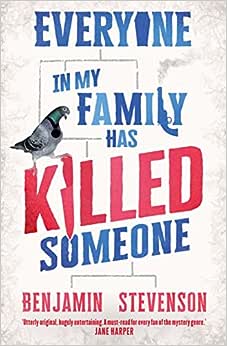
The book starts with the real-life Ronald Knox’s 10 Commandments of Detective Fiction from 1929, namely:
The criminal must be someone mentioned in the early part of the story, but must not be anyone whose thoughts the reader has been allowed to follow.
All supernatural or preternatural agencies are ruled out as a matter of course.
No more than one secret room or passage is allowable.
No hitherto undiscovered poisons may be used, nor any appliance which will need a long scientific explanation at the end.
No Chinaman must figure in the story. (although Stevenson omits this one because of its culturally outdated historical wording)
No accident must ever help the detective, nor must he ever have an unaccountable intuition which proves to be right.
The detective must not himself commit the crime.
The detective must not light on any clues which are not instantly produced for the inspection of the reader.
The stupid friend of the detective, the Watson, must not conceal any thoughts which pass through his mind; his intelligence must be slightly, but very slightly, below that of the average reader.
Twin brothers, and doubles generally, must not appear unless we have been duly prepared for them.
He then introduces his narrator, Ernest Cunningham, aficionado of crime novels, who proceeds to tell the reader the page numbers on which deaths will occur. He promises the truth, and “only one plot-hole you could drive a truck through”. For a genre in which the writer is the invisible puppet-master, Stevenson through his narrator Ernest Cunningham, is front and centre.
In best ‘big-house’ detective fiction tradition, he sets his novel in an Australian ski-resort, which provides the requisite isolated location and circumscribed number of protagonists. He devises a number of deaths through asphyxiation of fine cinder dust, some near misses, and even brings all the characters into the library to unveil the eventual murderer, which he does so clearly that even I understood it. The whole book is a spoof of the genre, and an extended exercise in metafiction, with frequent asides to the reader. I feel that this book is a bit of a one-off – this piss-take would be wearying carried onto other books – but I certainly enjoyed the ride far more than other detective stories with their cynical and inscrutable protagonists
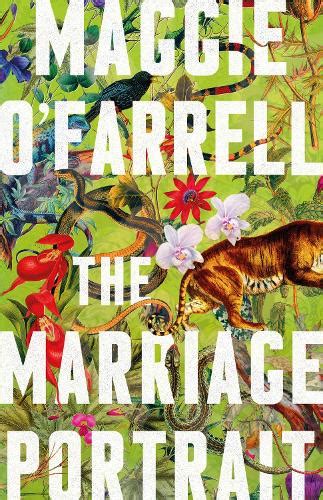
You know within a few pages of this book that there is a murder about to occur, who the perpetrator is and who the victim will be. It starts with a historical note that fifteen year old Lucrezia di Cosimo de’Medici left Florence in 1560 to begin her married life with her husband Alfonso II d’Este, the Duke of Ferrara. Less than a year later, she would be dead, with her official cause of death noted as ‘putrid fever’, but with rumours that she had been murdered by her husband. This is followed by two lines from Robert Browning’s ‘My Last Duchess’, subtitled ‘Ferrara’ where a widowed Duke is discussing the shortcomings of his deceased first wife with the emissary of his intended second wife. There is a chilling suggestion that he killed her.
Maggie O’Farrell’s book opens in Fortezza, near Bondeno, in a bleak isolated castle, and Lucrezia is convinced that her husband is about to kill her. The narrative in the story veers back and forth between this tense cat-and-mouse game, and earlier flashbacks to Lucrezia’s early life in the Florentine palazzo owned by her father, the wealthy Cosimo de Medici. We travel with her to Delizia, a rural villa, in Voghiera where she spends her early married days in a form of honeymoon; and the Castello Ferrara, the Duke’s ancestral castle where he lives with his family and where she comes to realize the mercurial nature of her husband and the dynastic imperative that she fall pregnant. We return to the forbidding fortezza near Bondeno ten times during the novel, which ensures that the tension is held throughout the novel. The book is written in the present tense, which I tend to find oppressive and straining, but O’Farrell’s choice to use it here adds to the suspense that is sustained throughout.
I liked that O’Farrell imbued Alfonso with such ambiguity that, like Lucrezia, you relaxed into his charm, only to find it whipped away in an instance. Lucrezia, astute and intelligent, only gradually realized the menace that she faced. However, I could have done without the multiple dream sequences in the book, which I always see as a rather clumsy backdoor way of advancing the story.
One of the things that I look for in a historical novel is that the characters act in a manner consistent with the norms of the time. It is not sufficient to pick up a 21st century character and sensibility, like a chess piece, and plonk it onto a historic situation that has its own expectations and coherence. Or, as historian Greg Dening put it, it is a mistake to think that “the past is us in funny clothes”. The actions need to remain consistent with the time, but the thoughts behind them don’t necessarily have to comply. As Hilary Mantel showed us, an author can stay faithful to the facts, while imbuing her characters with textured and nuanced motivations and reflections within those facts. I did think of Hilary Mantel while reading this book (which is, alas, just a shadow of her work), both in terms of the present tense voice, and also in its intent and richness of detail. But Hilary Mantel would never have written the ending of this book, and she certainly wouldn’t have foreshadowed it as clumsily as O’Farrell did. I guessed what the ending would be long before the end, and I felt rather disgruntled that she had set it up so obviously.
Nonetheless, I did find the final section of the book a page-turner, and stayed up much later than I intended to read it. It generated a good discussion, and exposed diametrically opposed attitudes towards the book at the Ivanhoe Reading Circle meeting.
My rating: 8/10
Sourced from: purchased e-book, read for the Ivanhoe Reading Circle.
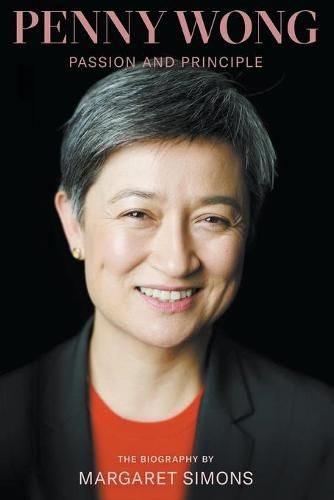
There are special challenges in writing about a current politician. While there are plenty of informants, there is also the spectre of defamation and the whole vexed issue of whether a biography is authorized or not. The political fortunes of the subject may change dramatically, and today’s policies and stances can be rendered obsolete by tomorrow’s developments. Margaret Simons’ biography of Penny Wong was written in 2019, while the Labor Party was still in opposition. Wong was reluctant to be involved in the biography and when she did finally agree to be interviewed, the sessions were conducted in neutral spaces (no empty fruit bowl for her!) with strict limits on what could and could not be discussed. I wonder if she would concede to be involved today, now that she is minister for Foreign Affairs: I suspect not.
Penny Wong is very much aware that she is the first Asian, gay, female Parliamentarian and it was largely because of these adjectives that she decided to run for the Senate with its statewide vote rather than the more geographically concentrated House of Representatives where a targeted negative campaign could cruel her chances. Because she is a Senator, and unlikely to change to the House of Reps, there has been little anointing of her as ‘the next female Prime Minister’.
She has never wanted the Asian/Gay label to define her, but that has happened anyway. I was surprised to learn that her mother’s family, the Chapmans, were an old Adelaide family with a much longer pedigree than many of those who told her to go back to where she came from. She was born in 1968 in Borneo, of Hakka heritage, a group originally from central and southern China, who had emigrated to Borneo to take up land offered to Chinese labourers by the British North Borneo Company. Her father Francis Wong came to Australia in 1961 under the Colombo Plan to study architecture, and he and his wife returned to Sabah, where he became a leading architect and minor public figure. She and her brother Toby were born in Borneo and brought up in a ‘cultural, religious and ethnic melange’. Her much-revered grandmother Lai was Buddhist, her father Catholic and her mother nominal Methodist, and the family celebrated Christmas, Chinese New Year and Muslim religious festivals. In 1976, Penny’s parents split up, and the siblings moved to Australia with their mother, although they returned often to Kota Kinabalu for school holidays. She was unprepared for the racism that she encountered in Adelaide: a neighbour yelled at her to ‘Go back to where you came from, you slant-eyed little slut!’ and anti-Asian slogans were spray-painted on their driveway. She was verbally and sometimes physically bullied at primary school. It was at primary school that she resolved not to show her hurt, and this restraint has followed her into her adult, political life, as has -unfortunately- the racist bullying. Racism seems to have formed an invisible straitjacket around her, and continues to constrain her.
This was less true of her sexuality. I was surprised to learn that she had been in a relationship with later premier Jay Weatherill before embarking on a relationship with Dascia Bennett, a woman eight years Penny’s senior with two children, who Wong considered as her step-children. She was later to meet and have two children with Sophie Allouache. As she says:
It is always about the person first. You fall in love with the person…I hope I have some empathy for those whose coming-out experience was really formative, but that wasn’t my experience. I was who I was in most ways before I decided I was in love with a woman. I was formed much more by an awareness of race than sexuality.
p.83
Once she was elected to the Senate, she and her political advisor John Olenich were debating ‘how to deal with the sexuality issue’. She protested that she had never been in the closet, and therefore she did not need to come ‘out’ but they agreed to a profile about the two new female Senators written by an acquaintance from university days, Samantha Maiden, which had a single reference to her sexuality: “In Labor circles, it is also well known Senator Wong is gay, a fact she would prefer to leave as a private manner. It was not an issue during her preselection to Labor’s highest ranks.” (The Advertiser, 10 August 2002)
After attending Scotch College where she proved herself to be an outstanding student, she attended the University of Adelaide, and this is where she became involved in student politics as a representative of the Students’ Association and the Adelaide University Union board. She was not necessarily fated to be attracted to the Labor Party. She could have just as easily become involved with the Liberal Party as the Labor Party, until John Howard moved to the right with his racist dog-whistling to attract Pauline Hanson-type voters. It was while she was protesting outside a Labor convention that was debating a graduate tax – and the vote was tied- that she realized the importance of ‘being in the room’, and this has become one of the touchstones of her political stance. At many times- and most particularly during the multiple futile attempts to change Labor party policy on same sex marriage- she remained in the room, even though she was then forced to publicly adhere to a policy that she did not agree with. But for her, the important thing was that the debate was still had, inside the room. But should she have openly opposed Labor policy? In reporting her interview over this topic, Margaret Simons observes that Wong was “defensive and combative”. Wong tells her:
I had a decision to make at that time that I could either resign in a blaze of glory or I could stay and fight. And I did make that decision in 2004- that I would make sure that we changed the party platform one day, and that ultimately we would change the country.
p. 149
It was to take twenty-three bills introduced into parliament, usually by minor parties, until marriage equality was finally achieved in 2017. With her hands covering her face and brushing away tears, the country had finally been changed.
Quite apart from the areas of race and sexuality, which are of personal importance to Penny Wong, I had forgotten that she had been responsible for the Water and Climate Change portfolios – two intractable policy areas, both of which were caught up in the toxic politics of entrenched interests and grandstanding. She was not particularly successful here – indeed, has any politician been successful? – although her pursuit of buybacks in the Murray-Darling scheme have turned out to be more successful than the infrastructure improvement approach which followed her tenure, with little evident improvement. As Climate Change minister, she got caught up in the international politics of the COP meetings and Kevin Rudd’s declaration and then retreat from ‘the greatest moral challenge of our time’. Her political judgement was astute but largely behind-the-scenes: she was the only colleague to raise the question of the electoral implications of Rudd’s back-pedalling.
Written in 2019 (an updated second edition is due out this year), Margaret Simons was witness to Labor’s defeat in an election that many thought was an assured Labor victory. It meant that Wong remained a shadow minister, but her work in preparing to be Foreign Minister was prodigious, and was evident (after the book had been published) in Wong’s quick spring to action as soon as Labor won office in 2022. Despite Paul Keating’s withering putdown of her for Penny Wong for “running around with a lei around [her neck] handing out money” in the Pacific, I think that she is very capable and her quiet, polite demeanour has enhanced Australia’s reputation, as well as her own.
I know that Adelaide is a small town, but I hadn’t realized how closely intertwined (dare I say ‘incestuous’?) Adelaide politics were, and probably still are both within the Labor Party and in the political arena generally. In the interplay between student politics, the legal/political profession and across formal political parties, allegiances and enmities were formed and continued over time, including when the participants moved onto the national stage. Wong established a firm friendship with Mark Butler, and a combative relationship with Don Farrell, both of whom are Adelaide representatives and current ALP ministers.
Simons makes no secret of the fact that Wong is a political animal. She has played political games and made political judgements, and not all of them do her credit. She has displayed loyalty, particularly to Kevin Rudd long after others had moved away, and to Anthony Albanese, whose time has come. She has made enemies too.
Simons has chosen as her subtitle ‘Passion and Principle’. Apart from the obvious alliteration, I wonder why she chosen “passion” in describing Penny Wong. Her demeanour is deliberately passion-less – her breaking down in tears after the same-sex marriage plebiscite notwithstanding- and Simons points out the ‘Wongisms’ that she uses to keep control of her language e.g. her low, quiet delivery; her expressive eyebrows to suggest skepticism; her vocal tics like ‘the best of our generation’ and ‘let me just say this’. It came as a surprise to read some of her lectures and addresses (e.g. the John Button Memorial Lecture) where she spelled out her beliefs and priorities and I found myself thinking “You are really good” in a way that doesn’t come through in other forums. While not indulging in ‘what-if’ thinking, Wong entertains counter-factuals as part of working out her position, and she eschews the idea of binary thinking, always looking for an alternative.
Her passion seems to have been constrained by the second ‘p’ of the subtitle: principle. In deciding to ‘stay in the room’ she steadfastly abided by cabinet solidarity outside it (something that I am criticizing pro-Voice Liberal front-benchers for doing), even when it went against her own interests. This came through most clearly to me at the 2011 South Australian Labor convention where the question of a conscience vote for same-sex marriage would come up for debate. She warned Julia Gillard (who opposed a conscience vote) that she would publicly support a change to the party platform. As the most senior South Australian member, she held Julia Gillard’s proxy, and knowing on principle that she couldn’t use it, she gave it to Don Farrell, thus giving her opponents an extra vote and opening up a space for Farrell to give an incendiary ‘no’ speech. (p.231) Given how important the question of same sex marriage was for her, that’s principle.
Margaret Simons is not an invisible presence in this biography. Coming from the press ranks herself, she affords an influence to the media that perhaps a political scientist or historian would not.She has had to actively pursue Penny Wong, and the long list of nearly forty named informants at the end of the book and an extensive bibliography and index reflect her diligence in writing this book. At times it reads like a tussle between two feisty interlocutors: she often challenges Wong’s assertions, and Wong pushes back. Penny Wong has been firm about the ‘no-go’ areas (e.g. her brother, her children). This is no hagiography: instead, as with other good interviewers (I’m thinking her of Janet Malcolm) Simons is reflecting on her own practice as a biographer and refining her own ideas about politics and politicians. In the final pages, Simon says:
…as the book had proceeded I had come to think of it as being about politics itself: how hard it is, the price that is paid in the struggle to make change, and both the necessity and inevitability of compromise, even when- as with climate change- such compromise may do us in. I was thinking that perhaps, as with a tragic play, the audience might leave with a greater understanding of the human affairs it depicted. Perhaps they might also grasp the humanity behind the headlines- and what it meant for a person of talent, passion and principle to devote herself to delivering the service of political representation.
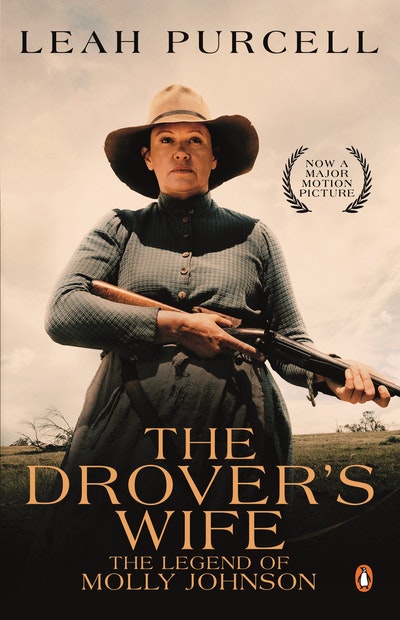
Any Australian child who grew up during the 1960s would know the story of The Drover’s Wife. It was in the Fifth Grade School Reader, and we all had the vision of the unnamed woman, dressing up on Sundays and walking through the lonely bush pushing the perambulator with her children beside her; and sitting up all night waiting for the snake to come out from the woodpile into the house, with Alligator the dog stretched out, his hackles rising as the snake finally slithers into the log hut.
I hadn’t realized that the version we read at school was an abridgment of the longer story (which can be found at http://www.eastoftheweb.com/short-stories/UBooks/DrovWife.shtml) and it was only when I read the longer version that I realized the racism threaded through it. The “stray blackfellow…the last of his tribe and a King” had built the woodpile hollow, and was thus indirectly to blame for the presence of the snake in the house; then there is the caricature figure of King Jimmy, who sent his wife Black Mary “the “whitest” gin in all the land” to assist with her third childbirth. Thankfully, these do not appear in the School Reader version.
But it’s easy to see how the story of The Drover’s Wife acts as a springboard into Purcell’s 20th/21st century reimagining of the story with an aboriginal protagonist, domestic violence and rape wrought by white men, and morally superior indigenous characters. Far from the heroic white settler ideal, the white men here are murderous brutes and ‘justice’ is warped. She fleshes out and gives a name to The Drover’s Wife – Molly Johnson- and she gives “Black Mary” a backstory that reflects the violence of Australia’s colonial history. There are no white saviours here: the good man is Yadaka, and it is Yadaka who reveals Molly’s own story to her.
There are nods to the original Lawson story – a fleeting reference to the Sunday walks through the bush- enough for someone who knows the story to recognize it. But younger readers, I suspect, would not know the Lawson story and would perhaps not recognize the subversion of the original that Leah has executed. Perhaps in 30 years, the subtitle will be sufficient ‘The Legend of Molly Johnson’.
This was such a clever, insightful playing with white settler fantasies that I feel curmudgeonly in pointing out the flaws in the story which are, unfortunately, many. The book is an expansion of the stage play and it still bears the strong use of dialogue that would have marked a performance. But with the tasks of expanding into a novel, Purcell has permitted herself to explore her characters’ “inner thoughts” and this is one of the things that brings the book undone. She skips from character to character, switching between first and third person which gives a disjointed feel to the narrative. She has introduced two white characters into the book – Nate and his wife Louisa Clinton- who, in a twist that doesn’t quite come off, ends up being a nod to Henry Lawson’s mother Louisa Lawson. There are plot steps that just don’t make sense: for an isolated bush-hut there seem to be many people going past, and it is never explained why Molly stops, endangering her children whom she has protected fiercely throughout, on their way to Yadaka’s cave. The ending was heavy-handed and cliched.
There were a number of disconcerting anachronisms in the book. Women had ‘baby bellies’; there were ‘hobby farms’; people did ‘business degrees’ (universities offered no such courses); people were affected by hormones (not discovered until 1935). This is not the American West: executions required a Supreme Court trial, not the local magistrate, and they took place in capital cities. Even the scenario of children ordered by a judge to be ‘taken’ without reason is anachronistic, the legislation being introduced in the early 20th century. This book cried out for good editing and fact checking.
There is much to admire in its subversion and defiance. But this book has shown me that playwrights are not necessarily novelists, and that even the most creative and politically sharp critiques can be brought undone by infelicities.
I read this in an e-book version, so I didn’t really have an opportunity to pour over the front and back covers. Without the little telltale identifier ‘biography’ ‘memoir’ or ‘non-fiction’ that some books have on the back cover, I found myself wondering exactly what I was reading here. Was it really a memoir written by a rather arch, conservative, class-conscious Englishman, or was this a masterful frame story for what was essentially fiction? Well, it seems that it is indeed non-fiction and a memoir, which places it back in the pack as being just another family-history-as-search type book, a genre of which I am not particularly fond.
Ferdinand Mount starts his memoir by recalling the various houses in which his Aunt Betty and Uncle Grieg lived. There are quite a few of them, in varying degrees of opulence, and the opening chapter starts, as the rest of the book continues, as a type of roll-call of the significant people to whom his aunt and uncle have tenuous links. It is Aunt Betty who suggests that instead of calling them such prosaic names as “Betty” and “Grieg”, her nephew and niece call them “Munca” and “Unca” after the two mice in Beatrix Potter’s The Tale of Two Bad Mice. At the time the author thinks that this is a childish suggestion to come from an adult, and inaccurate too, as there was actually only one mouse called Hunca (with an H) Munca. However, he acquiesced at the time, and continues to do so during the book, varying between “Munca” and “Betty”. The title of the book comes from a pre-war song with the lyrics:
I’m going to kiss myself goodbye
Oh goodbye, goodbye
I’m going to get on my wings and fly
Up high, Up High
This is more appropriate, because this is the story of the deception undertaken by several members of his family as they accelerate their climbing of the social ladder in Britain, breaking through the famed class system by the adoption of different names and shady dealings.This is not necessarily an unique story: Robyn Annear did it better with the Tichborne inheritance in The Man Who Lost Himself and Kirsten McKenzie adopted a more scholarly approach to false identity and deception in A Swindler’s Progress (my review here). However, while distance and the colonies provided good coverage for false identity, there is a certain brazenness about Aunt Betty’s story, slipping through names and marriages without moving out of England.
The book is structured around his family history search for the truth about his Aunt Betty, whom he always found evasive and mysterious. It is a search driven by documents and he is a particularly inept family historian, naive about sources, and unusually reliant on other people finding things for him. He uses his search for a particular member of his family as the rationale for a new chapter, which means that there is a certain amount of back-tracking and foreshadowing, and he weakens his book considerably by including updates on his searches at the end which diffuses, rather than tightens, his ending.
The book is not just about his Aunt Betty/Munca, but he infuses it with a lot of his own memoir as well. He is an undisciplined narrator, launching off into long descriptions of tangential information, and drawing links with minor royalty and celebrity figures. I don’t think that I would particularly like this man personally. He is certainly well-connected with the literary scene and Conservative Party politics: head of the Policy Unit during Thatcher’s time, the holder of a hereditary baronetcy through his uncle, contributor to the Sunday Times and the London Review of Books, former editor of the Times Literary Supplement for eleven years, and a fellow of the Royal Society of Literature. I can only assume that it is these latter connections that landed him Hilary Mantel’s saccharine and very prominent front-cover blurb that the book was “Grimly funny and superbly written, with a twist on every page”.
The book is well written, but there is a gaping vacuum at its heart where he fails to interrogate or even imagine the nature of Aunt Betty/Munca that led her to such contradictory and often callous actions. It is as if he has traced the steps but never stopped to ask “why”. This would, of course, require speculation but he has not resiled from speculation and guesswork elsewhere. Given the wreckage that she left behind her in terms of marriages and adoption, his tunnel vision suggests that perhaps there is more of Aunt Betty/Munca in him than he would like.
My rating: 6/10
Sourced from: purchased e-book; read for the Ivanhoe Reading Circle.


 The Resident Judge of Port Phillip