Category Archives: History

‘The Little Community’ by Robert Redfield

redfield2

1962, 168

I read this book alternating between a feeling of  “Toto,  I’ve got a feeling we’re not in Kansas anymore” and “Aha!!”.   I felt like Dorothy because this book is steeped in the language, methodology and publications of anthropology.  It took a number of important studies of little communities, including those written by the author himself, and examined the ethnographic methodology and questions  they utilized.  These studies were all unfamiliar to me, and because of the publication date of the book (1962), they were all fairly dated.  The book was not so much about the content of these studies, as of the role of the anthropologist and his/her methodology in that study.

But when I felt “aha!” was when he spoke about the nature and limits of the “little community”.   His “little community” has four qualities, that may exist in different degrees:

  1. it is distinctive-  where the community begins and ends is apparent
  2. it is small enough that it can be a unit of personal observation that is fully representative of the whole
  3. it is homogenous and slow changing
  4. it is self sufficient in that it provides all or most of the activities and needs of the people in it.

So does Port Phillip count as a “little community”? I’ve been conscious all along of the small size of Port Phillip- about 5000 people (although there’s no hard and fast population figures).  But was there a clear sense of “we?”. I rather think there was, in the push towards Separation from New South Wales, and distancing Port Phillip from the penal origins of Van Diemens Land and Botany Bay. Certainly, the Port Phillip press tried hard to foster a sense of  “we” (although I think that provincial presses always do this).  I think that the relatively late date of settlement indicates that geographically it was a separate entity to the two older colonies.

Redfield speaks about a “typical biography” among members of a little community- the life-path that most people in the community followed. Prominent, middle-class, public-oriented men can be traced quite easily through their involvement in different organisations in Port Phillip.  I think that you could probably construct a typical biography for Port Phillip during  the 1840s that would be triggered by a migration, involve an economic enterprise of some sort,  a financial setback, and the building of a home.  In fact, I’m about to embark on “Letters from Victorian Pioneers” and I’ll see if I can find the barebones  of a typical biography for Port Phillip there.

But Redfield warns that the descriptor of “little community” doesn’t fit comfortably with a society undergoing rapid change, especially a frontier society.   I think that whatever homogeneity there was in Port Phillip was challenged as the 1840s went on.   Change was rapid, and becoming even more so.  As such, perhaps the term “little community” is of limited usefulness in describing Port Phillip, but as he says, the question is not so much “Is this community a little community?” but “In what ways does this community correspond with the model of a little community?”

Port Phillip Apostle No 3: John Pascoe Fawkner

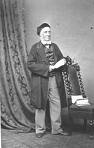
fawkner

Now what on earth is John Pascoe Fawkner doing here?  He was probably Judge Willis’ most vocal supporter and yet here he is embroiled with some of  Judge Willis’ most vocal opponents in the guise of H. N. Carrington and J. B. Were.   The most plausible explanation that I can think of is that, given his propensity to be right in the thick of all things Melbourne, he became involved because other people were.  Perhaps there’s a proprietorial  element of protecting the civic reputation of  “his” Port Phillip?  Who knows??- but then again, there are many things that puzzle me about John Pascoe Fawkner- most of all,  the nature of the connection between Judge Willis and John Pascoe Fawkner,  a man who seemed to exemplify the things that Willis most strenuously derided.

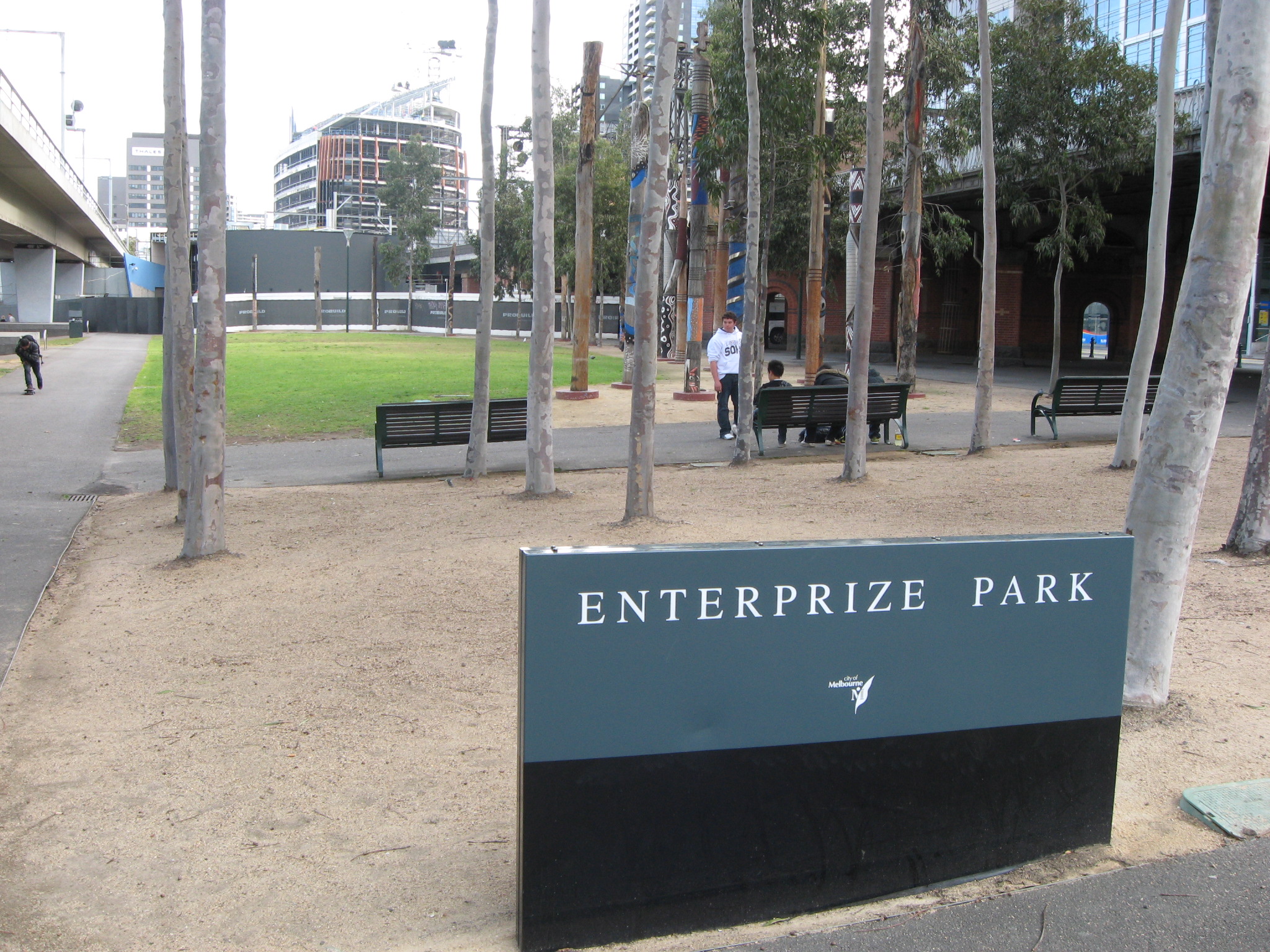
The two Johnnies- John Fawkner and John Batman have contested the title of “Founder of Melbourne” for about the past 100 years, and I notice that this year Capt Lancey nudged his way into contention as well.  Bain Attwood has written a fantastic paper describing the creation of the “founding of Melbourne” narrative that saw Batman championed as the founding father by James Bonwick, only to have this status questioned in recent years and more prominence given to Fawkner instead.  Attwood points particularly to the gradual disappearance of statues and commemorations to Batman and the increased visibility of Fawkner in the narrative, exemplified the recent creation of Enterprize Park (named for Fawkner’s ship The Enterprize)  opposite the Immigration Museum beside the river.

joe-william-street-012

Fawkner fits well into Ville’s “ex-convict and emanicipist” category of entrepreneurs, with their attendant desire for legitimacy, esteem and recognition.  He was the child of a convict and along with his free mother and sister, accompanied his father when he was transported for receiving stolen goods.   They were among the group of convicts and free settlers sent with Lieutenant Collins to establish a settlement at Sorrento until the struggling community was abandoned for Hobart Town instead.   John Pascoe Fawkner had his own brush with the law in 1814 when he was sentenced to 500 lashes and three years government labour for aiding and abetting the escape of seven convicts.  He returned to Hobart in 1816 where he opened a bakery, but shifted to Launceston a few years later after further problems over selling shortweight loaves and using illegal weights.  In Launceston he began anew as a builder and sawyer, then after some problems on character grounds in gaining a licence, opened a hotel and started the Launceston Advertiser newspaper.

Hearing positive reports of the coastal areas of Port Phillip, just across Bass Strait, he engaged a boat and launched an expedition of the area.  Well, that was the intention at least.  When the captain, John Lancey learned that he had violated a restraining order imposed on him because of debt, the ship turned back and deposited John Pascoe Fawkner back onto Van Diemen’s Land territory and sailed off without him.

Fawkner finally set foot on Port Phillip some two months later in October 1835, where he established a hotel, newspaper and bookselling and stationery shop.

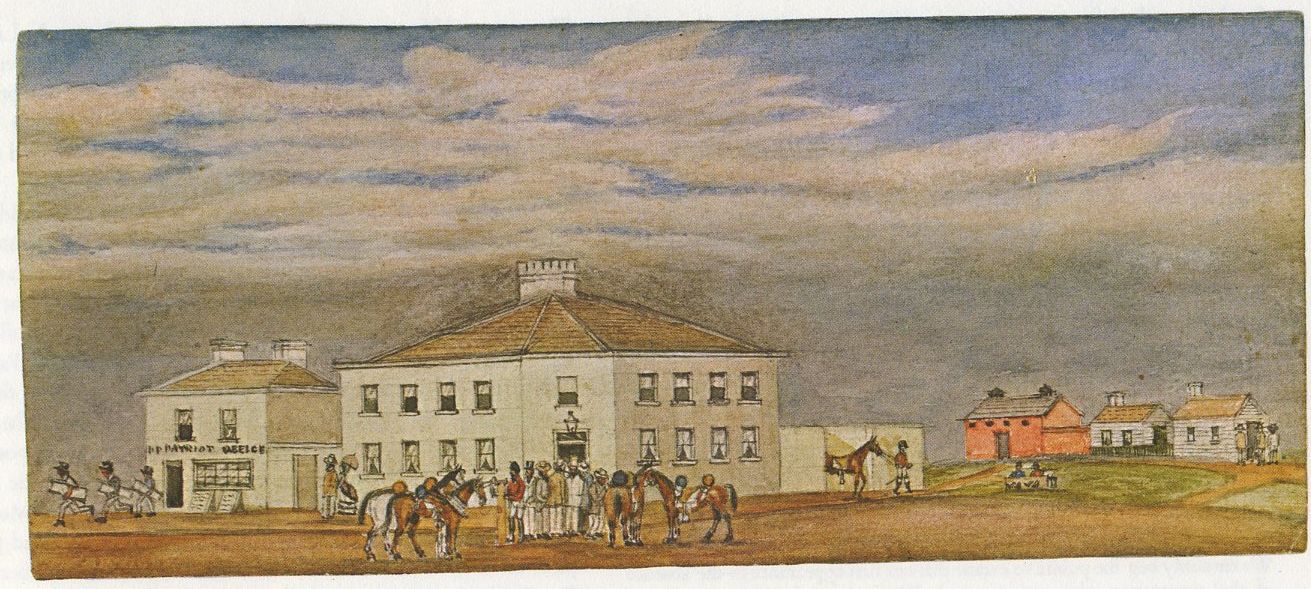
patriotoffice_melbclub2

Patriot office and Fawkner’s hotel  in Collins Street, later leased to the Melbourne Club

At the first government land auctions he purchased 92 pounds worth of land.  At the 1839 land sale he purchased 780 acres along the Sydney Road for 1950 pounds.  Within a fortnight he advertised that the land was available for tenant farms with seed provided, or a total of 85 acres for sale at 10 pounds an acre.  He confided to the Reverend Waterfield that he had gathered 20,000 pounds in four years.  He became a squatter in 1844, taking up a licence for 12,800 acres near Mt Macedon.

He obviously wasn’t always flush with cash, because in 1841 he approached Montgomery, the Crown Solicitor,  as guarantor for a loan to assist his friends Kerr and Holmes to purchase the newspaper and stationery businesses from him.  The money made available to him came from the funds of Judge Willis himself, who had placed his money in Montgomery’s hands for investment.  While this investment was, indeed, through a third party, and although Fawkner no longer owned (but did continue to contribute to) The Port Phillip Patriot, the paper’s unfailing and strident support for Judge Willis is notable.

His financial success came undone in the financial depression of the 1840s,  largely through acting as guarantor for so many bad loans.  He was particularly damaged by his involvement in Rucker’s scheme as one of the Twelve Apostles.   He fought the action strenuously in the courts, but finally declared insolvency in March 1845 listing liabilities of 8,898 pounds and assets of 3184 pounds and claiming to have been stripped of 12,000 pounds and ten houses. He vented his hostility to Rucker and Highett the bank manager through his letters to the Port Phillip Patriot.  Mr Rucker, he wrote,

although he has placed several gentlemen in most perilous circumstances, can yet ride into town and sport his figure as of the first water…

Mr Highett, the ex-manager of the bank

had helped to melt many a piece of worthless paper under the sunny side of the bank screw, so upon a crusade he goes, and by dint of cajoling he did succeed in effecting an arrangement whereby ten or eleven persons bound themselves to pay Mr F. A. Rucker’s debts.

But John Pascoe Fawkner was not to be kept down for long.  He retained his Pascoe Vale properties through a settlement on his wife, and his interest in the Patriot was signed over to his father.  He discharged his insolvency quickly and used his wife’s property settlement as a qualification to stand for a vacancy on the Town Council in 1845, a position he had had to relinquish when declared bankrupt.  He went on to serve for many years on the Legislative Council and died “the grand old man of contemporary Victoria” in 1869.

There were many reasons why Judge Willis might despise him: the ex-convict origins of his fatherand his wife and his own crime in facilitating the escape of convicts; his “fortuitous” financial arrangements during his insolvency which exemplifed the sort of trickery Judge Willis was determined to strike down; his involvement in the hotel trade,  and the rabid nature of his rhetoric in the Patriot.  He was viewed as a radical for many of his ideas:  his plans for a Tradesman’s bank and  schemes for a co-operative land society.  But yet, even though Judge Willis would protest it vigorously,  the two men have qualities in common.  They were both ambitious men.  Willis might have applauded Fawkner’s aspirations to improve himself:

One comfort I have which the falsely proud can never achieve, viz, I have not sunk below, but on the contrary, have raised myself above the rank in which at finding myself of years of discretion I was placed in, and I glory that I have thus passed them.

Both Willis and Fawkner took pleasure in “hunting high game”.  And both Fawkner and Willis seemed to exhibit a similar hot temper and vindictiveness that, at a stretch, might explain why such an otherwise mis-matched couple of men often acted as each other’s supporter.

References:

Bain Attwood ‘Treating the Past: narratives of possession and dispossession in a settler country’  http://law.uvic.ca/demcon/documents/Attwood.pdf

Hugh Anderson Out of the Shadow: the Career of John Pascoe Fawkner

C.P. Billot  The Life and Times of John Pascoe Fawkner.

Simon Ville ‘Business development in colonial Australia’ Australian Economic History Review, vol 38, no 1 March 1998

Departed historians and their historical tales

As you know, I’ve recently been considering the 1840s depression in Port Phillip.  So, off to the library shelves I go. The title certainly looked promising- Forming a Colonial Economy: Australia 1810-1850 by N. G. Butlin.  It even had a chapter ‘Instability and Economic Fluctuations with Special Reference to the Depression of the 1840s and Recovery’.  But how strange- the name of the chapter is almost longer than the chapter itself, which starts on p. 223 and finishes on p.224 with a Postscript.  And there it is:

“Noel Butlin died before he could complete this chapter, and I have not sought to go beyond the material he actually wrote.  His intention in this chapter- based on conversations shortly before his death- was to…. Unfortunately, Noel Butlin could not complete the task.  Having stated the intention of this remaining chapter, it now remains a matter for other scholars of Australian economic history.  M.W. Butlin” p. 226

Thwarted again by the curse of the historian- dying on the job, so to speak.  I seem to have run into a bit of this lately.

[But permit me to digress.  I hadn’t thought of economic history as a dynastic profession, but it seems that it is.  The remainder of Noel Butlin‘s missing chapter was sketched out by M. W. Butlin, who has a string of publications in economic history to his own credit.  And Noel Butlin was the brother of Sydney James Butlin who wrote Foundations of the Australian Monetary System 1788-1851 which I’ve just finished reading.  And S.J. Butlin himself had a book posthumously edited and published by his daughter Judith. ]

But back to the departed historians and their tales.  I’ve also picked up Alex C. Castles’ Lawless Harvests or God Save the Judges: Van Diemen’s Land 1803-55, a legal history (2007) as Tasmania provides a different but parallel legal environment to that of New South Wales.  I opened the preface to read:

“This wonderful book might never have been published had it not been for a chance comment by the Law Society of Tasmania’s former librarian, Mrs Kate Ramsay.  The death of Professor Alex Castles in 2003 prompted her expression of regret that we had never published his work.  That remark sent me rummaging through the Society’s basement archives, where the part-completed manuscript was eventually discovered.

Kate then took on the daunting task of re-keying the manuscript into electronic form and enlisted the assistance of Dr Stefan Petrow to edit the work, write an introduction and complete the bibliography.  The Society owes a debt of gratitude to Kate and Stefan for their outstanding contribution to the resurrection of this book. (p.vi)

And not long ago, I read Donald Horne’s memoir Dying.  The book was in three sections. In the first, he described from his side of the oxygen mask, the experience of dying from lung disease.  His narrative falls silent, and is taken up in the second section by his wife Myfanwy. The final section of the book consists of a collection of incomplete essays that he had not finished writing when he became too ill to continue.  On one level they  are complete, self-contained works, but there is a fuzziness and hesitation about their conclusions that I think he would have tightened had he worked them up to publication standard.  It seems that the act of publication in itself acts as a fixative and stiffener to one’s ideas- that you only really know what you think once you’ve taken another reader or listener through your argument and have enough confidence in what you have written to endorse it under your name.

Another exposure I’ve had to a posthumous work is one step further back than this.  The State Library of Victoria holds the research notes for David Scoullar’s Ph D on public performance in Melbourne 1839-1851.  The catalogue record shows that “Mr Scoullar died before he could complete this doctoral thesis” in 1995.   It’s a strange thing to look through someone else’s incomplete thesis. It’s arranged by chapter into coloured manilla envelopes.  The chapters are in draft form, and you can see him pruning here, adding there but, as with Donald Horne’s work, there is a tentativeness about it as he’s working towards his larger themes.  I know nothing else about him other than this work, but feel grateful that someone recognized its importance to him enough to make it available to other researchers.  It will live on, incomplete though it is and despite the difficulties of citation,  in footnotes and bibliographies of other people’s work.

And, sobered by this reminder of mortality, I shall read on…..

A poignant little postscript to J B Were

The Chronicles of Early Melbourne, from which I’ll be drawing much of my “Entrepreneur Watch” material  is really a fascinating book.  It comes in 2 large volumes and comprises 67 chapters.  It was written by the journalist Edmund Finn some thirty years after the events it describes, drawing on his own experiences and the newspaper reports he wrote at the time,  and the papers and memoirs of Port Phillip citizens still living in the 1880s.  It is witty, racy and, I suspect, rather prone to exaggeration, bluster and mockery.

It’s rather self-referential in places, where Finn discusses the process by which the material was collected and arranged.  As Finn himself tells it, when he was researching the chapter about the Twelve Apostles (which I shall discuss more when I get to Apostle No 1. Rucker), J. B. Were expressed his concern about  digging up the past, reminding Finn that some of the people were still alive and that their children and grandchildren might take action against him. When he enquired what sources Finn was going to draw his material from, he offered to write up his own recollections and construction of the events.  Finn did not, as he suspected Were wished him to, incorporate the material into his own narrative but instead attached it as an appendix.

I’ll let Finn tell the story from here on in:

The next time I saw Mr Were was our last meeting in this world, and it was caused by the receipt of the following communication:-

Wellington, 1st May 1885, Brighton Beach

Dear Mr Finn- I have been under the doctor’s care for the last six months, suffering from an attack of jaundice, and have become very emaciated with wasting and loss of appetite.  I am ordered to Riverina for change of climate, and I leave on Monday morning.  If you can see me this evening, or at any time tomorrow, I am gathering some papers which I desire to hand you, and to have the pleasure of a short conversation with you.  The terminus is within sight,  and a very short distance from my house.  Yours faithfully, J. B. Were.

After reading the foregoing I handed it to a friend sitting by me, remarking that the “terminus” mentioned therein was intended as a way-mark to point to my intended destination; but something seemed to foreshadow it as the terminus of the writer’s long and not unnotable terrestrial career…  In compliance with his desires, I visited Mr Were that afternoon, and noticed such a striking change in his appearance and manner as to leave but little doubt that if not absolutely in sight, the “terminus” was not far off….Shaking hands with Mr Were, we parted with mutual good wishes; but I never saw his face again. (p. 992)

So, poor old J. B.  The terminus was, indeed, within sight and a very short distance from his house.

Port Phillip Apostle No.10 J.B. Were

Is the name J. B. Were familiar to you?  It should be. Goldman Sachs JBWere is a large, multinational financial company, and prior to metamorphising into this splendid many-named creation, J B Were was a well-known Melbourne stockbroking firm.  In fact, come to think of it, my cousin worked there.

Although Garryowen places J. B. Were as No. 10 on his list of Twelve Apostles, I’ll start off with him because I have borrowed a book about him and he, of all of the twelve that Garryowen listed, most clearly evokes the term “entrepreneur” for me. The book, called “The House of Were 1839-1954” is an in-house publication.  It has a rather curious note on the title page:

This publication has not been registered as a book and is not available for sale because it has been issued by J. B. Were & Son for the interest and information of its clients, public companies, financial and other institutions with whom the prestige and business interests of the firm are identified.

Recipients of a copy of the publication are requested to regard the contents as for their information alone.  It is desired that no reference should be made to the publication in the Press.

What an odd statement. Well, they don’t say anything about blogs or the internet…..

Jonathan Binns Were was born in Somerset on 25 April 1809, the third of four sons to a landed gentry family.   The House of Were states that according to Burke’s Dictionary of Landed Gentry, the original family name was Giffard and the Weare-Giffard family is documented back to 1411 during the reign of Henry IV.  His father inherited from his father and grandfather three estates in Somerset: Landcox, Osmonds and Penslade.

De Serville, however, is rather equivocal about his social status.  Were is not found in De Serville’s Appendix 1 Gentlemen by Birth (“Gentlemen colonists from titled, landed or armigerous families”), but instead in Appendix III Colonists Claiming Gentle Birth (“A list of colonists whose claims to gentle birth have not been fully established. Those who were members of good society are also listed in Appendix II”).  Under the entry for Were, De Serville writes:

Were, Jonathan Binns. Merchant.  Son of Nicholas Were and his wife Frances Binns.  It is difficult to know whether to place him in Appendix I or III. His family were landowners in Devon and Somerset (especially his great-grandfather). However, after appearing in Burke’s Commoners, the family was dropped from the first and subsequent editions of Burke’s Landed Gentry.  It is hard to escape the conclusion that they were an ascendant family who gained the capricious attention of the Burkes and then lost it.  Were was prominent in the commercial and public life of the colony, where he died in 1885.

After finishing school Were received business training in the house of Collins and Co in the port city of Plymouth. Collins and Co. were involved in trade with the colonies where, no doubt, Were would have heard from colleagues and  clients about the commercial opportunities abroad.  Such contacts would place him in Ville’s third category – i.e. colonial merchants with experience in Britain or the colonies.

His father and older brother broke the entail on the Were estate and Jonathan received 9000 pounds from the sale of the family properties.  With this he purchased goods that netted him 70,000 pounds on resale in Australia.  (The ADB cites lower figures for this). Nonetheless, Entrepreneurial Lesson from J.B. Were #1: use your capital to buy cheap, sell dear.  Or perhaps there should be a lesson before that: have capital.

In fact, when he arrived in Melbourne on the William Medcalfe, most of the cargo in the hold belonged to him, including a demountable house, and a consignment of port wine that he picked up at Oporto en route. He, his Quaker wife, 4 year old daughter and baby son, his brother-in-law and two servants arrived in Melbourne on 15th November 1839 after a journey of 113 days.  Garryowen lists the other first and intermediate class passengers on the ship, including Mrs C. Liardet and five children in the intermediate berths, the wife of Liardet who painted the picture on my blog header.  There were also 230 assisted immigrants on board – I’m not sure whether they were ‘his’ bounty migrants or not, but he was certainly an immigration agent later on.

Entrepreneurial lesson #2 from J. B. Were: get cracking! Six weeks after arrival, Were assembled his house on the south-west corner of Collins and Spring Street (where No. 1 Spring Street is now?) which he purchased for 3 pounds 10 shillings an acre and named the property “Harmony Lodge”.  At about the same time he commenced trading as a general merchant advertising tents for sale on 1 January 1840- a highly sought after product.  By February, he had established himself as a general merchant, shipping and commission agent and advertised 200 rams due to arrive from the Murrumbidgee.  In March he formed Were Bros. and Co with his brother-in-law Robert Stevenson Dunsford (who had journeyed out with them) and his younger brother George Were (who must have made his own way to Melbourne separately).   Forming networks with family members like this, as Ville pointed out, was advantageous in a low-trust environment. By April 1840 he was advertising to buy wool from pastoralists, make advances against it, then ship it to London.  He was involved in the exchange business early- discounting bills for customers and arranging drafts on London, Sydney, Hobart and Launceston businesses.  He became involved in importing prefabricated houses (including a teak house!) and refurbished sailing sailing ships.

Entrepreneurial lesson #3 from J. B. Were: network! He was one of the directors of the Melbourne Auction Company, a successful venture which was ultimately thwarted by legislative red-tape.  He was also a director of the Melbourne Bridge Company which, although it had plans for a splendid iron suspension bridge, settled for a humble wooden bridge across the Yarra because of uncertainty about government plans to build Princes Bridge.  He was Chairman of the Temporary Exchange, a gathering of merchants who met daily at 12.00 noon in the rooms of the Melbourne Auction Company. He was a director of the Union Bank in 1841, a Lloyds Insurance Agent in 1842 and an agent for Alliance Fire and Life Assurance Company in 1843.  He joined the Shipping and Steam Packet Association in 1842 and was one of the five members of the the Steam Navigation Board which licensed and supervised steam ships.

He developed political and cultural networks as well. By May 1840 he was appointed one of the committee of three to draft a Separation memorial, praying for separation from NSW. He was involved in the planning for the Melbourne Hospital, he was on the Botanic Garden’s committee, and involved in the British and Foreign Bible Societies and the Philosophical Society (later the Royal Society).

Entrepreneurial lesson #4 from J. B. Were: position, position, position. Henry Dendy arrived in Port Phillip with a signed and sealed certificate from London allowing him to select 5120 acres at a fixed price of one pound per acre (a definite bargain given that land was selling at 5 to 40 pounds an acre at auction!).  Not unsurprisingly, he found that La Trobe and locally-based settlers resented this method of land sale, and difficulties were placed in his way when he tried to buy land at Williamstown and near Heidelberg.  Dendy approached J. B. Were, who advised him to use his land voucher in what is now Brighton.  It is not known when it happened, but by April 1845 Were was in possession of half the original survey.  He built there “Moorabbin House” with stone walls three feet thick, with huge hidden doors across the front that could be pulled across to provide a barricade should the house be attacked- I assume by aborigines? bushrangers? The house was demolished in 1924.

He later built other houses in Brighton again, Toorak and East St. Kilda.

Entrepreneurial lesson #5 from J. B. Were: be careful helping out your friends. The whole circumstance by which he became one of the “twelve Apostles” was by joining with ten other colleagues to come to the financial aid of William Rucker (Port Phillip Apostle No. 1) when he ran into difficulties as part of the general financial upheaval of the early 1840s.  It seems that he, in particular, sustained huge financial loss from this agreement and even ten years later, there was an instability in his affairs that led to further financial problems in 1854-6.

And what about Were’s relationship with Judge Willis? Garryowen claims that, after initially cordial relations, the two men fell out over Judge Willis’ pursuit of William Lonsdale (another story for another blogpost) and Willis’ emnity turned on Were. The most colourful display of this animosity occurred when Were was sitting as a magistrate alongside Willis on the bench when his name arose during the evidence being tendered to the court.  Willis ordered Were into the witness box where, startled and unprepared as he was, he was rather unforthcoming.  Willis charged him with contempt of court, and when Were asked for a copy of the Judge’s notes, Willis sentenced him to jail, and with every squeak of protest from Were, upped the sentence a month at a time.   Were actually served only one night in jail before being confined to the Rules, and the verdict was overturned once Judge Willis was replaced soon after.  Certainly, J. B. Were appears regularly on the petitions urging Justice Willis’ dismissal.

References

  • The House of Were 1839-1954: The History of J. B. Were & Son and its founder Jonathan Binns Were, 1954
  • Finn, Edmund The Chronicles of Early Melbourne 1835 to 1852: historical, anecdotal and personal by ‘Garryowen’ Melbourne, Fergusson and Mitchell, 1888
  • de Serville, Paul Port Phillip Gentlemen and Good Society in Melbourne before the Gold Rushes Melbourne, Oxford University Press, 1980
  • Ville, Simon ‘Business development in Colonial Australia’ Australian Economic History Review Vol 38 No 1, 1998 , pp. 16-41


Making a motza in Port Phillip

Let’s be quite clear about this: people came to Port Phillip to make money as individuals.  It wasn’t a penal colony like Van Diemens Land or Sydney. It wasn’t a philosophical-cum-evangelical political experiment like South Australia.  It was not a privately-run settlement scheme like Western Australia.  It was conceived in the pubs of Launceston, and talked over and gesticulated to by the pastoral overlanders of Sydney, by men out to make a motza and the government could just get stuffed.  And even more importantly, in the early years people came to Port Phillip from another Australian colony, rather than coming out straight from Europe.

As part of thinking about financial security in 1840s Port Phillip, I recently read Simon Ville’s article ‘Business development in colonial Australia’ .  He points out that New South Wales (of which Port Phillip was part) had strong entrepreneurial capacity:

1. There were the ex-convicts and emancipists who had been either pardoned or their sentences had expired, who, swept by fate onto the other side of the world were denied conventional routes to achievement, but had scope to forge their own, too.  Certainly some had only a poor education, and they often lacked institutional and infrastructure suport.  But some also had a strong desire for legitimacy, esteem and recognition.

2. There were the government officials, who had had access to higher educational levels, but were not motivated by the need for social elevation.  Because of their position in a penal colony, they had access to a means of overseas payment and free labour.  Particularly in the first decades, there was scope to indulge their entrepreneurial proclivities.  This was less true of Port Phillip than Sydney, but is nonetheless worth bearing mind when Judge Willis started castigating government officers for “speculation”.

3.There were colonial merchants living locally.  They were usually from Britain; sometimes from India, and they brought with them their accumulated experience of previous success, capital, information and credit links of their overseas partners and agents.

I suspect that there’s a fourth group too. Jim McAloon speaks of settler capitalists, of lower middle class origins who brought with them the values of the British middle class: thrift, deferred gratification, self reliance and steady capital accumulation.  Although his research is based on the South island of New Zealand, he cites Paul de Serville’s work in Port Phillip  on the colonial elite which distinguishes one fifth of them as  gentlemen by ‘birth’ as distinct from gentlemen by education and profession and a large group of unclassifiable middle-class gentlemen.

Industries and opportunities draw on innovation for success (Ye Gods! I sound like a management textbook!). Innovation doesn’t just mean invention of the completely new- it also involves the modification of imported technology to local circumstances.  Often entrepreneurial decisions of this kind are made under conditions of great uncertainty and highly imperfect information- and you can’t get much more uncertain and imperfect than settlement in a new colony on a new continent in a different hemisphere.

Ville points out that vertical integration is common at the start of an industry’s life, and a signal of a low-trust environment, but that as an economy matures, vertical integration is replaced by specialization .  Vertical integration is a form of management control where all aspects of a product or process are under the control of a common owner.  For example, the Sydney merchant Robert Campbell was involved in whaling, shipbuilding, shipping, banking and farming.  Early NSW certainly qualifies as a low-trust environment: the convict origins of the colony were reinforced by mutual suspicion between convicts, officers and immigrant merchants.  Networks, bound by social, religious and kinship ties provided a high-trust organizational form based on common interests and propinquity.  Often individual entrepreneurs operated several distinct partnerships with different business associates. Certainly in Port Phillip, we can see that entrepreneurs were involved in diverse activities- e.g. general mercantile, shipping and commission agencies, wool purchase and consignment. Their ubiquity and prominence makes them particularly important when we consider who backed whom in the local politics of the district, and especially in relation to Judge Willis’ dismissal.

Edmund Finn (‘Garryowen’) speaks of the Twelve Apostles who were dominant in financial circles in Port Phillip in these early days. They are:

  1. William Frederick Augustus Rucker, Merchant
  2. Thomas Herbert Power, Auctioneer
  3. John Pascoe Fawkner, Landholder
  4. Alexander McKillop, Settler
  5. John Moffat Chisholm, Landowner
  6. John Hunter Patterson, Landowner
  7. James Purves, Landowner
  8. John Maude Woolley, Settler
  9. Abraham Abrahams, Merchant
  10. Jonathan Binns Were, Merchant
  11. Horatio Nelson Carrington, Solicitor
  12. Patricius William Welsh, Merchant.

I can tell you now without going any further, that this group of men, like nearly every constellation in Port Phillip was split right down the middle in relation to Judge Willis.  Fawkner was his staunchest ally, Carrington his most ardent enemy, and the rest are distributed between them (with perhaps, at first glance, more opposed to him than for him).

My task is to look at these 12 men.  Do they fit into Ville’s three categories at all? How does de Serville classify them?  What was their entrepreneurial story in Port Phillip? How did the 1840s financial meltdown affect them?  And what position, if any, did they take in relation to Judge Willis?

References

  • Ville, Simon P. ‘Business Developmentin colonial Australia’ Australian Economic History Review vol 38 no. 1 March 1998 pp.16-41
  • McAloon, Jim ‘Gentlemanly Capitalism and Settler Capitalists: Imperialism, Dependent Development and Colonial Wealth in the South Island of New Zealand’ Australian Economic History Review, Vol 42, No. 2, July 2002
  • de Serville, Paul  Port Phillip Gentlemen and Good Society in Melbourne before the Gold Rushes, Melbourne, Oxford University Press, 1980
  • Finn, Edmind, The chronicles of early Melbourne, 1835-1852: historical, anecdotal and personal (by “Garryowen”, Melbourne, Fergusson and Mitchell, 1888 p. 707


Alas poor debtor!

As part of my avowed intention to explore the experience of financial anxiety during the 1840s, my eye was attracted to this little morsel in the Port Phillip Herald of 10 May 1842:

SHARP PRACTICE. A rather novel mode of obtaining the payment of a debt from an insolvent, has just come under our notice.  A gentleman of our acquaintance, whose change of fortune from affluence to indigence occasioned him so much excitement as to materially effect his intellect, and to leave him at times in a state of perfect imbecility, was a few days since arrested by the Deputy Sheriff at the suit of a Sydney creditor.  Having found the necessary bail he was allowed to occupy a tenement within the Rules. He had not been many days in confinement before his spirits were so materially afflicted as to bring on the malady before alluded to, and under which, we regret to state, he still labours.  In this fit of nature he proceeded to the wharf, but in less than half an hour returned to his prison, thus stepping out of the limits laid down for his safe incarceration.  Having been seen outside the Rules, a party acting as agent for the Sydney creditor, forthwith instructed his solicitor to write to his bail, informing them that as the debtor had exceeded his limits he should hold them liable for the account of the debt and costs, which are very considerable.  Now, for the honor of the Province, we hope such a case will never be brought before a court of justice, for sharper practice we never, in the whole career of our colonial experience, heard of…. An application is about being made to the Judge to release the unfortunate man from confinement upon the score of insanity, and if his Honor has the power, who can doubt his will to extend such an act of mercy?

Well, I’m now mid-way through June 1842, and I haven’t seen any public applications of mercy to the Judge, but perhaps such things did not occur in open court.  I, at least, do wonder about his will to extend such an act of mercy.  Perhaps he’d decide that this was another case of dishonesty and dissembling that he had to “sift to the bottom”: but, then again, perhaps not.  It was exactly this unpredictability that made his courtroom even more anxious than it had to be.  Which Judge Willis would be sitting today?- merciful Willis? or avenger Willis?

A number of things to remark on here:

1. The Port Phillip Herald is being particularly kind in their reportage of this case.  Certainly, they have not held back at all when insolvents have absconded, or indulged in their own “sharp practice” to avoid their debts.  Perhaps the key lies in that this is a “gentleman of our acquaintance” rather than a speculator, embezzler or rascal, as they could have just have easily designated him.

2. This is one of the first references I have found to insanity caused by insolvency.  There are certainly references to insanity and suicide:indeed, the very next issue of the Port Phillip Herald referred to the putrid bodies washing up against the wharf at the end of Elizabeth Street. (I wonder if it was, in fact, this gentleman? I haven’t seen any further mention of him.) There are many coronial inquests into women, in particular, throwing themselves into the Yarra. I wonder what stories lie there.

3. Although there was a strong belief in “British justice”, legislation particularly prior to the 1850s varied between colonies and was not necessarily the same as in England.  This was true of the Insolvency Act in New South Wales, which differed from the English insolvency laws in many fundamental respects.  The legislation was drafted by Justice Burton in 1841and allowed all debtors to take advantage of bankruptcy provisions.  Instead of imprisonment, as under the English act, debtors’ assets were distributed to their creditors, allowing them to resume business quickly.  Unlike the English law, the legislation did not emphasize morality- possibly because it was drafted at a time when many otherwise ‘moral’ people were facing insolvency. Imprisonment for debt was abolished in NSW in 1843 (i.e. after this vignette), predating similar changes to the English law by 26 years.  Justice Willis, however, was critical of Burton’s legislation (perhaps because it was Burton’s legislation and not his own???) and preferred the English approach.

4.  The ‘rules’ were instituted by Justice Willis almost as soon as he arrived in Port Phillip, initially in response to the severe overcrowding in the very small jail.  Rather than being sentenced to jail, minor offenders, bail applicants and insolvents, could be ‘confined to the rules’, which took up quite a large area of the built-up area of central Melbourne.

Bear in mind that at this time, the major development was located mainly along the Collins Street and Elizabeth Street area, rather than eastward along Swanston Street which, although probably regarded as the main thoroughfare through Melbourne today, was almost bushland in the early 1840s.  Confinement to the rules was often not a particular hardship: many people who were declared insolvent actually lived in the area, although it appears that our belaboured gentleman didn’t as he had to rent a ‘tenement’ specially.

5. Finally, we have to trust to our own empathy and imagination to flesh out this little vignette.  We can imagine him standing on the river bank, watching the river swollen with winter rains, weighing up his options, torn between loyalties and honour, then turning away and walking along the unpaved streets back into the rules again.

‘The Great Game’ by Peter Hopkirk

1990, 524 p

The Great Game commences with an execution- that of Capt Charles Stoddart and Capt Arthur Conolly by the Emir Nasrulla Khan in Bokhara in 1842.  Ironically enough, it was Capt Conolly who coined the term “The Great Game” , later adopted by Rudyard Kipling, to describe the political, military and strategic manoevres in Central Asia. There are many such vignettes in this book of crazy-brave  explorers and adventurers, both Russian and British, who surveyed and fought over the remote but strategically crucial area of the ‘stans’ that separated Russia from India.

Although the book covers the nineteenth century, the book has a cyclical feel as one set of adventurers takes up the baton from the previous ones, and borders move northward then southward only to move northward yet again.  Taken from the long view, it is clear that the political parties in Britain had consistently different foreign policy approaches: the Tories were always Russo-phobic and more inclined to opt for a military solution while the Liberals or Whigs feared overstretch and preferred to work through treaties.  Likewise, there was an ongoing tussle between the military and the politicians for control of the agenda, in both Britain and Russia. Neither approach yielded a permanent solution or outright victor.

Hopkirk’s use of vignettes helps to tether our attention and emotional response on particular men and events in what is a relentless succession of campaigns.  His book is engagingly written, although I found his cliff-hanger questions at the end of each chapter rather tedious after a while.  Although he commenced the book being fairly evenhanded, by the end of the book the Russians were more clearly identified as “the enemy”, and he increasingly resorted to that dead, pompous military citation language that is used to describe “our” heroes.

There were only three maps, but I found them indispensable and far more exhaustive than I would have imagined- almost without fail I could locate the positions he was describing.  I would have appreciated a 20th/21st century map superimposed over the 19th century one- although such a map would run the danger of being outdated, I suppose, as different countries assert their independence, as recent events in Georgia have shown.

I am left with the overwhelming impression that this is one wild place that is largely impervious to the designs that ‘great powers’ might have on it.  I think I’m with the UK envoy to Afghanistan, Sir Sherard Cowper-Coles (surely a name truly fitting for a Great Game player!) : this is a no-win situation.

Synchronicity!

I’m reading Sebastian Barry’s The Secret Scripture at the moment- borrowed from Trish (thank you Trish!) and short-listed for the Booker Prize.  And here I am, reading away, thoroughly enjoying it all when all of a sudden the REAL Resident Judge of Port Phillip- John Walpole Willis- comes bursting into the story!  Well, not so much him as his son, also named John.

The main character of the book, Roseanne, is a 100 year old woman, who has been incarcerated in an asylum for longer than anyone can remember.  Her psychiatrist, Dr Grene, comes into her room and picks up a book that used to belong to her father.

Because I knew the book so well, I could guess what Dr Grene was looking at.  It was a picture of Sir Thomas Browne, with a beard…Sampson Low, Son and Marston were the printers. That ‘Son’ was beautiful.  The son of Sampson Low.  Who was he ? Who was he? Did he labour under the whip of his father, or was he treated with gentleness and respect. J.W. Willis Bund supplied the notes.  Names, names, all passed away, forgotten, mere birdsong in the bushes of things.  If  J. W. Willis Bund can pass away forgotten, how much easier for me?  We share in that at least (p. 98)

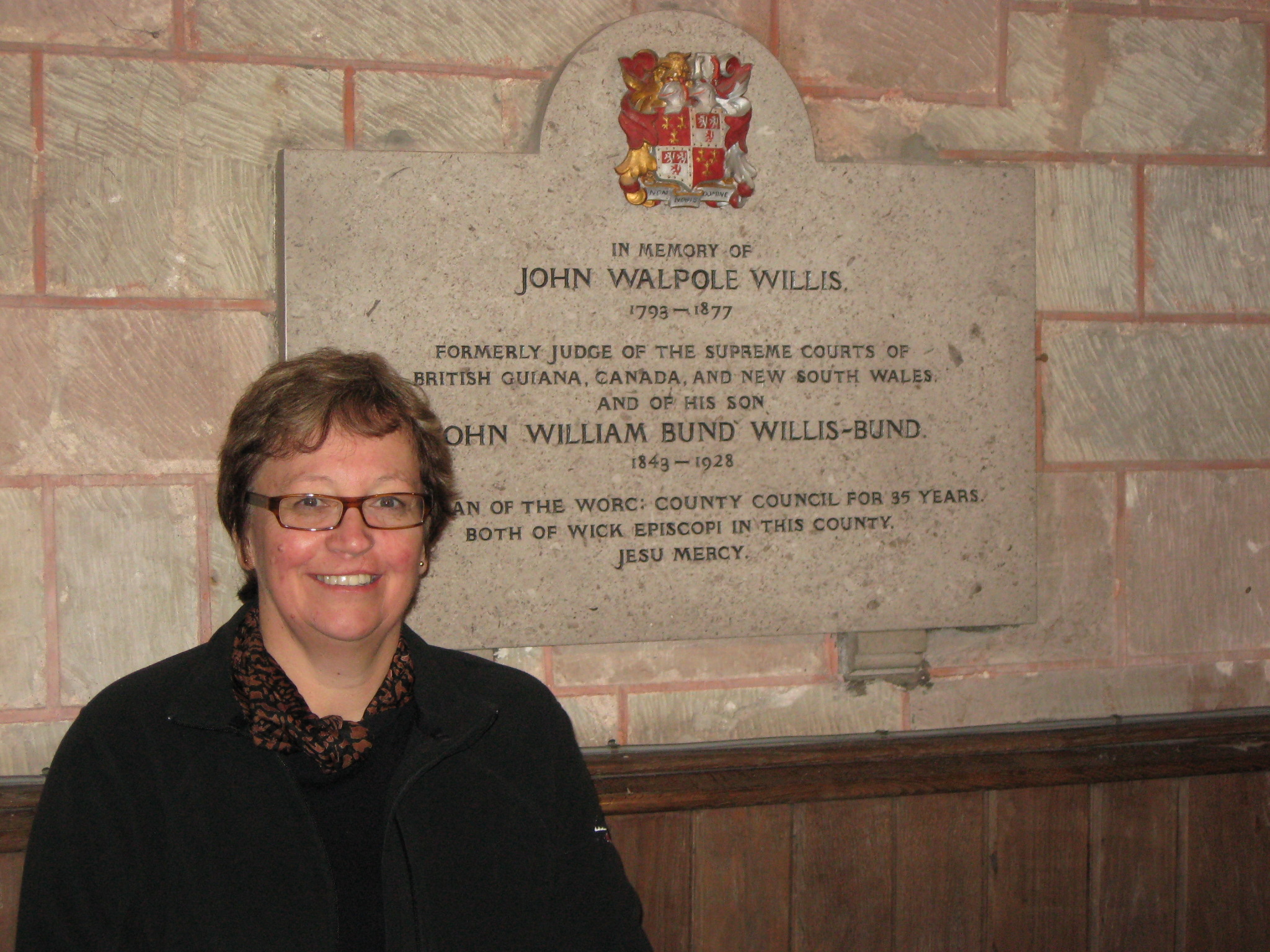
Ah- but J. W. Willis Bund hasn’t been forgotten- or at least his father hasn’t been.  They have been pursued all the way to Worcestershire by a woman from Melbourne, in the district of Port Phillip, Australia! And here she is (looking suitably maniacal) in the small local church in Powick, near the Wick Episcopi estate- found them at last!

(In case you can’t decipher the inscription, it reads:

In memory of John Walpole Willis 1798-1877, Formerly Judge of the Supreme Courts of British Guiana, Canada and New South Wales, and of his son John William Bund Willis-Bund 1843-1928 Chairman of the Worc. County Council for 35 years, both of Wick Episcopi in this county. Jesu Mercy.)

So who was J. W. Willis Bund?  He was born at Valparaiso (the usual stopping place on the western South American coast for ships returning from Australia to England), on the trip home from Port Phillip, after his father,  John Walpole Willis, the Resident Judge of Port Phillip had been removed from office in 1843.  His mother was the daughter and heiress of Colonel Bund who lived at Wick Episocopi in Worcestershire, and on return from Port Phillip, Judge Willis and his family lived there on the maternal family estate too.  In order to inherit the estate, it was necessary for Judge Willis’ son to take his mother’s name as well- hence the Willis Bund  (although the Bund Willis Bund seems a trifle excessive). He was prominent in local affairs in Worcestershire: he sat on the County council, he established the local historical society, and he was a prolific historian and writer.  And yes, he did write the foreword to the Religio Medici mentioned in Sebastian Barry’s book.

So, how about THAT!

‘An Unruly Child’ by Bruce Kercher

1995, 205p.

Lest you think I do absolutely no work on my thesis at all, last night I finished reading Bruce Kercher’s ‘An Unruly Child’. The  blurb on the back of the book describes it as “a provocative re-examination of our legal history, appearing at a time when Australians are reconsidering both their past and their future”.

Kercher’s intent is to critique the official view as taught to law students that Australian law is English law with minor adaptations to meet local circumstances.  His book examines the contest over the nature of the law in Australia, the struggle between local and imperial officials, and between popular ideas and the official law. Kercher probably leans towards John Hirst’s view that right from its inception, the NSW colony developed practices that subverted imperial intentions for a purely penal society.  He argues that particularly between the introduction of the Supreme Court in the 1823 NSW Act, (and even more in the 1828 Australian Courts Act),  and the mid-19th century, there was a period in which colonial law officers were authorized and even encouraged to consider the applicability of English law to local conditions, and to modify it where necessary.  More liberal judges embraced this opportunity: more conservative judges resisted it.   At the same time, colonists themselves subverted legislation that hampered them- for example, squatters in the Legislative Council protected their privilege and opportunities for expansion through the Squatting Acts; they insisted on Bushranger Acts that have some parallels with anti-terror legislation today, and in some regards  e.g. insolvency legislation, Australian colonial legislation predated changes made in later decades to English law.

John Walpole Willis is mentioned in this book, but is given less consideration than Montagu in Van Diemens Land and in particular Boothby in South Australia- the two other “bad boy” Australian colonial judges.  Possibly Montagu’s actions were more overtly intransigent or complicated by financial scandal, while Boothby in the 1860s was an anachronism in post-responsible-government times.  As with so much with Willis, I’m still not absolutely sure that he fits entirely into a ‘conservative’ pigeon-hole.  But as Kercher points out, conservative and liberal legal beliefs  could have ironic  consequences.  For example, the ‘liberal’ Francis Forbes quelled his misgivings over the highly repressive bushranger legislation because he strongly supported local law making powers, while the ‘conservative’ William Burton imposed the death sentence on white attackers at the Myall Creek massacre in a radical letter-of-the-law interpretation that outraged white settlers.  As Kercher notes “Liberalism and conservatism did not always have predictable results” (p.107).