Category Archives: History writing

Memory and history

Collective memory? No. Myth and memory? Nup. It’s all about me- it’s the historian’s memory- or lack thereof.

I’ve been writing away for the past couple of weeks on a little topic in my thesis that has me all excited and flustered.  I’m not going to go into specifics- not that I want to keep it from you, of course, but I must be a little circumspect and besides, who will buy “Judge Willis the Soap Opera” if I divulge all here?  But I’ve been quietly rubbing my hands in glee, anticipating interest from well, all of about twenty people in a particular thing I’ve found.  It was, as my earlier supervisor John Hirst would have said “a knock-down argument”.

Except that I found it. And lost it. And now I can’t find it again.

It’s a letter that I’m looking for.  I thought that I remembered seeing it typed up amongst a collection of other letters.  I think I can remember a rush of excitement seeing it- AH HA! There it IS- in writing! And can I find it now?? No…

I’m rather obsessive about my record keeping. I could pretend that it’s because I’m a methodical person, but the truth of the matter is that, commencing this thesis at a relatively advanced age, I’m frightened that my memory is going to go before I get it written.  I know that I sound like a hypochondriac, but perhaps you should consider my mother’s strong family history (five of seven siblings) who have suffered neurological illnesses of one type or another.  I’m watching my mother’s brain slowly turn to cement, and I’m losing the Mum I love bit by bit.  So my fears are not completely groundless.

So, I turn to technology. In my research mainly I’ve been working on letters, dispatches and newspaper articles.  I have an Access database that lists them chronologically by writer, recipient, topic, location 1, location 2 (because many of these letters are found it several locations). There are literally thousands of them – 1444 the last time I looked.

Books and journals go into Endnote.

I’m a fairly quick touch typist (faster than I could write by hand) so it’s no hardship to type up documents and I code them in NVivo.  N Vivo is intended as a qualitative research software program, but you can use it to code the themes in any sort of document or artifact.  I use it at a fairly basic level for data recovery only.  When you want to find all the material you have coded on a particular theme, it collates it into one document.  When I type up notes on a book or journal, it goes into NVivo as well.  Of course, this is the weak spot- if I don’t code the document, then I won’t find it in NVivo.  But I usually print out a hard copy and tick off on the top once I’ve put it into Access (if applicable), Endnote and N Vivo.

So how have I lost this letter?  I just don’t know.  I have a fairly vivid dream life- did I just DREAM that I read it?  I can’t work out why I didn’t make a note of it somewhere; why I just put it back into its plastic sleeve. And yet I have my chapter plan written a couple of weeks ago where I can see that I thought then that I had read it.  I must have read it in-between entries on my other ‘secret’ blog that I write about my thesis-writing because I don’t mention it there.  I’ve found one small reference, and another letter that perhaps I had misinterpreted.  Did I just misread it? Did I conflate the two?  I’m distrusting myself, and that’s not a good thing.

For those of you writing history, how do you keep a track of everything you have?

Kathleen Fitzpatrick and Jessie Webb

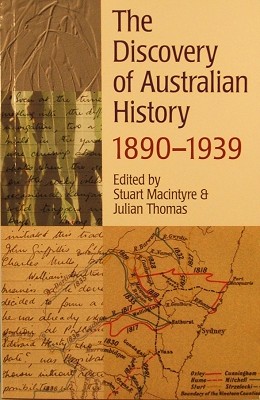
In Macintyre and Thomas’ book The Discovery of Australian History 1890-1939, two chapters are devoted to Kathleen Fitzpatrick and Jessie Webb– both from the University of Melbourne.  As the editors point out, there were no women appointed to chairs of history between the years 1890-1939 or indeed, until much later. I’ve just been flicking through the ADB to see if there were others they could have included and women historians are certainly thin on the ground, despite the fact that women made up a large proportion of history honours students.

I recently heard a pod-cast about Jessie Webb, (picture here)  presented by Ron Ridley at the Royal Historical Society of Victoria in May 2009.  You can download his talk here (lots of other good podcasts here too). Ridley wrote the book Jessie Webb: A Memoir in 1994.  Such a long career, with so much experience in teaching history- senior lecturer, acting professor-  but as was common at the time, not really in the running for a chair in her own right.

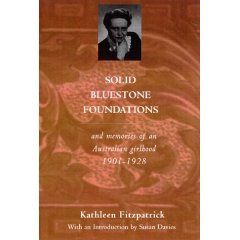
As for Kathleen Fitzpatrick, (picture here)  I read her book Solid Bluestone Foundations about eight years ago, before I returned to university.  I wish I had time to re-read it: at the time I enjoyed it mainly as a memoir of 1920s upper/upper middle class, privileged Melbourne.   The granddaughter of the J.P. Buxton real-estate founder, and the daughter of a Catholic/Protestant marriage, she always felt under-educated (despite attending Melbourne’s best girls’ school at the time) and certainly Oxford sneered at her colonial degree.

I haven’t read her work on Sir John Franklin (as it happens, I’m reading a book about Lady Jane Franklin at the moment just for fun), and she didn’t ever publish her work on Charles La Trobe which I certainly would have read, had it been.   Susan Davies, who wrote the chapter on her in The Discovery of Australian History, suggests that perhaps she abandoned her La Trobe biography because Alan Gross had entered the field with a competing biography, although she may well have decided not to continue before this.

In fact, she seems to have doubted her own ability throughout her career, in a way that does not seem apparent in the other male biographies in Macintyre and Thomas’ book.   Here she is, writing to Max Crawford in 1951, after the reviews of her book on Franklin began to appear in the Australian and English journals and newspapers.

Thank you for the kind words from the Bulletin of Historical Literature on Franklin, which bring balm to a bruised soul.  The bruising was caused by a review in the Times Literary Supplement of March the 9th.  Why doesn’t one, at one’s advanced age, and in view of not being inexperienced in the art of being slapped, why doesn’t one cease to mind? I minded so much as to stay awake all night and then to get violently sick.  Not that I was denounced.  It was just another summary, plus a few derogatory remarks, calculated to make the whole performance seem dull beyond words, and slightly ridiculous.  Not one kind word, even for my hard work, which indeed was only a cause for reproach, ‘overloaded with the minutiae of petty affairs’ or words to that effect.  Of course I know and tell myself all the answers, such as that a writer should be concerned with his work and not with his reputation etc…  (Davies in Macintyre and Thomas p. 163)

So very human and symptomatic, I suspect, of a male-dominated intellectual environment where women’s achievements were easily overlooked.

References:

Susan Davies ‘Kathleen Fitzpatrick: Sculptor with Words’ in S. Macintyre and J. Thomas The Discovery of Australian History 1890-1939,  Carlton South, Victoria, Melbourne University Press 1995.

Susan Janson ‘Jessie Webb and the Predicament of the Female Historian’ in S. Macintyre and J. Thomas The Discovery of Australian History 1890-1939,  Carlton South, Victoria, Melbourne University Press 1995.

Also:

Jayne’s review of Solid Bluestone Foundations here.

‘The Discovery of Australian History 1890-1939’ ed. Stuart Macintyre and Julian Thomas

1995, 191 p.

I borrowed this book from the library primarily for its chapter on S.H. Roberts,  the author of “The Squatting Age in Australia 1835-1847”.   Despite my intention to read only that chapter, comments on my post about that book and discussion here and here regarding what we would now call “political correctness” and historians led me to read the whole book.  I certainly do not profess any great knowledge here at all: I have read only this one book and a couple of other bits and pieces.

My gut-feeling was that the question of political correctness was anachronistic( i.e.  relating a phenomenon to the wrong time), and having read this book, I found nothing to disconfirm that view.  The book, edited by Stuart Macintyre and Julian Thomas (both of whom contributed a chapter) is a series of biographical sketches of key figures of the first and second generations of academic historians.  The focus is not so much on biography, but on the “profession and discipline” of history, both personally and as a field of intellectual endeavour.  Because of its time-span, the “sandstone” universities only are represented: George Arnold Wood and Stephen Roberts at Sydney; A.V.C. Melbourne at Queensland; G. C. Henderson and Keith Hancock at the University of Adelaide;  Edward Shann at the University of Western Australia;  Ernest Scott, Jessie Webb, Kathleen Fitzpatrick and Max Crawford at the University of Melbourne..

It is sobering to remember that until the 1890s, there were only three universities- Sydney, Melbourne and Adelaide.  At the University of Sydney prior to Wood’s appointment, history was included under the umbrella of natural history, or part of the classics. The University of Adelaide offered a chair of modern history and English language and literature. History had long been taught at the University of Melbourne, closely associated with political economy, law and the classics but the early holders of the chair were not recognizable as academic, research-based historians.  For many decades, there would only be the one professor at the single university in each state, with one or possibly two assistants and he – always ‘he’- would lecture across all history subjects presented. (A post on the women in this book will have to wait for another day).

The selection of any one professor was often not in the hands of the university at all- the University of Melbourne for example, delegated an English selection committee, based in England, to make the appointment.   Universities resisted what they perceived as government interference: at Melbourne, the chair had included history and political economy, but the second field was dropped in expectation of State government funding for a separate chair of economics or political science.  This funding did not eventuate because the university would not agree to the government’s stipulation that the new post be filled by one ‘whose views and training accord with Australian traditions and conceptions of economic matters’. (p. 72).  In their selection practices, and the talent pool to which they looked, Australian universities were integrated into an Imperial network.  Without exception, these academics gained their post-graduate qualifications  in England- predominantly at Oxford, with one or two in London.

And  to the extent that these Australian historians were involved in politics at all, it was generally at a British Commonwealth level through various Commonwealth bodies and sub-committees. They also contributed to ABC broadcasts as public intellectuals.  Two economic historians, however, played policy roles within government. Shann was very much involved in a sub-committee of the Australian Loan Council during the 1930s and later on a committee investigating unemployment under the Lyons Government- an involvement that he was later criticized for.  A.V.C. Melbourne was heavily involved in imperial trade policy.  As far as “political correctness” is concerned, George Arnold Wood seemed to have been affected most by it: after criticizing the British government for taking military action against the Boers, he was given only one lectureship up to 1916 and he felt that the university was unjust to him. Nonetheless, his appointment spanned 1891-1928.  The blurb on the back of the book writes that:

The path was not an easy one. The times and the institutions were conservative, resistant to change and new direction.

Institutional conservatism is clearly apparent but political conservatism less so. Certainly many of these historians had deep-seated political beliefs (Shann, for example was a Fabian; several of them embraced Liberalism) and publicly participated in the elite and  intellectual milieu of their societies. The chapters in this book do not pay much attention to the content of the histories produced by these historians, but there seems to be no suggestion that they tempered the narrative of the histories they wrote for the political government of the day.

The history discipline itself, across the world, underwent a huge change during these years as it shifted away from an antiquarian and chronicling emphasis to adopt von Ranke’s emphasis on primary sources.  Here there was fertile ground.  It was these historians who were involved, with others, in the compilation of the grunt-work of Australian historiography- the Australian Dictionary of Biography (Keith Hancock) and supporting,  the compilation of Historical Records of Australia (Wood and Henderson, among others; Scott was involved in writing a rather critical report on the project). It’s hard now to imagine that these sources were ever not available, but Henderson wrangled for five years with the Secretary of State for the Colonies, with the support of successive South Australian governors, over access to government dispatches, enclosures and reports relating to South Australia. The Secretary of State refused to give general access to records beyond 1837, although was willing to consider special cases for records up to 1860 and perhaps beyond (p. 39). When you look at the index, there is reference throughout the book to the  Australian and New Zealand Association for the Advancement of Science, the major professional body to which these academic historians belonged.

In the introduction Macintyre and Thomas note that the essays in their book

resist the temptation to chart a clear line of historiographical progress, whether in the form of an evolution from literature to science, or in the emergence of Australia as the subject of narrative or analysis, or the growing prestige and sophistication of the university. (p. 7)

I felt as if there was a qualitative difference between the chapter on Max Crawford, and the other chapters- as if there was a fundamental shift that occurred at the end of the timeline of this book.  The Cold War was no doubt largely responsible for this, as well as the ushering in of a more mass-oriented tertiary education system. I’ve just been looking, through Google Books, at the introduction and conclusion to Fay Anderson’s book  “An historian’s life: Max Crawford and the politics of academic freedom” . In her conclusion, she observes that selection committees considered the political affiliations of candidates for academic posts from the 1930s (p. 372) and suggests that the study of self-censorship among historians would be a fruitful area for research.

Certainly, I felt in reading these essays that they described a different world, a different intellectual milieu.  The huge expansion of university education in the post-war years brought a whole new environment with more students, a broader pool of historians vying for academic posts, a more defined set of local academic peers, and less integration with the imperial academic network.   All of this is much more familiar to us now, more conducive to intellectual jousts over the content of one’s history and I suspect, more responsive to party-political pressures than this earlier, elitist and empire-driven era.

‘The Suspicions of Mr Whicher’ by Kate Summerscale

304 p. 2008

It seems that after reading Curthoy and McGrath’s How to Write Histories that People Want to Read, I have picked up, one after the other, two books that would qualify-  Nicholas Shakespeare’s In Tasmania and now this one,  The Suspicions of Mr Whicher by Kate Summerscale.   This book won the Samuel Johnson Prize for Non-Fiction in 2008, and also bears the designation “New York Times Bestseller” on the front cover.

The book describes the true-life murder of a three year child in 1860, taken from his bed in the nursery outside the bedroom of his parents Samuel and Mary Kent, and found with his neck slashed and body wrapped in a blanket in the outside privy. The family that lived in this three-storey Georgian house was not a happy one.  It was a second marriage for Samuel Kent; the older children of the first marriage had been relegated for the second family; the new Mrs Kent was not all she seemed at first.  Suspicions mounted about the relationship between Mr Kent and the nursemaid who slept in the bed beside the murdered child, the sanity of the daughters of the house, the probity of the servants: the case opened the lid on the fug of family relationships amongst what otherwise appeared to be a respectable, prosperous middle class Victorian family.

The book takes a careful chronological approach with only what I marked as one example of foreshadowing that suggested that the outcome was known to the narrator.  Instead, events and evidence unfold bit by bit, complete with the false-starts and false-leads of any investigation,  and the narrative closely follows the newspaper articles and legal documentation generated by such a notorious case.  I hadn’t heard of the case at all but I assume, given that the murderer ended up depicted in Mdme Tussuad’s waxworks, that the case has more notoriety in England even today.  For someone completely unfamiliar with it, I wasn’t sure right to the end- and even then….?

But this is more than just a country-house murder story: instead it is a closely-grained and grounded study of domestic Victorian life and sexuality, the development of “the detective” as a profession and the relationship between the press and Victorian fiction.  The detective, Mr Whicher, is a lower-class employee in a newly-developing profession, and class sensitivities emerge over what is perceived as  his puerile probing of domestic relationships and middle-class respectability, and the derisive sneering of the popular periodical press.  Summerscale embeds this true-crime story within a broader study of the detective-novel as a literary phenomenon, both at the time in the work of Wilkie Collins and Dickens, and later as a literary genre much loved of BBC Friday night dramas.

The book is carefully footnoted and researched; there are maps and photographs, and an extensive bibliography.   Its chronological structure makes you feel as if it is unfolding before your eyes and it’s quite a page-turner.  And surely that qualifies it as “History That People Want to Read”.

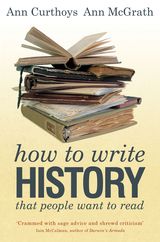
‘How to Write History that People Want to Read’ by Ann Curthoys and Ann McGrath

2009, 238 p.

This book is exactly what the title says it is: a how to book on writing history.  This no-nonsense approach pervades the book- it’s a real [clap] “Come on! Get stuck into it!” sort of book.  It could have, but wisely has not, been called “History Writing for Dummies” because it shares features of those little yellow books- the cheery, confident tone, the jokes that make you groan, the dot points,  the anecdotes and the bubbling optimism that of COURSE you can write history that people want to read!  I must admit that there’s something about all this bustling, practical advice that brings out the long-lost teenager in me.  I want to roll my eyes, toss my head, and mutter “der–” (the ultimate expression of nonchalance and superciliousness in my adolescence- I warned you that it was some time ago).

Except that it is so damned practical and, yes, good advice.  The book is aimed at a wider readership than just  PhD student- it also has family historians and local historians in its sights.  It is very simply written, with short sentences which at times seemed  just a little patronizing.  But of course, this is a book of advice and it does not pretend to be other than this. Clarity and  a certain amount of  firm direction is fundamental to the act of giving advice: I must remember that a bit of humility and preparedness to listen is fundamental to gaining from it.

This book starts from the beginning, right from conceptualizing your history project and your projected audience.  It has good, practical advice about archives  and the how-to of working with sources , then moves on to the writing.  It was at this point that I stopped my eye-rolling and read more carefully because writing, and thinking about narrative and action, character and the emotions  is right where I am at the moment.  And this is probably the real strength of this book; at some stage it is going to connect with you as history-writer at some point in the cycle.  In this regard, you could buy it at the start of your thesis or project, and dip into it usefully for a bit of a kick up the backside or a dust-off after a setback when you need it. The examples they used from a range of histories were well-chosen; you didn’t need to know anything about the content, and the text guided you to look through the content to the technique.  The discussion of footnotes, grammar and punctuation again had me tossing my head with impatience -until I’d come across something that I thought “oh really? Is THAT the difference between a colon and semicolon?” and “You mean that my examiners won’t even READ my quotations?”.  At times I bridled at the decisiveness of their approach but when I came to areas that for me are foggy and ill-defined, the clarity was reassuring.  I suspect that  I am very bad at taking advice.

The trouble with aiming at a broad audience is that sometimes, in order to avoid alienating one audience, the needs of another audience are put onto the backburner.  As a postgraduate student, I yearned for a chapter about analysis.  They do mention analysis, but its difficulty is downplayed by giving it equal billing with themes and chronology as a narrative problem.  I think that analysis is more than this: it goes to the heart of the endeavour; it is what makes history more than just a good story.  It might be stripped out of histories for publication so as to attract a wider audience; it might be over-kill for a local or family history, but for an academic thesis there  is a fundamental assumption that your thesis says something, means something beyond just the narrative at hand.  This is the real work of history,- it’s the part that makes your head hurt- and it’s hard.

I almost didn’t read this book when I first heard about it because I thought that I had read it before. But no- that was an earlier book (2000)  by the same authors that has been recently re-released: Writing Histories: Imagination and Narration.  It  is an edited collection of papers by contributors to a Visiting Scholars Program workshop for fifteen very lucky post-graduates, and is a who’s who of Australian historians who I admire deeply:  Tom Griffiths, Bill Gammage, Donna Merwick, Greg Dening, John Docker, Deborah Bird Rose, Peter Read and of course Ann Curthoys and Ann McGrath themselves.  This book, in many ways, supplied my “missing” chapter, even though I found it rather daunting.  In my reading journal after reading this book I wrote:

I can’t say that I feel empowered- intimidated more like it; overwhelmed by other people’s erudition and breadth, and feeling stodgy and constipated!

It’s a pity that the two books aren’t released by the same publisher, because they would be a wonderful combination within the same volume.  The prose and vision doesn’t exactly soar in “How to Write History” but it is warm, encouraging and empowering.  The virtuosity and incisiveness of the historians talking about their craft in “Writing Histories”  while inspirational, can be almost paralysing.  As an aspiring history writer, I need both.  I need to be beckoned onwards by those up ahead of me;  I need the grip of a confident, more experienced friend at my arm, and  a damned good shove from behind as well!