Category Archives: History writing

How many historians does it take to write a history book?

I see here that fifty historians  assembled at the recent AHA conference in Launceston to commence work on the new Cambridge History of Australia, scheduled for publication in 2013.  Fifty historians??!!!  Ye Gods!

Who are they, I wonder?  Will they divide into teams for specific chapters or sections? Are there lead writers with the rest as advisors?  Will they write collaboratively? Fifty!

‘Teaching Scholarship’ by Caroline Walker Bynum

The Facebook page of the Australian Historical Association had a link recently to ‘Art of History’, a column in the American Historical Association’s Perspectives on History publication.  The column contains essays by established American historians writing on the art and craft of historical writing.  Such copious advice is probably best taken in small doses, so I’ve been enjoying reading slowly, one article at a time.  The first link is to an article from 2009 called ‘Teaching Scholarship’, and a thought-provoking little article it is, not just for a clapped-out and inactive educational designer (as I am) but for historians more generally.

Caroline Walker Bynum, a professor of European medieval history,  starts by pondering what ‘scholarship’ is and comes up with a checklist for what it means for a historian in particular,:

Hard work in archives and libraries without taking shortcuts through the research of others; integrity of citation from primary sources and secondary authorities; thorough grounding in earlier work (and not just that of the 1990s or later); situating of specific conclusions in complex historical contexts; genuine discoveries and original questions, not just a rehash of current theories; and always, always the struggle to ensure that the issues raised are appropriate to the material at hand, that it is not pulled out of shape by contemporary concerns or anxieties…

These values, she suggests, are not part of the baggage that the young undergraduate, or even graduate, brings to history.  The American education system (and I suspect that much of this is true of the Australian system as well) encourages students to “do research” by cutting and pasting primary sources, predominantly from the internet.  By pushing students to move beyond this approach, she claims that college instructors have (albeit unintentionally) encouraged what she calls

a sort of hypercriticality that may undercut—even while it in some ways enhances—what they need in order to be scholars. We have taught them to be critical of where they find material; we have taught them to expect bias and to study authors for it; we have taught them to ask questions of their material, not just “accumulate facts.” All to the good. But in the process we have perhaps led them to think that when they have “critiqued” someone else’s position, they have found one of their own; that the work of the historian is to find the flaws in how others put things; that the task is finished when they have contextualized—as part of a “school” or a “trend,” a political commitment or an “identity position”—someone else’s conclusions. And such contextualizing or “critiquing” often means demolishing. We reward the cheekily worded rejoinder, the clever diagnosis of bias in their supposed elders and betters. It is hard to teach any other way when one needs to engender skepticism about the vast wash of material available out there in cyberspace.

But, she argues, beyond these so-called “critical skills”, there are those values of scholarship that she started her article with, and they often run counter to the quick demolition-job of hypercriticality

We value patience and the ability to postpone gratification until we get something right. We value the silences in our sources more than the speed with which we obtain results; and we are willing to slow down, to read again, to listen to what is not being said, in order that we may spot unlikely possibilities. We assume we are in continuity with the work of other scholars and that the best work is not necessarily the most recent. An archivist in France in 1900, for example, or an archaeologist in Mongolia in the 1950s may have gone further than a recent theorist who knows the basic material less well. We understand that the purpose of a footnote is not so much to disagree with someone else’s argument or call attention to our own interdisciplinary reading as to express gratitude to those earlier scholars without whose work we could not make progress ourselves.

She talks about techniques she uses to encourage this mind-set in her students. One involves getting students to review a review as a genre, to appreciate its demands and to break the reliance on oneupmanship and paraphrase.  A second activity involves getting students to critique a lengthy footnote by following up every source that it references, and to assess- positively or negatively- the relevance and strength that such sources bestow on the argument.   It is only at this point, after students have been alerted to the demands of reviewing and imbued (hopefully) with some sense of  humility, that she asks them to write a book review.

All of this touches on some of the insecurities I feel myself in writing reviews on this blog.  I sometimes come into contact with the authors of books that I’ve reviewed, and while I expect that they’re largely oblivious to the fact that I’ve written about them, I wonder if I’d be quite as confident making my comments to their face.  Sometimes I wonder at my own presumption in commenting on someone else’s achievement in something that I could only dream of: at other times, I wonder at my own presumption in even thinking that what I’m doing even matters at all!

How I work with my material- Access

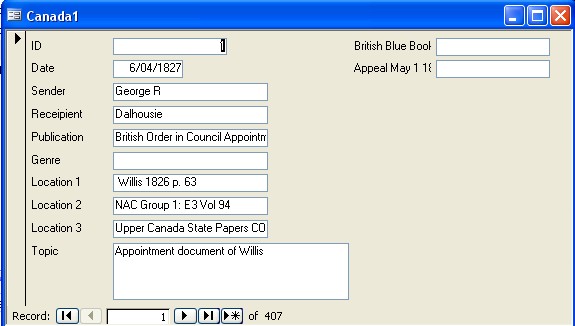
Big disclaimer upfront: my knowledge of Access is minuscule.  I bumble around and am fully aware that there are probably a million things that I could do with it, but can’t be bothered learning.   They speak of “just-in-time” learning- well, as far as Access is concerned, I have “just enough” knowledge for it to do what I need.

The British Empire, bless its cotton socks, was very good at one thing (at least) and that is information control.  Let’s imagine a letter written in Port Phillip about some little brouhaha that Willis might be involved in.  It would  go to Superintendant La Trobe as inward correspondence; he would make some comments on it in a covering letter and send it to Gipps in Sydney as outward correspondence; it would arrive there as Gipps’ inward correspondence and then he would make further comments in another covering letter and send it all to the Colonial Office as a Governor’s outward despatch.  It would arrive in London some 5-8 months later, be minuted by various public servants as it moved from desk to desk in the Colonial Office, making its way to the Secretary of State for the Colonies, then the reply would move back in the following direction.  All of this would be numbered, and entered in inward- and outward- correspondence letter books.

Beautiful though this system might be, it does mean that a single letter might appear multiple times in LaTrobe’s, Gipps’ or the Secretary of State’s archives, and may appear yet again in collections of correspondence bundled up for a special report.  Likewise for my Canadian material,  I’m working from a single archive divided up into separate files in my computer, and thus of no use to anyone else but me in finding where it is in my own records.  But each document also has its own numbering used in other archives and microfilms- and this is the information that is important for footnotes.  What I needed was a way of identifying an item and noting all the different numberings it might have in the major archives that I am working in.

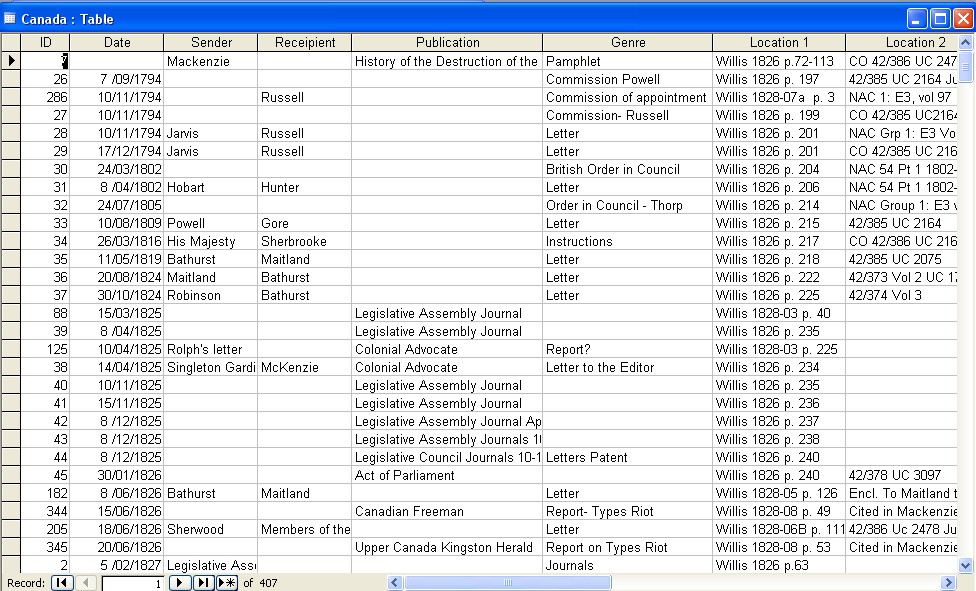
So I have developed a very basic database that shows the date of the correspondence, the names of sender and recipients, enough identifying information for me to know what it’s about, where it is in my own computer files and then the number it has in the major collections used by researchers generally that I would record in a footnote.

I stop at three locations- there are no doubt more, but this is probably enough.  The majority of entries relate to correspondence, but I also put newspaper articles in as well.   When I view it as a table, it runs chronologically.

I feel a little sheepish admitting to such a paltry database.  It is an idiosyncratic little thing, of minimal use to anyone else, but invaluable for me- and that’s probably the most important thing. No doubt others would say “But why don’t you use ——- instead?” and they’d probably be right.  I think, though, at some stage you need to stop shopping around for the perfect program, and just sit down and start putting some data into it and using the damned thing.  When I reach its limitations and become frustrated, then I’ll either learn the extra functions I need within the program, or  look for something else.  In the meantime, this works okay for me and I’m just getting on with it.

How I work with my material- NVivo

What’s NVivo? you may ask.  It’s a qualitative data analysis software program that I use to keep control of the data that I’m gathering as part of my research.  You can read more about NVivo here. 

I first came across NVivo in its earlier incarnation as NUD*IST, which was a much more playful and memorable name.  I am still using NVivo 7 because my clapped-out old laptop here wouldn’t download NVivo 8, and now I see that there is an NVivo 9.  Fortunately I use mine under my university’s site licence (I think that it’s very expensive) and for now the older versions are still available.

NVivo (or NUD*IST in its earlier life) was developed originally by Lyn Richards, a sociologist at La Trobe University, and it reflects many of the time-honoured ways that academics work with data anyway-  identifying major themes and points (which often found their way onto index cards); highlighting themes in a particular document with different coloured pens, cutting up documents to group all the themes together etc.  NVivo does much the same thing, digitally.  And because every project is different, and because people work differently, no two NVivo outcomes would be the same.

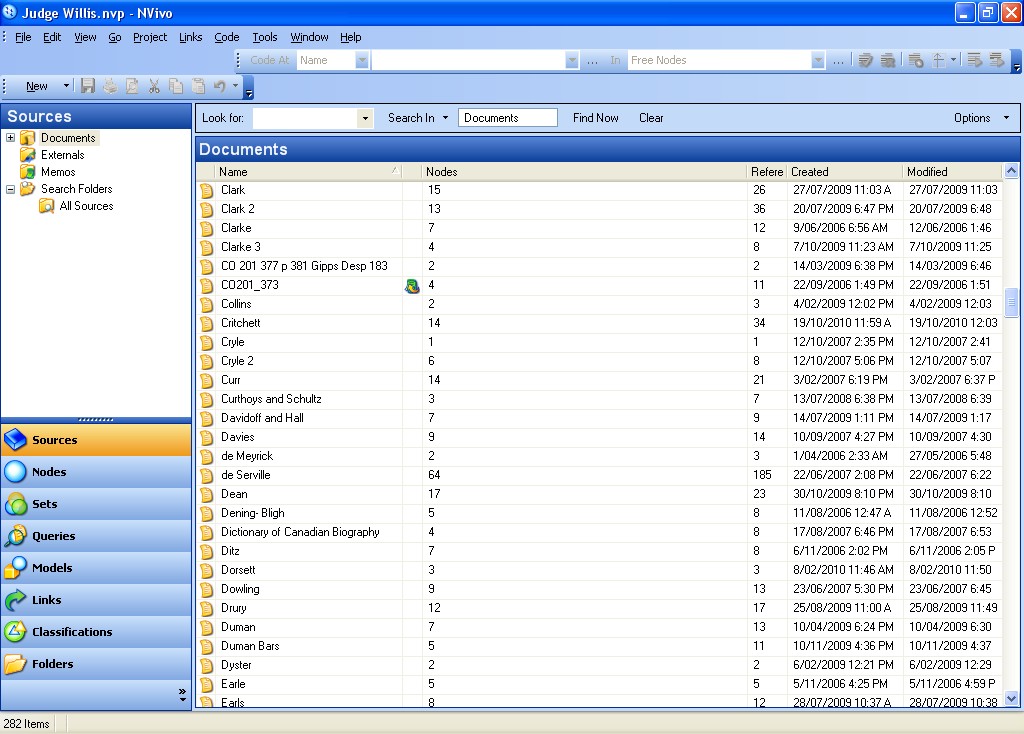
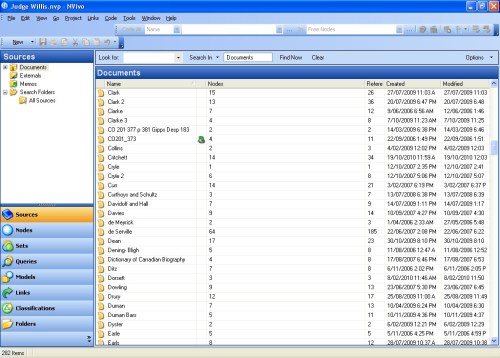
First you need to put a document into NVivo.   This isn’t a problem for me as I type up notes on the computer as I go.  Here’s a shot of all the documents or ‘sources’ that I have about Judge Willis in Melbourne.  Some of them are full transcribed documents, others are my notes.  If I have the document in hard copy or saved as a PDF elsewhere, I might save it as a ‘proxy document’ with a very stripped down content skeleton, with the expectation that I can go back and look at the full document easily.
When you have a document you identify the themes in it.  You call these themes ‘nodes’, and it’s just like tagging, or using a different coloured highlighter pen for each theme.  You develop the themes as you go along.
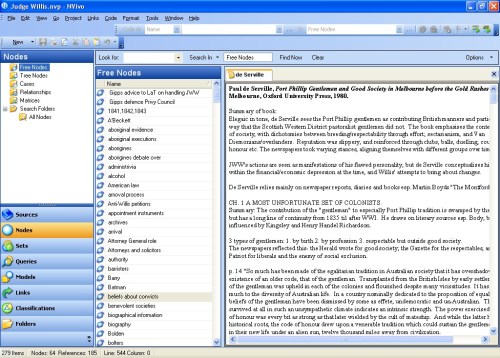
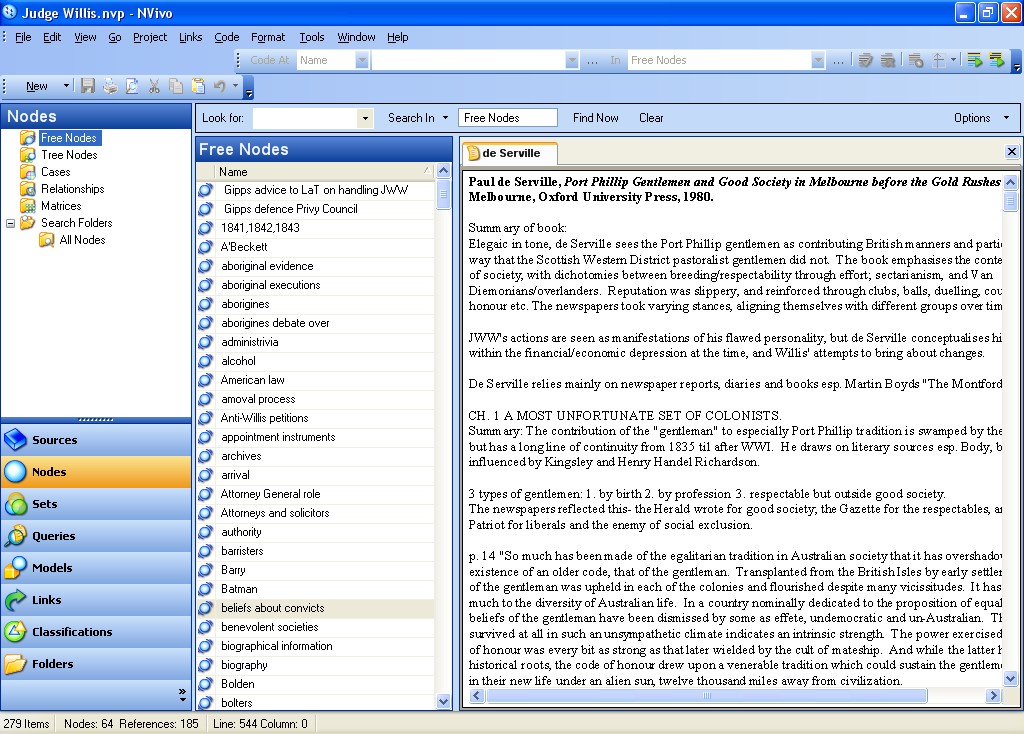
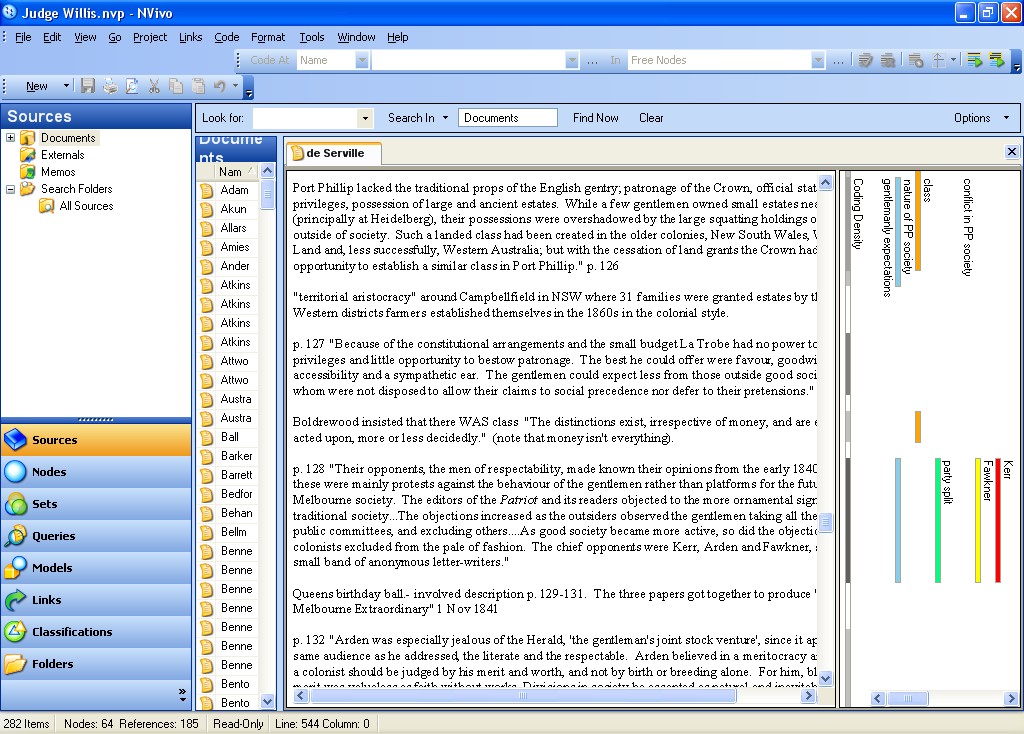
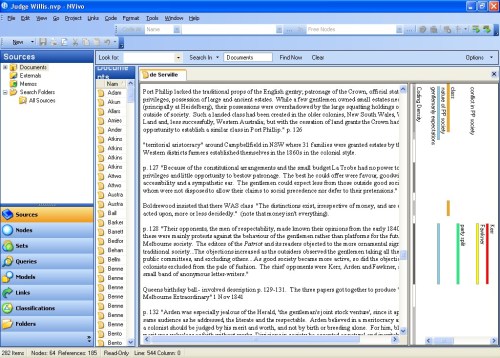
So, in the picture about, I might be reading Paul de Serville’s ‘Port Phillip Gentlemen’, and I might notice that a paragraph is about ‘authority’ or ‘class’ or ‘gentlemanly expectations’.  I would highlight the paragraph and select the node on the left hand side, or create a new node if it was something that I hadn’t come across before.

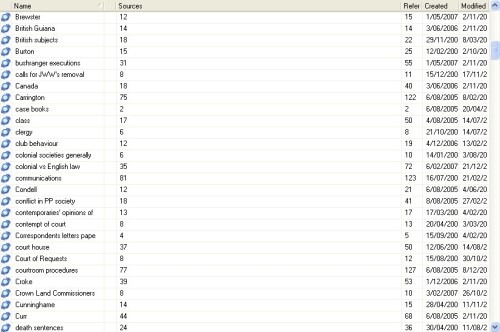
This means that you develop a long list of nodes that you’ve identified across all your documents.  You can group related concepts into ‘tree nodes’ or just leave them alphabetical as shown below.  Because you have developed the nodes yourself, you get to know what is there and move around it quite quickly.  When you’re working with a particular document it  also collects the nodes that you’re working on as you go along into a drop-down menu, and as they tend to recur, it means that you’re working with a smaller set. But here is my master list as of today of the Port Phillip nodes I’d developed. If I worked on a new document tomorrow and identified new nodes, they would be added to the list.
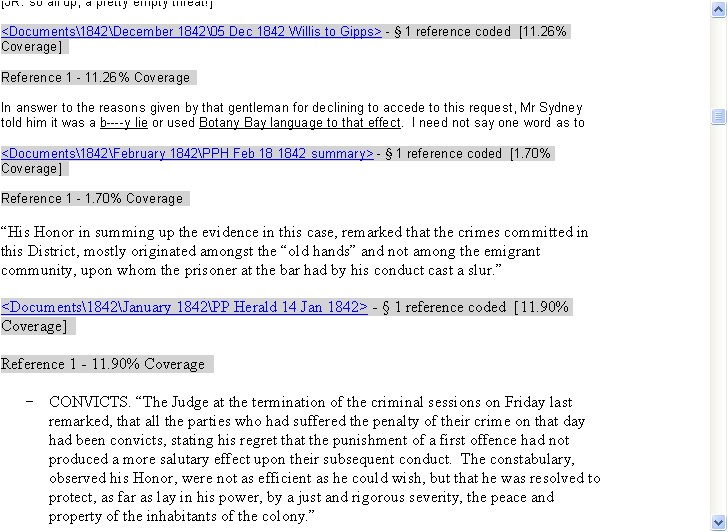
So if you want to find, for example, all the documents that you had tagged as being ‘beliefs about convicts’, then you can bring them all up onto the one page.
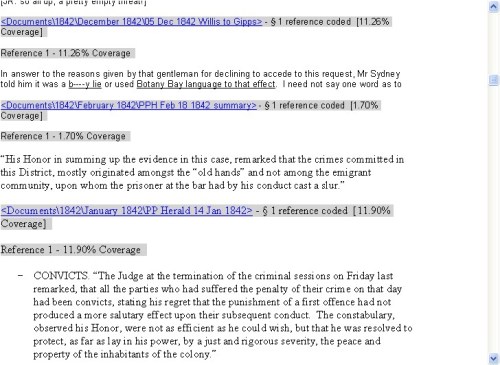
If you click on the underlined hyperlink, it takes you to the source document where you coded it in NVivo.  It’s better not to code great slabs of material; just enough for you to get the gist and then go back to the source document for the surrounding material.  The real advantage of this is that it means that you don’t forget about material that you read years earlier, especially once it mounts up.  It also brings together the primary and secondary material again when the tendency is to develop the tunnel vision of “now I’m working on letters”, forgetting about the insights you’d discovered in secondary sources. You can write ‘memos’, which are your own reflections on a particular point, which can also be coded and thrown into the pot as well.

You can also go back to a particular document (or ‘source’) and at a glance see the themes that you’d identified in it. For example, here’s my screen for Paul de Serville’s ‘Port Phillip Gentlemen’. At p.128 I’d found information about ‘the nature of Port Phillip society’, ‘party split’ ‘Kerr’ and ‘Fawkner’ and coded that paragraph accordingly.
It is intended that you develop the nodes as you go along which means that at some stage they become big, baggy unwieldy monsters.  At this stage you need to think- do I need to split this concept into smaller nodes? Or alternatively, you find that you’ve made several nodes that are really talking about the same thing-  are they really separate concepts? would I lose some particular quality of the concept if I combined two similar nodes?

It does also mean that sometimes documents you read earlier in your research have concepts that were not apparent to you at the time, but that’s true of research generally.  At least with a digitized program like this, you’re likely to come across the documents again under a different code and can go back and add extra codes as you go.  It’s intended that it keeps growing and changing.  For me, it’s certainly more dynamic than having notes filed in hard copy in folders where you forget you’d ever even seen the document at all.  It also means that my own fleeting reflections in ‘memos’ are brought back to life again.

As I said, I’m using an old version and I note that NVivo 9 has fixed up one of the real bug-bears – being able to see the codes while you’re actually coding- which for some reason you could no longer do, even though very early versions of the program did have this feature.  It would be worth getting NVivo 9 for this feature alone- in fact, it may even prompt me into splashing out for a new computer.  It also claims that you can use PDFs but I’m not sure- earlier versions claimed this too but it only worked for OCR’d or text-based PDFs – not image based PDFs which it inevitably seemed mine were.  I usually just save the PDF on the computer and make a proxy document (i.e. a dot point summary)- it’s too time consuming mucking around with it.

The drawbacks?  The major one is the fear that the whole system is going to crash and that you’ll lose everything.  Also, there is the limitation that you can only get out of it what you put into it-  it takes discipline and routine.  I type up my notes, save them,  print it off  (yes, I do keep hard copy- 2 sheets to a page), put it into Endnote, put it into NVivo, code it,  tick on the top of the hard copy that it has been endnoted and N-Vivo’d and then file it  in a ring folder alphabetically by author. The folders on my bookshelves are multiplying alarmingly.   It also has to be an ongoing process-  I have to be prepared to go back and fix up the deficiencies in the coding when I happen upon a document that I’d read early on, and sometimes this is a bit distracting. But this is the price of keeping it current.  I do have parallel systems: I also tag in Endnote and, to a lesser extent Zotero, which I use for  internet-based material and somewhat less methodically.

And the advantages?  Particularly with my family history of Alzheimer’s, I’m frightened of losing track of all this!  I think that any researcher has this fear, Alzheimers or not.  I’m relatively confident that I can put my hands on the main documents fairly easily.  When I’m working at a conceptual level, it’s easy to grab together all the examples of a phenomenon e.g. ‘loyalty’, and tease it out further because it’s all in one place.  Because primary and secondary sources are intermingled, then I  can find concrete examples relatively easily.  I’m very well aware that I only use it in a rudimentary fashion and that I could probably do other things with it, but I haven’t got time to learn them, and it works just fine for me.

Of course, it doesn’t always work, as this sad experience shows.  I still haven’t found the damned document that I was looking for, and I still don’t know whether it ever existed or whether I read into the document something that really wasn’t there.  In the end, I wrote around it and found other evidence that was good enough-  but I still live in hope that one day I’ll stumble across it again.

Uplifting Quotes for the Uninspired Historian #9

Not a historian this time but one of my favourite fiction writers, and not so much uplifting as interesting.  It’s the late Carol Shields from a short story I read last night called Collision. She’s talking about biography, not as a genre or literary construct, but as the live experience that we all accumulate around ourselves just through the act of being and living:

The only law of biography is that everything, every particle, must be saved.  The earth is alight with it, awash with it, scoured by it, made clumsy and burnished by its steady accretion… That’s the worst of it: there’s nothing selective about biography’s raw data, no sorting machine, no briny episodes underlined in yellow pencil or provided with bristling asterisks- it’s all here, the sweepings and the leavings, the most trivial personal events encoded with history.  Biography- it sniffs it out, snorts it up… (p. 315)

…Written biography, that’s another matter, quite another matter! Memoirs, journals, diaries. Works of the biog-imagination are as biodegradable as orange peels.  Out they go. Pssst- they blast themselves to vapor, cleaner and blonder than the steam from a spotless kettle.  Nothing sticks but the impulse to get it down. (p.316)

From ‘Collision’, Carol Shields The Collected Stories


Uplifting Quotes for the Uninspired Historian #8

Ged Martin, in Past Futures:  The Impossible Necessity of History, Toronto, Toronto University of Press, 2004

The original  lectures from which this book derives were delivered as part of the  1996 Joanne Goodman Lecture series, conducted annually at the University of Western Ontario. However, the closing chapter of the book  reflects on September 11, which indicates that this written version is far more recent.

One of the themes that runs throughout the book is the nature of decision making in history and the historian’s task in reconstructing it at a distance:

...historians must not simply embrace with gratitude whatever survives from the past. Rather, the whole process of historical reconstruction is one of dialogue, between our questions and their answers.   Sometimes that dialogue requires some sharp interrogation on our part, since there is often a mismatch between our concerns and their evidence…

A related problem, especially for those studying the activities of government, is that while historians ask questions about ‘why?’, most official records were designed to apply answers about ‘how?’. (p.22)

In fact, ‘why?’ is not the right question:

Unlike computers, people do not face an infinity of choices , but are usually obliged to select from a finite range of available options.  The real task for historians is to locate that moment in time and account for the range of options on offer- in short, to ask ‘why when?’ and ‘why what?’.   (p. 85)

Every decision is a double decision, requiring us to ask first, ‘why when?’ and only then ‘why what?’. The operative second part is the action of saying ‘yes’ or ‘no’ to the available options.  The historical core is to be found in that crucial first part, the decision to take a decision.  We should begin by seeking to understand not simply why a decision was taken but when it was taken.  This helps us to appreciate why, at that time, some options but not others were available to those making the decision. (p. 93)

Far too often, historical analysis begins by pressing the pause button on a videotape of the past.  The historian traps the characters to be studied in the awkward attitudes of the moment, and proceeds to explain how they had come to relate to one another in that frozen past present.  We need rather to ask which of the characters captured on the screen contemplated some form of future, in the hope of recovering how they shaped their actions in the moment of their past present to meet those futures.  Were their perceived futures short-term or long-term in scope, optimistic or pessimistic in character.  Were they adjusting to the collapse of previous assumptions about the road ahead or coping with the sudden arrival of a destiny that had previously been perceived as only a distant possibility….

Such an approach means that historians must place less emphasis on explaining static moments in the past, an exercise that is in any case impossible, and more upon locating those events in a longer sweep of time.  In other words, we must approach the study of history by seeing past, present and future as a single continuum.  Only thus can we enter into the world view of the people we study, to recapture how they reached their yes/no decisions in response to the propositions that confronted them at that ephemeral instant when they too stood on the moving frontier between their own past and a future that they could rarely foresee but never ignore. (p. 147)

Now that you mention it…

I was reading a fairly old book of collected essays on Upper Canada the other night.  It was the 1975 edition of Historical Essays on Upper Canada edited by J. K. Johnson.  There has been a second collection of essays  released in 1989, again edited by J. K. Johnson but  joined by Bruce Wilson this time.

It interested me that in the introduction to the 1975 book, Johnson noted that one of the themes of the essays was a preoccupation with economic affairs.  He wrote:

It is probably no accident that the preoccupation of historians of Upper Canada has often been with economic affairs- with the study of growth, of the metropolitan dominance of Toronto, of agriculture, of business firms, of lumbering or public works. It is true that Upper Canadian society showed a propensity to produce or adopt contentious public figures who have attracted the attention of historians, but the great majority of Upper Canadians were from the very beginning engaged in the more mundane business of developing the resources which the province had to offer- engaged in other words in the business of making a living, and wherever possible, in making a profit, a fact of Upper Canadian life which has been rightly stressed in historical writing.  If historians of Upper Canada can be said to have created an overall view of any kind it is of a society generally concerned with its own (mainly economic) betterment but in some dispute about the best ways of achieving that goal  (p. ix)

Now actually that he mentions it, I had noticed that much of the history I’ve read of Upper Canada has a strong economic history focus.   I don’t really think that Australian history has the same emphasis.  There’s Shann’s old Economic History of Australia written in 1948, and the Butlins whom I’ve written about here who also write economic histories.  Blainey’s work, especially The Tyranny of Distance makes an argument with strong economic strands, but it doesn’t have the tables and figures that mark so much of the Upper Canadian material I have read (which is, to be fair, often chapters and articles).  Nonetheless  I’d be hard pressed to think of a recent general book about Australian history that has a really strong economic focus.

Johnson’s justification for the emphasis on economic history among Ontarian historians would hold just as true for Port Phillip which was likewise established by people wanting to make money.  But again, I don’t think that this is the case. A.G.L. Shaw’s  A History of the Port Phillip District is a narrative history that includes a strong economic analysis, but it is just one strand among several.  Likewise the three volume Priestley/Broome/Dingle series published for Victoria’s 150th anniversary- the economic story is there, running steadily underneath, but not the main focus.

I can really only think of one academic on staff whom I would characterize as an “economic historian” and only one of my fellow postgraduates has written an overtly economic thesis.  Several of my colleagues are writing environmental histories, but they are of a different hue.

I’m aware that historical specialisations wax and wane, and that some institutions attract particular schools of historians.  But I’m wondering if there’s some cultural influence at play here too- a variation of the ‘tall poppy syndrome’ perhaps?

Uplifting Quotes for the Uninspired Historian #7

Greg Dening yet again.

Yes, imagination is an act of solidarity in our humanness. But there is a dilemma in that.  The humanness we share with the past is at the one time the same and different.  The most unhistorical thing we can do is to imagine that the past is us in funny clothes.  Our imagination has to allow us to experience what we share with the past and see difference at the same time…

…When we empower the past by returning it to itself, we empower our imagination to see ourselves.  Our certainties are our greatest enemy when we approach the past.  Hindsight is always blinding.  We know from our living experience that our present moments- this moment- has all the possibilities of the future still in it. None of us prescribes the reality we live in.  None of us controls the consequences of our actions.  None of us can predict with absolute certainty anybody else’s reaction tot he simplest gesture, the clearest sign, the most definite word.  But we have to cope with these ambivalences, interpreting these never- ending possibilities.  Hindsight, on the other hand, reduces all possibilities in the past to one.  Hindsight leaches out not all our uncertainties, but all the past’s uncertainties.  Hindsight closes down our imagination.  In hindsight we do not see the past as it actually was, only as it would have been if all its uncertainties were taken away.  Hindsight freezes the frame of every picture of the past.  Hindsight removes all the processes of living.  Makes the past our puppet.

From Empowering Imaginations 1998

‘Good Men and True: The Aboriginal Police of the Port Phillip District 1837-1853’ by Marie Hansen Fels

1988, 227 p. plus appendices and notes

In her book, Marie Fels warns of a number of ethnocentric blindnesses and misconceptions, and I’m afraid that I’m guilty of at least three of them.  The first, she says, is to simply not see the presence of the Native Police and I’m certainly guilty of this.  I’ve been aware of them in my reading on Port Phillip, but hadn’t particularly considered what they might be doing there.  Then I noted that Jan Critchett attributed the turning point in aboriginal/settler “collisions” to their skill in pursuit and this notion fed, I suppose into my second misconception- that the Port Phillip Native Police Corps, like the Queensland Native Police Corps which was later modelled on it, was responsible for atrocities against aboriginal people.  And this, in turn, reflects my third ethnocentricity: the assumption that the act of joining the Native Police Corps was a form of treachery, undertaken only by marginal men who would be ostracized by their tribesmen because of their involvement .

Instead, Fels argues, the men who joined the Native Police Corps were leaders of clans or their heirs.  They willingly joined with Europeans in policing work: policing in its pre-Peelite manifestation as ‘keeping the peace’ rather than ‘upholding the law’, and certainly more than just tracking.

Joining the Native Police Corps is best seen as a strategy in the direction of sharing power and authority in the Port Phillip District, in the changed environment of the powerful and permanent European presence.  Besides the material things that police could see they would get, an opportunity was put before them of becoming men of standing within their transformed world.  They took it, and furthermore, they used it.  They bent it back, exploiting their acquired prestige and influence to operate within traditional group politics, to such effect that while the Corps was in existence, these men were the powerbrokers… Being a native policeman was a state of dual consciousness and divided loyalty; it appears not to have been a matter of rejecting Aboriginality, but rather of learning to live in two different worlds (p. 87)

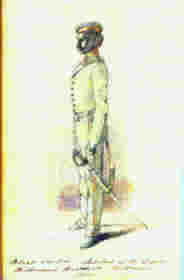
The men of the Native Police Corps were proud of their uniforms and they kept them in immaculate condition; they craved guns but rarely used them “on the side”;  they were able to read the nuances in status between white settlers, and they operated in a number of roles including escorting,  taking messages, guarding, search and rescue and a highly visible ceremonial role within white society.

Although men of  the Warwoorong and Bunerong tribes (her spelling) from around Melbourne initially formed the heart of the unit, they were not just 20 troopers drawn solely from those tribes, as it has been described in the past.  Instead she has identified over 140 individuals drawn from various tribes across Victoria- even, though to a lesser extent, from the Gippsland tribes who were the traditional enemies of the Warwoorong/Bunerong federation.  One of her appendices gives the biographical details of five such men, and she refers to the full 114 page version of the appendix that she attached to her thesis,  available at the University of Melbourne, which covers the other men.

Good men and true?  Dana, their commandant certainly thought so, and was staunch in his defence of his men.  For there were, and are, rumours that the Native Police Corps itself was involved in the slaughter of aboriginal people- indeed the Native Police themselves bragged of it.  Here Fels, likewise, springs to their defence, drawing on statistics about ammunition and weaponry to undercut the claims of multiple shootings; querying the motives of men who made the reports to La Trobe,  issuing cautions about the reliability of any Aboriginal evidence, and challenging the ready acceptance of Aboriginal reports of ‘many’ being killed.  While this may be true, it is an argument that must be balm to Windschuttle et. al who query the statistics over white atrocities as well.  Is there an ethical responsibility in using a line of argument that could be picked up and used to make a contrary, and possibly abhorrent point?  Or is there an intellectual responsibility NOT to resile from an argument out of fear that this might occur?   The line between challenging misconceptions and inaccuracies on the one hand, and defensiveness on the other  is a narrow one, and at times I felt that she over-reached a little.  But even she admitted her uneasiness about reports of the Native Police Corps in Gippsland, the territory of their enemies far from the reach of authority, and her credibility was strengthened by her caution here.

Top of the list of her acknowledgments is Greg Dening, and the book is dedicated to him.  I can see his influence here, in the way that she walks around an episode, reading against the record, stepping away and  reminding us:

Always the first question to be asked when examining the action of the Corps is ‘What was the nature of the traditional relationship?’ (p. 157)

I feel that the typesetting of her book did her a disservice, though.  The book is a densely woven argument and more white space would have given her reader a little more oxygen.  At times she launched into examination of an episode without warning and I’d screech to a halt wondering “Hold on- do I know about this? Has she talked about this earlier?” only to read on for a couple of paragraphs to realize that I’d been dropped into an episode for some close-up scrutiny.

In her introduction she stakes her claim:

Part of the task of the historian is to recognize that the issues which kindle interest and shape enquiry do emerge from the cultural present, but the written end-product succeeds or fails according to how well the historian has understood and explained the past on its own terms. (p. 5)

This book challenges our conceptions of the role of the Native Police Corps and its meaning for its participants and those who encountered it at the time.  I’ll leave the last word with her in her own closing paragraph, because it’s a strong argument:

To recognize that they were the victims of the European takeover of their land is one thing; to write a history of the origins and growth of the contemporary sense of oppression is another; but to impose the attitudes of the present on the evidence of the past is ahistorical, producing the effect of leaving out of our histories the evidence of creative and adaptive Aboriginal strategies such as this one- becoming a native policeman. (p. 227)

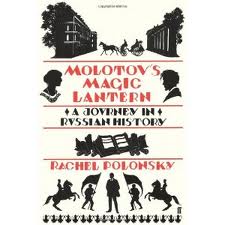
‘Molotov’s Magic Lantern: A Journey in Russian History’ by Rachel Polonsky

Rachel Polonsky Molotov’s Magic Lantern: A Journey in Russian History, London, Faber and Faber, 2010, 369 p.

One of my fellow students is writing a thesis about the status of family history and genealogy  within historiography more generally.  Is the  distinction always clearcut? I wonder.  After all, there are historians who write books that,  while not academic histories as such, combine elements of family history and broader history (Henry Reynolds’ Why Weren’t We Told? and Anne Summers The Lost Mother spring to mind).  In fact, just today I read a fascinating study by Cassandra Pybus of the negro ‘Commodore’ of Port Jackson (see citation below) where Pybus pursues, and  then interrogates, all those archival minutiae that are the family historian’s quest.  Richard Holmes’ Footsteps of a Romantic Biographer, which I enjoyed so much and have cited so often,  is a long reflection on methodology, arranged through the device of a journey.  Then  there are those popular historians/journalists who write books that combine history and travel (Simon Winchester Outposts, Bill Bryson even?).

So when I read a  glowing review of Rachel Polonsky’s  recent book Molotov’s Magic Lantern: A Journey in Russian History, I snapped it up.  Rachel Polonsky, Rachel Polonsky- where have I heard that name?  Then I remembered: she was involved in the recent academic brouhaha over Orlando Figes and Amazon reviews- see her perspective here.

Two personal libraries are the pillars of this book.  One of them was the library owned by Molotov, kept intact and largely untouched  (more through inertia than intent) in his apartment at the Romotov Lane building,  where Rachel Polonsky herself lived in while she was in Moscow many years later.

‘Have at it,’ the banker had said in his charming smoky drawl, dangling from one finger the keys to his apartment.  He had rung our doorbell early as he passed on his way down the stairs. ‘You’re the scholar, you’ll know what to make of it all.’

We had met the evening before at his welcome-to-Moscow party in one of the other Romotov apartments.  Over my champagne and his Jack Daniel’s, I told him, in my fumbling way, that I was some kind of fugitive academic, not really a journalist, working on a novel.. (p. 1)

…Our conversation picked up animation when he told me about Molotov’s library.  I already knew that the apartment he had moved into (immediately above our won) had been the Moscow home, in the last years of his long life, of Stalin’s most loyal surviving henchman. I did not know that some of Molotov’s possessions had remained in place- left there by the granddaughter who now let the apartment to international financiers- including hundreds of books, some inscribed to him or annotated in his hand, now apparently forgotten, in the lower shelves of closed bookcases in a back corridor. (p. 2)

And there it was- Molotov’s wood-paneled library- with a magic lantern in the corner that, when you cranked the handle, showed a succession of slide images; a carpet from the Shah of Iran on the floor, and books, books- some with the pages left uncut;  some inscribed to him; others underlined and annotated.

The second library was that of the Russian scholar, Edward Sands, who died a few weeks before the author took up her Cambridge fellowship.  He had died intestate, and not knowing what to do with the chaos of books and papers piled in his room among old shoes and half-empty medicine bottles, the bursar asked her to sort through them, working out which should go to the university library, and which should be given or thrown away. (p. 6)  Three years later, her husband called her from Moscow, encouraging her to join him.  She told herself and the fellowship that she would be back after a spell of 18 months working in the great libraries of Moscow and studying orientalism in Russian poetry.  Her eighteen months became ten years.  (p. 10)

These two libraries, then, are the foundations on which the book rests.  In her travels throughout the streets of Moscow,  down around the sea of Azov, up to the Finland border and across to Siberia and the Mongolian border, she reflects back on the  books and authors represented on the shelves of these two libraries.  There are many of them, but some are repeated again and again: Mandelstam, Akhmatova, Chekov, Dostoevsky, Pushkin, Shalamov, Marina Tsvetaeva.   Events and historical figures appear and re-appear as well: Molotov himself, Stalin, Lenin, Napoleon Bonaparte, Peter the Great, Tsar Alexander I, Catherine the Great- and with a burst of currency, Putin, Medvedev and the assassinated journalist Anna Politskovskaya.  Underpinning all this, like a ghastly merry-go-round tune is the repetition of repression, exile, and cruelty, repeated by the Cossacks, the Tsars, the Bolsheviks, Stalin- and she suggests, Putin too.  The reference of the rotating magic lantern in the title is apt- people and events flash before our eyes, disappear, only to reappear again later.

There are many, many names of people and places and Polonsky has supported her readers as much as she could with clear maps and a generous index. Ah- but there are so many names and I felt as if I needed to be taken up to the linchpin ones,  formally introduced to them and told “Remember this person- she’s going to be important”.   Unlike  more journalistic travel books (e.g. the Winchesters and Brysons), Polonsky did not give a rationale for the journeys she undertook, and so there was a sort of aimlessness to the book.  It could have been three chapters longer: it could have been three chapters less- the end came because she chose to end it there, but the journey itself did not demand it.

Her final chapter, however, does bring it all together.  By the end of the book, I realised that names and stories had become familiar, almost without my being aware of it.  I’m not particularly well-versed in Russian literature: I find myself becoming anxious over the profusion of characters and the similarity and length of the names, and this same concern that perhaps I’m not ‘getting it’ did steal over me at times with this book. But I closed it with a feeling that the deficit lay more in me than my guide, and I was sorry to leave my perceptive, erudite travelling companion.

References:

Cassandra Pybus ‘ The Old Commodore: A Transnational Life’   in Desley Deacon, Penny Russell and Angela Woollacott (eds) Transnational Ties: Australian Lives in the World, ANU e-press, 2008 available online at the publisher’s website [It has nothing at all to do with Russia, but it’s a fascinating read!]