Category Archives: History writing

Australian Women Writers Challenge 2013

awwbadge_2013

Well, I did it in 2012 and I’ll do it again in 2013. I’ll probably read quite a bit of fiction because I tend to anyway, but this year for the Australian Women Writers Challenge 2013,  I want to concentrate on Australian Women Historians writing Australian History.

Last year Yvonne Perkins in her blog Stumbling Through the Past analysed the gender balance of book reviews in three major Australian history journals.  She found that by and large, History Australia and Australian Historical Studies have a fairly even gender balance the books that are reviewed (with even a slight leaning towards female writers), while The Australian Journal of Politics and History had more reviews of male authors.  It’s an interesting post- read it here– and it spurred her to develop a list of books written by women historians.

To be honest, I was surprised that there was such strong gender balance in two of the journals she analysed, because my perception is that more books are written by male historians.  I did a little detective work myself, counting the books in the ‘Australian Studies/Australian History’ section of Readings bookstore in Carlton.  Whatever the breakdown in the book review section of the major Australian historical journals, on the shelves male historians romped it in – only 28 of the 95 books I counted were written by women.

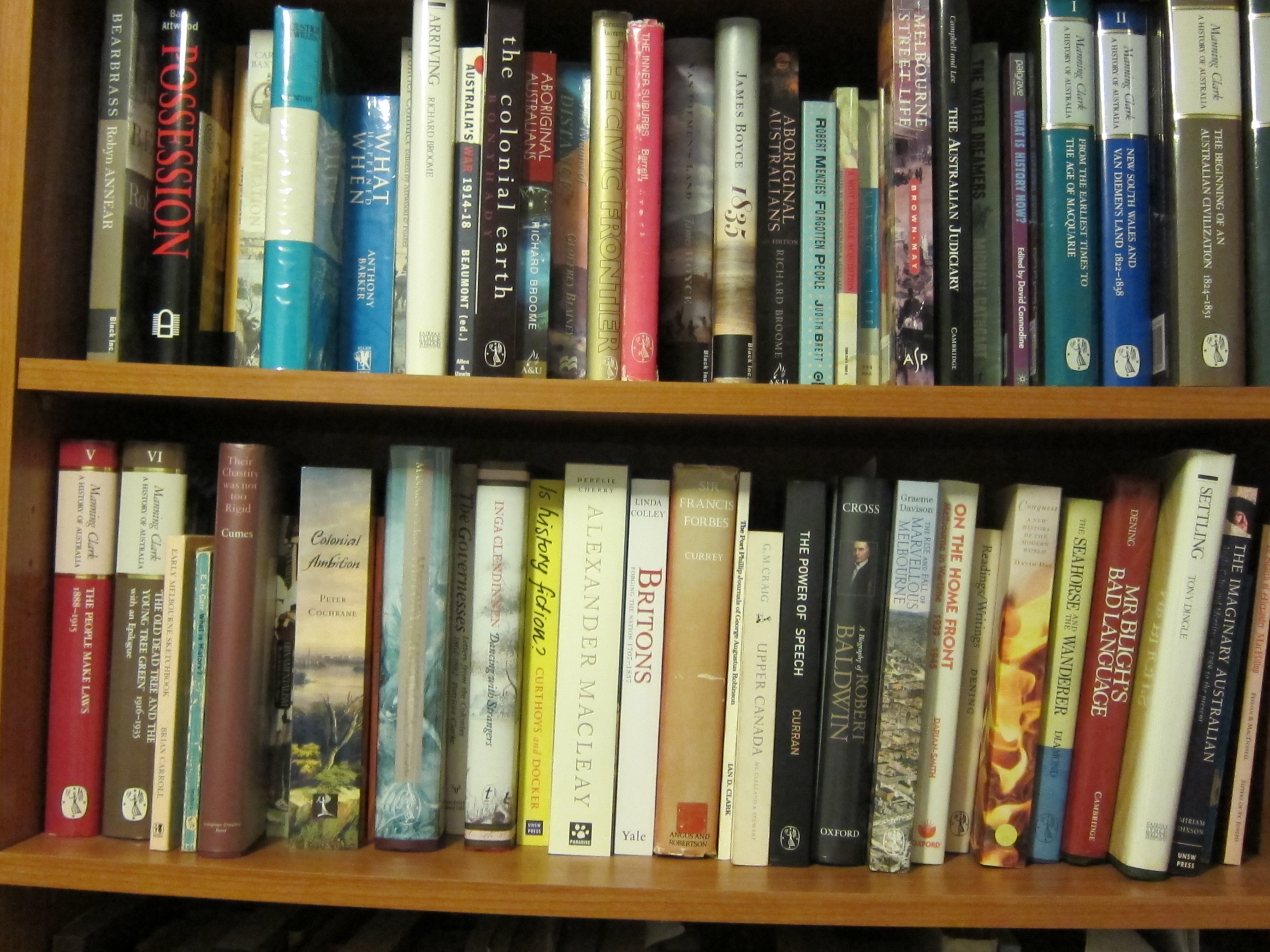
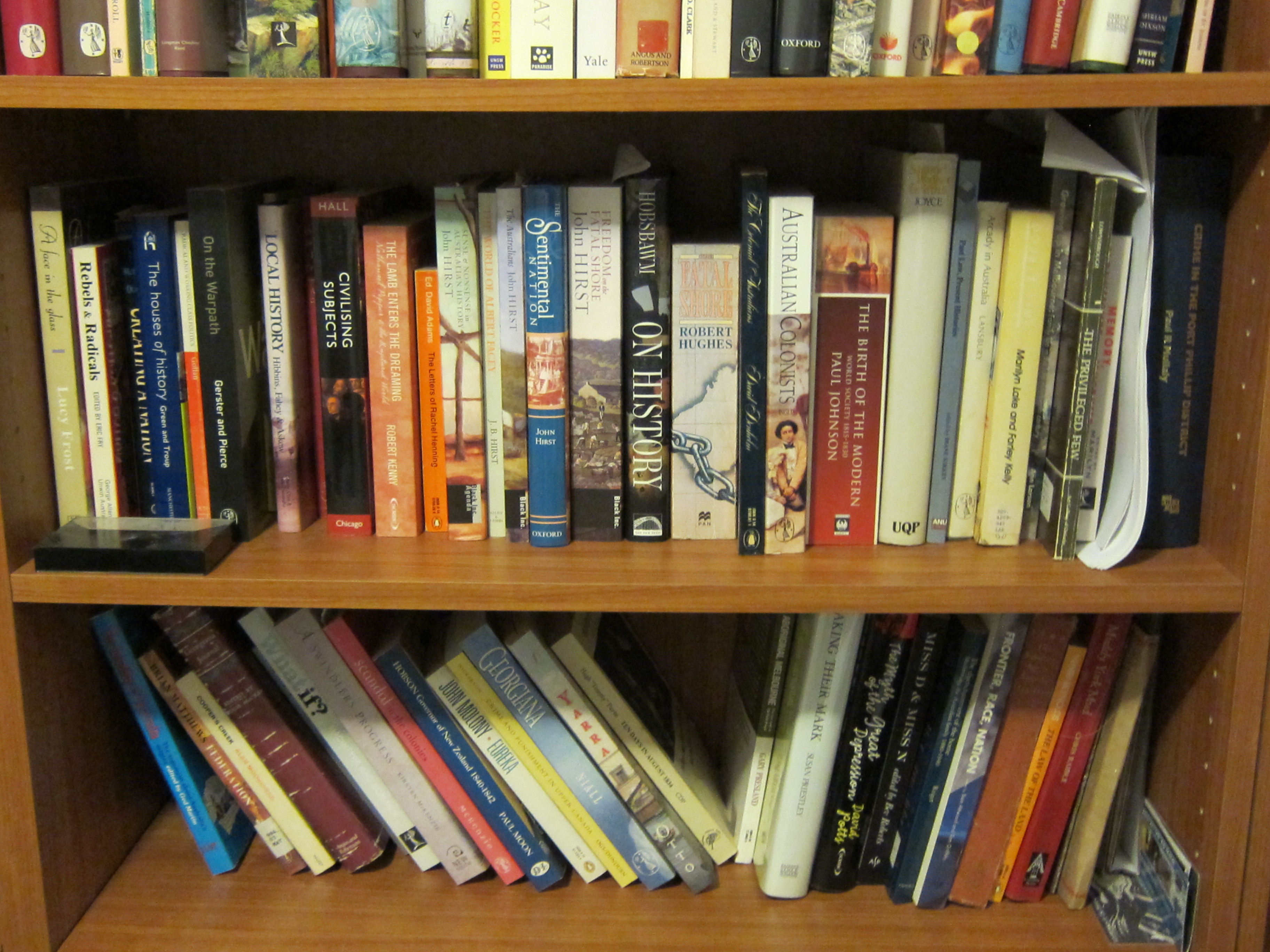
And certainly, if I turn my head to the left and look at my own bookshelves, there are many more books written by male historians.  I can think of a number of reasons for that.  First, I don’t very often buy history books new (whereas I do buy second-hand) and so any bias in the past will be reflected in the books I buy. I really am trying to have less clutter around, and so I borrow from the library, and try not to buy. But I’m often attracted to the remainder bin, the ‘Specials’ table and the second hand bookshop, and the piles of books that academics put outside their door when they’re cleaning up their offices…..and my bookshelves show the result.
IMG_0194

IMG_0195

Second, my area of interest is nineteenth century colonial societies in white settler nations- especially Australia and Upper Canada.  It’s a fairly old-fashioned sort of interest now, and was mined fairly heavily in the 1960s and 1970s.  I’m coming to it imbued with all the ‘isms’ and ‘turns’ of the past fifty years, but I must admit that many of the books on my shelf are terribly dated- and the bias towards male authorship in the 60s and 70s shows.

Finally, and related to this, early women Australian historians writing Australian history had a hard time even being recognized as academics, let alone published academics.  Some time ago, I wrote a post about Kathleen Fitzpatrick , a historian at Melbourne University who wrote, but abandoned, a book on Charles La Trobe that she had been working on for some time.  There is a suggestion that she withdrew from the field because another (male) historian was writing on him as well, and she didn’t want to compete with him.

Just recently, I read an article called ‘ The Writing of Australian Biography’ by M. H. Ellis who is depicted in his Australian Dictionary of Biography entry as just the sort of male historian that one might want to step back from.  It was published in Historical Studies (Vol 6, No. 24, May 1955) after being read before Section E of the Conference of the Australian and New Zealand Association for the Advancement of Science held at Canberra in January 1954.  I disagree with much of what he says in his paper, but what really struck me was the language. I’m sure that any female biographer with the audacity to even sit in the room slunk away quietly, well aware that she had no right to be there:

 No very young writer, hastily scrambling over a rich reef of documentary material, is likely to have the natural insight to enable him to distill from it a living image that will appeal as being the stuff of life to readers of diverse ages and mental outlooks in different periods, and inspire confidence in any picture he may draw of the mind and motives of a man of mature years… Nothing but slow filtering of essentials through the sieve of parallel experience can teach one man what makes another man function and behave as he does and enable him to put his findings down on paper in a manner to convince those who have endured or are enduring life that he is setting down truth.”(p 434)

Or how about this one?

There must be in all true biographers a natural and honest bias toward good principles, which are the yardstick by which men are measured.  Biographers should be the most human of men and subject to the decent prejudices and preferences which guide the ordinary citizen.  It would be right against human nature if such men did not involuntarily exhibit their likes and dislikes, their amusement or lack of amusement, their approval or disapproval, if they write from the heart.  But if he tries to suppress or falsify his natural emotions, then the biographer’s work becomes sodden dough or dead meat or false in note.  But in any case the chances are that when his subject takes control of his imagination he will be at his mercy if the man is worth writing about.  (p. 437)

Just imagine if a female biographer wrote about a female subject!!…ah, but would she be worth writing about??  It is sobering to think that this is the intellectual climate that our early women academic historians operated in.  It makes their few publications even more significant.

And so, for my Australian Women Writer’s Challenge this year, I’d like to consciously read and review some histories written by women.  Where possible, I’ll look for histories related to my thesis to review, but I’ll try to review them as a reader, rather than for the contribution they make to my own work. I did review a couple of histories for the Australian Women Writers Challenge last year, and I found myself consciously trying to make my review more general than I might have otherwise, and I’ll take the same approach this year.  Other histories I find, that are unrelated to my own work, I’ll be reading just as anyone else would, as I won’t have much pre-existing knowledge to bring to the book.

I often feel a bit diffident about reviewing books when I know that I’m going to run into the author- which is quite likely when reviewing Australian History books by Australian historians.   I get an attack of the M. H. Ellis-es, and I feel that I really have no right to review and that I should just slink out of the room.  But I shall stand tall (take that M. H. Ellis!!), knowing that on the few occasions when the connection has been made “Oh, so YOU’RE the Resident Judge!” (and I cringe at the presumption of my blog-name), there has never been any unpleasantness- to the contrary, in fact.
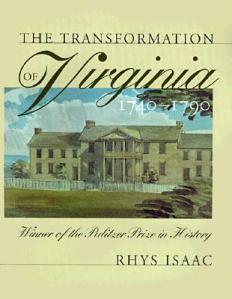
 

‘The Transformation of Virginia 1740-1790’ by Rhys Isaac

Transformation-of-Virginia-1740-1790-Isaac-Rhys-9780807848142

1982, 357 p

I have promised myself this book as a holiday reading treat.  I’ve been intending to read it for many years.  Rhys Isaac, who died in 2010 was a much-loved member of the history faculty at my university, and was one of the ‘Melbourne School’ of historians that I greatly admire (Rhys Isaac, Greg Dening, Inga Clendinnen, Donna Merwick.)  I would like to write my thesis within their historiographic tradition and approach- well, it’s something to aim for at least. So I approached this book with somewhat of a sense of reverence and with an eye to the writing up of my own work. Continue reading

Uplifting Quotes for the Uninspired Historian #15

Go on reading until you can hear people talking

G. M. Taylor (cited in many places including Today and Yesterday p. 112; and Last Essays p. 9 but I must admit that I haven’t actually seen it).

Uplifting Quotes for the Uninspired Historian #14: Keith Sinclair

Pardon the gendered language- it was written 35 years ago.

In biography, in other respects probably the most difficult form of historical writing, there is at least in principle a clear guide to what is relevant.  Biography is about a man, and the ideal data is that which seems to take us deepest into his or her personality, like Florence Nightingale’s Notes from God, or Alfred Deakin’s prayers.  Since he knows what is central, the author should know what  is peripheral.

Keith Sinclair ‘On Writing Shist’ Historical Studies Vol 13, No 51, 1968 pp. 426-432

Easy, huh?

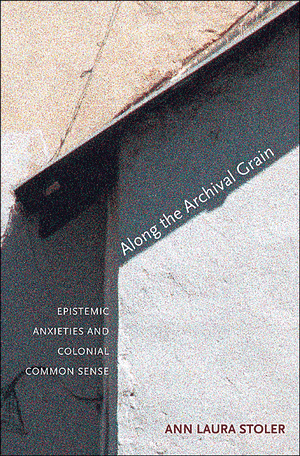
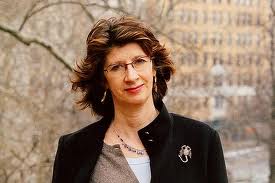
‘Along the Archival Grain’ by Ann Laura Stoler

Ann Laura Stoler Along the Archival Grain: Epistemic Anxieties and Colonial Common Sense, Princeton & Oxford, Princeton University Press, 2009, 278 p & notes.

It was only when I googled the title of this book that I realized that I’d been thinking of it under the wrong name: it was not, as I thought “against” the archival grain, but “along” the archival grain.  It’s an important difference, as the author points out.  While previous historians concentrated on compiling records from the archives in an accessible form- and this is particularly true of 19th century Australian historians like Frederick Watson and the Historical Records of Australia- now we are exhorted to read against the archive and to resist its hard-won accessibility.  But Stoler writes:

Some would argue that the grand narratives of colonialism have been amply and excessively told.  On this argument, students of colonialism often turn quickly and confidently to read “against the grain” of colonial conventions.  One fundamental premise of this book is a commitment to a less assured and perhaps more humble stance- to explore the grain with care and read along it first. (p. 50) …Reading along the archival grain draws our sensibilities to the archive’s granular rather than seamless texture, to the rough surface that mottles its hue and shapes its form.  Working along the grain is not to follow  a frictionless course but to enter a field of force and will to power, to attend to both the sound and sense therein and their rival and reciprocal energies.  It calls on us to understand how unintelligibilities are sustained and why empires remain so uneasily invested in them. (p. 53)

When I first returned to postgrad study in history after an absence of some thirty years, I was perplexed by other students’ references to “the archive”.  Where was “THE archive”, I wondered?  Was it some huge Borgesian labyrinth that had somehow escaped my notice, like Platform 9 3/4 in Harry Potter?  I’ve since realized that “the archive” is not so much a place, as a mental construct of the primary material that we draw on as historians.  Approaching “the archive-as-subject” worthy of scrutiny in its own right, rather than “the archive-as-source” that needs to be mined and extracted, reflects the “archival turn” captured  by Derrida’s book Archive Fever.  The link with Derrida and cultural theory might suggest to you that, in many ways, the writing in this book is rather dense and self-conscious, and it certainly is.  But it is also very careful, poetic writing.  The author weighs her words carefully, reveling in alliteration and paradox, and I found that I had to slow down and subvocalize while I was reading  to let the pleasure of the language wash over me.

The title hints at the theoretical emphasis of the book, but it makes no mention at all of the Dutch East Indies context in which it is applied.  I think that’s probably intentional.  Stoler has been writing about the Dutch Indies for decades- the earliest of her works that she cites was written in 1985- but this is a book borne of long years of immersion in a historical context and it moves far beyond that region.  It is a tribute to the accessibility of the book that I could read and enjoy it with minimal knowledge of the Dutch Indies, and come away feeling that I had learned a great deal (although I really would have appreciated a good map!)

The book itself is divided into three parts.  She starts with a two-chapter reflection on the archive itself and methodological and epistemological responses to it.  Part I which follows is headed “Colonial Archives and Their Affective States” where she examines three small, or even non-existent events in Dutch colonial historiography.  The first was a protest meeting held in 1848 against an edict that the upper echelons of the civil service would be restricted to young men who had been educated in the Netherlands; the second was a series of blueprints of state fantasies for solving the ‘problem’ of the Inlandesche Kindern, a shifting category that included Indies-born Europeans, and mixed bloods; and the third examined two commissions that were held into poverty amongst poor Europeans in the Dutch Indies.  Part II entitled “Watermarks in Colonial History” focusses on Frans Carl Valck, a lowly ranked assistent-resident whose unwelcome report on the murder of a plantation-owner’s family led to his hasty removal to another colony and eventual dismissal and subsequent complete disappearance from the official record. In this section she juxtaposes and interrogates two different archives- the official and the family- against each other.

Interestingly, she suggests in the prologue that

some readers may want to turn directly to these last two chapters that trace the biographies of empire, and may find it more compelling to read them first. (p. 51)

Ah- there’s a problem: when the author herself is not secure in the structure that she has,like all authors, eventually have to settle for.  Which to go for? Compelling reading or the structure that won out? I stayed with the chapters as laid down, but I wonder if it would have been a different book if I had read the last chapters first.  As it was, each chapter was quite self-contained, but it’s an interesting question.

I very much enjoyed this book.  It is a dense read, and at times I found the references to Derrida, Foucault, Rorty etc. rather overwhelming.  Check out the Amazon look-inside feature first, and you’ll quickly sense whether it’s a book that will appeal to you or appall you.  But it came at the right time for me, and it has stretched my thinking about my own work and even spurred me to WRITE a paragraph or two!

Uplifting Quotes for the Uninspired Historian #12: Hazel Rowley

I was saddened to read that Hazel Rowley died in March this year. It’s timely that I should write this post aware that the French department of the University of Adelaide is hosting a day-long tribute to her this coming Saturday 19th November. One of the  conundrums of the internet is the status of a website of a person who has died. Should it be left as it was? Does updating it somehow detract from its integrity, or does it honour the person’s ongoing relevance? Hazel Rowley’s website has been taken down this route by her sister.

I enjoyed reading Rowley’s 2007 LaTrobe University/Australian Book Review lecture “The Ups The Downs: My Life as a Biographer”, which is available on the ABR archives page (you’ll need to scroll down almost to the bottom of the page).  Once again, I haven’t actually read any of the biographies she has written, but this comment about the art of writing biography struck a chord with me:

Biographers carry a big responsibility.  They have someone’s life in their hands.  What’s unjust is that, if you read a dull biography, you come away thinking that person’s life was dull.  In reality it’s almost never the life that’s the problem; it’s the narration.  No wonder people are wary of biographers.  It’s hard enough to die; we don’t want some dullard turning our lives into insipid gruel.

Uplifting Quotes for the Uninspired Historian #11: Ged Martin again

p. 31 It is difficult to imagine that any historian would claim total survival of evidence for any episode of the past.  Indeed some might wearily conclude that far too much evidence has survived, especially if it consists of archival mounds that they must quarry to ensure that their own research is comprehensive, even though the documents were never designed to help their enquiries in the first place.  Some are tempted to defend their own specialized research by insisting that enough of the materials needed to form an explanation have survived.  This assertion, which is often the only basis on which the scholar can go to work, ultimately rests on the internally contradictory premise that we can identify the materials needed for an explanation even though we cannot be sure that we know everything about the problem we seek to explain.

Ged Martin Past Futures: The Impossible Necessity of History, 2004 p. 31

I was flipping through my notes looking for something this morning, and I noticed this quote from Ged Martin- a historian whom I keep encountering because of his work in Canadian, Australian and empire contexts.  I’ve already cited some of his wisdom previously, but I am particularly aware of him at the moment because I recently read an article of his that was exactly on the topic I needed at exactly the right time.  It was about empire federalism -surely a topic to make the hairs on the back of your neck stand up, yes? It was a fairly old article from the 1970s, located through Google Scholar, but it was exactly the sort of article that you would have fallen upon as if it were a gold nugget in the pre-computer days because it has exhaustive footnotes.  In particular, he had located evidence (by his own admission, sometimes small and oblique) of the stance of various politicians between 1820 and 1870 on the issue of the colonies being represented in the British Parliament.  As I gazed at these long footnotes, ranging across letters, speeches to Parliament and newspaper articles, I shook my head in awe at how long it must have taken and how much reading must have gone into that one footnote.

Then I thought about the opening line of Donna Merwick’s Death of a Notary. This is an unusual book, with a lyrical narrative in the first half, supported by ‘Notes and Reflections’, heavy-duty historical footnotes and nuts-and-bolts in the second half. And I do mean ‘half’- in terms of length and rigour, the two parts are equally balanced.  The opening line of the first half of the book is:

He was the only one. He was the only man to have committed suicide in the town’s seventeenth-century history.

Donna Merwick came out to speak to us during my honours year, and she talked about that first line, and the sheer amount of research that went into making such a definitive statement.  Would I ever feel confident enough to make such a statement?, I wonder.  So often I am paralysed by the fear that there is another source, another archive, that sits just on the other side of the line in the sand that I have drawn when I tell myself “Stop. You have enough. Just write.”

Sometimes I wonder if the sheer availability of texts now through the internet is drowning us, but then I look at Martin’s footnote,  and the Notes and Reflections in Merwick’s book. I consider the paper-based  research tools available in the 1970s, and try to imagine researching with a typewriter and a pile of catalogue cards and my complaint about the deluge of material seems rather lily-livered. I am humbled by the hard work and sheer doggedness such research reveals.

A-writing I will go

I’m off to Fish Creek for a couple of days with some of my postgrad colleagues for a writing retreat.  The Gods are smiling on us by sending lots of rain our way, hopefully enforcing an inside long-weekend.  Several of us attended a retreat conducted by Ron Adams from La Trobe last year, and we decided we’d like to do it again.

As one of the activities we’ve planned, we were asked to bring a couple of pages from a historian whose writing we admired.  So who to choose?  There is of course my beloved Richard Holmes, but then I realized that even though I gobbled up his Footsteps and Sidetracks, I haven’t actually read any of the biographies that he used as the basis for his meditations on biography and history.

What about Inga Clendinnen then? Certainly right up there in my constellation of historian stars, but Ron’s  workshop made much of the Clendinnen-Isaacs-Dening triumvirate, and I’d like to choose someone different.

Tom Griffiths I considered, and Lisa Ford too.  But in the end, I went for Kirsten McKenzie.  I haven’t reviewed her work in this blog because I read it before I started writing here.  Her book ‘Scandal in the Colonies’ was the book that made me start thinking about how I could deal with Judge Willis.  She combines incisive observations about colonial life, status and behaviour with real-life, sympathetically drawn examples.  The book is replete with beautifully crafted, pithy sentences, but the overall effect is light and readable.  You feel as if you’d like to meet the author, that there’s a sense of humour there.  She deals, as I want to do, with the nuances of behaviour as perceived by others at the time, that rumble underneath the official correspondence and are magnified and parodied  through the rumour mills and the  hysteria of the press.

So, off to Fish Creek I go- laptop in hand, no internet access (I hope) and Kirsten McKenzie tucked under my arm.

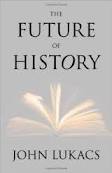
‘The Future of History’ by John Lukacs

2011, 177 p

There’s a new John Lukacs book out, I see.  I like books about history, written by historians. As a reader, they make me feel like an eavesdropper and novice rolled into one. This small book felt as if it were perhaps compiled from a series of lectures, similar to Margaret Macmillan’s The Uses and Abuses of History or Inga Clendinnen’s True Stories. But no- these are chapter-length reflections on historianship as a way of viewing the world and as a profession, and its relationship with literature.  They are written for their own sake.

I don’t really know all that much about John Lukacs.  I have only read one of his books- Five Days in London: May 1940- and I was very impressed by its close attention to just five days spent before and after Dunkirk, when Churchill decided that Britain would continue the war against Hitler after the fall of France.  It was a closely-focussed history that looked at just a few days (although VERY important days to be sure) while addressing big questions and issues.  After reading this latest book, I realize that it exemplified two of the big themes that Lukacs has explored over his long publishing history. First,  Five Days in London was an analysis of the personalities who were involved in the choice to stand up to Hitler, and the aspect of choice is important to Lukacs.

“Choice” is the operative word: because people, as well as their individual components, do not “have” ideas; they choose them. (p.30)

There is an emergent quality in events and decision-making as well: that perhaps the question is not “why” something happened, but “how” and “when” something became to be as it was:

Notice the emphasis on process in the syntax: not how “was” but how did it “become” (p. 39)

His second theme, again exemplified in Five Days in London is that of public sentiment. In the case of Churchill’s decision in 1940, it was set against the perceptions of the British people that were being monitored through the Mass Observation project.  He draws a distinction between Public Opinion which ostensibly can be measured and quantified and Popular Sentiment which is a more subtle and less graspable thing. I guess, in an Australian context, this would be the difference between  a Newspoll with its stark black and white choices, and a Hugh McKay survey .  He notes the dangers to democracy of government driven entirely by public opinion- and don’t we all know about that in Australia at the moment.

Lukacs is dismissive of statistical-based history, psycho-history and counterfactuals, and even more scathing of recent gender,  subaltern and other “faddish” histories.  However, it’s rather a cheap shot to mock journal papers from their titles alone, which are often framed to attract interest through their quirkiness.  There’s an element of grumpy-old-mannishness over the use of computers in research as well. He notes that there has always been more of a problem with spurious papers being inserted into an archive than papers being removed and that technology makes falsification even easier. He warns against the “insidious” practice of

“the presentation of a scholarly apparatus, listing or citing microfilm numbers or other archival “sources” that are not easily ascertainable- or, even if so require careful reading by a professional historian to eventually reveal that they do not prove the  “fact” or statement that they are supposed to confirm”. (p. 58)

To my mind, false claims can be made for both digital/technological and paper-based sources, and digital data-banks of journals and digitization have brought otherwise obscure journals and sources into a brighter light.  A microfilm is more accessible to many more sets of eyes than an individual archive will ever be, especially on the other side of the globe.

He notes that history is not science, and that it is much closer to literature.  Fact and fiction are related to each other, but not identical, and he champions not so much the fictional nature of history, as the historicity of fiction- that “every novel is a historical novel in one way or another” (p. 120)  He is open to the work of amateur historians and aspects of what-if histories that acknowledge the potentialities that lie in any situation.

“…the historian’s recognition that reality encompasses actuality and potentiality reflects his propensity to see with the eye of the novelist rather than with the eye of the lawyer” (p 124).

He closes the book with an Apologia and a greeting to his ‘good, serious’ historians.  He is, indeed, an “old” historian- eighty six years old, and by his own admission he spent much of his career working in small universities.  Although his list of publications is exhaustive, many were published by ‘trade’ presses with an eye to a wider audience and  he senses the ambiguity in the term “prolific” that his academic peers use to describe him. There is, as he admits, an element of  vanity in his chagrin at his marginalization.

Lukacs has elsewhere described himself as a reactionary and certainly elements of this come through here.  He is dismissive of the shortsightedness of American liberal historians, and there is an implicit assumption that the historians and the profession are male.  But I sense that he does not fit easily into any one political box.

He describes his book The Thread of Years as his “most extraordinary book”. It has 69 chapters, each consisting of two parts- the first a vignette about episodes in the lives of various imaginary people existing because of the historical realities of their places and their times.  The second part of each chapter is Lukacs’ own dialogue with an imaginary conversant who challenges either the historicity or the accuracy of the vignette.  He says that it is not a new kind of history, because almost all the men and women within it are imagined, but the times and places are not. He sees it as neither a history nor a novel.  And it’s sitting over there on the shelf, third row down, eight from the left.  I think he would want me to read it.

Uplifting Quotes for the Uninspired Historian #10

It is hard to think away out of our heads a history which has long lain in a remote past but which once lay in the future.

F.W. Maitland ‘Memoranda de Parliamento (1893) in Selected Essays (Cambridge University Press, 1936) p. 66

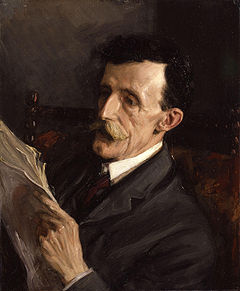
F. W. Maitland– now where have I heard that name before? I’m only too well aware of how limited my knowledge is of ‘older’ historians, but the name seemed familiar. I have been reading about Sir Peregrine Maitland in Upper Canada and I thought that perhaps I had the two mixed up.  But then I realized that a picture of F. W. Maitland was on the cover of the conference program at the legal history conference I attended at Cambridge a few weeks ago- in fact, he was the Downing Professor of the Laws of England at Cambridge between 1888-1906.  That surprised me: the quote above seems somehow more reflective and almost postmodern than I would have expected from a 19th century legal historian.

F.W. Maitland was a philosopher at heart, who went into the law for largely pragmatic reasons  and came to history rather late in his prolific, but rather short, academic career.  At the age of 25, and as part of his quest to earn a Trinity Fellowship  he wrote and self-published a treatise called ‘A Historical Sketch of Liberty and Equality as Ideals of English Political Philosophy from the Time of Hobbes to the Time of Coleridge’.   Much of his academic work elaborated on this foundation, whereby he unearthed, transcribed and commented on the broad sweep of English law, right back to Roman and Anglo-Saxon law.  From this he developed a sweeping vision of social relations and modernity both in Britain and the Anglo-world, and on the Continent.   While solidly a records-based historian, grappling with legal, highly technical documents, his works revolve around the larger philosophy of ideas exemplified by de Tocqueville, Adam Smith, Montesquieu and Marx. Although a prolific writer- over 5000 pages- much of his work was conducted in spite of ill-health through tuberculosis, and he died in 1906 at the age of fifty-six.

On the 4th January 2011  a memorial to him was placed in Poet’s Corner at Westminster Abbey, the only professional historian to be honoured in this way.   Quite apart from his interest in history and law,  and his clear, evocative writing, his approach to history itself speaks to me.  He was deeply conscious of the dangers of anachronism:

The history of law must be a history of ideas. It must represent, not merely what men have done and said, but what men have thought in bygone ages. The task of reconstructing ancient ideas is hazardous and can only be accomplished little by little.  If we are in a hurry to get to the beginning we shall miss the path. [… ]Against many kinds of anachronism we now guard ourselves. We are careful of costume, of armour and architecture, of words and forms of speech. But it is far easier to be careful of these things than to prevent the intrusion of untimely ideas. […]  ‘The most efficient
method of protecting ourselves against such errors is that of reading our history backwards as well as forwards, of making sure of our middle ages before we talk about the “archaic”, of accustoming our eyes to the twilight before we go out into the night.[…] Above all, by slow degrees the thoughts of our forefathers, their common thoughts about common things, will have become thinkable once more. F. W. Maitland, Domesday Book,  p. 356, p. 520

He knew the importance of starting in the right place to find the essence of the structure.

Too often we allow ourselves to suppose that, could we get back to the beginning, we should find that all was intelligible and should then be able to watch the process whereby simple ideas were smothered under subtleties and technicalities. But it is not so. Simplicity is the outcome of technical subtlety; it is the goal, not the starting point. As we go backwards the familiar outlines become blurred; the ideas become fluid, and instead of the simple we find the indefinite. F.W. Maitland, Domesday Book p. 9

References:

Alan Macfarlane (a renowned social anthropologist in his own right) F. W. Maitland and the Making of the Modern World. It’s downloadable as a PDF here and it displayed brilliantly on my e-reader- being able to read long PDFs in a book-like form without having to print off- now this is what an e-reader does really well.

A You-Tube video Alan Macfarlane lecturing on F.W. Maitland in 2001 in the Department of Social Anthropology, Cambridge University.  There’s no bells and whistles here- it’s just a straight out, softly-spoken, chalk and talk lecture that assumes familiarity with Maine, Montesquieu etc (an unfounded assumption in my case!) but it convey’s Macfarlane’s deep admiration of Maitland and the significance of Maitland’s work.