Category Archives: Historians

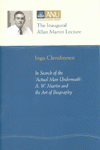
“In Search of the ‘Actual Man Underneath’: A. W. Martin and the Art of Biography” by Inga Clendinnen

martin_clen

2004, 33p.

Sometimes you read the transcript of a paper given to a conference or seminar some time ago and wish with all your heart that you could be there to witness it, not so much for the paper itself (which, after all, you have a copy of) but to sense the response to it at the time.  That’s the way I felt reading Inga Clendinnen’s inaugural Allan Martin Lecture, delivered at ANU on 4 May 2004.  The title of her paper was “In Search of the ‘Actual Man Underneath’: A. W. Martin and the Art of Biography”.

Inga Clendinnen knew Alan Martin from his decade at La Trobe University as Foundation Chair of the School of History, when he appointed her to a tenured lectureship at La Trobe  to join the 33 other historians he hired within three years to establish the department.  In this paper she speaks of him as administrator and mentor as head of school, but also as an academic and writer – and this is where I wonder if the audience started to lean in and listen a little more closely.

Allan Martin conducted an honours course in biography, and staff members were welcome to attend.  Clendinnen did, and she characterized it in 2004 as “probably the most sustained intellectual adventure of my rather long life”.  She attended every class over two years where they discussed the psychological theorizing then being pioneered by Gregory Bateson and Gordon Allport, and they worked on real documents, sequences of letters and confessional writings.  Martin was working at the time on his biography of Henry Parkes, the colonial politician, and when the class was ready, he gave the class some of his toughest Parkes material.  

Then some years later Martin’s work, Henry Parkes came out.

In the preface to ‘Parkes’ Allan made a remarkable apology.  He apologized to his biography class for something not there: the matter discussed in those enthralling sessions.  He acknowledged that he had initially planned ‘to explore Parkes’s life history under other categories’, to expose ‘those intersecting patterns of experience, personality and circumstance which mould a man’s response to the contingent and hence lie under the existential surface.’  Instead he had chosen to adopt ‘a rigid chronological framework’ (which was, he granted, ‘in some ways an intellectual and artistic defeat’) because it was the political Parkes he was determined to pursue- although, he said, he would also ‘try to tell the story of the man’s personal life as far as the documents would permit it to be glimpsed’- as if the story were there, as if ‘the documents’ spoke in a simple tongue- as well as ‘Parkes’ successes and failures in mastering his political environment.’ (Parkes, xi) Clendinnen, p. 13-14)

She was disappointed and she told him so.

On that first reading, I thought that any unusually good and judicious historian could have written A. W. Martin’s ‘Henry Parkes’.  Where was the brilliant essay into the art of biography I had been expecting? To me it was seeing a bright sword sheathed.  True, you could look up every light-footed political manoeuvre, every tricky little factional dance, and it would be there.  But where was the grappling with Parkes’s beguiling personal complexities?… A. W. Martin says in this foreword, ‘because one person cannot attempt everything’, and that’s true.  But only Allan Martin could have unraveled this strange, secret, public man.  He also claims to have been ‘defeated by structuring problems’, and that I simply don’t believe.  Allan had preternatural literary skills.  He could make his prose do anything he wanted, while his mind was as sensitive, as penetrating, as intrepid as any I have encountered.  So why did he choose to step back- and for him, truly, it was a step back (why else the apology?)- to pursue a conventional public-political biographical model?  Why didn’t he write the international state-of-the-art biography of which he was capable?  ( Clendinnen p. 15)

She suggests three reasons.  The first was Martin’s criterion of ‘good’ history:  that you could look something up, it would be there; and it would be right.  I was reminded of the writer’s ethical statement that Tony Birch talked about at the Past Matters festival at Montsalvat, and I wonder, as I suspect Clendinnen did, whether Martin’s own ethical statement served him, and his writing, well.  Historians hold facts in different degrees of reverence: military historians in particular have a grasp on detail and dates that I could never master (and to be honest, I don’t really know if I would want to) and my own certainty on dates in my own work is often slippery and vague.  Yet I veer between annoyance and exultation when I find a mistake in work that I’m familiar with- the academic ‘gotya’ moment. But it’s a hollow and rather demeaning victory: often the error relates to such minutiae that it is  ultimately irrelevant to a bigger picture.

A second reason, she suspects, was Martin’s own Calvinistic mistrust of his own talents, that he would have classified as self-indulgent; and finally, she concedes there was the inadequacy of biographical models that were available at the time- most particularly Jerome Bruner’s idea of self-narration, encapsulated in his book Making Stories: Law, Literature and Life (I reviewed it here) , – which emerged in the years after Henry Parkes was published.

Yet Martin did not immure himself completely in his strictures for ‘good’, fact-based, accurate history.  In an article published in Historical Studies in 1974, Martin tiptoed towards an exploration of the ‘Actual Man Underneath’- a phrase used by Henry Parkes himself, and apostrophized in Martin’s article title (‘Henry Parkes: in Search of the “Actual Man Underneath”, Historical Studies, vol 16, No 63, 216-234.)  After drawing on a myriad of sources to describe in some detail a period of years where Parkes’ political career seemed finished, Martin inched towards the approach that Clendinnen looked for, but did not find, in the book.  It’s there, right in the last paragraph, dangling tantalizingly at the end:

…one needs also to observe in the documents we have discussed the manifold hints that a life might fruitfully be conceived in more dynamic terms- from the inside a range of self-identifications held in fragile tension, personality a process rather than the unfolding of a given core of self-hood, and action the fruit of a traffic between circumstance and these unseen worlds.  It may be that such a perspective could melt the discrepancies between actor and man underneath, to merge the two and reveal in the individual’s struggle for their reconciliation the sources and character of motivation- and hence, for the outside observer, important keys to explanation. (Martin, 1974, p. 234)

Clendinnen rues that Martin came so close to the ideas that Jerome Bruner later articulated, but that he chose instead to work within the existing frames for political biography.  She admits, too, her doubts that even if Martin had had  Bruner’s ideas available to him, his choice of biographical model was deliberate:

So… at the end, despite contingencies of the availability of particular theories, the time of writing and so on, I have come to think Allan’s biographical model was fully deliberate: that it mirrored his moral temperament- as it had to.  Writing being the solitary business it is- sitting alone, making the dozens and hundreds of tiny choices of emphasis and selection we must make- I doubt if we could effect an enduring divorce from ourselves even if we tried.  That mass of barely-conscious choices figures forth the most intimate processes of our thinking. (Clendinnen, p. 23)

I very much enjoyed reading this small booklet and its exploration of the book not written.  It’s made me think a great deal about my own writing and the relationship between an academic’s personality and the type of history they write, and the ethical tenets she holds.  And gee, I wish I could have been there for the response that followed when Inga Clendinnen stopped talking and sat down.
Vale A.G.L. Shaw

I see in today’s newspaper that A.G.L. Shaw has died, aged 96.  His full name was Alan George Lewers Shaw, but I only ever heard him referred to as ‘Agl’ (pronounced ‘aggle’).  He was Professor of History at Monash University between 1964 and 1981, and took a leadership role in the Friends of the La Trobe Library, the Royal Historical Society and the C.J. L Trobe Society.

I first encountered him as the author of one of the textbooks we used in HSC Australian History in 1972- I can’t remember if it was The Story of Australia or The Economic Development of Australia– and with the callowness of youth, I always assumed that anyone who was old enough to write a textbook would surely be dead and buried by then.

However, I encountered him again once I commenced my work on Judge Willis some 27 years later only to find that he was not only not dead and buried, but still working hard.  I often find myself reaching for Shaw’s A History of the Port Phillip District: Victoria Before Separation, a book published in 1996 and remarkably, the first general history of the Port Phillip District written since Henry Giles Turner’s History of the Colony of Victoria in 1904.  Although there were books on particular subjects, and although such books usually had an introductory chapter on the period before 1851, he could find no general survey history.  So he decided to write one.  His introduction gives a hint of the flavour of the history that was to follow:

It is old-fashioned narrative history, and though I fully realise its statements can not be proved philosophically ‘true’ and that my judgements are my own, and therefore influenced by subjective bias and prejudice, in writing it I have been searching for the truth and trying to produce a narrative of unique events.  These are clearly not subject to general laws, which is not to say they are ‘uncaused’, but rather that they are the result of human agency, largely dependent on human motivation.

In one sense this seems a success story and therefore can be denigrated as ‘Whig’ history, but this depends on the meaning ascribed to success.  Everyone achieves something, whether it be good or bad, great or small, and I have tried to write about the bad as well as the good.  Such a mixture is, to my mind, inevitable given the mixture of qualities belonging to the members of any community- weak and strong, heroes and villains, intelligent and stupid, far-seeing and short-sighted, strong-minded and weak-willed, pushing and subservient, arrogant and humble.  From the interplay of these comes the community development, beneficial or harmful, and it is the story of that development in the Port Phillip District before the discovery of gold that I have tried to tell- though my prejudices will inevitably have influenced my telling of it.  (p. xv)

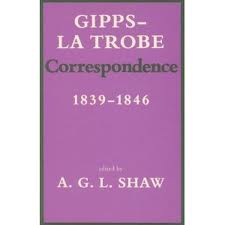
It is the interplay of personalities that is most clearly on show in my favourite of his works, and one that migrates frequently between my bookshelf and my desk: the Gipps-LaTrobe Correspondence,  written in 1989.

This is an edited collection of the ‘back-channel’ personal correspondence between Governor Gipps in Sydney, and Charles La Trobe, the first superintendent appointed to the nascent settlement of Port Phillip.  La Trobe was, perhaps, an unusual candidate for appointment.  Unlike many of the colonial appointees, he did not have a military or judicial background- indeed, he had spent quite a bit of time ‘rambling’ in Switzerland, then camping with Washington Irving in North America.  He had, however, worked on three reports on the emancipation of West Indian slaves in the mid-late 1830s, and it was this work that brought him to the attention of the evangelically-inclined Secretary of State, Lord Glenelg at a time when the Colonial Office was particularly attuned to the recommendations of the Select Committee on Aborigines (British Settlements). La Trobe brought with him his Moravian background, but he had had no experience at all in administration, and he was appointed as subordinate to Governor Gipps, an older and much more experienced officer of military background in Sydney.  La Trobe stayed briefly with Gipps en route to Melbourne, and the warmth of the relationship they established there is reflected in these personal letters.  It is a largely one-sided collection of correspondence, with relatively few letters remaining from La Trobe to Gipps, but as with such archives, it is possible to detect the tenor of the missing correspondence.  A.G.L. Shaw’s contribution to this collection is his extensive and minutely-detailed footnotes to the letters, providing not only context, but also small details of who, where, when. He is so sensitive to the reader’s needs that almost as soon as the question about something you have read forms in your mind,  the footnote number pops up to show you that Agl has thought about it before you.  And so, from a rather over-awed distance, thank you Agl Shaw.

Behaving badly

If Santa brought you ‘The Best Australian Essays 2011’, then you have probably already read Maria Tumarkin’s essay “The Whisperer in the Jungle” because it made the cut into that compendium.  But if you haven’t read it, it is available online here as it first appeared in Meanjin last year.

You may recall that I read Maria Tumarkin’s recent book Otherland recently, and I have her earlier work Traumascapes on my towering TBR list- a fate that, sadly and paradoxically, seems to befall books that I am keen enough to buy and yet never seem to get round to reading.  In this essay, she describes attending a Melbourne Writer’s Festival event in 2008 where Orlando Figes was discussing his then-recent book The Whisperers,  a much-lauded book on people’s private lives under Stalin.  I can easily see why she would have been attracted to the session: her own work examines the psychological cost of traumatic political and ecological phenomena, and as an Ukrainian-born historian, she would have a particular interest in the Soviet context.

But at one stage she reached across to take the hand of her Russian friend, whom she had cajoled into accompanying her:

After ten minutes I reached out and put my hand on my friend’s hand. I was afraid to look her in the face.

My friend and I, just by virtue of having been born in the Soviet Union, knew that the sweeping statements being hurled with overwhelming certainty from that stage were crude, conveniently mangled and phrased cheaply for effect, but it was something else that made us ill, a question. How could a person write a book about this kind of history and not have his heart even a little bit broken?

In this essay, written three years later, she returns to this memory of Orlando Figes’ appearance at the Melbourne Writers Festival in a reflection on moral bankruptcy in academia. For in 2010, news broke of the controversy over Figes’ anonymous and glowing comments on the Amazon site for his own book, and the equally anonymous and damning comments he made on the books of his academic rivals, in particular Robert Service and Rachel Polonsky (whose book I reviewed here).  The controversy is spelled out in more detail in an article about Polonsky here , and the comments that follow the story are revealing and hint at the venom that the controversy drew forth.

It was the critical acclaim that greeted Figes’ most recent book Crimea: The Last Crusade– in bookshops now as I speak-  that prompted her to dig up the story again.  She begins by citing Figes’ own anonymous praise for his own work:

‘Leaves the reader awed, humbled yet uplifted … A gift to us all.’

Ever since the story (the scandal, the row, the controversy) spilled forth in April 2010, these words have proved irresistible, to the British media in particular. They have been printed and reprinted countless times. I feel no hesitation in repeating them here once more. Let them stand. Let them be read more times still.

I am digging this story up again because to this day it feels large to me, not merely the incongruous straying of an academic at the peak of his powers but more like a sweeping epic befitting the Russian nineteenth-century literary tradition that Figes sought to capture in Natasha’s Dance, the book that preceded The Whisperers. …my feeling is that in front of us is a much bigger story, one symptomatic of a particular kind of public culture that is able to absorb certain transgressions but not others, a culture that has a bigger problem with the stain on Monica Lewinsky’s dress—such is this culture’s fixation on the thousand variations of sexual impropriety—than with, say, the ostentatious abuse of intellectual power. It is a culture that is forgiving, indeed encouraging in some of its quarters, of a certain intellectual psychopathology notable for its indifference to three key human emotions: empathy, shame and remorse.

…No-one (really) knows what to do with you—and not just you, Professor Figes, but all you celebrated writers, artists, scientists (you know who you are); you bullies, cowards, hypocrites and cynical opportunists; you filmmakers who forced your little selves inside other people’s children; you philosophers who abandoned your own children to orphanages; you eminent scholars who proudly headed university departments in book-burning, people-eating dictatorships.

We seem to be hearing quite a bit about intellectual and political psychopathology in the last week here in Australia.  We have been witnessing the fallout and the silencing that comes when people hold their tongues over the behaviour of a powerful man, and we can watch the rinse-cycle of public rehabilitation of reputation and legacy as it whirls into action.  I guess that we like to think that there are second chances, and the possibility of public forgiveness but sometimes it seems that some people have to fight harder for it than others.

‘Otherland’ by Maria Tumarkin

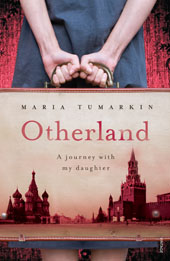
2010, 301 p & notes

“What IS this book?” I wondered half-way through. Travelogue; a reflection on literature and historical methodology;  a history of nations and a history of family; a reflection on the mother/daughter relationship- how would all that be summed up in the one-word descriptor that you often find on the back cover of a book?

“Memoir” .  It seems a little incongruous to me that anyone born in 1974 could write a memoir yet, but if a memoir is a literary construct through which the writer represents a lived experience, then yes, this is a memoir- but I’d qualify it by adding “and much more”.

The author is a Melbourne-based historian, who emigrated from the Ukraine with her parents and sister in 1989, a month after the fall of the Berlin Wall,  at the age of fifteen.  She had returned to Russia  previously, but had not made it to the Ukraine.  On this trip she takes her twelve- year old daughter, Billie, largely because she feels that it is the last chance she will have to do so:

Right now is my last chance to go back with her and still be the centrifugal force of our journey, exercising the course-setting and veto powers.  It is, in other words, my last chance to have Billie follow me around, however begrudgingly, as her mother’s tail.  In a year, maybe a few months, the tail will drop off, or the tail will be wagging the dog, and such a trip, if even possible, will be a different proposition altogether. (p. 28)

It is the journey that ties this memoir together, but it is a layered journey. Mother and daughter are travelling, but Tumarkin is making her own journey back to the relationships that were ruptured when she and her family left so abruptly, and she is making a journey into her own parents’ and grandparents’ experiences as well.  But it is not her story alone: she interweaves the journey with the stories and observations of writers, historians, poets and political dissidents.  In this way, it is an intellectualized endeavour- indeed, I had not heard of many of the writers she cited- but it is also highly personalized.

It is much more than the story of a mother and daughter, and yet this is important too. We read excerpts from Billie’s diary- am I the only one who felt slightly grubbied and complicit in this?  The mother/daughter relationship generally is often fraught, and here I found myself judging the author rather harshly for her own intrusion into her daughter’s perceptions of her experience, where she so much wanted her daughter to see and feel certain things. Ah, but in terms of judgement and criticism Tumarkin was often there before me, aware of her own shortcomings.  There is a stringent honesty in her writing, as when she describes her daughter opening up the piano to play in the apartment of an elderly woman herself the cultured, brilliant daughter of a revered dissident:

In this apartment at the very heart of Moscow, metres away from the Mossovet and Statira Theatres and the Tchaikovsky Concert Hall,  Billie sits down at the old piano.  She plays what she usually plays- Tori Amos and Coldplay.  How alien they sound inside these walls.  Not in Adorno’s ‘no poetry after Auschwitz’ kind of way, no.  And not in a vulgar popular-culture way.  It is just that here these songs, which evoke places and times that make no sense in the world of this apartment, sound thin, flat and inconsequential in the extreme, like a mobile ringtone underneath a cathedral dome. Momentarily I feel ashamed. Ashamed for both of us. (p. 76)

There are several mothers and daughters here.  It is also a history of a Jewish family, who were part of a much bigger history, and here I found myself hampered by my lack of late twentieth-century history: who came first again? Gorbachev? Yeltsin?  I craved a factual chronology, to juxtapose against this very personalized history.

This is a very carefully constructed memoir.  It opens with a cliff-hanger that is not resolved until after half-way through the book.  The writing is reflective and scholarly in places, and confessional and all too human in other places.  Like all journey narratives, it moves forward and there is a homecoming, in more than one sense.  It is quite a journey.

My rating: 9/10

Sourced from: Yarra Plenty Regional Library

Read because: I read it as my third book in the Australian Women Writers Challenge

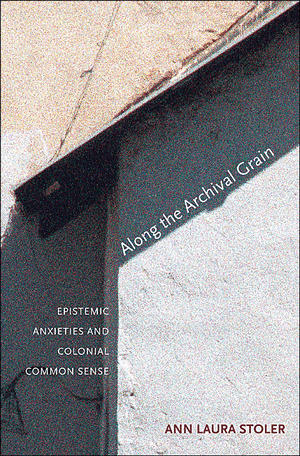
‘Along the Archival Grain’ by Ann Laura Stoler

Ann Laura Stoler Along the Archival Grain: Epistemic Anxieties and Colonial Common Sense, Princeton & Oxford, Princeton University Press, 2009, 278 p & notes.

It was only when I googled the title of this book that I realized that I’d been thinking of it under the wrong name: it was not, as I thought “against” the archival grain, but “along” the archival grain.  It’s an important difference, as the author points out.  While previous historians concentrated on compiling records from the archives in an accessible form- and this is particularly true of 19th century Australian historians like Frederick Watson and the Historical Records of Australia- now we are exhorted to read against the archive and to resist its hard-won accessibility.  But Stoler writes:

Some would argue that the grand narratives of colonialism have been amply and excessively told.  On this argument, students of colonialism often turn quickly and confidently to read “against the grain” of colonial conventions.  One fundamental premise of this book is a commitment to a less assured and perhaps more humble stance- to explore the grain with care and read along it first. (p. 50) …Reading along the archival grain draws our sensibilities to the archive’s granular rather than seamless texture, to the rough surface that mottles its hue and shapes its form.  Working along the grain is not to follow  a frictionless course but to enter a field of force and will to power, to attend to both the sound and sense therein and their rival and reciprocal energies.  It calls on us to understand how unintelligibilities are sustained and why empires remain so uneasily invested in them. (p. 53)

When I first returned to postgrad study in history after an absence of some thirty years, I was perplexed by other students’ references to “the archive”.  Where was “THE archive”, I wondered?  Was it some huge Borgesian labyrinth that had somehow escaped my notice, like Platform 9 3/4 in Harry Potter?  I’ve since realized that “the archive” is not so much a place, as a mental construct of the primary material that we draw on as historians.  Approaching “the archive-as-subject” worthy of scrutiny in its own right, rather than “the archive-as-source” that needs to be mined and extracted, reflects the “archival turn” captured  by Derrida’s book Archive Fever.  The link with Derrida and cultural theory might suggest to you that, in many ways, the writing in this book is rather dense and self-conscious, and it certainly is.  But it is also very careful, poetic writing.  The author weighs her words carefully, reveling in alliteration and paradox, and I found that I had to slow down and subvocalize while I was reading  to let the pleasure of the language wash over me.

The title hints at the theoretical emphasis of the book, but it makes no mention at all of the Dutch East Indies context in which it is applied.  I think that’s probably intentional.  Stoler has been writing about the Dutch Indies for decades- the earliest of her works that she cites was written in 1985- but this is a book borne of long years of immersion in a historical context and it moves far beyond that region.  It is a tribute to the accessibility of the book that I could read and enjoy it with minimal knowledge of the Dutch Indies, and come away feeling that I had learned a great deal (although I really would have appreciated a good map!)

The book itself is divided into three parts.  She starts with a two-chapter reflection on the archive itself and methodological and epistemological responses to it.  Part I which follows is headed “Colonial Archives and Their Affective States” where she examines three small, or even non-existent events in Dutch colonial historiography.  The first was a protest meeting held in 1848 against an edict that the upper echelons of the civil service would be restricted to young men who had been educated in the Netherlands; the second was a series of blueprints of state fantasies for solving the ‘problem’ of the Inlandesche Kindern, a shifting category that included Indies-born Europeans, and mixed bloods; and the third examined two commissions that were held into poverty amongst poor Europeans in the Dutch Indies.  Part II entitled “Watermarks in Colonial History” focusses on Frans Carl Valck, a lowly ranked assistent-resident whose unwelcome report on the murder of a plantation-owner’s family led to his hasty removal to another colony and eventual dismissal and subsequent complete disappearance from the official record. In this section she juxtaposes and interrogates two different archives- the official and the family- against each other.

Interestingly, she suggests in the prologue that

some readers may want to turn directly to these last two chapters that trace the biographies of empire, and may find it more compelling to read them first. (p. 51)

Ah- there’s a problem: when the author herself is not secure in the structure that she has,like all authors, eventually have to settle for.  Which to go for? Compelling reading or the structure that won out? I stayed with the chapters as laid down, but I wonder if it would have been a different book if I had read the last chapters first.  As it was, each chapter was quite self-contained, but it’s an interesting question.

I very much enjoyed this book.  It is a dense read, and at times I found the references to Derrida, Foucault, Rorty etc. rather overwhelming.  Check out the Amazon look-inside feature first, and you’ll quickly sense whether it’s a book that will appeal to you or appall you.  But it came at the right time for me, and it has stretched my thinking about my own work and even spurred me to WRITE a paragraph or two!

Uplifting Quotes for the Uninspired Historian #11: Ged Martin again

p. 31 It is difficult to imagine that any historian would claim total survival of evidence for any episode of the past.  Indeed some might wearily conclude that far too much evidence has survived, especially if it consists of archival mounds that they must quarry to ensure that their own research is comprehensive, even though the documents were never designed to help their enquiries in the first place.  Some are tempted to defend their own specialized research by insisting that enough of the materials needed to form an explanation have survived.  This assertion, which is often the only basis on which the scholar can go to work, ultimately rests on the internally contradictory premise that we can identify the materials needed for an explanation even though we cannot be sure that we know everything about the problem we seek to explain.

Ged Martin Past Futures: The Impossible Necessity of History, 2004 p. 31

I was flipping through my notes looking for something this morning, and I noticed this quote from Ged Martin- a historian whom I keep encountering because of his work in Canadian, Australian and empire contexts.  I’ve already cited some of his wisdom previously, but I am particularly aware of him at the moment because I recently read an article of his that was exactly on the topic I needed at exactly the right time.  It was about empire federalism -surely a topic to make the hairs on the back of your neck stand up, yes? It was a fairly old article from the 1970s, located through Google Scholar, but it was exactly the sort of article that you would have fallen upon as if it were a gold nugget in the pre-computer days because it has exhaustive footnotes.  In particular, he had located evidence (by his own admission, sometimes small and oblique) of the stance of various politicians between 1820 and 1870 on the issue of the colonies being represented in the British Parliament.  As I gazed at these long footnotes, ranging across letters, speeches to Parliament and newspaper articles, I shook my head in awe at how long it must have taken and how much reading must have gone into that one footnote.

Then I thought about the opening line of Donna Merwick’s Death of a Notary. This is an unusual book, with a lyrical narrative in the first half, supported by ‘Notes and Reflections’, heavy-duty historical footnotes and nuts-and-bolts in the second half. And I do mean ‘half’- in terms of length and rigour, the two parts are equally balanced.  The opening line of the first half of the book is:

He was the only one. He was the only man to have committed suicide in the town’s seventeenth-century history.

Donna Merwick came out to speak to us during my honours year, and she talked about that first line, and the sheer amount of research that went into making such a definitive statement.  Would I ever feel confident enough to make such a statement?, I wonder.  So often I am paralysed by the fear that there is another source, another archive, that sits just on the other side of the line in the sand that I have drawn when I tell myself “Stop. You have enough. Just write.”

Sometimes I wonder if the sheer availability of texts now through the internet is drowning us, but then I look at Martin’s footnote,  and the Notes and Reflections in Merwick’s book. I consider the paper-based  research tools available in the 1970s, and try to imagine researching with a typewriter and a pile of catalogue cards and my complaint about the deluge of material seems rather lily-livered. I am humbled by the hard work and sheer doggedness such research reveals.

A-writing I will go

I’m off to Fish Creek for a couple of days with some of my postgrad colleagues for a writing retreat.  The Gods are smiling on us by sending lots of rain our way, hopefully enforcing an inside long-weekend.  Several of us attended a retreat conducted by Ron Adams from La Trobe last year, and we decided we’d like to do it again.

As one of the activities we’ve planned, we were asked to bring a couple of pages from a historian whose writing we admired.  So who to choose?  There is of course my beloved Richard Holmes, but then I realized that even though I gobbled up his Footsteps and Sidetracks, I haven’t actually read any of the biographies that he used as the basis for his meditations on biography and history.

What about Inga Clendinnen then? Certainly right up there in my constellation of historian stars, but Ron’s  workshop made much of the Clendinnen-Isaacs-Dening triumvirate, and I’d like to choose someone different.

Tom Griffiths I considered, and Lisa Ford too.  But in the end, I went for Kirsten McKenzie.  I haven’t reviewed her work in this blog because I read it before I started writing here.  Her book ‘Scandal in the Colonies’ was the book that made me start thinking about how I could deal with Judge Willis.  She combines incisive observations about colonial life, status and behaviour with real-life, sympathetically drawn examples.  The book is replete with beautifully crafted, pithy sentences, but the overall effect is light and readable.  You feel as if you’d like to meet the author, that there’s a sense of humour there.  She deals, as I want to do, with the nuances of behaviour as perceived by others at the time, that rumble underneath the official correspondence and are magnified and parodied  through the rumour mills and the  hysteria of the press.

So, off to Fish Creek I go- laptop in hand, no internet access (I hope) and Kirsten McKenzie tucked under my arm.

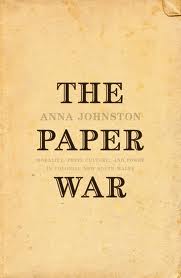
‘The Paper War’ by Anna Johnston

Anna Johnston The Paper War: Morality, Print Culture, and Power in Colonial New South Wales,  Crawley Western Australia,  The University of Western Australia Press, 2011.226 p. Plus notes

Now that my thoughts are actually turning to writing my big baggy monster of a thesis (stifle those snorts of laughter, please) I’m finding myself conscious of the way other writers are treading the tenuous line between ‘straight’ biography and something that’s not quite biography.  The Paper War by Anna Johnston is one such book.  Her focus is on Lancelot Threlkeld, the NSW missionary, and the texts he generated  by and about  his colonial experience. But it’s not a biography of Threlkeld as such, and the author is at pains to reinforce this distinction.  Her work is not history, or biography, but a literary/cultural study which

examines the archive as a set of writing and reading practices, seeking to make different meanings than a historian might.  The Paper War retells stories found in archives as well as revealing modes of construction, in order to create new narratives. It foregrounds the complexity (perhaps the impossibility) of efforts to establish coherent, credible narratives from partial sources  (p.4).

This means that, as well as looking at the content of a particular source, she also asks about the source itself : how did this document/series of documents come to be created?  What are the institutional structures, and individuals within those structures, that created them? Can we rely on these texts as stable and authoritative guides to the past? (p.4)   She is insistent on maintaining this emphasis on text as a mediated material when her reader’s attention might drift into the biographical corridors of  chronology and lifestory instead.

Her book focuses on the writings by and about Lancelot Threlkeld, the missionary in charge of the Lake Macquarie Aboriginal Mission in New South Wales in the 1820s, a man rather unkindly described as one of the “perpetual blisters” that the London Missionary Society (LMS)  seemed “destined to carry”.  He certainly seemed a rather pugnacious and belligerent character as a missionary and his writings to attack his adversaries and defend his own position generated what could well be described as a “paper war’.  As is often the case, his own irascibility was  in response to, and elicited, similar traits in his main clerical adversaries: the equally combative  Rev. Samuel Marsden and the protestant cleric John Dunmore Lang.  What a combination!  I’m particularly interested in this combustible 19th century character type, because our own Judge Willis himself exhibited many of the same traits.

Surrounding the Threlkeld/Marsden/Lang sparring ring were representatives of the broader 19th century  humanitarian network.  Daniel Tyerman and George Bennet were missionary agents charged with overseeing Threlkeld’s establishment of the mission at Lake Macquarie under the auspices of the London Missionary Society and thus his immediate supervisors.  James Backhouse and George Washington Walker were peripatetic Quaker investigators whose opinions were valued by metropolitan humanitarian networks for their independence and clarity.  The Paper War is very much embedded in the historiography of the ‘networked’ image of the British Empire (Zoe Laidlaw, Alan Lester, Kirsten McKenzie etc) and these agents and investigators exemplify the way that ideas were circulated throughout the empire by missionaries, intellectuals and London-based groups like the Ethnological Society of London.

The book itself has five main chapters, an introduction and a conclusion.  The first chapter, ‘Colonial  Morality’ gives a brief biographical account of Threlkeld’s career along with the careers of his major protagonists and the circumstances that led to the intersection of their careers with his.  The second chapter ‘Colonial Linguistics’, looks at Threlkeld’s pioneering work in researching the language of the tribes surrounding Lake Macquarie, and she traces the evolution in his thinking about how language can be studied and depicted.  His earliest work in 1825 was an attempt to develop an orthography (spelling) for an Aboriginal language, mainly in the form of question and answer phrases, strongly based on Europeans assumptions about categories and sentence structure by imposing  an artificial  one-to-one match between English and Aboriginal words.  In 1834 he changed his methodology to investigate the grammar of the language, followed by another work in 1851 written for the Great Exhibition in London called A Key to the Structure of the Aboriginal Language.   As was common at the time, colonial collectors were expected to scoop up the raw materials of plants, animals, languages and ethnography, which were channelled to the ‘experts’ in London for ‘proper’ classification and analysis.  She traces the use of his work by such ‘experts’, especially the way that it was posthumously re-published and co-opted as part of late 19th century racial theories.

Chapter 3, ‘Colonial Press’ shifts its focus to the newspaper record generated by and about Threlkeld, especially in relation to the execution of Tommy, an aboriginal prisoner for whom Threlkeld acted as interpreter.  This execution itself became subsumed within a broader sectarian argument, and in February 1828 Threlkeld wrote a series of letters to the editor- a common feature of colonial newspapers- against the Catholic Church.

Chapter 4 ‘Colonial Respectability’ takes up Threlkeld’s Statement Chiefly Relating to the Formation and Abandonment of a Mission to the Aborigines of NSW; Addressed to the Serious Consideration of the Directors of the London Missionary Society, written to justify his actions as missionary at Lake Macquarie.  Despite its title, it was not aimed at the directors of the LMS alone: he had at least 270 copies printed and distributed it to every director and missionary in the LMS network.  It is a 72 page document, largely composed of letters written and received in relation to the Lake Macquarie mission. Threlkeld’s adversary J. D.  Lang waded into this documentary swamp with his own series of newspaper articles criticizing the mission and Threlkeld’s character as a missionary, culminating in a civil court case Threlkeld v Lang in 1836.

Chapter 5 ‘Colonial Legality’ remains in the courts, but here investigates Threlkeld’s work as an interpreter in the courts, and his position and increasingly critical stance over questions of the amenability of Aboriginal people to British law, the use of Aboriginal evidence and questions of sovereignty.

The  conclusion of the book picks up themes from the introduction by returning to the question of historians’ uncritical use of the colonial archive.  Both Henry Reynolds and Keith Windschuttle as combatants in the ‘History Wars’ share, she claims, a “remarkably simple” view of the archive as unmediated primary source material that can be drawn out to construct a narrative. She picks up on Kevin Rudd’s championing of Thomas Keneally for the background in literary fiction that he brings to his retelling of Australian history (an issue also pertinent with Kate Grenville’s recent works). And here we are returned to the question of the heart and the affective world so prominent in the humanitarian world view, including that of Lancelot Threlkeld.

As I mentioned earlier, I was particularly interested in the structure of this book for my own work, given that it takes an documentary archive deeply imbued with questions of personality and temperament.  I ‘m interested by the decision to place Chapter 2 where it is- perhaps because Threlkeld’s linguistic work has been somewhat overlooked?- because it seems more related to Chapter 5.  I’m impressed by the way that her strong, minimalist chapter structure forces the reader’s attention on the form rather than the content of the archive. The book is on one level about Threlkeld , without being a biography as such, but on another level it works on a much larger canvas.

You can download a generous extract of the book here.

‘The Future of History’ by John Lukacs

2011, 177 p

There’s a new John Lukacs book out, I see.  I like books about history, written by historians. As a reader, they make me feel like an eavesdropper and novice rolled into one. This small book felt as if it were perhaps compiled from a series of lectures, similar to Margaret Macmillan’s The Uses and Abuses of History or Inga Clendinnen’s True Stories. But no- these are chapter-length reflections on historianship as a way of viewing the world and as a profession, and its relationship with literature.  They are written for their own sake.

I don’t really know all that much about John Lukacs.  I have only read one of his books- Five Days in London: May 1940- and I was very impressed by its close attention to just five days spent before and after Dunkirk, when Churchill decided that Britain would continue the war against Hitler after the fall of France.  It was a closely-focussed history that looked at just a few days (although VERY important days to be sure) while addressing big questions and issues.  After reading this latest book, I realize that it exemplified two of the big themes that Lukacs has explored over his long publishing history. First,  Five Days in London was an analysis of the personalities who were involved in the choice to stand up to Hitler, and the aspect of choice is important to Lukacs.

“Choice” is the operative word: because people, as well as their individual components, do not “have” ideas; they choose them. (p.30)

There is an emergent quality in events and decision-making as well: that perhaps the question is not “why” something happened, but “how” and “when” something became to be as it was:

Notice the emphasis on process in the syntax: not how “was” but how did it “become” (p. 39)

His second theme, again exemplified in Five Days in London is that of public sentiment. In the case of Churchill’s decision in 1940, it was set against the perceptions of the British people that were being monitored through the Mass Observation project.  He draws a distinction between Public Opinion which ostensibly can be measured and quantified and Popular Sentiment which is a more subtle and less graspable thing. I guess, in an Australian context, this would be the difference between  a Newspoll with its stark black and white choices, and a Hugh McKay survey .  He notes the dangers to democracy of government driven entirely by public opinion- and don’t we all know about that in Australia at the moment.

Lukacs is dismissive of statistical-based history, psycho-history and counterfactuals, and even more scathing of recent gender,  subaltern and other “faddish” histories.  However, it’s rather a cheap shot to mock journal papers from their titles alone, which are often framed to attract interest through their quirkiness.  There’s an element of grumpy-old-mannishness over the use of computers in research as well. He notes that there has always been more of a problem with spurious papers being inserted into an archive than papers being removed and that technology makes falsification even easier. He warns against the “insidious” practice of

“the presentation of a scholarly apparatus, listing or citing microfilm numbers or other archival “sources” that are not easily ascertainable- or, even if so require careful reading by a professional historian to eventually reveal that they do not prove the  “fact” or statement that they are supposed to confirm”. (p. 58)

To my mind, false claims can be made for both digital/technological and paper-based sources, and digital data-banks of journals and digitization have brought otherwise obscure journals and sources into a brighter light.  A microfilm is more accessible to many more sets of eyes than an individual archive will ever be, especially on the other side of the globe.

He notes that history is not science, and that it is much closer to literature.  Fact and fiction are related to each other, but not identical, and he champions not so much the fictional nature of history, as the historicity of fiction- that “every novel is a historical novel in one way or another” (p. 120)  He is open to the work of amateur historians and aspects of what-if histories that acknowledge the potentialities that lie in any situation.

“…the historian’s recognition that reality encompasses actuality and potentiality reflects his propensity to see with the eye of the novelist rather than with the eye of the lawyer” (p 124).

He closes the book with an Apologia and a greeting to his ‘good, serious’ historians.  He is, indeed, an “old” historian- eighty six years old, and by his own admission he spent much of his career working in small universities.  Although his list of publications is exhaustive, many were published by ‘trade’ presses with an eye to a wider audience and  he senses the ambiguity in the term “prolific” that his academic peers use to describe him. There is, as he admits, an element of  vanity in his chagrin at his marginalization.

Lukacs has elsewhere described himself as a reactionary and certainly elements of this come through here.  He is dismissive of the shortsightedness of American liberal historians, and there is an implicit assumption that the historians and the profession are male.  But I sense that he does not fit easily into any one political box.

He describes his book The Thread of Years as his “most extraordinary book”. It has 69 chapters, each consisting of two parts- the first a vignette about episodes in the lives of various imaginary people existing because of the historical realities of their places and their times.  The second part of each chapter is Lukacs’ own dialogue with an imaginary conversant who challenges either the historicity or the accuracy of the vignette.  He says that it is not a new kind of history, because almost all the men and women within it are imagined, but the times and places are not. He sees it as neither a history nor a novel.  And it’s sitting over there on the shelf, third row down, eight from the left.  I think he would want me to read it.

Historical Records of Australia


Looking for online? Go to the bottom of this posting.

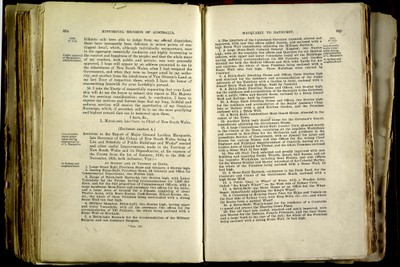
The Historical Records of Australia comprise three series of volumes. Within the series,  each separate volume is about 900 pages in length, containing transcriptions of the official documentation between the Colonial Office and the local governments in the different states.    Series I provides the Governor’s despatches to and from England, Series III contains documents related to the settlement of the states  (especially Tasmania)  while Series IV which has barely begun, features documents relating to the legal system.    Volume 8 of Series III only appeared in 2003, and Volume 9 in 2006.  Series II  never appeared at all.

The early volumes were collected and published by the Library Committee of the Commonwealth Parliament between 1914 and 1925.  James Frederick William Watson was the editor.  According to his ADB (Australian Dictionary of Biography) entry, he was a medical doctor and historian.  He was appointed a trustee, then acting principal librarian at the Public Library of New South Wales.  In this position, he inherited the responsibility for transcribing the official New South Wales documents and the papers held in London, a task commenced by F. M. Bladen and James Bonwick separately some  years earlier.  The Commonwealth agreed to finance the project in 1907 and the project was expanded and retitled as The Historical Records of Australia.

This national vision, in the years following Federation is important.  Until then, transcriptions of records had been undertaken on a state-by-state basis, largely by James Bonwick who had been contracted to make copies by the Queensland,  South Australian, Victorian and Tasmanian and later NSW governments separately, and by Barton and Bladen for the  NSW papers.  Indeed Bonwick’s entry in the ADB suggests that Watson used Bonwick’s work without acknowledgment in HRA .  The compilation of the Australian historical records was a task hemmed in by constraints. When Bonwick made his transcriptions in London, he was not allowed to include the minutes written on the papers by the Colonial Office bureaucrats (a fascinating counter-narrative that runs alongside the official stance).  Bonwick had included newspaper articles and engraved illustrations in his collection, but had left out other information in deference to the sensibilities of families who were  still sensitive about convict origins. There were no official archives at all at this stage- South Australia was the first state to establish its own state-based archive in 1919- and papers were distributed across several government departments (Chief Secretary’s office, the Supreme Court, Lands Office etc) as well as in private hands.

The vision for the project was broader than the eventual product.  Watson envisaged seven separate series, of which only three ever appeared (I, III, IV)

I Despatches of Governors To and From England

II Papers belonging to the general administration

III Settlements in the different states

IV Legal papers

V Explorations

VI Scientific

VIII Ecclesiastical, naval and military papers.

In 1917 the Library committee agreed that they would limit the scope of HRA to 1856, the beginnings of responsible government, with the states taking over their own publication programs for material after 1856.

Each volume of HRA commences with a commentary of the years and issues covered.  Watson’s ‘untutored prose’ was criticized and George Arnold Wood, the professor of History at the University of Sydney was appointed literary consultant.  Unfortunately he was unable to persuade Watson to provide evidence of the documents’ locations, although today it is sufficient to just cite ‘HRA vol xxiii’ etc.

Between 1914 and 1925, with a 2 year suspension during WWI,  Watson  collated, edited and supervised the publication of 33 v0lumes of documents covering the period 1786 to 1848.  Of course, he did not do this completely alone, and there are a string of assistants (many of whom were women) who remain largely invisible in the finished product.  By 1925 Watson’s relationship with the library committee had broken down resulting in legal proceedings and the collapse of the project. The project was recommenced in 1997 and the volumes produced since then in the ‘resumed series’ appear sporadically, published by Melbourne University Press and the University of Tasmania.

Most large libraries have the series, usually in the reference section but the older ones in particular are getting pretty tatty and worn and there’s a danger that they’ll be whisked off into some ‘rare books’ section where they’re no earthly use to anyone.

And so, I was absolutely delighted to find them online at a NSW government site (even though they were huge PDFs and took a long time to download). But then – oh, no! they disappeared.  Thank heavens that La Trobe University has since digitized them, and they’re available through their Research Repository. But you need to be a bit of a sleuth.  First go to their Research Repository at http://www.latrobe.edu.au/library/research-and-grant-support/research-online

Then type in “Historical Records of Australia” in inverted commas and -voila! They have been helpfully broken into smaller, dated PDF files as well as a larger file, so that if you know the date, you don’t need to download the whole thing.  There is an index at the end of each volume

References:

Ann M. Mitchell (1982): Doctor Frederick Watson and historical records of Australia , Historical Studies, 20:79, 171-197  (She also wrote Watson’s ADB entry).