
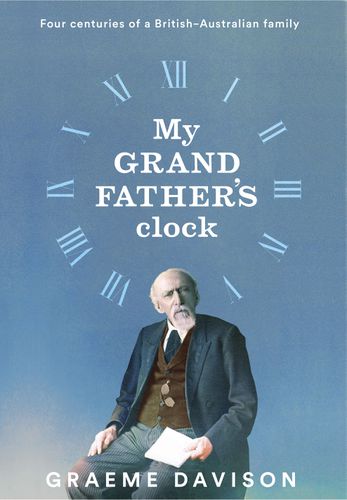
In 2015, Graeme Davison published Lost Relations, (my review here) where this acclaimed academic historian succumbed to his family’s entreaties and waded into the waters of family history to research his mother’s family. It was not without a bit of heartburn and defensiveness, but in telling his mother’s family’s story, he also gave us a reflection on family history itself, its emotional resonances and limitations, and the wider context into which the story of individuals must be placed.
In this more recent book, he turns instead to his father’s family. He writes:
When I published ‘Lost Relations’, a history of my mother’s family, some readers asked why I wrote so little about my father. As I grew up, he discouraged interest in his family’s past, not because it was scandalous- although, as I later learned, there were buried sorrows unknown to me and perhaps to him- but because it was, at least in his eyes, so recent and undistinguished.
p. 2
Later in his life, his father changed his mind, joined the local historical society, and wrote a brief account of his life. Davison changed his mind too, although in his case his interest was piqued by a 200 year old grandfather clock that had been willed to his father by his aunt, and eventually came to him. It couldn’t have gone to a better member of the family: Davison had always loved time-telling and clockwork and indeed, in 1993 had written The Unforgiving Minute, a history of time-telling in Australia. This clock becomes a sort of talisman in this book, marking not just the generations of family that it had passed through, but also marks the changing of attitudes to work, leisure and godliness over time. There is a danger in writing a family history that, to misquote Toynbee, it just becomes one damn generation after the other, but having a concrete object like a clock serves as both metaphor and sticky-tape, connecting albeit tenuously, generations and relationships. The clock is woven into an anecdote told to Davison by his Uncle Frank, who told of visiting his Great Grandfather Thomas Davison in 1929. When the clock chimed, Thomas lift one finger and said “listen to our ancestors”.
Davison, as you will see in my review of Lost Relations, reflected deeply and at length on the nature of family vs. academic history. He has no need to do so again. He pushes the family history boundaries harder in this book, starting in the Scottish borderlands and following the story through to his own career as historian in the academy. By tracing back beyond 1750 he needs to leave behind the genealogists’ stepping stones of formal written records, and turns to tribal and kinship memories- something that required him to bring “my scepticism as well as my romanticism along for the ride” (p. 26) He could only deduce from generalized knowledge of practices of the time and documented histories of the Davisons/Davysouns/Davysons who may or may not be direct descendants. He dips into the soup of DNA testing, and is disillusioned by the suppositions and guesswork it evokes without documentary evidence. He finds a few facts, but has to resort to questions and hypotheses as the family moves back and forth across the Scotland/England border, in a
journey that would take his descendants, step by step, from a small port town to an industrial village, to a factory suburb and finally to an industrial metropolis. Eventually, a century later, they would journey to the other side of the world…Each step was a one-off response to the map of opportunity at the time, but seen over the longue durée the moves fall onto a pattern that suggests the operation of powerful unseen forces… At each step along the journey, they became a little more accustomed to the ideas and values that prepared them for the next. Many factors, invisible to us, probably influenced their outlook, including religious and political ones
p.70-71
Through the “miracle of digitisation” of the British Library’s newspaper archive, he finds his great-great-grandfather addressing a temperance meeting in a speech that could just as easily have been given by his own grandfather and father, lifelong teetotallers. The family line shifts to Birmingham, the workshop of the world, and involvement in a more active political role through workers’ societies, and then a minor manager role in a tinplate company.
It was his grandfather, John Potter Davison, who in 1912, at the age of forty-three, closed his business, said goodbye to his parents and siblings, and embarked for Australia with his wife and four children, with only twenty pounds in his pocket. He was a Methodist, a denomination that encouraged migration, and in Australia he joined other members of the Islington Chapel who had emigrated earlier. They settled in Scotia Street Ascot Vale, along with other Methodist immigrants. Still in the western suburbs, Davison’s father lived with his family in a rented four-roomed cottage in Athol Street Moonie Ponds. The young men of the family moved into apprenticeships as printers and plumbers, joined the Scouting movement and were involved in the church. As the Depression hit, the family purchased a timber cottage in Washington Street, ten minutes’ walk from Essendon station and joined the North Essendon Methodist Church. It was here that Davison’s parents Vic and Emma met, thus joining this story with that he has already told in Lost Relations. He was born a little over nine months later “born into the luckiest and most consequential generation in the history of the planet.” (p 189)
At this point Davison moves into his own memoir, starting with his childhood home at 16 Banchory Street Essendon, purchased by his parents in 1939. He attended government schools in Aberfeldie and Essendon and in 1958 took up a studentship, with its stipend that made studentships particularly attractive to lower middle class parents whose families had no experience of university. He attended the University of Melbourne and gravitated towards the Student Christian Movement. He was one of the founders of The Melbourne Historical Journal, undertook his honours dissertation, and found himself as one of a small number of secondary teaching students released from their bond by the Education Department to become university teachers. He applied for scholarships in England, and found himself on a boat bound for England, in effect, completing the circumnavigation that his family started. The shift into memoir runs the risk of many professional memoirs that become a roll call of acquaintances’ names, and a travelogue – and although I’m interested in historians’ biographies and intellectual influences, I wonder how many other readers would be.
As well as covering a much wider 400-year timespan, this is a far more personal book than Lost Relations, and in many ways it is a more conventional genealogy-method book than the earlier one. Both books expand the circumstances of his particular ancestors into a wider context, and it is interesting that religion plays such a strong part in both strands of his family history given that it is often rather peripheral to Australian experience. He finds continuities, too, with the traditional of skilled manual work, and the moderate Labor or centrist politics. Of course, there is a limit to the interest that one might have in another person’s ancestors (and, it would seem, no limit at all for one’s own family, for some family historians). And as with Lost Relations, this is a stellar example of a master historian telling family history but drawing on much more than just documents and lineages. He finishes his book as he started it, with the clock that has accompanied his family story, joking about his own family’s eye-rolling when he, too, intoned “listen to our ancestors” on hearing the clock. Davison’s ancestors have clearly spoken to him, and through these two books we eavesdrop on the conversation.
My rating: 8.5/10
Sourced from: borrowed from my friend Patricia
 The Resident Judge of Port Phillip