Category Archives: Current events

Anniversary Day/ Australia Day/ Invasion Day/Survival Day

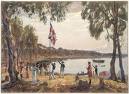
flagraising

So, January 26th- Australia Day.  In the 1840s and indeed for a hundred years after that, 26th January was known as Anniversary Day or Foundation Day.  Different groups in different states made it their own in different ways. In Victoria in the late 1880s and 90s the Australian Natives Association -a group whose membership was restricted to Australian-born men of European descent- championed the choice of 26 January as the national day.  Adelaide always distanced itself from the convict origins of the day and did not celebrate it at all for many years.  In New South Wales, where it was always  (and perhaps still is?) more  prominently celebrated,  the first recorded celebrations were held in 1808, and the first official celebrations marking thirty years of settlement were held in 1818.   The First Anniversary regatta was held on Sydney Harbour in 1836, and the fiftieth anniversary of Phillip’s landing was marked by a public holiday for the first time in 1838.

So, how was Anniversary Day celebrated in Port Phillip between 1841-1843 while Judge Willis was here?   Well, not at all it seems.  There was no mention of it in the Port Phillip Herald, beyond a reference in February 1842 to the Sydney celebrations reported in the Sydney newspapers, but no further details were provided.

We associate Australia Day with 26th January but an earlier ‘Australia Day’ was celebrated on 30 July 1915 as part of a soldier parade to honour soldiers who had served and to stimulate further enlistment.  It was not until 1946 that all states and territories adopted ‘Australia Day’ as the name for the 26th January celebrations, and it was only actually celebrated on the actual day itself, rather than as a long weekend, in 1994.

There is a degree of discomfort over the choice of 26th January as our national day.  Aboriginal groups have increasingly designated it as Invasion Day, or more recently Survival Day and I think that there’s a growing squeamishness over the knowledge that the aboriginal world fractured from that day onward.

So what alternatives are there?  There is the date of Federation, but on 1 January it would be overshadowed by New Years Day (and besides, it’s already a public holiday).   There’s the 9th May for the opening of Parliament in Melbourne in 1901, then the provisional Parliament House in 1927 and finally the new Parliament House in 1988.  But -oh yawn- there’s not much colour and movement there.  There’s the 27 May 1967 referendum that is the popular (but technically incorrect) date given for aboriginal citizenship.  The government tried to whip up enthusiasm for a Battle for Australia Day, but it’s an historically dubious concept based on public panic over a period of months, rather than one particular day. There have been suggestions that there could be a day to celebrate the end of White Australia, but that occurred in a piecemeal fashion over a long period of time.  Likewise the introduction of multiculturalism did not occur on one specific day.

My suggestion?  Well, perhaps we could look at early February to commemorate the drunken free-for-all in a thunderstorm,  once the convicts were unloaded at Sydney Cove about a week after arrival in 1788.  The date has got a lot going for it.  It’s at the height of summer; daylight saving is still in operation; it might get the kids another weeks holiday before the school year starts; it defers the knuckling down for the rest of the year for a couple of days more. It seems particularly apposite- alcohol, sex, beaches- but perhaps the multiple sexual couplings were not so much fun for the women so outnumbered in a complete break-down of order. On second thought perhaps commemorating mass rape on Orgy Day is not the way to go. I suspect that Sorry Day to mark Rudd’s apology to the Stolen Generations might take on a life of its own, although once we return to coalition government it will no doubt become even more politicized than it already is.

I propose that instead of looking backward, why not plan an Australia Day in the future?  I think we should start planning very carefully for Republic Day, and choose the day to suit the holiday.  The criteria:

1. must be in summer

2. must be a moveable day to ensure that we have a long weekend every time

3. must be irreverent

4. preferably break up the working year somewhat (although Criteria 1 militates against it a bit)

5. must promote at least a little consensus and enthusiasm amongst us all.

Update

In his chapter called ‘The Arrival of the First Fleet and the ‘Foundation of Australia’, in Turning Points in Australian History, David Andrew Roberts picks up on a suggestion by C.H. Currey that perhaps 7th of February should be THE DAY.  Currey, and Roberts later,  argue that it was on 7th February, the day after the orgy, that the judge advocate David Collins opened his leather cases containing the Commissions of the officers of the First Fleet and read them before the entire contingent, with the soldiers in full regalia, and the convicts no doubt feeling rather worse for wear.  The reading aloud of these documents finally proclaimed the extent of Britain’s territorial claim, activated the legal jurisdiction of the colony and revealed the broad scope of the Governor’s powers.  The ceremony ended with ‘God Save the King’, a discharge of muskets, and a dinner for the officers.  Hmmmm….works on several levels, but it is a little reminiscent of being harangued by the Headmaster.

Another update:

Look here.

The Aboriginal Executions on 20 January 1842

Joseph Toscano, well known anarchist and correspondent to The Age yesterday convened a commemoration ceremony of the 167th anniversary of the execution of two “indigenous resistance fighters”  who were  found guilty of murder by Judge Willis, the Resident Judge of Port Phillip.

It is striking that there were six executions in Port Phillip during 1842, and then none for several years.   This does not necessarily denote, though, that Judge Willis was a particularly vicious ” hanging judge”.  Until his arrival in Port Phillip in March 1841, all Supreme Court trials were conducted in Sydney. After Judge Willis’ removal in mid 1843, his replacement Justice Jeffcott refused to order the death sentence in his own right until the legality of Willis’s dismissal had been confirmed.  However, during 1842 there were six executions in total- two Aborigines in January 1842, three bushrangers in June 1842 and another Aborigine (Roger) in September 1842.  For that year, it must have seemed that the execution parade through the streets of Melbourne to the gallows outside the new gaol was becoming a regular feature.

It’s significant that both aborigines and bushrangers were the real hot-button issues for white settlers.  Judge Willis did pass another death sentence for murder on Thomas Leahy for murder of his wife, but the the sentence was commuted to transportation.  However, there was no mercy for aborigines or bushrangers found guilty of murder: their crimes challenged power and authority more generally.

The passage of 167 years certainly changes the language that we use to conceptualize this event.  Toscano speaks today of their execution as “a great Melbourne story of love, resistance, passion and violence”.   Judge Willis wrote to La Trobe describing the case as “one of great atrocity”.  Toscano today identifies them as Tunnerminnerwait and Maulboyheenner; at the time their names were recorded by the Aboriginal Protector as “Tuninerparevay: Jack, Napoleon” and “Small Boy: Robert, Timmy, Jimmy”  (Mullaly, p. 255)

“Bob” and “Jack”, as they were popularly known at the time,  were part of a group of Aborigines brought across from Van Diemen’s Land by the Aboriginal Protector G. A. Robinson when he was appointed to his post in Port Phillip, with the intent of using them as intermediaries when conciliating the local tribes. This seems a rather ill-informed intention on Robinson’s part,  given the language and territory differences.  After a time they were no longer staying with Robinson. When two white whalers were murdered, this group of five aborigines, two men and three women (including Truganini) were reported to have been seen in the location of the murder scene , and said to have committed other depredations in the area.

This complicates the picture somewhat.  Coming from Van Diemen’s  Land, it was not a simple matter of protecting traditionally-owned territory from invading settlers.  On the other hand, their transplantation from Van Diemen’s Land across the sea was an absolute dispossession, and resistance moved from the particular to the generalized- not a particular settler on a particular river, but white men in general.

The Port Phillip Herald of 21 January 1842 reported that there was no doubt about the justness of the sentence, and that their execution was the imperative duty of the authorities to vindicate the impartiality of British law.   It is interesting to note the objections raised by Redmond Barry in their defence.  At first he argued that half the jury should consist of people able to speak the language of the defendants which, not unsurprisingly, Justice Willis overruled.   In  his address to the jury, Barry referred to the ‘peculiar situation’ of ‘circumstantial evidence of dubious character’.    Likewise, it is interesting to note the issues that did not arise.  The amenability of these particular Aborigines to European law was not questioned.  It was ascertained from Robinson that the men had knowledge of the existence of a Superior Being and knew right from wrong, and that they could speak English.  These grounds were later used by Judge Willis in other cases to acquit Aboriginals in his court who were not deemed to understand English or have an understanding of a Supreme Being.

In his address to the jury, Judge Willis is reported to have commented on the criminal activities of the armed men prior to the attack on the unarmed whalers, and he distinguished between the role of the men as murderers and the women as accomplices.  He emphasized the necessity to prevent the ‘recurrence of similar acts of aggression’.  After a recess of half an hour, the jury returned with a conviction for the men with a recommendation of mercy ‘on account of general good character and the peculiar circumstances under which they are placed’ (Mullaly p 257). The more than I think about it, this recommendation of mercy arising from a community truly anxious about ‘depredations’ and its consequent dismissal by the authorities is perhaps the most surprising aspect of the trial.

This recommendation, however, was not strongly supported by Justice Willis, and the sentence was confirmed by Governor Gipps. Their executions were the first in Port Phillip.  Public executions at the time were understood by the white participants and specatators  (as distinct from the Aboriginal prisoners)  to represent authority, religion and humanity (Castle 2007).    It was a highly ritualized degradation ceremony, with specific clothing and practices and designated roles for the clergy, the judge, the governor and the prisoners to play.  The newspaper descriptions of the time reflected the traditional  narratives of repentance, scaffold confessions and fear,  well-known from similar practices in England.

However, this was mixed with a degree of sympathy and uneasiness among some- but certainly not all- spectators.   This was a ‘first’ for everyone, and it was generally agreed that the execution itself was botched and unpleasant.  Although this first execution attracted large crowds, by the time another Aborigine, Roger, was executed in September 1842 there was newspaper disapproval of the character of the spectators who attended- particularly women- and calls for the scaffold to be removed as quickly as possible and executions to be carried out within the gaol walls rather than in public view.  However, this  squeamishness needs to be balanced against the fear of  Aboriginal depredations  voiced by small settlers and more influential squatters and landowners in the outlying frontier areas.   In such an environment, and given the legal restrictions on Aboriginal testimony, it is perhaps not surprising that there were so very, very few executions of white settlers when it was Aborigines who were murdered.

Update: An interesting article by Marie Fels with David Clark and Rene White called ‘Mistaken Identity, Not Aboriginal Heroes’ in Quadrant October 2014 looks closely at the coal-mine manager William Watson. The only words uttered by Tunnerminnerwait and Maulboyheener in their own defence pertained to William Watson-  “We thought it was Watson”. This article looks carefully and critically at William Watson and carefully reconstructs the movements of the Van Diemens Land aborigines immediately before the murder.  Well worth reading.

References:

Paul R. Mullaly  Crime in the Port Phillip District 1835-51,

Ian Macfarlane  The Public Executions at Melbourne 1842

Tim Castle ‘ Constructing Death: Newspaper reports of executions in colonial NSW 1826-1837’ Journal of Colonial History, vol 9, 2007 p. 51-68.

Presidential ponderings

I see that Barack Obama is about to be sworn in using Abraham Lincoln’s bible,  he will attend a formal lunch modelled on food that Lincoln enjoyed, served on china replicating that chosen by Lincoln’s wife.  On Saturday he will reprise part of the train journey Lincoln took before his inauguration, travelling from Philadelpia to Washington, meeting people on the way.  It’s Lincoln redux.

I know that both men hail from Illinois; I know that Barack deeply admires Lincoln.  I  recognize that Americans lionize their past presidents in a way that is quite foreign to us in Australia.  For instance, I noted that G.W. B. referred to Little Johnny Howard as Australia’s 25th [?- see, I don’t even know!] Prime Minister when awarding him the Medal of Freedom- and what a nauseating ceremony that was.  The idea of counting off  a succession of prime ministers wouldn’t occur to us.

But, returning to these inauguration plans,  does any politician today ‘own’ a politician of the past?  How would I feel if it were G. W. Bush cloaking himself in the mythology and symbolism of Lincoln?  Surely such parallels should be earned over time, and conferred by others rather than appropriated by some event-planner.

Evan Thornley resigns

So Evan Thornley has resigned- ah, I knew he was too good to last.  Politics is a seductive siren: on the one hand, it is in the arena big-p Politics that things actually get done, and yet the compromises and conflicting priorities mean that good people are emasculated once they get there.  Look at Peter Garrett– on a hiding to nothing.  I don’t know what he’s going to do about Gunns in Tasmania, where the politics with the state ALP are ugly.   My perception is that he rarely upholds environmental concerns about infrastructure developments, but I don’t really have any figures on that.  Even his interventions in the arts are rather equivocal: I guess that if the intent was to get rid of  the board of the Australian National Academy of Music in South Melbourne, then he succeeded but at a heavy public-relations cost.   I wonder whether he feels good about what he’s achieved in either the environment and the arts, and how he’ll look back on this time in politics.

And then on the other side we have Ian Campbell who always seemed to me to be rather wishy-washy and captive to the energy-company lobby groups- who would have believed that an ex- Liberal politician would throw his support behind Sea Shepherd’s anti-whaling campaign?

I guess that there are different ways of exerting pressure, but good people seem to be  hemmed in by a political career and less able to influence change than they would be outside.

The rehabilitation of Ben Cousins

cousins

So, Ben Cousins is to be a Tiger now.

I bet you thought that I couldn’t make a link between a footballer and the Resident Judge of Port Phillip, but of course I can.  The original Resident Judge John Walpole Willis was in Melbourne too early to witness the ‘invention’ of Australian Rules football by Tom Wills in 1858.  Ironically Wills ended up suiciding in Heidelberg, which was where Judge Willis had lived some 37 years earlier.  There was another Thomas Wills who lived in the Heidelberg vicinity, down by the Yarra River, while Judge Willis was in Port Phillip, so it’s all rather confusing.

There was speculation that Ben Cousins would be drafted by St Kilda, my favourite team, but it did not eventuate.  I was pleased. To be honest, St Kilda has a lurid enough history of bad boys and there is no need to perpetuate it with Ben Cousins who is described as a ‘recovering drug addict’.  For me, the final straw was when he shaved his head and waxed all his body hair to avoid a drug test in November this year.  This is not the act of a recovered drug addict who desperately wants to play.  It smacked of arrogance and a misplaced sense of invincibility.

So, Richmond has taken him on instead.  Fair enough: their decision.  But I was interested in the front page article in today’s Age that examined the public rehabilitation process that has been set into train, largely driven by his manager Ricky Nixon.  Mention was made of ex-Richmond player and acclaimed coach Kevin Sheedy‘s influence, and more interestingly for me, that of football commentator Gerard Healy.

[Club President Gary] March says Kevin Sheedy’s role in bringing Cousins to Tigerland has been exaggerated at the Richmond end, but that the influence of another Cousins’ supporter Brownlow medallist and media commentator Gerard Healy, has been understated.  Healy is a mentor to Cousins and was one of the five people Nixon had engaged to protect and advise him in the event that he was drafted by the Saints.

Healy’s major role was not simply to lobby Richmond and the league, but to turn the tide of public opinion through his media outlets, especially 3 AW’s ‘Sports Tonight’ which became command centre of a shameless “Give Ben a Fair Go” campaign.  (Age, December 17 2008)

Ah, that’s right, ‘engage’ (i.e. pay) the media to smooth the path.  And when Gerard Healy gets behind a young player next season, shall we assume that he has been ‘engaged’ to promote him, too?  He’s a radio announcer: should he, like fellow radio announcers Alan Jones and John Laws be required to disclose the players that he has been ‘engaged’ to support?

Hans Heysen exhibition, Adelaide

heysen2

As an Australian of a certain age, I am well familiar with the typical Hans Heysen painting of gum trees that seemed to adorn every school corridor during the 1960s and 70s.  I wonder if the Education Department had/has  a warehouse with hackneyed Australian paintings- rows of faded “Shearing the Lambs”, a couple of hundred doleful Dobels and forests of Heysen gum trees.

I’ve been over in Adelaide the last week for the Australian and New Zealand Legal History Society conference.  I intentionally arrived one day early to check out the galleries and museum before the conference began.  I approached the Heysen exhibition with some trepidation, wondering if it would be gum tree after gum tree.

I was pleasantly surprised.  I hadn’t realized how much acclaim Heysen received at the time, winning scholarships and prizes overseas, and following that well-worn path to French art-school.  I particularly liked this painting of turkey bums- a painting which he noted for its complex structure with the movement of the turkeys through the saplings.

heysen

It was interesting to see the way that he had to recalibrate his eye for landscape once he went into the Flinders Ranges which were so different from the Adelaide hills and Hahndorf where he made his reputation.

The exhibition will be travelling to different locations in regional galleries next year.  It’s well worth a look, if nothing else to challenge your weariness over yet another Heysen gum tree.

It’s Council Election time

Ah democracy!  This weekend has been local election time in Victoria and my enthusiasm for compulsory voting EVEN extends to council elections, shabby and petty little events though they are.  Many councils opted for postal-vote only, but my council had ‘proper’ elections, complete with flyers, Victorian Electoral Commission staff, the little cardboard booths and the stubby pencils.  Although I could have probably survived without this exercise in local democracy, in general I’m very pleased that we have government-funded, compulsory elections.  I look at the queues of people at American elections, and the skewing of issues on all sides to “get out the vote” and I’m glad that there’s no question about it here: you just have to vote.  It only takes ten minutes out of your life because it’s funded on the knowledge that everybody will attend.

condell

Henry Condell, first mayor of Melbourne

The first council elections in the Port Phillip district were held in Melbourne on 1st December 1842. This was a time when the “anxiety” about Judge Willis was reaching a peak, before subsiding briefly to re-emerge the following year.  They were not the very first elections held in the district: there had been elections for the Market Commission in 1841, but few voted for it.

In Britain, the Municipal Reform Act of 1835 provided the first English municipal elections, and the Colonial Office was keen to extend this rudimentary form of ‘representative democracy’ to the colonies as well.  Given the influx of migration into Port Phillip after 1839, many people would have experienced  this new phenomenon of municipal elections ‘at home’, and certainly the English influence on the election process is very noticeable.

Even before the Government announced the final arrangements for the Melbourne Town Corporation election, there was jockeying between factions about how it would be managed.  There was one private meeting that sought to ensure that the ‘right’ sort of people were elected, drawing I suspect, on the British tradition of sorting it all out between gentlemen and avoiding an unseemly election at all costs.  In defiance of this concept of ‘hole and corner meetings’, a public meeting was held in opposition to proclaim the openness of the election to all qualified comers.

The bill for the Melbourne elections was passed in August 1842, providing for four wards.  Candidates had to possess real estate worth 1000 pounds or live in a residence with an annual rental value of 50 pounds. In order to vote, electors had to occupy property with an annual rental of at least 25 pounds.

On 12 September ‘collectors’ were dispatched to inspect properties to see if the rental value was worth 25 pounds.  As rental properties worth less than 25 pounds were exempt from taxation, the occupants were not qualified to vote.  Such a regulation also ensured that tenants had an incentive for downplaying their rental to avoid taxation.   After the Burgess List had been published, its valuations were challenged by a Committee, which heard appeals.

Prior to the election, all candidates were furnished with ‘queries’ – not unlike the questions posed today in more recent times by lobby groups today before an election.  However, these queries were not so much about policies, but more about establishing the integrity of the candidate.  The questions also reflect an intention, at least, to avoid the secrecy, patronage and jobbery of Old Corruption back in England.  Not all candidates answered the questions.  The questions were (roughly paraphrased)

1. Do you have the time and energy to devote to the position?

2. Will you vacate your position if requisitioned by 2/3 of the burgesses?

3. Will you vote for open-door proceedings? (one of the first actions of the newly elected council)

4. Will you select the mayor and aldermen from among the elected council? (because under the Act, outsiders could be appointed )

5. Will you stay in your seat unless faced with uncontrollable circumstances or requisitioned by 2/3 of the burgesses?

6. Will you oppose the election of any candidate to an office in the gift of countil unless their moral character will bear strict scrutiny ?

7. Have you pledged yourself or put yoursdelf under any obligation?

The election itself was treated as a ‘festival’, but not a public holiday as such.  A hotel in each ward was designated as an ‘alderman court’, and it opened at 9.00 a.m. Electors would take their ballot paper to the polling room in the hotel, check their name against the Burgess list, then their registered vote was read aloud to the gathered throng- thus reinforcing the ‘pledge’ that would often be given before the election to vote for a particular candidate.  Electors had more than one vote to bestow- for example, in the Lonsdale Ward each elector had three choices and could, if desired, spread the vote among three individual candidates, or ‘plump’ all three votes for the one candidate of their choice.  The tally was announced hourly and ‘treats’ were laid on.  At 4.00 p.m. the final total was declared, speeches delivered, bands playing and celebrations and commiserations all round.

And where does our Judge Willis fit into all this?  The newly elected town council trooped before him for a public reception followed by cold corned-beef sandwiches where he was noted for wearing a hat of remarkable construction (the mind boggles).  Garryowen has a good description:

“Judge Willis was fidgetting impatiently on the Bench, commanding the crier to keep order; and the Court, now thronged, to be cleared, commands impossible to be enforced, for the crier was irrepressible with excitement, the spectators were in no humour to be trifled with, and this was one of those occasions on which Willis condescendingly left his bouncing unnoticed.  The Judge as he appeared robed on the Judgement-seat cut a rather grotesque figure.  His coiffure was constructed upon an admixture of two or three orders of hat-architecture, a tripartition of the billy-cock, the shovel, and cocked-hat.  It was not unlike the “black cap” in which Judges pass capital sentences, but it was winged, padded, enlarged and ornamented in such a manner as to be unrecognisable. “

Judge Willis’ own contribution to this newly-minted representative democracy was rather equivocal. He declared that the elections were constitutionally invalid because they had not received the Royal assent, even though he was sure that it would be received in due course and even though the Colonial Office had strongly encouraged the holding of municipal elections.  As a result, the new Town Corporation was unable to levy rates for some time.  Furthermore, the candidates split quickly along class, sectarian and ‘party’ lines to the extent that cases were launched in Judge Willis’ court when disagreements amongst councillors reached such a pitch that they refused to sit together in the same room!

doyle

All in all, happy times.  Welcome to the Lord Mayorship, Robert Doyle (but don’t even THINK about reintroducing cars to Swanston Street!)

References:

David Scoullar’s uncompleted Ph D thesis in SLV

Bernard Barrett The Civic Frontier: the origin of local communities and local Government in Victoria

M. M. H. Thompson The Seeds of Democracy

Garryowen

And they’re off and racing….

Garryowen lists the germs of an Australian township: first there’s  a waterhole, then a forge, then a store and grog-shop. Then there’s a Wesleyan Church, a Temperance Society, and finally a race club or a cricket club. (Finn, p. 711)

Melbourne developed that way too.  The Wesleyans and Temperance Society had already arrived by the time the first races were held by the Melbourne Race Club on what is now the site of Southern Cross railway station in 1838.  Postboy won the first race- now that’s a bit of trivia we might all need one day.  But wait- there was more!  The races had finished, people were feeling mellow, and then someone suggested a bout of the olde English sport of “grinning”- where men would stick their head through a horse collar, then spend the next five or ten  minutes pulling the ugliest faces they could.  A hat was passed around, and a prize stake of 40 shillings was soon collected.  The winner was Thomas Curnew, fifty years of age, and a carpenter by trade.

The “phizical” pantomime then commenced, and for ten minutes there was a display of physiognomical posturing, difficult to be accounted for by any deductions of anatomization.  The bones, muscles, sinews, and tissues of Curnew’s head seemed as if composed of whalebone and India-rubber.  At one time his tongue looked as if jumping out of his mouth, his lips and palate would be drawn in as if to be swallowed, whilst the chin and forehead approached as if to meet.  His antics evoked thunders of acclamation, in the midst of which he regained terra firma, secured the proceeds of the hat-shaking, and betook himself to the Fawknerian [grog] booth, where the stakes were speedily melted down through the agency of a “fire-water”.  And so wound up the first public race day in Victoria. (p. Garryowen, p713)

Now, that’s what the Melbourne Cup Carnival needs to do- revisit its ‘carnivale’ origins and bring back the “gurning” contests. In fact, there’s a World Gurning Championship too.  I don’t think her Maj is amused, though.

By 1840 the races had shifted to Flemington, named after Bob Fleming, the local butcher.  The carnival stretched over three days, reported in mind-numbing detail by the Port Phillip Herald, and years later by Garryowen as well.

It’s interesting how, for us today, horse racing has been ‘eventi-ised’ in recent years with corporate sponsorship and Government tourism funding etc.  It’s no longer about the races as such.  It seems that the drone of the race-call drifting over the back fence from a neighbour pottering around in his shed is one of the lost sounds of the 1960s.  Even twenty years ago, the news on the television would devote a good five minutes to footage of the races- a time slot gobbled up now, no doubt, by the finance report.

But much is still made of the egalitarian nature of the Melbourne Cup carnival today.  Right from its inception, the races have brought the gentlemen of Port Phillip society to the track to see their own horses run,  cheered on by the working men out for a good time.

Now, you ask yourself, can we possibly insert our Judge Willis into a day at the races?  Yes, we can.  March 1842 was the second race carnival held at Flemington.  It was hot, and in anticipation of crowd unruliness, ticket-of-leave men were called up and sworn in as special constables for the day. (Yes, ticket-of-leave men as constables).  As there was no lockup, those who were somewhat drunk and disorderly were chained up to a log and left in the sun to repent of their overindulgence.  Yet another unfortunate reveller had been apprehended and was being dragged off to the log when two gentlemen rode up, the Honorable James Erskine Murray the barrister, and Oliver Gourlay, “a fast, devil-may-carish merchant of the period”.   They remonstrated over the rough treatment of the man to the constable- “Shame! Shame! Don’t ill-use the man!”-  when Dr Martin the J.P. rode up with another justice of the peace, William Verner, to help control the crowd.  They called out to Murray and Gourlay not to interfere; Murray retorted that he was only giving the prisoner advice.  Three prisoners took advantage of the resulting contretemps to unshackle themselves from the log and disappear into the crowd. The whole thing ended up in the Police Court the next morning.  Gourlay was charged with assaulting a police constable in the execution of his duty, and the constable admitted that he would have charged Murray too, except that he was a gentleman. Gourlay was released on bail.

What does all this have to do with Judge Willis (who was not at the races himself)?  As Resident Judge, and responsible for oversight of both the bar and the magistrates, he wrote to Erskine Murray demanding an explanation for his behaviour.  He then forwarded Murray’s explanation to Verner and Martin for their side of the story.   He was not, perhaps, completely impartial here- both Verner and Martin were Heidelberg neighbours, and were to be strong supporters throughout Judge Willis’ time in Melbourne.  Murray, on the other hand, had clashed with Judge Willis in the courtroom on several occasions.

Murray applied to have Gourlay’s case heard quickly, so that he could clear his own honour.  Willis refused and postponed the case, claiming that the furore needed to die down first.  As it happened, Gourlay made good use of his time on bail.  Bushrangers were terrorizing the eastern and northern outskirts of the town and a number of gentlemen banded together to capture them.  Gourlay was shot in the melee and returned to Melbourne covered in glory.  Charges against the hero were dropped.

So, knowing that there probably won’t be a grinning (gurning) competition, or gentleman justices remonstrating with ticket-of-leave constables as they drag the tipsy off to be chained to a log, what is my pick for the races? Well, I like the young ‘girly’ on Moatize and it’s always a pleasure to see Bart Cummings and his eyebrows.  I can’t be bothered going to the TAB though, so I’ll satisfy myself with entering the sweep down at the street barbeque in half an hour’s time.  But if Moatize DOES win, you heard it here first.

‘Infidel’ by Ayaan Hirsi Ali

2007, 350p.

I wasn’t really sure whether I wanted to read this book.  I’m aware that the author ended up working in US for the American Enterprise Institute, a group whose philosophies I abhor and methods I distrust.  I knew that she was an outspoken critic of multiculturalism and Islam, and I didn’t particularly want to expose myself to all that.

Having finished the book, I still feel much the same way.  I think that she is naive in aligning herself publicly and politically ,on the basis of her one-issue world view, to organisations and people whose agendas are inimical to her own and are happy to use her own stance to further their own broader purposes.

Her campaign against what, no doubt, Peter Costello would characterise as “mushy multiculturalism” feeds right into right-wing extremism and white/European supremist ideologies, but is confounded and complicated by the fact that she herself is a Somali immigrant. But she is not, however, Islamic any more, and in her atheism she is just as strident and divisive as Richard Dawkins.  I’m not sure that her calls for an Islamic enlightenment are going to be heeded within Islam when she has placed herself so prominently and aggressively outside it.

There is also an impatience and ahistoricity in her exhortations for an islamic Enlightenment.  She holds up the Reformation and Enlightenment as her beacons but these were long, drawn-out, contested movements and reactions across centuries.   There’s an impatience and ahistoricity in her beliefs about immigration as well:  the newest immigrants “won’t” assimilate; “they” won’t let go of their customs and be like “us”.  Perhaps this is different from other waves of migration, but that’s a judgement that can’t be made after ten or twenty years: maybe after 100 and maybe not even then.

There are aspects of exceptionalism that run through her whole life story.   She was the daughter of an activist and exile from Siad Barre’s dictatorship, who had himself lived in America and rejected many aspects of Somali upbringing and practices. ( It was her grandmother who organised the genital mutilation of Ayaan and her sister. )  They lived as refugees in  Saudi Arabia, Ethiopia and Kenya .  She portrays her flight to Germany and Holland as a spur of the moment decision, and can barely believe the ease with which she gains refugee status and housing and income support in Holland. Apparently the policies have changed since, but she doesn’t seem to acknowledge that her experience may have been the exception then, and even more now.

I was interested in the parallels between her increased devoutness as an Islamic adolescent and the experience of evangelical Christian adolescence (and yes, reader, I must confess to personal experience here).  Both have  similar struggles over sin and being worthy; in both there is the hero-worship of particularly devout and charismatic older role-models, and both provide an all-round intellectual and social experience.

The book also gave me a better understanding of clan-based society, and the web of expectation, support and obligations that run like warp-wise against the weft of nationality and party affiliation.

I was looking over some of the other book reviews that I’ve posted here, and I so often come over as conflicted and diffident about the books I read.  Probably it’s a symptom of my indecision about anything really, but sometimes it’s just so damned hard to know what you think.  I don’t know whether perhaps I am slow in coming to a reasoned stance, or whether other people are premature.  I think that’s why I resent Hirsi Ali’s flight to the American Enterprise Institute, whose fellows are so supremely confident of their opinions.  She herself recognises the complexity and contradictions in her position, and I think that she is aware that other people have difficulty with what comes over as her own rigidity and certainty.  I’m not sure that aligning herself with the AEI is going to help, though.

Good on you, Evan Thornley

Although I do often tune into News Radio, I generally only last about ten minutes listening to the Parliamentary proceedings before I switch stations in frustration at the raucousness, ratbaggery and inanity of it all. The weary tones of the Speaker remind me of  extras duty as a teacher, having to take a Year 9 class for the  last period of the day, say,  in mathematics. You don’t give a fig for these kids, or their work; you just want something less than absolute mayhem; you’re more concerned about the hubbub leaking out through the windows than anything else and you just want to get out of there with a shred of professional dignity intact.

I was looking through James Curran’s book The Power of Speech and note that political speeches are not only delivered in parliament, but also at events like the Australia Day Council, launches of awards and celebratory events,  commemorations, party conventions and conferences.  Some of the anticipation that preceded Rudd’s “Sorry” speech in February was an awareness that something important was about to happen in Parliament itself, as the highest expression of national discourse. Quite beyond my own feeling of relief and pride that it had been said, I recognized the importance of the context and setting as well.

Of course, there are those curious parliamentary aberrations, the conscience vote, that seem to be exclusively centred on sex and particularly the consideration of sex and women.  Obviously there is no room for conscience and ethics in considering poker machines, going to war, climate change, treatment of refugees etc. but if we’re talking about abortion or RU486 then, well, every parliamentarian has a story. And they share those stories with us, each and every one of them, in more detail than perhaps any of us want to know.

The Victorian government recently passed legislation to decriminalize abortion in Victoria.  It went to a conscience vote, and there was plenty to say- especially from ‘no’ voters like Liberal Bernie Finn, who spoke for nearly six hours, and DLP member Peter Kavenagh who managed three hours.  The newspaper columns were full of letters on both sides, dominated, I perceive (I wish I’d kept a running tally) by angry male voices.

I was delighted to read this report in yesterday’s Age by Paul Austin about Upper house Labor MP Evan Thornley’s contribution to the debate- an elegant, succinct, powerful, aposite ten-minute speech.

It is simple as it is obvious: if men took as much responsibility for contraception as women did, the number of unwanted pregnancies would drop like a stone…How much courage or responsibility does it take for a bloke to walk into this place and pronounce moral judgement on women in a situation that he will never find himself in?… Mr Finn, Mr Kavenagh and others have asked, ‘Where are the men in this picture?’. I ask the same thing….If you walk into this chamber wanting to take some responsibility and wanting to show even the tiniest amount of courage compared to that which women must face when they have an unwanted pregnancy, then when you walk out of here you should take the lead in convincing men to take their share of responsibility for contraception.  If you are serious about the unborn and if you are serious about reducing the numbers of abortions, then get out there with your videos and your horror stores, get out there with your moral righteousness and self-importance, and walk into the pubs and clubs, the footy clubs and the construction sites, the high school halls and the army barracks, and tell the blokes to take responsibility for contraception.

If you do that, you will save thousands of unborn children from abortion.  If you do not do that, all you can do is parade around here in cowards’ castle excoriating women for making a decision- that you will never, ever have to make- for whatever you perceive to be their moral shortcomings.  If that is all you do, that is basically gutless and it raks being nothing more than political grandstanding and campaigning for votes.

I am up for it- and I hope you are too, boys! It’s time for men to show some leadership, to show just a tiny fraction of the courage that women have to have every day when they contemplate how to deal with an unwanted pregnancy.  It is time for men to take responsibility for contraception and contribute to a massive reduction in the number of abortions and the suffering involved to the unborn, their mothers and their families.

Good one, Evan.