Category Archives: Colonial biography

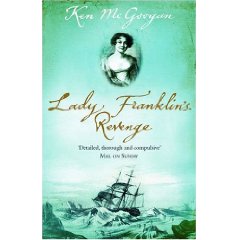
‘Lady Franklin’s Revenge’ by Ken McGoogan

2006, 435p & notes

The author of this book has written several biographies related to arctic exploration and one senses that he came to this biography almost grudgingly.  His other biographies focus on Arctic heroes- John Rae, Samuel Hearne and Elisha Kent Kane.  Amongst these male explorers, Lady Jane Franklin must have seemed an obsessed, vindictive, indulged woman, intent on pushing forward her husband’s reputation to the expense of others’.   Perhaps McGoogan still feels that way, but it seems that he found much more in Jane Franklin than he expected to.

Well educated and well-to-do, Jane Griffin did not marry John Franklin the Arctic explorer until she was thirty-seven years old.  He was a fleshy, dull man and she was driven and ambitious and she used her connections to procure a position for him on the Mediterranean, and later as Governor of Van Diemen’s Land.  She was an inveterate traveller, heading off for months and sometimes years at a time, accompanied by her iron bedstead which she insisted on having assembled for her on her travels.

The author is Canadian, with a readership no doubt attuned to Arctic themes.  But as an Australian, Lady Jane Franklin is far more familiar to us as the Governor’s wife; we see her in Richard Flanagan’s Wanting; we know of the Franklin River, and her diaries while travelling to Melbourne and Sydney have been well-mined. In fact, there seems to have been quite a Lady Jane Franklin revival recently.

McGoogan captures well the limitations of women’s financial position and influence in Victorian Britain.  He describes well the small-colony political machinations surrounding the dismissal of the VDL Colonial Secretary Montagu, and the lumbering, stiff style of Colonial Office politics and communications.  Lady Jane Franklin has money in her purse to bankroll numerous expeditions in search of her husband when he disappears into the Arctic white and she uses her connections with Dickens, the media, the American government and the Admiralty well.

There is much detail in this book- rather too much, I thought.  He does rise above the mass of detail to make informed and informative observations about gender, patronage, love, women’s position, memory and memorialization, but sometimes it is engulfed by too much information. Of course, Jane Franklin is a generous source: she diarized her life extensively; there is a wealth of communication; the Colonial Office and British bureaucracy built their edifice on paper and she used the public sphere to her advantage.  It is an embarrassment of riches- oh to have that as a problem! but I can see that sometimes you just have to say ‘enough’.

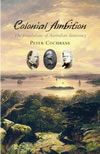
‘Colonial Ambition’ by Peter Cochrane

2006, 511 p & notes.

As you might expect, I am fascinated by the 1830s and 1840s in Australia- that time when the penal colonies were emerging into something different-( but what? ) and new colonies driven by a mixture of philosophy, moral entrepreneurship,  political theory and capitalism were being brought into being- (and would it work? ).  But try as I might, I find it hard to get energized by the crown land acts and constitutional legislation.  Perhaps it’s those years in school going on about squatters, selectors, dummying and peacocking;  and all those men in top-hats and Legislative Councils and Legislative Assemblies.  The lived politics of the time only really came to life for me with Margaret Kiddle‘s Men of Yesterday (of which more anon, I think) which brought people back into the situation- and this is what Peter Cochrane has done in this book too.

In one of the blurbs on the back, John Hirst wrote that

This is not the usual political history; it’s more wide-ranging, more vivid, more alive with people, places and talk.

At first I thought this a rather prosaic endorsement, but having finished the book, Hirst is spot-on.  There are people here- strongly drawn, complex, real people who change over time, whose public life is interwoven with their private concerns and anxieties.  And what a cast:  the strange-looking, brilliant, waspish Robert Lowe; the wealthy, bombastic, driven Wentworth, stung by  social exclusion on the grounds of convict origin ;  the versatile, enthusiastic, financially-straitened toyshop owner Henry Parkes.   And there are places: the action is located onto the Sydney city map  in theatres, parade grounds, street corners and houses.  The sense of place is perhaps not quite as strong as in Grace Karsken’s The Colony, but it’s reminiscent, say, of Jeff and Jill Sparrow’s work on Radical Melbourne.  It’s a politics that spills out of Governors’ offices and Legislative Council chambers onto the streets and newsprint, placards and petitions. And talk- yes, there’s lots of talk as well in the bubbling cauldron of the newspaper editorial and the forceful oratory of the public address.

What comes over strongly in this book is the dilemma of liberal politics at this time.   “Democracy” at this time- and especially during the politically turbulent mid-1840s-  was a concept that dared not speak its name. Both liberals and conservatives drew on the trope of Britishness, and ancient British traditions and loyalties.  For the liberals in particular,  responsible government was a poisoned chalice if it was a means by which the existing elites could cement their political position indefinitely.  For conservatives, long-standing demands like a nominated upper house and lifetime nominations became just as toxic when it was a liberal government in ascendancy, cementing its own position indefinitely.  To draw on cliches: you leave the book aware that, somehow or other, a fork in the road had been negotiated and that there was an alternative road that had not been travelled.

The book weaves local and imperial politics together well.  The regular churning of Secretaries of State at the Colonial Office was matched by the instability of the early ministries in the years immediately following responsible government in Australia.  Cochrane alerts us to the wider political debates and issues that the Colonial Office was dealing with at the same time: the Durham Report in Canada and the gradual implementation of its recommendations; the political trickiness for the British Government of the Crimean War; the empire-wide horror at the Indian Mutiny.  In the speeches quoted from radicals, liberals and conservatives alike, we see orators cherry-picking from historical analogy, particularly drawing on the American War of Independence and Canadian history for examples.

The book captures change well.  An idea that might be greeted with horror in one decade is not so unthinkable in the next.  The empire changes: local politics change: people change.   Cochrane illustrates that all sides of politics needed to learn how to “do” politics: governors needed to learn how to withdraw; liberal politicians like Cowper needed to learn how to make space for negotiation;  conservative politics like Henry Parker needed to learn how to bring his own colleagues along with him.   Liberals, conservatives and governors alike had to learn how to handle the politics occurring “out of doors” in meetings and street protests; how to project decisiveness and yet temper it with a degree of responsiveness.

I learned a great deal from Cochrane’s intermeshing of personality, place and politics- and it’s something that I’d like to emulate in my own work.  The book was written for the Sesquicentenary of Responsible Government in New South Wales (hence the focus on Sydney) and could have suffered from a eye-glazing sense of  “worthiness” and hat-doffing to a small readership.  Instead, it won the inaugural Prime Minister’s Prize for History in 2007, along with Les Carlyon’s The Great War.    At over 500 pages, Colonial Ambition is a long book but it moved quickly.  It is a very human book, and this focus on personality, flaws, ambitions and emotions was well-sustained and only on rare occasions struck me as being perhaps a little too fervent in places.  The ending, while emotionally satisfying and well-crafted in terms of the structure of the book, was rather too  rounded-off for my taste, and is perhaps my main qualm about the book. Nonetheless, as throughout the book,  his final paragraphs returned us to a person, to encapsulate the long constitutional journey we had been on.

But I don’t want to end on such a snarky note.   Cochrane has opened my eyes to a different sort of writing, and he has breathed life into a topic that could be otherwise dry and unappealing.  It’s a damned good read.

‘Hobson: Governor of New Zealand 1840-1842’ by Paul Moon

hobson

1998,  307p

If you ask a Melbournian about William Hobson, most of us would mutter something about Hobson’s Bay or the Hobson’s Bay City Council.  I hadn’t really thought about who ‘Hobson’ was: I assumed that he was an old sea-dog living down somewhere around Williamstown, and when I thought hard about it, I wasn’t even really sure if I knew where Hobson’s Bay was.  “Somewhere in Port Phillip Bay” I would airily gesture- thereby setting my Uncle Peter’s teeth on edge over the tautological use of  Port and Phillip and Bay in the same phrase.  (“It’s Port Phillip, Janine, – the Port named after Governor Phillip; not Port Phillip Bay”)

Hobson’s Bay is the bay immediately at the mouth of the Yarra River, with Williamstown on its west shore and Port Melbourne and Middle Park round to the east.  And Hobson, for whom it is named, was not a long-term Melbourne resident but instead spent a three-month stint between September and December 1836 surveying and charting the coastline of Port Phillip, returning to Sydney before a second brief trip accompanying Governor Bourke for an official visit and exploratory expedition in March 1837.  Hobson  was impressed with Port Phillip and was already dreaming of the fortune that could be made there.  In his letters to his wife he expressed hopes of perhaps being appointed Governor there in the future.  That didn’t happen.  Instead, he was sent off to New Zealand to investigate conflict there and on the basis of the report he submitted to the Colonial Office, he was appointed Consul to New Zealand in August 1839.  There seems to have been some slippage in the terminology of Consul/Lieutenant Governor/ Governor that probably signalled much about precedence and status at the time, but which is less significant to us now.  After meeting with the recently-appointed Governor Gipps in Sydney in December 1839, he sailed off to New Zealand arriving 29th January 1840 and was not to leave the country again before his death in 1842.  He didn’t muck around when he arrived: the first copy of the  Treaty of Waitangi was signed  on 6th February, just over a week after his arrival.

Which is, of course, where my interest comes in.  On the flight over to New Zealand, I read a review of Paul Moon’s latest book The Edges of Empire: New Zealand in the mid-Nineteenth Century.  I hadn’t heard of Paul Moon- not that that necessarily means anything- but I had heard of Claudia Orange and other historians who have written about the Treaty of Waitangi.  From his Wikipedia entry, he seems to be a prolific and at times controversial historian from Auckland University of Technology- perhaps an unusual location for an academic historian?

Certainly in his preface he distances himself from other historians, their methodology and their debates.

In preparing this biography, I have cautiously avoided trying to make the subject conform to a particular theme or line of argument, and any themes that do arise tend to be incidental…Consequently, many of the episodes in this work have been retraced in the way that they unfolded for Hobson at the time, rather than with the didactic and ‘superior’ sort of hindsight that necessarily distorts as it attempts to simplify and clarify. (p12)

In his eschewal of historiography and debate, he relies heavily on fairly lengthy slabs of official correspondence and primary sources predominantly from the New Zealand end.  The Colonial Office is depicted as a lumbering, compromised body ‘over there’- a simplistic approach which overlooks the contested nature of lobbying politics and the machinations of individuals and factions.  These political currents are well described by Adams in Fatal Necessity and more recently in Zoe Laidlaw’s analysis of the Aborigines Select Committee, the lobby group that lay behind much of the Colonial Office approach to indigenous affairs right across the empire.   Moon does, despite his protestations, engage with historical debates, most particularly over the Treaty of Waitangi, but does not extend what I conceive to be the courtesy of naming the historians or their arguments-  instead prefacing his own sallies with “It has been suggested that…”  It’s also striking how few recent references he cites in his bibliography: there is a heavy reliance on works from the early 20th century or the 1960s.  He critiques Paul Scholefield’s ‘hagiographical’ and ‘apologetic’ (p. 12) treatment of Hobson in 1934, but doesn’t take up any of his points in detail beyond this blanket condemnation.

By concentrating on the time 1840 to 1842, Moon does not pick up on the significance of Hobson’s naval background, a theme explored so well in Greg Dening’s Mr Bligh’s Bad Language and in Jane Samson’s Imperial Benevolence: Making British Authority in the Pacific.   He also skips over the significance of the patronage of Lord Auckland, after whom Hobson named the town he chose as capital city.

However, his approach does shed light on the contest  between the missionaries and the Wakefieldian-influenced land settlement company New Zealand Company, both of which vied for Hobson’s attention and decried his limitations to their patrons back in England.  Add to this the corrosive influence of self-serving and canny civil servants,  plucked from obscurity in Sydney on  Hobson’s way to New Zealand, who were just as avaricious as any land entrepreneurs in London or in Port Nicholson, the rival North Island city settled by the New Zealand Company.  Then, if that’s not enough, overlay this with Hobson’s own evident ill-health, evident even to me 160 years later,  looking at the shaky and at times child-like signature of Hobson’s name on different versions of the Treaty of Waitangi.

References

Peter Adams Fatal Necessity: British Intervention in New Zealand.1977

Greg Dening Mr Bligh’s Bad Language, 1994

Zoe Laidlaw ‘Integrating metropolitian, colonial and imperial histories- the Aborigines Select Committee of 1835-7’ in Tracey Banivanua Mar and Julie Evans Writing Colonial Histories: Comparative Perspectives, University of Melbourne 2002.

Claudia Orange The Treaty of Waitangi, 1987.

Jane Samson Imperial benevolence: making British Authority in the Pacific 1998.

Paul Scholefield Captain William Hobson: First Governor of New Zealand 1934.

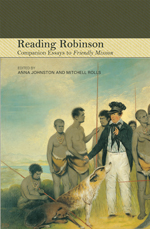
“Reading Mr Robinson” by Anna Johnston and Mitchell Rolls (eds.)

“Reading Mr Robinson: Companion Essays to Friendly Mission”, Anna Johnston and Mitchell Rolls (eds.)

reading_robinson_cover

2008, 188p. + notes.

N. J. B. Plomley’s Friendly Mission was published in 1966, with a reprint in 1971.  It’s a big book, close on 1000 pages and it has been out of print for over thirty years.  It has been recently re-released, and this companion book of essays has been published to accompany the new edition.

Friendly Mission is a transcription of the journals of the Aboriginal Protector George Augustus Robinson, with a lengthy introduction by Plomley.  Plomley’s work made the Van Diemen’s Land journals of George Augustus Robinson available and accessible- because  Robinson’s handwriting was truly wretched- for the first time to a wider audience.  This book of essays celebrates Plomley’s work and they testify to the importance of Friendly Mission as a contested and influential text that over 40 years ago encapsulated many of the debates still pertinent today about Aboriginal and Australian settler history.

There are three themes that run through the essays.  The first is consideration of Friendly Mission in is own right, as a text.   It is obviously a book that has deeply impressed the people who have read it, or chosen not to do so.  Lyndall Ryan speaks in her essay of  purchasing the book in its blue covers from the top shelf in a bookshop and reading it transfixed on public transport on the way home, and the encouragement she received from Manning Clark and Rhys Jones to explore it further.  A counterpoint to this enthusiasm is the response of three Palawa (Tasmanian Aboriginal ) contributors who write short reflections on their response to the book.  Some choose not to read it at all: others feel negated and angered by the perceived inevitability of ‘extinction’ and the self-aggrandisement and nonchalance of Robinson in the face of such tragedy.

N.J. B. or Norman James Brian Plomley- although known as Brian-  was a scientist and curator who wrote widely on a variety of natural history, medical, dentistry and museum studies issues.  His long introduction to Robinson’s diaries reflects the historiography of his times: he did not even consider the use of oral histories with living Tasmanian Aborigines- if, indeed he even considered them that at all- and his views on hybridity and purity of bloodline reflect attitudes towards aboriginality and identity that are not accepted today.  Rebe Taylor’s essay points out that there are oral history sources available, through the Westlake Papers collected by the geologist  Ernest Westlake (1855-1922) which among other things included interviews with the descendents of  the Bass Strait sealers and their Aboriginal women from 1908-10.   Plomley himself edited a collection of these interviews in 1991.

A second strand of these essays deals with the diarist George Augustus Robinson himself, the Great Conciliator with the Van Diemen’s Land tribes, and then Chief Protector in the Port Phillip Protectorate during the 1840s.   Alan Lester’s essay ‘George Augustus Robinson and Imperial Networks’ highlights Robinson’s religious and humanitarian motivation, and places him within the context of evangelical approaches being implemented by British and American missionaries across the Cape Colony, the West Indies, and American and Canadian frontiers.  Elizabeth Elbourne’s contribution ‘Between Van Diemen’s Land the the Cape Colony’ compares these two colonies, particularly in relation to the coercion of women and children, and links these to the small, but influential anti-Slavery lobby in the Colonial Office and the Aborigines Protection Society which itself was distancing itself from Robinson’s approach by the early 1840s.

Henry Reynolds in ‘George Augustus Robinson in Van Diemen’s Land: Race, Status and Religion’ embraces Robinson as a conscientious missionary, outraged by the injustices he witnessed.  The name-giving ceremonies, Reynolds claims, were an attempt to replace the derogatory names conferred by hostile settlers with more others with more dignity.  Robinson’s Christian belief in the brotherhood and equality of all men contrasted with the polygenetic views that were coming into currency whereby different branches of humanity were distinguished and ranked – with the British ascendant of course.  This is not to say that Robinson was unaffected by the early Victorian emphasis on status and respectability: his career was an perpetual struggle to maintain and boost his own standing both in the colonies and with the Colonial Office, and the seating arrangements in the church services he organized reflected an acute consciousness of gradations of status.

Cassandra Pybus’ essay ‘A Self Made Man’ is less complimentary, portraying Robinson as a vain-glorious, manipulative man who carefully massaged his own image.  She introduces as a counter-point Gilbert Robertson, the capital-strapped chief constable at Richmond in Tasmania, who claimed to have been the originator of the concept of a “Protector” and who put himself forward as an applicant.  As she says, it is an unedifying spectacle to see

these two colonial misfits scapping over the paltry financial benefit and dubious social advantage to be got in taking credit for the almost complete destruction of a whole people (p. 109)

The final theme involves the use of the Robinson diaries through Plomley’s publication by other historians over time.  Ian McFarlane in ‘N J B Plomley’s Contribution to North-West Tasmanian Regional History’  places Robinson’s account of the Cape Grim massacre against Curr’s rather self-serving account found in the Van Diemen’s Land Company papers, and finds that Robinson’s estimate of 40 deaths (rather than Curr’s admission to 3) is likely to be correct.   Patrick Brantlinger’s paper ‘King Billy’s Bones: Colonial Knowledge Production in Nineteenth-Century Tasmania’  compares Robinson’s account with James Bonwick’s history The Last of the Tasmanians written in 1870 and  overlaid by later-Victorian ideas of racial superiority, craniotomy and scientific measurement.  John Connor in ‘Recording the Human Face of War: Robinson and Frontier Conflict’ uses Robinson’s observations on warrior behaviour and weaponry to conceptualise Aboriginal resistance as ‘war’.   Rebe Taylor’s paper ‘Reliable Mr Robinson and the Controversial Dr Jones’ examines the archaeologist Rhys Jones’ development of the regression theory that Aborigines lost the ability to fish and light fires- a suggestion repeated more recently by Jared Diamond and Keith Windschuttle- a shadowy, rejected commentator whose influence (and notoriety) pervades the book.

I’m wary of celebratory and clear-cut history with simple “goodies” and “baddies”.  I’m glad that the Robinson diaries are ambiguous and contradictory, and that he himself is a flawed man who, even at the time, did not fit comfortably into his society. And I’m pleased too, that the discussion continues about what we as historians and Australians do with such a tragic, conflicted story.  Plomley’s Friendly Mission and the diaries it makes available are an ur-text that is mined again and again by authors- Richard Flanagan in Wanting, Robert Drewe in The Savage Crow, Mudrooroo in Doctor Wooreddy’s Prescription for Enduring the Ending of the World, Matthew Kneale in English Passengers; Nicholas Shakespeare In Tasmania; Cassandra Pybus in Community  of Thieves, among others.  It’s like a scab that we need to keep picking; an itch that we need to scratch; a wound that has not yet healed.

‘Colonial Improver: Edward Deas Thomson’ by S. G. Foster

PortDeas Thomas2

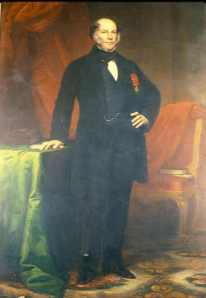
Once you’ve got some little way into your research, it’s quite amusing to look back at the things that puzzled or amazed you right at the beginning.  For me, it was coming across so many letters addressed to ‘E. Deas Thomson’.  Who WAS this man, I wondered, who seemed to write with such authority on so many topics- and why had I never heard of him?

Edward Deas Thomson was originally appointed clerk to the Legislative and Executive Councils under Governor Darling in 1829, then went on to serve as  Colonial Secretary for Governors  Bourke, Gipps, Fitzroy and Denison between 1837-1856.   The term ‘Colonial Secretary’ is a little confusing, as it was used both  for the Secretary of State for War and the Colonies in London (e.g. Marquess of Normanby,  Lord John Russell, Lord Stanley during Judge Willis’ time in NSW) as well as for the chief adviser and second administrator to the Governor here in the colonies.  In my focus on the empire-wide peregrinations of colonial civil servants and judges as they crisscrossed between Upper and Lower Canada, Newfoundland, Cape Colony, the West Indies, New Zealand, Australia, Sierra Leone etc., I have tended to forget that their mobility was supported by an ongoing administrative structure that remained more or less stable, despite the comings and goings of Governors.   This was the case with E. Deas Thomson who served under four governors, of varying political stances and administrative habits.

E. Deas Thomson was born in Edinburgh in 1800 to a family with naval and merchant connections.  His father was  the sometime accountant-general of the Navy, and family drew heavily on the patronage of Sir Charles Middleton (Baron Barham) , First Lord of the Admiralty, and his family after Sir Charles’ death.    His mother was from South Carolina, where Thomson’s father had worked as a plantation agent for his uncle.  After marriage, the couple moved back to Scotland but Deas Thomson’s mother seems to have not settled well and returned alone to South Carolina after suffering a period of paranoia, leaving the 5 year old Edward with his father.  Edward was educated at Harrow, then spent two years in France,  returning to London for a period before travelling to America, then Canada after attending  to business arising from his mother’s death in 1826-7.  The French and American connections, though not necessarily out of the ordinary, do suggest a broader experience than many other civil servants may have been exposed to.

Through his contacts with Sir Charles Middleton’s family, he appealed to Huskisson, then Secretary of State for War and the Colonies for a position in the colonial civil service.  At first he was offered the position of registrar of the Orphan Chambers in Demarara, then a second offer of Clerk of the Council of New South Wales, which he accepted, despite the lower salary, on account of the healthier climate.  This consciousness of the tropical climate, and its deleterious effects, is an ongoing theme in the English imagination of Empire.

He came to his position as Clerk of the Councils via a circuitous route.  The previous incumbent, Henry Grattan Douglass had been removed from the position, and Darling tried to replace him with his own brother-in-law Henry Durmaresq. However the appointment was vetoed by the Colonial Office after complaints of nepotism and Darling was warned against the appointment to public office of  ‘any relative or near connection’.  The position was then open for Thomson’s appointment.

Thomson was not particularly impressed with the drought-striken New South Wales during his first year in 1829, but his perceptions improved as the drought lifted and his friendship with Governor Darling developed.     He maintained a good relationship with Darling’s replacement, Richard Bourke ,and dined frequently with him, despite differences in political stance.  He married Bourke’s daughter Anna, which then placed him in a similar position to his predecessor Dumaresque when Bourke recommended Thomson (his son-in-law) as a replacement Colonial Secretary in place of Alexander Macleay– an erstwhile friend whose nephew ended up marrying Thomson’s own daughter in 1857- ah, the tangled intermarriages amongst colonial ‘gentry’ family!

Despite Bourke’s qualms about nepotism, the appointment went ahead, and as it was, Thomson remained Colonial Secretary for twenty years, long outlasting his father-in-law’s stay in New South Wales.   As such, he acted as confidant, advisor and spokesmen for the succession of governors.  His role changed after the 1842 Constitution introduced a partially-elected Legislative Council, and again with 1856 responsible government when, relucant to engage with electoral politics, he became a life appointee of the Legislative Council where he came to be aligned with the conservative element.

My own awareness of E. Deas Thomson, however, arises from his position as medium between Governor Gipps (the governor in charge during Judge Willis’ time in Port Phillip) and official and individuals in the community at large.   The protocols of communication were an important means of control:  individuals and government officials were instructed to direct all communication with the governor through his Colonial Secretary, and all communication with the Secretary of State in the Colonial Office in London also had to be channelled through Governor Gipps in Sydney (and hence, his Colonial Secretary E. Deas Thomson).   Certainly individuals could, and did, circumvent this process by writing directly to the undersecretary at the Colonial Office , but by Judge Willis’ time this practice, overtly encouraged by Undersecretary Robert Hay in the mid 1820s, had been regularized by the new undersecretary  Sir James Stephen.   Likewise,  there was an off-record back channel of communication within the colonies as well:  Gipps wrote personally to Superintendant La Trobe, and Thomson himself maintained long-standing communications with Denison in Van Diemen’s Land who was later to become Governor of New South Wales.   Indeed,  Thomson became increasingly critical of Governor Gipps’ carelessness in communications with local politicians,  and his inability to recognize when to speak and when to remain silent.  At the same time, leading members of the community recognized that it was better to sound out Thomson before approaching the Governor directly. (Foster, p. 62).

E. Deas Thomson himself has been cast as ‘conservative’ in his politics, particularly when he became a political actor in his own right after representative and then responsible government was granted to the colonies.  Certainly he came to be  seen to represent the interests of the squatters,  and expressed wariness and distaste for universal suffrage and wanted the constitutional backstop of a conservative upper chamber on a restricted franchise.  However, other aspects of his politics are less clear-cut.  He was a lifelong Free Trader, right from his time back in Scotland where he attended lectures by J. R. McCulloch.   He supported the idea of ‘improvement’- a theme picked up on in Foster’s title to his book- through schooling, universities, postal communications, railways, and his involvement in a range of benevolent societies and educational instutions including the Australian Museum and Sydney University.

The lives of E. Deas Thomson’s surviving children illustrate major themes in Thomson’s own life.  His eldest son suffered an ‘unstated ailment’ and could not hold down a job and drew on large sums of his father’s money- shades, perhaps, of Thomson’s mother’s ‘instability’; or maybe just colonial waywardness??? A second son became heavily involved in the Church of England and the temperance movement- the ultimate ‘improvement’ activity.  His three daughters’ marriages are a microcosm of empire: one married a nephew of Thomson’s own predecessor as Colonial Secretary, Alexander Macleay; another married a member of the Indian civil service, and the other married a naval officer.

Thomson’s own early career demonstrates once again the importance of patronage in embarking on a colonial role.   Patronage seemed to make the world go round, but it’s easy to overlook its infantalizaing aspects.  Thomson’s own father, dismissed from his position as accountant-general in the Navy by the incoming Whig Government, turned his attention to a rich widow.  To his son he wrote:

The party I have had in view and still have, if it can be accomplished is a Mrs C a person about 50, being neither (of course) young nor handsome but with more good temper than falls to the lot of most people in life- She is the widow of an army surgeon who has been dead about 7 years- Her father left her about 15,000 pounds which has not been decreased but rather added to… Lord and Lady [B]arham approve the Match  & have visited & paid the necessary attention (quoted Foster p. 36)

Shades of Lady Catherine de Bourgh in Pride and Prejudice??  I suspect, but am not certain, that by now the Barham influence rested with 1st Earl of Gainsborough– or perhaps Lord and Lady Barham are a different branch of the family?  Ah, it’s hard to shake my 21st century perception that there’s something rather demeaning in all this deference and condescension.

Foster paints a picture in this biography of a public servant who was not just a cipher for the Governor but who had influence in his own right.  He was in the mould of 19th century gentlemen improvers: he was concerned to ‘maintain balance’ between the forces in society, and he embraced technology, communications and education as a way of improving society.  His efficiency as public servant and administrator in many ways blunted the calls for responsible government: had the position of Colonial Secretary been filled by someone less capable, there would possibly have been more political agitation for constitutional change, much earlier.

References:

S. G. Foster Colonial Improver: Edward Deas Thomson, Carlton Vic. Melbourne University Press, 1978

‘Lawless Harvests’ by Alex Castles

hobart-jail

2003, 209 p.

As a primary school child in the 1960s, there were certain stationery items that your parents had to buy for you each year.  They always had to buy two HB pencils and a red-lead pencil that would kill you if you sucked the end of it (surely not?).  There was the 12-pack of Cumberland pencils that always looked insipid and cheap against the 24-pack Derwent pencils that the luckier kids had, with that brilliant aqua and lush bright green that even now gives me pleasure.   There was the pack of Greyhound Dry Pastels that went unopened all year until they crumbled to dust in your desk.  And then there was the plastic stencil map of Australia, with the states marked out with a thin line except for Victoria, where the boundary with NSW seemed to inexplicably dribble out into a series of dots on the right hand side.

It must have been a source of much chagrin for school children on the Apple Isle (Tasmania) to realize that their own state was left off the map.  No doubt having the little island dangling below Victoria added a level of complexity and expense to the manufacturing task that was not worth the effort.  And so, if you remembered Tasmania at all, you had to hand-draw it, down below Victoria somewhere.

Yet when looking at Port Phillip in the 1840s, one is struck by the dominance of Van Diemens Land on the new settlement.  George Town at the mouth of the Tamar River was much closer to Port Phillip than Sydney, 600 miles away.  Trade was frequent between Hobart, George Town and Port Phillip, and it was largely the scarcity of  available land after a heavy bout of land-grant activity in the late 1820s/early 1830s that drew men’s eyes northwards across Bass Strait.  Just as men and stock meandered down from the settled districts of New South Wales, so too did ship after ship from Van Diemens Land disgorge sheep that moved into farms throughout the Port Phillip district.

New South Wales dominates our awareness of early colonial Australia, but Van Diemens Land runs alongside it as a parallel but separate colonial entity.  Although the NSW Governor was officially Governor-in-Chief,  from 1825 onwards he played no active role in the administration of Van Diemens Land. The Van Diemens Land Lieutenant-Governor styled himself “His Excellency” (suggesting that there was no immediate superior) rather than the “His Honor” title that he had used up until this date, and the Tasmanian Supreme Court, officially proclaimed on 31 March 1824 was a separate entity in its own right rather than an arm of the Supreme Court of New South Wales as Judge Willis’ Port Phillip court was.

Alex Castle’s book, published posthumously in 2003 tells the story of the Van Diemens Land legal system.   The book had its genesis in a plan by the Law Society of Tasmania in 1985 to commission a history of the legal profession in Tasmania.  Professor Alex Castles from Adelaide University offered to write it, with a view to publication during the Law Society’s centenary year in 1988.  But only 3 chapters were written at that stage, and focus shifted to the 28th Australian Legal Convention to be held in September 1993.  By May of that year, twelve chapters had been completed and the final chapter was in draft form.  However it was never editted sufficiently for publication and the manuscript remained unpublished in a filing cabinet.  In 2003, after the death of Professor Alex Castles, the Law Society remembered the part-completed manuscript, and engaged its librarian to retrieve the text, and Dr Stefan Petrow to edit it, write an introduction and epilogue and compile a bibliography, as the text itself does not have footnotes.

In his introduction, Stefan Petrow discusses this book in relation to Castles’ other work, particularly his pioneering textbook 1971  ‘Introduction to Legal History’.  In this textbook, Castles concentrated on the English influences on the Australian legal System but Petrow detects  a movement in Castles’ work in later years that acknowledged local variation, particularly in frontier legal environments.  I wonder if Castles had written the introduction himself,  how he would have addressed himself to this question.

This book traces through the earliest legal steps in Van Diemens Land, which are hard to recover because the papers were burnt on the evening of  Lieutenant Governor Collins’ death- possibly to obscure legal decisions made during his time of office.   Collins’ successor Davey was completely out of his depth, and it was William Sorell, the next Lieutenant- Governor who reordered local affairs.  But the main focus of the book is on Lieutenant George Arthur and his devolution of power to himself, with the acquiescence of his fellow-Tory Supreme Court judge Pedder.   Castles credits Sir John Franklin (yes,  the villain of Richard Flanagan’s Wanting) with introducing the legal changes resisted for so many years by Arthur.  He traces through the amoval of the puisne judge Algernon Montagu and the attempted amoval of Pedder by Franklin’s successor Denison over the taxation-like nature of the Dog Act-  the same process of amoval (but for different reasons) which finished off Judge Willis’ career.

One thing that I very much appreciated in this book was the way that each chapter started anew with a little vignette or anecdote that piqued the reader’s interest anew.  He finished each chapter a similar way too, often returning to the episode with which he opened the chapter.  In between things got a little turgid, with a very ‘top-down’ perspective running throughout, but the openings and closings of each chapter remedied this.  I’m not sure that Castles himself would have finished the book with the what-happened-next epilogue that Petrow wrote-  the book suffers from the lack of a strong, argumentative final chapter.  However, it would have been beyond the ethical and editorial demands on Petrow to have written anything beyond what he has done.

Brigid Brereton ‘Law, Justice and Empire: The Colonial Career of John Gorrie 1829-1892″

brereton

1997

I’ve  often found, when I shut the covers after reading yet another colonial judicial biography, that however much I may have enlarged my understanding of a particular colonial official, there is still an opaque screen of inscrutibility about him.  There’s the judicial mindset that sees nuances and distinctions across all aspects of human interaction, and then it’s overlaid with the expectations and restrictions of the worldview of the early Victorian colonial gentleman.  Whatever humanity or common feeling the biography may have evoked, I’m left with the knowledge that the past is, indeed, as L.P. Hartley famously announced, a different country, and the people who lived there were of a different kind too.

However, this biography by Brigid Brereton, is different.  It came to me well recommended as an excellent example of judicial biography, and it is.   Perhaps it’s the choice of subject.  John Gorrie, the son of a dissenting United Presbyterian Church minister, took from his Scottish education and bar training an emphasis on philosophy, and working from first principles rather than the English reliance on case law- and indeed, though he worked for the Colonial Office all his professional life, was was not ever admitted to the English Bar.  This meant that he was well-placed for those colonies of the Empire where England took over from another European colonial power, where a pre-existing Continental system of justice  was already in place.  Hence his initial placement at Mauritius, the former Ile-de-France, which passed to Britain by conquest in 1810.  Here he worked under Governor Arthur Gordon,  who became confidante, friend and patron, and who was largely responsible for his second posting to  the newly-acquired British colony of  Fiji.  His experience with multi-racial colonies led to his final posting to Trinidad, which was enlarged to include Tobago.

Gorrie was not particularly interested in a judicial career, even though that is what he ended up with.  He had a deep commitment to political action as a way of bringing about change, and was heavily involved with the Aborigines Protection Society.  This led him to involvement with the Governor Eyre case on the part of the mutineers, and a lifelong interest in protecting the imported and native labourers in plantation colonies.   In his youth he had contact with the English radicals, especially Cobden and Bright, stood for parliament himself, and worked as a journalist on their  Morning Star newspaper.

It is in his correspondence with Governor Gordon that we see a man who is more recognizably modern than many of the other 19th century judges I’ve read about.  There’s a intimacy and affection in his relationship with Governor Gordon, and his writing, informed perhaps by his journalistic experience, has more colour and flow than similar correspondence I’ve read. He lived life fully: he enjoyed balls and social occasions, supported different philanthropic bodies, and enjoyed sports with his family.  And, when the political causes he espouses resonate with twentieth century liberal democratic thinking, then he comes over as one of the “good guys”.

But, of course, he was not a democrat as such, and much of his temperament and courtroom interaction is strongly reminiscent of that of Judge Willis.  He rubbed up badly against the entrenched elites in the colonial societies he moved between.  And, as is often the way, they got him in the end, although he died before he had a chance to contest his dismissal properly back in Britain.

This is a wonderfully contextualized biography.  The details of the social, political and historical mileui of each of his postings make each one seem quite distinct, even though there were many commonalities between them.  Gorrie himself comes over as a complete, coherent man who acted  consistently within a moral and political framework.  I wonder if this lies in the teller, or the tale?

‘Redmond Barry: An Anglo-Irish Australian’ by Ann Galbally

barry3

1995, 228 p.

As a Melburnian, it’s difficult to get past the image of Redmond Barry as a strong, imperious philanthropist.  He is still very much a visible presence:  a large statue of him rears up in front of the State Library (one of his projects); his name adorns prominent buildings at the University of Melbourne (another of his projects), and of course his reputation has been forever intertwined with that of Ned Kelly, whom he sentenced to death.  This is the stuff of myth-making: the pompous Supreme Court judge cursed by the fearless bushranger “I will see you there when I go” (or words to that effect), only to die 12 days later of “congestion of the lungs and a carbuncle in the neck”.  [ Can you die of carbuncle? Dear Lord, if I should die, please let it NOT be of a carbuncle!]

Ann Galbally’s biography covers, of course, his whole life but my interest is mainly on his early years in Port Phillip and his relationship with Judge Willis.  Barry was born into the Anglo-Irish ascendancy.  The peace that followed the Napoleonic Wars cruelled his chances for a military career, so he entered the law instead only to find the Bar crowded with other young men who had made the same vocational choice.   When his father died in 1838, he emigrated to Sydney where there was less competition.

barry4

On the journey out, he embarked on a relationship with a Mrs Scott- and worse still, continued it when he reached Sydney.  News of the affair reached the ears of Governor Gipps, and he was awarded few government briefs as a result.  He continued to suffer from disapprobation even after leaving Sydney for the small town of Melbourne because, although he socialized and got on well with Superintendent La Trobe, the more prominent legal positions were in the gift of Gipps rather than La Trobe.   His unorthodox relationships with married women seem to be an ongoing theme: in 1846 he took up with a Mrs Louisa Barrow, with whom he had four children, in a  public, lifelong relationship that was never regularized by marriage.

Barry was only 26 when he arrived in Melbourne, and Galbally paints an engaging picture of Barry socializing with the other predominantly-Irish members of the Bar:  his good friends Sewell, Foster and Stawell and fellow Trinity-college and King’s Inn  graduates Brewster and Croke.  Although a member of the Melbourne Club and welcomed to all the vice-regal social occasions, he had little capital behind him and thus was not caught up in the land speculation of the early 1840s and  “perhaps for this reason his managed to maintain civilized relations with Willis for longer than most of the legal fraternity” (Galbally p. 49).

Not that Barry found Willis easy.  His diary records a succession of entries where he “argued with Willis“, “fought with Willis” or had a “blow-up with Willis who threatened to suspend me“.  He greeted the news of Willis’ suspension with relief  “Supreme Court Willis suspended + removed, Te Deum Laudamus” (24 June 1843).

In spite of this, Barry did not seem to have been exposed to the same personal insults or attacks that other barristers and officers of the court suffered.  Willis seemed to greet his appointment as the Commissioner for the Court of Requests in January 1843 with genuine approval, and at times their sparring in court (complete with historical allusions and Latin jests)  seemed to be equally relished by them both.   Although Barry had a reputation as a bit of a dandy who wore an old-fashioned Beau Brummel style suit, obviously Judge Willis did not take exception to this as much as he did the trimmed moustaches of Edward Sewell, Barry’s friend and erstwhile housemate.

barry1

Unlike Judge Willis, Barry was noted for his “dignified deportment and invincible politeness” (Garryowen p. 867). Galbally captures this quality well.   Against such a man, Willis’ own failings of temper and demeanour would have been even more marked.

References

Ann Galbally  Redmond Barry: An Anglo-Irish Australian

Barry, Sir Redmond, Australian Dictionary of Biography (online)

‘David Collins’ by John Currey

sillsbendjan2009-036

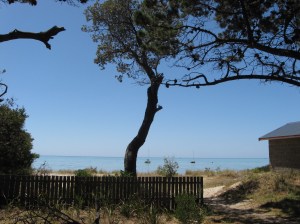
If my postings here have been a bit erratic lately, it’s because I’ve been going back and forth between home and my little caravan on the Mornington Peninsula.  It’s daggy and unsophisticated but as the sun sets over the bay, it’s a beautiful spot- here’s my view from outside the van, just up the track a bit.

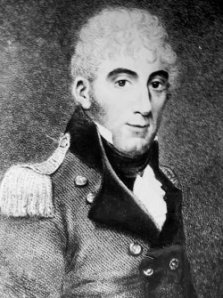
Being in such close proximity to the 1803 settlement at Sorrento has prompted me to read John Currey’s biography of David Collins– the leader of the aborted settlement of a consignment of convicts direct to Port Phillip.  By sending the fleet straight to Port Phillip from England, the Colonial Office intended to both quickly create a British presence and to alleviate the moral corruption of the constant inflow of convict blood into Sydney.  The settlement only stayed in Port Phillip for eight months until it shifted to Risdon Cove (Hobart) in two separate journeys separated by months.

The author, John Currey, describes himself in his preface as “an independent scholar without access to the services and resources normally associated with an academic environment”.  He has written and edited  a number of works of early Australian settlement.  The epigraph that commences his preface is an admonition from Andre Maurois’ Aspects of Biography (1929):

Every biographer should write on the first page of his manuscript: ‘Thou shalt not judge”.

He draws heavily on Collins’ letters to family and patrons, family papers and official correspondence, supplemented by newspaper comments and other peoples’ observations and comments on their relations with Collins.  Currey is scrupulous in his search and documentation, and almost succeeds in following Maurois’ advice.  But even he, at the end of the book raises questions that verge on the edge of judgement:

“Essentially conventional in so many ways, Collins was at the same time a complex and enigmatic man.  His written legacy, despite some tantalising revelations, offers few answers to the questions his life provokes.  How could a man so attentive to minute detail in his public duties be so negligent of his own financial affairs?  By what circuitous route did the man who aspired to ascend the pulpit come to find himself reviled as a lecherer and an adulterer?  Why did a mind so receptive and alive with curiosity become so dulled and inactive?  How could a man so blessed with so many natural charms fail to find enduring love and companionship? Did Collins himself, for all his introspection have any insight into his actions?  The exhumation of  [Collins coffin in ]1925 removed some of the mysteries surrounding Collins’s death.  It offered no explanation of the profound mysteries of his life.” (p. 308)

I find it frustrating when an author raises the very questions you want answered, but draws back from actually risking an answer to them.  Currey’s conception of his role as historian constrains him from venturing his own response, informed by his research, to these questions.  He should not be so cautious.  He has read the documentation: he has spent years with this man; he is qualified to venture a judgement.

In fact, I’d add a couple of other questions.  Why was he so unsuccessful in negotiating the patronage networks that all colonial civil servants had to manage?  How exceptional or commonplace was his relationship with the various convict women he had relationships with over his time in New South Wales?  What was the public response to these relationships?

collins

Inga Clendinnen in her Dancing with Strangers is less squeamish about speculating and judging David Collins as one of her informants.   After reading his published journal about his time with the First Fleet she characterizes its author as ” the Master of Plod” (ouch!).  She describes him as a man “susceptible” to liaisons with convict women.  She notes that Collins is

…a perfect representative of the moral and material economy of European culture.  It was these assumptions he brought to his analysis of the convict condition, and which he initially brought to the encounter with the very different culture and economy of the nomad people of Australia…. But as the slow years pass we watch David Collins ripen into an absorbed observer of native conduct, and a man capable of recognizing, indeed of honouring, a quite different way of being.” (p. 55, 56)

In reading this book, I found myself thinking of James Boyce’s Van Diemen’s Land which, like Clendinnen’s book, carves out a small what-if lacuna of time where the dispossession which certainly, inevitably and inexorably occurred was not yet deepened with violence and bloodshed. I found myself wondering if Collins’ insecurity and unsteadiness in his own authority did not hold the seeds of the 1803 failure in Port Phillip, thus averting an alternative history of Port Phillip as another convict outpost of New South Wales.  Boyce’s book about Van Diemen’s Land describes a benign environment: Collins saw it as hostile.  Boyce sees plenty and food sufficiency: Collins sees starvation and abandonment.

Although Currey doesn’t say so, the  David Collins I drew from his biography was a flawed man, who failed to achieve the hopes he had for himself.  He was impotent in using patronage to his ends; his career sputtered then died out; in an environment where many others prospered financially he ended up almost penniless;  he displayed poor judgement in relation to importing cattle from Bengal at huge expense; he failed to settle an area which just over thirty years later sprang into activity; despite his cheerful exhortations and assessments to some of his correspondents, his world view was essentially pessimistic.

‘An Architect of Freedom: John Hubert Plunkett in NSW 1832-69’ by John N. Molony

plunkett

1973, 280p.

The author, John N. Molony signals in his introduction that this biography has its limitations.  John Hubert Plunkett, Solicitor General, Attorney General, politician, and education board member left virtually no personal papers.  As a result,

If he is to be found today it must be through public sources such as the newspapers, the parliamentary reports, the official communications between Sydney and Downing Street and the legal opinions he gave during his twenty-five years as Solicitor and Attorney-General.  It is chiefly on such sources that I have perforce relied in the writing of this book (p xiii) ….It has been my loss as much as it will be to any reader that Plunkett rarely comes alive in the narrative.  No attempt has been made, no attempt can be made to see him in his home, to dwell on his own innermost thoughts and hopes, because Plunkett did not leave any record of these things.  Some scholar of the future may perchance discover Plunkett the man; some scholar, irritated by the gaps in this work, may till this field again and reap a richer harvest…” p xiv

We have been forewarned: this book will focus on actions and decisions at a top-down level, rather than at the level of man and motivation.  However, I think Molony sells himself a bit short here because the book does give an interesting insight into the Catholicism of a man who sensed that he had been enabled, rather than disadvantaged by his faith at a particular moment of English political history.  The Catholic Emancipation Bill provided space for his patrons to further his career, and he was conscious that opportunities were open to him that had not been available for earlier generations of Catholic lawyers.  He therefore had a strong loyalty to ‘the system’ and British law and worked within it as lawyer, then politician.

The book also highlights the theme of personal consistency in the midst societal change.   Two hefty winds of change swept through his world: after the initial co-operation of the different churches in the establishment phase,  their doctrines and personalities became more rigid from the 1860s onward, and sectarian hostilities became more strident.  Secondly, the change to representative and then responsible government  meant that his world view and ways of negotiating with politicians rather than officials, needed to change.  Such fundamental challenges to his world view did not come easily to him, and I closed the book with a sense that the wealth of experience he brought to his political roles was more hindrance than benefit in a changed world.

I was interested in reading this book because firstly, I’m interested in reading biographies about Judge Willis’ contemporaries in NSW at the time (although Plunkett was absent during Judge Willis’ dismissal and, indeed, was spot-on in his predictions of what the outcome of the Privy Council appeal would be).  Secondly, I’m not really sure what an attorney general DID in the  colonial constitutional system of the time. Certainly, Judge Willis clashed with acting Attorney General Therry in NSW, and with the Attorney General in Upper Canada earlier.   Was there something about the Attorney General role that acted as a flashpoint?  Or was it the individuals filling that role?

I don’t know if I’m much further advanced in my understanding of colonial Attornies-General, but I am clearer about the fact that they acted as legal advisors for the Crown- in this case, for Governor Gipps, and if the Governor was acting to discipline or dismiss Willis, then he was presumably acting on the Attorney-General’s advice.  Hence, some tension could be expected!  I was also surprised to read that the Attorney General could act as a Grand Jury in his own right (i.e. he could launch proceedings in his own right).  For example, Plunkett acted as a Grand Jury against cattle-stealers and against a conspiracy of six men “all of substance” who conspired to parcel out land at advantageous prices to themselves.  I wonder if perhaps Judge Willis would have relished having such powers, particularly in relation to the corruption and sharp-dealing that he felt himself surrounded by.  Methinks I need to look at constitutional development a little more closely, although I must admit that my toes curl up at the thought of it.

Reading this book has also made me think about the scope for the “scholar of the future” that Molony envisages “till[ing] the field again and reap[ing] a richer harvest”.  How would/will I do anything different?