Category Archives: Colonial biography

‘The Paper War’ by Anna Johnston

Anna Johnston The Paper War: Morality, Print Culture, and Power in Colonial New South Wales,  Crawley Western Australia,  The University of Western Australia Press, 2011.226 p. Plus notes

Now that my thoughts are actually turning to writing my big baggy monster of a thesis (stifle those snorts of laughter, please) I’m finding myself conscious of the way other writers are treading the tenuous line between ‘straight’ biography and something that’s not quite biography.  The Paper War by Anna Johnston is one such book.  Her focus is on Lancelot Threlkeld, the NSW missionary, and the texts he generated  by and about  his colonial experience. But it’s not a biography of Threlkeld as such, and the author is at pains to reinforce this distinction.  Her work is not history, or biography, but a literary/cultural study which

examines the archive as a set of writing and reading practices, seeking to make different meanings than a historian might.  The Paper War retells stories found in archives as well as revealing modes of construction, in order to create new narratives. It foregrounds the complexity (perhaps the impossibility) of efforts to establish coherent, credible narratives from partial sources  (p.4).

This means that, as well as looking at the content of a particular source, she also asks about the source itself : how did this document/series of documents come to be created?  What are the institutional structures, and individuals within those structures, that created them? Can we rely on these texts as stable and authoritative guides to the past? (p.4)   She is insistent on maintaining this emphasis on text as a mediated material when her reader’s attention might drift into the biographical corridors of  chronology and lifestory instead.

Her book focuses on the writings by and about Lancelot Threlkeld, the missionary in charge of the Lake Macquarie Aboriginal Mission in New South Wales in the 1820s, a man rather unkindly described as one of the “perpetual blisters” that the London Missionary Society (LMS)  seemed “destined to carry”.  He certainly seemed a rather pugnacious and belligerent character as a missionary and his writings to attack his adversaries and defend his own position generated what could well be described as a “paper war’.  As is often the case, his own irascibility was  in response to, and elicited, similar traits in his main clerical adversaries: the equally combative  Rev. Samuel Marsden and the protestant cleric John Dunmore Lang.  What a combination!  I’m particularly interested in this combustible 19th century character type, because our own Judge Willis himself exhibited many of the same traits.

Surrounding the Threlkeld/Marsden/Lang sparring ring were representatives of the broader 19th century  humanitarian network.  Daniel Tyerman and George Bennet were missionary agents charged with overseeing Threlkeld’s establishment of the mission at Lake Macquarie under the auspices of the London Missionary Society and thus his immediate supervisors.  James Backhouse and George Washington Walker were peripatetic Quaker investigators whose opinions were valued by metropolitan humanitarian networks for their independence and clarity.  The Paper War is very much embedded in the historiography of the ‘networked’ image of the British Empire (Zoe Laidlaw, Alan Lester, Kirsten McKenzie etc) and these agents and investigators exemplify the way that ideas were circulated throughout the empire by missionaries, intellectuals and London-based groups like the Ethnological Society of London.

The book itself has five main chapters, an introduction and a conclusion.  The first chapter, ‘Colonial  Morality’ gives a brief biographical account of Threlkeld’s career along with the careers of his major protagonists and the circumstances that led to the intersection of their careers with his.  The second chapter ‘Colonial Linguistics’, looks at Threlkeld’s pioneering work in researching the language of the tribes surrounding Lake Macquarie, and she traces the evolution in his thinking about how language can be studied and depicted.  His earliest work in 1825 was an attempt to develop an orthography (spelling) for an Aboriginal language, mainly in the form of question and answer phrases, strongly based on Europeans assumptions about categories and sentence structure by imposing  an artificial  one-to-one match between English and Aboriginal words.  In 1834 he changed his methodology to investigate the grammar of the language, followed by another work in 1851 written for the Great Exhibition in London called A Key to the Structure of the Aboriginal Language.   As was common at the time, colonial collectors were expected to scoop up the raw materials of plants, animals, languages and ethnography, which were channelled to the ‘experts’ in London for ‘proper’ classification and analysis.  She traces the use of his work by such ‘experts’, especially the way that it was posthumously re-published and co-opted as part of late 19th century racial theories.

Chapter 3, ‘Colonial Press’ shifts its focus to the newspaper record generated by and about Threlkeld, especially in relation to the execution of Tommy, an aboriginal prisoner for whom Threlkeld acted as interpreter.  This execution itself became subsumed within a broader sectarian argument, and in February 1828 Threlkeld wrote a series of letters to the editor- a common feature of colonial newspapers- against the Catholic Church.

Chapter 4 ‘Colonial Respectability’ takes up Threlkeld’s Statement Chiefly Relating to the Formation and Abandonment of a Mission to the Aborigines of NSW; Addressed to the Serious Consideration of the Directors of the London Missionary Society, written to justify his actions as missionary at Lake Macquarie.  Despite its title, it was not aimed at the directors of the LMS alone: he had at least 270 copies printed and distributed it to every director and missionary in the LMS network.  It is a 72 page document, largely composed of letters written and received in relation to the Lake Macquarie mission. Threlkeld’s adversary J. D.  Lang waded into this documentary swamp with his own series of newspaper articles criticizing the mission and Threlkeld’s character as a missionary, culminating in a civil court case Threlkeld v Lang in 1836.

Chapter 5 ‘Colonial Legality’ remains in the courts, but here investigates Threlkeld’s work as an interpreter in the courts, and his position and increasingly critical stance over questions of the amenability of Aboriginal people to British law, the use of Aboriginal evidence and questions of sovereignty.

The  conclusion of the book picks up themes from the introduction by returning to the question of historians’ uncritical use of the colonial archive.  Both Henry Reynolds and Keith Windschuttle as combatants in the ‘History Wars’ share, she claims, a “remarkably simple” view of the archive as unmediated primary source material that can be drawn out to construct a narrative. She picks up on Kevin Rudd’s championing of Thomas Keneally for the background in literary fiction that he brings to his retelling of Australian history (an issue also pertinent with Kate Grenville’s recent works). And here we are returned to the question of the heart and the affective world so prominent in the humanitarian world view, including that of Lancelot Threlkeld.

As I mentioned earlier, I was particularly interested in the structure of this book for my own work, given that it takes an documentary archive deeply imbued with questions of personality and temperament.  I ‘m interested by the decision to place Chapter 2 where it is- perhaps because Threlkeld’s linguistic work has been somewhat overlooked?- because it seems more related to Chapter 5.  I’m impressed by the way that her strong, minimalist chapter structure forces the reader’s attention on the form rather than the content of the archive. The book is on one level about Threlkeld , without being a biography as such, but on another level it works on a much larger canvas.

You can download a generous extract of the book here.
‘This Whispering in our Hearts’ by Henry Reynolds

1998, 251 p.& notes

The title of this book is taken from a speech delivered by Richard Windeyer as part of a 5-night debate carried out  in September 1842.  Henry Reynolds describes the speech, called ‘On the Rights of the Aborigines of Australia’, as “perhaps the most sustained and intellectually powerful attack on Aboriginal rights ever mounted in early colonial Australia.” (p.20).  Certainly it was felt at the time that Windeyer’s speech for the negative side had carried the day:

…we believe it to be the unanimous opinion of the members, that the speech of Mr Windeyer, for the negative, was the most argumentative and logical… He distinctly proved not only that the Blacks have no right to the soil of Australia for want of settled occupancy and cultivation; but that they have no right even to the kangaroos more than we have, the game laws of England agreeing precisely with the great law of nature, that wild animals not confined by enclosure are not, and cannot be the property of any man. (Sydney Morning Herald 12 Sept 1842)

And yet, after denouncing traditional Aboriginal society, and insisting that they had no claim on the land, Windeyer admitted at the end of his speech

How is it that our minds are not satisfied? …What means this whispering in the bottom of our hearts? (cited in Reynolds p. 21)

It’s an evocative term- the whispering at the bottom of our heart- and yet the fact that it was Richard Windeyer who voiced it is but one of the many complexities and contradictions that arise when trying to tease out of nuances of public utterances about Aborigines in the early decades of settlement in Australia.  Reynolds, perhaps, does not highlight the context of the speech sufficiently – i.e. it was argued as part of a debate where one often argues against one’s own beliefs.  Still, it’s hard to pin down Windeyer’s politics,  as it is with many of these 1830s and 40s public men.   Richard Windeyer was a parliamentarian and barrister: he had been at the meeting that established the Aborigines Protection Society in 1838 and yet he had defended the white stockmen in the Myall Creek trials (although there is a limit to what one can deduce from courtroom advocacy).  What are we to make of his position if  his head was telling him one thing and his heart another? In the final analysis, which one matters more?

In this book Henry Reynolds looks at three periods of white humanitarianism: the 1830s and 40s; the 1880s and the period 1926-34.  He deals with a small number of individuals in each period: George Augustus Robinson and Lancelot Threlkeld, Louis Giustiniani and Robert Lyon in the first period; John Gribble and David Carley in the second; and son Ernest Gribble and Mary Bennett in the third.

My interest in reading this book was mainly on his first period, and in many ways the people he considers in this section are the most difficult to reconcile with our own ideas of humanitarianism today.   Like the settlers whose actions they deplored, these humanitarians were likewise steeped in  ethos of colonisation, albeit for different purposes:

It was not that they were against the establishment of British colonies.  They spoke themselves of spiritual empires.  They were zealous to evangelize the pagan, to save the souls of Aborigines and other indigenous people.  They firmly believed they should both civilize and Christianise or at least radically change local cultures. The missionary could be more overbearing, more interfering, more insensitive than frontier settlers and stockmen.  And they were characteristically profoundly self-righteous, often with the fixed stare and intense focus of the convert. (p. 33)

Some writers- for example Lindsey Arkley– would be surprised to find George Augustus Robinson featured here, and Robinson’s role and motivation continues to be contested territory among historians.  Importantly, Reynolds charts the differences between 1830-40 humanitarianism and the humanitarianism of the 1880s.  A much changed intellectual climate and two generations of colonization meant that by the 1880s there was no longer any assertion of racial equality based on the biblical notion of shared descent and common blood.  It was taken for granted that Aborigines were members of an inferior race, and many assumed that they would eventually die out.  The horror of shedding blood, so prominent during the 1830s, had moderated and it was now seen as a regrettable, but unavoidable accompaniment to colonization.  Colonization and development were now a justification in themselves.  (p. 112, 113)

Reynolds reminds us that there have always been humanitarians- people who were willing to raise their voices and inured themselves to the abuse and obloquy  that they attracted.  But he also reminds us that these humanitarians of the past were for the most part unsuccessful:

… Australians of today who find comfort in the history of the humanitarian crusade should reflect that the protesters had little influence on events. Their assertions, however cogent, their moral appeal however persuasive, were largely ignored. Arguments forcefully put in the 1830s required restating in the 1930s. Many are still relevant today.  What the humanitarian story shows is that an alternative agenda was aired, a more humane course projected, was listened to, understood and then comprehensively rejected, often with derision  (p. 249)

The little moral force that they could exert often depended on overseas support- the Anti-Slavery society, the Aborigines Protections Society and various Colonial Office pressure groups in the 19th century and the League of Nations in the twentieth.   Access to the press  was crucial and skillfully used by many of these humanitarians: a sobering thought in our Wikileaks days.

And finally, and most importantly when looking at the 1830-40 period, our idea of what humanitarianism looks like is different.  We tend to shuffle away and distance ourselves from the “fixed stare and the intense focus” of such men (used intentionally), and there are statements in their rhetoric that send alarm bells ringing in our heads.  We would do well to remember:

The humanitarians were often paternalistic/maternalistic and shared many of the ideas that were current in their generation.  Some of them undoubtedly were racists in the way we understand that term now.  They were people of their period.  But if inquiry and understanding stops there we miss the passion for justice, the anger about cruelty and indifference which drove humanitarians along lonely, thankless and unpopular paths (p.251)

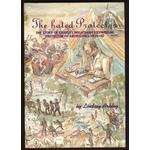
‘The hated Protector’ by Lindsey Arkley

2000, 469 p. & notes

Lindsey Arkley The hated Protector: The story of Charles Wightman Sievwright Protector of Aborigines 1839-42. Mentone Vic, Orbit Press, 2000.

Charles Sievwright is an ‘interesting’ man from 170 years distance, and was certainly controversial and combative at the time.  This biography of Sievwright examines his time in the Port Phillip District as Assistant Protector for Aborigines in the western district of Victoria between 1839-1842.  Lindsey Arkley, the author, also wrote Sievwright’s entry in the Australian Dictionary of Biography.

The Aboriginal Protectorates were an experimental measure, urged on the Colonial Office  in London by the evangelical pressure groups concerned about the treatment of indigenous subjects throughout the empire.   They were established as a secular adjunct to the church missionary system and comprised a Chief Protector and several Assistant Protectors. They were given the remit to firstly, protect indigenous people from settler cruelty and secondly, assist the church-based missionaries in converting Aborigines from a wandering and barbaric state into sedentary,  ‘civilized’ Christians.   The inland areas of the  Port Phillip District had only been recently exposed to widespread settler incursion, and it was rather optimistically hoped in London that this could herald a new and better approach.  It was an experiment imposed on Governor Gipps in Sydney and his local superintendent in Melbourne, Charles LaTrobe, and in the absence of any clear vision of how it would work in practice, George Augustus Robinson was appointed Chief Protector on the basis of his work in Van Diemen’s Land.  Unlike the other Assistant Protectors who were school teachers, Charles Sievwright had a military background and used his admittedly rather impressive patronage ties to get the position after some rather dubious gambling problems back in Europe.

It was a position fraught with tension, ambiguities and contradictions, even without the added complication of the deeply flawed individuals who were chosen to fill the roles.  Chief Protector Robinson was variously jealous, ambitious, inefficient, blustering, out of his depth and conflicted, and the Assistant Protectors soon began fighting both with Robinson and among themselves over lack of supplies, perceived lack of support, ambiguous instructions and – importantly for Sievwright- rumours of sexual impropriety.   In Sievwright’s Port Phillip career, and in his subsequent dismissal, these rumours of sexual misconduct including domestic violence, attempted seduction of other Protectors’ wives and most damaging of all, incest with his own daughter bubbled underneath all his interactions with his superiors, other bureaucrats, and the white settlers who resented his presence in prime grazing territory.

This is a very long biography at over 400 pages dealing mainly with three years of Sievwright’s career in Port Phillip, although the ‘before’ and ‘after’ are dealt with in the opening and closing chapters.  Arkley has drawn heavily on official correspondence, particularly the letters written to, from and by La Trobe and the local bureaucracy and the resultant reports between and by Gipps and the Colonial Office.    This is territory that I have been likewise wading through with my own research, and seeing how Arkley has dealt with it has made me more reflective about its value and limitations as a genre and source.  He has published much of this information in a much more accessible form than the originals, and been punctilious in his footnoting, but there is so much of it and often over so little.   This is something that I have likewise struggled with, in both a narrative and methodological sense.   Arkley reproduces the texts and has placed  the ‘controversy of the moment’ (and there were many!) within its context, but much of this is ‘he said/he said’ reportage.

Arkley started each chapter- and there are (too) many at 35 of them- with a few brief, interest-arousing observations but these are fairly general, often rejoicing in coincidence and juxtaposition and not always particularly relevant to the chapter.   In Arkley’s telling there are clearcut baddies- “Flogger” Fyans, Robinson, and the duplicitous La Trobe and Gipps- and one senses that Arkley’s purpose is largely to rescue Sievwright’s reputation from their clutches.

But in doing so, there is no scholarly discussion of the protectorate system and its ambiguities and no exploration of the meaning of the sexual scandal and its relationship with the other grounds given for Sievwright’s dismissal.  Perhaps this was not Arkley’s intention: I see in the blurbs that the book was embraced by local historians and Arkley himself works as a journalist.  Other historians have picked up on Arkley’s work- in particular Alan Lester and Fay Dussart in their article “Masculinity, ‘race’ and families in the colonies: protecting Aborigines in the early 19th century” [1] who thank him directly in their Acknowledgments.  I’m sure that Kirsten McKenzie [2] would do much with  Arkley’s work on Sievwright as well.

Is it valid to critique a book for what it doesn’t do, and perhaps even had no intention of ever doing? I’m not sure.  After all,  we stand on the shoulders of other researchers, and there is certainly value in Arkley’s collection and reproduction of much of the archival material on Sievwright.  His footnoting is excellent, and I’ve been able to find many of the sources he cites.  But at times I found myself wary of his clear attempt to promote and rehabilitate Sievwright’s reputation, and found myself having to read against Arkley’s text for much of the time and wanting to prod him a bit further.  Sometimes a bit of ambiguity and scepticism is not a bad thing.

Notes:

[1] Alan Lester and Fay Dussart ‘Masculinity, ‘race’ and families in the colonies:  protecting Aborigines in the early 19th century’ Gender Place and Culture, vol 16, no 1, 2009 pp.  65-76

[2] Kirsten McKenzie Scandal in the Colonies: Sydney and Cape Town 1820-1850 Carlton Victoria, Melbourne University Press, 2004

Also:

Ian D. Clark The Hated Protector: The Story of Charles Wightman Sievwright Protector of Aborigines 1839-42 [Book Review]  Aboriginal History, Vol. 24, 2000: 305-313.

Margaret and Maggie

Some time ago, in reviewing Peter Cochrane’s book Colonial Ambition, I made an offhand reference to Margaret Kiddle’s book Men of Yesterday and had obviously intended writing a more considered post about Kiddle’s book at some later date.  Now that I come to write about it, I find myself flicking through my reading journals that predate this blog (which has largely usurped their function) and I am surprised and regretful that I didn’t write an entry about it.  It was a book that deeply affected me at the time and the only explanation I can think of for its omission is that I must have considered it ‘work’ reading as distinct from ‘leisure’ reading.  I’m increasingly finding that there is no boundary between the two- I don’t know whether that’s a good thing or not!

Men of Yesterday is framed by the poignancy of the circumstances by which it posthumously reached publication.  Its author, Margaret Kiddle was a tutor at the University of Melbourne, but described and downplayed herself as “not an academic”.  She died of renal failure, after years of illness and a decade of dialysis, at the age of 44 with her manuscript finished but unrevised.  She left for her literary executors (including Max Crawford and John Le Nauze)  a list of what she saw as essential revisions and this note:

I guess this is just another ‘Melba farewell’ but if not-

Max, as you will be going to Wisconsin, I suggest that if he will, John takes over the revision.

John- I should be very grateful if you would do it for me.

Acknowledgements: The file correspondence and comments on notes will help you- don’t forget to thank yourselves!…This book has been finished in dramatic circumstances- for publicity purposes cash in on them as much as you like- it may earn some money!  (cited in MacKellar, see below)

But this was no ‘Melba farewell’– it was the real thing, and the book needs no cashing in.   Margaret Kiddle was proud of her pioneer ancestors, and the book is almost an act of love to the experiences of her forebears.  It is a very human book and it has attracted its share of critique. As the pointedly-titled thesis What Kiddle forgot reminds us,  aboriginal dispossession and women’s roles were kept in the  background,  and it has attracted (perhaps unfairly)  a reputation  as  a book of its time and historiography.

I’ve been reunited with Margaret Kiddle through a beautifully written opening chapter in a book by Maggie MacKellar called Strangers in a Foreign Land.  It has been generously- indeed rather TOO generously??- downloaded into Google Books and the opening chapter, at least, is a cracker.  MacKellar describes her  rediscovery of Kiddle’s work as part of her own project on the Niel Black diaries and the book that follows is an edited and interwoven transcription of Niel Black’s diaries.   In her introductory chapter she reprises early Port Phillip and Western District history, interweaving it with Major Mitchell’s acclamation of Australia Felix as the culmination of his journey that started just several kilometres from her own home.  She explains, as all historians experience and many (too many?) describe, the rush of emotions in dealing with primary documents, with her consciousness of what she is reading heightened by the elemental summer smell of bushfire that seeps into the cloistered space of the State Library reading room.  Despite my own as yet unresolved feelings about historians’ use of themselves in the history they are telling,  I have no such qualms about  edited diaries and letters.  It is in the historian’s interaction and shaping of the primary documents that the engagement with larger historical questions emerges:  it is obtuse to pretend that the historian is not there reading, absorbing, making connections and talking back to the material.

Just from the extracts available online, this looks a beautifully presented book.  Time, and an awareness that I am becoming distracted,  prevent me from reading further, but the opening chapter is a delight in itself.

References

Kiddle, Margaret Men of Yesterday: A social history of the Western District 1834-1890 Melbourne, Melbourne University Press, 1961

MacKellar, Maggie Strangers in a Foreign Land: The Journals of Niel Black and Other Voices from the Western District,  Carlton Vic., Melbourne University Publishing, 2008

J. I Little (ed) ‘Love as Strong as Death: Lucy Peel’s Journal in Lower Canada’

Lucy Peel was the wife of a naval officer on extended half-pay leave and in 1833 she and her young husband  Edmund arrived in Sherbrooke, Lower Canada, “attracted to a romantic and utopian dream of creating their own genteel Eden in the wilderness, but they were pragmatic enough to regard a permanent return to England as a possibility” (Little 1999 p.58).  And indeed, this is what happened- some three years later they returned, despondent that their plans had not come to fruition:

Edmund is, after four years hard labour, convinced that nothing is to be done by Farming in Canada; the land here produces too little to pay the labour requisite to cultivate it.

Lucy’s diary  has been published as Love strong as death: Lucy Peel’s Lower Canadian Journal 1833-1836, edited by J. I. Little (2001).    It was written as a “letter diary”, where she recorded the letters that she sent as monthly instalments to her mother and occasionally to her sisters and in-laws.  Her husband Edmund also contributed a few letters as well.  The letters survived as transcriptions in three bound volumes titled “Letters from Canada” and the transcriptions, written (and possibly culled?)  in two different hands, were donated to a university archive by a great-great-grandson. As such, it should be seen as a series of letters rather than a journal as such, and subject to the qualifications about letters discussed and commented on previously by Hels and Yvonne.

I have not been able to locate a copy of Little’s book here in Australia, but Googlebooks has a generous excerpt that includes the introduction and the Canadian Historical Association’s journal has a downloadable version of Little’s article “Gender and Gentility on the Lower Canadian Frontier: Lucy Peel’s journal 1833-36.”

Little cautions us:

While it is necessary to remember that journals such as Lucy Peel’s reflect the experiences and views of a small, privileged sector of society, their authors were nevertheless sharp observers of their social and natural surroundings and they provide valuable insights into the ideology and behaviour of the families who dominated the Canadian colonial socially and politically in the pre-Rebellion era. (2001 p. 2)

My interest is in Upper Canada, and at this stage I am not sure how much the mindset in terms of social expectations within the English community differs between Upper and Lower Canada.  Of course, the French presence in Lower Canada was a major distinguishing feature between the two provinces.  Little notes that English gentry preferred Lower Canada to the more sparsely populated Upper Canada, which was afflicted with cholera and malaria. (In my total ignorance of Upper Canadian climate at this stage, the reference to malaria surprises me.)   Peel, at least in the excerpts and article, does not make much comment on the French at all, but she does describe the English community and expresses some fairly virulent anti-Americanism, and I would expect that similar sentiments would apply in Upper Canada as well.

The excerpts reveal a lively, perceptive letter writer, and their marriage seems to be a loving one.  Little uses Vickery’s book The Gentleman’s Daughter as a thematic touchstone for describing Peel’s writings and identity as a gentlewoman on the frontier : love and duty; fortitude and resignation, prudent economy, elegance, civility and vulgarity, and propriety.

Both she and her husband Edmund are engaging and surprisingly modern writers, and I was touched by Edmund’s description of his wife’s experience of childbirth.  I suspect that many men stumbling out of the labour ward today might say the same thing, perhaps less eloquently (although possibly with fewer commas!) :

I was present all the time to support Lucy and I was much distressed to witness her agonies.  I thought it the proper place for a husband at such a moment, considering it nothing more than false delicacy which would make a man absent himself at a time when his presence and support are most required, it is a fearful thing to see a woman in her pain, I could not have believed it possible they had suffered so much, at times I felt quite distracted, as soon as the child was born I staggered into an adjoining room and cried like a child until I saw Lucy smiling and free from pain, her face last seen was distorted with pain, the impression made on me will not be forgotten (19 Dec 1833 entry by Edmund, cited in Little 1999)

Move over, Lucy- I think I’m a bit in love with him myself!

Sources:

J. I. Little Love “Strong as Death”: Lucy Peel’s Lower Canadian Journal , Ontario, Wilfrid Laurier Press, 2001. Googleview excerpt

J. I. Little  ‘Gender and Gentility on the Lower Canadian Frontier: Lucy Peel’s Journal 1833-1836.’ Journal of the Canadian Historical Association Vol 10 (new series), 1999

Uplifting Quotes for the Uninspired Historian #6

History is made up of a multitude of whispery but insistent voices from the past, each filled with its own imaginings and fond hopes, cynicism or despair, its own way of understanding an endlessly complex world, of explaining the inexplicable, of articulating an imperfect, subjective grasp on an historically determined existence. This conglomerate of contested, contingent meaning making that we call experience must be caught in a finer mesh, in the analysis of the webs of life as lived by individuals in relation to each other, as well as in the broader web of discourses that shaped and sought to define those lives. In analysis of the particular, and in the complexity of its relationship to the general, lies the recurring fascination of history.

Penny Russell, ‘Cultures of Distinction’ in Hsu-Ming Teo and Richard White Cultural History in Australia, Sydney, UNSW Press, 2003  p. 169

‘Memoirs recorded at Geelong by Foster Fyans’ ed. Phillip L Brown

“What is the use of a book, ” thought Alice “without pictures and conversations?”  I’m with you, Alice.  I  certainly wasn’t expecting conversations in Foster Fyan’s memoirs, and I very much appreciated the maps and illustrations.

Foster Fyans is well known in Geelong as the first police magistrate there (1837-40), then he became Crown Land Commissioner in the district.  The area just out of Geelong known as Fyansford is named after him, and there’s a Fyans Street in Geelong itself.  After visiting Geelong a fortnight ago for the Robert Dowling exhibition I seem to be rather Geelong-conscious at the moment, and I’ve been reading Fyans’ memoirs for a paper that I’ll be giving much later in the year.

As his entry in the Australian Dictionary of Biography suggests, there is not much known about his early life beyond that he was Irish and brought up by an uncle.  In these memoirs he springs from the page as a fully-formed army man, in charge of taking bringing a band of recruits to Portsmouth.  From the start he portrays army life full of masculine humour, eating and drinking, marching and high-jinks- almost a dead ringer for Lydia Bennett’s Mr Wickham and his mates.   His description of the Peninsular War likewise emphasizes life amongst his fellow soldiers, with more distress ascribed to the illness that swept through the camps rather than actual combat.  Then off to India for several years where again, life revolved around hunting and carousing and little mention of actual soldiering.  After a short time in Cape Colony (more parties and shooting), he arrived in Sydney where he spent a short, restless, lonely time before reporting to his regiment and joining his fellow soldiers at Parramatta.  Although he attended Government House, the jocular hail-fellow tone falters here, as the realities of convict settlement and official responsibilities become more apparent to him.  He is sent to the high-security  Norfolk Island where he eventually becomes Acting Commandant, and from there as commandant to Moreton Bay (now Brisbane) which was also a penal settlement at the time.  While  in Moreton Bay he oversaw the rescue of  Eliza Fraser.   His response to the convicts probably reflects the contradictions thrown up by the system- an uneasy wariness of violence that runs just below the surface co-existing with close day-to-day proximity with men not so different from oneself.

From there he was sent as Police Magistrate to Geelong, which is about fifty miles from Melbourne and rich pastoral land.  His memoirs become even quieter at this stage.  He spends quite a bit of time describing an expedition to the port settlement of  Portland, the first recognized land journey between the two settlements.  With only two mounted police and the surveyor Mr Smythe and no maps, they set off in what seemed to be atrocious weather, greeted each morning by the “flying jackass” (kookaburra), the “chanticleer of Australia”.   By 1840 he had been appointed Commissioner of Crown Lands, responsible for maintaining order among the squatters and investigating clashes between the settlers and the displaced aboriginal groups.  Here is a sad litany of violence,  where he mainly sides with the settlers in sympathy for what they perceive as needless stock loss. Like the settlers he is critical of the Aboriginal Protectors and the nearby mission station that he feels only attracts more aborigines to the area and imbues them with a misplaced sense of inviolability.

What started out as a military romp has become a nomadic police-like existence, accompanied mainly by his aboriginal “boy” Bon Jon (the purpose for my reading these memoirs).  It has become much quieter and more isolated.  Perhaps it’s the memoirist running out of puff too, because the memoirs stop abruptly in the bush in 1842.

The editor has written an introduction, where he describes the provenance of the manuscript and the various branches of the Fyans family tree, then gives a brief summary of the content of the memoirs.  I always enjoy hearing about how a manuscript comes to be published. The original, scrawled across five hundred foolscap pages had been typed up by Fyans’ great grand-son and it was donated by his descendants to the State Library of Victoria in 1962.   Although Fyans himself did not divide it into chapters, he did create sections by inserting a page with rough headings for the pages that follow. The  editor has created chapter headings and provided notes  at the end of each chapter.  These rather dour and punctilious annotations to the entries, which are painstaking in their detail, remind the reader of the fallibilities of memory and chronology, and the infelicities that arise when a raconteur is  telling a good story.

I think that it’s almost certain that anyone working exhaustively on an archive of memoirs, diaries or letters comes to build some sort of a relationship (albeit completely one-sided) with the author.  The editor, P. L. Brown (who also wrote the ADB entry) seems rather disenchanted by the many inconsistencies and errors he found

Fyan’s reminiscences had to be checked in order to assess their worth as historical material. This checking disclosed considerable and frequent divergence between actual and remembered events, and made it clear that the text, unless fully annotated, must be more entertaining than instructive. Hence the presentation of archives, both British and Australian, from the latter of which Fyans emerges as an energetic, conscientious public servant, rather let down by his rambling old self, who nevertheless conveys the authentic atmosphere of his historical period, and told few stories which lacked a germ of truth (p. xv)

The memoirs themselves ended abruptly, and the notes themselves end with the transcription of assorted letters and returns, and further details about wills and inheritances.  I found myself wishing that P.L. Brown had returned at this point to round out the picture somewhat and to help me, as reader, to bid farewell to Fyans.  After all, he’d been a rollicking companion for the first 100 pages or so, and despite infelicities and distortions in his retelling, he sure had a story to tell- Spain, India, Cape Colony and Australia- as did many of those peripatetic colonial civil servants.

Robert Dowling, Tasmanian Son of Empire.

If you put your skates on, you’ll catch the Robert Dowling, Tasmanian Son of Empire exhibition at the Geelong Art Gallery. But be quick- it finishes on 11 July.  There’s a beautiful NGA site about the exhibition here–  go have a look, it’s a stunning site and almost as good as being there.

Robert Dowling was born in 1827 in Colchester in England, the son of a Baptist preacher.  In 1834 he arrived in Tasmania with his parents, who followed their older sons who had emigrated to the colonies some time earlier.  This Evangelical background is important because it influenced the subjects he painted  for the rest of his life.  He was apprenticed as a saddle-maker but did not follow his trade. Instead he set himself up as a painter of commissioned portraits.  He travelled between Hobart and Launceston painting portraits of many prominent figures and personal friends, including John West the Congregationalist minister and other leading Evangelicals.  In 1854 he shifted across to Port Phillip in the hope of capitalizing on the post-Gold Rush prosperity.  However he found it difficult to gain patronage in Melbourne, so he shifted down to Geelong closer to his extended family, and where he was commissioned to paint portraits by the wealthy Western District pastoralists.

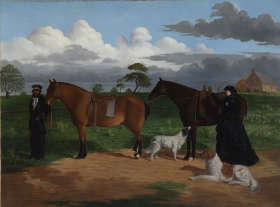
In every exhibition, there’s usually one painting that you linger in front of, and often return to in order to scrutinize it more closely.  For me, it was this painting: Mrs Adolphus Sceales with Black Jimmie on Merrang Station

The catalogue described this as a ‘mourning painting’.  The exhibition catalogue (a beautifully presented book by John Jones) tells me that  Adlophus Sceales died in 1855, leaving a young widow Jane and two young daughters.  Mrs Sceales commissioned the work, and how I wish that I could eavesdrop on the conversation between subject and artist when the painting was being planned!  The riderless horses remind me of the military funeral tradition, but I assume that they were portrayed because he must have loved riding, perhaps with the two dogs shown.  I wonder whose decision it was to include Jimmie, and what his clothes and stance indicate about his role on the station- it looks very formal attire, befitting a manservant for an Englishman.  The emptiness of the picture is striking: the house is not shown, only the stables and it looks rather bleak, empty and cold. The daughters are completely absent.

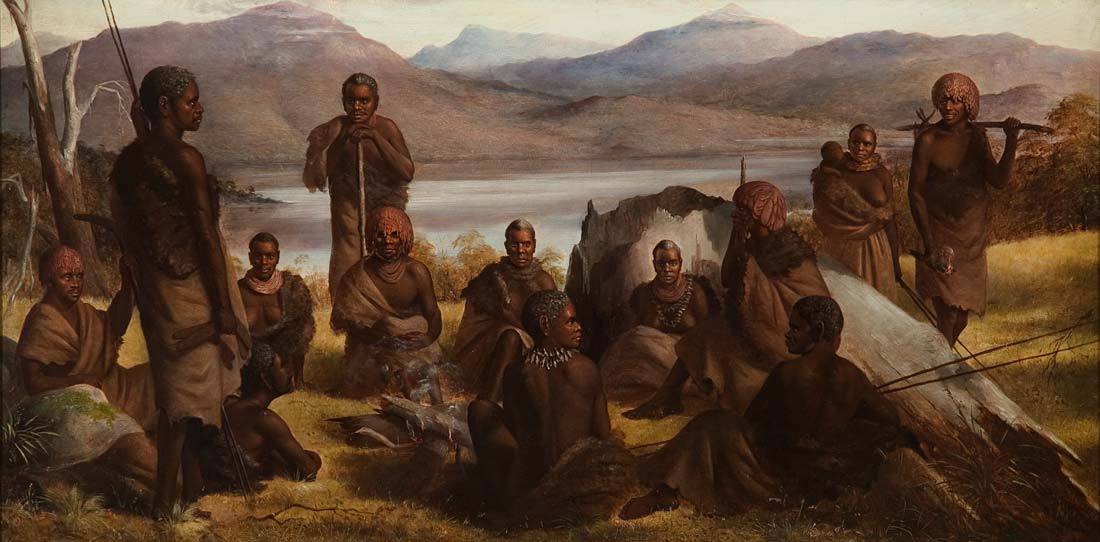
This was one of several paintings that show Aboriginal people in the Western Districts, sometimes in family groupings, and at other times in close proximity to the settler families with whom they lived.

These are the children of his brother-in-law’s family and I’m struck by the easy pose of the little girl draped innocently ( but not entirely appropriately to our eyes today) over the young  aboriginal man.  What does it say about his role in the family? He’s obviously much older than the children- does he have a carer role?

In 1857 Dowling travelled to London to study art, sponsored by the good citizens of Tasmania. He stayed there for nearly thirty years, improving his technique to be sure, and acting almost as a conduit of empire.   He made copies of British paintings for an antipodean audience- a portrait of Queen Victoria, for example was sent back to the colonies as an  important official painting. He sent images of empire home, and he brought images of the colony to the metropole. On the other side of the world, he worked up the paintings of Van Diemen’s Land aborigines painted by the ex-convict artist Thomas Bock, who had possibly instructed Dowling in painting many years earlier.  Bock had died by this time, and Dowling copied Bock’s paintings and inserted them into a range of landscape settings in grand History Paintings.  He made multiple copies, with the same central figures in different groupings and with different backgrounds.

Click on the NGV website about the Dowling exhibition for a zoomable close-up and explanation of the painting.

And, true to form, I can find six degrees of separation (even fewer!) from Judge Willis and this painting.  The smiling figure on the right hand side is Tunnerminnerwait, also known as Cape Grim Jack, who was one of the Van Diemen’s Land blacks who accompanied Protector Robinson across Bass  Strait. He was sentenced to death by Judge Willis and executed in January 1842.  If you have access to academic journals at all, there’s an excellent essay by Leonie Stevens in the June 2010 Victorian Historical Journal called “The Phenomenal Coolness of Tunnerminnerwait” ( a rather phenomenally cool title for the article, too!)

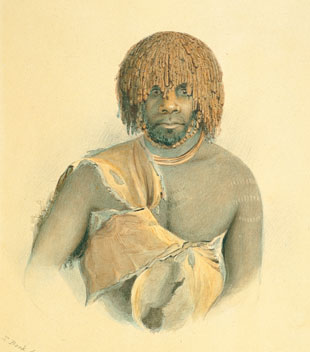
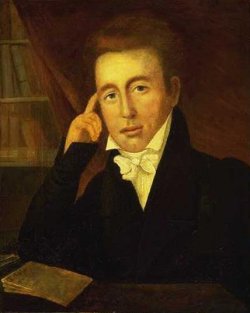
In a world where a few snatched bars of “Kookaburra Sits on the Old Gum Tree” can lead to a lawsuit, we might raise our eyebrows at Dowling’s appropriation of Bock’s images in this way. Here’s Bock’s version of Tunnerminnerwait on the left, and Woureddy on the right. You’ll be able to easily locate them in Dowling’s picture above.

Dowling’s re-presentations of Bock’s images found their way to the Ethnological Society of Britain and the Royal Academy where they fed the interest in anthropology and primitive societies.  Although these paintings were created in London, using sketches from Bock’s originals, they eventually found their way back to Australia as part of the swirl of cultural artefacts throughout the Empire.

Dowling returned to Australia in 1884 and set up a studio in Melbourne.  He returned to England two years later with the intention of packing up and moving permanently back to the colonies, but died suddenly.  As Jones points out, it’s interesting to speculate how he would have responded artistically to the Australian Impressionists and their take on Australian landscapes.

References

Jones, John.  Robert Dowling, Tasmanian son of Empire, Canberra, National Gallery of Australia c 2010

Stevens, Leonie  “The Phenomenal Coolness of Tunnerminnerwait” Victorian Historical Journal, Vol 8, No 1 June 2010 pp.18-40.

‘A Manifesto for New South Wales” Edward Smith Hall and the Sydney Monitor’ by Erin Ihde

Who’s Edward Smith Hall, you say?

He was the editor of the Sydney Monitor between 1826 and early 1840, which makes him exceptional among the highly fluid editorial scene in colonial New South Wales.  Many editors lasted only two or three years before their papers either faltered or merged and transformed themselves into yet another entity. So as Erin Ihde points out in this book, the Sydney Monitor under the editorship of just one man provides us with

…not just a newspaper but a most important manifesto, one which outlines a complex social vision as it evolved, on deeply laid principles, over a period of fourteen years.  In it we see revealed more clearly than in any other accounts, including the works of Wentworth and Macarthur, the intellectual problems faced by one person in their quest to clarify their hopes for New South Wales. (p. 244)

Edward Smith Hall was born in London in 1786, one of six sons of a bank manager.  He arrived in Sydney on 10th October 1811 bearing a letter of recommendation from Peel, the under-secretary for War and the Colonies, citing contacts with two other M.P.s   On the basis of this recommendation, he received several land grants but the life of a pastoralist was not for him. He became involved in merchant shipping and banking, then in 1826 established the Sydney Monitor.

Ihde’s book is an intellectual history, and it draws mainly on Hall’s editorials and articles over a 14 year period.  Hall seems to be a hard man to pin down intellectually, given often to puzzling logic and outright contradiction.  In a time without official political parties as such, over such an extended period of time, and under the pressure to generate two, and by 1836 three issues a week, it’s perhaps not surprising that his stance shifted on the hot topics of the day.  Moreover, many of these topics were just as thorny and contested and “wicked” as, for example, climate change and asylum seekers are today.  They were, as our ex-Prime Minister might have said, the great moral challenges of their time.  Nonetheless, Ihde has set out to try to trace Hall’s underlying philosophy and having attempted a similar endeavour with Judge Willis, I have some appreciation of how difficult this can be.

Hall operated from a practical Evangelical, yet surprisingly liberal Christianity- a contradiction right from the start.  He placed more emphasis on moral character than status; he believed strongly in the “moral economy” and the rights of free-born Englishmen and did not accept that convictism cancelled out these rights.  He strongly supported the continuation of transportation, and yet was seen as being an advocate for emancipists.  He acknowledged the Aborigines as the original possessors of the land, and yet accepted as part of the natural order of things that the Aborigines would be usurped- or rather, than the superiority of Englishmen would lead to their ‘adoption’ of the land.

He has been characterized as “changeable” by later historians, but Ihde argues instead that

…Hall’s stances on various issues prevent his easy classification as a supporter of any single ideological or political grouping for any length of time.  The complexity of his views and his struggles to find solutions to fundamental moral problems meant that while on the surface he appeared to be subject to abrupt changes of mind, in reality he was driven by a clash of circumstances and principles.  His contradictions were the result of his search for all-encompassing solutions…Hall has been portrayed by historians as having a very changeable attitude.  Such a view is unfounded. (p 245)

Ihde largely restricts his analysis to the columns of the Sydney Monitor.  His book commences and closes with biographical details about Hall himself, but Hall as a living, breathing Sydney man does not come through clearly through the body of the work.  I suspect that Ihde would say that this was not his intention: the book emerges from his doctoral thesis, and the blurb on the back of the book tells us that he is working on a full-scale biography of Edward Smith Hall- an admission that this book has not told all there is to tell about Hall.   Ihde consciously decides not to enter into Hall’s imprisonment for libel because, as he points out, other historians including C.H. Currey and Brian Fletcher have already ploughed this field.   I found myself disappointed by this.   Along with interest in how Ihde dealt with the intellectual beliefs of a “changeable” public figure, I was curious to see how Hall, bearing the religious, philosophical and intellectual beliefs that Ihde has analysed,  reacted as a man and public figure when they had real-life, physical consequences.  While Currey and Fletcher may have already described the situation, they did so from the perspective of Forbes and Darling, not from Hall himself.

So is it fair to judge a work by what the author has made a conscious decision NOT to deal with? There’s always a tussle between what a reader wants from a book, and what the author him/herself has marked out as the territory in which they want to excavate.  Part of the argument lies in convincing the reader stay with the author in that part of the field instead of gazing over the fence and wondering what’s over there instead.  I’m not sure that Ihde managed to do this with me completely , but in terms of technique, I gained much from watching a historian dealing with inconsistency and contradiction in the search for a philosophical bedrock in a public figure.

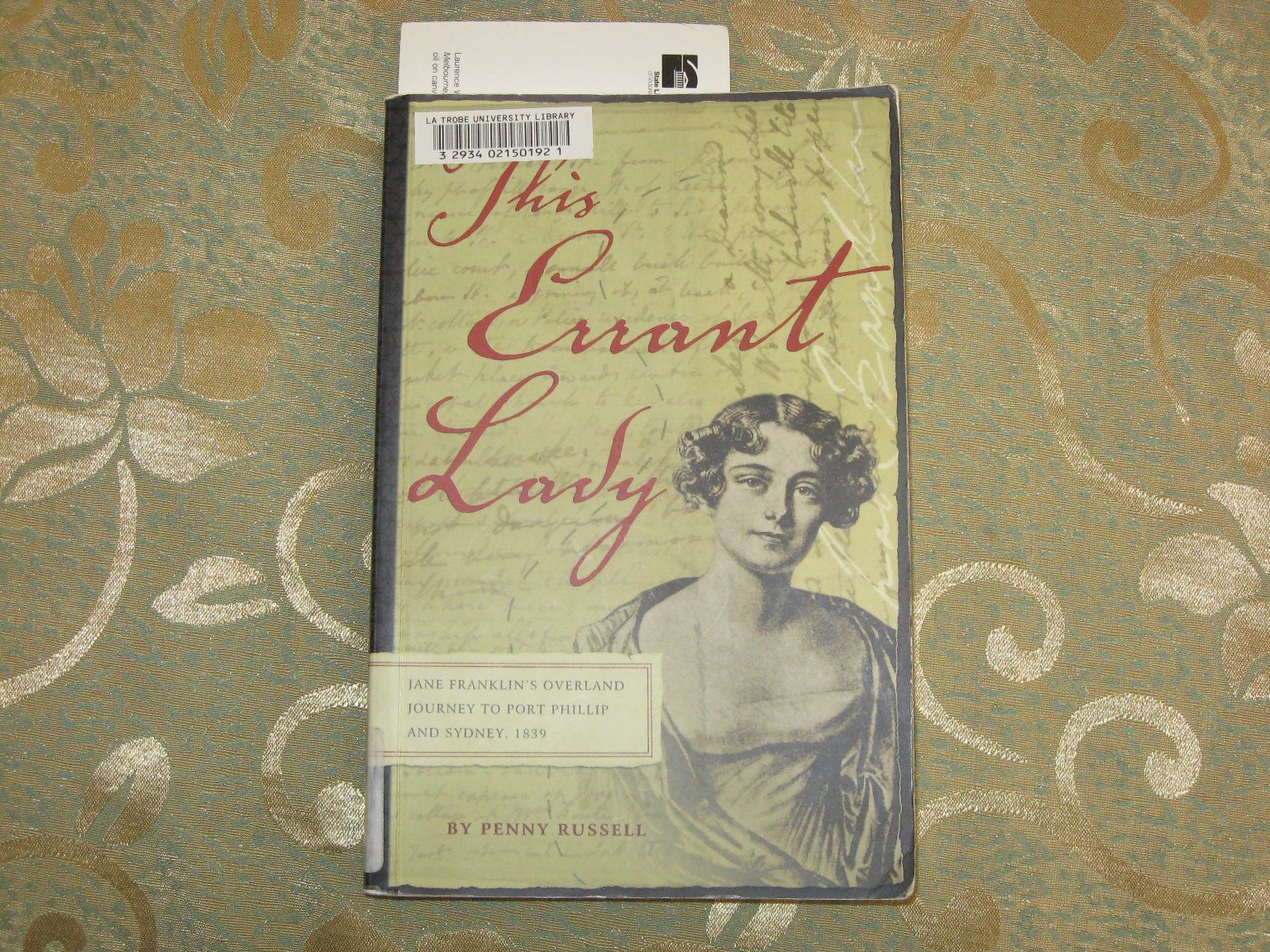
‘This Errant Lady’ by Penny Russell

2002, 207p.& notes

Now here’s a way to decide which book to read next-  what goes well with your decor?  It gave me great pleasure to see Penny Russell’s This Errant Lady lying on my bed, matching so well with my doona cover!  Martha Stewart, eat your heart out!

I was drawn to read this after finishing Ken McGoogan’s Lady Franklin’s Revenge recently.  I’d forgotten that Jane Franklin visited Port Phillip and Sydney in 1839 and I was interested to see what she said about Port Phillip in particular, even though Judge Willis, the Resident Judge of Port Phillip had not arrived at this stage.  I’ve been writing a chapter the last few weeks on Judge Willis’ involvement in colonial politics, which has taken me back to his relationships with Sydney colonists, and as a member of the government elite (albeit of a neighbouring colony), Jane Franklin was well-placed to comment on political events and personalities in Sydney.

Having now read her journal of her overland trip to Port Phillip and Sydney in 1839, I can now see why Ken McGoogan wrote the biography he did, quite apart from any other propensities that a writer on arctic exploration might have.  Jane Franklin’s journals are travel diaries in the true sense of the word- lots of information about routes taken, facts gleaned, people met etc. but not much about her own inner world.  I share the frustration of Penny Russell the editor in her preface:

In recording this epic adventure, Jane Franklin treated her diary essentially as a notebook, producing a compendium of often unrelated scraps of information.  This was in keeping with her general habit in travel writing.  Despite her enthusiasm for knowledge, Jane Franklin rarely ventured to express her opinions, speculations, or interpretations in writing.  The judgments offered in this, as in all her diaries, are generally borrowed from guidebooks, histories or local inhabitants.  Whether she agreed with them or not, she did not see her diary as a space for formulating her own opinions.  She confined her attention to the external, the observable- to what could be ‘fixed’ on the page (p. 16). … Her opinions, her thoughts, her own personality must be deduced as much from what is unwritten as from what is written- her character sketched in the space left vacant in her accounts. (p. 17)

This utilitarian approach can be partly explained by the fiction by which her trip was justified, both to her husband and to Tasmanians generally- that it was a research trip into a sister-colony that would be of use to her husband Sir John Franklin, Governor of Van Diemen’s Land, and would be a form of diplomatic representation of VDL at a governor-to-governor level.  The reality was that she was restless and curious and liked nothing better than getting away from her husband and the scrutiny of a small colonial society.  Mind you, she liked her comforts too- the iron bedstead came on this trip, just as it did on all her journeys.  But she revels in ‘roughing it’ and escaping amongst people who were only vaguely aware of who she was, and you sense the increasing tightening of protocol and deference as she moves from the outlying areas into the more settled districts surrounding Sydney.

The editor, Penny Russell, has excluded much of  the weight of detail that shackled Ken McGoogan’s biography, but she has tried to keep enough in

to preserve the rich texture of Jane Franklin’s portrayal of a colony arrested at a particular moment of development: a moment of optimism for the future, in a society still built on convict labour and pastoral expansion, in which progress rested upon the sufferings of the chain gangs and the brutually dispossessed Aborigines…But the catastrophic pastoral depression that would destroy the hopes of so many in the early 1840s had not yet made its mark, and the grandeur of half built churches and suburban villas, the growing concern over education, and the diversity of experiments in agriculture and industry all suggest an overall confidence. (p. 16-7)

Russell  has also worked hard, though, to preserve the human aspects of Jane Franklin’s interactions with the people she met.  Her trip was a long one- from April to July 1839- and she was quite devious in her excuses to cut it short as Sir John wished her to do.  But she probably should have come home earlier: it was quite clear by July that she had outstayed her welcome with the Gipps’, and it is her discomfort at this knowledge that makes her more likeable.  We have the intimacy of her coming into Mrs Gipps’ bedroom for a chat, thinking that she was alone, and finding Governor Gipps stretched out on the bed; we have the cringing, walking-on-eggshells  embarrassment when Gipps was furious that she had allowed his carriage to become soaked while she was using it.

For me- and I admit that this is probably an acquired taste- I enjoyed finding characters from “my” Port Phillip and Sydney strolling onto the stage.  So we meet Mr Verner (who was to become Judge Willis’ good friend and neighbour) bowling along in his carriage with two friends;  there’s a ship with Protector Robinson’s Van Diemen’s Land aborigines on board (some of whom were to be sentenced to death by Judge Willis two years later);  Captain Lonsdale (who was to become one of Judge Willis’ targets) taking them to a corroboree but arriving late so that it was all over by the time they arrived; there’s Chief Justice Dowling and his wife, and Justice Alfred Stephen (Judge Willis’ brother judges with whom he was anything but ‘brotherly’).  In fact- and this is important for my purposes- conspicuously absent is Judge Willis and his good lady from the balls and levees and receptions that were laid out for Lady Jane Franklin.

And so, eventually Jane headed for home. What a trip that was!  As with all journeys, once you’ve decided that yes, you’re ready to go home, it seemed to take an age.  But in this case it did-  five weeks from leaving the heads to their arrival back in Hobart (a trip that can take about 3-4 days for the Sydney to Hobart yacht race today).  Buffeted by storms, and with food and water supplies running low, their ship bobbed around; once almost glimpsing the coast of Tasmania before being swept out into the seas again over towards New Zealand.   Relieved, no doubt to be back, you still sense Hobart society swallowing her up again, with criticisms of her recklessness in even embarking on the trip and sniffy comments about petticoat government.

Penny Russell has intervened quite a bit in this book.  She has, by her own admission

emphasised particular stories, bringing into bolder relief images that are blurred, tangled or broken in Jane Franklin’s original. (p.17)

From the original transcript, retrieved and recorded by Roger Millis (who wrote the huge tome on Waterloo Creek), she has favoured people over trees or buildings, but not reproduced “the exhaustive and inexhaustible coverage of the original”, she has omitted hearsay information, and trimmed wordiness and detail “to give them greater narrative cohesion and more dramatic immediacy.”  She has supplemented the text with lengthy footnotes, giving a biographical sketch of the people Franklin mentions in passing, and interspersed Jane Franklin’s own text with clearly marked corroborating information from letters and other people’s diaries.  The book is given a clearer structure by its division into chronological chapters, many of which are prefaced by an italicized introduction.  You are aware, and Russell makes no secret of the fact, that you are reading a mediated text.   Which is probably a good thing: as the back cover blurb notes:

An intrepid traveller, Jane Franklin was consumed by an unquenchable curiosity. She looked, questioned, listened and wrote- pages and pages of minuscule notes on every topic that came to hand.  This edition, carefully abridged and introduced by Penny Russell, makes the diary available for the first time to general readers.

And while it’s probably not exactly a ripping yarn,  we general readers (and more specialized ones too)  should be glad that she has.