Category Archives: Cambodia

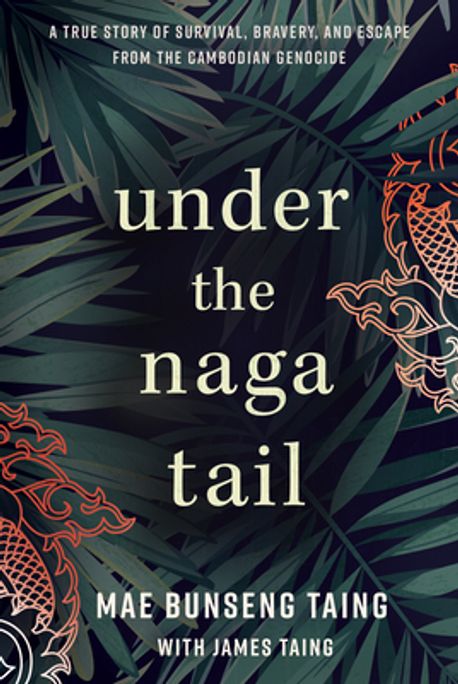
‘Under the Naga Tail’ by Mae Bunseng Taing with James Taing

2023, 352 p.

I was in Cambodia, and I wanted to read something Cambodian, but most of the fiction involved the Khmer Rouge period written by people who have escaped to Western countries. This book falls into this category too, although it is slightly different in that the narrator, Mae Bunseng Taing, is of Chinese ethnicity, living in Cambodia. I was interested to know what difference that would make. Unusually, all of Mae’s siblings survived, which is not true of many Cambodian families.

Mae was a teenager and living a fairly affluent life with his entrepreneurial family when the Khmer Rouge marched into Phnom Penh. As with other stories I have read, there was the utter bewilderment as Phnom Penh was completely emptied of people, urged (forced) to leave on the pretext that the Americans would bomb the city. He and his family were forced into the provinces to undertake agricultural work- a far cry from their trading activities in Phnom Penh previously. The family was split up as siblings were sent to different agricultural projects and communities, while his elderly and ill father was left behind in a village. They had secreted away some jewellery, so they were not completely penniless, but under the surveillance of soldiers and ‘Angkar’ operatives, they were only safe if they could merge in amongst other people. The book gives a good glimpse into the ideology that the Khmer Rouge were imposing on their countrymen, who were reduced to a form of slavery.

He finally decided to escape into the jungle, and survived several heart-stopping confrontations. With the defeat of the Khmer Rouge, he decided to cross back over into Thailand and look for his family amongst the refugee camps there. But there had been a change in Thai government policy, and now refugees were being returned to Cambodia, taken into the jungle, and left to find their own way through the explosive-laced jungles at Preah Vihear. It was an inhumane form of mine-clearing, using desperate refugees who were left screaming alone in the jungles, limbs missing, after standing on mines. Mae was, in many ways, in more danger now than he had been under the Khmer Rouge.

This, then, was a second form of Killing Fields. I found myself feeling ashamed at the kindness and the prejudice and indifference that these refugees faced, all too aware that our refugee policy some fifty years later has elements of both. The story was written down by Mae’s son James, who makes an unheralded and abrupt appearance during the narrative, and clearly Mae found his way to a Western country to start a new life.

There is a film by James Taing that you can see on You Tube here. (If you can stand the incongruent ads)

My rating: 7/10

Sourced from: purchased e-book

Read because: I was in Cambodia at the time.

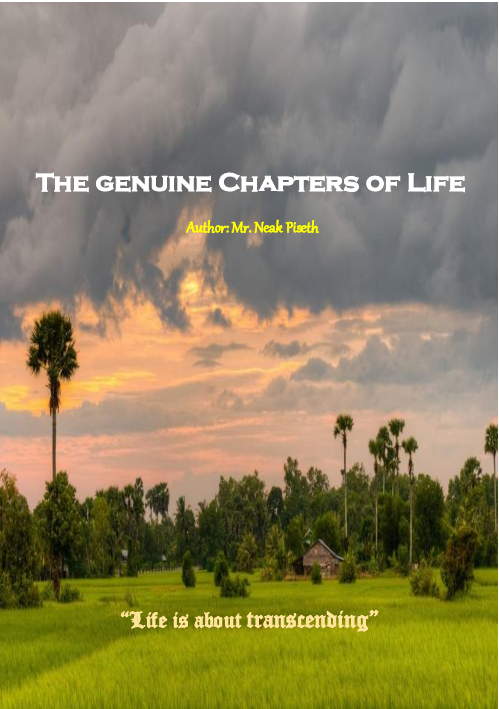
‘The Genuine Chapters of Life’ by Neak Piseth

2016, 116 p.

I’m not sure how I stumbled on this e-book which you can access through academia.edu or through issu. In fact, I’m not really quite sure what it is: on one level it is a memoir of a young man growing up in rural poverty in the 1990s to attain his dream of high education at the Royal University of Phnom Penh. But at another level, particularly near the end, it seems to become a scholarship application document where he outlines his vision for changes that he would make to his society were he successful in studying overseas. It must have worked, because he received a scholarship to pursue his master’s degree in Non-Formal Education at Chulalongkorn University in Thailand in 2019, continuing on as a PhD candidate from 2022. He has been working as an English Lecturer and as a lecturer in the Faculty of Education at the Royal University of Phnom Penh and has a number of publications under his belt.

His grandparents died under the Pol Pot regime and he was born to poor parents in 1994 with, at that stage, only one older sister. His father, an illiterate orphan, had inherited a one-hectare plantation in a village, and the family lived in a crumbling cottage while his father worked as a motor taxi driver in the city. In 1999 they received a contract to grow rubber trees on their plantation, but this necessitated moving to another dilapidated thatched, earth cottage closer to the trees. After the contract expired, they used the money they had earned to move back into the village where the author and his sister began attending school. They walked the three kilometres to school, and had to help after school looking after their three cows, while their parents worked in a small business, arriving home at midnight. In 2003 his mother had another daughter, who was often sick, and his father had to stop working to assist his mother at home. This meant that, in order to keep attending school, the author and his sister had to sell banana cakes after school to support the family. The family remained in poverty, especially after an accident on the rubber plantation resulted in his father’s blindness. Despite his father’s violence against his mother, the author deeply respects his father, and craves his approval.

He gives a fairly damning view of education in Cambodia. Teachers often took on private students as tutors in order to get additional money, which meant that they often did not teach the full curriculum at school, or charged for teaching and examination materials as a way of gaining extra students. The tutored students often received passing grades, to encourage their parents to continuing paying out for tutoring. Some students’ parents bribed the teachers, and many teachers arrived late.

Despite these difficulties, he was a very conscientious student, spending hours at night rote-memorizing his work. He really struggled to learn English- and indeed, this text is clearly written by a second-language learner- and he lacked confidence to speak in English, even when he knew the answers. By sheer hard work, and the good and well-earned fortune of a scholarship, he was able to attend Western International School in Phnom Penh. He lived in a small, dark room, continuing to rote-learn as much as he could. By the end of the book, his hard work is paying off, despite the discrimination against poor kids from the provinces.

I hadn’t expected to encounter Jane Austen and Bill Gate (i.e. Gates) in this book, but each chapter closes with an inspirational quote that he has gleaned as part of his studies. Beyond this, though, I’m really glad that I read this book while I’m here in Phnom Penh. I’ve found myself looking at the school children walking to their schools, and tuk-tuk drivers who are possibly working for their families in the provinces, with new eyes.

I hear with my little ear: Podcasts 16-23 March 2024

History Extra I recently saw the movie ‘Zone of Interest’ and so I was interested in the episode The Man who ran Auschwitz: the real story of the Zone of Interest, featuring acclaimed history of Nazi Germany Richard J. Evans. He had acted as historical consultant on Martin Amis’ novel on which the film is loosely based, and he approved of the film even though he felt that it smoothed out the sexual dysfunction in Hoss’ family. Hoss was born in 1901 and joined the German Army in WWI as a 14 year old. He was jailed during the Weimer Republic as a right wing fanatic, and once the Nazis achieved power, he became a member of the SS. Along with his colleagues, he believed that the Jews had to be eliminated as enemies of the Government. Auschwitz was originally a labour camp then expanded into an extermination camp- actually it was three separate camps. Hoss came up with the idea of gassing, and his career was seen as a success. He married young and his wife was a strong Nazi. After the war, many Nazis suicided or fled the country and took up false identities. It was the practice for arrested Nazis to be committed, tried and hanged in the country where the crimes were committed. He did admit his crimes (he had become a Catholic), which was unusual, and he was forced to write his memoirs prior to his execution. Evans says that you can’t expect films to be historically accurate and he was more critical of the films of the Boy in the Striped Pyjamas and Schindler’s List (the film) for their distortions.

Nichey History. I’m off to Phnom Penh again, so I thought I’d revisit some Cambodian history podcasts again. I thought that this podcast sounded pretty undergraduate, and it is- the presenter Jessa Briggs is currently an undergraduate studying English with creative writing, History and Global Studies. Listening to her murdering pronunciation of Cambodian names, and presenting in effect an overview of other people’s writing, this is not high-tech or particularly original work. But it was a good refresher for me. Episode 9. Cambodia’s Khmer Empire (aka the civilization that created Angkor Wat, et. al) starts by pointing out that the Khmer Empire was bigger than the Byzantine Empire, reaching its peak between the 11th and 13th centuries. In started in the 8th century, from the east, and reached its apogee with Jayavarman VIIth, their greatest king. Greatest because of his military prowess; his ability to unify Buddhist and Hindu believers and his building program, some of which still stands today. He was followed by Jayavarman VIIIth who followed the Hindu god Shiva, and who destroyed many Buddhist temples. In 1295 the new King took them back to Buddhism. All this back and forth was a big shift, and Kings were no longer deities. She is at pains to point out that the Khymer culture went into decline, but not collapse. Some theories for why: first, the shift from Buddhism to Hinduism and back again; second, foreign invasion especially from Thailand fuelled internal conflict, and third environmental factors. Angkor was a hydraulic city, and once the elites could no longer guarantee two rice harvests a year (and all the wealth that conferred), then they lost power. She suggests that it was a combination of all three factors.

Episode 10. Recovered from the Jungle: Angkor Wat (or the temple that is a city) takes up the story, looking at Angkor Wat itself. It was recovered from the jungle, and as the only Khmer temple that is oriented to the West it is suggested that it was a final resting place for Jayavarman’s ancestors, but there is no evidence for that. It contains 1200 kms of waterways, and water was necessary to make the ground strong enough to withstand all this building.

Global Story People Will Keep Dying: the spread of Fentanyl across the US/Mexican border Fentanyl is 50 times stronger than heroin, and it kills 200 people a day in the US. However, although all the talk is of the effect in America, despite the President of Mexico’s denial, it’s affecting Mexico as well. Ironically a shortage of the ‘wake up’ drug Narcan in Mexico means that Narcan is being smuggled back across the border into Mexico! Drug cartels are behind it, and unlike cocaine or marijuana, it is a completely synthetic drug, so there’s no dependence on growers and crops. It’s portable and is even being smuggled in through tunnels. The cartels and the mafia have tentacles deep into the US.

Things Fell Apart Episode 5, Series 2 Things Weren’t Going Back to Normal starts off with the gay-hate crime Pulse Nightclub shooting in 2016 then jumps ahead to 2020 in Tallahassee where the mother of a 13 year old girl was worried when her daughter told her that she didn’t feel like a girl. The mother, January Littlejohn, told the school that she would let her daughter take the lead on this. However, when she found that the school had written up a plan, aided by a group which emerged as a response to the Pulse Nightclub shooting four years earlier, she contacted Ron de Santis, who used her example as a rallying call for his ‘Don’t Say Gay’ law. Despite the moral panic, from 33,000 students, only 10 plans had been written, and the panic about young people identifying as cats i.e. ‘furries’ is unfounded. Yes, there are buckets of kitty litter in classrooms, but that’s in case the students are locked in because a school shooter is on the loose. Fix that up, de Santis.

The Rest is History Episode 1 The Tragedy Begins. Dominic and Tom are embarking on a series on the Titanic which they claim encapsulates bigger themes than just a movie. The sinking of the Titanic is now seen as a metaphor for the coming of the War. They concentrate in this first episode on three men: J.P. Morgan the ‘King of the Trusts’ (whose uncle wrote Jingle Bells no less). Morgan formed a conglomerate with the White Star line, emphasizing speed. The second man is Thomas Ismay, a rough hewn entrepreneur who made money shipping goldseekers to the Australian goldfields, and who owned the parent company. The third man is William Pirrie, who worked his way up at Harland and Wolfe in Belfast, who had dreams of being a politician, but was a supporter of Home Rule. At the end of the Gilded Age, there is competition between US and UK, now joined by Germany, and an emphasis on speed, luxury and modernity.

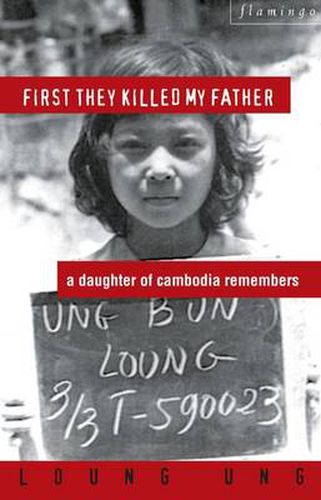
‘First they killed my father: a daughter of Cambodia remembers’ by Loung Ung

2001, 336 p.

As you might know, some months ago I travelled to Cambodia and am likely to repeat the trip a few times more over the next few years. First They Killed My Father is one of the books that tops the ‘Books You Must Read Before Travelling to Cambodia’ lists, but I felt rather reluctant to read it. In my mind Cambodia was defined by two things: Pol Pot and Angkor Wat, but I want it to be more than that. And yet, having now been there, the influence of both is inescapable. They don’t necessarily define Cambodia, but they have shaped it.

Loung Ung was five years old when the Khmer Rouge swept into Phnom Penh. They were wealthy and of Chinese descent: her mother was ‘full Chinese’ and tall, with almond shaped eyes and a straight Western nose. Her father, part Chinese, part Cambodian, she describes as having “black curly hair, a wide nose, full lips and a round face” with “eyes shaped like a full moon.” Her father originally worked for the Cambodian Royal Secret Service under Prince Sihanouk, and then as a major in the military police under Lon Nol. We don’t actually learn what he did in either of these jobs, but it did afford them an upper-middle class lifestyle in Phnom Penh. She was raised to distance herself somewhat from Cambodia: in the mornings she studied French, in the afternoons Chinese and at night Khmer, and her parents spoke about Cambodian customs as being something “other”.

Not that any of this helped when the Khmer Rouge evacuated the city completely, under the pretense that the US was about to bomb the city, and that they could return in three days. Her mother soon realizes the reality, with her offering money notes to her daughter to use as toilet paper. The family is shifted from location to location, siblings are sent to jobs in different places, and her parents are acutely aware of hiding their middle class origins and pretend that they and their children are peasants. Her parents had reason to fear. I found that one of the most chilling sights in the Tuol Sleng Prison (Security Prison 21), which I visited, was the sight of children, arrested along with their parents, who were questioned and later killed. It was fear of being arrested as a family that led her parents to send their daughters away to fend for themselves. Yet somehow, miraculously, some (but not all) members of the family find their way back to each other when the madness comes to an end. With the family in tatters, she and her brother travel to Vietnam, then use a people smuggler to go to Thailand where they end up in the Lam Sing Refugee Camp, waiting to be taken in by another country. Did her brother’s conversion to Christianity help?- possibly, and she and her brother are granted residency in Vermont.

The book is written in the present tense, and it moves chronologically in a methodical way, with each chapter headed by a date. It purports to be a child’s-eye view, but of course it is being written by an adult. The book has been criticized in Cambodia for inaccuracies, her obliviousness to her privilege, implausibilities and the racism she displays against the ‘base people’ in emphasizing her Chinese origins. You can read several critiques at Kymer Institute – in fact, it’s well worth doing so. Certainly I noticed her disdain of peasants and Cambodians generally, but as for the rest of the criticism- I don’t know enough. I read it partially as a way of trying (unsuccessfully) to understand the Khmer Rouge and how and why they took power with so little apparent resistance. Exhaustion from war and exposure to unyielding and ideologically-driven violence have much to do with it, I suspect. Reading this book while in the country, I enjoyed the descriptions of Phnom Penh (albeit at fifty years remove) and gave context to my ambivalent visit to Tuol Sleng Prison. I’m still looking for books about Cambodia that, while not blithely ignoring the Khmer Rouge years, are not defined by them.

My rating: Hard to say – 7???

Read because: I was there. E-book.