Category Archives: Book reviews

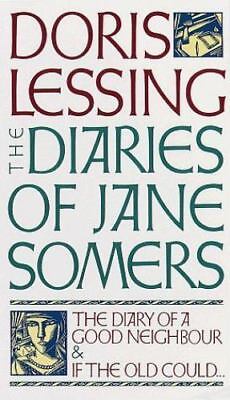
‘The Diaries of Jane Somers’ by Doris Lessing

501 p. 1984

I was going to say that I hadn’t read any of Lessing’s work because I saw her as an outdated writer from the 1960s in a tweed skirt and pudding-basin haircut. I now realize that I had her mixed up with Iris Murdoch, and that she actually lived until 2013, writing until the early 21st century. And consulting my reading journals from before starting this blog, I found that I had read a Lessing before – The Good Terrorist, a book I loathed. So it’s just as well that I was pushed into reading this book by my CAE bookgroup, because I would never have read it by myself (if I could even find it because it’s not widely available any more).

It has an interesting publishing history. It was published as two separate novels ‘The Diary of a Good Neighbour’ (1983) and ‘If the Old Could…’ (1984) under the pseudonym of ‘Jane Somers’. Lessing explains in the preface to this 1984 volume that she sought to publish the books under another name to test out the publishing industry’s willingness to take on an unknown author, and the effect of a known ‘name’ in achieving publication. She was right to be sceptical about the industry: her main publishers of her many previous works both rejected it. When it was picked up by Michael Joseph (later Penguin), they said that The Diary of a Good Neighbour reminded them of Doris Lessing. Her French publisher made a similar observation. Unlike her other books, it was mainly reviewed by women journalists in women’s magazines, highlighting for her the difficulty in bringing books to the attention of readers (I’m not sure that this is such a problem now, is it? Although you only have to look at the piles of remaindered books to realize just how much writing becomes literally junked because it has missed its wave).

Spoiler alert

Set contemporaneously in the early 1980s (which is when they were published) the books are written in the form of undated diary entries, a format which becomes increasingly implausible with the increasing use of direct speech and which leads to one continuous screed of writing. Jane, or as she calls herself, ‘Janna’ is an editor at Lilith, an upmarket glossy women’s magazine that includes several ‘serious’ sociological pieces on birth control, sex, health, social problems generally, often gleaned and barely disguised from New Scientist and other publications, as well as a heavy photographic emphasis on clothes, food, wine and decor. Janna was smart, fastidious about her own grooming and presentation, with a stylish home but a circumscribed social life beyond work. She had started working at Lilith in 1947, straight from school, and she was still there some 35 years later, although the magazine itself had changed its focus and structure over time. She had married in 1963, but her husband Freddie died with cancer. Several years later her mother died, after living with her briefly when her married sister Georgie said that she could no longer cope with her, as she had four children of her own. By her own admission, and increasingly, Janna realizes that she had been repulsed by, and emotionally absent for, both these deaths.

It is strange, then, that in The Diary of a Good Neighbour this chic and self-contained woman should befriend Maudie Fowler, whom she met in the chemist’s shop and accompanied back to her home. More than ‘befriend’ in a bureaucratic sense: she became a mainstay, a ‘carer’ (before than was a thing) and intimately involved with Maudie’s increasingly frail body in a way that she never could would have done with her husband and mother. This is part of Janna’s own growth as she reaches middle-age and looks back on her earlier life with an appalled guilt and regret that she had not really engaged with mortality, even when it affected those closest to her. Lessing captures well the despair felt at the betrayal by the body in old age, the mutual love/hate relationship between the aging person and their carers, and the bureaucratization of ‘care’ contracted out as part of a financial arrangement. Although set in the 1980s, the old women that Lessing describes live in squalor, with no internal bathrooms and inadequate heating. It’s pretty bleak.

If the Old Could’ picks up after Maudie’s death as Janna falls unexpectedly in love with Richard, a married man. It seemed light and airy after the oppressive sadness of the first book, although as time goes on the one-sidedness of the relationship becomes increasingly apparent. It is clear that Richard is not going to leave his wife; neither Richard nor Janna can bring themselves to actually make love with each other; Richard has Janna’s phone number but she has no way of contacting him; they spend a lot of time moving from pub to coffee shop and walking the suburbs of London. Janna’s caring responsibilities have, if anything increased, as her moody and indolent niece Kate moves in with her and Janna becomes a frequent visitor to Annie, an old, complaining woman who stays immured in her stuffy rooms. Kate is clearly mentally ill – her other niece Jill and Janna’s co-workers at Lilith can see it- but Janna is largely passive in the face of Kate’s slovenliness and her half-hearted involvement with a group of squatters who trash Janna’s immaculate apartment and take advantage of her generosity (shades of The Good Terrorist here). Janna herself is likewise passive in the face of the theft and cheating of the carers employed to look after Annie, perhaps through a misplaced sense of solidarity at the poor treatment of women working for the elderly. If Janna didn’t give enough to her mother or her first husband Freddie, she is surely compensating here, from a sense of guilt and lost opportunities. But the last part of her relationship with Richard and his family, particularly his son, is puzzling and strains credulity.

Moreover, I was never really convinced by Lessing’s selection of career for Janna. We are told repeatedly that she is very busy, but I couldn’t really work out what Janna did at Lilith. She seems to spend a lot of time worrying about her former co-worker and friend Joyce, who leaves for America to save her marriage, and she can drop everything for lunches and walks with Richard when he deigns to call. Janna’s focus on clothes and presentation (both for herself and in judging others) is an important part of her personality, but these could be woven into any professional job. I suspect that Lessing knew little about the high-end magazine industry.

Taken together, this is a lengthy two-part book. Particularly at the start, I seemed to read and read without making progress, and I despaired at ever reaching beyond the first quarter of the book. The writing is dense and wordy. The lack of chapters gives the book a feeling of relentlessness, especially in the dark sections with the increasing oppressiveness of Maudie’s frailty.

However, Lessing is very good at depicting the contradictions and compromises of women’s lives. Although written in Janna’s voice, she leaves space for the reader to make their own judgments of Janna’s actions and priorities. Despite my qualms about Lessing’s choice of high-end journalism for Janna’s work, the book itself has an emotional authenticity that is best appreciated, I suspect, by older readers. Readers who have watched their elderly parents die, have made mistakes and feel regrets, and have lived more than one life. In fact, I can’t imagine younger readers persisting with this book at all but, as an older reader myself, I appreciated watching a woman re-evaluating her life, finding her younger self a puzzling creature, and facing her own mortality head on.

My rating: Hard to judge. 8??

Sourced from: CAE Booksgroups (The Ladies Who Say Oooh)
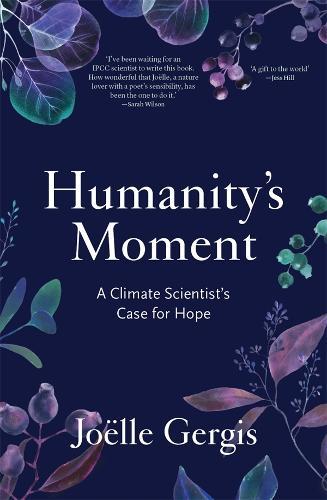
‘Humanity’s Moment’ by Joëlle Gergis

2022, 320 p.

The full title of this book is Humanity’s Moment: A Climate Scientist’s Case for Hope. I find it hard to imagine that a climate scientist could have any hope. Report after report comes out, each hammering the same point – that we have to act NOW- only for it to be engulfed in the news cycle by some new event with better video footage to attract eyeballs. Australians concerned about climate change congratulated themselves for shaking off the climate inertia of the last ten years, only to see our newly minted government open up exploration licences for more fossil fuel extraction and parrot the mining companies’ “well-if-we-don’t-dig-it-up-someone-else-nasty-will” mantra. Even I with my admittedly limited scientific education was shouting at the television: so I wonder what climate scientists were thinking as they heard this?

Joëlle Gergis IS a climate scientist. She was one of about a dozen Australian lead authors working on the United Nations’ Intergovernmental Panel on Climate Change (IPCC) Sixth Assessment Report that was released mid-2021. As part of Working Group 1, her task was to provide the scientific foundation for understanding the risk of human-induced climate change, its potential impacts and options for adaptation and avoidance of dangerous levels (p10). It was her job to review thousands of peer-reviewed scientific studies, and distill their key findings. Their draft underwent government and expert review, and they returned to their chapter to address the 51,387 technical comments they received before its release in August 2021, in the midst of the pandemic. By the time the Seventh report comes out in 2030, it may well be too late to achieve the Paris Target.

What a thought. Too late by 2030. Eight years. My eldest grandchild will be a teenager. My youngest grandchild will be in lower primary school. Ah, you say, you’re thinking with your heart and not your head. But this is exactly what Gergis does in this book: she thinks with her heart AND her head. This is not without risk. She is open about her own depression, much of which springs from being heart-sick about the implications of her work. This is still a ‘brave’ thing for a scientist to do, particularly a female scientist who would face old stereotypes of being ‘hysterical’ and ‘shrill’. But she insists that we cannot think about climate change with our head alone: we need to bring our hearts to it as well.

The book is divided into three sections on this basis: The Head, The Heart and The Whole. The first section, The Head, is facts and statistics. There was so much I didn’t know. As part of the the IPCC Sixth Assessment, five ‘shared socioeconomic pathways’ were developed, showing temperature rises under very low, low, intermediate, high and very high greenhouse gas emissions. It is discouraging that the ‘intermediate’ scenario is now seen as the most likely, with a rise in temperature of 2.0 degrees in 2040-2060 and 2.1 – 3.5 degrees between 2081 and 2100 (when my grandchildren will probably still be alive). A whole cascade of consequences will ensue: changes in weather patterns and ocean currents, sea level rise, loss of biodiversity, food insecurity, water insecurity, refugee flows… It is just overwhelming and terrifying.

Part II, The Heart, acknowledges this:

I’m sure, by now, many of you want to put this book down and stop reading. Trust me, I understand how you feel. These last few chapters have been really, really difficult for me to write….I’ve found myself overcome by tears many times and I’ve come to terms with the reality of what I’m writing, especially material that I don’t deal with directly as a climate scientist. Usually I’m working with physical variables like temperature and rainfall that can be neatly analysed and understood. But when you start to understand the reality of what the numbers actually mean for the people and places we love, you find yourself face to face with something so profoundly sad…This process has put me in touch with a sense of grief that sometimes leaves me feeling like a broken mess.

p.137

This section is written in “us” language: she, the writer, is talking to us, the reader. She speaks of fear, despair, frustration – deeply human responses- and I feel as if here I am reading the answer to my own question “what were climate scientists thinking when they heard this?”. They were crying. They were frightened. And when I hear this, I am frightened too.

Who is going to lead us out from all this? she asks in Part III. Her answer is that we are going to have to do it ourselves. This is an ‘active hope’ for her but I wish I felt as sanguine as she does. She sees hope in COP26’s agreement to phase out coal-fired electricity in the 2030s for major economies and 2040s for developing countries. She despairs at the failure of leadership that led to the watering-down of pledges, but holds onto the awareness that the 100,000 people protesting in the streets of Glasgow were part of a world-wide Global Day of Action for Climate Justice taking place in over 100 countries. It is, she says “the biggest social movement of our time. A time of true global citizenry, driven by our passion to save the one thing that sustains us all: our Earth”(p.162). She celebrates the arrival of the Teal Independents and the success of the Greens in recent Australian politics, and the election of Joe Biden with his strong emphasis on climate action, especially in comparison to Trump. She looks to books, music, films and poetry as fuel for the social movement that will bring change. She acknowledges that

no matter how many facts and figures I give people, in the end it is probably going to be a book, an artwork, a song, a photograph, a play, a performance or a film that eventually helps awaken their sense of care for other people and the natural world…. We need artists to help scientists translate the cold, hard facts into raw human emotions.

p 188,190

She talks about how change happens, looking at the domino effect when a critical threshold of society changes its minds. She cites a study by Damon Centola from the University of Pennsylvania who argues that the threshold for a social tipping point was passed when the size of a committed minority reached approximately 25 per cent of the population. Once this social tipping point was reached, between 72 and 100 per cent of people eventually adopted the new convention (p.194, 195).

I must say that I find some of these tendrils of hope rather insubstantial. Teals and Greens notwithstanding, those exploration licences were still issued by the Federal Government. The fossil fuel lobby is just as powerful as ever, now cloaking itself in support for “blue” hydrogen. That number of 25% support to bring about social change, however it was reached, can go just as easily the other way. I note that 25% was pretty much the proportion of votes attained by right wing parties in Sweden, and projected for the Brothers of Italy in the upcoming Italian elections. For myself, I bristle against the ‘preachiness’ of the arts dressing themselves in the most recent issue of the month, and climate change is too important to have us rolling our eyes at being ‘told’. Let music, art, writing celebrate being human and our environment on its own terms: it is enough.

For it is her final claim on the goodness of people and the need to keep “showing up” that probably chimes closest to my own ideas.

While we all behave badly sometimes, most people are honestly doing the best that they can from day to day. Most ordinary people, deep down, really do care about the planetary crisis we are facing, but they often feel powerless and disillusioned about their ability to influence change…Instead of being someone who confirms someone’s distrust of the basic goodness in humanity, you can choose to be a light in dark places for those around us…We can choose which side of history we want to be on and make the personal choices that help make the world a better place. So many of us have lost faith in the goodness in humanity, we’ve lost touch with our inner knowing of what is true and whole in ourselves and each other. When we contact this universal place of compassion and the interconnectedness of our hearts, we experience a sense of homecoming, a deeply felt sense of our belonging to our shared humanity.

p. 226, 227

This is an important book because it connects the head and the heart. It is deeply rooted in the science- you only have to look at the bibliography to see that- but it is realistic about the political challenge. At times the writing, especially when describing nature, is a bit overwrought and self-conscious, but the passages where she talks about her response at an emotional level are raw and honest, and above all human. Because in the end, it is the recognition of being human, together, that is our best hope.

My rating: 8.5/10

Sourced from: Review copy Black Inc.

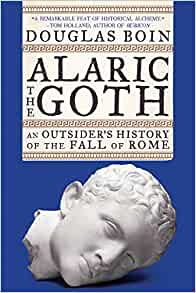
‘Alaric the Goth: An Outsider’s History of the Fall of Rome’ by Douglas Boin

2021, 272 p.

Just a little shift of perspective can bring a whole new way of seeing. When we think of “The Goths”, we tend to think of something dark, gloomy and menacing. “The Goths” are often linked with the category of “Barbarian” and they are seen as one of the main causes of the downfall of that marbled, marvellous empire of Rome. But if we shift our focus slightly, we can see the Goths as a tribal group with their own territorial, cultural and political aspirations within and alongside an arrogant culture which was happy to use their labour and bodies but with-hold any power. “The torture of our powerlessness” was how the Uluru Statement described it in Australian history, and in Douglas Boin’s biography of Alaric the Goth, we see how this powerlessness was turned against a society eaten hollow from within by compromises made to protect the wealth and interest of the powerful.

Alaric was born in around 370CE in what is now Romania. He lived close to the banks of the Danube River, a physical border which at some times was outside the Roman Empire or, at other times, was seen as a provincial part of the Empire. The designation of the border determined whether an inhabitant might be eligible to be a Roman citizen or not. In 212 Emperor Caracalla published the Antonine Declaration, which immediately gave citizenship to every free-born resident of a Roman province. However, by 275CE Rome had abandoned Dacia, along the Danube, as a Roman province, and had withdrawn its legal system and financial investment, along with its military. Had Alaric been born 150 years earlier, he would have been a Roman citizen.

As it was, by 370CE the only way he could achieve citizenship was to serve in the army for decades, and that is what he did. Goths could serve in the Roman army, but instead of marking inclusion, the presence of non-Roman soldiers was a sign of Rome’s entropy. Italian landowners did not want to pay taxes, so Rome had to keep expanding outwards to take in more tax-paying inhabitants, without actually making them citizens. Wealthy Roman families kept their best workers hidden, so that they would not be drafted into the army and so the Roman army became dependent on mercenaries from the surrounding peoples. Alaric, who had the trust of the Goth troops he led, moved up the military ranks, but the imperial government always maintained a ceiling on the aspirations of its ‘alien’ generals. After having his troops used as cannon fodder in battles, and being sidelined and retrenched once too often, Alaric rallied the Goths against Rome. His knowledge of Roman tactics and logistics empowered him to take the battle right to Rome itself, which his troops ‘sacked’ in 410CE , although even this ‘sacking’ did respect the sanctuary provided by churches, as Alaric shared the Christian faith of the Roman Empire by this time.

Any historian working on this era is frustrated by the partisanship and paucity of sources. There is no written record of Alaric until he emerges as an adult, and Boin has to rely heavily on Jordanes’ The Origins and Deeds of the Goths, the only Gothic history book which survives from antiquity. In this absence, Boin extrapolates and turns around the sources we do have from other perspectives to locate Alaric within the broader historical movements of the time. He is aware of the dangers and limitations of this approach, but I think that he succeeds in providing a context and a rationale for Alaric’s actions. His argument that the bombastic attitude of Roman society towards ‘outsiders’ is a strong one, which has resonances for today’s politics of the West as well. As well as fleshing out a biography for Alaric this book is, as the title suggests ‘An Outsider’s History of the Fall of Rome’ and although Boin suggests most of the same factors as other historians, by shifting the focus to the success of the Goths rather than the failure of the Romans, these factors become personalized.

Although Boin does not mention it at all, this book fits well into the recent turn to the History of Emotions. Any Roman history is incomplete without battles (particularly if it’s a biography of a general and warrior) but Boin focuses more on the individual’s experience of warfare rather than military strategies. Insult, frustration and pride – the emotions of oppression and injustice- are given full weight, and make this a very human biography. I have only come to Roman History recently, and I prefer big history on a human scale.

The book is beautifully written. Boin has a light touch, a good eye for description, and takes the reader – including readers (like me) with little knowledge of Rome, or the Goths – along with him. There are little digressions which detract him (and the reader) at times, perhaps because as a historian he could not resist the more definitive sources that did come his way. Judging by Goodreads comments, readers either tend to love it or hate the book. For me, it was a really engaging read in its own right for its exploration of an individual and the broader forces of history.

My rating: 8.5/10

Sourced from: own copy.

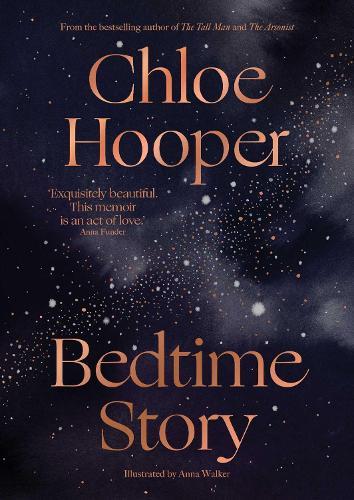
‘Bedtime Story’ by Chloe Hooper

2022, 288 pages

Illustrated by Anna Walker.

How do you tell a six year old that his father is gravely ill with cancer? Or his four year old brother? What does a child do with that information? When Chloe Hooper’s husband, historian Don Watson, received the diagnosis of a rare and aggressive form of leukemia, she turned to what she and her husband knew best: words and stories. Humans have drawn upon stories for time immemorial- indeed, it may be stories themselves that make us human- as a way of explaining the world around us and containing fears. Cancer, that very adult fear, is often described as a “journey”, drawing on ideas of the hero who inhabits both children’s and adult literature. As adults, we may think of fear of the dark as a childish fear, but it seeps through the pages of this book in Anna Walker’s illustrations that capture the inkblot of fear and death, the brush with spiders’ legs and the oppression of the deep, dark wood.

Hooper pores over the children’s literature shelves of bookshops and libraries, buying but ultimately rejecting the books written especially for children whose lives or families are touched by cancer. Instead, this book is presented as her story for her unnamed elder son, who is addressed as ‘you’ throughout. At one level it is an almost abstract, dispassionate survey of children’s literature from its “golden days” of the nineteenth century but, underneath her summary of the themes and biographies of authors like Tolkein, C. S. Lewis, L. Maud Montgomery is a more plangent question for her: what pain or trauma drove these authors to write for children?

These digressions into children’s literature are a way of avoiding the more immediate threat. Hooper traces through the early diagnosis and initial chemotherapy treatment, then the long, leaching period of ongoing chemotherapy and its side effects. The eye of the writer is always looking. As they drive in silence towards St Vincent’s Private Hospital for the initial chemo, the hospital where her young children were born (as, indeed were my own, more than 20 years earlier), the traffic is stopped on account of a young psychotic man up on the roof of the adjacent public hospital, threatening to commit suicide. The irony of suicide juxtaposed against people like them, desperate to hold onto life, is not lost on her. They sit in their room on an upper floor of the hospital, decorated in an intense purple, waiting, waiting, waiting – as much of the next year will be spent waiting. She reflects:

Is this what everything has been leading to? All the business that fills a life- two marriages, two divorces, a daughter, three stepchildren, a year later two young sons- was the fucking and the fighting and reading and the writing all leading to this high, purple room?

p.105

“Don” as his children call him, was very much an older father – he was aged 62 when the son referred to as ‘you’ in this book was born- and nurses sometimes mistake him as the children’s grandfather. I can only think that it was the presence of this young life around him that gives him the strength to face the chemotherapy regime which extracts its own toll in the time he has left to him (the oncologist Ranjana Srivastava addressed the issue of ‘time toxicity’ in an excellent recent article in the Guardian). The book is, too, a tribute to “Don’s” own achievements with his degree in history from (my own) La Trobe University (pointedly but accurately described on p.105 as “a newly built institution set in a dust bowl between two mental asylums, a cemetery and a drive-in movie theatre”) through to his work as speech writer for Paul Keating, leading to his wonderful biography/reflection Recollections of a Bleeding Heart and later books on the use of language in politics. But it is almost as if she is watching Don from behind glass: it is his struggle, on his own. The world closes in on them, as the family becomes transfixed by the nesting of a pair of white-plumed honeyeaters in their garden, and as the house becomes the centre of Don’s fight. She continues her work on completing The Arsonist, published in 2019 but it is as if all this is happening in another universe. Meanwhile, what they fear most is played out in front of them as the father of her eldest son’s friend dies of cancer too. Books may not be able to tell how to get through this: seeing another family doing so, does. The pages become drenched in black, and the upper-case text shouts “TEAR IT ALL UP” “STORIES AREN’T HELPING” “THEY ARE ONLY MAKING THINGS WORSE” “NO STORIES, NO MORE”

As she notes, readers often jump to the end of a book to find out how it finishes. I won’t tell you.

I finished this book feeling quite wrung out by it, and almost as if I had invaded their family territory. Hooper herself, of course, has invited us to draw close, but I still couldn’t help feeling as if I had somehow trespassed into someone else’s pain. I did find myself wondering about the logistics of writing this book – it followed a chronological thread but it was not a diary. At what point was it decided that it become a publishable piece? Do the commercial decisions of cover, illustrations and editorial shaping undercut its authenticity? What do you do with such an intimate piece of writing? Does the author climb onto the publicity treadmill, numbing herself to rehash the same conversations over and again for an audience?

This is beautiful, honest, human writing, but I really don’t know how to honour it without cheapening it. Do I give it a ‘score’? Stars on Goodreads? Do I listen to the interviews that she is giving (e.g. with Richard Fidler on ‘Conversations’) while I’m driving along in the car? Will it win literary prizes, with all the accompanying hoop-la? I feel as if she was compelled to write this book, as the only thing that she knew how to do. I felt that I wanted to keep reading it, to acknowledge her humanity and generosity in sharing it. But I still feel as if I am intruding.

Sourced from: Yarra Plenty Regional Library

‘The Crime of Not Knowing Your Crime’ by Karen Throssell

2021, 301 p & essay

One of several very good things that the Labor government has done since taking power is to discontinue the case against Bernard Collaery, charged with helping his client Witness K who acted as a whistleblower over East Timor oil negotiations (I reviewed Collaery’s book here). This is not the only case that has been brought by the Australian government that is shrouded in secrecy and non-disclosure (indeed there may be others under way- how would we know?) Just recently we have learned that senior intelligence officer Witness J. was tried, sentenced and imprisoned in secret under s22 of the National Security Information (Criminal and Civil Proceedings) Act 2004. For the individuals involved, their cases might be discontinued, inquiries might be held, sentences may be commuted – but what happens afterwards?

Ric Throssell could tell you. The son of Australian writer Katharine Susannah Prichard (see review of Nathan Hobby’s biography here) and war hero Hugo Throssell, he found himself caught up in the surveillance of his openly-communist mother, was identified by Petrov as a spy, and was brought before the Royal Commission on Espionage 1954-55. He was cleared by this commission, but the allegations never went away. He had already been employed by the Department of Foreign Affairs before these accusations surfaced, and for the rest of his life he found himself passed over for promotion. The allegations continued to be promulgated by media figures and historians.

Karen Throssell, Ric’s daughter, takes up her father’s fight in this book that was shortlisted for the Dorothy Hewett Award for an Unpublished Manuscript It is very much a labour of love, as you see the adult daughter continue her father’s vigilance against repeated public accusations made by historians and commentators, balanced against her memories of a father, a familiar (in both senses of the word) presence in her life. There’s an element of the wounded child there too, as her father took his own life on the same day that her mother died.

The typesetting is very important in this book. There is a lot of white space, with a heading on each left-hand page and sometimes as little as a sentence on the right hand side. It is presented as a series of 103 “Items”, each numbered “Item #103” as a file might be. This evocation of the file is important, because Ric and his daughter’s fight was against files: files made, files with-held. The items comprise a range of genres: poetry, paragraphs, newspaper cuttings, letters, more extended writing over one or two pages.

I’m not particularly keen on a recent form of memoir where the author throws everything onto the table, leaving it to the reader to piece together a narrative (see here and, to a lesser extent, here). I’m old-fashioned enough to expect that the authors have a responsibility to structure the narrative. Throssell’s book does have a narrative, in that there is a roughly chronological order, and the book is divided into sections as the long campaign for justice moves forward. The “item” layout gives a sense of the fragmentary and disconnected.

However, the ordering of the book seems strange to me, although this possibly says as much about me as a reader as it does about the book. There is a system behind the typography, but you only discover the ‘key’ if you turn to the notes at the back of the book. There you learn that the white type on black boxes are Ric Throssell’s own writings, as distinct from Karen’s. Bold format within quotes denotes words written by the author. I would have appreciated this information at the start, because the white on black boxes particularly puzzled me – who is writing this? is this fictional or not? While I acknowledge that this confusion can be interpreted as a meta-comment about truth/allegation and the file as artifact, it did not contribute to my reading at the time.

The book finishes with an essay by historian Phillip Deery which gives the historical context to ASIO, the Royal Commission and the Venona Project but I felt that this would have been much better placed at the beginning. In fact, I’m a little surprised that the author didn’t want to have the last word, instead of turning it over to someone else- after all, the “last word” is what her father had fought for all his adult life.

And, as long as ‘secrecy’ trumps ‘justice’, he won’t be the last to do so.

My rating: 6.5

Sourced from: Yarra Plenty Regional Library

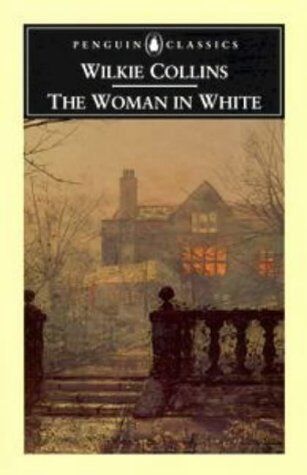
‘The Woman in White’ by Wilkie Collins

1985, 646p.

I can remember this book being on the shelves at my high school library, but I was never tempted to read it. Perhaps its length was off-putting then, and that’s probably just as true today at 640 small-print pages. (My Kobo estimates a reading time of 22-24 hours). Who has time to read such a lengthy book? But – oh, what we would miss out on!

The Woman in White was serialized in 1859-60 and first published in book form in 1860. It is pure Victoriana, with its grand houses, fortune hunters, madness, swapped identities, secrets, dastardly deeds, swirling fog and graveyards. It uses a favourite Victorian technique of doubles: two sisters; two houses; two villains. But it also comes over as quite modern with its multiple narrators, evoking the structure of a court case, with its steady accumulation of evidence and witnesses. It starts with a young drawing-master, Walter Hartright (is that a pun?) who helps a distressed young woman, dressed all in white, on a dark country road. When he is later appointed as a vacation art tutor to two sisters, he notices the similarity between the youngest sister, Laura, and the unknown Woman in White. He falls in love with her, despite the differences in their social standing, but Laura is already promised to Sir Percival Glyde, a man many years her senior. Sir Percival is not all that he seems, and Laura is the unwitting victim of a conspiracy to defraud her of her inheritance. And I’ll stop here….

It is easy to dismiss as “Victoriana” the concern with inheritance, and women’s financial powerlessness until the passing of the Married Women’s Property Act in 1870 in the UK. But the heiress kidnappings, and the ‘gas-lighting’ of women to the point of insanity were not just literary plot devices: they were real. In fact, Collins dedicated the book to Bryan Proctor, the Commissioner for Lunacy, who had championed Louisa Nottidge, whose real-life story encompasses many of these themes. Although an utterly evil, decisive bout of murder might have solved all the plot machinations, Collins maintains enough ambiguity about his characters – even the baddies- that as a reader you’re glad that the author hasn’t taken such a bloodied step (besides, that could finish the book in 200 pages, instead of 600!) He is a very visual writer, and although his language is convoluted, the accretion of small details helps the reader to ‘see’ the characters and setting. Although it was serialized, its careful plotting right from the start means that you don’t have whole chapters of ‘filler’ and implausible false-leads as you sometimes get in Dickens.

He sustains the tension so well over these 600 pages, so much so that I could hardly put it down at the end and kept sneaking away to snatch covert 15-page reads whenever I could. It has been described as a melodrama, but I prefer to think of it as a thriller, with mounting suspense and a sense of dread, ratcheted-up as the story proceeds. There’s nothing hard-boiled about it at all: instead, it is intricate, verbose, lush, formal – and a damned good read. Even at over 600 pages.

My rating: 9/10

Source: CAE bookgroup (aka The Ladies Who Say Oooh)

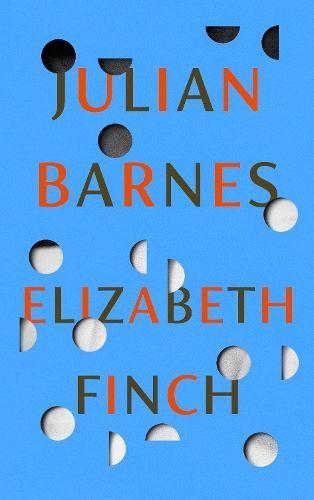
‘Elizabeth Finch’ by Julian Barnes

2022, 192 p.

There are many reasons why a reader might pick up Elizabeth Finch. After all, Julian Barnes is one of UK’s notable writers; each of his books tends to be quite different from the others; and he displays wit and erudition in his works. I’ve read quite a few of his books after being stunned by History of the World in 10 1/2 Chapters and Flaubert’s Parrot (both read before I started blogging), and all up I have read eight of his books.

But the real reason that I read this book was because, nestled between Parts I and Part III is an essay on Julian the Apostate. I should imagine that for many readers, this section on Julian was an obscure and boring distraction – after all, who has an essay in the middle of a novel, especially about a long-dead Roman emperor? But if you follow this blog, you’ll know that for the last 18 months I have been listening to Mike Duncan’s ‘History of Rome‘ podcast- a mighty 189-episode performance. I was fascinated by Julian, later designated ‘the Apostate’, who was the last non-Christian ruler of the Roman Empire and who tried to undo his uncle Constantine’s tolerance for -and indeed encouragement of- Christianity. I know that ‘good’ historians shouldn’t indulge in ‘what-if?’ history but -oh- alternative scenarios just unroll before your eyes when considering the suppression or withering away of Christianity before it really got started: no churches; no Popes; a whole range of gods to choose from. Perhaps. But ‘what if’ Julian didn’t die at just 31 years of age, but instead lived to become more intolerant and repressive and ended up ‘Julian the Cruel’ instead? This is one of the threads in the 48-page essay about Julian the Apostate in Part II of this book, an essay which may have led me to choose this book, but probably repelled many more readers than it attracted.

Parts I and III of the book return to the eponymous Elizabeth Finch, a quietly-spoken, demure lecturer in a Culture and Civilisation course for adult students. The narrator, Neil, is one of the older students in the class, and while he shares the fascination of his fellow students for this inscrutable, rather insipid, teacher, Part I is almost a love-letter to her and her effect on transforming his ‘paltry thoughtlets into something of fuller interest’ (p.15). The course completed – even though Neil didn’t get round to writing the required essay on a topic of his choice- he and Elizabeth (abbreviated to E. F.) continued to meet for lunch for the next twenty years. Pasta, one glass of white wine, coffee: she always paid and the meal always lasted seventy-five minutes. When she died, she left to him all her books and papers, although her only sibling Christopher was the executor of the rest of her estate. It was while going through her papers that Neil realized that E.F. (like me!) had been drawn to Emperor Julian, and it was now- 20 years later- that Neil wrote the essay that he had failed to write at the end of the course- and it is this essay that makes up Part II of the book. In Part III we return to Neil, who is by now trawling through E. F.’s life, trying to make small snippets fit, and recalling what Neil came to think of The Shaming, when a small public lecture for the London Review of Books given by E.F. blew up into a small but ultimately inconsequential controversy. Neil is making a dogged attempt to reconstruct her biography, but the pieces don’t fit. Her rather dull brother Christopher knows only ‘Liz’, his fellow students have had their own interactions with her, of which he was completely oblivious, and have made their own judgements. The hero-worship of Part I gives way in Part III to a rather bleak acknowledgment of the unknowability of any other person and the unrecoverability of the past.

I must say that I am rather puzzled by this book. It reminded me of J.M. Coetzee’s Elizabeth Costello in more ways than one. Barnes’ choice of title evokes Coetzee’s book, and both are about the research passions of middle-aged academic women (both written by middle-aged academic-type men).

As far as Elizabeth Finch is concerned, I don’t really know what it’s for. I wasn’t particularly convinced by Elizabeth Finch’s brilliance, I found Neil’s adoration rather mawkish and his attempts to trawl through her life intrusive, and his essay -his act of devotion- on Julian rather uninspiring. I don’t know whether to be disappointed or to wonder whether there was something I missed.

My rating: 6.5/10

Sourced from: Yarra Plenty Regional Library

Other reviews: Lisa at ANZLitLovers reviewed it and discovered that the front cover has been carefully designed to highlight the fragmentary nature of our knowledge of other people – something that was completely lost on me, because my library book had been covered in plastic! (E-book readers will miss it too)

‘His Name is George Floyd’ by Robert Samuels and Toluse Olorunnipa

2022, 380 p

I must admit that I have not watched the video of the full 9 minutes and 29 seconds that it took George Floyd to die under Derek Chauvin’s knee as he was being arrested. I wonder how many people have: after all, nine minutes and 29 seconds doesn’t fit well into a half-hour news broadcast. But in that time a giant of a man, pinned down by a little, cocky man oblivious to the entreaties of George himself and the remonstrations of a small crowd of onlookers, exemplified what the Uluru Statement here in Australia identified as “the torment of our powerlessness”. Since his death on Memorial Day 25 May 2020, George Floyd’s image has been painted on walls, printed onto t-shirts, and the demand to ‘Say His Name’ echoed around the world, spawning protests across the world sparked by, but not restricted to, his death. This book, subtitled ‘One Man’s Life and the Struggle for Racial Justice’ looks at George Floyd as a person, but also the whole web of history, economics and politics that brought that knee down on his neck.

The book is based on more than 400 interviews with the people who were close to George Floyd. It is interwoven with explanations that knot together the specifics of Floyd’s life and wider historical movements. What this book lays out is the way that structural racism, built gradually by historical events both large and small, government policies and their intended and unintended consequences, and spoken and unspoken assumptions have constructed a web that held George Floyd under, just as surely as that knee did.

Although some of the interviewees, who knew him as Perry rather than George, imbue him with a posthumous sanctity that might not have been commented on while he was alive (a not uncommon phenomenon), there is no attempt here to hide the fact that George Floyd was struggling with poverty and addiction. A big man, he was very much aware that people were frightened of him. He had been a football and basketball player at school and college, in an educational sporting environment that prizes sporting prowess over educational achievement in a lottery of sporting contracts with little preparation for anything else. A string of eight minor crimes led to him accepting a plea bargain for a crime which he probably did not commit, and he spent four years in prison. He left Houston Texas and his extended family to go to Minneapolis, where he tried to start again but was drawn back into addiction.

But there’s a political and social background to all this. Turning back to Reconstruction after the Civil War, there was a deliberate policy of ‘take down’ as black families worked hard and some became successful, only to lose their properties through tax defaults and bureaucratic hurdles imposed on people who, when enslaved, were not permitted to learn how to read. Housing policies and red-lining saw neighbourhoods rise and fall economically; the state of Texas refused outright to desegregate their schools leading to a two-track education system; the plea-bargain system balances the possibilities of long and short sentences in a form of judicial gambling; employment possibilities narrowed once a prison sentence was served; State policies over health and welfare support acted as push factor (away from Texas) and pull factor (towards Minnesota) factors; the opioid epidemic linked the medical system and the street scene; the over-policing of his neighbourhood meant that a disputed $20.00 note ended up in death.

The authors are journalists, and certainly this book flows well. The backgrounding chapters give clear, historical information showing the almost inevitable conjunction of George’s death and the wider forces that had shaped his life. Although there are no footnotes as such, the page-number references at the back of the book give their sources, most with a web reference attached.

The book does not end optimistically. The Rev. Al Sharpton warned George’s brother Philonise that for every action there is a reaction, and this has proven to be true. The conservative uproar about Critical Race Theory and the ‘White Lives Matter’ rhetoric is a pushback and an attempt to silence. But I don’t think that you could finish reading this book without having a better grasp of the sequence of small events that constitutes structural racism, and its almost inevitable aftermath.

My rating: 8/10

Sourced from: Yarra Plenty Regional Library

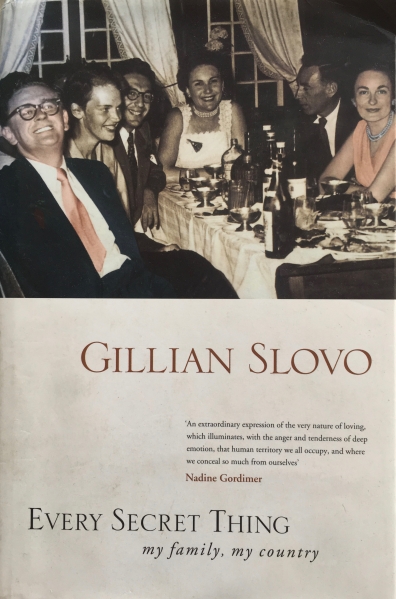
‘Every Secret Thing: My Family, My Country’ by Gillian Slovo

1997,282 p.

Gillian Slovo, the daughter of white anti-Apartheid activists Joe Slovo and Ruth First, was standing with her siblings at just one of the many public events surrounding her father’s funeral. Nelson Mandela came in.

[Mandela] told us how one day when he had gone to hug his grown-up daughter she had flinched away from him, and burst out “You are the father to all our people, but you have never had the time to be a father to me.”

He let that last sentence hover before speaking again. This, he said, was his greatest, perhaps his only regret: that his children, and the children of his comrades, had been the ones to pay the price of their parents’ commitment…

They knew it somewhere, all their generation: as the state poured out its wrath, they had watched their children suffer. And yet, and yet- what else could they have done?

p.214

What else could they have done? This is the question that lies at the heart of Gillian Slovo’s memoir Every Secret Thing. The answer she would give, I think, is “more”. More time, more contact, more honesty, more love. As the child of two committed, White anti-Apartheid activists, Slovo and her sisters shared their parents with a broader political project, as suggested by the title. Their family and their country were indivisible, even though they spent many years living elsewhere. They had grown up with secrets, with whispered conversations between heads almost touching, with a succession of fleeting and shadowy contacts and the knowledge that, as far as their parents were concerned, they always took second place to the larger struggle. Their father Joe Slovo and mother Ruth First were the glamour couple of the anti-Apartheid movement, born themselves to Communist parents, and active members of the South African Communist Party. They resisted apartheid right from the late 1940s, with Joe an advocate at the Johannesburg Bar, acting as a defence lawyer in political trials. Both were under surveillance, and both spent years in exile in UK, Mozambique, Swaziland and Zambia. Ruth was detained under consecutive 90-day detention periods while the government played cat-and-mouse with activists, while Joe spent decades out of South Africa. She was assassinated in 1982 in Zambia through a letter-bomb. Her father lived until 1995, by which time the ANC had been elected through democratic elections and he had become the Minister for Housing in Nelson Mandela’s government- an almost unimaginable change of events from the perspective of the 1950s and 1960s.

Throughout all this, their daughters were observers: told little, kept safe but also kept at arms-length emotionally. In the weeks before his death from cancer, Gillian asked her father about his life, but he furiously exploded “You can write what you want to, but I won’t tell you.” After he died, Gillian returned to South Africa, to try to uncover the secrets that her parents had held from her and the last third of the book revolves around this search. She wants to know the circumstances and the perpetrators of her mother’s murder, and this brings her face-to-face with more secrets – the power apparatus that lent force to the apartheid regime but which has also managed to shapeshift and insinuate itself into the present security structures. She uncovers secrets about her parents as well, secrets which make her question her parents’ marriage and their fidelity and which serve further to underscore the children’s marginality to their parents’ lives.

Her parents were public figures, excoriated by the apartheid regime, but embraced as part of the struggle by the ANC – indeed, Joe Slovo is buried in a formerly-black only Avalon cemetery in Soweto. Their daughters did not know where they fitted in. They were white, had black servants, spent much of their life in England, and yet they stood, almost as ornaments, at the huge funeral celebrations held when their father died. But Gillian also knew that she and her family were not part of that white silence that pervaded the fifty years of apartheid – as she wryly remarked, it has been impossible now to find anyone who owns up to supporting it- and she bridled at the comment of a White driver that he “didn’t hold grudges”, as if he were the victim. Yet, Gillian feels that she has been a victim in that the larger struggle made her inconsequential to the people to whom she most wanted to matter.

As it turns out, I have read two memoirs written by daughters about their parents, one after the other. This memoir, and Swimming Home are similar in that daughters are holding their parents (especially their mothers) to account, and both share a broadly chronological narrative with multiple digressions and time shifts. What I really admire in this memoir is Slovo’s honesty in her motives and her expressions of disappointment in both parents and her frankness in stating that her parents’ commitment came at her expense. But how to measure the contribution of people passionate about huge events and conditions that affect millions, against the demands of three daughters? I don’t know, and at the end, I don’t think that Slovo does either. She will never find out ‘every secret thing’ – an impossible goal- but she concludes that

I, a child of secrets, had done something that I had needed to do. I had laid to rest some of the ghosts that had stalked my life, and in doing so, I’d found a kind of peace.

p. 281

Perhaps, a “kind of peace” is the best that any of us can hope for.

My rating: 8/10

Sourced from: CAE bookgroups

‘Lives of Houses’ by Kate Kennedy and Hermione Lee (eds.)

2020, 262 p. plus notes

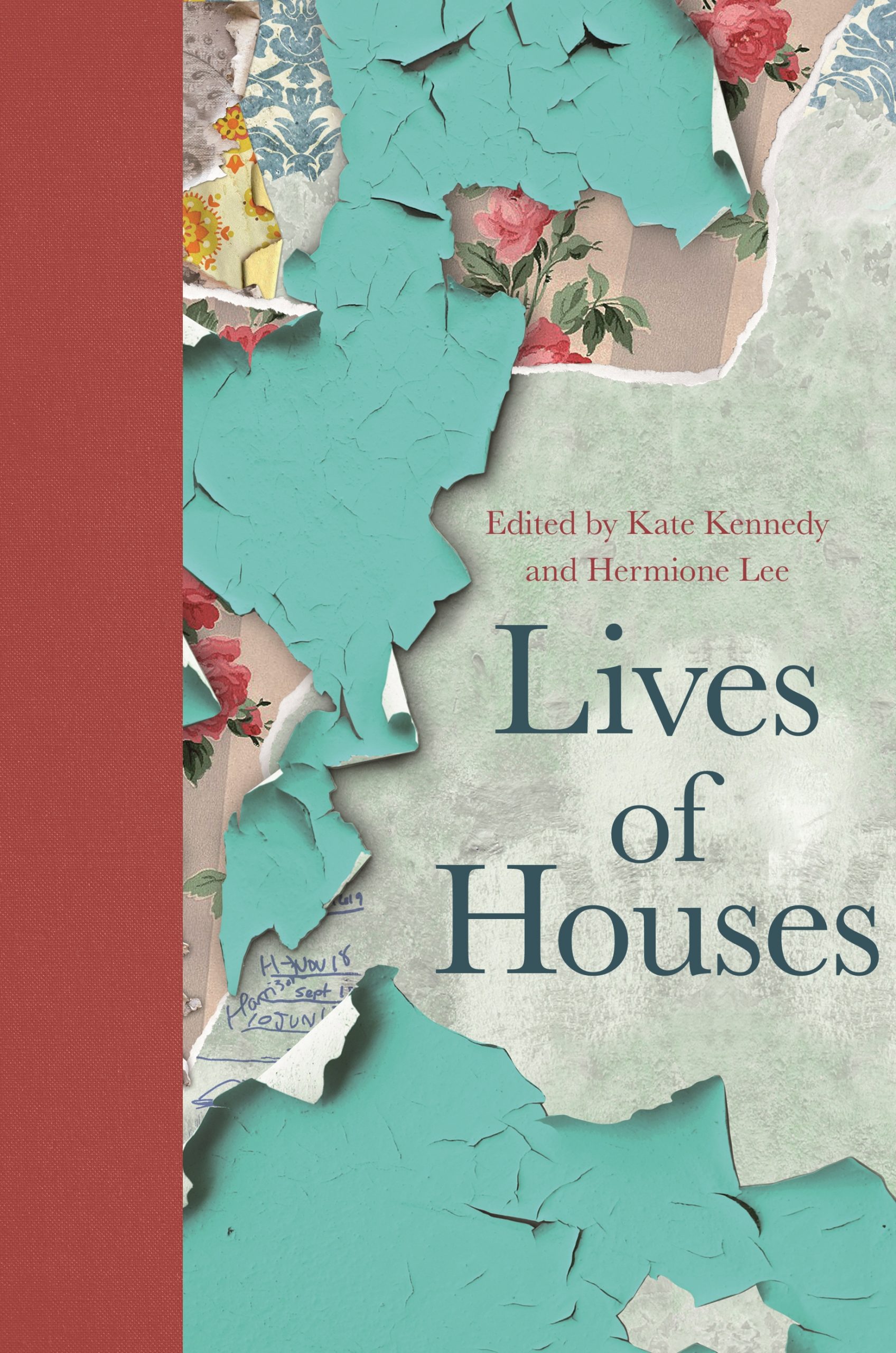
I must confess that I was initially attracted to this book by its striking cover, but when I dipped into the preface by Hermione Lee, I thought that I would enjoy it.

The writing of lives often involves writing about houses. Bringing a house to life through observation, familiarity, memory or excavation can be a vital part of narrating the life of an individual, a family, or a group: life-work as house work. A house can embody a person’s childhood, the story of a marriage, an inherited way of life, or a national history. The constructing of a house can be the fulcrum of dreams, ambitions, illusions and pretensions. How a house is lived in can tell you everything you need to know about people, whether it’s the choice of a wall paper, the mess in the kitchen, the silence or shouting over meals, doors left open or closed, a fire burning in the hearth. the loss of a house can be a turning point that shapes the rest of a life.

p.xiii

If I had read a little further into the preface, I would have seen that the collection of essays in this book emerged from a 2017 conference titled ‘The Lives of Houses’ held at the Oxford Centre for Life-Writing at Wolfson College, Oxford. My ambivalence about the book probably springs from the conference-paper genre from which it emerges. This conference brought together scholars from different disciplines and professions, with an emphasis on British, Irish, American and European houses. As with all conferences, the speakers (particularly the ‘big names’) would have been known to each other, their areas of interest already known, and their contributions would have been rather standardized in length. And ‘big names’ there are: Hermione Lee, Margaret Macmillan, David Cannadine, Jenny Uglow, Julian Barnes. Although there were papers that broke the mould, the overwhelming impression that I took away from the book was of 19th century British writers and a peculiarly British form of being ‘the writer’ in a mixture of eccentricity and domesticity.

The first two essays suggested a less biographically-oriented approach. Alexandra Harris’ chapter ‘Moving House’ pointed out that ‘moving day’ was a common annual or biannual spectacle across Europe and America from the Middle Ages to the early 20th century. Leases ran from one quarter-day to the next, and so expired in tandem, so Whitsun (25 May) in Scotland or Lady Day (6 April) in England was ‘moving day’, with another round at Michaelmas and Martinmas (11 November). Susan Walker’s chapter ‘Built on Memory’ examined the House of Venus in Morocco, a Roman house constructed in the late 1st century CE in what was at that time the edge of empire, extended and changed over the centuries, and finally abandoned in the early 5th Century CE until its excavation in the last years and aftermath of WWII. But with the exception of Canadian historian Margaret Macmillan’s reminiscences of her childhood home in Ontario, the majority of essays are about British writers, composers and politicians: Virginia Woolf, Elizabeth Bowen, Coleridge, Tennyson, Lear, Benjamin Britten, W. H. Auden, Samuel Johnson, H. G. Wells and politicians Churchill and Disraeli.

This wasn’t quite what I expected, and so I enjoyed shaking off all this writerly clutter with the chapters that were not about houses. Alexander Masters’ chapter ‘The Fear of Houses’ was an examination of homelessness, and interviews with homeless people about houses (as distinct from homes) and house-less-ness. Elleke Boehmer’s chapter ‘When There is No House to Visit: a Migrant Writers’ sites’ traced the Zimbabwean writer Dambudzo Marechera as he moved around Oxford in 1976, moving later to London where he slept rough on park benches and squats, hanging out with other African writers at the Africa Centre in Covent Garden. ‘A Place One Can Go Mad In’, by Kate Kennedy, followed the WWI survivor Igor Gurney as he was committed to Barnwood House in Gloucester, and later the City of London Mental Hospital near Dartford, where he died in 1937.

In her chapter Hermione Lee writes about the ‘pilgrimage’ that devotees, descendants, friends or biographers, make to a writer’s house .

Why do millions of people visit Shakespeare’s “birthplace”? To see if something will rub off on them? To try to get the key to the vanished genius? It is a strong but muddled impulse, a mixture of awe, longing, desire for inwardness, and intrusive curiosity. Expectations are always high for such pilgrimages, and disappointment can be correspondingly sharp. The famous writer’s house you long to see may have vanished, but the urge to go to the site still remains.

p.33

When I thought about it, most of my ‘pilgrimages’ have been to houses overseas, rather than in Australia. We visited the Jane Austen Centre in Bath (a rather tenuous connection with Austen); we stood outside a house in Stratford on Avon; and William Morris’ house in Bexleyheath, London. I visited Pablo Neruda’s house in Santiago, I went into a bar where Hemingway wrote in Havana, and Lorca’s house in Granada. We visited Karen Blixen’s house in Nairobi. I had to think harder about Australian/NZ houses: Henry Handel Richardson in Chiltern, Adam Lindsay Gordon’s cottage in Ballarat and Janet Frame in Oamaru. Are there more? I can’t think of any.

For me, visiting a writer’s house is an act of homage, I suppose, and perhaps a bit of pretension that I know who these authors were. Highlighting the connection between biography, writing and ‘the house’, and its afterlife as a tourist attraction, and extrapolating it beyond the rather cosy coterie of 19th/early 20th century writers and their biographers in this book, has prompted me to think about my own response to The Writers House and what draws me to visit- something I hadn’t thought about before.

My rating: 7/10

Sourced from: Yarra Plenty Regional Library.