Category Archives: Book reviews

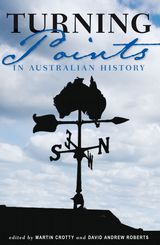
‘Turning Points in Australian History’ ed. Martin Crotty and David Andrew Roberts

turningpoints

2009, 254 p plus notes.

I would have loved to have been a fly on the wall for some of the concept discussions for this book, published by the University of New South Wales press.   It takes a similar format to a preceding volume by the same editors which looked at Great Mistakes of Australian history. I find myself wondering whether the editors themselves pitched the idea, or whether it sprang from a marketing initiative of UNSW Press.  For there is certainly an ambivalence about the whole endeavour as even the back cover  blurb indicates:

This exciting and stimulating book examines turning points and crucial moments in Australian history.  Rather than arguing that there have been forks on a pre-determined road, the book challenges us to think about other paths or better paths that might have led to different outcomes.  It shows that a decisive event often only becomes so only in retrospect and that what seemed like a major turning point at the time often had no real impact at all.

I’m not sure that the book is as conditional and ‘if only’ or ‘what if’ as the blurb suggests.  Instead, its chapters are structured as fairly straight narratives on a particular event with, except for two chapters (Chs. 1 and 13) , a specific month and year identified as the ‘turning point’.

1. 14000 BP. On Being Alone: The isolation of the Tasmanians by Iain Davidson and David Andrew Roberts

2. 26th January 1788: The Arrival of the First Fleet and the ‘Foundation of Australia’ by David Andrew Roberts

3. 19 June 1822: Creating ‘an Object of Real Terror’: The tabling of the first Bigge Report by Raymond Evans

4. 15 July 1851: Hargreaves Discovers Gold at Ophir: Australia’s ‘golden age’ by Keir Reeves

5. 16 August 1890: The Maritime Strike Begins: On upotia and ‘class war’ by Melissa Bellanta

6. 1 January 1901: Australia Federates, Australia Celebrates by Erin Ihde

7. 25 April 1915: Australian Troops Land at Gallipoli: Trial, trauma and the ‘birth of the nation’ by Martin Crotty

8. 10 June 1931: The Premiers’ Plan and the Great Depression: High politics and everyday life in an economic crisis by Erik Eklund

9. 27th December 1941: Prime Minister Curtin’s New Year Message: Australia ‘looks to America’ by David Day

10. 16 September 1956: ‘It’s here, at last!’ The introduction of television in Australia by Michelle Arrow

11. January 1961: The Release of the Pill: Contraceptive technology and the ‘sexual revolution’ by Frank Bongiorno

12. 27 May 1967: The 1967 Referendum: An uncertain consensus by Russell McGregor

13. 1970: When it Changed: The beginnings of women’s liberation in Australia by Susan Magarey

14. 26 January 1981 The Opening of the Australian Institute of Sport: The Government takes control of the national pastime by Brett Hutchins

15. I July 1983 Saving the Franklin River: The environment takes centre stage by Melissa Harper

16. 14 May 1986 Paul Keating’s ‘Banana Statement’ and the End of the ‘Golden Age’ by Ray Broomhill.

17. 26 August -11 September 2001: From Tampa to 9/11: Seventeen days that changed Australia by Robert Manne.

There’s some very familiar names amongst the historians here- they have been chosen well.  But in several of the chapters you sense a real ambivalence with the whole project.  The concept being written about often spills out of a chronological strait-jacket, and the selection of an arbitrary date obviously leaves several of the authors feeling quite uncomfortable.  More than one author questions whether it’s really a turning point at all, or whether the concept of a turning point is even valid or useful.   The editors themselves raise this question in the introduction, and in this radio segment about the book.

The chapters are fairly uniform in length, and while not formulaic, tend to follow a pattern of ‘what happened’ then some analysis of the aptness of the designation ‘turning point’ for the event in question.  With the exception perhaps, of Susan Magarey’s chapter, you don’t really get a sense of the distinctive writing style or methodology of the authors’ other work.  The frequent use of inverted commas (‘golden age’ ,’class war’, ‘sexual revolution’)  in many of the chapter titles reflects the rebuttal of popularly-received myths, images and understandings of the events described.

The particular selection of ‘turning points’ (or not) tells us just as much about 2009 as it does about the events under consideration.  I wonder if a similar book, written 50 years hence will feature the same events- I suspect not.  Many of the chapters discuss parallels between current events and the ‘turning point’, which of course adds to its appeal today and its quaintness tomorrow.

I find myself wondering who the intended audience is for this book- well, me for a start, I suppose.  The tenor of the book seems to have been written simultaneously to feed on, and yet resist, the ‘just stick to what happened’ continuous narrative genre that has become associated with John Howard’s attempt to rewrite the history curriculum for schools.  I enjoyed it in small grabs, a chapter here and a chapter there, much as I might read essays in a magazine.  I learnt things I didn’t know; I found myself curling a skeptical lip over the inclusion of some events at times (for example, on the Australian Institute of Sport chapter which, while making an interesting link with the Cold War, didn’t make a very convincing case for its inclusion as a ‘turning point’. ) It’s a bit like eavesdropping on an interesting conversation with informed, thinking people who have considered a phenomenon more deeply than you have, and are able to place an issue into a broader historical context.   The research is sound; the arguments are well-put but it is a book of its time, so read it now, while it’s still fresh!
Brigid Brereton ‘Law, Justice and Empire: The Colonial Career of John Gorrie 1829-1892″

brereton

1997

I’ve  often found, when I shut the covers after reading yet another colonial judicial biography, that however much I may have enlarged my understanding of a particular colonial official, there is still an opaque screen of inscrutibility about him.  There’s the judicial mindset that sees nuances and distinctions across all aspects of human interaction, and then it’s overlaid with the expectations and restrictions of the worldview of the early Victorian colonial gentleman.  Whatever humanity or common feeling the biography may have evoked, I’m left with the knowledge that the past is, indeed, as L.P. Hartley famously announced, a different country, and the people who lived there were of a different kind too.

However, this biography by Brigid Brereton, is different.  It came to me well recommended as an excellent example of judicial biography, and it is.   Perhaps it’s the choice of subject.  John Gorrie, the son of a dissenting United Presbyterian Church minister, took from his Scottish education and bar training an emphasis on philosophy, and working from first principles rather than the English reliance on case law- and indeed, though he worked for the Colonial Office all his professional life, was was not ever admitted to the English Bar.  This meant that he was well-placed for those colonies of the Empire where England took over from another European colonial power, where a pre-existing Continental system of justice  was already in place.  Hence his initial placement at Mauritius, the former Ile-de-France, which passed to Britain by conquest in 1810.  Here he worked under Governor Arthur Gordon,  who became confidante, friend and patron, and who was largely responsible for his second posting to  the newly-acquired British colony of  Fiji.  His experience with multi-racial colonies led to his final posting to Trinidad, which was enlarged to include Tobago.

Gorrie was not particularly interested in a judicial career, even though that is what he ended up with.  He had a deep commitment to political action as a way of bringing about change, and was heavily involved with the Aborigines Protection Society.  This led him to involvement with the Governor Eyre case on the part of the mutineers, and a lifelong interest in protecting the imported and native labourers in plantation colonies.   In his youth he had contact with the English radicals, especially Cobden and Bright, stood for parliament himself, and worked as a journalist on their  Morning Star newspaper.

It is in his correspondence with Governor Gordon that we see a man who is more recognizably modern than many of the other 19th century judges I’ve read about.  There’s a intimacy and affection in his relationship with Governor Gordon, and his writing, informed perhaps by his journalistic experience, has more colour and flow than similar correspondence I’ve read. He lived life fully: he enjoyed balls and social occasions, supported different philanthropic bodies, and enjoyed sports with his family.  And, when the political causes he espouses resonate with twentieth century liberal democratic thinking, then he comes over as one of the “good guys”.

But, of course, he was not a democrat as such, and much of his temperament and courtroom interaction is strongly reminiscent of that of Judge Willis.  He rubbed up badly against the entrenched elites in the colonial societies he moved between.  And, as is often the way, they got him in the end, although he died before he had a chance to contest his dismissal properly back in Britain.

This is a wonderfully contextualized biography.  The details of the social, political and historical mileui of each of his postings make each one seem quite distinct, even though there were many commonalities between them.  Gorrie himself comes over as a complete, coherent man who acted  consistently within a moral and political framework.  I wonder if this lies in the teller, or the tale?

‘Wanting’ by Richard Flanagan

wanting3

2008, 261 p.

I haven’t see Baz Luhrman’s Australia (and nor do I think I shall), but I wasn’t surprised to hear that Richard Flanagan had worked on the screenplay.  From the comments of those I’ve spoken to who have seen it, the film  seems to elicit a shifting discomfort in its audience – as if the viewer is not quite sure whether it’s a parody or not; whether to go with it, resist it or mock it.

It seems that Flanagan has quite a skill at unsettling his reader by playing around within genres.  As with Luhrman, you’re always very much aware of the author there, constructing, drawing together, working, and so the work becomes performance as much as narrative.  This was particularly the case in Gould’s Book of Fish which I think is probably the best ‘Australian’ novel of the last five years- a wild, inventive riff on a historical character that was also beautifully, carefully, lovingly presented as artefact.

Wanting is in much the same vein. It  plays within the historical fiction genre, leaping across continent and plotline to draw together Charles Dickens, Sir John and Lady Jane Franklin,  the young Aboriginal girl Mathinna, George Augustus Robinson, Wilkie Collins- a whole cast of mid-century ‘historical’ characters.  As a reader, you’re constantly aware of Flanagan moulding and threading his different storylines, and his deliberate construction of ironies, opposites and parallels in the surface and ‘true’ stories in the book.  I noticed that he used the term “motley” several times in the book and on his website, and he uses it in the sense of the costume, the trappings of the fool who jeers and capers while he tells the truth.

Flanagan on his website shrugs off the research he has done for this book:

These notes are for those readers who wish to discover something more of the historical truth behind some of the characters and events mentioned in Wanting. Perhaps because I am drawn to questions which history cannot answer, and because these characters and events thus become the motley thrown over the concerns that are the true subject of this novel, I am disinclined to research. Accordingly, I have leaned heavily on a very small post made up of only a few books. I do not know if they are definitive, only that they were useful.

He’s being too modest here: the historical research holds up well, but it doesn’t hamstring him as it so often tends to do with ‘historical fiction’ in more reverent, tentative hands.   He uses it as a playground, a trampoline, an arena in which he can write about bigger truths that cannot be held by a single act in a single lifestory.  The quote from the back cover “We have in our lives only a few moments” has all of the schmaltz and extravagance of  Baz Luhrman’s red-curtain trilogy- in fact, for me, the cover evokes  red velvet, sunset and blood-, and yet the phrase also captures the paradox of the historical ‘actor’ and the banality, humanity, and  tragedy of small actions, petty desires and fleeting decisions when they are writ large on the historical stage.

‘Redmond Barry: An Anglo-Irish Australian’ by Ann Galbally

barry3

1995, 228 p.

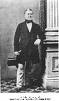
As a Melburnian, it’s difficult to get past the image of Redmond Barry as a strong, imperious philanthropist.  He is still very much a visible presence:  a large statue of him rears up in front of the State Library (one of his projects); his name adorns prominent buildings at the University of Melbourne (another of his projects), and of course his reputation has been forever intertwined with that of Ned Kelly, whom he sentenced to death.  This is the stuff of myth-making: the pompous Supreme Court judge cursed by the fearless bushranger “I will see you there when I go” (or words to that effect), only to die 12 days later of “congestion of the lungs and a carbuncle in the neck”.  [ Can you die of carbuncle? Dear Lord, if I should die, please let it NOT be of a carbuncle!]

Ann Galbally’s biography covers, of course, his whole life but my interest is mainly on his early years in Port Phillip and his relationship with Judge Willis.  Barry was born into the Anglo-Irish ascendancy.  The peace that followed the Napoleonic Wars cruelled his chances for a military career, so he entered the law instead only to find the Bar crowded with other young men who had made the same vocational choice.   When his father died in 1838, he emigrated to Sydney where there was less competition.

barry4

On the journey out, he embarked on a relationship with a Mrs Scott- and worse still, continued it when he reached Sydney.  News of the affair reached the ears of Governor Gipps, and he was awarded few government briefs as a result.  He continued to suffer from disapprobation even after leaving Sydney for the small town of Melbourne because, although he socialized and got on well with Superintendent La Trobe, the more prominent legal positions were in the gift of Gipps rather than La Trobe.   His unorthodox relationships with married women seem to be an ongoing theme: in 1846 he took up with a Mrs Louisa Barrow, with whom he had four children, in a  public, lifelong relationship that was never regularized by marriage.

Barry was only 26 when he arrived in Melbourne, and Galbally paints an engaging picture of Barry socializing with the other predominantly-Irish members of the Bar:  his good friends Sewell, Foster and Stawell and fellow Trinity-college and King’s Inn  graduates Brewster and Croke.  Although a member of the Melbourne Club and welcomed to all the vice-regal social occasions, he had little capital behind him and thus was not caught up in the land speculation of the early 1840s and  “perhaps for this reason his managed to maintain civilized relations with Willis for longer than most of the legal fraternity” (Galbally p. 49).

Not that Barry found Willis easy.  His diary records a succession of entries where he “argued with Willis“, “fought with Willis” or had a “blow-up with Willis who threatened to suspend me“.  He greeted the news of Willis’ suspension with relief  “Supreme Court Willis suspended + removed, Te Deum Laudamus” (24 June 1843).

In spite of this, Barry did not seem to have been exposed to the same personal insults or attacks that other barristers and officers of the court suffered.  Willis seemed to greet his appointment as the Commissioner for the Court of Requests in January 1843 with genuine approval, and at times their sparring in court (complete with historical allusions and Latin jests)  seemed to be equally relished by them both.   Although Barry had a reputation as a bit of a dandy who wore an old-fashioned Beau Brummel style suit, obviously Judge Willis did not take exception to this as much as he did the trimmed moustaches of Edward Sewell, Barry’s friend and erstwhile housemate.

barry1

Unlike Judge Willis, Barry was noted for his “dignified deportment and invincible politeness” (Garryowen p. 867). Galbally captures this quality well.   Against such a man, Willis’ own failings of temper and demeanour would have been even more marked.

References

Ann Galbally  Redmond Barry: An Anglo-Irish Australian

Barry, Sir Redmond, Australian Dictionary of Biography (online)

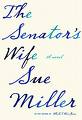
‘The Senator’s Wife’ by Sue Miller

miller

2008, 306p.

I’m a big fan of Sue Miller, ever since I read The Good Mother years ago.   Her books are domestic in detail, and yet capture ordinary people in painful dilemmas that set their lives off into new trajectories.  The Senator’s Wife is such a book.

The book revolves around two women living in adjoining houses in New England: Meri a young, married faculty-wife and new mother, and her older neighbour Delia, the estranged but still emotionally attached wife of a well-known liberal Senator.  Meri surreptitiously learns of Delia’s relationship with her philandering political husband while negotiating her own tentative marriage and new career, cut short when she unexpectedly falls pregnant.  When the Senator suffers a stroke and is brought home to Delia’s house,  his decline and helplessness mirrors Meri’s post-natal depression and feelings of inadequacy with her own new baby.  As with Sue Miller’s other books there is an inexorable crisis, foreshadowed in an ever-tightening string of contingencies, so that as a reader you almost want to look away before the crash.

More than her other books, this one seemed a particularly physical book:  breathy, sticky and uncomfortably intimate.

I think of Sue Miller and Anne Tyler as similar types of writers.  I enjoy them both, but in both this and Anne Tyler’s most recent book Digging to America, I found myself shifting restlessly at the Mills and Boon aspects that threatened to submerge the narrative at any minute.  But, particularly with Sue Miller, just as I’m about to admit disappointment, she breaks through with cutting observations that capture the pain and complexity of just living.  For instance, Delia is being pressured by her adult daughter Nancy over the arrangements for the senator’s care after he has suffered the stroke.

Desperate or not, after Nancy left, Delia has lain awake for a long time in her bed, feeling a kind of terror envelop her.  What frightened her was that she wasn’t sure she could resist her daughter’s power.  She thought this might be the moment, actually, the moment she’d heard about from a friend or two- recollected sadly, ruefully- when the grown children swept in and irresistibly took over your life.  When you could no longer say no, because it was clear that all the things you thought of as belonging to you were in the process of becoming theirs- their possessions, and of course, their heavy burdens too: your life, your spouse’s life, your illness, his illness, your death.  The moment when you owed them something, when you had to give way, out of a kind of fairness to them and then also because you just didn’t have the strength left anymore to fight. (p. 191)

Her observations here are those of experience: of being daughter and partner herself.  It’s almost as if she has been eavesdropping on your own family dynamics with its fears and joys.  Here she is on an older woman’s feelings for her adult son as she watches him meeting his father Tom for the first time, after he has suffered the stroke:

She watched Evan, his beautiful face lifting in response to Tom, smiling, talking.  How much he had changed over the years!…And yet the love she felt for him was unchanged, was based on who he’d been and who he still was to her.  This is how it is with your children, she thought.  You hold all the versions of them there ever were simultaneously in your heart. (p.276)

It’s these small insights into our shared vulnerabilities and pleasures that draws me back to Sue Miller again and again.  I shut each book of hers with admiration at her ability to set up, almost without your awareness of it, scenarios that suspend her characters exquisitely over a dilemma that is much bigger than the domestic setting she has drawn so carefully.

‘David Collins’ by John Currey

sillsbendjan2009-036

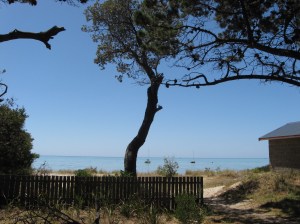
If my postings here have been a bit erratic lately, it’s because I’ve been going back and forth between home and my little caravan on the Mornington Peninsula.  It’s daggy and unsophisticated but as the sun sets over the bay, it’s a beautiful spot- here’s my view from outside the van, just up the track a bit.

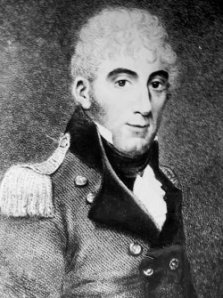
Being in such close proximity to the 1803 settlement at Sorrento has prompted me to read John Currey’s biography of David Collins– the leader of the aborted settlement of a consignment of convicts direct to Port Phillip.  By sending the fleet straight to Port Phillip from England, the Colonial Office intended to both quickly create a British presence and to alleviate the moral corruption of the constant inflow of convict blood into Sydney.  The settlement only stayed in Port Phillip for eight months until it shifted to Risdon Cove (Hobart) in two separate journeys separated by months.

The author, John Currey, describes himself in his preface as “an independent scholar without access to the services and resources normally associated with an academic environment”.  He has written and edited  a number of works of early Australian settlement.  The epigraph that commences his preface is an admonition from Andre Maurois’ Aspects of Biography (1929):

Every biographer should write on the first page of his manuscript: ‘Thou shalt not judge”.

He draws heavily on Collins’ letters to family and patrons, family papers and official correspondence, supplemented by newspaper comments and other peoples’ observations and comments on their relations with Collins.  Currey is scrupulous in his search and documentation, and almost succeeds in following Maurois’ advice.  But even he, at the end of the book raises questions that verge on the edge of judgement:

“Essentially conventional in so many ways, Collins was at the same time a complex and enigmatic man.  His written legacy, despite some tantalising revelations, offers few answers to the questions his life provokes.  How could a man so attentive to minute detail in his public duties be so negligent of his own financial affairs?  By what circuitous route did the man who aspired to ascend the pulpit come to find himself reviled as a lecherer and an adulterer?  Why did a mind so receptive and alive with curiosity become so dulled and inactive?  How could a man so blessed with so many natural charms fail to find enduring love and companionship? Did Collins himself, for all his introspection have any insight into his actions?  The exhumation of  [Collins coffin in ]1925 removed some of the mysteries surrounding Collins’s death.  It offered no explanation of the profound mysteries of his life.” (p. 308)

I find it frustrating when an author raises the very questions you want answered, but draws back from actually risking an answer to them.  Currey’s conception of his role as historian constrains him from venturing his own response, informed by his research, to these questions.  He should not be so cautious.  He has read the documentation: he has spent years with this man; he is qualified to venture a judgement.

In fact, I’d add a couple of other questions.  Why was he so unsuccessful in negotiating the patronage networks that all colonial civil servants had to manage?  How exceptional or commonplace was his relationship with the various convict women he had relationships with over his time in New South Wales?  What was the public response to these relationships?

collins

Inga Clendinnen in her Dancing with Strangers is less squeamish about speculating and judging David Collins as one of her informants.   After reading his published journal about his time with the First Fleet she characterizes its author as ” the Master of Plod” (ouch!).  She describes him as a man “susceptible” to liaisons with convict women.  She notes that Collins is

…a perfect representative of the moral and material economy of European culture.  It was these assumptions he brought to his analysis of the convict condition, and which he initially brought to the encounter with the very different culture and economy of the nomad people of Australia…. But as the slow years pass we watch David Collins ripen into an absorbed observer of native conduct, and a man capable of recognizing, indeed of honouring, a quite different way of being.” (p. 55, 56)

In reading this book, I found myself thinking of James Boyce’s Van Diemen’s Land which, like Clendinnen’s book, carves out a small what-if lacuna of time where the dispossession which certainly, inevitably and inexorably occurred was not yet deepened with violence and bloodshed. I found myself wondering if Collins’ insecurity and unsteadiness in his own authority did not hold the seeds of the 1803 failure in Port Phillip, thus averting an alternative history of Port Phillip as another convict outpost of New South Wales.  Boyce’s book about Van Diemen’s Land describes a benign environment: Collins saw it as hostile.  Boyce sees plenty and food sufficiency: Collins sees starvation and abandonment.

Although Currey doesn’t say so, the  David Collins I drew from his biography was a flawed man, who failed to achieve the hopes he had for himself.  He was impotent in using patronage to his ends; his career sputtered then died out; in an environment where many others prospered financially he ended up almost penniless;  he displayed poor judgement in relation to importing cattle from Bengal at huge expense; he failed to settle an area which just over thirty years later sprang into activity; despite his cheerful exhortations and assessments to some of his correspondents, his world view was essentially pessimistic.

‘Hazel’s Journey’ by Sue Pieters-Hawke

hazel

2004, 306p.

At the moment, I am wary of books written by children about their parents’ struggle with Alzheimers.  Increasingly, I know, I will find myself identifying with them more and more because someone very close to me has Alzheimers.

I picked up this book in a bookshop while I was down at the beach, and put it down again.  But when someone who knows my family-member offered it to me, with some trepidation, I accepted her offer and settled down to read it.

Hazel Hawke is the ex-wife of Bob Hawke, the former prime minister.  In Australia, we don’t particularly think in terms of “first ladies” as such, but the Prime Minister’s wife often escorts her husband on official occasions and acts as patron to charities and causes close to her own heart.  Prime Minister Bob Hawke was a flamboyant, emotional larrikin. Although he always acted with propriety while Prime Minister, his past of alcohol and womanizing always seemed close to the surface.  You always sensed that he would be a challenging man to live with.  When the marriage broke up after he was no longer Prime Minister, Hazel kept her silence and her dignity.

When reading this book, I was reminded of the deep affection I have for Hazel Hawke.  She earned it through her own intelligence and interests, her strong advocacy of abortion rights, and although I’m sure she didn’t wish it this way, her resilience after her marriage breakdown was a model for the many others in similar situations.

In 2003, she and her daughters revealed on the ABC television program Australian Story that she was suffering with Alzheimers, or ‘The Big A’ as she called it.   I watched the show with a mixture of admiration for her courage and selflessness in so publicly aligning herself with such a silencing, stigmatized illness, and a feeling of dread that I was watching what will, inevitably, also be my fate as daughter.

To be honest, the tone of this book really annoyed me.  It was like listening to someone affecting a rather forced cheerfulness,  full of platitudes, and talking too much.  If it’s beautiful writing you’re after, then Sue Miller’s book The Story of My Father is far superior.  But both these books are not really about the writing and  they’re not only about the father or mother whose stories they are telling.  What they are both about is grief, loss and being a parent to one’s parent.

This book reminded me that, in spite of the loss of planning abilities, routines and conversation, it is the emotions that remain.  As someone who loves them, it is the emotions that matter and emotions that we need to respond to.

‘Consolation’ by Michael Redhill

redhill

2007, 469p

So what does a new historian, weary of combing 19th century newspapers about  little colonial communities read when she heads down to the beach for a few days?  Why, a NOVEL emerging from combing 19th century newspapers about a little colonial community, of course!

I’d heard Michael Redhill talking about his book ‘Consolation’ on Radio National’s The Book Show last year.  The 1850s setting in Toronto, Canada attracted me particularly because if I am going to trace my Resident Judge John Walpole Willis to his career in Canada and British Guiana by upgrading to a PhD, then these places are going to be as familiar to me as Port Phillip is now.  But is that possible?  One of my fellow students commented that she had heard that, in the end, your thesis is always about you.  I’d resisted that thought for a while, as there seems something so self-indulgent and self-aggrandising about it, but perhaps there’s more than a little truth in it, especially in my case.  After all, my first awareness of Judge Willis came from living in Heidelberg, in what was originally the Port Phillip district.  I do not have a judicial bone in my body, but I am attracted to the idea of community cohesion, and its flipside, community rejection of someone who doesn’t fit role expectations.  I’m fascinated by the intersection of small, face-to-face relationships and politics and the Big Imperial Politics of the nineteenth century Colonial Office.

Is it possible to write about a place and a culture that you have never been to?  In the furore over Kate Grenville’s book The Secret River, particular criticism was directed at her efforts to absorb the atmosphere and emotional responses to a rough sea crossing, or the banks of the Thames by visiting them today and trying to imagine herself into the responses of people of the time.   Approaching the Heads of Port Jackson on a safe twentieth century boat with lifeboats, communications and a nearby coastguard could not possibly parallel the experience of a small boat with men alone facing huge seas, it was argued.

But, on the other hand, can a description of the courtroom atmosphere of the 1840s ignore a February heatwave?  Can the episode of two men serving papers on Judge Willis on his way to inspect the half-built courtroom make sense without an imagination of the straggly streets of early Melbourne?    How necessary is it to be aware of such things?   If I’m drawing on this almost environmental contextual awareness as the well-spring for my treatment of him in the Port Phillip community,  will I be able to do it for Upper Canada- where I have never been, and as  an even greater challenge, in British Guiana?   Port Phillip, Upper Canada, British Guiana- even their names have changed, to say nothing of the colonial nature of their societies.

And so, I thought I might turn to fiction as a taster.  Consolation is written as two interwoven stories.  The ‘modern’ story is set in a Toronto high-rise hotel, where the widow of a recently-deceased historian is looking down on an excavation where, perhaps, artefacts will be discovered to vindicate her husband’s claims over the shoreline and the likely existence of a shipwreck containing a box of photographic plates of 1850s Toronto.  The ‘past’ story concerns the photographers who created the plates and their adjustments to colonial Toronto and separation from family and ‘home’.

There’s always a peril in the ‘two interwoven stories’ structure that one will overshadow the other, and I think this happened here somewhat.  I really enjoyed the 1850s sections, and felt quite impatient when I was dragged back to the drawn out ‘suspense’ of a Time Team program written on paper.  Of course, my motivation for reading the book may differ from that of other readers, but I felt that he made the characters of the photographic partners  J. G. Hallam and Mrs Rowe come to life.  His descriptions of 1850s Toronto had the whiff of the newspaper article about them, but I enjoy that.

Apparently the book received muted praise in Toronto itself.  There is a slightly evangelical authorial tone that comes through in the ‘modern’ section about heritage and community identity, and perhaps I, too, bridled a bit against being lectured about something that, in reality, I do feel strongly about.

Putting my historian hat on, I could see parallels between the 1850s Toronto he describes, and the 1840s Port Phillip where I spend most of my mental time.  Even the concept of the photographic panorama was replicated here in Port Phillip at much the same time, for slightly different reasons.  And as a fiction reader, I was drawn to the characters he evoked and the little community in which they lived.

‘When a Crocodile Eats the Sun: a memoir’ by Peter Godwin

godwin

2006, 340 p.

A memoir is not the same as an autobiography.  An autobiography is driven by the ongoing elapse of time, where chronology imposes an order onto the narrative.  A memoir, on the other hand, is a construction placed over events which can be quite independent of time.  It is, in its own way, just as much an argument as a non-fiction book can be.

Godwin uses the metaphor of the solar eclipse- the crocodile eating the sun- to frame his memoir of Mugabe-era Zimbabwe.  And oh what a descent into darkness it is.  We can read in our newspapers of the inflation, the cholera etc etc and yet be none the wiser about how people continue to live in Zimbabwe (as distinct from merely surviving).  For me, it was the footage of the bashed Morgan Tsvangirai, right in the middle of an election campaign in the glare of the world’s media, that reinforced the ruthlessness, defiance and absolute power of an autocratic regime.  If this could happen to the leader of the opposition, what was happening to people without an international political profile?

But, just as much as a political commentary, this book is about being a son and identity.  Godwin’s parents are becoming increasingly frail.  Peter, the author is seeking citizenship in America where he works as a journalist, angling for African assignments that will enable him to be return to see his parents .  His sister Georgina works as an activist broadcaster and would be endangered by a return to Zimbabwe, while another sister was killed by gangs several years earlier.  At times I just wanted to shake him- why was he allowing his work to dictate when or if he would see his parents- just go there without waiting for an employer to pick up the tab.  Isn’t there some obligation on children?- I’m old enough to think that there is.  But then again, what if parents absolutely refuse to move from a situation that puts their children into danger in meeting these obligations?

The twist in this memoir is the author’s discovery that his father has hidden from his children his  Jewish identity and his lifestory as sole survivor of his family from the holocaust.  As well as shaking the author’s confidence that he ‘knows’ his father, this knowledge leads him to reconsider the role of the outsider, statelessness and exile in  twenty-first century Zimbabwe as well.

Although it would be easy to typecast the author’s family as stubborn white colonialist farmers in a changed political situation, it is not as clearcut as this.  The opposition to Mugabe’s rule seems to be class-based as much as colour-based, and many of the relationships that Godwin’s parents have with neighbours,  fellow professionals and employees cross racial boundaries.

But, as with all  people born into a post-colonial society, there is a mixture of guilt, self-interest, love of country and one’s own national identity.  Godwin’s mother, in trying to explain to her son why she cannot leave, turns to Rudyard Kipling’s poem “The Roman Centurion’s Song: Roman Occupation of Britain, A. D. 300”.  She chooses this prominent poet of the Empire, knowing that he is writing from the ‘invader’s’ perspective:

Legate, I come to you in tears- My cohort ordered home!

I’ve served in Britain forty years.  What should I do in Rome?

Here is my heart, my soul, my mind- the only life I know,

I cannot leave it all behind.  Command me not to go!”

‘When a Crocodile Eats the Sun’  is a beautifully crafted memoir.  The book starts with the cremation of his father, and closes with the same episode, in exactly the same words- evoking for me the circularity and rhythm of the eclipse metaphor he has chosen.  The author’s deliberate and self-consciousness construction of his narrative at times threatens to become a bit forced, but the raw conflict of loyalities on so many levels is the stronger quality of this book.

‘The Little Community’ by Robert Redfield

redfield2

1962, 168

I read this book alternating between a feeling of  “Toto,  I’ve got a feeling we’re not in Kansas anymore” and “Aha!!”.   I felt like Dorothy because this book is steeped in the language, methodology and publications of anthropology.  It took a number of important studies of little communities, including those written by the author himself, and examined the ethnographic methodology and questions  they utilized.  These studies were all unfamiliar to me, and because of the publication date of the book (1962), they were all fairly dated.  The book was not so much about the content of these studies, as of the role of the anthropologist and his/her methodology in that study.

But when I felt “aha!” was when he spoke about the nature and limits of the “little community”.   His “little community” has four qualities, that may exist in different degrees:

  1. it is distinctive-  where the community begins and ends is apparent
  2. it is small enough that it can be a unit of personal observation that is fully representative of the whole
  3. it is homogenous and slow changing
  4. it is self sufficient in that it provides all or most of the activities and needs of the people in it.

So does Port Phillip count as a “little community”? I’ve been conscious all along of the small size of Port Phillip- about 5000 people (although there’s no hard and fast population figures).  But was there a clear sense of “we?”. I rather think there was, in the push towards Separation from New South Wales, and distancing Port Phillip from the penal origins of Van Diemens Land and Botany Bay. Certainly, the Port Phillip press tried hard to foster a sense of  “we” (although I think that provincial presses always do this).  I think that the relatively late date of settlement indicates that geographically it was a separate entity to the two older colonies.

Redfield speaks about a “typical biography” among members of a little community- the life-path that most people in the community followed. Prominent, middle-class, public-oriented men can be traced quite easily through their involvement in different organisations in Port Phillip.  I think that you could probably construct a typical biography for Port Phillip during  the 1840s that would be triggered by a migration, involve an economic enterprise of some sort,  a financial setback, and the building of a home.  In fact, I’m about to embark on “Letters from Victorian Pioneers” and I’ll see if I can find the barebones  of a typical biography for Port Phillip there.

But Redfield warns that the descriptor of “little community” doesn’t fit comfortably with a society undergoing rapid change, especially a frontier society.   I think that whatever homogeneity there was in Port Phillip was challenged as the 1840s went on.   Change was rapid, and becoming even more so.  As such, perhaps the term “little community” is of limited usefulness in describing Port Phillip, but as he says, the question is not so much “Is this community a little community?” but “In what ways does this community correspond with the model of a little community?”