Category Archives: Book reviews

‘The Age of Wonder’ by Richard Holmes

holmes

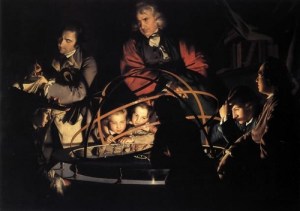
The front cover of Richard Holmes’ book The Age of Wonder: How the Romantic Generation discovered the Beauty and Terror of Science shows the beautiful painting ‘A Philosopher giving that Lecture on the Orrery in which a Lamp is put in place of the Sun‘ by Joseph Wright of Derby, 1766.   Quite apart from the impact of the lighting, the expressions on the faces and the spread of generations depicted, the title of the painting is important- a philosopher– and in Richard Holmes’ book we explore the shift from ‘philosopher’ to ‘scientist’ in the nineteenth century.  The term ‘scientist’ itself is of fairly recent origin, coined as part of this transition between 1830-1834, and initially rejected because of its analogy with ‘atheist’ but rapidly taken up in common usage.

Holmes argues that the bifurcation between science and romanticism took place only  in the mid 19th century, and was preceded by a period in which what we now call ‘science’ was part of a broader fascination with theology, poetry, painting and literature.   In this multiple biography, not unlike Jenny Uglow’s  The Lunar Men (which I’m also looking forward to reading), Holmes uses Sir Joseph Banks as a type of bookend to encapsulate a number of other interwoven biographies.  The book opens with Joseph Banks in the South Seas, the young, libertine ethnographer who literally ‘goes native’  during his voyage of exploration.  It closes with Banks’ death in London, where he is the bedrock of the Royal Society and a one-man communication hub between the  ‘philosophers’  he championed and mentored across the globe.   Between these bookends are other biographies: particularly those of William and Caroline Hershel the astronomers and Humphrey Davy the chemist and inventor, who each have two distinct chapters, as if Holmes himself is orbiting them.  Mungo Park the African explorer is here too, reaching into the darkness and emptiness of Africa as it was known then;  as are the balloonists in England and France who had the first glimpse of the earth from on high, just as momentous and re-orienting as the photographs of the earth taken from space 150 years later.  This is not just a ‘great man’ approach: there is also the more troubling diversion into the experiments into galvanism (news of which travelled all the way to Port Phillip) and attempts to create life itself as displayed in Mary Shelley’s Frankenstein.

These ‘philosophers’ were not set apart from artists and poets: instead they were friends with them, and in many cases were themselves poets and writers- especially Humphrey Davy who, for me, is the luminous presence of the book.  Holmes’  incorporation of women philosopher/scientists – Caroline Hershel, the indefatigable assistant to her brother and astronomer in her own right, Mary Shelley and Mary Somerville – does not feel forced, while acknowledging the societal structures that privileged their male colleagues.

Holmes is a wonderful biographer.  His footnotes at the end of the book are spare but painstaking, reflecting the depth of archival research he has undertaken.  They are supplemented by the occasional note at the bottom of the page, denoted by a trefoil, that provides glimpses of the biographer at work and in thought.  His note, for example, attached to a glancing reference to a ribbon that Davy enclosed in a letter:

In 1795 Pitt had levied a tax on hair powder, to help raise funds for military campaigns abroad.  The ribbon fell out of Beddoe’s letter as I unfolded it in the Truro archive, and I let out a republican whoop! that almost led to my ejection. (p. 252)

This is not just a series of scientific biographies: it is an argument about Romanticism and science, and the nature of human intellect and endeavour.  It is a deeply rewarding read.

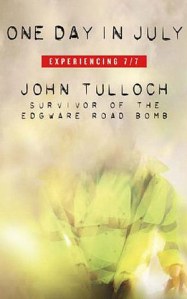
‘One Day in July: Experiencing 7/7’ by John Tulloch

Tulloch2

2006, 223 p.

Today is the fourth anniversary of the London bombings.   A memorial has been unveiled in Hyde Park this year, and I have no doubt that every passenger on the Underground today will think of the bombings, even if just to push the whole idea away as too terrifying to contemplate (or maybe I’m projecting my own claustrophobia here.)

John Tulloch, an Australian academic, became one of the ‘iconic’ images of the bombing as he was led from Edgware Road, a bandage wrapped around his head, with eyes darting sideways. His studies specialized in the media and risk, and he brings this perspective to his experience of the bombings.  This is more than a survivor story- although he writes graphically and minutely of the bombing and its aftermath- but the real strength of his telling is the intelligence and insight he brings to the experience and its portrayal in the media, theatre and literature.  Here he is able to step away and analyse the intent and techniques in the narrative as it is portrayed through different media.  He puts his politics upfront: he is vehemently anti-Blair, anti-Bush (and anti-Howard); he is convinced of the relationship between our involvement in Iraq and the bombings and clear eyed about our own complicity in allowing the war to continue.  Ironically, he found himself used as a political image to further Britain’s involvement, rather than to question it.

tulloch3

John Tulloch is obviously a sharp and rather irascible ‘older’ academic, and he puts his wisdom, experience and deep knowledge to its best use by adding shades of complexity, contingency and nuance to events that are too easily depicted in only black and white language- something that I’m pleased to see our Federal Government is moving towards consciously expunging from the political lexicon.

‘Addition’ by Toni Jordan

Grace Lisa Vandenburg is an unemployed teacher on sick leave after a breakdown triggered by a young boy’s accident in the schoolyard.  But Grace’s problems lie deeper than this: she counts obsessively and incessantly, as a way of trying to control her world and all around her.  Into this ordered and tense life comes Seamus, who is attracted to her humour and quickness, and steers her towards therapy and medication as a way of overcoming her obsessiveness.  We lose our perky, wisecracking, passionate and controlled narrator as the medication submerges her into a slow, passive inertia. Will she lose the medication or lose her man? Or both?

This is all the stuff of good chick-lit, in this case bolstered by clever use of narrative to reveal the personality change that Grace undergoes as a result of her medication.  In this regard, it reminded me of Daniel Keye’s short story Flowers for Algernon, which was picked up as the film ‘Charly’.  I think that this use of narrative voice to denote change is one of the real strengths of the book, along with a main character who is not just sassy but also sees the world quite differently.  The book also introduced me to Nikola Tesla, a Croatian engineer who was likewise driven by the need to count, but for him it ended in madness.  The book explores the often narrow line between habit and obsession;  routine and ritual; self control and control of others; passivity and strength; eccentricity and madness.  In these regards, it steps out of the chicklit genre into something more complex.

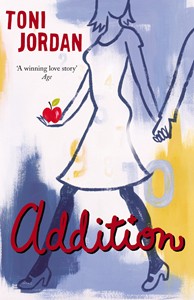
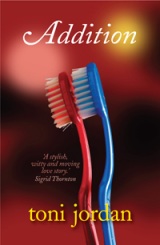
But Toni Jordan has not been served well by her publishers, methinks.  There are several versions of the front cover, and none really does justice to a book that is more than just chick-lit.

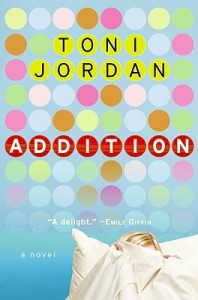
Here’s the American version.  Who the hell is Emily Giffen? Thank you Wikipedia-  Emily Giffen is obviously the Queen of Chicklit. Her insightful blurb  calls it “A delight”. I hope that no-one offered their first-born child in exchange for such a glowing endorsement.  I wonder if her books are so nuanced?  And in case you think it’s a primary school textbook- a not unreasonable assumption really-  the cover helpfully labels it as ‘A novel’.

jordanaddition2

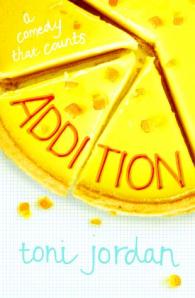
The English version has a little pun – “A comedy that counts”.  The lemon tart is nice and cheerful- but surely it should be a flourless orange cake sprinkled with poppy seeds- if you’ve read the book, you’ll know why.

jordanaddition3

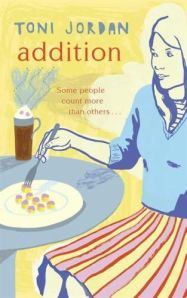
There’s a second UK cover that sticks with the pun on counting: this time “Some people count more than others”.

jordanaddition4uk

One of the covers available in Australia resembles this British one, but with a sassier girl who looks more like a model and less like a schoolgirl.  The blurb cites The Age’s recommendation:  “A winning love story”.

jordan5aust

Then finally, there’s one that perhaps gets closer to the tone of the book.  Sigrid Thornton (much loved of Sea Change) endorses it as “A stylish, witty and moving love story”.   But as the Resident Husband commented “Since when has Sigrid Thornton been a book reviewer?”  Maybe I should keep an eye on my toothbrush, lest it also get up to shenanigans.

JordanAddition

There is a happy ending in this feel-good, romantic fiction book, and it’s good fun, engaging and heartwarming.  I gobbled it up, and shut the book with a smile.  I think we can all do with a bit of this, in small doses.  And, of course, only as part of a well-rounded reading diet.

‘Family Fortunes’ by Leonore Davidoff and Catherine Hall

davidoff

Some time ago, I read Michael Roe’s ‘Quest for Authority in Eastern Australia’.  Roe argued that the tenor of Australian society appeared to be set on a paternalistic, conservative path dominated by a landed elite who had been dealt with generously in the carve up of land and authority in the former  penal colony.  By the 1820s, however, a diversion from this path occurred with the influx of mainly British settlers who were shaped by what Roe called  ‘moral enlightenment’,  a philosophy drawing on 18th century thought, combining Romantic, utilitarian, Protestant and liberal values.  He did not claim that this was an intrinsically Australian characteristic- instead it was a ‘transplanted species’, drawn from similar currents in Britain at the time.

As I wrote in my post on Roe’s book, I was nudged into reading it by a friend’s dissatisfaction with the sterility and abstraction of his argument, which was largely a roll-call of local colonial male-dominated politics, with no ‘real’ people.  This didn’t trouble me so much, but I found myself wanting to dig back even further into the mental baggage of new settlers- where did this ‘moral enlightenment’ come from?  This led to me onto reading Davidoff and Hall’s ‘Family Fortunes’- a book that seems to have been cited everywhere!- a sure sign of the ‘landmark’ and ‘seminal’ text!

The full title of the book is ‘Family Fortunes: Men and Women of the English Middle Class 1780-1850’.  Its time-frame is important for considering early Australian society because it encapsulates the settler phase of Australia so closely, and even though this book is set entirely in Britain, I found resonances in Australian history as well.  Every white settler carried with them the sensibilities of their home society, not necessarily replicated in the new society, but present nonetheless.    The authors argue that the middle class mentality of the early 19th century (later overwhelmed by the dominance of later Victorian bombast) was centred in the religious revivals of the late 18th century, manifested through the non-conformist and  evangelical Anglican middle class families that prospered in the early years of the Industrial Revolution.  They based their argument on the study of four locations: Birmingham and its satellite suburb Edgbaston; the market town of Colchester, and the villages of Witham in Essex, and Suffolk.  Their book is studded with people, met again and again, who exemplify the embeddedness of religion in family, business and public life: here are the fleshed-out personalities so absent in Roe’s book.

They draw an interesting distinction between adult converts in the religious evangelical fervour of the 1780s and 90s, and their own children, born as natives into evangelical Christian families.  Many of my Port Phillip pioneers are here among this group: particularly those public men who expressed their respectability and masculinity through the Debating Society, the balls, the subscriptions and churches in the new town of Melbourne.

The full title of the book emphasizes family and the role of both men and women in the economic milieu of middle-class English society.  They argue that during the first half of the 19th century, middle-class women were removed from the ‘establishment’ that supported the family- in terms of both role and location.  They moved to less visible, ‘back of house’ roles within the family business and the enterprise itself became town-based, while the family shifted to outlying satellite housing suburbs.  Male and female roles became increasingly separated into public and private spheres, that varied during the life cycle, with women’s contribution to the family capital and success increasingly sidelined.

I find myself thinking of Port Phillip’s development, starting with a blank slate as it were.  In the earliest days, housing and enterprises were intermingled- Georgiana McCrae and her family started off in Argyle Cottage in Little Lonsdale Street West, and many public men lived ‘in town’ as well as having other properties further out.  As part of the 1840s land boom, suburbs like East Melbourne, Fitzroy and Brighton were being subdivided and sold as residential property. Yet among the ‘public’ families, however, in a social and economic sense the  separate spheres seems to have been established almost from the start- although this would no doubt be less true amongst smaller trading and shop-keeping enterprises.  I’m also very much aware of the phenomenon of brothers emigrating together and business partners becoming -in laws: that web of family connections that was elastic enough to stretch across the globe, and yet was still stitched closely together where it caught at the extremities.

‘Family Fortunes’ is exhaustive (and exhausting!) in the sheer weight of evidence drawn from a variety of sources including diaries, letters, hymns, memoirs, family and local histories, minutes, business documents, wills and tracts- this is a BIG, important history drawn from small, domestic, often ephemeral, lived-in documentation.

‘Modern Interiors’ by Andrea Goldsmith

goldsmith

1991, 242p.

This is Andrea Goldsmith‘s second book, and one that I hadn’t heard of before.  I read it for my C.A.E. bookgroup – a night of wine, laughter, affection amongst the women my daughter has dubbed “The Ladies Who Say Oooooh” (because apparently we work ourselves up into a chorus of  ‘oooooh’ at some stage during the night. I’m not sure if this is a compliment or not).

The book’s main character, Phillipa Finemore, is a wealthy widow whose adult children expect her to share the family money with them and subside into a well-heeled widow’s existence as their mother and grandmother.  Instead she sells the big family home, shifts into a terrace house in Carlton, starts a charitable foundation, travels with her deceased husband’s lover and secretary, and befriends a Jewish bookstore owner and then a 25 year old university student.

The goodies and baddies are stereotyped and one-dimensional.  There’s the grasping daughter and embezzling son-in-law; the insipid and incompetent son, and the good gay son who gets on well with his mother.  There are overdrawn parodies of the self-aggrandizing business school and a grasping evangelical preacher and his young wholesome wife.  The slabs of Goldsmith’s own opinions about the perils of family and the commodification of university education, voiced through the characters, became laboured too.

In spite of all this, though, I enjoyed reading the book.  It was almost Anne Tyler-ish in places, and although very wordy, captured emotions and descriptions well.  I felt glee at the come-uppance of such unpleasant people, so I must have been engaged with this book in spite of myself.

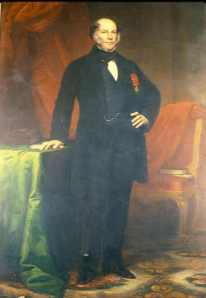
‘Colonial Improver: Edward Deas Thomson’ by S. G. Foster

PortDeas Thomas2

Once you’ve got some little way into your research, it’s quite amusing to look back at the things that puzzled or amazed you right at the beginning.  For me, it was coming across so many letters addressed to ‘E. Deas Thomson’.  Who WAS this man, I wondered, who seemed to write with such authority on so many topics- and why had I never heard of him?

Edward Deas Thomson was originally appointed clerk to the Legislative and Executive Councils under Governor Darling in 1829, then went on to serve as  Colonial Secretary for Governors  Bourke, Gipps, Fitzroy and Denison between 1837-1856.   The term ‘Colonial Secretary’ is a little confusing, as it was used both  for the Secretary of State for War and the Colonies in London (e.g. Marquess of Normanby,  Lord John Russell, Lord Stanley during Judge Willis’ time in NSW) as well as for the chief adviser and second administrator to the Governor here in the colonies.  In my focus on the empire-wide peregrinations of colonial civil servants and judges as they crisscrossed between Upper and Lower Canada, Newfoundland, Cape Colony, the West Indies, New Zealand, Australia, Sierra Leone etc., I have tended to forget that their mobility was supported by an ongoing administrative structure that remained more or less stable, despite the comings and goings of Governors.   This was the case with E. Deas Thomson who served under four governors, of varying political stances and administrative habits.

E. Deas Thomson was born in Edinburgh in 1800 to a family with naval and merchant connections.  His father was  the sometime accountant-general of the Navy, and family drew heavily on the patronage of Sir Charles Middleton (Baron Barham) , First Lord of the Admiralty, and his family after Sir Charles’ death.    His mother was from South Carolina, where Thomson’s father had worked as a plantation agent for his uncle.  After marriage, the couple moved back to Scotland but Deas Thomson’s mother seems to have not settled well and returned alone to South Carolina after suffering a period of paranoia, leaving the 5 year old Edward with his father.  Edward was educated at Harrow, then spent two years in France,  returning to London for a period before travelling to America, then Canada after attending  to business arising from his mother’s death in 1826-7.  The French and American connections, though not necessarily out of the ordinary, do suggest a broader experience than many other civil servants may have been exposed to.

Through his contacts with Sir Charles Middleton’s family, he appealed to Huskisson, then Secretary of State for War and the Colonies for a position in the colonial civil service.  At first he was offered the position of registrar of the Orphan Chambers in Demarara, then a second offer of Clerk of the Council of New South Wales, which he accepted, despite the lower salary, on account of the healthier climate.  This consciousness of the tropical climate, and its deleterious effects, is an ongoing theme in the English imagination of Empire.

He came to his position as Clerk of the Councils via a circuitous route.  The previous incumbent, Henry Grattan Douglass had been removed from the position, and Darling tried to replace him with his own brother-in-law Henry Durmaresq. However the appointment was vetoed by the Colonial Office after complaints of nepotism and Darling was warned against the appointment to public office of  ‘any relative or near connection’.  The position was then open for Thomson’s appointment.

Thomson was not particularly impressed with the drought-striken New South Wales during his first year in 1829, but his perceptions improved as the drought lifted and his friendship with Governor Darling developed.     He maintained a good relationship with Darling’s replacement, Richard Bourke ,and dined frequently with him, despite differences in political stance.  He married Bourke’s daughter Anna, which then placed him in a similar position to his predecessor Dumaresque when Bourke recommended Thomson (his son-in-law) as a replacement Colonial Secretary in place of Alexander Macleay– an erstwhile friend whose nephew ended up marrying Thomson’s own daughter in 1857- ah, the tangled intermarriages amongst colonial ‘gentry’ family!

Despite Bourke’s qualms about nepotism, the appointment went ahead, and as it was, Thomson remained Colonial Secretary for twenty years, long outlasting his father-in-law’s stay in New South Wales.   As such, he acted as confidant, advisor and spokesmen for the succession of governors.  His role changed after the 1842 Constitution introduced a partially-elected Legislative Council, and again with 1856 responsible government when, relucant to engage with electoral politics, he became a life appointee of the Legislative Council where he came to be aligned with the conservative element.

My own awareness of E. Deas Thomson, however, arises from his position as medium between Governor Gipps (the governor in charge during Judge Willis’ time in Port Phillip) and official and individuals in the community at large.   The protocols of communication were an important means of control:  individuals and government officials were instructed to direct all communication with the governor through his Colonial Secretary, and all communication with the Secretary of State in the Colonial Office in London also had to be channelled through Governor Gipps in Sydney (and hence, his Colonial Secretary E. Deas Thomson).   Certainly individuals could, and did, circumvent this process by writing directly to the undersecretary at the Colonial Office , but by Judge Willis’ time this practice, overtly encouraged by Undersecretary Robert Hay in the mid 1820s, had been regularized by the new undersecretary  Sir James Stephen.   Likewise,  there was an off-record back channel of communication within the colonies as well:  Gipps wrote personally to Superintendant La Trobe, and Thomson himself maintained long-standing communications with Denison in Van Diemen’s Land who was later to become Governor of New South Wales.   Indeed,  Thomson became increasingly critical of Governor Gipps’ carelessness in communications with local politicians,  and his inability to recognize when to speak and when to remain silent.  At the same time, leading members of the community recognized that it was better to sound out Thomson before approaching the Governor directly. (Foster, p. 62).

E. Deas Thomson himself has been cast as ‘conservative’ in his politics, particularly when he became a political actor in his own right after representative and then responsible government was granted to the colonies.  Certainly he came to be  seen to represent the interests of the squatters,  and expressed wariness and distaste for universal suffrage and wanted the constitutional backstop of a conservative upper chamber on a restricted franchise.  However, other aspects of his politics are less clear-cut.  He was a lifelong Free Trader, right from his time back in Scotland where he attended lectures by J. R. McCulloch.   He supported the idea of ‘improvement’- a theme picked up on in Foster’s title to his book- through schooling, universities, postal communications, railways, and his involvement in a range of benevolent societies and educational instutions including the Australian Museum and Sydney University.

The lives of E. Deas Thomson’s surviving children illustrate major themes in Thomson’s own life.  His eldest son suffered an ‘unstated ailment’ and could not hold down a job and drew on large sums of his father’s money- shades, perhaps, of Thomson’s mother’s ‘instability’; or maybe just colonial waywardness??? A second son became heavily involved in the Church of England and the temperance movement- the ultimate ‘improvement’ activity.  His three daughters’ marriages are a microcosm of empire: one married a nephew of Thomson’s own predecessor as Colonial Secretary, Alexander Macleay; another married a member of the Indian civil service, and the other married a naval officer.

Thomson’s own early career demonstrates once again the importance of patronage in embarking on a colonial role.   Patronage seemed to make the world go round, but it’s easy to overlook its infantalizaing aspects.  Thomson’s own father, dismissed from his position as accountant-general in the Navy by the incoming Whig Government, turned his attention to a rich widow.  To his son he wrote:

The party I have had in view and still have, if it can be accomplished is a Mrs C a person about 50, being neither (of course) young nor handsome but with more good temper than falls to the lot of most people in life- She is the widow of an army surgeon who has been dead about 7 years- Her father left her about 15,000 pounds which has not been decreased but rather added to… Lord and Lady [B]arham approve the Match  & have visited & paid the necessary attention (quoted Foster p. 36)

Shades of Lady Catherine de Bourgh in Pride and Prejudice??  I suspect, but am not certain, that by now the Barham influence rested with 1st Earl of Gainsborough– or perhaps Lord and Lady Barham are a different branch of the family?  Ah, it’s hard to shake my 21st century perception that there’s something rather demeaning in all this deference and condescension.

Foster paints a picture in this biography of a public servant who was not just a cipher for the Governor but who had influence in his own right.  He was in the mould of 19th century gentlemen improvers: he was concerned to ‘maintain balance’ between the forces in society, and he embraced technology, communications and education as a way of improving society.  His efficiency as public servant and administrator in many ways blunted the calls for responsible government: had the position of Colonial Secretary been filled by someone less capable, there would possibly have been more political agitation for constitutional change, much earlier.

References:

S. G. Foster Colonial Improver: Edward Deas Thomson, Carlton Vic. Melbourne University Press, 1978

‘Queen of Fashion’ by Caroline Weber

weber

2006, 292 p + notes

If I’d written this book, I couldn’t have resisted her subtitle: ‘What Marie Antoinette Wore to the Revolution’.  Although to be fair to any humourless editor who may have insisted on the more staid title, the first half of this book does deal with Marie Antoinette as Queen, and only the second half is devoted to the Revolution.

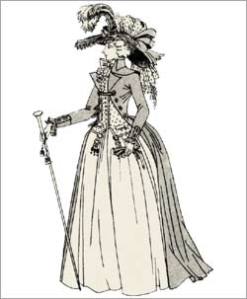
A French Queen’s clothes were never neutral: the young bride-to-be  Marie Antoinette was stripped of her Austrian clothes on the border, despite her mother’s care in making sure that they were of the latest French design, and clothed in authentically French court fashion, including a wicked boned corset and the ceremonial grand habit de cour – the court dress of Versailles with a tight-fitting bodice, voluminous hoopskirts and long train.  The clothes were not enough, though, to encourage her diffident husband, the future Louis XVI and it was in the in-between phase, before he bolstered her position at court by bedding and impregnating her, that she began experimenting with court fashion.  She scandalized the court by refusing to wear the corset; she introduced the English-style redingote (riding coat) and wore trousers while riding.

Redingote

Redingote

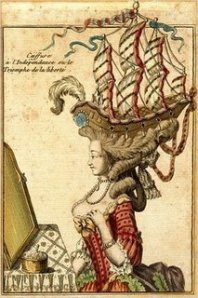
Once Queen, her own style set the standard for fashion at court.  She introduced the pouf– huge, towering hairstyles built on scaffolding made from wire, cloth, gauze, horsehair, fake hair and the wearer’s own hair, teased off the forehead.   In amongst this would nestle an elaborate miniature still-life- for example ‘ a three-foot high pouf that replicated a verdant garden, replete with flowers, grass, a bubbling stream, and a tiny windmill edge with jewels and powered by a clockwork mechanism’ (p. 104.); or more political poufs, like one that depicted the French frigate that won a key victory against the British in June 1778.

pouf a la Belle Poule

pouf a la Belle Poule

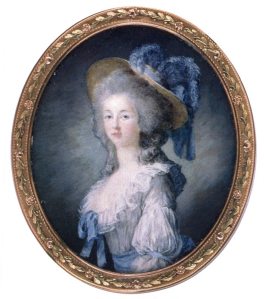
Away from the court, at her Petit Trianon garden shed, she broke away from the formality of the court by wearing a lightweight chemise dress known as the gaulle, made of airy, ruffled muslin with a wide sash at the wait and ribbon bracelets at the elbows. The gaulle was popular not just in France, but across the Channel in England as well.

The Princess de Lamballe, Marie Antoinette's BFF, wearing a gaulle

The Princess de Lamballe, Marie Antoinette's BFF, wearing a gaulle

This earlier section of the book was interesting, but rather laboured.  Perhaps this reflects the long waiting-around time that Marie Antoinette had to endure before her husband managed to ‘do the deed’.  Weber draws heavily on Antonia Fraser’s biography of Marie Antoinette throughout her book- I don’t know why, but I’d mentally placed Fraser’s meticulous work into a different category from a scholarly (but popular) book like Weber’s.  At times I felt like saying “Okay- I get it! Clothes matter!” during the early chapters.

For me, the book really took off with the Revolution.  Weber spends little time discussing the Revolution per se, but instead looks at it through the lens of Marie Antoinette’s clothing, and just like the Revolution itself, there is a dizzying array of statements being made in the clothes she wears.  During the early days of the Revolution she adopted the cockade in blue, white and pink (not red) worn by the people in the streets, to express her sympathy in the movement.  In trying to escape to Varennes, she adopts an unassuming dark brown dress with a black shawl and hat, but in the pictures portraying their escape, she is depicted wearing the gaulle she made famous.  Once arrested, she adopted again the colours of royalty- purple and green, and sometimes the Austrian colours of yellow and black: at the risk of a bad and anachronistic pun, surely a ‘red rag’ to the Revolutionaries.  She insisted, over her jailers, on wearing black once her husband had been executed, a dress that became progressively more tatty and threadbare as her imprisonment stretched on.  Finally, taken to the guillotine, she pulled out a white dress that she had kept carefully hidden throughout her imprisonment, and died in that.   Even the fact that she had saved this white dress highlights her awareness of appearance: she had been suffering very heavily from uterine bleeding for months, was desperate for rags to staunch the flow, and to have kept this dress intact speaks volumes.

Weber draws on other biographies, the memoirs of royalists written at the time and small ephemeral documents like receipts and accounts with her dressmakers and milliners.  It is a beautifully written book that she has obviously enjoyed writing- so much so that there is a personalized narrator-centred introduction and afterword- as if she can’t bear to let the topic go. And yet I wish she had integrated her afterword into her introduction, because it detracted from the masterful closing paragraph of the book that encapsulated everything that had come before:

Even before she had reached the guillotine, this aspect of her history, her body, her being, had been erased- leaving only white.  But the erasure reveal even more than it concealed, condensing as it did the whole of her perilously fashionable past.  White the colour of the fleur-de-lys and of a young bride’s complexion. White the colour of costume parties and sleigh rides in the snow.  White the color of a powdered head, coiffed by Bertin and Leonard- or by the mob.  White the colour of a muslin gaulle, imported or otherwise: pretty at Trianon, perverse in Paris.  … White the simultaneous coexistence of all colours: revolutionary blue and red, royalist violet and green.  White the color of the locks that she saw the executioner slip into her pocket as he sheared her head to prepare her for her fate.  White the color of martyr-dom, of holy heaven, of eternal life.  White the color of a ghost too beautiful, or at least too willful, to die.  White the color of the pages on which her story has been- and will be- written. Again and again and again.

‘Ice’ by Louis Nowra

nowra

2008, 322 p.

I’ve now finished  the final of the Miles Franklin shortlist for 2009- a shortlist this year dominated by the literary bulls of Australian literature (Winton, Flanagan, Nowra, Bail and Tsiolkas).  I don’t know whether to be assured that the shortlist is truly gender-blind by not including a token female writer, or whether to snort that SURELY one of the many books published by female writers must have qualified.

I think this is the one amongst the shortlist  that I enjoyed reading the most.  At first it seems to be a straight fictionalized biography of Malcolm McEacharn,  a colonial entrepreneur responsible for the refrigerated meat export trade among other things.   Nowra has used some fictional licence here, but sticks fairly closely to McEacharn’s biography.  A shy, diffident man, McEacharn’s mother remarried and shifted to India, leaving him as a young worker to find his own way in the world. He falls in love with Ann, a bewitching beautiful girl. When she dies, he is maddened by grief, and the rest of his life- apparently successful with money, clothes, mansions, political influence- is just a series of layers with his love for Ann at its core.

Running parallel to this is the present-day voice of Rowan Doyle, likewise maddened sitting beside his comatose wife, who had been writing a biography of McEacharn when she sustained catastrophic injuries when attacked by a crazed ice addict.  Doyle picks up the story, based on her research, but embues it with his own feelings of grief and loss, and finds himself unable to stop writing because it is his last contact with his wife.

This juxtaposition of death/coma and ‘ice’ in its many manifestations is deliberate, self-conscious and a little laboured at times, but I found myself drawn into the sorrow and obsessive love in the book and was in tears by the end of it.  The modern narrative breaks in at unexpected places, and because the biography itself is a product- their joint product, already researched with its ending known- there is quite a bit of foreshadowing.

Louis Nowra was interviewed on RN’s ‘Book Show’ and made this comment about biography and historians:

Louis Nowra: The interesting thing about all this is that I don’t believe you can know anybody after two generations. What I’m saying is if I write about an historical character…I really don’t know Malcolm. All I know is these papers that I’ve read and a couple of interviews that he did. I have a kind of a vague idea about him. So really the novel is not an historical fiction. What I’m attempting to do is almost parody historical fiction. I’m not saying this is the real Malcolm, I’m saying this is Rowan’s version. No one can possibly know about people more then 50 years into the past, I think…

Ramona Koval: So you’re talking about straight history as well?

Louis Nowra: I think straight history is fine, but once you start to second-guess characters, once historians start to identify with a character, I think you become very much on slippery ground. Like my grandparents, for example, I have learned a lot about their lives when I wrote my first memoir. At the same time, they are tremendously vague for me because I don’t have their values, I don’t have their sense of morality and I don’t have their sense of how they fought so hard for money. So I cannot judge them. And the same is with historians. I actually think that sometimes there’s a bit of flimflam that goes on.

Through his character Rowan, Nowra (hah! an anagram!!) backs away from claiming ‘truth’ from his writing.  He tells his comatose wife that he’s found extra information to add to her already-completed  research; he reads her research notes and moulds them into an explanation that is more consonant with his own emotional response to grief, rather than a straight biographical account.

And as Nowra says in this interview, ‘Ice’ is very much a love story and a meditation on the narrow line that divides love from obsession.  It’s not unlike ‘Wanting’, one of the other Miles Franklin shortlist for 2009, but it’s more tender in its approach.  I hope it wins, although I suspect that ‘The Slap’ will win, and that ‘Wanting’ should win.  But I can always hope, can’t I?

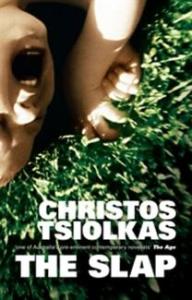
‘The Slap’ by Christos Tsiolkas

the-slap-by-christos-tsiolkas

2008, 483p.

It’s doing well, this one.  Plans for a television series; won the Commonwealth Writers Prize, and shortlisted for the Miles Franklin.   The Miles Franklin is awarded for any ‘published novel or play portraying Australian life in any of its phases’ .  [An aside: I hadn’t realized that a play could win it.]  Certainly, The Slap portrays Australian life of  the backyard barbeque of inner-ish  suburb of Northcote, Melbourne in the 2000s in all its domestic, self-absorbed, middle class glory.  When one of the fathers slaps an obnoxious four-year old he triggers off much tut-tutting amongst the witnesses that ripples out into broader questions of discipline, family loyalty, abuse, friendship, class, religion, ethnicity, suburbs- the lot.  Everyone’s here- the yuppie bayside suburb Greek boy made good; his cousin married to the Indian vet; the Sex-and-the-City writer who wants to do more than write soap opera scripts; the earth mother and her drop kick partner; the young gay adolescent boy struggling with his sexuality; the Greek grandfather; the Aboriginal muslim and his Aussie wife.  Yep- I think that covers every inner-city suburban stereotype we need.

The book is told in long chapters written from the perspective, but not in the voice of,  people who were at the barbeque and witnessed the slap.  For some, it was just that- a spur of the moment slap to a child behaving badly; for others it was a violation of the rights of the child and his parents; others saw it as a criminal act; yet others as an unspoken manifestation of other domestic violence.   These chapters work well: they are long enough for a reader to shift into the character’s mindset, and because they move forward chronologically, they keep the plot unspooling.

There are actually two slaps- or at least physical encounters with this same little brat-  in this story, each bookending the first and last chapters of the book, and yet we don’t see them in the same way- largely because of  the other knowledge we have gleaned about the characters along the way.   Much of this other knowledge is fairly unattractive.  It uncovers infidelity, jealousy, class envy, prejudice, vindictiveness, self-centredness  and dishonesty. To be fair, it also uncovers loyalty to family and loyalty to friends, but even these things look rather shabby and unhealthy too.

Gerard Windsor reviewed this book in the Sydney Morning Herald where he described this book as “a strikingly tender book”. I didn’t see it this way.  I think it’s a jaundiced book, populated with human, recognizable but ultimately unlovely people.  I’m not convinced that it’s high literature: it smacks of the four-part miniseries- almost like Big Brother in the Backyard.  Perhaps the same sense of voyeurism is what keeps you reading, to find out what people just like you are going to do in this situation.

As a Port Phillip District resident, I enjoyed reading about my Melbourne home town.  The Heidelberg Court House is just down the road,  I know the streets that he’s talking about.  I know these people too. As  inner suburban, middle class, university-educated, chardonnay-sipping Melburnites older than 25, we’ve met them all one way or another.  It truly is “Australian life in its 2008 phase”, but somehow I think I’ll feel a bit short-changed if it wins the Miles Franklin.  Is “reality reading” (like reality television), authentic and identifiable as it is, the same as “literature”? I’m not sure.

‘The Pages’ by Murray Bail

bail

2008, 199 p.

To be honest, I’m not absolutely sure that I ‘got’ this book.  I am wary with Murray Bail- the first time I read ‘Eucalyptus’ I found it pleasant enough though underwhelming, but on a second reading wondered why I hadn’t picked up on the brilliance of its structure the first time.   Does ‘The Pages’ have another level as well?  But should you have to read a book twice in order to understand it?

In many ways ‘The Pages’  reads as if it is a complement to ‘Eucalyptus’.  Where in ‘Eucalyptus’ we had an antipodean Scheherazade weaving stories from the landscape, in ‘The Pages’ we have an antipodean Wittgenstein who travels the world and returns to immure himself in the solitude  of his  shearing shed to write his philosophy of the emotions.  In ‘Eucalyptus’ we have stories hanging like leaves, evoked by the names and appearances of eucalyptus trees ; in ‘The Pages’ we are left with sheets of paper, largely empty except for single, aphoristic thoughts.

The plot, such that it is, operates at two levels.  Erica, a competent, articulate academic philosopher, has been engaged to assess and edit for publication an archive of papers left by Wesley Anthill,  a peripatetic and largely self-taught philosopher who returned from travelling Europe to his family pastoral property, where he locked himself away to write a philosophy of the emotions.  Erica travels out to the outback homestead to examine the materials, accompanied by her psychoanalyst friend Sophie who is recovering from yet another failed relationship, this time with a married man.   While there, Erica sinks into the quiet rhythms of the pastoral lifestyle shared by Wesley’s brother Roger and sister Lindsay, who indulged  and supported their eccentric brother’s writing.  Erica comes to appreciate and love Roger’s  earthy, grounded ‘philosophy of the hand’ which is such a contrast to the laboured and hard-wrung philosophy that Wesley had grappled with, alone in his woolshed and now nothing more than sheaves of paper, expungable with the simple act of spilling a cup of coffee.

The second plot involves Wesley’s own gradual quest for knowledge, stepping tentatively from autodidactism into formal academia, then moving around Europe in the footsteps of other philosophers.  Although he fled Australia because he felt it unreceptive to philosophy, he returned there, after tragedy, to find and write his own, original philosophy.  An essentially solitary man, he seems ill-fitted to write a philsophy of the emotions.

The pacing of this book is unusual.  It unspools slowly, like a laconic country story, and when I was approaching the end of the book, I wondered how Bail was going to finish it in so few pages. It ends with a string of disconnected thoughts that just hang there.     It’s a big book: themes of philosophy, psychoanalysis, words, Europeanness, Australianness ; and yet not much happens in the book.  It’s complex but simple.

If this sounds ambivalent and contradictory, it’s probably because that’s how I found the book.  I’m not sure if it’s brilliant or banal- which is very much the way I felt about ‘Eucalyptus’.   Miles Franklin winner? Well, ‘Eucalyptus’ won the Miles Franklin a few years back- so obviously many people detected at first what I took two readings to find.  Perhaps ‘The Pages’ is like that also, but I tend to think that put up against novels with a stronger story, ‘The Pages’ will be seen as too elusive, too strange.