Category Archives: Book reviews

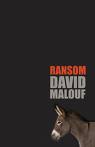
‘Ransom’ by David Malouf

2009, 224 p.

In this book Malouf takes a couple of lines from the Iliad, where King Priam travels to recover the body of his son Hector, who died on the battlefield as a revenge killing.  His body has been dragged behind a chariot, day after day,  in a fury of grief and revenge by the crazed Achilles.  From the interstice of Homer’s brief telling of this paternal act of love, Malouf fashions a small jewel of a story about love, masculinity, fatherhood and fame.  I use the word “fashions” deliberately because as you’re reading it, you’re very much aware of the careful weighting of each word and the crafting of the images. It is deeply poetic in places, and makes you as a reader slow down, re-read, and roll the words around in your mouth, savouring them.

His plan is to travel incognito to meet with Achilles: to speak with him man-t0-man and father-to-father to ask that Hector’s body be released to his family.  Instead of travelling in state, he decides to travel with an unlettered carter named Somax and his mule-drawn cart, selected almost at random from the market where Somax awaits work as he does every day.  This small book is the story of the short journey they take together, and Priam’s encounter with his son’s enemy.

Priam is powerful, and yet powerless to stop the desecration of his son’s body at the hands of his enemy.  His is an act of paternal love, and yet in terms of fatherhood, his relationship with his many sons (borne of many wives) is sterile and formalistic with none of the intimacy that Somax has had with his sons before their deaths.    Priam is feted as the wise king, and yet he knows little of the world outside his own palace walls.

Both Achilles and Priam are aware, through the prescience granted to them by the gods, of the past and the future and their own place in stories to be told in the future.  Achilles is fired by grief , rage and bursting masculinity; Priam, as an older man, is aware of the contingency of a life’s journey and the life not lived.  My favourite part of the book was where he considered the other life he could have had, if his sister had not ransomed him from captivity as a boy. Despite his wealth and position, he is haunted by this other-life and feels somehow inauthentic.

Time in the book seems suspended, like a drop of water  shimmering from a branch before it falls.  The war has dragged on for years and it has that nightmarish quality of an never-ending, intractable stalemate.  Achilles drags Hector’s body behind his chariot, hour after hour, day after day and yet the gods renew it each night so that the nightmare goes on.  The trip in the cart itself takes only a day, and yet it feels much longer.   The meeting with Achilles occurs abruptly.

In the afterword, and in interviews at the launching of this book, Malouf alludes to the wartime experience of his childhood, and indirectly today in Iraq and Afghanistan, where war seems intractible and never-ending.   I don’t really think that this book needs contextualizing in this way.  It stands in its own right as a book that, perhaps, only an older man could have written. There’s a timelessness about the themes and the literature from which it springs, that does not need to be historicized.

There is a dreamlike quality throughout the book, as with many Greek myths.  Gods materialize in a thickening of the air and shift shapes between the prosaic and the ethereal.  The world of the gods works to its own whims: the world of men has a rhythm and meaning of its own.  And as with much of Malouf’s work, the imagery is crystalline and quite, quite beautiful.

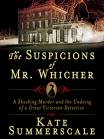
‘The Suspicions of Mr Whicher’ by Kate Summerscale

304 p. 2008

It seems that after reading Curthoy and McGrath’s How to Write Histories that People Want to Read, I have picked up, one after the other, two books that would qualify-  Nicholas Shakespeare’s In Tasmania and now this one,  The Suspicions of Mr Whicher by Kate Summerscale.   This book won the Samuel Johnson Prize for Non-Fiction in 2008, and also bears the designation “New York Times Bestseller” on the front cover.

The book describes the true-life murder of a three year child in 1860, taken from his bed in the nursery outside the bedroom of his parents Samuel and Mary Kent, and found with his neck slashed and body wrapped in a blanket in the outside privy. The family that lived in this three-storey Georgian house was not a happy one.  It was a second marriage for Samuel Kent; the older children of the first marriage had been relegated for the second family; the new Mrs Kent was not all she seemed at first.  Suspicions mounted about the relationship between Mr Kent and the nursemaid who slept in the bed beside the murdered child, the sanity of the daughters of the house, the probity of the servants: the case opened the lid on the fug of family relationships amongst what otherwise appeared to be a respectable, prosperous middle class Victorian family.

The book takes a careful chronological approach with only what I marked as one example of foreshadowing that suggested that the outcome was known to the narrator.  Instead, events and evidence unfold bit by bit, complete with the false-starts and false-leads of any investigation,  and the narrative closely follows the newspaper articles and legal documentation generated by such a notorious case.  I hadn’t heard of the case at all but I assume, given that the murderer ended up depicted in Mdme Tussuad’s waxworks, that the case has more notoriety in England even today.  For someone completely unfamiliar with it, I wasn’t sure right to the end- and even then….?

But this is more than just a country-house murder story: instead it is a closely-grained and grounded study of domestic Victorian life and sexuality, the development of “the detective” as a profession and the relationship between the press and Victorian fiction.  The detective, Mr Whicher, is a lower-class employee in a newly-developing profession, and class sensitivities emerge over what is perceived as  his puerile probing of domestic relationships and middle-class respectability, and the derisive sneering of the popular periodical press.  Summerscale embeds this true-crime story within a broader study of the detective-novel as a literary phenomenon, both at the time in the work of Wilkie Collins and Dickens, and later as a literary genre much loved of BBC Friday night dramas.

The book is carefully footnoted and researched; there are maps and photographs, and an extensive bibliography.   Its chronological structure makes you feel as if it is unfolding before your eyes and it’s quite a page-turner.  And surely that qualifies it as “History That People Want to Read”.

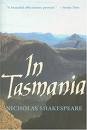
‘In Tasmania’ by Nicholas Shakespeare

2004, 396p.

It was fitting that I should read this book so soon after finishing Ann Curthoy and Ann McGrath’s book “How to Write History that People Want to Read“.  Nicholas Shakespeare certainly can write and his book did quite well as I recall. So, two out of the three.  But I ask myself- is it history?  I suspect not, despite the “History/Travel” designation on the back page- or at least, it’s history in the same way and to the same extent that the television program  “Who Do You Think You Are?” is.

In fact, the “Who Do You Think You Are” television series came to mind several times while reading this book: there’s the quest story for an ancestor; the findings; and some sort of meta-narrative that ties it together.  As with the television show, there’s an emotional and partisan sympathy for characters solely on the basis of their blood-relation to the narrator:  a large and all-encompassing historical tragedy only becomes real once it can be centred on an individual who happens to be related.  And as with the television show,  the voice and perspective of a professional historian who weighs in with an objective, distanced observation rescues you as reader/viewer from the fug and too-close identification with an ancestor.

Shakespeare himself is a recent immigrant to Tasmania, and part of his own sense of belonging in Tasmania is tied up in the identities of two ancestors, from different branches of his family tree, whose destinies- as one might expect in a small island community- run parallel with occasional points of connection.  Anthony Fenn Kemp, the army officer and merchant is a linch-pin figure whose ubiquity enables Shakespeare to bring in Alexander Pearce the cannibal, Tasmanian Tigers and other riffs on Tasmanian history.  The other ancestor, Petre Hordern was a failed alcoholic from a wealthy family, who submerged himself in the bush and dragged his family into poverty.  These two characters form the book-ends of his narrative, and Shakespeare meanders throughout history and his current-day genealogical quest.

Shakespeare speaks to historians, and reads the histories they have written, but he cites only conversations.  His intent springs from the personal, and he excavates the primary material he has unearthed,  literature and other writers, and family lore as his richest lode. His eye is always on the story as story.  Nonetheless, it is beautifully written, human and textured- but it’s not necessarily history.

Richard Holmes, Nerval, madness and a book not written

Have I mentioned to you that I really very much enjoy Richard Holmes’ work? I think I may have, once or twice.

You might be wondering why I am so enamoured of Richard Holmes at the moment.  I have not particularly characterized my own work as biography- in fact I think that I have consciously resisted the idea of writing biography.  Yes, I am looking at my judge, but I’m even more interested in the reaction to him in the societies in which he operated, the hot-buttons he pushed, and what that suggests about that colony.

And yet I find myself identifying with much of what Holmes says about the biographer’s relationship with the subject.  My family rolls its collective eye and  I often laugh at my ability to play Six Degrees of Separation between any possible event or person and Judge Willis.  I read court reports in the newspaper and wonder “What Would Judge Willis Do?”.  I seem to be able to find some connection, however tenuous, between Willis and practically anyone in Port Phillip in the 1840s.  I walk around Melbourne and I try to “see” it with 1840s eyes.

It was rather reassuring to find that Richard Holmes does this too. In talking about his four-year passion in writing about Shelley, he writes:

The pursuit became so intense, so demanding of my own emotions that it continuously threatened to get out of hand.  When I traveled alone I craved after intimacy with my subject, knowing all the time that I must maintain an objective and judicial stance.  I came often to feel excluded, left behind, shut out from the magic circle of his family… I was often in a peculiar state, like a displaced person, which was obviously touched off by some imbalance, or lack of hardened identity, in my own character… Indeed I came to suspect that there is something frequently comic about the trailing figure of the biographer: a sort of tramp permanently knocking at the kitchen window and secretly hoping he might be invited in for supper.  (Footsteps p. 143-4)

He talks about the biographer becoming gradually more confident about his/her subject’s character.  This is something that I’ve only recently been able to say about myself.  Just recently, I mentioned to a fellow-student something that I felt about my judge, just on the gut-feeling that, knowing what I do about him, I think he would act this way.  I was right, and even though I often bemoan that “I just do not get this man”, I think perhaps I do more than I admit.  Holmes writes:

Yet a biographer does become slowly convinced about his subjects’ characters.  After studying them and living with them for several years he finds that they become one of the most important of all human truths; and I think perhaps the most reliable….   [The subject might act ‘out of character’] Yet the biographer views and witnesses these daily human affairs in a special and privileged perspective.  He gains a special kind of intimacy, but quite different from the subjective intimacy that I had first so passionately sought.  He sees no act in isolation; nor does he see it from a single viewpoint.  Even the familiarity of a close friend or spouse of many years suffers from this limitation.  The biographer sees every act as part of a constantly unfolding pattern: he sees the before and the afterwards, both cause and consequence.  Above all he sees repetition and the emergence of significant behaviour over an entire lifetime.  As a result I have convinced of the integrity of  human character. Even a man’s failings, sudden lapses, contradictory reactions, sudden caprices, seem in the long run to fall within a pattern of character.  One could say, paradoxically, that people even act out of character in a certain way: there is always, so to speak, meaning in their madness, provided one has full knowledge of the circumstances.  (Footsteps p. 173,4)

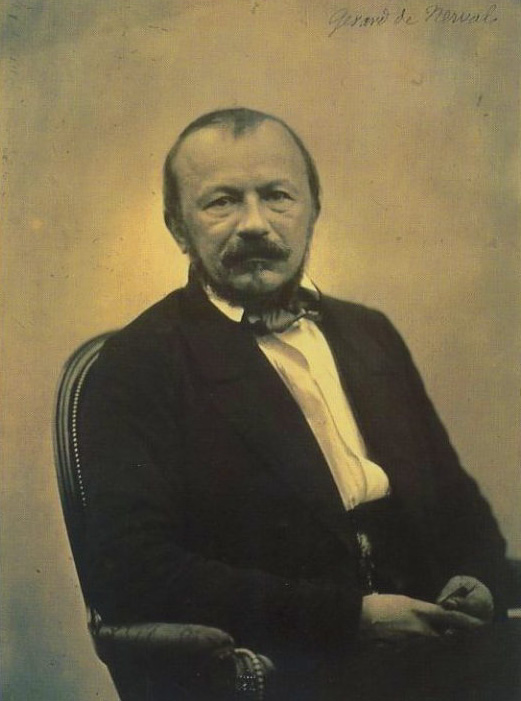
But Gerard de Nerval nearly brought him undone.  In his book Footsteps: Adventures of a Romantic Biographer, he writes of his obsession- and it truly became that- with the writer Gerard de Nerval, a French journalist and writer who was himself floridly insane and ended up committing suicide.
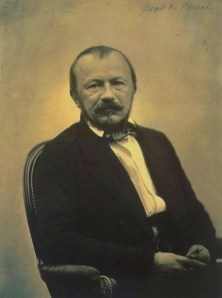
Gerard de Nerval

The biographical problems in writing about Nerval were daunting.  What to even call the man? (given that this was an assumed name).  How much to trust Nerval’s unverifiable telling of own childhood, given that it was written in the grip of madness?  How to write about the madness when it was at the centre of his self?  How to write about a person when Nerval himself often saw himself as two people?

All the logical and traditional structures that I had learned so painstakingly- the chronology, the development of character, the structure of friendships, the sense of trust and the subject’s inner identity- began to twist and dissolve.  It was becoming more and more difficult to tell, or to account for, Nerval’s life in the ordinary narrative, linear way. (p. 249)… As my months went by in Paris, I became more and more convinced that was exactly what could not be done, and that I had reached the limits of the biographical form, as a method of investigation.  Instead, I found myself slipping further and further into a peculiar and perilous identification with my lunatic subject, as if somehow I could diagnose Nerval by becoming him.  As if self-identification- the first crime in biography- had become my last and only resort. (Footsteps p. 264)

Holmes experimented with different techniques.  Could he write a biographical group portrait of the people who surrounded Nerval, using “a central but relatively neutral or unfamiliar figure to tell the story of a famous group of circle”? (p. 208) But the danger is that the “neutral” figure becomes the focus.  Should he abandon any pretence of objective documentation, evidence or chronology and write it as a novel instead? (p.265).  Could he use the Tarot cards that Nerval placed such credence upon as an organizing device for a life that defied chronological and developmental unity? [Personally, I think that this could have worked really well.]

In the end, his major work on Nerval remained unpublished- a book not written, so to say, – or at least, a book not read, although he did contribute an essay to a translation of Nerval’s work in 1985.   Until- voila!- Nerval reappears in  Holmes’ 2000 book Sidetracks: Explorations of a Romantic Biographer,  in the form of a radio documentary called “Inside the Tower” – or as he describes it “a radio drama based on the life of the poet Gerard de Nerval.  All Nerval’s speeches are drawn from his own essays, letters and journals.”  It was broadcast in 1977 by Radio Three, with Timothy West as the voice of Gautier.

Holmes noted:

The discovery of radio, as a vehicle for biographical story-telling, moving effortlessly inside and outside its characters’ minds, shifting with magical ease between different times and locations, was a revelation and an inspiration to me. (Sidetracks, p. 55)

And even moreso now, I would say, with podcasts that can give a program a life beyond its initial airing.  This genre solved so many problems:  he could capture the multiple perspectives of Nerval’s friends by writing commentaries for them as bit-players, so that they contribute to our understanding of Nerval without having to take centre stage themselves.  He could use Nerval’s own words- great screeds of them- to capture Nerval’s own voice, and what an acute and lyrical one it is too!  He starts with the suicide,  in the form of a police report, with eyewitnesses, mortuary assistant, police commissioner; then broadens out to include his friends, his doctors- then finally Nerval himself.  Holmes himself speaks as biographer, but he doesn’t dominate the stage.  Instead, it is Nerval’s voice, unadulterated, honoured.  Brilliant, brilliant stuff.

References:

Richard Holmes Footsteps: Adventures of a Romantic Biographer (1985)

Richard Holmes Sidetracks: Explorations of a Romantic Biographer (2000)

‘The Stone Angel’ by Margaret Laurence

1964, 308p.

[There are plot spoilers here]

I’m not a great epigraph reader, but the epigraph of this book seemed particularly apposite- Do not go gentle into that good night/ Rage, rage against the dying of the light (Dylan Thomas). Hagar, the focal character of this book is raging all the way, just as she has throughout her long life.  The only daughter of a rich merhant, she despised her widowed father’s pride in her achievements and emotional dependence on her, and deliberately  married the sort of man she knew he disapproved of.  The marriage foundered: she was ashamed of her husband’s uncouthness and refused to ever reveal the pleasure that sex with him brought her.   Her eldest son Marvin was invisible to her throughout his life; her favourite son John died in a stupid driving prank.  And yet it is the long-ignored Marvin that she shares her home with, along with his dowdy wife Doris, on whom the care burden falls as Hagar becomes more frail, dependent and confused.   Doris herself is nearly seventy, and Marvin and Doris plan to place her in a nursing home.  Enraged and frightened, Hagar runs away to an old family property in the country where she spends a few cold, thirsty dank nights until found and hospitalized with a diagnosis of cancer and a short time to live.

Laurence has wonderful control of this story.  She handles the time shifts deftly as Hagar slips between reminiscence and present awareness- sometimes even within the same paragraph.  Although Hagar is the point of consciousness in the book, your sympathies for Marvin and Doris are aroused because Hagar surely is a vicious, acidic, scheming, vindictive, selfish and unfair old woman.

There are biblical allusions throughout the text that I chose not to explore, enjoying it sufficiently without feeling the need to contort it into a Christian frame.  In a nice little postmodern touch, as I neared the end of the book I realized that the text turned upside down.  “How prescient! How modern for a book written in the 1960s!” I thought, assuming that it was a commentary on Hagar’s own mental confusion.  But no- the book was just misbound.  Sometimes a cigar is just a cigar…

‘How to Write History that People Want to Read’ by Ann Curthoys and Ann McGrath

2009, 238 p.

This book is exactly what the title says it is: a how to book on writing history.  This no-nonsense approach pervades the book- it’s a real [clap] “Come on! Get stuck into it!” sort of book.  It could have, but wisely has not, been called “History Writing for Dummies” because it shares features of those little yellow books- the cheery, confident tone, the jokes that make you groan, the dot points,  the anecdotes and the bubbling optimism that of COURSE you can write history that people want to read!  I must admit that there’s something about all this bustling, practical advice that brings out the long-lost teenager in me.  I want to roll my eyes, toss my head, and mutter “der–” (the ultimate expression of nonchalance and superciliousness in my adolescence- I warned you that it was some time ago).

Except that it is so damned practical and, yes, good advice.  The book is aimed at a wider readership than just  PhD student- it also has family historians and local historians in its sights.  It is very simply written, with short sentences which at times seemed  just a little patronizing.  But of course, this is a book of advice and it does not pretend to be other than this. Clarity and  a certain amount of  firm direction is fundamental to the act of giving advice: I must remember that a bit of humility and preparedness to listen is fundamental to gaining from it.

This book starts from the beginning, right from conceptualizing your history project and your projected audience.  It has good, practical advice about archives  and the how-to of working with sources , then moves on to the writing.  It was at this point that I stopped my eye-rolling and read more carefully because writing, and thinking about narrative and action, character and the emotions  is right where I am at the moment.  And this is probably the real strength of this book; at some stage it is going to connect with you as history-writer at some point in the cycle.  In this regard, you could buy it at the start of your thesis or project, and dip into it usefully for a bit of a kick up the backside or a dust-off after a setback when you need it. The examples they used from a range of histories were well-chosen; you didn’t need to know anything about the content, and the text guided you to look through the content to the technique.  The discussion of footnotes, grammar and punctuation again had me tossing my head with impatience -until I’d come across something that I thought “oh really? Is THAT the difference between a colon and semicolon?” and “You mean that my examiners won’t even READ my quotations?”.  At times I bridled at the decisiveness of their approach but when I came to areas that for me are foggy and ill-defined, the clarity was reassuring.  I suspect that  I am very bad at taking advice.

The trouble with aiming at a broad audience is that sometimes, in order to avoid alienating one audience, the needs of another audience are put onto the backburner.  As a postgraduate student, I yearned for a chapter about analysis.  They do mention analysis, but its difficulty is downplayed by giving it equal billing with themes and chronology as a narrative problem.  I think that analysis is more than this: it goes to the heart of the endeavour; it is what makes history more than just a good story.  It might be stripped out of histories for publication so as to attract a wider audience; it might be over-kill for a local or family history, but for an academic thesis there  is a fundamental assumption that your thesis says something, means something beyond just the narrative at hand.  This is the real work of history,- it’s the part that makes your head hurt- and it’s hard.

I almost didn’t read this book when I first heard about it because I thought that I had read it before. But no- that was an earlier book (2000)  by the same authors that has been recently re-released: Writing Histories: Imagination and Narration.  It  is an edited collection of papers by contributors to a Visiting Scholars Program workshop for fifteen very lucky post-graduates, and is a who’s who of Australian historians who I admire deeply:  Tom Griffiths, Bill Gammage, Donna Merwick, Greg Dening, John Docker, Deborah Bird Rose, Peter Read and of course Ann Curthoys and Ann McGrath themselves.  This book, in many ways, supplied my “missing” chapter, even though I found it rather daunting.  In my reading journal after reading this book I wrote:

I can’t say that I feel empowered- intimidated more like it; overwhelmed by other people’s erudition and breadth, and feeling stodgy and constipated!

It’s a pity that the two books aren’t released by the same publisher, because they would be a wonderful combination within the same volume.  The prose and vision doesn’t exactly soar in “How to Write History” but it is warm, encouraging and empowering.  The virtuosity and incisiveness of the historians talking about their craft in “Writing Histories”  while inspirational, can be almost paralysing.  As an aspiring history writer, I need both.  I need to be beckoned onwards by those up ahead of me;  I need the grip of a confident, more experienced friend at my arm, and  a damned good shove from behind as well!

‘Little White Slips’ by Karen Hitchcock

2009, 249 p.

I’m not a great short-story reader, especially when they are in a collection like this.  If they are truly short short-stories, then do you read them one at a time over an extended period, or do you pop them in, one after the other, like a bag of lollies?  I don’t like being jerked around from one situation to another in a single reading.  I tend to remember short stories better when I hear them read aloud, rather than when I read them myself.  With the exception of Nam Le’s The Boat, I  tend to find a volume of short stories to be a bit of a curate’s egg.  But is it realistic to expect every story in a collection to blow you out of your reading-chair, or is a hit-rate of a couple of memorable stories within one volume sufficient?  Is a short story MEANT to be memorable? If so, then I am a miserably failed short-story reader.

Karen Hitchcock is being hailed as a “bold new voice in contemporary fiction”.  Certainly, the first couple of stories in this book were very good, especially the first rather lengthy story about a doctor swotting to pass her specialist examinations.  There are a couple of stories about body image; a couple about the study involved in becoming a psychiatrist- the first of which seemed to form a good counterpart to the opening story about studying to become a specialist from the other partner’s perspective.  But the middle of the book seemed to sag with stories that seemed more like baggy and rather nebulous reminiscences, and too many stories  seemed to pick up on the same themes from a different perspective.  The last story, which gives the collection its title, was good, as I rather hoped it would be.

Perhaps there is an overarching structure to this book that I couldn’t detect.  Certainly it deals with “women’s iss-ews” like body image, medicine,  the limits of male and female friendship, professional life and identity etc.   But I felt as if the same narrative voice was telling all these stories- an educated, Australian, mid-30s, often childless, professional voice, or in the case of the reminiscences,  the voice of someone who would grow up to be this person.  Did the author have a vision for this collection of stories as a whole that contributed to this sameness? or is the author not ready or unwilling to move beyond this?

I will read other stories written by Karen Hitchcock.  Perhaps I would have enjoyed her more in a collection with other writers where she shares the stage with others, rather than a solo performance- I see that several of these stories have previously appeared in Meanjin and The Sleepers Almanac, and were picked up in Best Australian Short Stories in 2006, 2007 and 2008.   Or perhaps I just need to find a way to read short stories differently.

‘Footsteps: Adventures of a Romantic Biographer’ by Richard Holmes

275 p, 1985

If Richard Holmes wrote blockbuster movies instead of biographies, this book would be one of those “Making of…”  extras on the DVD.   “Footsteps” is the biographer as autobiographer, shining his spotlight onto the biographer doing biography. It combines an explanation of Holmes’ own search for understanding of his subjects, his decision-making in shaping the story of their lives in a narrative sense,  and his reflections on his own development as a biographer.

The book itself is divided into four fairly lengthy parts (about 60 pages), and each deals with a different biographical “hunt”.  Not all of these searches seem to have eventuated in a publication, although it’s a little hard to tell as there are two Richard Holmes, both historians, both British, – one a military historian (born in 1946) and then my Richard Holmes the biographer (born in 1945).  The biographies described in this book revolve around Romantic intellectuals during, and in the decades following, the French Revolution.

In Part I he starts off retracing (literally) Robert Louis Stevenson’s tour through the Cevennes  in France.  This is the biographer with his hiking shoes and backpack, embarking on a kind of pilgrimage to the places Stevenson visited.  Holmes is only 19 here, and he comes to realize as he tries to cross a now-derelict and impassible bridge that Stevenson crossed that it is not possible to for the biographer “cross literally into the past”.

Even in imagination the gap was there.  It had to be recognized; it was no good pretending.  You could not play-act into the past, you could not turn it into a game of make-believe.  There had to be another way.  Somehow you had to produce the living effect, while remaining true to the dead fact.  (p. 27)

The next section takes us to Paris in 1968, and Holmes, not yet settled in his vocation as biographer,  is swept up in the drama and historical self-consciousness of the 1968 student riots.   Yet he felt a certain distance from the events: was this, he wondered, how English intellectuals in Revolutionary France had felt too?   In particular, he considered Mary Wollstonecraft who arrived in France in 1792 and remained there during the excesses of the Revolution and when many other English intellectuals had returned home.  He focussed on her time alone at Le Havre  with her young child.  In this section Holmes uses his own experience of the 1968 riots at a touchstone by which to explore the reactions of English intellectuals in Paris over 150 years earlier.

1968 was not the break with the past that he (and many others) thought it would be.  For the Romantic intellectuals, too, the conservatism of the 1820s extinguished much of the optimism generated by the early Revolutionary days.   In the third section of the book- the one I enjoyed the most- he focusses on Shelley and his wife Mary, and the relationship with Claire Clairmont, Mary’s step-sister.  From his 1972 perspective of broken and experimental marriages, Holmes explores the emotional lives of these exiles and argues that there was a relationship between Shelley and Claire that they concealed from Mary Shelley.

The final part of the book jumps forward to 1976 when Holmes, almost against his will, is drawn into exploring the life of Gerard de Nerval, a journalist and poet who committed suicide in 1855.  This biography was never published and Holmes himself seemed to be drawn into a labyrinth of insanity, tampered documentation and shifting identities during the process of following Nerval’s footsteps.

What I loved about this book was when he talks about biography as a literary genre and the role of the biographer.  The index is brilliant for this book- without fail, each time I found a part that I thought “Oooh, I must put a post-it note here”, the indexer had noted it before me.  There’s much food for thought for me here:   the salience of place and location in writing a biography; the technique of writing from the subject’s view outwards rather than the other way round;  the biographer’s intimacy with her subject; the biographer’s trust in character and the problem of self-identification.  This is not heavy-handed- it is sprinkled throughout the book, and generally raised in the context of a particular biographical problem.  And as you might imagine, the book is beautifully written.  One slight quibble would be that the French quotations throughout the book are not translated, although usually he provides enough contextual cues to work out what has been said, and he’s challenging his reader to work a little.  Nonetheless a very little footnote wouldn’t go astray.

I loved this book.  In fact, I may even come back for more, because he also released Sidetracks: Explorations of a Romantic Biographer in 2000.  There’s an interesting article about Richard Holmes in the Guardian. His partner (in 2008) is Rose Tremain-  I wonder if they’d invite me for dinner one evening?

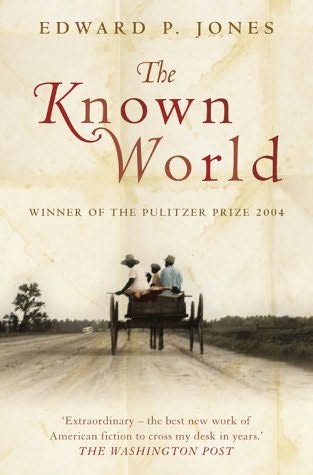
‘The Known World’ by Edward P. Jones

2003,  388p.

This book won the Pulitzer Prize in 2004, but I have only just read it.  In many ways, I’m glad that I’ve read it six years after the hoopla, when the coodabeens and shouldabeens of other competing titles for that year has subsided and the book has to stand on its own two feet.

Edward P. Jones is an African-American writer, and as a recent Washington Post article explains, has written two books of short stories and The Known World is his only full-length novel.  He hasn’t written a word of fiction in four years but he’s obviously a slow worker:  he carried around The Known World in his head for ten years, then wrote it in a three-month rush.  Once I saw this, I recognized what it was that I’d sensed while reading it: that we have been given a self-contained story world, complete and interwoven, unfolded to us by an all-knowing narrator.  It was the voice of this book that really drew me in- it had a formal dignity in its own simplicity, mixed with sadness and wisdom.  It felt like an old, old story.

It is entirely appropriate that the story be written by an African-American writer, and I really don’t know what the effect would have been had it been penned by a white author.   For in this book, based on a footnote to the documented history of slavery in America, the slave-owner, Henry Townsend,  is black and the owner of black slaves.  Henry’s father saved the money to purchase his son’s freedom from William Robbins, the most powerful man in Manchester County, Virginia.  But Henry in turn, purchased his own slaves.  His ‘investment’ (and Jones does not let you forget that slaves are a commodity, with a dollar price) falls under the protective umbrella of the whole slave-owning economy and structure established by white slaveowners, and when Henry dies there is a restless anxiety amongst Henry’s slaves about whether they will be liberated, sold or whether the overseer Moses will emerge as a controlling force.

It is a fact of history that blacks did hold other blacks in slavery. But there are many things in this book that are not, despite appearances, historical fact.  Manchester County itself is an invention; Jones cites studies that do not exist, invents historians and publications, and smudges reality and fiction.  In  what could have been, in cruder hands a “gotcha” white-triumphalist tract,  characters (both white and black) are morally complex and the situation challenges our preconceptions of slave ownership.

The narrative is not easy to follow.  There is a huge array of characters, and the omniscient narrator flings us around chronologically at a dizzying pace.  We are introduced to a character and immediately told that “ninety years later, she will…”.  In a reflection of the powerlessness and contingency of life, appalling things happen abruptly without warning.  But there is no mistaking the author’s horror at slavery and its corrosive effect on all people it touches, and he passes it to us.

I was challenged by this book in its style and in its content.  I know that it has been compared (generally unfavourably) with Toni Morrison’s work, but to me that seems a little unfair and too simplistic.  The book is valuable in its own right and its real power  is in the creation of this bounded, “known” world- Jones’ world- crafted by him alone.

Peter Cochrane and the writing of narrative history

I’d only read about three pages of Peter Cochrane’s Colonial Ambition before I realized that I was reading a very different Australian colonial history than I am accustomed to reading.  Why is this? I wonder.  It’s not that I eschew narrative history: in fact, I seek it out when I’m reading in an area that is not particularly familiar to me, and I enjoy it.  I’ve read quite a few Simon Schama books:  his History of Britain series to support the television documentary, Rough Crossings and Rembrandt’s Eyes.   I loved Orlando Figes’ works on Russia  Natasha’s Dance and A People’s Tragedy ,   or Nathanial Philbrick’s Mayflower.  I’m drawn to biographies ,and especially group biographies which have a strong narrative thread, for example Louis Menard’s The Metaphysical Club or Richard Holmes’ The Age of Wonder.  I enjoy Peter Ackroyd’s border-crossing as, for example, in London: The Biography.   I encountered most of these books through online book clubs that I belong to ( for example Yahoo’s All NonFiction group) and I guess there’s part of my answer:  such groups gravitate towards best-sellers, and best-sellers tend to be narrative histories.

And yet, for Australian history, I tend to steer clear.  I have four Manning Clark volumes on my shelf and am daunted by them.  I have Michael Cathcart’s abridgement but, perversely,  haven’t read it because I feel I would be cheating.  I am wary (perhaps without justification?) of Thomas Keneally’s Commonwealth of Thieves or Australians: Origins to Eureka, even though I’ve enjoyed several of his fictional works set in colonial times.   Alan Atkinson’s The Europeans in Australia is right at the top of the list- particularly because am I grappling with another library patron with holds and recalls over Volume 2 which is nigh on impossible to buy-  but I haven’t started it yet.  I notice that these are all very long works: perhaps narrative history requires length in order to unspool character and chronology?

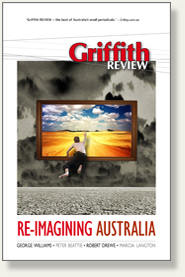
As Peter Cochrane himself explains in his essay Peter Cochrane “Stories from the dustbinGriffith Review, 19, Autumn 2008 (Full text available here), academic historians tend to distance themselves from narrative history, characterizing it as “dumbed down, simple storytelling, the business of amateurs, a trick, sub-history- myth even.” (p. 71).  He cites John Hirst (who contributed a blurb to the back cover) who, in an essay about his own attempt to write an “official history” of Australia for John Howard’s government, described narrative histories as ” a standing temptation to evasion” that avoids big questions. And yet, as Don Watson has noted “history is nothing less than the whole human drama and it is pretty well anything we want it to be” (cited in Griffith Article on p. 71)

Cochrane picks up on the theme of “human drama” and in his essay explains his choice of Wentworth as “leading man”.   And yet, as he explains:

Colonial Ambition is not a biography. It is political history written as narrative.  The story turns like a double helix winding through the book, political history curving into and around the biographical thread of Wentworth and his family, a thread that gets thicker as we go, knitting in other key players in Sydney and London: Henry Parkes, Sir George Gipps, Earl Grey, Robert Lowe, Charles Cowper, Herman Merivale, Lord John Russell at the Colonial Office, and numerous others including the women whose political influence was a much neglected and elusive part of the story (Griffith article p. 74)

I was interested in the way that, structurally, he used the Wentworth character.  The book Colonial Ambitions starts and ends with him.  In the opening pages we have Wentworth in an uncharacteristically humble speech, apologizing to the Legislative Council for his bad language and the “flood of lava” that bubbles up out of him him,   and intimating that he would soon be leaving Australia.  This speech re-appears much later, on p392, and as a reader I experienced that deeply-satisfying ‘aha’ moment when, like a kaleidescope, a pattern falls into place.  The book closes with Wentworth too, but in juxtaposition to the very public opening speech, we end with an intimate family communication between the father and his physically close but unwillingly estranged daughter.  My favourite part of the book- the section that made me think “Gee, he’s doing this well” – was when he reported on political changes taking part in Australia from the distant perspective of Wentworth over in England.  This view with the telescope, instead of the magnifying glass, allowed Cochrane to maintain the metropolitan and colonial perspectives at the same time and enabled him to stride quickly over events that would have bogged him down had he located the narrative back in New South Wales.

From a writer’s perspective, it’s movement in the narrative that is the problem, and Cochrane has obviously worked hard on achieving this:

The emphasis here is on the movement of the story.  How should it- how can it- move? Narrative movement is a bit like tacking on a yacht- the line is constantly shifting while moving forward, zigzagging from one location to another, from one debate to another, from drama here and drama there.” (p. 77)

I enjoyed the shift from location to location, but at times felt a little uncomfortable with the heightened sense of drama that pervaded the book.  In examining the various sides of a debate, Cochrane took pains to describe the motivations and passions lying behind the individuals’ differing stances, but such an approach intimated that titanic political and personal struggles underpinned all such debates.  This fevered atmosphere can become breathless, particularly when sustained over such a long book.  I found myself yearning for the prosaic and everyday, half-hearted politicking just for the sake of it, without such crucial issues at stake.  And after arousing and keeping the reader at such a pitch of expectation for over 500 pages, the denouement, when it comes, is drawn-out and rather disappointing in comparison.

But movement also occurs, Cochrane writes, through the dialogue between historian and historical documents.

The narrative historian has to wrestle with the literary dimension as well as the problem of how the past has been defined, interpreted, ignored or mischaracterized by other historians.  And that engagement has to be immersed or infiltrated into the story without getting in the way of the story.  In narrative it is argument by stealth… Analysis may be unobtrusive but it is, or should be, present at all levels. ..But this does not mean that historiographic concerns are neglected.  On the contrary, they become part of the story only occasionally removed to a footnote- the manuscript that routinely exiles historiographical concerns to the footnotes is likely to be a vacuous and probably a tortured text.” (p. 79, 80)

Cochrane does engage with other historians- in particular John Hirst and Ged Martin- but much of the detailed by-play takes place in the footnotes.  However, in the text itself, as a reader you are aware when Cochrane is planting his feet in the narrative as a historian and taking a stand.  It’s not a combative or dismissive stance,  but you’re aware that you’re reading a historian with his work-apron on.

Historian, and writer too.  There’s some crystalline phrases here: the “dialogue of echoes” in the months-long communication lag between the Colonial Office and New South Wales (Colonial Ambition p.204); his description of Parker’s impotent ministry shuffling on “like a man who could not get out of his slippers” (Colonial Ambition p. 459).

There’s much here that appeals to me: the emphasis on personality; the concept of life trajectory with its own timelines and chronology; the dual focus of empire-wide events and perceptions and the grounding in physical and social locations.  Ah- but he’s been given the luxury of 500 pages: I have 70,000- 100,00 words.  He has Melbourne University Press: I have a couple of thesis examiners.  Sigh.