Category Archives: Book reviews

‘Sea of Poppies’ by Amitav Ghosh

2008,  468 p.

This book is part of a projected trilogy and it was shortlisted for the Booker Prize in 2008.  It did not win, and perhaps it’s a work best appreciated once the other volumes appear.  There are hints throughout the book that there is an endpoint in sight for the author, even if we don’t as yet know how we’re going to get there.  The author foreshadows that people and events will one day be represented in a shrine, but we don’t know where this shrine will be, or when it will be created.

The story line unspools slowly, almost as if the plot itself is caught in a sticky opium haze.  Within the 468 pages we have the arrival of a boat, its provisioning and slow movement down the river towards the open sea, then its journey to Mauritius, and the story closes before landfall is made.  The impetus of the book is the gathering together of the cast of main characters- a widow who escapes suttee, a bankrupt rajah,  a mulatto American sailor, a French woman under the care of a wealthy English opium-trader- and the chain of circumstance that brings them to this boat.  It was in this slow accumulation of characters that I was most aware of the trilogy-nature of the book- not unlike Lord of the Rings perhaps, although I hope that the  book doesn’t take as long to divest itself of all these characters as that particular trilogy did!  In less assured and more impatient hands, this would have been rushed but in this book I found myself introduced to each character and drawn into his or her story before moving onto the next one.  Each character was clearly established in my mind, so that it was a case of merely picking up interest when I met them again, rather than having to flip back to see “Now, who’s this again?”. There is no cast of characters, and to Ghosh’s credit, I didn’t feel that I needed one.

Beyond the literary level, the book is an explication of British colonialism and the networks between different ports of Empire across the globe.  Set specifically in time- March 1838- the book captures well the interconnectedness of British colonialism.  The Indians provide the opium that is forced onto the Chinese in order to prevent a currency imbalance in return for Chinese goods.  Slave ships are reconfigured to ship indentured Indian labour to Mauritius to exploit the sugar industry which in turn is fed into the colonial economy.  We have characters who straddle cultures:  the French Paulette drawn into the British colonial family despite her upbringing by an Indian foster-mother, and Zachary Reid, the son of an American slave mother and white father.

The language of the novel draws on a pidgin-English, a “jolly hockey-sticks” bombast amongst the English characters and Indian vernacular.  Ghosh makes no concessions here.  The dialects are part of the text, with no glossary, no semantic crutches, and as a reader you just have to deal with them and move on (dare I say “Move Forward”?).  And move on I did, and I look forward to reading the next installment.

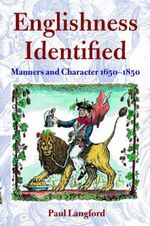
‘Englishness Identified: Manners and Character 1650-1850’ by Paul Langford

2000,  320p & notes

It seems that much ink has been spilled in Australia trying to define Australianness, and I had always assumed that this was a form of nationalistic adolescence that we would eventually outgrow.  Just as it’s hard to imagine your own parents as teenagers, it hadn’t occurred to me that the Mother Country herself might have undergone the same soul-searching.  But clearly the debate over Britishness and Englishness is a lively one. I’m aware of, but to my embarrassment have not read Linda Colley’s Britons, even though it sits on the shelf waiting to be read. However this book distances itself from the endeavour of explaining the distinction between Britishness and Englishness, and does not enter into the debate over the process by which the two concepts were developed.  Instead, Langford looks at “the things identified rather than the process of identification” (p. 2)  In particular he focuses on manners and character.

Langford argues that until about 1650, the English were viewed as Europe’s mavericks- capable occasionally of spasmodic splendour, but also prone to bouts of violence, turbulence and instability.  If pressed to nominate the point at which there was acceptance of the possibility of English pre-eminence, it probably came somewhere around the 1760s.   From the eighteenth-century on, there was increasing interest in England and its people from Continental travellers and an period of outright Anglo-mania, particularly on the part of the French, between the 1730s and 1780.  Langford draws on the travel writings of these visitors as his primary sources, much of which was written with the droll superciliousness not unknown to travel documentaries today.

He has divided his book into six main chapters: Energy, Candour, Decency, Taciturnity, Reserve and Eccentricity and these in turn are divided into subsections likewise headed by nouns- barbarity, domesticity, clubbability etc.  At times the distinctions are not clear-cut.  For example, the coverage of Liberty  under “Eccentricity” is not intuitive;  or the inclusion of Conversation, Oratory and Clubbability under “Taciturnity” undercuts the chapter heading somewhat. But as he says, “feelings are hard to distinguish from thoughts” (p.251), and hard to distinguish from actions as well.  They’re slippery things, feelings, and don’t always fit neatly under a heading.

The chapter structure of the book reflects the emphasis on affective concepts, as suggested by the title.  There is an underlying chronological thread to the argument as well, though, and it is not served well by the overarching structure.  He argues, as did Marjorie Morgan, that the Evangelicalism of the late 18th century gave rise to new ideals of behaviour, and he begins his two-century examination of the change in Englishness from the middle of the 17th century.  He notes that there is an evolution over time, but he does not give the chronological factor much prominence.  This a-chronological (if there is any such word) approach is underscored by the formatting of his  footnoting, where a primary source is dated on its first appearance, but not in subsequent citations.  Because there is no bibliography, it is nigh on impossible to locate a reference amongst his detailed footnotes to ascertain whether it is an observation made in the late seventeenth or mid-nineteenth century.  The footnoting format could well have been imposed by the publishers- although it would be a pity to learn that a University publisher was stepping back from academic conventions in this way- but it does not serve the book well.

Although not engaging at a theoretical level with the Britishness/Englishness identity debate, the foreign travellers that Langford cites can clearly differentiate between the English, Scots, Irish and Welsh in their observations.  Because he is drawing on such a large dragnet of observations, there are often inconsistencies between them, especially when closely related traits are discussed in separate sections of the book.  However this did not detract from his argument: instead it served to underline that character is just as much in the eye of the beholder as in the image that the subject wants to project, and just how complex, baffling and nuanced a ‘national character’ can be once you try to move beyond the stereotype.

‘Manners, Morals and Class in England, 1774-1858’ by Marjorie Morgan

1994,  148p.  & notes.

This is not a book about events or facts, but instead it is about ideals.  Ideals, suggests the author, reveal as much or more about a society as reality does. The ideals she is exploring are those found in three different genres of improving literature published from the late eighteenth century to the mid nineteenth century.

The first genre is the courtesy book, a literary type written primarily by and for men.  Courtesy books often took the form of an informal, practical guide written by an older man, based on his personal experience, for a younger man.  Some focussed on the arts of worldly success, others on civility and deportment, but underlying them all was the assumption that manners and morals were inseparable and indistinguishable.

The second genre is the conduct book, which became more popular under the influence of Evangelicalism in the mid-late 18th century.  The underlying principle was that religion- not fashion, or custom, nor taste- was the basis of both manners and morals.  The writers were middle class and many addressed female audiences.

Finally there were etiquette books, which emerged in the 1830s, even though etiquette itself had been around for much longer than that.  They did not so much create behavioural rules in the 1830s, as codify those that had been in existence for the previous 50 years. They were practical digests of rules and information to avoid vulgar behaviour, and unlike the Conduct Books, they were largely indifferent to one’s internal nature and character, moral paradigms or the spiritual domain.  Instead, the focus was on outward visible indicators and display.

She suggests that the etiquette book arose during the 1830s as  the upwardly mobile middle class became wealthier and the boundaries were blurred with the aristocracy.  However, she is at pains to point out that both the middle class and the aristocracy, in and among themselves, expressed conflicting values.  The middle class may have been industrial, but it also embraced an antithetical ethic that denigrated competition; the aristocracy combined elements of disinterestedness with aggressive competition.  Depending on the values under discussion, relations between the middle class and aristocracy could conflict with, or accommodate each other.

She has examined a huge range of texts across these three genres- her bibliography for these primary sources stretches to eight pages.   The whole enterprise of proscription and prescription of morals and manners was steeped in paradox.  The standards for fashionable behaviour were spelled out to facilitate social advancement, but at the same time, they kept changing so as to keep people out.   The evangelical moralists exhorted people of sound moral character to appear as they really were, but at the same time they were to avoid offending others and be reserved and modest and above all, sincere- even if they weren’t really.

However, she noted a change in the early 1840s, when etiquette books began to incorporate elements, albeit superficially at first, of principles of morality and ethics while continuing their emphasis on manners and decorum.  This trend manifested itself in the rise of professionalism whereby aristocratic and middle-class ideals were merged into legally sanctioned professional behavioural codes and credentials, firmly ground in etiquette and ethics, in a range of fields- the church, law, medicine, government and armed services.  It was an accommodation on the part of both the aristocracy and the middle class and both groups felt that they could embrace professional goals without feeling they had compromised their values.

Written in 1994, this book travels in the wake of Davidoff and Hall’s Family Fortunes which was first published in 1987.  Its argument is largely consistent with Davidoff and Hall, but it delves into the realm of ideals and expectations, rather than actual lives that figure so strongly in Davidoff and Hall’s book.  The earlier book took the middle class, and particularly women, as its focus, but Morgan’s book looks at the accommodation between both the aristocracy and the middle class, both in expectation of behaviour in the home and in the professions more widely.

This book interested me in relation to Judge Willis because I am examining his career from the 1820s to 1840s- precisely the time that these changes were occurring.   Our perception of  the early Victorian sensibility tends to be swamped by the depictions of behaviour and expectations so vividly drawn by the mid-Victorian novelists- our Dickens and Trollopes.  The settler colonial condition, both in Upper Canada and New South Wales, added more tension to already brittle upward mobility.   The Port Phillip newspapers carried in their columns the reports of fashions and observations about behaviour taken from metropolitan newspapers, and although these new societies brought together strangers into new constellations, you have the sense that, among those who aspired to colonial gentry at least, everyone was watching everyone else very closely.  There was a mental template for how one ought to behave, and this book provides one way of investigating this ideal- no matter how imperfectly it was met.

‘Aspects of Aristocracy’ by David Cannadine

1994, 245p

This book is a series of essays that Cannadine wrote during the process of writing his Decline and Fall of the British Aristocracy.  Having not read that book, I can only assume that the essays reflect aspects of the larger work, but in themselves they are self-contained and immensely readable.

Cannadine argues that, despite the assertion by the aristocracy itself of its unchanging nature and antiquity, the aristocracy was in fact transformed in the late eighteenth century. Because of a largely unexplained demographic crisis among English noble families at that time, estates were integrated and consolidated into supra-national empires, spanning England, Wales, Ireland and Scotland, thus leading to a new apex of super-rich grandees.  These were supplemented by self-made merchants, nabobs and industrialists who bought their way in, then established themselves as bona-fide landlords.  Public servants, too, fitted themselves out with the accoutrements of landed aristocracy.  That bible of gentility, Burkes Peerage, published in 1826  documented this new/old phenomenon, a hold that they maintained by making, in reality, very few concessions.

He picks up on the debate between David Spring and F.M.L. Thompson over aristocratic indebtedness, and especially the received Spring-ian view that the Regency families were spendthrifts, while their mid-Victorian sons moved towards sobriety and solvency in the mid 1800s. Cannadine finds that debt seemed to be an ongoing reality, though its arena changed- e.g. development of money markets with local attorneys and solicitors, banks, insurance companies etc.  There was borrowing to maintain and enhance family prestige e.g. to provide settlements for members of the family, to build houses and buy land, but there was also borrowing for profit e.g. improvement of land and investment in non-agricultural enterprises- especially coal mining and transport.  He concludes, therefore, that the distinction between early and mid-Victorian debt was overdrawn, and that if there is a pivotal period, rather than the 1840s  it is 1870-1880 when declining rentals and agricultural prices led to greater indebtedness.  When death duties were introduced in 1894, they were 10% of the property assessed higher than 1 million pounds- ruinous if a property was heavily encumbered.

Cannadine points out that

while biographers are conscious of the things that make their subjects unique, historians are more concerned with seeing individuals in the context of their times and class (p.3)

The rest of the book deals with different dynastic and individual portraits that illustrate his central thesis.  Lord Curzon is depicted as a “ceremonial impressario” whose stage-craft embodied and shaped the image and consciousness of empire. Winston Churchill he sees as inherently unrespectable in both his relatives and choice of friends: he was politically suspect and unpredictable, and essentially paternalistic and anti-democratic.  The Cozens-Hardy family of Norfolk exemplify the ‘new’ upper class, spreading across trade, the law, local paternalist government and local/antiquarian history.  Nicholson/Sackville-West are addressed less as sexual and literary oddities than as exemplars of the snobbish, anachronistic, sheltered and nostalgic twentieth-century upper class.

To prove, eventually, that he has a political purpose, Cannadine closes with a condemnation of country-house worship that embalms what their owners themselves were happy to demolish, and transforms country houses into shrines to private galleries, a risible moral superiority and an unconscionable claim on public money.

Enough of snobbery and nostalgia.  Good riddance to ignorant and sentimental deference. It is time we got beyond the country house (p.245)

That’s telling ’em.

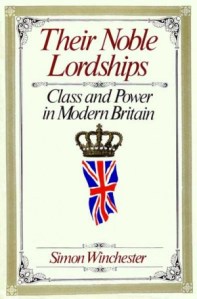
‘Their Noble Lordships’ by Simon Winchester

1981, 305 p.

I am of an age and political bent that makes me fairly dismissive of aristocracy and I bridle at deference demanded on the basis of birth or wealth alone.  On the other hand, I must admit a sneaking fascination, tinged with horrified incredulity, at lifestyles and attitudes that seem so foreign to me and yet part of the cultural baggage that comes from growing up in a Commonwealth country.  Since I have started my thesis, I have often been frustrated by the impermanence of the titles by which a person was known:  Viscounts turn into Earls, not just Viscount Bill to Earl Bill but Viscount Bill to Earl Ben.  Meanwhile family names (surnames to the rest of us) coexist with titles, so that one person can move through an array of names and titles within one lifetime. Conversely one title can, within a few decades, be held by several people.

This is one of Simon Winchester’s early works, published in 1981 but actually written in 1976 when he was still a journalist and travel writer.  The hiatus between manuscript and publication is interesting: the book was held up because of threats of legal action against the author by some of the peers he interviewed.   It finally emerged, it would seem, with the legal assistance of the “redoubtable scholar of Scots peerage lore”, the splendidly named Sir Iain Moncrieffe of that Ilk (yes, that’s his whole name), whom Winchester thanks in his preface.  He also thanks Hugh Mongomery-Massingberd of Burke’s Peerage as well, but he did not return the favour.  In a review of the revised and finally released book  in the Times, 28 Jan 1982, Mongomery-Massingberd responded to Winchester, “a drippingly wet liberal” by writing:

Apart from the cuts imposed by the lawyers, one wonders how much real revision has been undertaken by the author; the book is frequently out of date.  The learned Sir Iain Moncreiffe of that Ilk has clearly had a hand in the overhaul; many of the pithy footnotes can be confidently attributed to this colourful scholar…To be fair to Mr Winchester this second attempt is an improvement on his first- as far as I can recall the “suppressed” version contained about one mistake a page, this time the average is nearer one to every two-and-a-half pages.  As he has regaled us with so many meaningless statistics I offer these by way of exchange: from a total of some 259 pages of actual text (as opposed to absurd maps, corny or pointless epigraphs etc) I counted very nearly 100 errors ranging from really whopping howlers to mere misspellings of names. This is surely unacceptable for any book with even half a claim to be taken seriously.

While I certainly didn’t take the umbrage that Hugh Mongomery-Massingberd (where DID that ‘t’ in Montgomery go?), I do agree with the dated feel to the book, but probably not for the same reasons.  I raised an eyebrow at the designation of the Labour party as the “Socialist Party” complete with capital S.    What about Thatcher? What about Lady Di? I asked.  But, on closer investigation, I have become muddled over dates and chronology.  He does mention Prime Minister Margaret Thatcher, but she had not, when he wrote the book, yet created the last three hereditary peers (Viscount Whitelaw (Wille Whitelaw) created in 1990, Viscount Tonypandy (Thomas- a Labour Party politician)created  in 1983 and the Earl of Stockton(Harold Macmillan)  in 1984).  Lady Diana Spencer, whose royal descent brought the peerage into full view only became engaged and married to Prince Charles in 1981.  So it was not so much that Winchester’s work was dated, as that these events had not yet occurred.

Winchester goes through the five ranks of the peerage, from highest to lowest.  For this, I am grateful.  I have now devised my own mnemonic, using the names of my children, to keep them straight in my own mind: Dean and Martine Eat Victoria Bitter.  (Duke, Marquis, Earl, Viscount Baron).  Yes, I know that it doesn’t make sense.  Yes, I know I could have them “enjoying” Victoria Bitter, or eating “Vita Brits”.  I like it the way it is:  it works for me, and that’s all that matters.

Dukes are the highest, and at the time of writing this book there were only twenty-five surviving, not including the three Dukes of the Blood Royal or the Duke of Edinburgh.  Fewer than 500 men have been Dukes in the last six and a half centuries they have existed.  They are called “Your Grace”, not “My Lord”, and the monarch calls them “Our right trusty and right entirely beloved cousin”.

Then come the Marquesses, which has always struck me as a rather effeminate name.  Its origin is the Latin marchio, referring to the Continental counts who guarded the “marches”, the borders with neighbouring countries.  Apparently it’s not a particularly well-received honour, and often the Earls who follow them in precedence are wealthier. There were thirty-seven when the book was written, with the last created in 1936.  Many Viceroys of India were awarded the honour.

The Earls are the backbone of the British peerage system, with Lord Lucan one of the more notorious twentieth century ones.  At the time of writing there were 173 non-Irish Earls and Countesses dotted around the country. They are often of Old English or Scots county stock, distinguished heroes, or ex-Prime Ministers.

They are followed by the Viscounts- 110 of them in 1981.  They are a recently revived rank, with more than a hundred created in the twentieth century.  Here there can be detected the rewards for mercantilism, with the captains of industry often being awarded the title.  Few are landowners to any great degree,  but they do not lack money.

The Barons are the broad base of the pyramid, with 438 men and women in 1981.  Hereditary barons are no longer created : since 1958 with the Life Peerages Act, they are now life peers.   The bulk of the baronage is of twentieth-century origin, with many war heroes being awarded the honour after WWII, and industrial figures, civil servants, judges, politicians, scientists, writers and artists being recognized  with the title.

The Irish Peers,  left out in the cold, are awarded their own chapter.

The book has a chatty, journalistic tone as the author travels around the countryside, conducting interviews with various worthies.  There are direct quotes, and quite a bit of paraphrasing but it is reported without much rigour in a strictly historical sense.  There is a reading list, organized alphabetically by title (rather than author), and although David Cannadine is quoted as the one academic text, the title of his work is not included in the reference list.  Each chapter begins with a map, showing the distribution of the title under discussion, but I found my lack of knowledge of British geography rather limiting here- a label or two wouldn’t have gone astray.

Near the end of the book he tries, without success, to establish the land holdings of the nobility. Interestingly enough, it was a very difficult endeavour with few firm official figures available- intentionally so.  It is obviously a question that powerful people did not want answered, at least in the 1980s.  His conclusion?

On Spaceship Earth, ennoblement by reason of fortuitous birth has no place: the British nobility, decent a body of men and women as well they may be, have outlived their usefulness, and must go quietly, out by the back door. (p. 305)

And it seems, by the House of Lords Act of 1999, that certainly things have changed since the book was written, and no doubt will change even further.

This book is not academic and seems to have sunk without a trace- Simon Winchester’s own webpage certainly underplays it.  I think that perhaps it was a book of its time, written largely for a home audience, and surpassed by his later work.

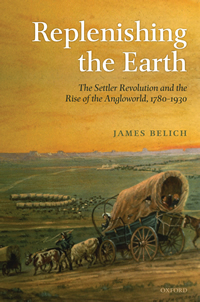
‘Replenishing the Earth’ by James Belich

Replenishing the Earth: The Settler Revolution and the Rise of the Anglo-World 1783-1939, Oxford University Press.

2009, 579 p.

Melbourne, formerly Port Phillip, is mentioned right from the opening words of this book.

Let us begin with two problems in urban history, exemplified by two pairs of cities:  Chicago and Melbourne and London and New York. (p.1)

Why did Chicago and Melbourne undergo such explosive growth, and why in 1890 were London and New York the only two mega-cities in the world?  And why are these four cities English-speaking? Given that there were other empires and cultures- the Portuguese, French, Dutch, Chinese, Russian- that could have rivalled or even exceeded the British empire, why didn’t they?

Replenishing the Earth is a big book that asks big questions and gives big answers.  Big ideas demand mental dexterity of readers, and Belich asks us to do some geographical somersaults as well.  He speaks not of  the “British Empire” as such, but of the Anglo-world, composed of two parallel, twinned structures (I wish I could show you the diagram- see Note 1 below)

To visualize this two-pair Anglo-world, imagine a malleable map like those used to illustrate pre-historical continental drift.  Place your thumbs above Florida, and your forefingers firmly in the Great Lakes.  Prise the United States apart along the line of the Appalachians, splitting it into Atlantic East, roughly the original thirteen colonies, and the vast American West.  The East, in our period, was an emigrant society as well as an immigrant society.  It was one of the world’s greatest sources of long-range migration and investment.  It was the American ‘old-land’, a metropolis equivalent to Britain.  Now gather up Australia, New Zealand, and with some hesitation, South Africa and place them in the Central Atlantic.  With Canada, the Dominions make up a water-linked ‘British West’. This West and old Britain combined to comprise ‘Greater Britain’, the white, un-coerced part of the British Empire, the British flank of the Anglo-world.  Here we have two metropolises or ‘oldlands’, the British Isles and the US East, and two Wests or constellations of ‘newlands’, land-joined in the American case and sea-joined in the British. p. 70

These two parallel ‘oldlands’  (i.e. Britain and Eastern America)  spawned what he calls a ‘settler revolution’ as people, technology and communications flooded into the ‘newlands’ (i.e what became the Dominions and Western America).  This might be thought of simply as good old-fashioned colonization but he separates out four phases that have their own rhythm:

  1. incremental colonization- the slow development of small settlements along trade routes and waterways, looking seaward with their interiors viewed as wild back-country
  2. explosive colonization.  This occurred from 1815 onwards with the mass transfer of technology, money, information, skills and people.  The settlers demanded oldland support, often on their own terms, and the whole scenario usually ended with a bang
  3. re-colonization.  Once things went pear-shaped, settlers cast about for an export that fed into oldland demand that would rescue their local economy- sheep, tallow, timber etc.  In this regard, “[t]he Anglo-world was built like a coral reef on layer after layer of fiscal corpses” (p. 206)  But this was not necessarily exploitative, but a matter of mutual dependency. By integrating themselves into the oldland economy, they saw themselves as part of ‘Greater Britain’ or ‘Greater America’, and “virtually metropolitan co-owners rather than subjects…” p. 180
  4. decolonization. This works only for the British scenario, but it marked the emergence of real as distinct from nominal Dominion independence.

His book focusses mainly on explosive colonization and re-colonization and he argues that the boom-bust waves run as an undercurrent through the histories of the newlands and their relationship with the oldlands.   He suggests that being aware of these rhythms is akin to being attuned to the seasons when describing agriculture- something that I had sensed myself in my own work with Judge Willis in Port Phillip during a time of financial bust, reflected in my several postings on this blog on the Twelve Apostles.

This book invites those who study settler pasts to add another colour to their palette. A booming settler society was very different from the same society in busts, or under re-colonization.  The mood was different, the atmosphere was different, the popular culture was different.  Social structure, crime levels, labour relationships, and gender relations in an explosive colonial society all differ significantly from those in a re-colonial one. (p. 548)

This book draws heavily on economic history: you only have to look at the secondary sources he has used to see that.   This is not the type of history with which I am particularly comfortable, but he adds to the ‘rational choice’ explanation of human economic activity another less measurable influence.   Immigrants, or their immediate forebears, had often shifted internally within Europe in preceding decades, and they were not moving as strangers into another people’s society, but were instead part of the cloning process whereby Anglophone language, institutions, credit and finance systems, plays, books, newspapers, fashions were transplanted into newland territories.  There were always the ‘boosters’ in these newland communities who spruiked the climate, the riches for the taking and the opportunities for settlers- and even the terminology that came to be used for the newcomers is important here-  but the mass transfer of people happened because of what happened in people’s heads when they weighed the possibilities of migration.  This, too, is an approach to history that I feel comfortable with.

His book focusses on the Anglo-phone world, but he makes -rather unclearly-  a distinction between Anglo-phone and Anglo-prone.  Quite apart from the linguistic punnery here, he is at pains to point out that many of the features he identifies are not exclusive to English-speaking peoples, but that they were more likely to display them than, say, French or Spanish societies. His book also encompasses Brazil, Argentina, Siberia, Algeria and Manchuria as alternative scenarios.

There are big ideas in this book, and I can’t do justice to them.  In fact, in a blogpost of this length I can’t even give Belich’s answer  to the questions he posed in his opening sentence above.  I am in awe of the breadth of reading that the author has undertaken and the sheer size of the explanation he offers.  I could not write this sort of history- I admire those who can- but I don’t know if I would necessarily want to, even if I could.  I found myself sitting up a little straighter once people and voices were brought into the spotlight, and I think that reflects my own historical leanings.

Note

You can see the map if you go to the Googlebooks page and search for “The Two-Pair ‘Anglo-World'”. This will take you to Page 70, from which you can go back one page to p.69 where the map is shown.

Other reviews of this book:

The Independent 3 July 2009

The Times Higher Education 27 August 2009

Andrew Smith’s blog (which is where I read of the book, then made the connection with the Keynote speaker at the recent AHA conference- that’s Australian Historical Association, by the way)

‘The Lion, the Eagle and Upper Canada’ by Jane Errington

The Lion, the Eagle and Upper Canada: A Developing Colonial Ideology

1987, 192 p & notes.

This book, developed from the author’s Ph D thesis of a similar title, won the Corey Prize for 1988.  So far I can still count the number of books I have read on Upper Canada on my fingers, but even I was aware while reading it that I was tiptoeing across what we would characterize in Australia as a “history war”.  Has Canada had its own history wars? I suspect, from this article, that it has.  No doubt I shall soon become more familiar with all this.

In her introduction Errington identifies the characterization of Canadian history that she is arguing against- i.e. that hardy British-American settlers fled the destructive influence of American democracy and republicanism and established a new, counter-revolutionary British society in Northern America that “rejected all things American while embracing 18th century British conservative values and traditions” (p. 4).

Instead, she argues, there were ongoing personal and intellectual links between settlers who had crossed to Canada, and the families and friends they left behind in America.  The major communications links with England passed through America; people crossed the border both ways, and there was a strong interest in federalist politics particularly as it played out in the nearby American state of New York.  She argues that rather than a horizontal line drawn between Canada and America, there was a cross-border sympathy between the Canadian reformers and their ideological brethren, the American federalists.  The settlers who crossed into Canada were not British themselves: they had been born in America and the vast majority of them never set foot in England.  She argues that Upper Canadian society was shaped by the dual influences of Great Britain and America, and that the political  controversies of the 1820s and 1830s had at their heart differing perceptions of the British constitution and parliamentary traditions- whether the principles, or the image,  of the British constitution should apply there.  There are resonances here with the same issue for Australian judges and governors at the same time:  the relevance of what we would now sneer as “one size fits all” law and policy.

Errington flags right from the beginning that she is taking a view from the top, restricting her analysis to the articulate elite:

This study is an attempt to understand what some Upper Canadians, those few individuals who were recognized as leaders of their communities, actually believed about themselves and about others, particularly the United States and Great Britain, and how their views of themselves intersected and depended upon their views of others and changed over time. (p.10)

She draws heavily on newspaper articles and the personal correspondence of a number of key individuals, particularly Richard Cartwright, John Strachan and  Stephen Miles whose perspectives appear throughout the book.  Perhaps it is because this area is new to me, but I found myself wishing that she had fleshed out these characters a little more, given that they were to be the chorus of voices heard throughout- perhaps in the way that Inga Clendinnen did in Dancing with Strangers, so that each time you encountered them again, it was like meeting an old friend.

I gather from some of the reviews I have read of this book, that it was felt that, by concentrating on the views of the elite,  she overlooked other arguments in making her own.  That didn’t worry me at all- it is the views of the elite that I need for my own purposes.   She does address the issue of her close focus in the introduction, but perhaps it was a methodological choice that she needed to prosecute more insistently.

I’ve already spoken of my interest in the way she integrated quotations into her analysis,  and I certainly felt as if I was reading a viewpoint, formed and promulgated over time by living, inconsistent, evolving people rather than a political stance delivered ready-made.  I like the way that she emphasizes the evolving and contingent nature of political ideas, the effect of generational change on political protest, and the way that British and trans-colonial ideas, events and politics played out at a local level.

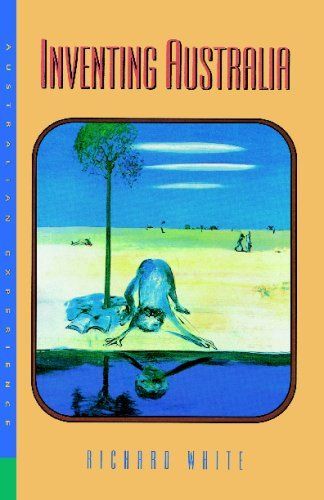
‘Inventing Australia’ by Richard White

1981, 171 p & notes

Inventing Australia is one of those books that appears in many, many bibliographies but I hadn’t read it until now.  The grammar of the title is important- Inventing Australia- because his argument is that the search for a distinctively Australian identity is an ongoing and never-ending one. It’s not like Benedict Anderson’s Imagined Communities where the tense of the title suggests that the concept of community identity has been developed and reified. 

In the introduction, White argues that

When we look at ideas about national identity, we need to ask, not whether they are true or false, but what their function is, whose creation they are, and whose interests they serve (p viii)

This seems unremarkable enough, as does much of his argument in the book because it has infiltrated our understanding of the creation of national identity so thoroughly that it is no longer particularly discernable as White’s argument alone.  I had to remind myself that the book was written in 1981 and although there have been several reprints and White has written other works, this particular book itself remains in the original edition and has not been updated.

The language that runs through the book speaks of classes, intelligentsia and bourgeoisie, which places it firmly within a 1970s/80s historiography.  It traces through the different images of  “Australia” that have been projected by different groups over time- early explorers like Dampier and Cook; Enlightenment philosophers, Social Darwinists, the critics and promoters of transporation, and the critics and promoters of immigration.  Sometimes the image of Australia was consciously crafted by a small group of the intelligentsia, as with the bohemians from the 1890s onwards,  who used their “brand” as a form of artistic protectionism for the local cultural industry. At other times images have been co-opted by conservative forces, as with the returning soldiers after WWI.  Much of this argument builds on, and has been taken further by other historians writing on these topics at much the same time.  I think that John Hirst’s Convict Society and its Enemies, written in 1983, is a more nuanced argument than the one that is presented here;  Graeme Davison had already noted the urban origins of what we think of as “bush” poets and artists in 1978 and Ken Inglis and Geoffrey Serle had already discussed the creation and co-option of the Anzac legend. It’s impossible to tease out, after thirty years, the genealogy of many of these arguments, and to work out what was completely new in White’s book and what has been built on further and incorporated into the work of other historians who followed him. 

However, what does emerge clearly is his insistence that many of the influences that fed into different depictions of Australian identity were Empire-wide and not Australian at all.  For example, he speaks of the approval given to the “bushman soldiers” in the colonial troops as a whole during WWI-  not just the ANZACS.  There  was an Empire-wide expectation of the Coming Man, exemplified by empire-wide  publications  called”Young Australia” and “Young Canada” that were part of a series that was customized for each country. He underscores the importance of “whiteness” in the conceptualisation of the Coming Man, again part of a wider movement.

He notes the shift from the search for a “national type” with its uneasy fascist over-tones to a promotion of “The Australian Way of Life”, just as vague and useful as an exclusionary device in post-war Australia as it is today.   Again, he emphasizes that this part of a more general Western trend, and one that was literally more conservative (in terms of keeping what we already have) and less likely to be co-opted by radicals.

The book finishes with the 1970s youth culture, dissatisfaction over Vietnam, New Left intellectuals, the women’s movement and multiculturalism.  Reading the book thirty years on, the ending seemed rather abrupt and many other later developments flood to mind – tourism,  changes in multiculturalism and immigration patterns, new media, the History Wars- the list goes on and on.  How would these events challenge or alter his hypothesis? I wonder.

Nonetheless, I’m pleased that he has resisted the temptation to keep adding new chapters to the book.  The full title of the book is Inventing Australia: Images and Identity 1688-1980.  Its chosen time frame  takes it right up to what were then current events for a book published in 1981. The argument is made for the time span he chose, and to keep updating it would lessen its force as a historical argument which makes sense within its own chronological parameters.

‘Cosmo Cosmolino’ by Helen Garner

1992, 221 p.

Helen Garner is thirteen years older than I am, and I feel as if I have been walking in her footsteps all my life.  Not following her lifestyle, mind you, but watching her with curiosity, as a life that I might have led had I been a little older and more confident. I felt as if I knew Dexter and Athena in The Children’s Bach– in fact, I’m sure I know where their house is!  When I was an undergraduate, still living at home with Mum and Dad, I’m sure that my fellow students were living a far more exciting Monkey Grip life than I was. Like Garner, I felt troubled by the challenge to feminism in The First Stone, and repelled and yet fascinated by Anu Singh in Joe Cinque’s Consolation.  Now that I’m growing older and facing the deaths of parents and friends, I see myself in The Spare Room.  But with Cosmo Cosmolino, published  in 1992 when Garner was fifty, my sense of identification breaks down.

The book contains three stories, tangentially linked.  Cosmo Cosmolino is the longest of the three, and although they are different characters, the lifestyle of its protagonists almost picks up, twenty years on from where the lifestyles of the people of  Monkey Grip left off.  The anarchic share-houses of the 70s are now just shells, containing wary, embittered middle-aged people, somewhat discomfited by the capitalist mores they found themselves adopting almost in spite of themselves, and younger drifters in a world of marginal working lives that is less tolerant of the artistic temperament than the 70s were.  These are people whose family relationships are just single strings rather than a densely woven fabric; there is a bleak loneliness about their situation and their outlook.  They are trying to find some meaning in their days, either through trying to recreate an idealized past of share-houses now gone, or through a fervid evangelical Christianity or a loopy new-age spirituality.

I’m not sure if my discomfort with this mushy angel-think is a reflection of my own cynicism, or whether it is because the book is nearly twenty years old.  Perhaps in the early 1990s, belief in angels was not so twee and flaky- after all, didn’t they market those bumper stickers “Magic Happens” back then? When were healing crystals and all that other dusty paraphernalia around?  There’s something pathetic about this book, and I suspect that it was not intended to be so.  I think that Garner is genuinely working through issues of spirituality and meaning.  It’s just not a quest that I find particularly compelling.

‘Bright Planet’ by Peter Mews

2005, 295 p.

I was browsing around my local library the other night and caught sight of “Bright Planet” and smiled.  I read it several years ago and loved it, and given that some of you may have been lured here by a search related to early Port Phillip, you might love it too.

I’m a difficult customer as far as historical fiction is concerned.  I feel smothered by too much research if  it means that the story is battling to escape, but on the other hand I am annoyed by small inaccuracies and a basic inauthenticity when twenty-first century ideas are put into nineteenth-century heads.  I first heard of this book during the brouhaha between Kate Grenville and Inga Clendinnen over Grenville’s book The Secret River, where it was held up as an example of a novelist using history well.

Bright Planet is the name of a ship- and it really is, too!  After reading this book, each time I came across Bright Planet in the shipping news column in Port Phillip newspapers, I’d have a little smile to myself.  It sails into Bareheep (one of the early names suggested for Melbourne, and strongly recognizable as Robyn Annear’s Bearbrass)  and the small town forms the backdrop for a succession of walk-on Port Phillip characters, Johnny Fawkner,  John Batman complete with his diseased nose and Mr Le Soeuf the Aboriginal protector.   There’s a slew of fictional characters as well, who could just be true, including Quiet Giles the botantist, who sails up what seems like the Yarra on a fictional expedition.  In best Voss-meets- Monty-Python tradition, there are a string of deaths through a whole range of misadventure, and it’s an irreverent romp through a young, bawdy town on the edge of the unknown.  It’s not true and it plays with the historical fiction genre.  It’s very carefully researched and, in its way is a critique of colonialism and imperial masculinity.  But don’t let that put you off: dammit-  it’s just downright good fun.

If I’ve piqued your interest, there’s a transcript of an interview with the author from the ABC’s Book Talk program.