Category Archives: Book reviews

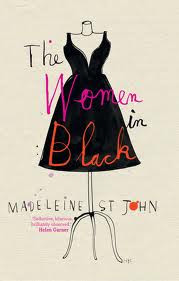
‘The Women in Black’ by Madeleine St John

1993,  228 p.

(4/5)

The further I get from the right side of fifty years of age, the more I am drawn to writers who don’t get published until they themselves are over fifty. What in my younger days I may have perceived as to be rather pathetic (the idea of someone scribbling away secretly for years, the mounting rejection slips, or life just slipping away with ambitions unfulfilled) I now see as an affirmation of the strength of maturity, a victory for persistence and dedication, the triumph of character and a validation of life experience!  Methinks I do protest too much.

Madeleine St John’s first book The Women in Black was written in 1993 when she was fifty-two years old.  She’d been working odd jobs in bookshops in London for years and, convinced that she could do as well as the authors of the books she was selling, she wrote this book and three succeeding books, one of which was shortlisted for the Booker Prize.  From the preface ‘Madeleine and Me’ written by Bruce Beresford and the obituary at the end by Christopher Potter, she seems to be a rather reclusive expatriate who lived her life in London, seeking various kinds of spirituality and with rather brittle friendships and little contact with her family back in Sydney.  She was an undergraduate at Sydney University in the early 1960s, alongside Clive James, Germaine Greer, Robert Hughes, John Bell and Bruce Beresford: were university students more brilliant then in the rarified air of fees and Commonwealth Scholarships, or arriving early on the cultural scene,  have they just promoted themselves better?

The Women in Black relates a sliver in the life of the main character, Lesley who has adopted the name Lisa instead, who is I suspect rather biographical. Lisa has taken a job in the Ladies Cocktail Dress department of F.G. Goode in Sydney- a thinly disguised David Jones.  I say ‘a sliver’ because Lisa is  in that hiatus between completing her Leaving Certificate results and finding out whether she has been accepted for University.  She is the young casual, working alongside older permanent women as one of the “women in black”, changing from their street clothes into the black uniform of F. G. Goode before starting work. She just works the one Christmas/New Year period, then she moves on.

The narrative shifts in successive small chapters (often only 2 pages in length) between the lives of the women who work in the department store.  I’m starting to make “being able to build a sustained narrative over 20 pages” as one of my criteria for good writing: I am tiring of these short, jumpy snatches that seem to be common in recent writing.  It seems ridiculous that a novel  of only 228 pages should have 55 chapters.

The front cover of the book suggests chick-lit, and it IS an easy read.  But I think that St John has captured the early 1960s  well here: the wariness and yet curiosity about ‘New Australians’ who seem cultured and exotic with their strange food, coffee and wine;  the stifling embarrassment about sexuality even among married couples, and the world of promise opening up with universities that is stretching the expectations of women for their lives. It is an intellectual coming-of-age book too, in a way, as Lisa finds herself feeling embarrassed about her home-made clothes and dipping her toes into adult social life.  Her father is gruff but grudging: her mother is out of her depth both socially and educationally but she is encouraging her daughter to move into this world that she knows nothing of.

It is certainly a well-blurbed book  with Clive James, Bruce Beresford and Barry Humphries (Helen Garner???)  as contemporaries, and with younger women writers Toni Jordan, Joan London, Kaz Cooke and Deborah Robertson as well.   They refer to the warmth, wit, wistfulness and sharp observation of the book, and they’re right.  It’s a small nugget of a book, affectionate, nostalgic and optimistic.  And yes, I did laugh during this book- at force 2 level (breaking into a smile with a little chuckle). It’s only short- you could almost knock it over at a reading- but it was a satisfying, happy read.

Sue at Whispering Gums and Lisa at ANZLitLovers have both reviewed this book.  It’s not a coincidence that Sue and I have read this together: it was the January selection for the online Australian Literature group we’re both in.
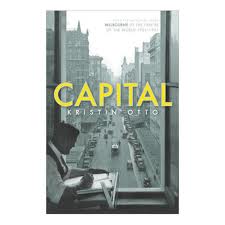
‘Capital’ by Kristin Otto

364 p.  2009

I’m not really sure how to review this- as a reader or as an historian- and I’m not even certain that it’s possible to have a clearcut distinction between the two.  This is Kristin Otto’s second book after releasing Yarra: A Diverting History of Melbourne’s Murky River (and how odd- the small biographical sentence in Capital calls the first book Yarra: A Meandering History of Melbourne’s Murky River. I wonder if the name has changed? I suspect that this is an error.  If so, not a good start given that the same publisher released both books!)

The two books have much in common: both published by Text Publishing,  generous use of black and white photographs, no footnotes, a diverse bibliography and a rather chatty tone that ties together many small details into a clearly identified theme.  It is popular history, aimed largely at a local audience.  The research for this book was funded through a Redmond Barry Fellowship that encourages its recipients to use the collections of the State Library of Victoria and the University of Melbourne (institutions that both have links to Redmond Barry).  She has certainly mined these collections well, and the book is a mass of small details stitched together into a broader fabric.

The book opens with a dictionary definition of ‘capital’ which includes its political, economic and evaluative dimensions- capital city; capital wealth, and excellence.  We could also include human capital here and this, in effect, sums up the spirit of the book.

Otto takes as her focus the years 1901-1927, when the new Federal Parliament sat in Melbourne prior to shifting to the newly-constructed Canberra as national capital.  It takes a basically chronological approach, starting from the Federation Celebrations in 1901 and moving in two or three year steps through to 1927.  Superimposed onto this chronological skeleton is a theme for each time slice: celebrations 1901-3; amusements 1904- 1907, social laboratory 1908-10  etc.  It’s worth looking at the table of contents here.   This double-themed approach groans a bit under its own weight here because concepts like “amusements” or “social laboratory” or “style” were not restricted solely to the three-year period she has pegged them to alone.

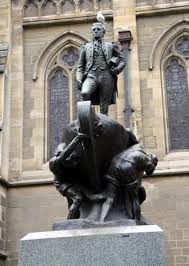
Then she explores these themes through a number of pivotal and fairly well known Melbourne characters including Alfred Deakin, Nellie Melba, John Monash, Tom Roberts, Macpherson Robertson,  Helena Rubenstein, Vance and Netty Palmer,   Janet Lady Clarke and Charles Web Gilbert.  This last name may not be immediately familiar, but it is to me as he is my husband’s grandfather. You may know him by this statue

One of the emphases in this book is on the interconnectedness of people within Melbourne at this time and the author can barely suppress her glee at finding connections and coincidences which she notes in quirky little footnotes.  Although it was obviously a pleasurable hunt for her,  it is no real surprise to me that if you choose to focus on an elite in a community then almost by definition there will be connections between them.  Her linchpin characters are fairly well-mined biographical subjects, although Web Gilbert and Annie Bon, a patron of the Coranderrk Aboriginal settlement in Healesville, less so.   She did attempt to draw in some less noted personalities- Albert Mullett, an Aboriginal man living on Coranderrk, Harold Clapp the Commissioner of Railways- but largely the narrative draws on a strong “aha!” factor amongst a largely Melbourne readership which would recognize familiar names and buildings even today.

The book is generously sprinkled with black and white photographs and was shortlisted by the Galley Club of Australia under the ‘Webfed- Mono/duotonebook/4c, limp bound, no price limit’ category (who would have known that there are so many categories of books?).   Among the images in the book there is a double-page reproduction of both the Tom Roberts and the Charles Nuttall depictions of the opening of Parliament which she discusses exhaustively in the first chapter, but I found myself craving an identification key to the people she describes.  Otherwise the photographs are well chosen, well placed and fascinating.

The book, both in narrative voice and conceptualization,  is similar to that adopted by Robyn Annear in her books Bearbrass and A City Lost and Found and I am sure that it would attract a similar readership.  Otto provides her sources at the end of the book, and they are exhaustive and largely of a biographical or local history bent.  I mourned the absence of footnotes- there were several times when I wondered where she’d gleaned her information- but footnotes are an acquired taste I suspect and I’m sure that many other readers would not notice their absence at all.

I enjoyed the book and the strong recognition factor that it evoked in me, but I do wonder if the complexity of its structure,  with its chronological slices, themes, then biographical linchpins was rather too heavy for it.  And at the risk of being labelled a grumpy old woman, I do find myself wondering if “young people these days” would have the same recognition response to, say, C.J. Dennis or AM band radio stations and the many small details that make up this book.  Who knows- perhaps a book like this is a way of alerting them, but I suspect instead that its readership will be drawn more from people already familiar with them.  The blurb at the front suggests that

For anyone who knows Melbourne, ‘Capital’ will be a fascinating conversation with an old friend.  For others it will be a compelling introduction to a new one.

I suspect that the former will outnumber the latter.


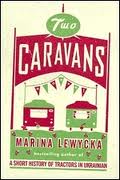
‘Two Caravans’ by Marina Lewycka

309 p. 2007 p.

(2.5/5)

That’s it.  I’m over Marina Lewycka.  I really enjoyed A Short History of Tractors in Ukranian but I loathed We Are All Made of GlueTwo Caravans, which is her second book, comes in between, so perhaps my esteem for her declines with each publication.  I do not intend reading any more of her work: I wouldn’t have read this one, except that it was a selection by The Ladies Who Say Oooh (aka bookgroup).

The title refers to the two caravans that house a motley group of itinerant workers drawn from various countries: Irina and Andriy are both Ukrainian but from very different political and cultural backgrounds; Tomasc,  Vitaly, the middle-aged Yola and her daughter Marta are Polish; there are two Chinese girls, Emanuel from Africa, then the dog.  The dog was probably the last straw for me.  They are swimming in the slimy waters of the pits of the British economy working as fruit pickers on strawberry farms, processors on a chicken-farm assembly line, kitchen hands and waitresses.  Some of the others disappear as sex workers, or reappear as spivs.

They fit every stereotype and I felt uncomfortable reading it and somehow colluding in it. Yes, I know that Lewycka herself is Ukrainian, and that there is a whole vein of humour that can be generated and voiced within a minority group that could not and should not be voice elsewhere-  I’m thinking the string of “Wog” comedies created by Nick Giannopoulous and suchlike.  But it’s a sharp and dangerous humour that feeds on stereotypes, and while some might be challenged by it, others draw a perverse pleasure from having all their prejudices confirmed.

It is touted as a comedy, but I found little to laugh about. I suppose that the book worked in that the amorphous umbrella term “immigrant worker” was broken down into individual people from a range of backgrounds, and it was not an ‘us versus them’ scenario as there were shysters, grubbers and exploiters among the English and the immigrants alike.

Obviously some reviewers liked it- The Sunday Times, The Telegraph and The Guardian.  Reviews from Australia are rather less glowing- The Australian was equivocal and The Age rather dismissive.  I’m wondering if it’s a cultural thing perhaps?  As we well know, there’s a strong streak of prejudice and intolerance that runs through Australia, and probably every other country as well, but what struck me in England in particular was the assumption, from people you’d just met, that you would unquestionably share their barely-disguised contempt for people from the eastern EU countries.  I didn’t want to buy into it then, and I don’t now- even if it does come from ‘inside’.

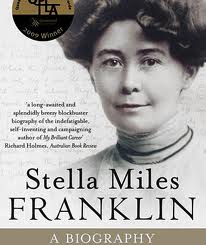
‘Stella Miles Franklin: A Biography’ by Jill Roe

569 p. plus notes, 2008

(4.5 /5)

Miles Franklin, to the extent that she is known at all today, is  probably most famous for the film of her book My Brilliant Career and for the Miles Franklin literary award that bears her name.  Jill Roe has been working on Miles Franklin for many years and this long biography- all 700 odd pages of it including notes-  will probably be the definitive biography for many years.

The first thing to notice is the title: Stella Miles Franklin.  The writer we know as Miles Franklin was called by her first name, Stella, by her family and friends.  Although in the body of the text Roe calls her “Miles”, the title clearly marks out that this is not a literary biography alone but an examination of her life in its many facets: as daughter and sister, as labour activist,  office worker and friend- as well as writer.

The second thing to notice is how little of the book – the first hundred odd pages only- deals with the writing and publication of ‘My Brilliant Career’, for which she is probably best known today.  Once I turned to Part II of the book, I wondered how on earth Roe was going to sustain this biography for the succeeding 450 pages.   She did it largely by following Miles’ career across the span of her life:  in America as a women’s labour organizer between 1906- 1915,   then following Miles to England where she worked in a stultifying job as admin support for a Housing reform authority, nursed in the Balkans during World War I, moved back and forth between Australia and UK before finally returning to Australia in 1933 to live out her final years before her death in 1954.   I think that Roe is firmly making the point here that the whole of a life matters: as a ‘woman of certain age’ herself Roe is not content to shove Franklin’s  later years into a perfunctory final chapter before dispatching her unceremoniously.

Franklin’s bequest of money for the literary prize that bears her name comes almost as a surprise at the end of the biography.  Miles lived alone and frugally in the family home and it surprised many that her 8922 pound estate had been squirreled away for a literary prize awarded to “the Novel for the year which is of the highest literary merit and which must present Australian Life in any of its phases“.   Australian commentators, writers and readers have often chafed under what now seems a rather jingoistic, dated and parochial restriction, but having read this biography I am now more aware of and sympathetic to what Franklin probably hoped to encourage: a publishing industry more independent of British and American publishing houses and  an appreciation of a literature that rings true to Australian experience and consciousness.  As Roe points out,  there are no national eligibility criteria so that, conceivably, the prize could be awarded to a non-Australian writer for a work that was published outside Australia.  This, too, reflects Franklins’ priorities- that Australia and Australian life that should be rendered realistically (she was no fan of modernism or Americanization) , and that Australian writers and Australian themes take their place amongst world literature as a whole.

The bequest was not Miles Franklin’s only gift to her country.  Her other gift was a huge archive of her correspondence which eventually numbered at least 10,000 items from 1000 or more correspondents , diaries and manuscripts, collected over a lifetime.  It is here that we see her rich intellectual life in the admittedly small Australian literary culture and  her involvement with politics both in Australia and overseas.  Her association with communist writers like Jean Devanny and Katharine Susannah Prichard brought her to the attention of ASIO during the Cold War, but she was also associated through friendship, but not politics, with the uncomfortably right-wing views of P.R. Stephensen and his Australia First movement.  Miles herself was neither communist nor fascist, being more aligned with  traditional post WWI British Liberalism.  Franklin herself expressed fears of Asian immigration and over-breeding in a political stance that makes me shift uneasily today.  As Roe explains, she was a first-wave feminist, steeped in ideas of moral purity, and as part of the ‘Australian girl’ trope of the first decades of the 19th century, claimed the suffrage and Australia’s relative progressiveness as part of her own identity as an Australian working in American women’s and radical organizations in the US. Through her correspondence and hospitality she fed, and fed on, camaraderie with fellow writers and their circle- Nettie Palmer, Dymphna Cusack and Florence James,  David Miller, Katharine Susannah Prichard etc- but she was wary and defensive amongst academics and academia.

Miles Franklin’s own identity, her “essential self” as she put it, centred around being a writer and indeed, writing was work that she carried out throughout her life.  I was unaware just how much there was, often dusted off and recycled, in the hopes of publication under yet another guise or as often unsuccessful entries for a string of literary prizes.   This approach to her work partially explains her insistence on nom-de-plumes, most notably Brent of Bin Bin, but also more risible pseudonyms (like ‘William Blake’, or ‘Mr and Mrs Ogniblat L’Artsau’)  which came to be viewed more as a form of eccentricity than, as she intended, literary commercial savvy.  Much of this work remains unpublished- often for good reason as Roe suggests- although much of it attracts me as an historian:  she went ‘undercover’ as a domestic servant in the early 1900s and wrote about her experiences, and her novels set during WWII sound interesting from a social history point of view.  But much of her work sounds (admittedly only from Roe’s summaries of the unpublished manuscripts) overly melodramatic, self-referential and repetitive and perhaps best left in the archive.

Roe approaches this work more as historian than literary biographer, focussing on the act of writing and what it meant to Miles and her milieu, rather than the texts themselves.  She has mined the huge Franklin archive exhaustively (an archive now supplemented even further by later purchases) and she represents it in its entirety, perhaps to the detriment of her biography overall.  To Roe’s credit, she provided enough background information about Miles’ friends and contacts for the book to veer away from mere name-dropping, but it is a narrow line.  It is a huge, detailed biography but I found myself enjoying most the parts where Roe stepped back with her historian’s hat on to explain, for example, the demographic phenomenon of the single female in the 19th and 20th centuries, and the nuances of first-wave feminism and its approach to men and marriage.   I can’t imagine that other scholars will be able to top the detail of this biography, but their interpretations may differ.

Further reading:

The State Library of New South Wales presented an exhibition on Miles Franklin Miles Franklin: A Brilliant Career? and the exhibition catalogue, including photographs, has been archived here.

See also ANZLitLover’s review of the book, and a review by Nicole Moore in The Australian

‘Solar’ by Ian McEwan

285 p. 2010


3.5/5

Ian McEwan is one of those prolific writers who is able to produce a string of books with each quite unlike the one that preceded it.   Thriller, historical fiction, small polished novella… he can turn his hand to them all, but I must admit that I wasn’t expecting comedy from him.   ‘Solar’ is one long satire centred on  the pompous and repellent Michael Beard, an overweight, lazy, adulterous  physicist who has done virtually nothing after early research  coupled his name with Einstein in the barely-explained, Nobel-Prize winning theoretical construct of the  Beard-Einstein Conflation.   The book romps along as he pushes his way to the front with not a shred of moral compunction- indeed his actions regarding a young postgraduate student are appalling on first reading and even more reprehensible if you really think about it.   He is so truly repulsive that you really relish his downfall.

It’s a 21st century morality play, but rather heavy-handed and buffoonish.  McEwan pricks at many forms of pretension in this book beyond Michael Beard himself:  the carpet-baggery of climate change politics,  the confected outrage over plagiarism and academic purity, and academic fakery.  His Michael Beard swots up on literature in order to woo his first wife, and I suspect that McEwan himself has swotted up on physics here and is  laughing up his sleeve at his less-scientifically-inclined readers who wouldn’t know whether the plot is risible or not.  The book ends with a rather destabilizing extract from Michael Beard’s citation by the Nobel Prize committee which just seems to hang there at the end of the book- and you know damned well that McEwan has just put it there deliberately.

The book is in three parts- 2000, 2004 and 2009 but there are no chapters at all within these three sections.   McEwan relies on his own control of the narrative to sweep between backgrounding, foreshadowing and present-time dialogue, and he does it with the confidence of a master story-teller.  Like Michael Beard himself, it’s all rather too much, and you just strap yourself in and go along for the ride.  Just don’t take any of it too seriously.

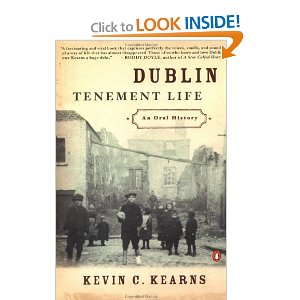
‘Dublin Tenement Life: An Oral History’ by Kevin C. Kearns

1994, 220 p.

If I had to think up a pithy title for this book, I think I’d call it “Angela’s Ashes: The Documentary”. It’s all here: the feckless father, the bedraggled and burdened mother, the dead babies, the supercilious priests and nuns, the sheep’s head stew and the overflowing toilet.  And the power of this book is that it’s here again, and again, and again, and again.  In his lengthy introductory chapters, the author comments that the sainted-mother-who-held-the-family-together is a stereotype, and yet when you encounter her so often, it is insensitive to dismiss her as just a sentimental trope.

In his introduction, the author asserts that

Simply put, there exists no first-hand authentic chronicle of Dublin tenement life as experienced by one-third of the city’s population during the first half of this century…to reconstruct historical reality we must seek to record the personal “missing portions of the picture of life” within a social community. In the case of Dublin’s tenement enclaves what is conspicuously missing from the historical scene is credible verbal testimony about daily life patterns by those who were looking out from behind the grim brick walls….By contrast, the avowed purpose of this book is to create an authentic and wholly original chronicle of Dublin tenement community life based on the oral histories of the last surviving dwellers. P.3

I find the claim that this is the first such account surprising- perhaps I have been too influenced by the recent genre of memoirs that he criticizes for their “blinding nostalgia”, although I think that they tend to be more afflicted by the Monty Python “Four Yorkshiremen” syndrome.

And why Dublin, I wondered?  Surely there were tenements in many 19th century urban centres that lingered right up until the second half of the 20th century?  His opening chapter ‘History and Evolution of the Tenement Slum Problem’ explains that the tenement process was particularly accelerated in Dublin after the 1801 Act of Union emptied Dublin of the Anglo-Irish gentry who had built their spacious Georgian houses terraces and squares close to be close to the centre of Irish government and the Irish Parliament.

They were two-to five-storey brick structures splendidly ornamented with ornate plasterwork ceilings, marble fireplaces, mahogany woodwork, and elegant doorways and fanlights.  They represented a glorious period of architectural achievement and social life in Dublin but when the aristocracy departed they left behind their grand homes to be managed by agents. Property values plummeted dramatically.  Resplendent Georgian abodes purchased for £8000 in 1791 sold for £2,500 a mere decade later and by 1849 could be bought for a paltry £500. (p. 7)

The acid-laden smoke, mists and rain corroded the exteriors, while the cheap internal conversions into partitioned room for perhaps a dozen families drastically altered and compromised the internal framework and fittings.  The Dublin Corporation, many of whom were themselves tenement landlords, failed to force negligent landlords to make improvements, forwarding the rationale that if they condemned and closed dilapidated tenements, it would lead to large-scale homelessness (p. 10)

The second chapter ‘Social Life in the Tenement Communities’ is a good summary of the recurrent themes that emerged from the oral histories: so good, in fact, that the oral testimony itself began to seem rather repetitive and redundant.  Still, it is the oral narrative that is important here and the way that the respondents framed their story.  In this regard, Kearns was largely silent about methodology, except to thank particular individuals in a short Acknowledgments page.  The book is probably aimed at a more general readership, but I would have appreciated an appendix giving more information about how participants were recruited, when the interviews were conducted, and the prompt questions used, if any.

The oral testimonies are repetitive but repetition itself underscores the commonality of shared experiences. Kearns has managed to triangulate his themes by recruiting a range of voices- shopkeepers, chemists, charity workers, school teachers- as well as the tenement dwellers themselves.  Again, an appendix summarizing the status and situation of the informants would be helpful, as this information is enclosed in a brief italicized paragraph preceding each narrative and not easily searchable.  There are good photographs which I discovered just at the point when I thought I might jump onto Google image to find some- again, there is no list of illustrations to alert you that they have been provided.

In his chapters preceding the oral testimony, Kearns summarizes the evidence and teases out the main themes but does not interrogate them particularly stringently.  I would have liked to have seen a more critical discussion of the role of the church and religion, and an exploration of the apparent paradox of professions of happiness alongside such poverty.  In an Australian context, David Potts broached such topics in his book The Myth of the Great Depression, sparking quite a controversy in so doing, but also providing a meatier book than this one.  Suffice to say that I read the summary chapters with interest, read several testimonies until I realized that they were all saying much the same thing, picked my way through the rest on the basis of the italicized biographical paragraph at the start of each one, then read the four longer narratives with which the book closes.  I’m not really sure what qualities qualified these closing narratives for special treatment beyond their length.  The book cried out for a conclusion of some kind as it just seemed to trail away at the end.

So- my assessment? Interesting initial chapters; good for dipping into; evocative photographs; let down by lack of appendixes and tables; and valuable for providing the testimonies themselves, albeit rather uncritically.

If you’re interested in some photos:

http://www.census.nationalarchives.ie/exhibition/dublin/index.html

http://multitext.ucc.ie/viewgallery/937

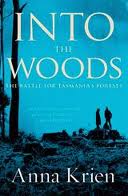
‘Into the Woods’ by Anna Krien

298 p.  2010

I did intend starting this blog with a reflection on the “Note about the Printing of this Book”  that appears at the end of this book- you know, the page where somebody (the author?) waxes lyrical about the paper and coos about the  font used and how boutique it all is.  But then I looked at the YouTube footage of the attack by Tasmanian forestry workers on the protesters that prompted this book, and somehow my opening observation seemed rather twee.

The footage is below.  The language is crude and ugly, but I suggest that you do not turn off  the sound because the rage, and the terror it induces, are also muted if it plays silently.

You wonder where this would have ended had the protesters actually “got out of the f***ing car” and taken them on.  Likewise you wonder what publicity if any this would have garnered had there not been the video evidence and the platform of YouTube to distribute it.

And yet, the raw and ugly emotion of the video and the slight preciousness of the anxiety over the type of paper selected for the book are both manifestations of the complexity of the Tasmanian forests debate.   Few (none?) of us can avoid using forestry products; this very book discussing the issue is printed on it and sold in shops choked full with the stuff.  There are generations of forestry workers and there are timber communities.  Beautiful objects are made of wood. There are those mountains of woodchips sent offshore as fodder to enrich other economies, but then there are the environmental hazards of the pulp processing facilities that perhaps we don’t want here after all.

Anna Krein makes no secret of the fact that her first sympathies lie with the protesters.  It is the video footage above that propelled her across the straits to write the essay from which this book arose, and although repulsed by the dreadlocks and dumpster-diving,  it was amongst the protesters and their share houses that was ‘home’ during her time there.   But she ranges across a number of players as well- the loggers,  the timber workers, the politicians, representatives from Forestry Tasmania, but not the timber company Gunns itself which did not participate.   However, these were excursions to ‘the other side’, and she makes no secret of this.

This book is not the  ‘he said’/’she said’ pretence of even-handedness by which objectivity is claimed by providing equal time to all sides.  At some point, the journalist/writer/historian  has move beyond being a mouthpiece for conflicting interests by confronting the “here I stand” moment and actually crafting an argument that she owns.  Krien perhaps sidesteps this slightly by shifting her gaze onto the relationship between Gunns and the Tasmanian government- a relationship that is tangled by the small size of the Tasmanian population and the myriad and constantly shifting connections between government, Forestry Tasmania the government-owned enterprise, and Gunns itself.  It’s a grubby and disheartening story, and one that makes me bristle with distrust.  It makes me wary of the recent ‘Statement of Principles to Lead to an Agreement’ of October 2010 which seems to have been conducted in secrecy- the hallmark of the Gunns/Government/Forestry Tasmania triumvirate- yet to have garnered the support of groups across the spectrum.  I have seen little analysis or detail of the agreement, but it is being lauded as a blue-print (green print?) for Victorian forests as well, and again conducted privately, out of sight.

The blurb from Chloe Hooper on the front cover is apposite, because Hooper and Krien are similar types of writers who move into a situation, confess (and perhaps even emphasize?) their novice status and write themselves and their emotions into their narrative.  They both are careful observers of both people and environment, and both write evocatively, clearly and conversationally.  The book confirmed and gave more factual validation to my own pre-existing sympathies- I’m not sure how I would have felt had it refuted them.  I do feel as if I am better informed, but I’m not sure if my smug “Huh- I thought so!” response takes me far.

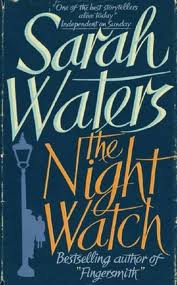
‘The Night Watch’ by Sarah Waters

2006, 503 p.

What a good book!  And what an encouraging way to start my reading for 2011 with a book that I gobbled up eagerly and closed with regret at the end.

I’ve read two other works by Sarah Waters: Fingersmith and Tipping the Velvet. While I very much enjoyed them, I wondered if Waters was becoming bogged down in lesbian faux-Victoriana.  When I read that she had broken with 19th century London to move into Blitz Britannia,  I was rather relieved but again a little frustrated that it was yet another narrative with lesbian main characters. But  I know that I should not feel that way, especially when I’m in the hands of a such a sensitive and nuanced author. Many authors that I enjoy have made a particular type of story their own- Dickens with his mosaic carnival of characters; De Lillo with his America; Anne Tyler with her domestic family narratives, and I don’t at all begrudge them another book in a similar vein.  And in my own life experience over the last few months, I’ve come increasingly to sense that what really matters is love and relationships, irrespective of time, politics, country, milieu and the genders of those involved. Every life is a love story of one sort or another- and the variety is endless; or else it is a tragedy.

Waters’ narrative revolves around four main characters: Kay, Helen, Viv and Duncan. Her master stroke is to tell the narrative backwards, starting in 1947, then 1944 and finally 1941. It’s a risky technique, though. As a reader there is none of the backgrounding that you come to expect and you are forced to draw your own hypotheses about the characters and how they came to be in the situations in which you originally encounter them.  At 171 pages the opening 1947 section is relatively long to sustain such uncertainty, and there is a drabness about the post-war England it portrays and the flatness of her characters’ lives.

The 1944 section is the real heart of the book, both in terms of length and in character development, and many of the questions and suppositions raised in the first section are spelled or dispelled here.  Her attention to historical detail is assured and deft, and it’s at this point that a book either wins me over or turns me off.  As I’ve often commented, I squirm when an author overloads the narrative with the cargo of historical colour and movement uncovered by too much research: on the other hand, I rebel when anachronistic sensibilities are ascribed to the characters in historical fiction.  Here Waters excels: there was only one point at which the historical detail became suffocating (it was one product-placement of Max Factor too many, I’m afraid), and by writing from a lesbian sensibility she risked, but avoided, the danger of violating the integrity of a historical fiction narrative by framing it with a 21st century mindset.  There is a timelessness about desire, fulfillment, betrayal and loss, in both mixed and same-sex relationships. It was always there, even if it was not written about at the time.

The 1941 section is short, barely 50 pages, and it provides the context that was withheld in the first section.  Somehow, by this point, it no longer matters and you find yourself nodding, as if you already understand.

I found this an absolutely satisfying book.  I’m drawn to stories about the Blitz, and although I do not know enough to judge objectively,  I had a sense that she had captured an emotional fidelity to the time.  Is it too soon, I wonder, to mark this as one of my top reads for 2011?

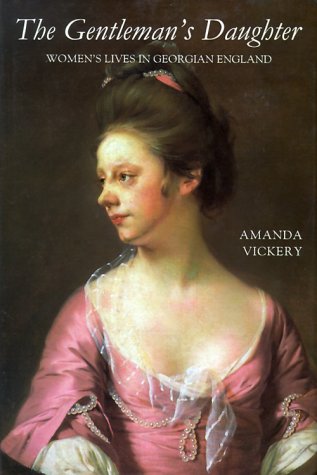
‘The Gentleman’s Daughter’ by Amanda Vickery

1998, 436 p.

Don’t let the demure cover deceive you: this is a rather pugnacious book that rattles the commonly-received image of female domesticity during the 18th and 19th centuries.  Amanda Vickery points out in her introduction that historians of epoch after epoch have  adopted the argument that women’s lives became increasingly marginalized and  constricted to the private sphere during the particular period that they have studied. Surely, she suggests, they can’t all be right.  Instead of identifying a particular time when women’s experience changed, she emphasizes the continuity of women’s lives across the eighteenth and nineteenth centuries.

Her research is grounded in local elites, in particular that of Lancashire.  In an exhaustive study, she examined all the letters and diaries of privileged women from the early 18th to early 19th centuries the Lancashire Record Office, irrespective of how that wealth was accrued.   By casting her net wide like this, she eschews the view of the gentry, the professions and the upper trades as distinct strata of the social hierarchy.  Instead, she sees them as part of a “woven fabric” or an “intricate cobweb” of social structure and social relations that extended both horizontally and vertically.   This local examination is then compared with London because there were so many links between Lancashire and the metropole.  One of her main information sources is Elizabeth Shackleton, whose detailed diaries for the years 1773 and 1780 are mined for a database of all social interactions in that year.

Again, though, I find myself wishing as a reader, that the introductions to her main informants were not so rushed.  One of the things that I admire so much about Inga Clendinnen’s Dancing With Strangers is that she slows down to properly introduce her sources as discrete, rounded characters.  Vickery does introduce several women in her early chapters whom we will meet again and again, and who represented a period of over 100 years but I don’t think that I realized while reading it the importance of the wide time-span that her informants operated within.  She is arguing for the continuity of women’s experiences across a wide expanse of time, resisting the urge to identify any one period of dramatic change.  This is an important argument, but  I didn’t pick up sufficiently in her opening introductions to her main informants.

From these sources, she draws out a number of themes that exercised the letter-writers and diarists of her study rather than the interests of twentieth-century historians : gentility, love and duty, fortitude and resignation, prudent economy, elegance, civility and propriety.   These abstractions were played out in the lived experience of women’s lives through courtship, marriage, childbearing, housekeeping, material culture and sociability as described by real people in their diaries and letters to each other.

My own work is based on the colonial experience, and I found myself thinking of colonial letters and diaries where these same interests were aired, but in a different setting, far from the density and bustle of English life.  For example, Vickery writes of the importance of promenades and walks as a site of leisure for the female world, and I found myself thinking of The Block in Melbourne- a smaller walk perhaps, but one which fulfilled the same function.  She describes the way that roles and responsibilities were often mutually agreed, and sometimes bitterly contested,  by a man and his wife, and I think of the journals of early settlers in Upper Canada and Port Phillip.  She describes the way that genteel families were linked to the world through a multiplicity of ways and I think of the smaller, but equally dense connections between Port Phillip elites and those in Upper Canada.  At the end of the book she points out that the sociability of  any individual woman’s life shifted according to her progress through the life span- as young girl on the marriage market, mother of young children, then later chaperone of her own daughters.  “Women’s lives” are not a static condition- they respond to biology and societal expectations alike.

Why a pugnacious book? It might not seem so from my description, but she shapes up to and wrestles with the biggies of domestic historiography and sociology-  Phillipe Aries,  Lawrence Stone, Davidoff and Hall, Veblen, Habermas.   It is not particularly necessary to be familiar with these scholars and their arguments- I’m not- but perhaps the academic jousting might be a more enjoyable spectator sport if you are.  For myself, I was content with the fine detail of the lives she describes so sensitively, on their own terms and using their own concepts, and I found it a useful lens through which to view the experience of the colonial women I am encountering.

‘Exiles at Home: Australian Women Writers 1925-1945’ by Drusilla Modjeska

1991, 258 p

I feel as if I am reading this book at several steps removed. My copy of this book is the 1991 reprint of the original 1981 version which itself was taken from Modjeska’s PhD thesis.  So they do exist-those mythical creatures who actually get a book out of their PhD!  In the introduction to the 1991 edition  she describes the intellectual milieu in which she wrote her original thesis.  It was written in the early 1980s when she could not foresee the dominance of women in Australian writing and publishing in the upcoming decade, and under the influence of the Women’s Liberation Movement as it was known at the time.   There’s a rather rueful admission at the end of Chapter 2 that perhaps she had mis-attributed a publication to a particular author (and unfortunately, she does make rather a lot of this publication), but she allows the original text to stand.  I assume that many academics have similar infelicities which they know about in their own work, but can allow them to go through to the keeper because the work is not reprinted.  I found it interesting to read the rather earnest 1981 acknowledgments page, followed by the 1991 introduction which reflects an older, more relaxed narrative voice, more similar to that found in her other, later writings.

Modjeska points out

The 1930s were remarkable years in Australian cultural history.  Women were producing the best fiction of the period and they were, for the first and indeed only time, a dominant influence in Australian literature… They were politically active, they were often angry and they made sure their presence was felt as writers and as women.  Their remarkable history and the broader tradition that stretches beyond them has been undervalued and obscured.  This book is a history of these women writers, tracing the interconnections between their lives, their work, their politics and their fiction.  It is a book not only about social history but about writing, about cultural and ideological struggle, about feminism and fiction, about the contradictions of class and gender. (p. 1-2)

Her book ranges around a number of women novelists of the 1920s and 30s- Miles Franklin,  Marjorie Barnard, Flora Eldershaw, Eleanor Dark, Jean Devanny, Dymphna Cusack and Katharine Susannah Prichard (my impetus for reading the book).   Many of these women were linked through their contact with Nettie Palmer, whom I had only ever encountered as part of the Vance-and-Nettie-Palmer team.  Miles Franklin gets a chapter to herself, while the others are woven together by their letters and communications to and through Nettie Palmer and amongst themselves.

Much of the book discusses the role of politics on these women’s writings and identities as public intellectuals during a decade of the Depression, the rise of Fascism, Stalinism, the Spanish Civil War and World War II.   Some of them, like Prichard and Devanny became overtly identified with the Communist Party, to the detriment of their writing;  while others distanced themselves from or resisted such clear allegiance, even though Modjeska portrayed most of them as leftist in their politics. They all had to face and somehow accommodate the demands of being wife, mother and daughter.

For me, the least successful chapter came near the end of the book where she discusses a string of books, many of which I have not even heard of, let alone read.   Modjeska’s analysis is heavily influenced by the Marxist Feminism of the 1970s and 80s , something her subjects lacked:

One of the problems for the writer-women of the thirties was that their anger, their feminist protest was backed by very little theory. In consequence their political anxieties deflected from the early feminist impulse in their fiction while forcing them back on a commonsense faith  in what they knew was important in their experience as women and which they expressed as a female humanism… In the absence of theory they had to rely on those old female virtues of commonsense and intuition (p.256)

I’m not convinced that it was such a deficiency as Modjeska felt it to be, or whether she would feel that way today.

I admit to being out of my depth in much of the subject matter and I ‘m not sure whether I picked up on the overarching argument of the book.  The chapters were self contained and read almost as essays in their own right, but I wasn’t able to pull them together into a structured argument.   I have seen this book cited several times, and it obviously broke new ground when it was published.   I also sense that in many ways, the deficiencies that Modjeska identifies in terms, say, of a strong critical biography of Miles Franklin have been taken up in recent scholarship. What I did detect, however, was the complementarity between this book and Modjeska’s later work Stravinsky’s Lunch, which I class amongst the best Australian non-fiction books I have read.  And I find myself wondering, if Modjeska were to write this book today 30 years on, what sort of book it would be.