Category Archives: Book reviews

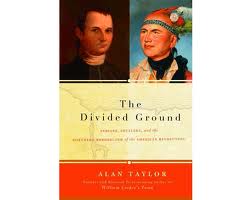
‘The Divided Ground’ by Alan Taylor

2006,  395 p. & 128 p notes

I’m not quite sure how it happened, but one way or another I managed to get through 12 years of schooling and three years of undergraduate university education without doing any American history.  We were supposed to do it in Form II but somehow Henry VIII seemed to stretch on forever, and we only got to those funny men in hats and Thanksgiving before the year ended. By Form V obviously the attraction of Henry had won out because I selected 19th Century British over American history.  At university in the mid-1970s we were all protesting US imperialists and the Vietnam War, so I wasn’t going to do any of that culturally imperialist history (why, no, I’d do British history instead…no cultural imperialism there!!)  I’ve  kept a record of my reading over the last ten years or so, and I’ve only read eight books about American history in that time, from popular history to rather more erudite works.  Among them there’s been more of a focus on colonial and early 19th century America with a smattering of “people’s histories”.  Hence, I continue to feel on pretty shaky ground as far as my knowledge of American history goes.

So to Divided Ground. I came to read this book through a suggestion from Andrew Smith’s blog, who cautioned that in order to understand Upper Canada, I needed to look to America as well.  Point taken.

The title mirrors Richard White’s The Middle Ground which dealt with the Algonquian people of Great Lakes and Ohio Valley in the century before the American revolution. But this book speaks instead of divided ground: divided between the land to the north still controlled by the British empire and the land south of the American states.  There was an east/west boundary as well, separating the settled states on the eastern seaboard from the Indian territory further inland.  These were the borders of land hungry settlers, patriots and politicians. Then there was a borderland as well, at least in Indian consciousness, where the Indian tribes would live as an autonomous people, between the British and Americans.  But this borderland would not survive the determination of speculators and politicians, and it was overlaid by a third type of boundary: the boundary of private property as landholdings were carved out and subdivided, turnpikes created, taverns built and forests cleared.

Taylor tethers this story in two men, Joseph Brant and Samuel Kirkland, who met at a boarding school run by Rev Eleazar Wheelock in Connecticut in 1761. Brant’s sister Molly was the Indian mistress of Sir William Johnson, the most famous and powerful colonist on the American frontier.  His patronage extended to her brother Joseph of the Mohawk tribe. Samuel Kirkland, on the other hand, was the son of an impoverished white Minister, taken on as a charity student who, as a missionary later on, became highly influential with the Oneida.  These two men appear throughout the narrative as they rise to prominence in  different Indian tribes that take different pathways.  Brant moves his tribe into Upper Canada and diffidently sides with the British while the tribe that associates with Kirkland sides with the Americans.  But neither man, nor their tribe, could ultimately withstand the appropriation and double-dealing that ran through the dealings of settlers and Indians and the broader agendas of politicians and policy makers.  There is a great deal of detail in this book- some reviews have suggested rather too much detail- but I found that having these two men as anchors helped keep a clear narrative thread throughout the book.  It’s a technique that I like, and I’m wondering if I could do something similar in my own writing.

It is often pointed out that in the settlement of Australia, treaties were not even offered to the Aborigines, beyond Batman’s rapidly over-turned attempt in Port Phillip.  I do not in any way deny the brute power and arrogance that the wholesale appropriation of Australian land displays, but having read this book I’m not sure that these treaties denote a very much higher moral ground.  Untrammelled power is at least transparent in its intentions.  The dripping hypocrisy of declarations to Indian “brothers” mouthed in honeyed language and proffering false generosity is ruthless, too.
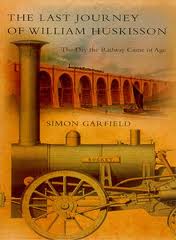
‘The Last Journey of William Huskisson’ by Simon Garfield

2002, 229 p

(3.5/5)

My real work has taken me away from the Resident Judge of Port Phillip, John Walpole Willis, to the Puisne Judge of the Kings Bench of Upper Canada, the same John Walpole Willis.  So here I am, wading through the Colonial Office correspondence from Upper Canada that looks and sounds so similar to the Colonial Office correspondence from New South Wales.  Because it’s dated some fifteen years earlier, it is addressed to Secretary of State for War and the Colonies Huskisson instead of Secretary of State for War and the Colonies Russell, then Secretary of  State for War and the Colonies Stanley.  Huskisson, Huskisson- where do I know that name? Corn Laws? And then I remembered this book, written by Simon Garfield, that lies directly in my eyeline in the bookshelf beside the television in Mr Judge’s loungeroom. William Huskisson, as well as being  the Secretary of State for War and the Colonies, was also the first victim of a railway accident in 1830.

From the title and the preface, you know that this is not going to end well:

There were a great many witnesses to the terrible accident which befell William Huskisson, but none could agree precisely what occurred.  Some said his left leg fell on the track in one way, some quite another, and some said it was his thigh.  A few observed a ‘fiery fountain’ of blook, but others saw only a trickle.  Some claimed there was shrieking, but the rest believed he was rendered mute by the shock. Yet there was one thing on which everyone agreed. They all said that the accident was the worst thing they had ever seen, and the one thing they would never forget.

The following pages recount how a day of triumph became a day of despair at the turn of a wheel.

This is only a short book, and Garfield certainly takes his time getting the accident that we all know is going to occur- 140 pages no less. On the way, he takes us on quite a journey into British parliamentary politics, the economics of railways compared with canal transport, the rivalry between competing inventors and the  entrepreneurial drive of railway promoters.  Not that it’s a boring trip- in fact, it is quite fascinating- but it does take rather a long time to get there.

The book is generously illustrated with black and white photographs and images, and it has a lively conversational tone.  The irony that this popular, if somewhat politically clumsy politician should be run over by the first train running on the railway that he had done so much to champion,  is rich and runs throughout the narrative.  Garfield has captured well the energy of industrializing Britain, the edginess of pre-Reform Bill politics and the bustling self-importance of Victorian Man.  It’s an interesting, easy ride.

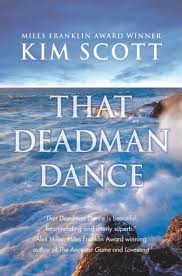
‘That Deadman Dance’ by Kim Scott

2010, 406 p

(5/5)

Is it too soon to say three little words: “Miles Franklin Prize”?  I don’t think so: I see that this book has been nominated as the Pacific region contender for the  Commonwealth Writers Prize for 2011, and it’s surely destined for the Miles Franklin shortlist at least.  And this is just as it should be.

I found myself reminded of many other works, both historical and fictional, while reading this book: Inga Clendinnen’s Dancing with Strangers which echoes more than the title alone, Kate Grenville’s The Secret River, and most recently Lisa Ford’s Settler Sovereignty. But this book, taking as it does an Aboriginal – specifically Noongah- sensibility and voice could be written by an Aboriginal person alone, and this, too, is just as it should be.

That Deadman Dance is roughly chronological, although we learn early in the book that Bobby Wabalanginy , the main character, will end up a dishevelled busker-type, entertaining  tourists with a patter that combines history, pathos and showmanship.  The book opens in 1833-5 with Bobby already ensconced in among the whalers and early settlers on the Western Australian coast.  It then backtracks to 1826-30 with first contact, a spearing, accommodation and wariness, and the actions of  Dr Cross – a good man who trod carefully in this strange and old land, remembered kindly by the Noongah people who knew him, and claimed and acclaimed as a venerable ‘old pioneer’ by subsequent white settlers who did not.  Then forward again to 1836-8 in Part III, followed by 1841-44 in Part IV.  There’s an increasing sense of foreboding as the book unfolds.  The abundant whales stop coming, the ‘depredations’ intensify, and the Governor and his son Hugh impose an imperial imperative onto the narrative.

Kim Scott makes you work hard as a non-Indigenous reader.  There’s Noongah language here, untranslated, and the narrative voice is a lyrical but overwhelmingly oral one.  I found myself slowing down while reading, apprehensive of what was to come in the steadily decreasing pages, but also just to subvocalize as I read and to let the language wash over me.

I cannot help it: I am a historian, and even in my fiction reading I cannot turn this part of my brain off.  But here I found no false notes, no clashing consciousness. Indeed, I felt as if I were reading Lisa Ford’s Settler Sovereignty being acted out in front of me:

Laws were being enforced now, thankfully.  Natives must be clothed and without spears if they were to enter town.  It was only decent, and if we are to civilise them, as Papa said is the only way, then clothing is an important precursor…to what use do they put this ownership as against what we have achieved in so short a time? Papa could sometimes explain things so well. It may have been expedient at one time, but was no longer necessary (p367)

Scott does not set out to write history, but there is an authenticity to his work, and I sense that he has not hard to work as hard at finding it as, for example, Kate Grenville admits to have done in her Searching for the Secret River.  It is a book that uses fictional names but is solidly grounded in Noongah country and landscape. But the story it tells is bigger than this and it has its echoes in Bennelong and  Charles Never.  There’s an element of magic realism as well, and a sense of ‘if only’ as well as tragedy.  Well, well worth reading.

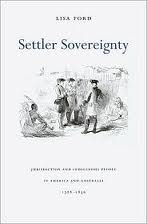
‘Settler Sovereignty’ by Lisa Ford

Lisa Ford ‘Settler Sovereignty: Jurisdiction and Indigenous People in America and Australia 1788-1836’

2010 , 210 p & notes (86p)

I’m starting to think that a good gauge for my response to a book is the resounding slap of the book as I close it, and the whispered “Well done!” or “You beauty!”  that accompanies it.  That’s how I finished Tom Griffiths’ Hunters and Collectors, and it was my response as I finished Lisa Ford’s Settler Sovereignty as well.  I’m not alone: obviously the judges of the 2010 NSW Premier’s History Award felt the same way.

I was lent this book an embarrassingly long time ago, and I have been eyeballing it rather guiltily for some time.  Any of you who follow this blog chronologically may have noticed a  preponderance of reviews of books related to Aborigines in Port Phillip over recent months.  I have been writing a paper that looks at Judge Willis and the Aboriginal cases that came before his court, and I kept deferring reading Ford’s book until I’d finished because the 1836 cut-off in the book’s title was too early for the case I was examining.  How wrong I was: I would have gained so much from this book had I read it earlier.  Ah well.

In this book Ford takes Georgia (in America) and New South Wales as two exemplars of the development of what she calls “perfect settler sovereignty”. By this she means that,  in claiming the territory of the indigenous people who were there before them, white settler governments claimed sovereignty and legal jurisdiction over them as well.  There’s shades here of  Fran in the ABC series The Librarians voicing the same assertion-  “Our Country: Our Rules.”  This had not always been the case.  Both colonies, up until the 1830s, had tolerated plurality through a combination of dependence on native expertise,  uncertainty, impotence, silence  and ‘leaving them to their own business’. But in both colonies this was to change, at much the same time and based on much the same rationales.

We might raise a quizzical eyebrow at this combination of Georgia and New South Wales.  Traditionally Canada, Australia and New Zealand have been linked together as imperial triplets on the basis of their shared relationship with the Colonial Office, especially after the American Revolution sent America off onto a different trajectory.   Certainly during Willis’ time,  Australian judges were viewed as rather suspect if they referred to American law, and they took every occasion to declare their fidelity to British justice.  However, recent work has begun considering American legal conditions alongside those of Canada/Australia/New Zealand e.g. John Weaver’s The Great Land Rush, Peter Karsten’s Between Law and Custom: ‘High’ and ‘Low’ Legal Cultures in the Lands of the British Diaspora and James Belich’s Replenishing the Earth.

In both Georgia and New South Wales, settlers did not seek to govern through indigenous hierarchies (as they did in India), and in both places indigenous people occupied arable or pasture land.  Farming did not proceed through the forcible co-option of indigenous labour, although it did run on imported free, indentured or slave labour.  But there were differences too: Georgia was surrounded by other powers (Spain, France, the Creek and Cherokee Indians), and Georgia used slavery.  There was a multiplicity of treaties in Georgia, and none in New South Wales beyond Batman’s quickly disowned ‘treaty’.  And yet, both Georgia and NSW passed similar declarations in 1830 and 1836 that abandoned the legal pluralism that both had exhibited previously, ruling that indigenous violence fell within the jurisdiction of settler courts.  They used the same legal arguments at the same time, and it is this historical congruence that Lisa Ford sets out to explore.  Her approach is strongly based in legal history and court cases, and this is the lens through which she views the world.

By linking two apparently dissimilar colonies like this, she runs the risk of leaving scholars of one or the other societies bemused.  It’s a testament to her writing that, even though the New South Wales cases were far more familiar to me, I feel that I understood the Georgian cases as well and the parallels she was drawing.  But was there something particularly special about Georgia and New South Wales, or could she have chosen any other American state  and drawn the same connections? I’m not in a position to say. Or, indeed was New South Wales the best Australian example? Henry Reynolds in his review of this book in the Australian Book Review in April 2010 thought that Georgia and Tasmania would have been a better pair for comparison because both societies took up expulsion as a way of solving the ‘problem’ of their indigenous populations.  But I think that Ford is looking not so much at the outcomes of legal actions, as the philosophy behind the legal interventions.

For the most part, her chapters are organised thematically- e.g. pluralism as policy (Ch.2); indigenous jurisdiction and spatial order (Ch. 3); legality and lawlessness (Ch. 4) etc.  She starts each with a general introduction,  examines Georgia, then New South Wales, then draws parallels and distinctions between the two.  This pattern is broken at Chapter 6 where the narrative splits into two separate streams, with what she has identified as a seminal case in each colony.  Chapter 6 focuses on a case in Georgia  while  Chapter 7 looks at the case of Lego’me in New South Wales, tried and found guilty for a particularly petty robbery (of a pipe, no less!)  as part of a more general clampdown on Aboriginal ‘lawbreaking’.  In chapter 8 she then returns to the pattern of  intertwined chapters to discuss the way that 1830 in Georgia and 1835 in New South Wales marked a turning point in settler sovereignty. In both colonies, the claim of settler ‘ownership’ of territory was now offered without question as the rationale for the extension of settler law over indigenous people .   In relation to New South Wales, she goes on to explore the way that this rationale fed into R v Murrell, which has long been viewed as the touchstone case on which all subsequent legal policy in Australia has been based.

She points out that this shift was not restricted to Georgia and New South Wales alone.  Instead it was part of the post-Napoleonic era trend of formalizing or eroding legal pluralism world-wide, including in Europe itself.   She recognizes that by ending with the great cases of the 1830s, she is creating “historical closure where there was none historically” (p.204)- and this is exactly the point at which my own work with Judge Willis fits in.

This is a beautifully written book.  It has a very disciplined chapter structure- an introduction, an argument (clearly bifurcated into the parallel Georgian and New South Wales scenarios) and succinct and thought provoking conclusions.  Fairly conventionally academic, perhaps, but certainly clear. She obviously enjoys language, images and words- she rolls words around, rejoicing in alliteration, repetition and nuance.  We see it where  she describes the imperial network of bureaucrats as they “moved about the Atlantic, Pacific and Indian Oceans with Vattel and Blackstone under their arms” (p.4), and the settlers as “savvy masters of the discourses and politics of settler jurisdiction…eager for its bounties and wary of its gaze” (p. 84).

I’ll leave the last part to her.  She is describing how the flexible pre-1820s plurality that had governed settler/indigenous relations began to chafe against hardening notions of sovereignty:

Again and again, troubled executives and their law officers tried to perfect settler sovereignty by bringing indigenous-settler conflict within the bounds of settler law.  Again and again, they tried at the very least to preserve order in their towns and on the roads that connected them.  Again and again, they were thwarted by indigenous people, by frontier settlers or by local magistrates…The period described here, then, is one of plurality in transition, when a new vision of perfect sovereignty emerged from long-practiced and institutionally entrenched pluralism. (p. 120)

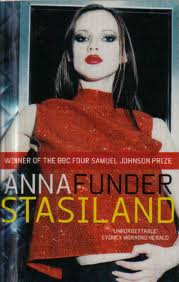
‘Stasiland’ by Anna Funder

2002, 288 p.

(4/5)

Every year for the last five or so years I have put Stasiland onto my list of selections for my face-to-face bookgroup (AKA ‘The Ladies who say Ooooh’). Every year for the past five years, the year elapsed and Stasiland wasn’t chosen.  Ah! But this year IT WAS!!!

I was a little tentative about subjecting The Ladies to yet another of my gloomy selections after subjecting them to The Land of Green Plums about Ceausescu’s Romania last year- what would they think of the Stasi in East Germany this year?  I need not have feared: the narrative was more straight-forward here, and having a young Australian journalist as the first person narrator introduced a familiar voice and viewpoint onto something that, fortunately, is not within the experience of most of us.

Funder, working as a journalist in Europe after reunification, was first attracted to investigating East Germany when a request for a program on the “puzzle women” was brushed aside by the television producers she worked with. There was, it seemed, an embarrassment about the East Germans, as if it would all just disappear if no-one spoke about it.  These “puzzle women”, she later discovered, were employed to reassemble the papers shredded by the Stasi as the wall was falling, a task that would take over 300 years at the current speed.  Methodical to the end, the papers had been shredded in order and shoved into a bag together, and so it was possible to piece them together and reveal the banality and the all-pervasive intrusion of the Stasi into the lives of East Germans.

In East Germany, it has been estimated, there was one informer for every six people.  Some of the surveillance was the stuff of farce, like the  ‘smell samples’ that purported to capture every individual’s smell for later reference.  Other surveillance was more insidious: the reports that were given to potential employers who later changed their mind about the offer of a job; the insistence that there was no unemployment when, as a result of such reports,  one could not get a job; the  warning that a rock group singing subversive lyrics would no longer exist, only to disappear completely from all public view and hearing.  Escapes that were thwarted, imprisonment, blackmail, and the withholding of contact for years with a sick baby on the other side of the wall- by such means the Stasi dabbled in one’s very soul.   There was physical torture as well, but she broaches this only at the very end of the book.  By this time the claustrophobia, vindictiveness and degradation of such minute surveillance seemed on a par with physical torture.

But of course, such intrusion and cruelty leaves no physical trace.  She comments on the memorialization- or more correctly, the distortion of memory regarding East Germany.  She notes the way that East Germans distanced themselves from the Nazis immediately after the war, as if Nazi ideology had flowed from the West and engulfed them, then withdrawn completely afterwards, leaving them innocent of it completely.  She comments on tourist industry that has arisen around the physical fact of the wall- the remnant sections, the tours- that co-exists with a nostalgia amongst some East Germans for the simplicity and security of a life without the bombardment of consumer ‘choice’ and capitalist pressure.  When she places an advertisement seeking ex-Stasi operatives for interview, she encounters men  holding onto the shreds of a Communist dream,  in denial of reunification, and hopeful of the re-emergence of the Stasi.  She finds men who have mounted their own museums to East German life; she speaks to others who have their own justifications for their actions which ring hollow and rather pathetic in a changed world.

The stories of the Stasi operatives and their victims are important, because the Stasi’s reach was not so much in physical things but in the more intangible  sense of safety, identity and autonomy.  There is no museum to hold such things.

I was particularly interested in this book because of the role of the narrator in it.  It is not an academic book as such, and I was surprised to find notes related to specific pages at the end as there had been no footnotes to alert me to their existence.   The narrator is front and centre in this book: we see through her eyes and filter through her consciousness.  At times you need to read against her prejudices- for example, with one man who, as perfect East German man, was moulded this way through his own father’s well-founded fears and insecurities as a dissident, and was to a large extent, a victim as well as perpetrator.  I’m aware of a trend in academic history,  to make oneself part of the story as well, and to use one’s own doubts, questions, misconceptions and false trails as part of the intellectual journey.  I can see its allure as narrative device, but I’m wary.

Funder is not, though, offering this as academic history.  She is upfront about her outsider status, and she documents rather than explains.  It is powerful, chilling reading nonetheless.  Timely, too, as we hear of the Egyptians gaining access this week to their files, many of which had been hastily shredded.  Just as the East Germans before them, they are becoming aware of the size and pervasiveness of the secret police and the complicity of family and neighbours in their midst.

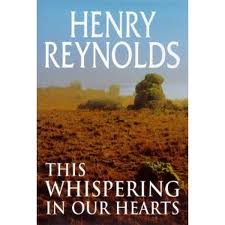
‘This Whispering in our Hearts’ by Henry Reynolds

1998, 251 p.& notes

The title of this book is taken from a speech delivered by Richard Windeyer as part of a 5-night debate carried out  in September 1842.  Henry Reynolds describes the speech, called ‘On the Rights of the Aborigines of Australia’, as “perhaps the most sustained and intellectually powerful attack on Aboriginal rights ever mounted in early colonial Australia.” (p.20).  Certainly it was felt at the time that Windeyer’s speech for the negative side had carried the day:

…we believe it to be the unanimous opinion of the members, that the speech of Mr Windeyer, for the negative, was the most argumentative and logical… He distinctly proved not only that the Blacks have no right to the soil of Australia for want of settled occupancy and cultivation; but that they have no right even to the kangaroos more than we have, the game laws of England agreeing precisely with the great law of nature, that wild animals not confined by enclosure are not, and cannot be the property of any man. (Sydney Morning Herald 12 Sept 1842)

And yet, after denouncing traditional Aboriginal society, and insisting that they had no claim on the land, Windeyer admitted at the end of his speech

How is it that our minds are not satisfied? …What means this whispering in the bottom of our hearts? (cited in Reynolds p. 21)

It’s an evocative term- the whispering at the bottom of our heart- and yet the fact that it was Richard Windeyer who voiced it is but one of the many complexities and contradictions that arise when trying to tease out of nuances of public utterances about Aborigines in the early decades of settlement in Australia.  Reynolds, perhaps, does not highlight the context of the speech sufficiently – i.e. it was argued as part of a debate where one often argues against one’s own beliefs.  Still, it’s hard to pin down Windeyer’s politics,  as it is with many of these 1830s and 40s public men.   Richard Windeyer was a parliamentarian and barrister: he had been at the meeting that established the Aborigines Protection Society in 1838 and yet he had defended the white stockmen in the Myall Creek trials (although there is a limit to what one can deduce from courtroom advocacy).  What are we to make of his position if  his head was telling him one thing and his heart another? In the final analysis, which one matters more?

In this book Henry Reynolds looks at three periods of white humanitarianism: the 1830s and 40s; the 1880s and the period 1926-34.  He deals with a small number of individuals in each period: George Augustus Robinson and Lancelot Threlkeld, Louis Giustiniani and Robert Lyon in the first period; John Gribble and David Carley in the second; and son Ernest Gribble and Mary Bennett in the third.

My interest in reading this book was mainly on his first period, and in many ways the people he considers in this section are the most difficult to reconcile with our own ideas of humanitarianism today.   Like the settlers whose actions they deplored, these humanitarians were likewise steeped in  ethos of colonisation, albeit for different purposes:

It was not that they were against the establishment of British colonies.  They spoke themselves of spiritual empires.  They were zealous to evangelize the pagan, to save the souls of Aborigines and other indigenous people.  They firmly believed they should both civilize and Christianise or at least radically change local cultures. The missionary could be more overbearing, more interfering, more insensitive than frontier settlers and stockmen.  And they were characteristically profoundly self-righteous, often with the fixed stare and intense focus of the convert. (p. 33)

Some writers- for example Lindsey Arkley– would be surprised to find George Augustus Robinson featured here, and Robinson’s role and motivation continues to be contested territory among historians.  Importantly, Reynolds charts the differences between 1830-40 humanitarianism and the humanitarianism of the 1880s.  A much changed intellectual climate and two generations of colonization meant that by the 1880s there was no longer any assertion of racial equality based on the biblical notion of shared descent and common blood.  It was taken for granted that Aborigines were members of an inferior race, and many assumed that they would eventually die out.  The horror of shedding blood, so prominent during the 1830s, had moderated and it was now seen as a regrettable, but unavoidable accompaniment to colonization.  Colonization and development were now a justification in themselves.  (p. 112, 113)

Reynolds reminds us that there have always been humanitarians- people who were willing to raise their voices and inured themselves to the abuse and obloquy  that they attracted.  But he also reminds us that these humanitarians of the past were for the most part unsuccessful:

… Australians of today who find comfort in the history of the humanitarian crusade should reflect that the protesters had little influence on events. Their assertions, however cogent, their moral appeal however persuasive, were largely ignored. Arguments forcefully put in the 1830s required restating in the 1930s. Many are still relevant today.  What the humanitarian story shows is that an alternative agenda was aired, a more humane course projected, was listened to, understood and then comprehensively rejected, often with derision  (p. 249)

The little moral force that they could exert often depended on overseas support- the Anti-Slavery society, the Aborigines Protections Society and various Colonial Office pressure groups in the 19th century and the League of Nations in the twentieth.   Access to the press  was crucial and skillfully used by many of these humanitarians: a sobering thought in our Wikileaks days.

And finally, and most importantly when looking at the 1830-40 period, our idea of what humanitarianism looks like is different.  We tend to shuffle away and distance ourselves from the “fixed stare and the intense focus” of such men (used intentionally), and there are statements in their rhetoric that send alarm bells ringing in our heads.  We would do well to remember:

The humanitarians were often paternalistic/maternalistic and shared many of the ideas that were current in their generation.  Some of them undoubtedly were racists in the way we understand that term now.  They were people of their period.  But if inquiry and understanding stops there we miss the passion for justice, the anger about cruelty and indifference which drove humanitarians along lonely, thankless and unpopular paths (p.251)

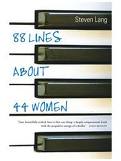
’88 lines about 44 women’ by Steven Lang

2009, 257 p

(4.5 /5)

This is a damned good book.  I hadn’t heard of it at all until Lisa at ANZLitLovers reviewed it. I liked the title and, self-willed exile from the land of new wave music that I am, I didn’t realize that it was the name of a song by The Nails that has moved into its second generation with a recent digital remastering.  The author does mention this in passing, which is just as well because I’d been wondering where the other 41 women in the book were. In fact I’ve just realized that,  like the remastering of the song that gives the book its title,  in this book we are seeing an old event re-lived and re-enlivened many years later.

There may not be forty-four women, but there are three women in this book, with the shadowy presence of many more.  We meet the most significant one in the opening pages of the book- and what a jolting opening it is, drawing you right in- and she dies right there within the first chapter.  For the next twenty years her husband Lawrence (Larry)keeps returning to her death, shamed and shrunken by it. He had been the keyboard player in a successful rock band: she had been a TV soapie star. He’d had a peripatetic life: boarding school education, Scotland holidays   with his boarding-school friend Roly who later cajoled him into joining him in Australia where their musical career began, and touring with the band on the fringes of international stardom. Twenty years later he is back in the  Scotland highlands, leasing a cold and isolated farmhouse to work on his music again more seriously, facing medical problems and still paralysed emotionally by Gizelle’s death.  There had been a New-Age lover in Byron Bay who filled his head with psychobabble, and now in Scotland he meets Sam, a self-reliant, fiesty single mother.  She learns, independently, of Gizelle’s death and bridles against his secrecy over it.

The book itself is divided into three parts marking the three days since Sam confronts him after learning about his first wife’s death.  Within these parts, Lang traverses back and forwards across the  twenty years since Gizelle’s death, Larry’s childhood, his emergent relationship with Sam, his relationship with his elderly parents and his rock star lifestyle.  I’ve been complaining lately about books with short, hyperactive ‘chapters’ that lurch the reader from one narrative viewpoint and location to another.  There’s none of that here-  Larry as the narrative voice is leisurely, discursive, emotionally complex and ultimately unreliable.  After a gripping beginning, the story unspools almost effortlessly with beautiful descriptions of landscape and a vulnerable, damaged masculine consciousness.

This book had me in from the very beginning.  It was shortlisted for the 2010 Christina Stead  Prize for fiction and the Queensland Premier’s Award.  Lang has given us an assured, pitch-perfect work that would have been a worthy winner.

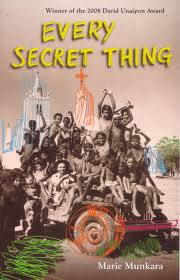
‘Every Secret Thing’ by Marie Munkara

2009, 179 p

(3.5 /5)

Before I talk about this book, a word first about humour, and aboriginal humour in particular.  Inga Clendinnen closes her analysis of the very earliest days at Port Jackson in her book Dancing with Strangers with an observation about humour as a means of connection between black and white Australians.  (Among historians, there’s often an anxiety about nomenclature for aborigines/Indigenous/specific tribal name/Aboriginal Australians- and to a lesser degree for whites/British/settlers as well.  Clendinnen settled on the term ‘Australians’ for the former, and ‘British’ for the latter, recognizing the limitations of both terms.)  But humour, she suggests, has been a bridge:

There remains a final mystery. Despite our long alienation, despite our merely adjacent histories, and through processes I do not yet understand, we are now more like each other than we are like any other people.  We even share something of the same style of humour, which is a subtle but far-reaching affinity.  Here, in this place, I think we are all Australians now. (p.288)

And so I come to Every Secret Thing by Maria Munkara, which was awarded the 2008 David Unaipon Award. It’s only a small book at 179 pages, and while it’s not, and does not claim to be,  high literature, it’s an important book nonetheless.  It is a series of tales set around an Aboriginal mission in far northern Australia with the Mission mob, the Catholic clergy, trying to convert the Bush mob who lived just outside the Mission.  The Bush mob move back and forth between the arbitrary strictures and efforts of the  clergy and their own more grounded life outside.  They are clear-eyed about the hypocrisy and smallness of these white priests and nuns, but they are also painfully aware of the degree of control that the mission has over their lives.

The stories are self-contained, but there is a broader chronological arc that runs through them, particularly in the second half of the book.  Hippies with marijuana arrive amongst the Bush mob, a mission is established for the ‘half-caste’ children who are taken from their families and sent into domestic service,  and just occasionally a child returns to the mission but cannot find her place back amongst her family again.  And finally a couple of the Bush mob men confront Father Voleur of the mission, “asking that the mission mob leave because no-one wanted them there any more” and were told to bugger off:

So began the slow downwards spiral of despair…Then the grog came and the winding path of good intentions became a straight bitumen four-laned highway that led even deeper into a world of self-destruction and hopelessness that no-one knew how to fix.  And then more and more people began to leave unexpectedly without goodbyes or explanations and a sorrow so deep that no-one could see an end to the despair descended upon them and they’d be found hanging  from trees or electrocuted by the power lines and the cemetery had to be made bigger to accommodate the unexpected influx of new residents.  But there was one thing they were certain of.  They didn’t have to die to go to hell because the mission had happily brought that with them when they’d arrived unasked on the fateful shores of the place that was their heaven all those years before. (p. 179)

This stab of pain runs throughout the book, right alongside slapstick and send-up, derision and wry irony.  Yes, there were places where I laughed out loud in this book (a 2.5 on my 4-point  laughter scale) and  Munkara’s  real skill  is to write so that, after reading a comic scenario, your smile freezes as the underlying pain and cruelty of what she is describing seeps into you.  It is a quick, deft, cutting wit.  There’s anger here too: an almost shaking rage at the inhumantity of separating the ‘half-caste’ children from their families into the ‘Garden of Eden’ mission on a nearby island.

But time has a way of covering all wounds with scar tissue, and the little abductees eventually settled down into their new life away from their homes and their families….But if the nuns at the Garden of Eden knew about the scars they certainly didn’t show it as they worked relentlessly to shape the unruly half-caste rabble into obedient and God-fearing servants of the muruntani [whites].  No rod was spared or abductee spoilt in the process as the little coloured kids were repeatedly chastised and flayed until prayers and hymns and excerpts from the Bible were slowly absorbed by rote into every fibre of their being.  And when they were eventually knocked into shape they were passed on to caring white families as domestics and the like because, let’s face it, the mission mob knew these useless individuals would never amount to anything else.  In order to control them many of the good Christian families duly followed in the incarcerators’ lead by perpetuating the violence, sometimes throwing in a few more tortures for good measure like rape and mental abuse, because this was the only thing this half-caste lot understood.  A few even had to be sent back to the mission because they just didn’t seem to respond to the kindly ministrations of their new families and kept trying to run away or told wild stories to people about their treatment.

It was sad really. (p81)

Sad, sad indeed. There’s anger at the hypocrisy by which the Mission mob decided that  a white woman, Odile, who had a ‘half-caste’ child called Treasure should be allowed to keep her own child:

And didn’t the anger of the bush mob bubble away in their guts as they grumbled at the injustice of it all.  The more erudite had reasoned that if they had to hand over their coloured kids then why shouldn’t Odile.  No matter that the mother wasn’t black, the kid was still coloured, wasn’t he, and everybody knew what happened to them. (p. 137)

But Father Macredie found a way to rationalize himself around this:

…there’d be no way he’d be taking young Treasure away from his rightful parents and the bush mob would just have to accept and understand that.  Despite Treasure’s coloured skin, he would always be white on the inside not like their kids who would always be black on the inside- and that’s where the difference therein lay. (p. 138)

This sounds bleak, and it is bleak.  But just as importantly, there is humour here too, and the author’s photo on the front page shows that.  The pettiness of the Mission mob is skewered, but with almost a sense of pity. There is a generosity of spirit among the Bush mob that is often completely lacking amongst the nuns and priests who have such power over them. It’s the ridicule of pomposity and the refusal to take things too seriously that reflects the humour that Inga Clendinnen noted.   We see it in the recent musical Bran Nue Day, and it’s there in the term ‘Moomba’ (meaning ‘up your bum’) offered up as an aboriginal translation for ‘let’s get together and have fun’ for the founders of  Melbourne’s festival some fifty years ago: a scenario repeated in this book where an earnest ethnographer is tricked into recording a string of expletives and obscenities as ‘authentic’ language.  But make no mistake amongst the derision and send-up, the mission mob do hold the power here, but it’s a hollow and ultimately unstable victory.  And I’m glad that it is.

Some other links:

Blog review from Musing of a Literary Dilettante

Interview with the author by Bob Gosford on Crikey

Biographical information about the author

‘The hated Protector’ by Lindsey Arkley

2000, 469 p. & notes

Lindsey Arkley The hated Protector: The story of Charles Wightman Sievwright Protector of Aborigines 1839-42. Mentone Vic, Orbit Press, 2000.

Charles Sievwright is an ‘interesting’ man from 170 years distance, and was certainly controversial and combative at the time.  This biography of Sievwright examines his time in the Port Phillip District as Assistant Protector for Aborigines in the western district of Victoria between 1839-1842.  Lindsey Arkley, the author, also wrote Sievwright’s entry in the Australian Dictionary of Biography.

The Aboriginal Protectorates were an experimental measure, urged on the Colonial Office  in London by the evangelical pressure groups concerned about the treatment of indigenous subjects throughout the empire.   They were established as a secular adjunct to the church missionary system and comprised a Chief Protector and several Assistant Protectors. They were given the remit to firstly, protect indigenous people from settler cruelty and secondly, assist the church-based missionaries in converting Aborigines from a wandering and barbaric state into sedentary,  ‘civilized’ Christians.   The inland areas of the  Port Phillip District had only been recently exposed to widespread settler incursion, and it was rather optimistically hoped in London that this could herald a new and better approach.  It was an experiment imposed on Governor Gipps in Sydney and his local superintendent in Melbourne, Charles LaTrobe, and in the absence of any clear vision of how it would work in practice, George Augustus Robinson was appointed Chief Protector on the basis of his work in Van Diemen’s Land.  Unlike the other Assistant Protectors who were school teachers, Charles Sievwright had a military background and used his admittedly rather impressive patronage ties to get the position after some rather dubious gambling problems back in Europe.

It was a position fraught with tension, ambiguities and contradictions, even without the added complication of the deeply flawed individuals who were chosen to fill the roles.  Chief Protector Robinson was variously jealous, ambitious, inefficient, blustering, out of his depth and conflicted, and the Assistant Protectors soon began fighting both with Robinson and among themselves over lack of supplies, perceived lack of support, ambiguous instructions and – importantly for Sievwright- rumours of sexual impropriety.   In Sievwright’s Port Phillip career, and in his subsequent dismissal, these rumours of sexual misconduct including domestic violence, attempted seduction of other Protectors’ wives and most damaging of all, incest with his own daughter bubbled underneath all his interactions with his superiors, other bureaucrats, and the white settlers who resented his presence in prime grazing territory.

This is a very long biography at over 400 pages dealing mainly with three years of Sievwright’s career in Port Phillip, although the ‘before’ and ‘after’ are dealt with in the opening and closing chapters.  Arkley has drawn heavily on official correspondence, particularly the letters written to, from and by La Trobe and the local bureaucracy and the resultant reports between and by Gipps and the Colonial Office.    This is territory that I have been likewise wading through with my own research, and seeing how Arkley has dealt with it has made me more reflective about its value and limitations as a genre and source.  He has published much of this information in a much more accessible form than the originals, and been punctilious in his footnoting, but there is so much of it and often over so little.   This is something that I have likewise struggled with, in both a narrative and methodological sense.   Arkley reproduces the texts and has placed  the ‘controversy of the moment’ (and there were many!) within its context, but much of this is ‘he said/he said’ reportage.

Arkley started each chapter- and there are (too) many at 35 of them- with a few brief, interest-arousing observations but these are fairly general, often rejoicing in coincidence and juxtaposition and not always particularly relevant to the chapter.   In Arkley’s telling there are clearcut baddies- “Flogger” Fyans, Robinson, and the duplicitous La Trobe and Gipps- and one senses that Arkley’s purpose is largely to rescue Sievwright’s reputation from their clutches.

But in doing so, there is no scholarly discussion of the protectorate system and its ambiguities and no exploration of the meaning of the sexual scandal and its relationship with the other grounds given for Sievwright’s dismissal.  Perhaps this was not Arkley’s intention: I see in the blurbs that the book was embraced by local historians and Arkley himself works as a journalist.  Other historians have picked up on Arkley’s work- in particular Alan Lester and Fay Dussart in their article “Masculinity, ‘race’ and families in the colonies: protecting Aborigines in the early 19th century” [1] who thank him directly in their Acknowledgments.  I’m sure that Kirsten McKenzie [2] would do much with  Arkley’s work on Sievwright as well.

Is it valid to critique a book for what it doesn’t do, and perhaps even had no intention of ever doing? I’m not sure.  After all,  we stand on the shoulders of other researchers, and there is certainly value in Arkley’s collection and reproduction of much of the archival material on Sievwright.  His footnoting is excellent, and I’ve been able to find many of the sources he cites.  But at times I found myself wary of his clear attempt to promote and rehabilitate Sievwright’s reputation, and found myself having to read against Arkley’s text for much of the time and wanting to prod him a bit further.  Sometimes a bit of ambiguity and scepticism is not a bad thing.

Notes:

[1] Alan Lester and Fay Dussart ‘Masculinity, ‘race’ and families in the colonies:  protecting Aborigines in the early 19th century’ Gender Place and Culture, vol 16, no 1, 2009 pp.  65-76

[2] Kirsten McKenzie Scandal in the Colonies: Sydney and Cape Town 1820-1850 Carlton Victoria, Melbourne University Press, 2004

Also:

Ian D. Clark The Hated Protector: The Story of Charles Wightman Sievwright Protector of Aborigines 1839-42 [Book Review]  Aboriginal History, Vol. 24, 2000: 305-313.

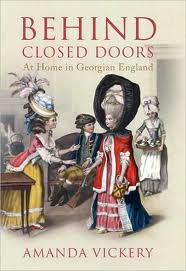
‘Behind Closed Doors: At Home in Georgian England’ by Amanda Vickery

2009,  307 p & 84 p. notes, bibliography and index

At a stretch I could say that this is ‘work’ reading, but the reality is that I just wanted to read it after reading The Gentleman’s Daughter last year.  I can, however, justify this little excursion.  As I  move away from researching my Judge Willis’ time in Port Phillip back into his earlier postings and life, I’m having to look at him in a domestic sense as well as father, brother and patriarch.  I’m aware that he is a Victorian man in that he died in the 1870s, but particularly in the 1820s and throughout breakup of his first marriage, he’s operating within the values of the ‘long 18th century’ which stretched up to Waterloo and even the Reform Bills of 1832.  But to be honest, I read this book just because I wanted to.

In her introduction, Vickery describes her intent:

This book takes the experience of interiors as its subject, staking claim to an uncharted space between architectural history, family and gender history and economic history.  It brings hazy background to the fore to examine the determining role of house and home in power and emotion, status and choices. (p.3)

In many ways this book is an extension of the arguments Vickery mounted in The Gentleman’s Daughter, grounded in domestic artefacts and consumer choices.  She reprises her arguments here: that the separation of domestic and public spheres for men and women is not as hard and fast as has been suggested; ideas tend not to emerge suddenly but instead evolve over time; that ‘turning points’ are often misleading and that

More helpful in my view is to disentangle the persistent and the newly emergent in the jurisdictions of both men and women. (p. 301)

This book explores the concept of ‘home’ in Georgian England- not necessarily the ‘house’ but ‘home’ in a psychological as well as physical sense. It  covers much the same chronological and social territory of her earlier book with a focus on the lesser gentry and the family members who slip between the more clearly defined roles: the widows, the unmarried daughters and sisters and the bachelors.  In a way, she is bringing the masculine back into the domestic.  She argues that although structurally and legally women were subject to their husband’s authority, within the home and domestic arrangements there was a more co-operative arrangement.

She uses a fascinating and exhaustive array of sources: the diaries and letters as you might expect, fiction (especially Austen and Gaskell) ,  but also court records, business letters and  account books.  These latter were an important find.   She could locate only three examples where she had the account books that documented the spending of both husband and wife, and although at first glance they appear to be just a list of outgoings, she draws so much more out of them.  It was the women (in this admittedly very small sample) who paid the servants’ wages, food, paid the children’s clothing and schooling expenses and especially paid for the linen, while the husbands paid rates, taxes and especially horse tackle- a huge expense which she likens more to the upkeep of a helicopter than a car today.  This differentiation in finance reflected a larger bifurcation in responsibilities and interests: masculinity was allied with formal grandeur, landscaping, silver and mahogany while femininity expressed itself through flower beds, ornamentation, textiles and ceramics.  Although women were often derided as spendthrifts, it was often men who indulged the big luxury purchases. But it was not a clearly defined ‘his’ and ‘hers’ at play: creating a home was often a shared endeavour and one that men, by themselves, felt quite at a loss to perform alone and they craved domesticity rather than feeling stifled by it.

She makes the interesting point that in a time of written orders, people had a vocabulary for describing exactly what they wanted.  (Ironically, with the rise of internet shopping we’ve returned to depersonalized shopping where we no longer finger and weigh the goods we buy but depend on image and words again.)  This was particularly well illustrated on her chapter on wallpaper, where again, she uses an unusual archive with flair and imagination- in this case, an otherwise rather boring archive of business correspondence to a wall-paper company in London.  She combs over these outwardly functional letters, noting language like ‘neat’ and ‘pretty’  and how it captured aesthetic judgments and charting, over time,  the way that wallpaper styles became more gendered.  But, she emphasizes, the decision making over purchases was shared- even where letters were written by men, their women’s input was clear.

She starts her book with the almost stifling claustrophobia of so many people living within the Georgian house- the maiden aunts, the boarders, the servants- and the practice of the householder in going round at night, locking people into their rooms as well as securing the front door and windows.  There is not much privacy here- physical or psychological.  Her chapter on bachelors acts almost as a counterpoint to her earlier work on the Gentleman’s Daughter.

This is a beautifully illustrated book, with very well chosen illustrations that are signalled well and clearly in the text, and which really add to the reading experience.  Vickery often starts the chapter with a little vignette that perks up the interest anew, and she has key characters that she returns to in different chapters.  I had felt in The Gentleman’s Daughter than I hadn’t been introduced well enough to her main informants: in this book, she draws on a wider cast but I felt more comfortable with them all, probably because she introduced the specific exemplars at the beginning of each chapter and didn’t relying on them so much to carry the argument of the book as a whole but just that chapter.  When you meet them again in a later chapter, it is an unexpected surprise.

There’s a podcast with Amanda Vickery here on the publisher’s site and a Guardian review of the book and one from the New York Times as well.  Reviews in History has a perceptive review, along with Vickery’s response. It would seem that I’m not alone in my admiration for the book.