Category Archives: Book reviews

“A Search for Sovereignty” by Lauren Benton

2010, 300 p & notes

Lauren Benton A Search for Sovereignty: Law and Geography in European Empires 1400-1900

As a 1960’s schoolgirl, there was something rather comforting about all that red (or was it pink? or just faded?) territory on the map of the world that graced every classroom.  So much red; so neat and decisive.  In the same vein,  I think that John Howard was also drawing on the soothing idea of defined borders- so easy in an island continent- when he thundered that “we will decide who comes to this country and the circumstances in which they come”.

But as Lauren Benton argues in this book, borders (even for islands) are porous and contested. Although laws might be passed to regulate who comes, they often cannot be enforced-  or I’d suggest can only be enforced at significant financial and moral cost.  Nor did all that red on the map unfurl in an orderly, deliberate fashion.  Instead,  European control in new colonies was often “lumpy”. It was thick along river-banks, but sparse to non-existent inland; harsh on islands; cocooned in enclaves; and subsumed by the larger ‘law of the sea’ in open waters.

Benton divides her book into four geographical sites: rivers regions, oceans, islands and hill enclaves, and she ranges across a number of European empires to illustrate the contingent, fragile and contested nature of legal authority in these settings.

Rivers were “corridors of elusive but essential imperial control” and counterintuitively, it was the law of treason that colonists wielded against both whites and indigenous peoples perceived to be hindering exploration.  Quite a deft legal move there: using the crime of treason against people to whom legal protection was not offered!

She depicts the oceans as an even legal space, divided into long, thin zones of imperfect control that connected port towns, coasts, garrisons and islands.  Pirates and privateers drew on several competing legal regimes in drawing up commissions and in transacting privateering schemes, and they operated in the margins of the distinctions between the right to navigate and the right to exclude others from navigating.

Islands were used by empires as sites of exile with their own anomalous legal regimes (Van Diemens Land, Norfolk,…Guantanamo, Nauru,  Manus….) underpinned by military discipline of civilians and justified by evocations of vaguely defined emergency.  In such places,

…nature would corral criminals, military rule would ensure order, and systemic violence would respond to vaguely defined necessity (p.220)

Hills, too, were defined either as sites of lawlessness (think bushrangers in VDL, the maroons in Jamaica) or purity (Indian states- even Shangri-la??) and often became little enclaves, carved out and separate from surrounding legal, social and political regimes.

The structure of this book works well in explicating  the argument by jolting the reader loose from a focus on a particular territory or  empire. Instead, it ranges across the globe in exploring a geographical rather than territorial topic, and it includes Spanish, Dutch, English, Portuguese empires.  The structure also works chronologically as well, and the book ends with a  reminder of current fault lines between geography and law: the contentious status of Guantanamo Bay, the bare sovereignty offered to Iraq and Afghanistan, jurisdiction within US Indian reservations, and part-sovereign enclaves like Gaza.
‘The Lake Shore Limited’ by Sue Miller

2010, 270p.

“The play’s the thing!” announced young Hamlet, and the play’s the thing in this book as well.  But it’s not Denmark, instead it’s Boston, but as with Shakespeare’s play-within-a-play, the theatre acts both as a focal point of the work, and as a teller of truths to writer, audience and actors alike.

The play at the heart of this novel is written by Billy, a young ambitious female playwright.  It is opening night, and she has invited Leslie, the older sister of her former partner Gus to the performance, and she and her husband bring with them Sam, a twice-married divorcee as a bit of diffident matchmaking.

Billy’s partner Gus had died in one of the planes that crashed into the World Trade Centre on September 11, and so Leslie was discomfited by Billy’s new play that focussed on a man whose wife was on a train- not a plane- that was bombed.  The marriage was unhappy, on the verge of breakdown, but their family and friends did not know this.  When news came of the bombing, he was caught between numbness, elation, relief….many emotions, but none of them clearcut.  Although Billy declared that the play was not autobiographical, Leslie found herself wondering about her brother’s partner, and whether she too, felt ambivalent. Billy’s relationship with the now-deceased Gus was, indeed, tenuous and there was far more autobiography in her play than she realized.

The story is told in alternating chapters that move between Leslie, Billy, Sam, and Rafe, the lead actor.  Sam and Rafe have had their sadnesses and ambivences about their own wives too: Sam’s first wife died of cancer and his second marriage fractured quickly, and Rafe’s wife has motor neurone disease.  So, as you can see, it is a play-within-a-play that sets off the emotional tripwires in all its characters.

I like Sue Miller, and I was rather surprised (and pleased) to see that, over about twenty years, I have read nearly all of her books although I’ve only reviewed one here on this blog.  I feel almost as if I have grown up with her, as her books have moved from young mothers with new lovers, share houses, neighbours, and now aging baby-boomers.  I’m not aware enough of American geography to be able to locate them exactly, but they’re east-coast, suburban, middle-class, educated settings and there is often snow, lighted windows, and deciduous trees. I’m sure that all her characters would vote Democrat.  She often has ‘pairs’ in her novels: contrasting characters and situations that are played off against each other.  They’re the sort of book that could easily be graced with a ‘Women’s Weekly Great Read’ sticker, with all that denotes and yet there’s a bit of an edge to them as well that makes them more than this.

But I didn’t enjoy this one quite as much.  I found myself becoming annoyed at the frequent backgrounding and reminiscences. Admittedly, perhaps as her baby-boomer characters age, there’s more back story to draw on, but I felt that it was overdrawn here.  She has always had a very good eye for detail, but there’s a narrow line between building up texture and burdening with minutiae. I’m not sure that perhaps it wasn’t crossed in this book.  So with regret, I have to admit that this particular Sue Miller didn’t quite do it for me.

My rating: 7.5/10

Read because: I do like reading Sue Miller’s books

Sourced from: Yarra Plenty Regional Library

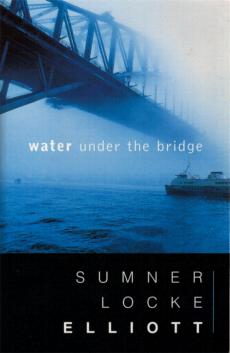
‘Water Under the Bridge’ by Sumner Locke Elliott

1977, 367 p.

After I finished reading this book, I got to thinking about the marvel of reading: that somehow those printed words on the page become an internal experience of seeing, hearing, even smelling that somehow the reader generates for herself in her own head, and yet can be shared with others who have read the same book.  It was only when I arrived at bookgroup last night, fresh from finishing reading it the night before, that I realized that my fellow book-groupers felt very much the same way.  Perhaps there’s something special about this book.

Water Under the Bridge is a very consciously plotted book.  It begins and ends with fireworks and a party- at the opening to celebrate the opening of the Sydney Harbour Bridge in 1932 and at the end to celebrate the Sydney Opera House some forty years later.  In the opening party scene, he introduces all the main characters: the wealthy, socialite Mazzini family, Neil Atkins the restless and dissatisfied actor, the rather pathetic middle-class Flagg sisters, Maggie McGhee the journalist and Archie Ewers, an insufferable little bully.  At first this deluge of characters seems overwhelming, but they soon distinguish themselves one from another as he traces through their trajectories in the four parts of the novel. The author was well-known as a screen writer and playwright, and you sense how well this book would translate onto the screen (where, indeed, it did end up as a miniseries).  His characters do veer a little too close to caricatures but he  gives them enough depth to rescue them from this fate.  Somehow, in a book with many characters, it’s hard to label any of them as “minor”.   He has a keen ear for language, and is highly attuned to class distinctions in our so-called classless Australian society.

Looking at the book 35 years after it was written, it is a good social history- perspicaciously so.  His descriptions of the opening up of experience for women and gay men during World War II Australia fit in very much with the current historiography, and his marshalling of small details from his own memories and experience is impressive.  It evoked many other books for me-  George Johnston’s My Brother Jack, and F. Scott Fitzgerald’s The Great Gatsby– and it didn’t suffer by comparison with these literary heavy-weights.

I’ve only read one other Locke Elliott- Careful He Might Hear You, and I don’t know why I waited so long to read another one.  One day I’d like to read his biography too- Sumner Locke Elliot Writing Life.  The introduction to the thesis on which the biography is based is available here and this review of the biography gives a hint of the man: gay, expatriate, brought up by his aunts- all themes that he mined heavily in his fiction.  I waited twenty years between reading my first and second Sumner Locke Elliott.  I won’t wait that long to read my third.

My rating:  9/10

Sourced from:  CAE bookgroups

Read because: it was the October book for my bookgroup.

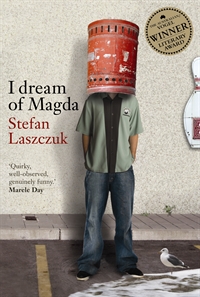
‘I Dream of Magda’ by Stefan Laszczuk

2008, 270 p

When I read the blurbs on some books, I sometimes find myself wondering whether I read the same book as the reviewer did.  “Quirky, well-observed, genuinely funny” wrote Marele Day about this book.  The first two I concur with, but I found very little humour in the book.  It seemed achingly sad to me.

George and Matthew Harrison are two twenty-something brothers sharing a house.  Both are wounded, damaged young men.  The narrator, George is not exactly the sharpest knife in the drawer, and he works amiably enough in a dead-end job at a bowling alley washing dishes and doing other odd and demeaning jobs around the place.  His boss takes advantage of his acquiescence, placing the reader in the uncomfortable place of watching injustice at a distance, unable to intervene.  I sorrowed (because I was reading as a mother of young adult children no doubt) at the obsessiveness and desperation with which he  grapples with his break-up with a girlfriend who, frankly, seems much brighter than he is, and at the rather brittle bravado with which he props up his self-esteem. His older brother Matthew is recovering after a car accident that killed his girlfriend.  He’s not eating, he’s sleeping too much.  He’s not doing well.  The boys’ father had committed suicide; their mother has her own strangeness.  So, in all, not a lot to laugh about here.

The triumph of this book, I think, is George’s voice.  There’s a danger in having such a flawed, unconscious narrator in such a look-away situation, balancing the reader’s discomfort and even embarrassment for the teller, with enough sympathy to keep reading, almost with a sense of concern for him.  The book is written in the first person present tense, which I always find a rather oppressive and intrusive style, but I think that it works well here.

There are no chapter divisions, but the book is written in three parts. It starts with a short prologue. The narrative is broken up by dream sequences, without punctuation, unevenly spaced and told in disconnected snatches, as dreams often are.  There’s some beautiful, plaintive writing here that balances the rather plodding, impoverished real-life of daylight.

I feel a bit embarrassed to confess this, but I misread the dream sequences until almost the closing pages of the book, attributing them to the wrong brother.  When I looked back, I found that it is clearly identified who is dreaming in the opening pages, but I missed it- or perhaps the characters were not well enough established at that point? It was a rather strange experience being jolted to realize that the dream sequences were not what I thought they were, so late in the book, and considering what change that made to the way I had read and interpreted them.  I had felt rather foolish, but then I looked at the title again, and realized that the “I” in the title is a bit misleading too- so perhaps the fault is not all mine- or was the ambiguity intentional?

So, for me, I was led into an unexpected detour into a consideration of my own reception of the book as a reader.  Adding to this reflexivity- from the writer’s perspective this time, rather than the reader, is the fact that it was written as part of a PhD in creative writing, and won the Vogel Award for an Unpublished Manuscript.  [As an aside,  I must admit to being a little perplexed about the conjunction of an academic award for writing intended as a commercial product- not just for this book, but generally.]

The thesis containing the original book- not the ultimately published one- and his reflections on the writing process are available through the University of Adelaide website at http://digital.library.adelaide.edu.au/dspace/handle/2440/52229

[ A further aside: The availability of theses online is an interesting development- especially when considered against the commercialization of research which is being pushed so heavily.  I recall being advised strongly against putting a copy of my thesis (hah! that it should ever be written!) online because it would jeopardize the chances of having it published (hah! that it should ever be published!). I see that at my university, it is now compulsory to make a digital copy available, accessible in full through Trove.  While I’m well aware that a thesis and a book are two different creatures; while I’m also conscious that taxpayers’ dollars go into supporting postgraduate research; while I welcome with wide open arms the thought of being able to access recent research from universities right across the globe…. all these things- I’m aware that it’s not at the forefront of your mind when you’re actually writing the thesis.  It’s probably even more of an issue when the product of the thesis itself – a book, a piece of music- is written with an eye to its commercial value from the start?]

The abstract of his thesis reads:

People who write books are invariably asked how they do it, by people who read them, in a similar way, for example, to how pilots might be asked ‘How do you fly a plane?’ by passengers who couldn’t imagine steering several tonnes of metal through the sky at 30,000 feet. Although there is a consistent, if complicated, logic to the flying of planes, I’m not sure there is a definitive one with regards to writing books. Creative processes, in whatever genre, are by their own nature constantly evolving and redefining their own boundaries. I decided to remain acutely aware of the creative processes involved with writing the novel for my PhD, ‘I Dream of Magda’. I also made note of external inspirations and practical considerations I encountered along the way. This resulting exegesis is an attempt to explore the genesis and creative evolution of my novel. Specifically, it will address the various challenges and benefits involved in writing the novel to a predetermined form, which, in this case, was the musical form ‘sonata’, adapted for literary expression. In the end, it may not be any more helpful in addressing a general question on how to write a book, but it should go a long way to explaining how the initial idea for this book, in particular, took off and eventually flew at 70,000 words.

Very interesting reading- especially in light of my own response to the book.  The completed, published book stands perfectly well and confidently on its own two feet, but I found it fascinating to read the author’s reflections on the book that it could have been, and the changes that he made to it along the way.

My rating: 8/10

Sourced from: Yarra Plenty Regional Library

Read because: I had heard about it- and was puzzled by the title.  Is it THAT Magda?

‘3,096 days’ by Natascha Kampusch

240 p. 2010

I must admit to ambivalent feelings when reading this book.  Was my interest prurient and unworthy, or was I honoring her own story, given in her own words, above the use that journalists might make of it?  What ever my motivation for starting the book, I found it a distressing read and yet I felt that I owed it to her to finish it. The events that she wrote of made me often feel as if I was suffocating.  Unlike this poor, captured child, I knew that there would be a ‘happy’ ending, and I marvel at her ability to transcend let alone survive this ordeal.

Natascha Kampusch was kidnapped by a stranger at the age of ten while walking to school, bundled into a white van, then kept in an underground cellar for eight years.  In many ways her abduction is a text-book example of the warnings that children were given in that time when children did walk to school (as distinct from being driven by their parents).  The darkness, constriction and the incessant sound of the exhaust fan bringing air into her room were physical imprisonments, but there was also the emotional manipulation as well where her kidnapper oscillated between being her provider, saviour from worse fates, abuser, companion, domestic martinet and jailer.  It is probably the intermingling of these roles that renders Kampusch unable to see her kidnapper, Wolfgang Priklopil, only as a monster. He committed suicide on the day she escaped.  She angrily rejects her compassion and ambivalence towards him being characterized as Stockholm Syndrome, arguing that this denies her the right to analyse and describe for herself the complexity of the relationship.

There are no pictures in this book, and I think that I am glad of that. Instead, we have her own words, and her own story.  She is owed that.

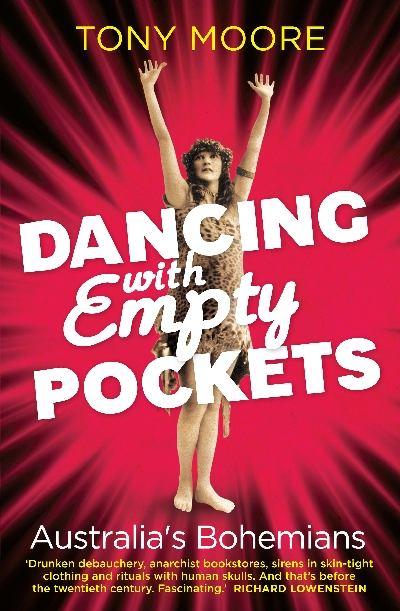
‘Dancing with Empty Pockets: Australia’s Bohemians’ by Tony Moore

2012, 351 p

Thanks to the vagaries of the hold system at my library, I read this book shortly after reading Melissa Bellanta’s book Larrikins: A HistoryAs with Bellanta’s book, this one too was adorned with the label on the spine describing it as ‘Travel and Culture’, and both books explored in different but complementary ways the appropriation of the term ‘larrikin’.  Bellanta’s book is much more accessible and person-based than this one, which is based on the author’s doctoral research, more heavily freighted with theory and hence requires more concentration.  But it’s worth it.

Moore looks at bohemianism as a mindset and abstract phenomenon, and locates its starting point with Henri Murger’s 1851 book Scenes de la View de Boheme ,  based on the author’s own lost youth amongst the  unconventional and impoverished aspiring writes, painters, poets and philosophers of the Latin Quarter of Paris.

Moore commences his study of Australian Bohemianism with Marcus Clarke, who is better known today for his book For the Term of his Natural Life than for his voluminous press writings or lifestyle.  Clarke adopted the stance of the urban flaneur, strolling observing and reporting about town, playing the dandy, joining mock clubs and,  descending into ‘lower bohemia’ for brief excursions. Clarke preferred the city to the bush, but this was reversed by the ‘bush bards and artist heroes’- the Heidelberg School of Artists, Lawson, Dennis, Lindsay et al- who identified with and drew upon the culture of both town and country workers. Here is the crossover with Bellanta’s work where Lawson and Dennis romanticized and sentimentalized the urban, delinquent larrikin culture, and identified themselves as having a softer, cosier ‘larrikin streak’.  Moore explores the overlap between bohemianism and radical politics at the turn of the twentieth century, a theme picked up again in his analysis of the Cold War anarchists of the Sydney Push, and its mainstreaming with the victory of the Whitlam government.  Yet interweaving, and sometimes challenging, this more ‘intellectual’ political seriousness was the carnivalesque, performance aspect of Bohemia, present from the start but most notable during the 1920s Jazz age and again in the expression and resistance to the modernist avant-gardes like the Angry Penguins.

The book is arranged chronologically, and switches its focus mainly between Sydney and Melbourne, and particular suburbs and places within these cities- Darlinghurst,  King’s Cross, Fitzroy, Eltham, my own Heidelberg.  Structurally, the chapters take in 20 or 30 year thematic bites, with single chapters devoted to the 1920s and the 1950s. However, the period of the 1960s to 1980s is treated to three chapters, where he discusses the commodification of bohemianism, the politics leading up to Whitlam, and the capture and contribution of bohemians in the exploration and dissemination of the “Australian identity”.  The book closes with a chapter dealing with 1980-2012 which argues the continuation of the bohemian tradition through the counter-culture, punk and pomo.

His focus is mainly on artists and writers (journalists rather more than novelists) and I found myself wondering about earlier musicians and theatrical performers, although these do get a look in with Dulcie Deamer in the 1920s and even more so from 1970s on.  There is a huge cast of characters here- the index really doesn’t do it justice- but at times this felt a little like a roll-call.

He argues that the connections, transmissions and patterns of living implicit in Bohemianism are often invisible to the historical actors themselves, but apparent to the historian who takes a long term perspective (p. 344).  Indeed, bohemianism often manifests as a conscious push against what immediately came before it, and conversely, bohemians tend to see themselves in retrospect  as the last ‘authentic’ bohemians.

It was common for Australian bohemian artists and writers, once established and grown older, to recycle the bohemianism of their youth as nostalgia in memoirs, journalism, exhibitions, television documentaries and even semi-autobiographical films.  Across the generations they close down the possibility of tradition by denying the credentials and credibility of young artists who came after them. (p. 345)

Although I am in no sense WHATEVER a bohemian, perhaps I too am doing this because I found the last chapter of this book the least satisfying and often found myself thinking “But they’re not real Bohemians!” In this regard,  Moore was right, I think, to separate out his analysis of the 1960s-80s to explore the commodification of bohemianism because I think that it marked a qualitative change from the ongoing ambivalence that had always existed between rebellion and the need to earn money to eat.  Hence, I found myself puzzling over some of the current mass-media ‘personalities’ he included within the bohemian tradition- the Masters Apprentices, The Chaser, Midnight Oil- and distrusting somewhat his inclusion of his own contribution to bohemia.  Was the last chapter perhaps more a manifesto, a claim for a stake in the bohemian paddock, rather than a historical analysis?  Perhaps it’s just that I feel uncomfortable having my own present historicized?

Just an aside- a fascinating interview with Dulcie Deamer (complete with cupid’s bow lips) from the 1960s here.  In fact the whole collection of You Tube videos Stations of the X is engrossing.

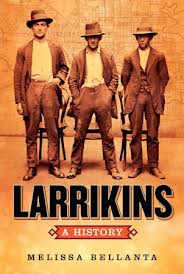
‘Larrikins: A History’ by Melissa Bellanta

2012, 191 p & notes

For some reason my local library has taken to sticking little labels on the spines of its books denoting ‘biography’ ‘crime’ ‘Australian’ etc. Even though this book is titled Larrikins: A History, the library-gods have decreed that this book is ‘Travel and Culture’.  At first this seemed to me to be rather inappropriate, but on reflection, it is a journey into the subculture of the Australian larrikin between 1870 and 1930, framed very much in a current commentary.  This presentism may do the book a disservice ten or so years down the track however, when I hope that Corey Worthington (who?) has shrivelled back into  irrelevance and that Steve Irwin is just an embarrassing jingoistic memory. Bellanta starts and finishes her book with these men, along with the Beaconsfield miners and Bob Hawke, who are affectionately viewed as ‘a bit of a larrikin’, a good bloke, who cuts through the bullsh*t, and doesn’t stand on ceremony.  She reminds us of Kevin’s Rudd’s cringe-inducing attempt to be a larrikin with his ‘fair shake of the sauce-bottle’ (although I note that the ANU Word Watch gives this mangled expression a shred of credibility) and even ropes the Bundy Bear into the larrikin camp.

But, she argues, although there might be a feel-good factor about larrikins today, when the term first emerged around 1870, it was a term of abuse for shiftless, marginal, disaffected teenaged boys and girls – and certainly no Prime Minister would be falling over himself to be labelled a ‘larrikin’ then.  The origin of the term ‘larrikin’ is not clear-cut, but  the whole larrikin milieu was heavily influenced by English slang and the stage depictions of cockney characters who circulated as part of the empire-wide theatrical circuit of the mid-to-late nineteenth century.  In fact, many aspects of the larrikin phenomenon in its original form were moulded by what we would now call the media: the ‘Today/Tonight’-like feature articles on larrikin gangs in the press and in more ‘respectable’ publications like Blackwood’s Magazine,  the geographical nomenclature given to larrikin gangs like the ‘Gipps Street Push’ or the ‘Haymarket bummers’  in the crime reports, and the music-hall burlesque tradition.  But make no mistake, these larrikins were hooligans and thugs: they were involved in rape, bashings, theft, anti-Chinese riots as well.  They were mixed-sex groups, with girls or ‘donahs’ fronting the courts as well.  Their faces stare out from the mug shots that stud the book: young, defiant, with the odd hint of a shared street identity in their haircuts and clothes.

However, at the turn of the century and in the shadow of WWI both the larrikin phenomenon and its depiction changed.  Several factors were at play. European battlefields winnowed the ranks of these young men; there was a change in the retail sector that removed the  itinerant trade from the streets, and the rise of football, especially in inner-city Melbourne, both channelled and was an outlet for larrikin behaviour.  The burnishing of the Anzac legend incorporated a soft-focus version of larrikinism, and the swell of nationalist literature in the 1890s and early 20th century brought a tamed, more affectionate depiction of loveable larrikins like the Sentimental Bloke and Stiffy and Mo.  Larrikinism and organized crime were two completely different phenomena, and there gradually came to be increased tolerance for larrikinism in a world that had seen worse things.

The book is prefaced by three reproduction maps of the ‘larrikin belts’ of Melbourne, Sydney and Brisbane.  It is a paradox of this early larrikinism that it was strongly geographically based, often honing in on a particular street, a particular building, and yet the phenomenon itself spanned urban environments across colonies, and even spanned metropole and periphery.  In many ways the crime reports and mug shots are interchangeable: you’d be hardpressed to distinguish a Melbourne larrikin from a Brisbane one.

The frequent references to current events (Cronulla, hoodies) kept the tone of the book light, without detracting from the nuance of her analysis.  I must confess to being a bit disconcerted by her paragraph structure  that has a foreshadowing final sentence leading into the next paragraph- probably a grammar lesson well learnt- but I found myself re-reading thinking “hold on, do I know about this person?” until realizing that all would be revealed in the next paragraph.  It’s a stylistic choice, I suppose, but one that tricked me again and again.

Although the meaning of ‘larrikin’ might have changed from its nineteenth century usage, the fond, chuckling, good-guy version is likely to be with us for some time, especially at times of high public sentimentality.  As for that other, darker, more dangerous meaning which has never really completely disappeared-  the ugly, thuggish one-  no doubt new labels will be found for that too.

awwbadge_2013

‘Victorian People and Ideas’ by Richard D. Altick

 1974 (first edition)  309 p.

This book is subtitled: ‘A companion for the modern reader of Victorian literature’.  This qualification is an apt one as the book is intended,  as Altick makes clear in the preface, to be a background accompaniment to literature rather  than a history in its own right.

This book is rather like of of those “Music Minus One” records of a concerto, in which the orchestral accompaniment is present but the solo instrument lacking.  The different voices of Victorian social and intellectual history here provide the background, that is to say, the thematic material which in a fully realized concerto is developed by the solo instrument.  The unheard soloist- the real center of interest- is, of course, Victorian literature itself… The chapters that follow are designed, then, to supply the accompaniment by which Victorian literature can be made more intelligible and pertinent to a reader in the last quarter of the twentieth century.  The accurate understanding of any era’s literature depends to a greater or less extent on a grasp of its historical context, but the danger of misreading and of anachronistic criticism increases when one deals with literature so intimately connected with contemporary life as was that of the Victorians. (p. ix)

The mentions of vinyl records and the ‘last quarter of the twentieth century’ remind us that this book is now forty years old.   It was written before the various ‘turns’ that have spun historiography around during the last 35 years (the ‘linguistic turn’; the ‘cultural turn’ etc.).  Although it styles itself a ‘companion’, it is in fact a history, but largely shorn of the historian’s footnotes and references.

There are a number of factors that complicate any attempt to examine Victorian literature or society generally.  The first is that ‘Victorian’ covers so many years, and multiple epochs, extending even beyond the 63 years of Queen Victoria’s reign.  As he points out:

Seen in a century’s perspective, the age merges at either end into epochs of a very different tone, from which, retrospectively in the one instance, by anticipation in the other, those earliest and latest years acquired their distinctive coloration. p. 1

He is thus careful to distinguish between ‘early’  and ‘mid’ Victorianism, and in several respects notes the decay of Victorianism even before Victoria’s reign was over.  He notes that the 1830s were a period of transition from the romanticism of the early 1800s, and that the early years of Victoria’s reign were “bathed in [the] gawdy twilight” of the Regency era.  The prudery and strict moral conduct that is synonymous with ‘Victorianism’ in our mind today began, in fact, during the Regency period, evidenced by the publication of Bowdler’s santized version of Shakespeare (from which we get the term ‘bowdlerism’) in 1818.  What we know as ‘Victorianism’ did not spring forth fully formed in 1837, and it did not stop in its tracks in 1901.

Second, in examining Victorian literature in particular, it is both an expression and a product of its time.  Author and audience are both ‘Victorian’ and each shapes the other.  Altick discusses Dickens, Eliot, Wilde and Ruskin both as authors who were forming the mind-set of their readers, but also as products themselves of their own intellectual and social milieu. He doesn’t discuss individual works as such, but he does use their characters  to exemplify the major  themes, concerns and mentalities of the day.

As such, this is a light-touch intellectual history, with well over half of the book devoted to utilitarianism, evangelicalism,and attitudes towards art and culture. There is quite a bit of church history here, but this is important in defining the Victorian temper.  Hence he explores the development of evangelicalism first within the Anglican church then as it split oft into non-conformism, and the influence of the Oxford Movement and Tractarianism. He distinguishes between utilitarianism (in its purest form known as Benthamism) and laissez-faire, and the political and social implications of each. He suggests that if you depicted utilitarianism and evangelicalism as two irregularly shaped designs, and then superimposed one upon the other, you would be struck by the number of portions that would merge into a single image.  Both promoted the value of work (evangelicals for its moral benefit; utilitarians for efficiency and because it is a ‘good’) and both looked askance at artists (evangelicals disliked their warped morality; utilitarians saw them as parasites).

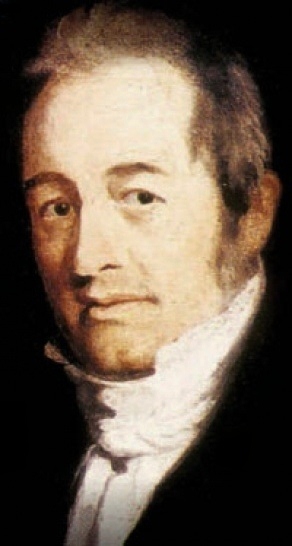
Periodization of an individual’s thinking is complex.  As a biographer/historian, I find ‘habits of mind’ the most slippery aspect to pin down.  I am working on a man born in the closing decade of the 18th century, educated in the Regency years, whose career was at its zenith (such as it was) during the decade immediately before and after Victoria’s ascension to the throne, yet to all intents and purposes is very much ‘the Victorian man’.  But how old is the core of him?

Thinking of myself,  I was born in the 1950s and hence ostensibly a baby-boomer, and I have tumbled into a different millenium in a digital, market-oriented world.  But if I had to nominate the decade with which I most closely identify, it would be the early 1970s when I formed my political ideas, embarked on my bed-rock career and became at my core the adult I am.  This core has been overlaid by later experiences and influences, but at my very centre is a Whitlam-era, middle class, suburban Melburnite.  Is it common for the age of roughly 20 to be the setting-point for an individual generally, or was there something about those particular years in my case?  What about you- what decade is the core of you set in?

And so, I have found this book useful in teasing out the intellectual currents and concerns that manifest themselves in the 19th century English worldview that was tucked up and carried to different outposts of empire.  It does not pretend to explore them at any great depth and does not do so, but it does complicate and give depth to the ‘Victorian’ mindset so definitively stamped into our literature and culture generally.

‘Domestic manners and social conditions of the white, coloured and negro population of the West Indies’ by Mrs. A. C. Carmichael (1833)

2 volumes, 1833 available through the Internet Archive

What a silly sausage I am! Here I was, rejoicing at the cessation of slavery in the West Indies in 1834 but I need not have worried.  Why, slaves received a weekly allowance, a home, they were fed, their clothes were washed and mended, they received free medical care and their children need not be a burden to them! They ate well from their own allotments and if they dressed in rags in the fields- well! they had plenty of rich, colourful clothes at home! They looked forward to the sugar harvesting time and the boiling-house, instead of being a satanic hell-hole was instead a scene of great merriment with young and old gathering there, singing songs, telling jokes, sitting down enjoying themselves, roasting and eating yams and plantains.  Who wouldn’t want to be a slave?

Well, that’s the way that Mrs A. C. Carmichael tells it, anyway.  This two-volume book was published in 1833, eight years before her Tales of a Grandmother that I reviewed earlier.  This is in effect the ‘grown-up’ version of her later children’s book: I find myself wondering at a world where there was a perceived need for a children’s pro-slavery tract.

So who was this Mrs Carmichael?  According to a very interesting article by Karina Williamson, published in the International Journal of Scottish Literature in 2008 (see here) she was Alison Charles Stewart who migrated to the West Indies with her two young daughters to live on the plantation owned by her husband John Wilson Carmichael, who had been assigned to St Vincent with the 53rd regiment in the 1790s.  He had married his first wife in St Vincent and became an absentee proprietor when he returned to England.  He was considerably older than Mrs Carmichael, and had two daughters from his first marriage.  Mrs Carmichael was married in Edinburgh, where she lived prior to her shift to the West Indies and on her return ‘home’, she spent the rest of her long life as an expatriate Scot in England or the Channel Islands.

Although the title of the book suggests that it will deal with the white, coloured and negro races of the West Indies, in fact it deals only with St Vincent and Trinidad, with a very heavy preponderance of attention paid to the negro races. However, she says, her observations are “applicable to many, and in a great degree to all the West India colonies” (p. 15) because the “negro character is the same” and

…the circumstances in which the white and black population are relatively placed- their respective occupations; their interests; the climate- are all so similar, that no very marked dissimilarity can exist in the character and conduct of the population of the different islands (p. 15)

Although clearly written for a ‘home’-based readership, apparently the book  came to be viewed with suspicion in the West Indies itself for its inaccuracies and misrepresentations.  Williamson cites an English traveller in the 1840s and 50s who tried to find a copy in the West Indies so that he could read it on the spot, as it were:

Throughout the islands that I have as yet visited, she is denounced continually by some mendacious epithet or other, and even her own relations, both in Trinidad and in St. Vincent, disclaim connection with her, asserting that she was notorious in her own family for habitually not speaking the truth. Whenever I endeavoured to borrow her book, some excuse was made to prevent my seeing it—‘It was mislaid,’ or ‘lost,’ or ‘destroyed,’ and never forthcoming.[…] At last I obtained a loan of it from a nearly white young man, who, however, did not fail to caution me that it was ‘full of lies.’[Charles William Day, Five Years’ Residence in the West Indies, 2 vols. (London: Colburn and Co., 1852), I, p. 129.]

The book was written with the clear intent to rebut the abolitionist rhetoric about slavery circulating in England, and is best regarded in that light.  Hence the heavy emphasis on the ignorance of English commentators, the great progress that had been made in ameliorating the conditions of the slaves, the unreadiness of the slaves for emancipation, and their happiness with conditions as they were.  It is very much a book of its time, written for a particular political purpose, and it comes across to a modern reader as a missive from a discombobulating  parallel universe.

Additional reference: Karina Williamson ‘Mrs Carmichael A Scotswoman in the West Indies’ International Journal of  Scottish Literature Issue 4, Spring/Summer 2008.

‘The Galts: A Canadian Odyssey’ by H. B. Timothy

1977, 175 p.

Well, now that I’ve read a book written by John Galt about Canada, an autobiography by John Galt, and now finally this biography of him, I’ve got to admit that the biography wins hands down.  It’s set me off wondering about the relationship between autobiography and biography, especially when considering a literary figure, as John Galt is.  I can only think of two other cases where I’ve read a writer’s autobiography followed by a biography penned by another person: Janet Frames Angel at my Table trilogy  paired with Michael King’s Wrestling with the Angel, and Patrick White’s Flaws in the Glass paired with David Marr’s Patrick White: A Life.  In terms of feeling that I understood the character, the biography trumped the autobiography each time, no matter how beautifully or incisively the self-penned work was written.

Am I surprised by this? I don’t know. The autobiography of a writer, by its very nature, will be framed by the author’s own self-image and imbued with a literary sensibility and becomes  source material itself for the biographer, as well as a work in its own right.  The biographer can challenge, contextualize and interrogate the self that is portrayed by the autobiographer, bringing the questions, perspectives and judgments of the outsider in a way that the autobiographer cannot. The autobiography is undertaken at a particular time of a life not yet fully lived- not on the deathbed as a rule!- and the biographer can know things to which the autobiographer is oblivious or blind.

This biography of the author John Galt is written by a Canadian academic who brings with him the nationalist agenda of claiming Galt as part of a significant Canadian family dynasty, even though John Galt (1779-1839) spent only a small proportion of his life in Canada itself, and  he set relatively few of his books there.  As a result, the author privileges Galt’s experience with Canada as a lobbyist and Canada Company promoter and administrator over his identity as a literary figure.  I’m interested in Galt’s Canadian connection, too, so even though Galt in his autobiography sees Canada as just one thread of his life story,  I’m glad that H. B. Timothy has teased it out in this way.

One of the things that I have been grappling with in dealing with my own research interest (Justice John Walpole Willis) is cracking through the brittle, rather volatile early-Victorian masculinity that is displayed by both men, cloaked in obsequious language and intellectual self-possession.  While living in Upper Canada Willis and Galt became friends, for whatever reason, and they obviously recognized some commonality between themselves.  The autobiography, because it emerges from such a  brittle, rather volatile man, exemplifies this sensibility but it does not interrogate it.  The biography is able to do so somewhat more easily.

Then there is the knowledge of subsequent events and broader context that a latter-day biographer can bring as well: the ‘unknown unknowns’ if we want to get all Donald Rumsfeldian about it.  In this case, Timothy suggests that there was an element of set-up at play: that members of the Established Church back in England acted in the interests of Anglican Church interests in Upper Canada in engineering Galt’s financial downfall (is ‘conspired’ too strong a word?).  He explores the possibility that Maitland and the Family Compact elite had Galt under surveillance even before he set foot in Canada, and that his links with people active in politics to the embarrassment of the administration rendered him suspect from the start.  If so, there’s an element of rather touching, unwitting naivete  about the autobiography because of his unawareness of these larger political forces at work.  This rather tragic edge enhances the autobiography, rather than working to its detriment.