Category Archives: Book reviews

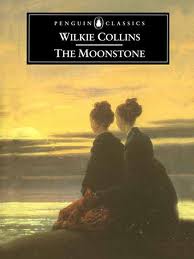
‘The Moonstone’ by Wilkie Collins


moonstone

1868 (reprinted 1998), 473 p in very small font!

Oooof! That took some reading!  Nothing like a big, flapping Victorian novel to gobble up reading time.

The Moonstone by Wilkie Collins has been hailed by some as the first detective story, and it certainly has many of the features of every BBC production you’ve ever seen: the amateur detective, the country house, the incompetent and bumbling police officer, the canny ex-policeman, sleep-walking, creeping round corridors in the night.

The Moonstone is a huge diamond, pillaged on a colonial adventure in India, and brought back ‘home’ to England where it is bequeathed by her uncle to Rachel Verinder on her 18th birthday.  That night, after her party, the diamond disappears.  Suspicions fall on three mysterious Indian gentlemen who have been seen around the country estate, and when an unnamed object is committed to the care of a banker for one year, it is assumed that it is the Moonstone.  Meanwhile there are distraught servant girls, opium addiction, quicksand…it’s got it all, really.

I’m not particularly enamoured of detective stories, but what really impressed me was how modern (or post-modern, really)  this book is in its construction.  After a brief prologue, detailing events of 1799, it is told in two parts or ‘periods’.  The first, set in 1848 is titled ‘The Loss of the Diamond” and consists of one long narrative,  ‘The Events, related by Gabriel Betteredge, House Steward in the service of Julia, Lady Verinder”.  The section period, “The Discovery of the Truth” is set a year later, and consists of eight separate narratives, contributed as statements, or drawn from letters and journals.  There is an epilogue, itself in the form of three statements.  It reminded me a little of Tristram Shandy in that Collins deliberately sets the narratives up against each other, parodying the author in some segments, and unsettling your confidence in others.  It could have quite easily come from the pen of John Barth (e.g. The Sotweed Factor) a hundred years later.

But, indeed, it was published in 1868 in serial form in Dickens’ magazine All the Year Round, which no doubt contributed to its rather daunting length.  We modern readers more accustomed to our books in 300 page bites, and I must admit that I did pick it up each night marveling at the fact that I seemed to have been reading for so long with still so far to go.  Still, at least when I got to the end of it, it was perfectly clear just what happened, instead of the rather vague endings in more recent books that leave you wondering whether you really do know who committed the crime after all.

It’s the first book for 2013 with my face-to-face bookgroup, and I’m wondering if others made it to the end.  I’m glad that I did, but I think what I took away from it was more a sense of admiration for Wilkie Collins’ writing than a driving need to know who-done-it.
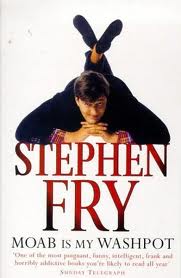
 

‘Moab is my Washpot’ by Stephen Fry

moabismywashpot

2011 (originally 1997),  434 p.

When, for what seems like years, the best-seller lists were dominated by Fifty Shades of Twilight (or whatever it was), one little spark of light was Stephen Fry’s ‘Moab is my Washpot’ which seemed to just hover there for month after month.  I had no idea what the title meant, and now, with this reissue, I find that obviously no one else did either because he has had to append an explanatory preface.  The title is a quote from Psalm 60 (‘Moab is my washpot, and over Edom I throw my sandal’). For the young Stephen Fry, it captured the idea that the world was a battleground between beauty and the barbarians, between sensitive souls like himself and the Phillistines who were everyone else.  For the adult, successful Stephen Fry, it now captures the “rebarbative, supersensitive and insanely solipsistic soul that I was”. He has a measure of affection for that earlier Stephen Fry though, and by the end of the book, so I do.

Despite his claims to be “middle class at a middle-class school in middle England” (p. 201), it’s certainly not a middle-class that many Australians would recognize.  Boarding school seems such a terribly British phenomenon,  the tattered photograph of his childhood mansion that he carried with him throughout his life is certainly no middle-class Australian home, and the language in which he revels is certainly English, but not Australian.

It is a very self-aware autobiography.  As he himself says:

…I was and am both transparent and opaque, illegible and an open book. (p. 319)

At times he addresses his putative reader: “Bloody hell, I do rattle on, don’t I?” (p. 256) and “Yeah, yeah, yeah- you were a thieving little tosser, we get the picture, we will draw the conclusions thank you.” (p 303).  You are constantly aware of his awareness that this is all construction.  He is, indeed, both transparent and opaque.  He seems to write with disarming honesty about his inability to sing and play sport, his late maturation into adolescence, the almost-expected school-boy sex play with his peers, and his long awareness of his own queerness in both senses of the word, his stealing, his arrogance.  In his writing about his infatuation with Matthew Osborne  all the Bridesheadness of his story drops away: a crush is a crush, and an exhilarating, searing, heightened, poignant, unrealizable and utterly human thing it is too.

But being a book written Stephen Fry, you are well aware through his use of  rolling, fruity, razor-sharp language that you are in the presence of a huge intellect and a huge ego very much in control of what he is divulging or choosing not to divulge. He’s aware of the power of his language too:

I have always wanted to be able to express music and love and the things that I have felt in their own proper language- not like this, not like this with the procession of particular English verbs, adjectives, adverts, nouns and prepositions that rolls before you now towards this full-stop and the coming paragraph of yet more words.

You see, when it comes down to it, I sometimes believe that words are all I have…Language was all that I could do, but it never, I felt, came close to a dance or a song or a gliding through water.  Language could serve as a weapon, a shield and a disguise, it had many strengths.  It could bully, cajole, deceive, wheedle and intimidate.  Sometimes it could even delight, amuse, charm, seduce and endear, but always as a solo turn, never a dance. (p. 101)

It comes as a surprise, then, to learn that he had to have speech therapy to slow down his speech enough to make it intelligible.  But even that’s part of the man too: the stream of synonyms and witticisms comes tumbling out so quickly that you can barely keep up and you feel that you’re drowning in his language. You sense that he’s toying with you as a reader too, and yet you don’t really want it to stop.  I think that I would be struck dumb with fear, completely intimidated,  if I were ever to sit next to him at the  hypothetical celebrity dinner party that people keep summoning up.   I very much enjoyed his book, but I think I prefer him safely in print.

My rating: 9/10

Read because: it’s a good before-bed read and I quite like Stephen Fry.

Sourced from: Yarra Plenty Regional Library.

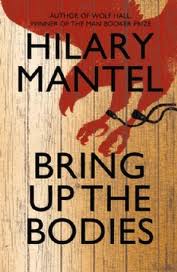
‘Bring up the Bodies’ by Hilary Mantel

mantel_bringupbodies

2012, 407 p.

I had promised myself two book treats over Christmas.  One was Rhys Isaac’s The Transformation of Virginia and the second is this one- Hilary Mantel’s Bring up the Bodies.  I had purchased it the very week that it became available…and of course it has sat on my bookshelf unread ever since.

I loved Wolf Hall, the first book in the series. It was one of those engulfing reading experiences, where you don’t want to pick up another book for days afterward because everything else will look sallow and weedy in comparison. I must admit that I haven’t been quite as blasted-away over this second book, but it is still a damned fine read and it had me sneaking away to grab 15-minute reads whenever I could.

It is written in the same second-person present tense voice as Mantel used in Wolf Hall– naturally enough, because it is a sequel.  It is at times a little ungainly: in a conversation between several men, she had to qualify “he-Cromwell….” when there were a few too many he’s around.  I found it distracting in the first book, but I fell more easily into it this time, and found that it served to evoke memories of the earlier volume.  That’s the problem with the second book in a trilogy that is published several years after the first: how can you remind the reader of what occurred earlier without burdening the book with flashbacks, and yet bringing new readers, unfamiliar with the earlier volume, along with you?  I found this with Amitav Ghosh’s  River of Smoke, and vowed then never again to read a series until it was completed.  Ah, but this is Hilary Mantel, and she struck just the right balance- and I think that her continued use of this unconventional narrative voice assisted her.

Thomas Cromwell is the main protagonist of this book as well, and while he continues to be a complex, conflicted man, you see the cold steel in him as well.  In the earlier book, Cromwell had negotiated Henry’s divorce from Katherine of Aragon in order to marry Anne Boleyn.  In this book, Henry has turned against the Boleyn marriage, and Cromwell again needs to shift and manipulate the pieces into place to meet the king’s desires.  The Henry/Anne story has been told many times, but not as quietly and with such menace.  Small events and conversations flit in and out, and it is only later in the book that you see them woven into the sticky web of coercion, blackmail and power that Cromwell so quietly and ruthlessly uses to immobilize his enemies.

Mantel helpfully provides a very good ‘who’s who’ at the start, arranged by place and allegiance.  I found myself referring to it often- maybe a little too often- but perhaps that reflects the nibbly way in which I read it, even though I would have loved to have read it in one big gulp.

Was it better than Wolf Hall?  I don’t think so- Wolf Hall was so big and so different that I don’t think any sequel could continue at the same intensity without becoming a parody of itself.   This book is tighter, more claustrophobic and more chilling.  Can’t wait for the third.

My rating: 9.5/10

Read because:  I knew that I would enjoy it and wanted to relish it.

Sourced from: my very own bookshelf.

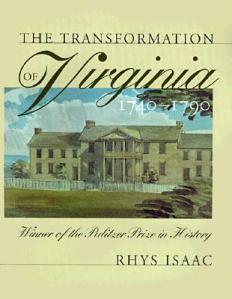
‘The Transformation of Virginia 1740-1790’ by Rhys Isaac

Transformation-of-Virginia-1740-1790-Isaac-Rhys-9780807848142

1982, 357 p

I have promised myself this book as a holiday reading treat.  I’ve been intending to read it for many years.  Rhys Isaac, who died in 2010 was a much-loved member of the history faculty at my university, and was one of the ‘Melbourne School’ of historians that I greatly admire (Rhys Isaac, Greg Dening, Inga Clendinnen, Donna Merwick.)  I would like to write my thesis within their historiographic tradition and approach- well, it’s something to aim for at least. So I approached this book with somewhat of a sense of reverence and with an eye to the writing up of my own work. Continue reading

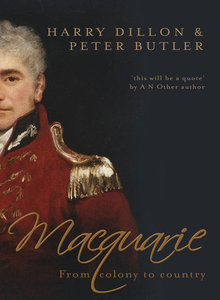
‘Macquarie: From colony to country’ by Harry Dillon and Peter Butler

macquarie

2010, 329 p.

Probably my first introduction to historic argument, as distinct from historic narrative and fact, came in HSC Australian History (yes, I am old enough that it was HSC and not VCE and young enough that it was no longer ‘matric’.)  There I was feeling all soft and fuzzy over Macquarie when along came that nasty Bigge character.  But was it as simple as this? For the first time I realized that historians- Manning Clarke, Ellis, Ritchie- could have a different take on the same event, and that you could talk about historians’ arguments and set them up against each other,  rather than just relate what happened.

And there I was nearly 40 years later, reading another book on Macquarie, nicely timed with my trip to Sydney in December last year.  It evoked a whiff of the goodies-and-baddies sense of history, and Macquarie is definitely in the goodies camp in this book.  It’s a very readable account of Macquarie’s time in New South Wales and his contribution to the shift from ‘New South Wales’ to the entity of ‘Australia’.

The authors argue that Macquarie was the victim of a mismatch between the intended use of New South Wales as both penal settlement and free colony.  His position at the head of a penal colony gave him autocratic powers but he used them to make opportunities for ex-convicts, rather than the elite- which was pretty much the expectation at the time.  He was, at heart, a military man, which expressed itself through his authoritarianism and brittle response to criticism.  The authors emphasize his Scots background as a motivating factor, and indeed call him the ‘laird’ throughout, arguing that his policies sprang from a paternalist mindset.  I’m not convinced that ‘laird’ is the right imagery, and it’s not something that Macquarie himself claimed.  The book is written from a very Australian-centred perspective, and I think that the depiction of the Colonial Office would have benefited from a fuller empire-wide analysis. As it is, the goodies/baddies dichotomy is a little too simple.

Although the biographical details of the authors links them with Charles Sturt University, they both have a background in journalism, and I think that this comes through in the book, which is eminently readable.  They have been granted all the publishing features on a historians’ wishlist- footnotes (not all that many) AND a bibliography (what luxury!), index, and source list for the illustrations.  Many other much more academic tomes than this one are often short-changed in this regard.

I was attracted to read this book after a brief browse at the ‘reduced’ table in my uni book shop. I noted that the book started with a chapter highlighting the heritage of Macquarie today, followed by a chapter that had him returning home ‘under a cloud’.  It then reverted to a more conventional biography, ending with a 2010 visit to his ancestral home.  I’m interested in the way that historians structure biography at the moment, hoping to break out of a strictly chronological form for my own thesis, and so I was interested to see how this worked as a reader.  I think it did, in that it had a pleasing sense of symmetry and that the bookend chapters allowed an argument to be mounted in what is, essentially, narrative history.

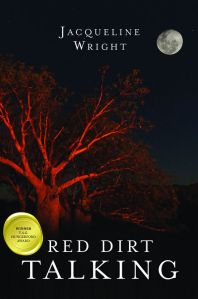
‘Red Dirt Talking’ by Jacqueline Wright

wright_reddirttalking

346 p. 2012

I’m nearly always disconcerted by film footage of aboriginal settlements- the dust, the rubbish, the band of kids clustering around.  Yet I sense, despite the many deficiencies that can be picked out so easily, that there’s another way of living there with priorities and resiliences that I can’t see.  Alexis Wright gave us a glimpse of it in Carpentaria, as did Maria Munkara in Every Secret Thing.

Red Dirt Talking is a whitefella perspective on this landscape.  The small town of Ransom is in outback Western Australia; eight kilometres  out  is the ex-mission station  Eight Mile Creek, smaller still; and 370 kilometres further out again  the Aboriginal communities of Yindi and Breakaway.  Here are all the set pieces of what we understand of outback life today-  the smelter and its fly-in, fly-out workers that distorts the economy of small towns; the art centre co-op that teeters uneasily on the line between exploitation and entrepreneurship; the whitefella managers; the Toyota trucks; the Flying Doctor Service.

The book opens with the first-person narrative voice of Maggot the Garbo whose job takes him round the camps and pubs, the haunts of hard-bitten men and women, hoarders and crazies.   An eight year old Aboriginal girl, Kuj, has disappeared.  He doesn’t know what’s happened to her- no one does- but they all have their theories and suspicions.  The second narrative, told in the third-person voice,  is set some months earlier, focussing on Annie, a 40 year old anthropology postgraduate who arrives at Ransom, tape-recorder in hand and thesis in sight, hoping to collect some quick oral history interviews about a massacre some decades earlier.  Of course, such earnest whitefella briskness is completely the wrong approach.  Annie finds herself drawn into a diffident but increasingly complex relationship with the laconic Mick Hooper, one of the white project officers, and is gradually forced to let go of all the objectives, timelines and academic protocols that the university is trying to impose on her research.  Kuj is one of the constellation of children who swarm around the community, and as time elapses, the narrative takes us up to her disappearance but this time through the web of relationships- marriages, deaths, breakdowns, fosterings- that blur the boundaries between long-term black and white inhabitants of Yindi. Finally, there are the transcripts and contextualizing introductions to her interviews, printed in a different font on coloured paper: white-fella academia that stands apart both visually and as knowledge, from the rest of the book.  The book is called Red Dirt Talking, but it’s even more about silences and listening.

I must admit to becoming rather jaded at all the historian-as-protagonist stories that I seem to have read this year.  There’s a whole string of them- Candice Bruce’s The Longing; Paddy O’Reilly’s The Factory; Anne Summers’ The Lost Mother and Eliot Perlman’s The Street Sweeper.  What’s going on? Is it the influence of all these creative writing courses in universities, so that ‘writing what you know’ starts and ends with an academic?  Is the academic hunt an upmarket version of the ‘journey’ narrative that we all seem to be on these days?  With the increase in tertiary education levels, are we all academics and historians these days? Or am I hyper-aware of this  because my own thesis-clock is ticking away in the background?  I suppose that it’s a common framing device, but it’s wearing a bit thin for me at the moment- and so, I put A. S. Byatt’s The Biographer’s Tale back onto the shelf until I can read it with fresher eyes.

Red Dirt Talking was written as part of a creative arts doctorate, it won the T. A. G Hungerford award for an unpublished debut West Australian manuscript, and the author Jacqueline Wright has worked as a teacher and linguist in outback Aboriginal communities.  I think that you can detect all three influences in the text.  As a debut book, it is probably fifty pages too long and it has far too many characters to remember.  She has acutely depicted the politics and protocols of academia, and I suspect that she has observed other Annies, ( if, indeed, she was not an Annie herself when first arriving in the outback).  I found it hard to keep track of who was black and who was white (in fact, I don’t think that Wright did identify in terms of black/white anyway)- which is probably a good thing; her descriptions of landscape are evocative, and she captures dialogue particularly well.

But most importantly, she cuts through the visual imagery of outback life- the mess, the flies, the rubbish strewn yards, and the people gathered under trees- and picks up on the humour, the complexities of relationships and histories, and the uneasy coexistence of wariness and generosity in a community where she is an outsider.  I found myself perfectly happy to pick up the book to keep reading, and I was drawn along by wanting to know what happened to Kuj.

My rating: 8/10 maybe 8.5

Sourced from: Yarra Plenty Regional Library

Read becauseLisa at ANZ LitLovers reviewed it, and I read a good review of it somewhere (although I can’t remember where!)

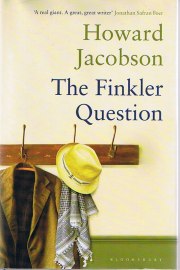
‘The Finkler Question’ by Howard Jacobsen

finkler10082

320 p. 2010

It’s an odd coincidence that the books chosen over the course of a year by my face-to-face reading group often end up having a common theme.   We send in a list of about 40 possible titles, and yet somehow or other there are often connections between the eleven that actually land in our laps. It seemed that one year we read a succession of Asian family-history stories spread over three generations (oh, please spare me another of  those!) and this year we seemed to have stumbled onto a Jewish theme.  One book, Lily Brett’s You’ve Got to Have Balls annoyed me and I was relieved to find that I couldn’t attend the meeting and promptly ditched it.  The second The Full Catastrophe, I enjoyed.  And now this third book The Finkler Question.

It won the 2010 Man Booker Prize.  What was it up against?  Hmm. A Carey, Emma Donoghue’s Room, Damon Galgut, Andrea Levy- I think I like her, and Tom McCarthy’s C. Well, I’ve heard of two of them (Parrot and Olivier in America and Room)  and the longlist had The Slap and a Rose Tremain book as well.  If I’d written any of these books, I’d be pretty annoyed. I really didn’t enjoy this book much at all.

The “Finkler” Question is actually the “Jewish Question”, posed by the protagonist Julian Treslove, retired BBC employee now working as a celebrity impersonator, who decides that after he was mugged by a female assailant who hissed “You Jew” at him (or at least, he thinks that’s what she said) that he really must be Jewish and just didn’t know it before.  And off it goes into a long conversation about Jewishness and Jewish self-loathing and anti-Semitism- on and on it goes; talk, talk, talk.  It’s a bit like reading a British Woody Allen, and I don’t really like him much either.  I find the language overwhelming, and the self-absorption tedious.  This book is promoted as a comic novel, but I barely found anything more than mildly humorous in it.

I don’t know what the other contenders were like, but I sure wouldn’t be awarding it the Booker Prize.

My rating: 6/10

Read because:

Sourced from: Council of Adult Education.

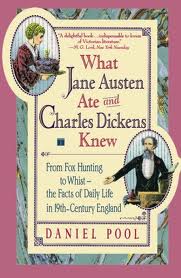
‘What Jane Austen Ate and Charles Dickens Knew’ by Daniel Pool

416 p. 1994
Some time ago I read and reviewed Victorian People and Ideas, a book that I described as a ‘light touch intellectual history’ that explored the mental furniture of  characters in the canon of Victorian Literature.   As you might guess from the title of this book, it has a similar intent but it’s Mills and Boon in comparison, and not so much about mental furniture as the actual furniture that Elizabeth, Anne, Tess et al might have sat on.

No concerns here about periodization- Austen,  the Brontes, Trollope, Hardy- they’re all bundled in together with nary a thought about the wider political and physical world outside.
The book is a cradle-to-grave, upstairs-to-downstairs explanation of the domestic and social world of the characters one might find in Victorian literature. It explains clothes, food, business practices, social manners and expectations etc in a rather whimsical fashion.  It doesn’t take itself too seriously, and you don’t really need to have read particularly widely to enjoy it.  It is divided into two parts- the first is organized thematically, while the second part is a glossary of particular terms and phrases that you’re likely to encounter in reading Victorian novels.

The author is American, and the book felt a bit like a travel guide from the self-assured comfort zone of Americana into the weirdness of British life and customs.  It’s written in a breezy style and you can easily pick it up and put it down again, but I found that very little actually stuck with me- with two exceptions.  One was his explanation of entail and inheritance, which is of course so important to Victorian novels, and the other was his description of promissory notes.  I see that the author is a lawyer, and I think that he put his skills to good work here.

I know that the book is not intended in any way to be an academic tome, but I did find myself frustrated that there were no footnotes or references at all. You were just left to trust him and not question too deeply. Still, the book is intended as a bit of a hoot, and in that way it probably fulfils the promise of its catchy title perfectly.

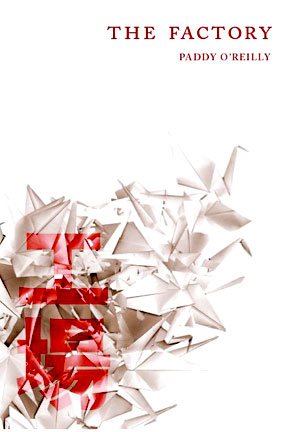
‘The Factory’ by Paddy O’Reilly

2005, 258 p

Ah, synchronicity!  Within days of reading Lisa’s review of this book at ANZLitLovers, why there it was sitting on my library shelf.  It’s out of print, she tells us, and very good she says, so off to the borrowing machine I go!

You’re drawn in from the opening paragraph:

They took away all my research papers when I was arrested on the mountain in Japan.  As the four policemen crowded into my cubicle, neatly piling up my reams of handwritten notes and packing my computer into its travelling case, I sat on the bed and started to tremble….

…Later, during my interrogation, an interpreter with a twittery voice read out some badly translated excerpts of my notes.  Did I write that? I wondered.  Did he say that?  I may never have those notes returned, so now I can only write from memory.  Some events are hazy, others I remember so clearly that my eyes ache from the pain of those days living in the sharp light reflected off the sea around the peninsula.

Hilda Moore is an Australian PhD student, researching the establishment and collapse of  Koba, a Japanese community dedicated to rescuing traditional folk-arts and performing them for new audiences during the 1970s, based at The Factory on a Japanese island.  It combined radicalism with tradition, artistic high-mindedness with more human jealousy, manipulation and power-trips. There were certainly cultish aspects to the group, which revolved around the master Yasuda sensei, and it collapsed after the death of one of its members, only to be revived again twenty years later.  This is Hilda’s opportunity- she agrees to act as record-keeper for this second manifestation of the group, while interviewing the original members for her research, some of whom have rejoined; others who eschew any contact with it.

The book has a complicated structure: the stories she pieces together of the original Koba, the interviews from her informants who each give their own conflicting perspectives on Koba and its collapse, and her own experience as she and another Western girl, Eloise, join the second-generation Koba as it re-establishes itself at its original home at the Factory. Suspended throughout  are the present-tense episodes from the quiet, sterile, lonely and controlled jail.  We do not know why she is there, and it seems to exist completely outside time and place.

It was mainly this jail narrative that kept me going through the book, and at the risk of spoiling I will just say that I was rather disappointed by the ending.  The ending is beautifully written and open-ended, but I didn’t think that it was strong enough for what had come before.

Unless I didn’t ‘get’ the ending. That’s a distinct possibility.

My rating: 7/10

Sourced from: Yarra Plenty Regional Library

Read because: Lisa spoke so highly of it.

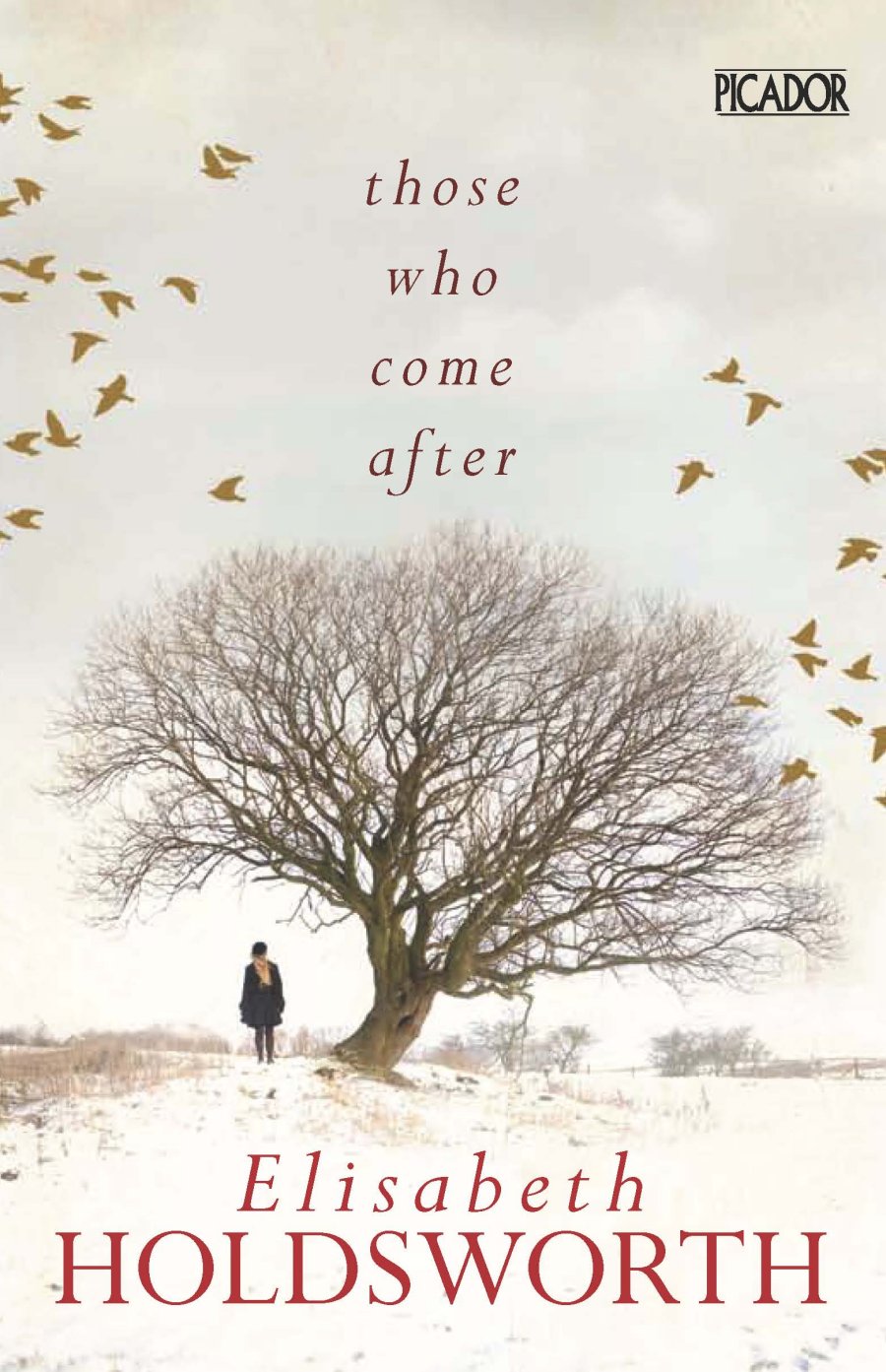
‘Those who come after’ by Elisabeth Holdsworth

2011, 342 p.

I snapped this book straight off the shelf as soon as I saw it because I remembered the author’s Calibre-Prize winning essay that was published in The Australian Book Review about five years ago.  I recall where I read the essay: in a cafe in North Melbourne that I walked to from the Public Records Office to stretch my legs after a morning steeped  in the archives .  It was a powerful read that combined history, memoir and reflection as a middle-aged, Dutch-born, now Australian narrator returned to her childhood home in Walcheren, a flat island sheltered from the sea by a network of dykes off the coast of Netherlands.  Her father had been the scion of an old, aristocratic family; her  mother a Jewish beauty.  She tells of the war and its aftermath that swept away the history of her family with such  a flatness of tone that the reader is left  to fill in the betrayal and violence that such actions engendered for herself.  I found myself sitting there, quite stunned by the strength of such a quiet retelling. You can read the essay here:  it’s called An die Nachgeborenen: for those who come after, published in the Australian Book Review in February 2007.  I had remembered the essay, and its effect on me for all those years.

But on reading the book, it seemed as if I was reading the essay again, except in a longer form.  Here was the child, the old aristocratic family, the Jewish mother, the dykes, the flooding again, but now intertwined with a longer travel narrative and a migrant story as well.  It was fuller, but somehow seemed emptier.

It was only when I read an essay that Elisabeth Holdsworth wrote about the writing of the book in ABR in October 2008 that I realized that what I was missing in the book was the writer herself.  I hadn’t noticed the switch between first person voice in her original Calibre-prize essay and the third person voice of her novel, and having now read her reflection on her decision to write her memoir as fiction, I’m even less sure of the distinction between them.

I think, actually, that I preferred the first essay.  There, the flatness of tone conveyed a dignified restraint, whereas in the book it seemed like an absence and a distance.  It’s unusual to read three versions of the same story like this – essay, novel, reflection – and it raises many questions about the choice of genre, the line between memoir and fiction, and the author at work.

My rating: for the book 7/10; for the essays 9/10

Read because: I enjoyed the essay so much

Sourced from: Yarra Plenty Regional Library

awwc2012